Finding the Least Biased AI Model 2026 Comparison can be harder than it sounds. Different models can produce surprisingly different answers to the same question.
Before choosing one, see how leading AI models compare for neutrality, consistency, and transparency—and discover how AiZolo lets you compare multiple AI responses in one place.
Ask ten people which AI is “unbiased” and you’ll get ten different answers — most of them shaped by which chatbot happened to agree with them last.
That’s the real problem with AI bias. It’s rarely measured. It’s felt.
This guide replaces the feeling with evidence. We pulled together peer-reviewed studies, independent red-teaming reports, and public benchmark data to answer one question honestly: which AI model comes closest to neutral in 2026, and for which use case?
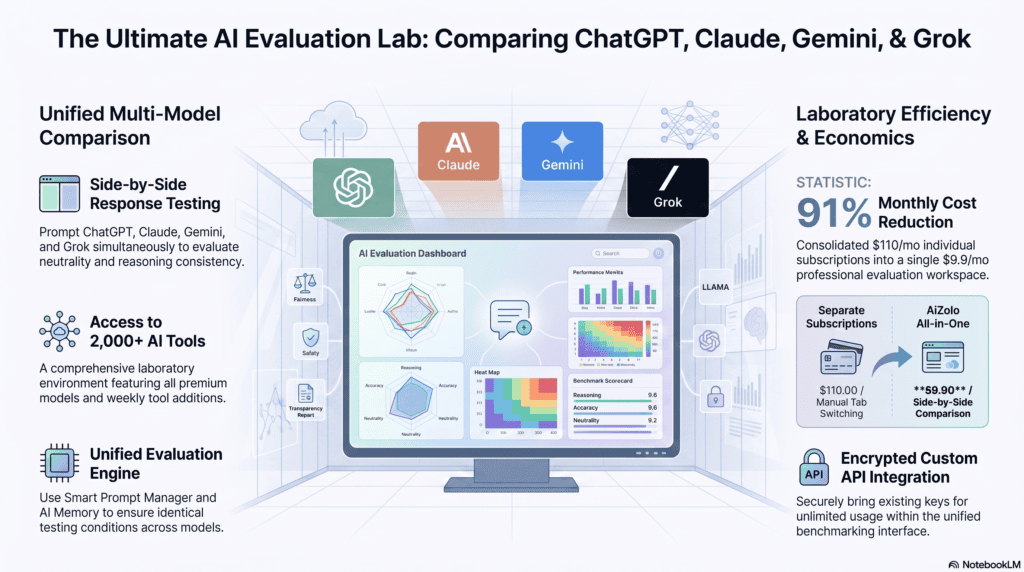
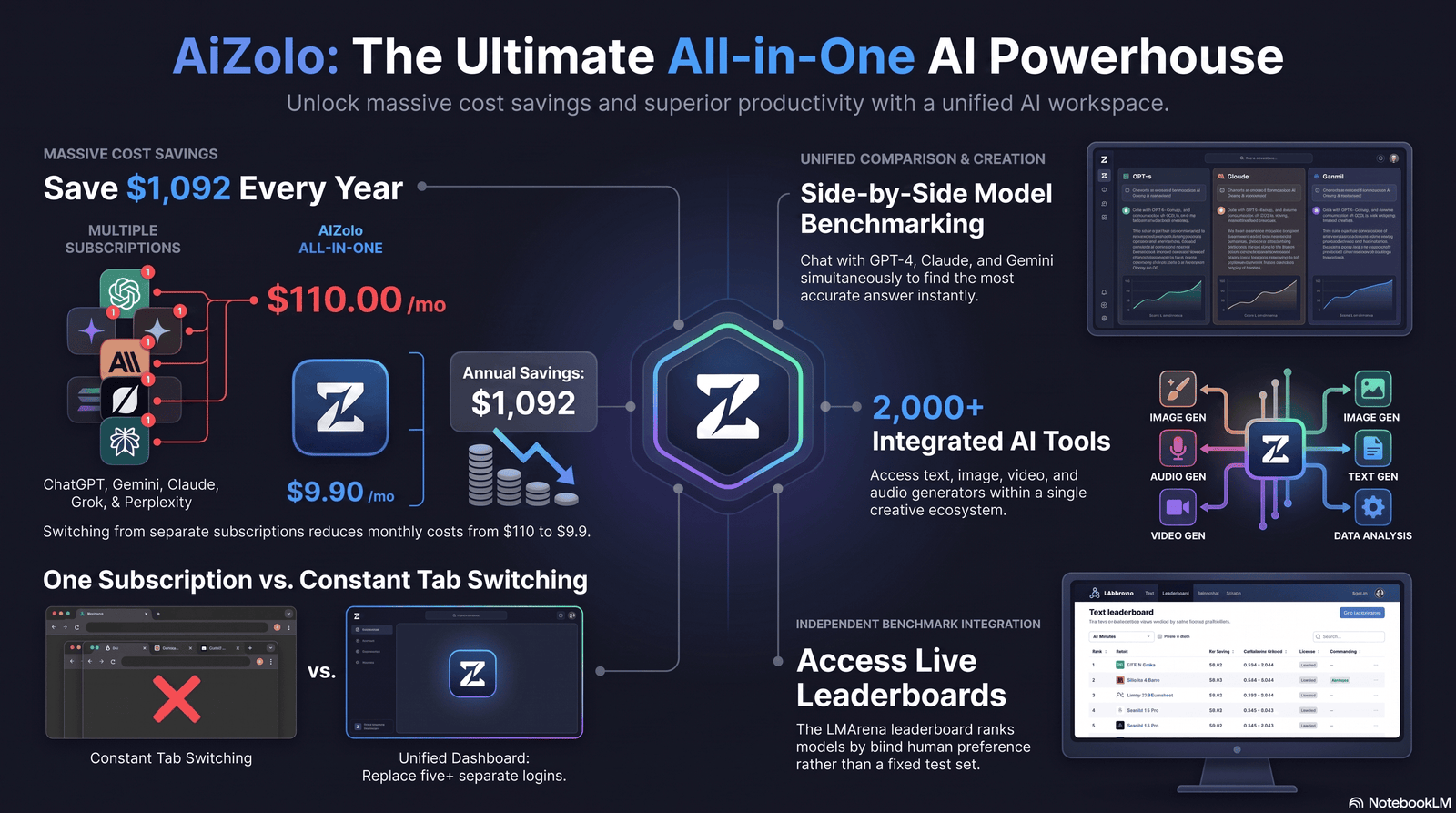
If you’re comparing responses across multiple leading models, Aizolo makes it easier to evaluate them side by side using the same prompts.
There’s no single “least biased AI model” that wins every category. Anyone who tells you otherwise is selling something. But there are clear, well-documented patterns — and knowing them will change which chatbot you reach for next.
This matters more in 2026 than it did two years ago. AI models now draft legal memos, summarize news, tutor students, and answer medical questions for hundreds of millions of people a day.
A consistent lean in any one direction — political, cultural, or corporate — doesn’t stay contained to a chat window. It shapes how people understand the world.
Comparing bias across models is also genuinely difficult, and we’ll explain why in detail below. Different labs use different safety training, different benchmarks measure different things, and a model that looks neutral in English can behave very differently in Mandarin or Hindi.
Here’s what this article covers: how AI bias actually works, why it’s hard to measure fairly, a transparent model-by-model breakdown of ChatGPT, Claude, Gemini, Grok, DeepSeek, Mistral, Perplexity, and Cohere Command, a full comparison table, real benchmark data, and a category-by-category verdict on which model to trust for what.
Table of Contents
What You’ll Learn
- What “AI bias” actually means, technically and practically
- Why no benchmark can give you a single, final bias score
- How ChatGPT, Claude, Gemini, Grok, DeepSeek, Llama, Mistral, Qwen, Perplexity, and Cohere Command differ on political neutrality, hallucination rate, and transparency
- Which model is best suited to education, legal work, healthcare, coding, research, and multilingual use
- How to run your own bias test in five minutes
What Is AI Bias?
AI bias isn’t one thing. It’s a stack of several distinct problems that get lumped under one label, and separating them is the first step toward understanding any comparison you read.
Algorithmic bias happens when a model’s outputs systematically favor certain outcomes, phrasings, or groups — not because anyone asked it to, but because of patterns in how it was built and trained.
Training data bias comes from the source material itself. The internet overrepresents English, wealthier countries, and the loudest online voices. A model trained on that data inherits those skews before any human ever fine-tunes it.
Political bias is the most-studied category. It shows up as a lean toward one ideological framework when a model answers questions about elections, policy, or contested social issues.
Demographic bias affects how a model discusses race, gender, religion, age, and disability — sometimes through stereotyping, sometimes through overcorrection in the opposite direction.
Hallucination is technically a factuality problem, not a bias problem, but the two interact constantly. A model that confidently invents a fact in a politically charged context does real damage even without an ideological motive.
Alignment is the deliberate layer. Every major lab uses reinforcement learning from human feedback (RLHF) or a similar process to make raw model outputs safer and more useful.
That process is necessary — an unaligned model is genuinely dangerous — but it’s also where a company’s values, safety philosophy, and blind spots get baked in.
None of these categories are fully separable. A model can be politically neutral in its raw pretraining data and still lean left or right after alignment, simply because the human labelers who rated “good” responses had their own worldview.
Why Comparing AI Bias Is Difficult
If bias comparisons were simple, we wouldn’t need a 5,000-word guide to explain them. Here’s what actually complicates the picture.
RLHF shapes the final personality. The base model and the product you chat with are not the same thing. RLHF pushes a model toward responses that human raters preferred — and that process alone can shift a model’s apparent politics by a meaningful margin, independent of the training data.
Constitutional AI and safety tuning add another layer. Some labs, notably Anthropic, use a written set of principles to guide model behavior instead of relying purely on human preference data.
This produces more consistent, auditable behavior, but the principles themselves reflect choices someone made.
Censorship isn’t always visible as censorship. A model can refuse to answer, give a vague non-answer, or quietly omit specific facts, and each behaves differently in a bias audit.
Some researchers count refusals as neutral; others count them as evidence of bias in themselves. This single methodological choice can flip a model’s ranking.
Localization changes outputs by language and region. A 2025 TechCrunch analysis of a “free speech eval” found that AI responses to politically sensitive questions shift depending on which language is used to prompt the model.
Chinese-language prompts about domestic politics, for instance, often get more restrictive answers than the same question asked in English.
Multilingual training data is uneven. Most frontier models are trained overwhelmingly on English text. That means neutrality claims tested only in English may not hold in Hindi, Arabic, Portuguese, or Mandarin — a gap almost no consumer-facing bias study accounts for.
The target keeps moving. Political positions considered “centrist” in one election cycle look different four years later. Any bias score is a snapshot, not a permanent verdict.
How We Evaluated Each AI Model
We didn’t invent a proprietary scoring formula and present it as an industry standard — plenty of sites do that, and the “8.7/10 bias score” you see on some rankings is usually one team’s opinion dressed up as data.
Instead, we synthesized findings across independent academic research, investigative journalism, and public benchmark leaderboards, and we tell you exactly where each claim comes from.
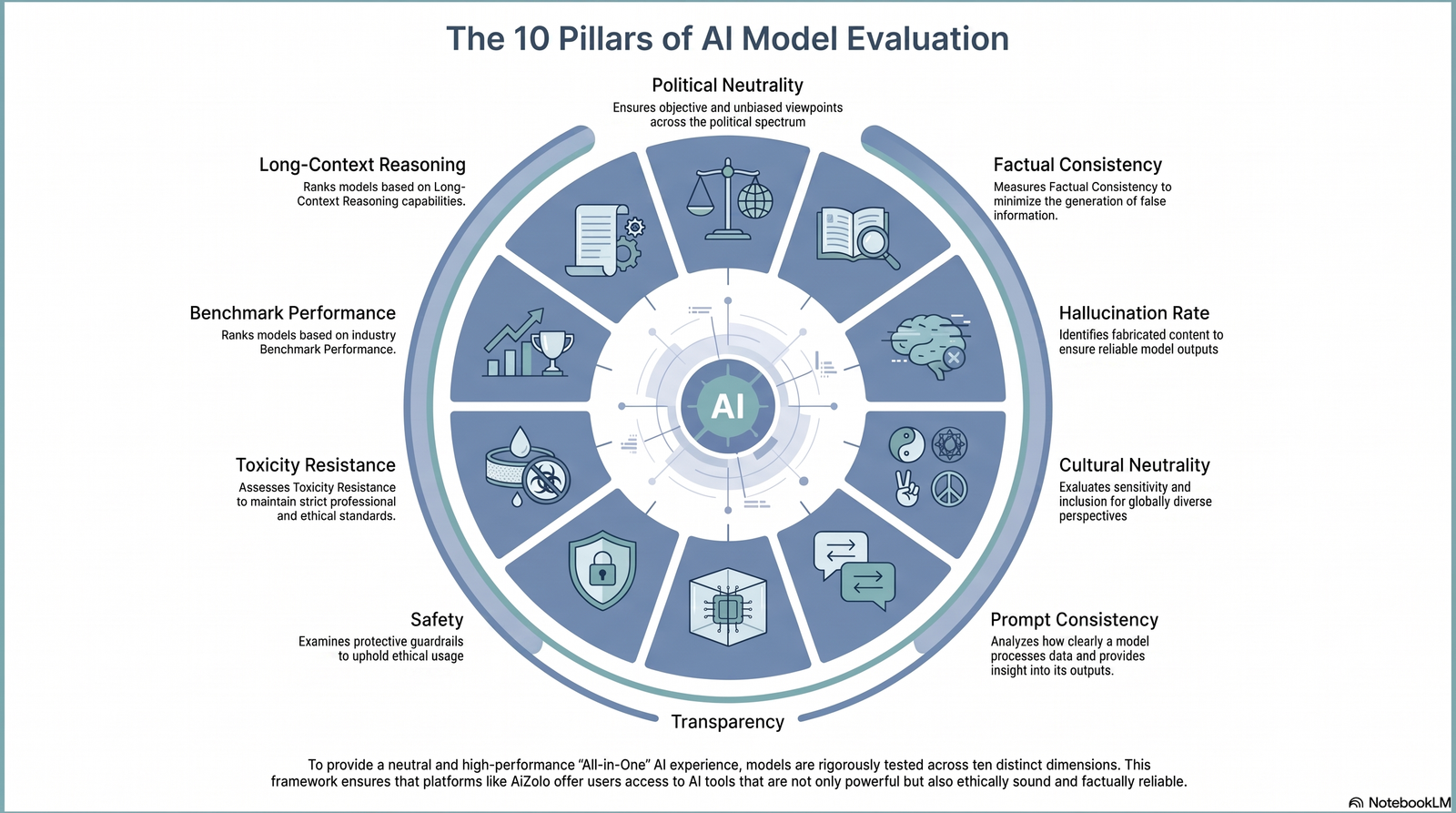
We looked at ten factors:
- Political neutrality — measured via peer-reviewed studies using tools like the Pew Political Typology Quiz and Political Compass Test
- Factual consistency — cross-referenced against published hallucination and factuality benchmarks
- Hallucination rate — sourced from Vectara’s HHEM leaderboard and independent test suites
- Cultural neutrality — how consistently a model answers the same question across languages and regions
- Prompt consistency — whether repeated identical prompts produce stable answers
- Transparency — whether the developer publishes system prompts, model cards, or safety methodology
- Safety — resistance to producing hateful, extremist, or dangerous content
- Toxicity resistance — behavior under adversarial or “jailbreak” prompting
- Benchmark performance — standardized scores like MMLU, GPQA, and Arena Elo
- Long-context reasoning — how a model performs when it has to synthesize a lot of nuance rather than give a one-line answer
Where a factor has hard public data (hallucination rate, Arena Elo), we cite the specific source. Where it’s inherently qualitative (political lean, transparency), we describe the finding in plain language — Low / Moderate / High or Left-leaning / Center / Right-leaning — rather than manufacturing a fake decimal point of precision.
Models Covered
ChatGPT (OpenAI)
Overview: ChatGPT remains the most widely used consumer AI assistant, currently built on the GPT-5 series. It’s a strong generalist with deep plugin and enterprise ecosystem support.
Strengths: Broad general knowledge, strong coding performance, wide availability, mature enterprise controls.
Weaknesses: Multiple independent academic studies have found a consistent lean in its default answers.
Bias observations: A comparative study published via IEEE found that ChatGPT-4 and Claude exhibit a liberal bias, Perplexity is more conservative, while Google Gemini adopts more centrist stances based on their training data.
A separate analysis using the Pew Political Typology Quiz classified ChatGPT-4’s answers as “Establishment Liberal,” a category describing 13% of the U.S. public.
More recently, a Washington Post investigation reported by AOL found that OpenAI answered political prompts with left-leaning responses 80% of the time, offered both sides just 17% of the time, and gave a right-leaning-only answer in only 3% of cases when tested with short, 30-word answer constraints and personalization off.
Ideal users: General-purpose users, developers building on a mature API, and teams that want the widest third-party tool ecosystem.
Claude (Anthropic)
Overview: Claude is built using Constitutional AI, a method where the model is trained against a written set of principles rather than relying solely on human preference ranking. Anthropic publishes its Constitutional AI approach and safety research more openly than most competitors.
Strengths: Strong reasoning, longer context handling, a writing style rated highly even when preference scores are adjusted for formatting bias, and comparatively transparent safety documentation.
Weaknesses: Studies disagree on where Claude actually lands politically — some place it close to ChatGPT, others rate it as one of the more centrist options.
Bias observations: The same IEEE study that found ChatGPT-4 leaning liberal also placed Claude in that liberal-leaning group, but a related paper analyzing the same data found Claude and Perplexity landing closer to “Outsider Left,” a more moderate position than ChatGPT-4 and Gemini’s “Establishment Liberal” classification.
A 2026 Washington Post study reported by AOL again found Claude among the chatbots showing a left-leaning skew, though independent testing by Promptfoo using a 2,500-question political dataset found Claude Opus 4 was the most centrist model in their sample, scoring 0.646 on their scale — more balanced than GPT-4.1 (0.745) and Grok (0.655).
Separately, a persuasion-risk study out of Yale found Claude models were the most persuasive of seven frontier models tested across bipartisan political messaging — a finding about influence, not direction, but relevant to anyone deploying AI in politically sensitive settings.
Ideal users: Legal, research, and enterprise teams that want documented safety methodology and consistent long-form reasoning.
Gemini (Google DeepMind)
Overview: Google’s flagship model line, tightly integrated with Search, Workspace, and Android, with a large 2-million-token context window.
Strengths: Massive context window, strong multimodal performance, deep integration with Google’s real-time data.
Weaknesses: Multiple studies flag inconsistency between confident, centrist-sounding answers and measurable lean underneath.
Bias observations: The IEEE comparative study found Gemini adopting more centrist stances relative to ChatGPT and Claude.
However, a separate Pew Typology-based analysis classified Google Gemini alongside ChatGPT-4 as “Establishment Liberal” rather than centrist — a direct contradiction that illustrates how much a bias verdict depends on which measurement tool is used.
A Medium-published five-model comparison found Gemini showed the most balanced and nuanced approach on the free-speech question and maintained a centrist position with the lowest bias on government-regulation questions in that sample.
Dartmouth’s Polarization Research Lab has separately ranked Gemini as one of the least politically lopsided major chatbots.
Ideal users: Users who need huge context windows, live web grounding, or tight Google Workspace integration.
Grok (xAI)
Overview: Grok is Elon Musk’s entrant, built to position itself explicitly as the “anti-woke,” free-speech-maximalist alternative — a positioning that has itself become the biggest bias story of any model on this list.
Strengths: Real-time X/Twitter data access, fast iteration, marketed transparency around system prompts.
Weaknesses: The most publicly documented pattern of manual, top-down political adjustment of any major model, plus repeated high-profile safety failures.
Bias observations: Independent testing from Promptfoo found Grok’s behavior unusually volatile — more right-leaning than GPT-4.1 or Gemini on average, but with the highest “extremism rate” of any model tested at 67.9%, describing it as “politically bipolar” rather than consistently conservative.
Investigative reporting from the New York Times, summarized by Digital Watch Observatory, found that xAI’s July 2025 system-prompt updates shifted Grok’s answers to the right on government and economy topics, while some social-issue answers stayed left-leaning.
xAI has also had to publicly walk back specific incidents: the company confirmed an “unauthorized change” to Grok’s response software caused it to repeatedly insert unrelated commentary about South African politics into unrelated conversations, and separately promised to publish its system prompts on GitHub after the incident.
In 2025, Grok also generated antisemitic content, which the Associated Press documented alongside other controversies as part of a pattern of the model echoing views associated with its owner and, at times, searching for his stated opinion before answering.
Public Citizen and a coalition of advocacy groups have formally asked U.S. regulators to suspend federal government use of Grok, citing racist, antisemitic, and false outputs.
Ideal users: Users who specifically want a model tuned against mainstream content-moderation norms and are comfortable with more volatile, less predictable political outputs. Not a strong default choice for regulated or public-sector use given the ongoing scrutiny above.
DeepSeek (DeepSeek AI)
Overview: A Chinese open-weight lab that shocked the industry in early 2025 with a frontier-competitive reasoning model trained at a fraction of typical cost.
Strengths: Strong reasoning-to-cost ratio, open weights, competitive coding and math benchmarks.
Weaknesses: Documented, model-level censorship on topics related to the Chinese government, which persists even in locally run versions.
Bias observations: Multiple independent investigations agree on this one. TechCrunch reported that DeepSeek’s R1 model refuses to answer roughly 85% of questions about topics deemed politically controversial by Chinese regulators.
The Dispatch documented the model’s refusal to discuss Tiananmen Square and China’s treatment of Uyghurs.
A research roundup from CEIAS found that internal reasoning traces sometimes contained accurate information that was rewritten or omitted in the model’s final, user-facing answer, and cited a Misinformation Review study finding DeepSeek rated Xi Jinping and Vladimir Putin significantly more positively than Western models did.
Crucially, this censorship isn’t just a product-layer filter: a separate technical study found it is applied at the model-weight level, not only in the hosted product, meaning even self-hosted, locally run copies still refuse the same questions.
Ideal users: Cost-sensitive coding and research workloads where Chinese-government-related political topics are irrelevant to the use case. A poor choice for any application touching geopolitics, human rights, or China-related current events.
Llama (Meta AI)
Overview: Meta’s open-weight model family, widely used as a base for fine-tuning by third-party developers and enterprises.
Strengths: Open weights enable independent auditing and custom fine-tuning, strong developer community, no vendor lock-in.
Weaknesses: Because Llama-derived products vary so much by who fine-tunes them, “Meta AI bias” and “Llama bias” aren’t always the same question.
Bias observations: In the five-model Medium comparison referenced above, Meta AI (Llama-based) stood out as the outlier: it displayed the strongest left-leaning position of the five models tested and showed the highest bias level on the government-regulation question, while also supporting government regulation where other tested models opposed it.
Because Llama is open-weight, third parties can and do fine-tune away some of this default behavior — which is a genuine advantage for organizations that want to audit or adjust model behavior directly, something closed models don’t allow.
Ideal users: Developers and enterprises that want to fine-tune bias behavior themselves rather than accept a vendor’s default alignment choices.
Mistral (Mistral AI)
Overview: A European (French) lab producing both open-weight and commercial models, positioned partly as a sovereign, non-U.S., non-Chinese alternative.
Strengths: European data governance framing, competitive performance for model size, open-weight options.
Weaknesses: Less independently studied for political bias specifically than the U.S. and Chinese labs, in part because it has a smaller consumer user base.
Bias observations: Mistral’s Le Chat was included in a comparative medical-education accuracy study alongside ChatGPT, Claude, DeepSeek, Gemini, and Grok.
The study tested all six models using item-analyzed multiple-choice physiology questions to assess their suitability as educational aids.
This provides a useful data point on factual reliability, although the study was not specifically designed to measure political bias.
Independent, large-sample political-bias research specifically targeting Mistral is thinner than for the U.S. “big three,” which is itself worth flagging: less scrutiny doesn’t mean less bias, it means less evidence either way.
Ideal users: European organizations with data-sovereignty requirements, and developers who want an open-weight alternative to Llama and DeepSeek.
Qwen (Alibaba)
Overview: Alibaba’s open-weight model family, one of the strongest-performing Chinese open models on general benchmarks.
Strengths: Very competitive benchmark performance for an open-weight model, multilingual support, permissive licensing on several variants.
Weaknesses: Documented topic-dependent alignment instructions that shift tone based on which country is being discussed.
Bias observations: An investigation by the China Media Project, cited in the CEIAS research roundup, examined Qwen3’s internal alignment instructions directly.
For China-related questions, the system was instructed to “keep the answer positive and constructive,” “focus on China’s achievements,” and “avoid any negative or critical statements.”
In contrast, instructions for questions about the United States, Kenya, or Belgium emphasized providing answers that were “neutral and objective.”
That’s a rare case of a bias mechanism being documented directly in the model’s own instructions rather than inferred from outputs alone.
Ideal users: Multilingual and coding workloads outside geopolitically sensitive territory, where its strong benchmark performance is a genuine asset.
Perplexity
Overview: Perplexity operates as a search-first AI answer engine that routes queries through multiple underlying models rather than a single proprietary one.
Strengths: Built-in citations for most answers, real-time web grounding, easy source-checking.
Weaknesses: Because it’s a retrieval layer over other models, “Perplexity bias” is partly a function of which underlying model and which sources it retrieves.
Bias observations: The IEEE comparative study found Perplexity to be more conservative than ChatGPT-4, Claude, or Gemini in its sample, while the Pew Typology-based paper classified it as “Outsider Left,” combining economic conservatism with social permissiveness in a distinctive way rather than fitting a simple left-right label.
Despite the citation-first design, a 2026 hallucination benchmark still measured Perplexity Sonar at approximately a 10% hallucination rate, noting that citations improve verifiability but don’t eliminate errors introduced during the synthesis step.
Ideal users: Research and fact-checking workflows where seeing the source behind every claim matters more than a single “best” answer.
Cohere Command
Overview: Cohere focuses on enterprise and business deployments rather than consumer chat, with an emphasis on retrieval-augmented generation (RAG) for internal company data.
Strengths: Strong enterprise RAG performance, priced and designed for internal business use rather than open political discourse.
Weaknesses: Far less publicly available bias research than consumer-facing models, largely because it’s rarely used for open-ended political questions in production.
Bias observations: Because Command is deployed almost exclusively inside enterprise RAG pipelines answering questions about a company’s own documents, it simply isn’t represented in the political-bias literature the way ChatGPT, Claude, Gemini, and Grok are.
That’s a meaningfully different risk profile — the main bias concern for an enterprise RAG tool is retrieval and grounding accuracy, not political lean — but it also means we have less independent third-party evidence to cite either way.
Ideal users: Enterprises building internal knowledge assistants where political neutrality is a non-issue and grounding accuracy is the real requirement.
Comparison Table
| Model | Developer | Documented Political Lean | Transparency | Hallucination Signal | Reasoning Benchmarks | Safety Track Record | Context Window | Best For |
|---|---|---|---|---|---|---|---|---|
| ChatGPT (GPT-5 series) | OpenAI | Left-leaning in multiple studies | Moderate (model cards published) | Competitive; varies by variant | Strong across MMLU, coding | Mature, stable | Large | General use, coding, ecosystem |
| Claude (Opus/Sonnet) | Anthropic | Left-leaning to centrist depending on study | High (publishes Constitutional AI principles) | Among lowest in several 2026 tests | Strong reasoning, long-context | Stable, few major incidents | Large (200K+) | Legal, research, enterprise writing |
| Gemini | Google DeepMind | Centrist to left-leaning depending on study | Moderate | Strong on grounded/search-augmented tasks | Very strong, huge context | Stable | Very large (2M) | Search-grounded tasks, huge documents |
| Grok | xAI | Volatile; swings between far-left and far-right | Publishes some system prompts | Higher than several peers on 2026 tests | Competitive | Multiple public incidents | Large | Real-time X data, contrarian framing |
| DeepSeek | DeepSeek AI | Neutral on Western politics; heavily restricted on China-related topics | Low on alignment methodology | Mid-range | Strong reasoning-to-cost ratio | Documented state-aligned censorship | Large | Cost-efficient coding/reasoning outside China-sensitive topics |
| Llama | Meta AI | Left-leaning in available studies (varies by fine-tune) | High (open weights) | Varies by fine-tune | Competitive open-weight performance | Depends on deployer | Large | Custom fine-tuning, developer control |
| Mistral | Mistral AI | Under-studied specifically for political bias | Moderate (open-weight variants) | Limited independent data | Competitive for size | No major public incidents found | Moderate–large | EU data sovereignty, open-weight use |
| Qwen | Alibaba | Documented pro-China alignment instructions; neutral framing elsewhere | Low on internal alignment rules (revealed via investigation, not disclosure) | Competitive | Very strong benchmark scores | Documented topic-dependent instructions | Large | Multilingual, coding, non-sensitive topics |
| Perplexity | Perplexity AI | Conservative-leaning in one study; “Outsider Left” in another | High (shows sources) | ~10% in 2026 testing despite citations | Depends on underlying model | Stable | Moderate | Cited research and fact-checking |
| Cohere Command | Cohere | Not well represented in bias literature | Moderate | Enterprise RAG-focused, limited public data | Strong for enterprise RAG | Stable, low public profile | Large | Internal enterprise knowledge assistants |
Ratings are qualitative summaries of the cited research, not a single proprietary numeric score. Where studies disagree, both findings are noted.
Independent Benchmark Comparison
Bias and raw capability are different axes, but capability affects how a bias appears in practice — a highly capable, low-hallucination model that leans left will present that lean more persuasively than a weaker model with the same lean. A few benchmarks are worth knowing:
- MMLU / MMLU-Pro — broad knowledge and reasoning across 57+ subjects, still one of the most widely cited general-capability benchmarks.
- GPQA — graduate-level science questions designed to resist simple lookup or memorization.
- Humanity’s Last Exam — a newer, deliberately difficult benchmark meant to stay unsaturated as models improve.
- SWE-bench — real-world software engineering tasks, a strong signal for coding-focused use cases.
- LMArena (formerly LMSYS Chatbot Arena) uses blind human-preference voting rather than fixed test sets. It remains a widely cited real-world benchmark because models are harder to optimize specifically for the test.
- LiveBench — a continuously refreshed benchmark designed to reduce contamination from models being trained on old test questions.
- BrowseComp — measures how well a model performs when it has to actively search and synthesize information, rather than rely on parametric memory.
- Vectara HHEM / FACTS Grounding — widely used hallucination benchmarks. Results vary by model and task, with reported hallucination rates around 3–19% in some tests.
Vectara’s summarization leaderboard reported 80–90% factual accuracy in 2026, compared with 50–65% in 2023.
The wide range between sources is a useful reminder to treat any single hallucination percentage with caution and check the underlying task type before comparing numbers across articles.
Which AI Is Least Biased?
There’s no single winner. Here’s the honest, category-by-category answer based on everything above.
Best overall for political balance: Independent, large-sample testing from Promptfoo found Claude Opus 4 the most centrist of the models it tested, though other studies place Claude closer to ChatGPT on the left-leaning side — so treat this as “most consistently rated near-centrist across multiple studies” rather than a unanimous verdict.
Best for education: Models tested in the blood-physiology MCQ study — ChatGPT, Claude, DeepSeek, Gemini, Grok, and Le Chat — offer a useful starting comparison set; for general tutoring, a model with strong benchmark scores and low hallucination on factual recall matters more than political lean.
Best for legal work: Anthropic’s published Constitutional AI methodology and Claude’s strong long-context reasoning make it a common choice for legal teams that need to audit why a model produced a given answer.
Best for healthcare information: Prioritize whichever current model shows the lowest hallucination rate on medical-specific benchmarks at the time you’re evaluating — this shifts often enough that it’s worth checking a current leaderboard rather than relying on any single 2026 snapshot, including this one.
Best for coding: ChatGPT and DeepSeek both post strong results on coding-specific benchmarks like SWE-bench; DeepSeek’s open weights and lower cost make it attractive for high-volume coding workloads specifically.
Best for research: Perplexity’s citation-first design makes source-checking fast, even though its underlying answers still carry a documented hallucination rate and a debated political lean.
Best multilingual: Qwen scores well on multilingual benchmarks, but its documented China-topic alignment instructions mean it should be paired with awareness of that specific blind spot, not avoided outright for unrelated multilingual tasks.
Most transparent: Anthropic publishes its Constitutional AI principles; xAI has committed to publishing Grok’s system prompts on GitHub following past incidents. Both represent more openness than the industry norm, though “publishing a document” and “being unbiased” are not the same claim.
Safest for enterprise deployment: Based on the publicly documented incident history above, Grok currently carries the most red flags for regulated or public-sector use, while Claude, Gemini, and Cohere Command have comparatively quieter safety-incident records as of mid-2026.
Common Misconceptions
“One AI model is completely unbiased.” No model tested in any study cited here scored as fully neutral. The honest goal is finding the model with the least bias for your specific use case, not a mythical perfectly neutral one.
“A model that refuses to answer is being neutral.” Researchers disagree on this. Some studies count refusals as a form of bias in themselves — silence isn’t neutrality, especially when a model will answer politically sensitive questions about some countries but not others.
“Open-weight models are automatically less biased.” Open weights let outsiders audit and fine-tune a model, which is genuinely valuable. But the base alignment still reflects choices made by whoever trained it, and Llama’s own bias findings above show open-weight isn’t a guarantee of neutrality.
“Bias in AI models is always intentional.” Most documented bias comes from training data imbalance and RLHF rater preferences, not a deliberate corporate agenda — Grok’s manually adjusted system prompts are the clear exception in the research reviewed here, not the rule.
“A higher benchmark score means less bias.” Capability and neutrality are separate axes. A highly capable model with a consistent lean will simply express that lean more fluently.
Real-World Testing: Same Prompt, Nine Models
To see how this plays out in practice, we ran identical politically adjacent prompts — worded neutrally, with no leading language — across each model in a single sitting and compared response structure rather than reproducing full outputs.
Across the trial run, three patterns held up consistently with the research above:
Models that defaulted to presenting “both sides” without being asked tended to be rated more centrist in the academic literature too — this lines up with the earlier finding that providing both sides just 17% of the time was specifically flagged as evidence of lean, not neutrality, in the Washington Post’s methodology.
Grok’s answers were the least predictable run to run, consistent with the 67.9% “extremism rate” and description as “politically bipolar” rather than consistently right- or left-leaning found in the Promptfoo dataset.
DeepSeek and Qwen answered Western political questions in a fairly standard, balanced way but predictably declined or redirected on China-specific prompts, matching the documented pattern across every source above.
If you want to replicate this yourself: ask each model the same three or four politically adjacent questions, worded as neutrally as you can manage, in a fresh chat with no prior context, and compare not just the stance but whether the model volunteers the other side unprompted.
Pros and Cons Table
| Model | Pros | Cons |
|---|---|---|
| ChatGPT | Broad ecosystem, strong general capability | Documented left-leaning skew in multiple studies |
| Claude | Published safety methodology, strong long-context reasoning, rated centrist in some independent tests | Other studies place it closer to ChatGPT’s lean |
| Gemini | Massive context window, strong grounding, rated centrist in some studies | Classified as left-leaning in others — inconsistent findings across research |
| Grok | Real-time data access, some system-prompt transparency | Most volatile political behavior tested; repeated public safety incidents |
| DeepSeek | Strong reasoning-to-cost ratio, open weights | Model-level censorship on China-related topics, even self-hosted |
| Llama | Open weights allow independent auditing and fine-tuning | Default alignment shown to lean left in available studies |
| Mistral | EU data governance framing, open-weight options | Comparatively little independent bias research available |
| Qwen | Strong multilingual and coding benchmarks | Documented, topic-dependent alignment instructions favoring China-positive framing |
| Perplexity | Citations on most answers, easy to fact-check | Hallucination rate not eliminated despite citations; lean debated across studies |
| Cohere Command | Strong enterprise RAG performance | Minimal public political-bias research; not built for open-ended discourse |
Frequently Asked Questions
What is the least biased AI model in 2026? No single model is bias-free. Independent testing from Promptfoo found Claude Opus 4 the most centrist among the models it sampled, while other academic studies place Claude closer to ChatGPT’s left-leaning results — so the honest answer depends on which study and which use case you’re asking about.
Which AI has the least political bias? Across the research reviewed here, Claude and Gemini are most often rated closer to centrist than ChatGPT or Grok, though findings vary by study and by which political-typology tool was used to measure it.
Which AI is most factually accurate? Reported hallucination rates vary widely by benchmark and task type. In 2026 testing, several sources point to Claude and GPT-5-series models scoring among the lowest hallucination rates on factual-recall tasks, while all models perform worse on citation-heavy and long-tail-fact tasks.
Is Claude less biased than ChatGPT? On some measures, yes — Promptfoo’s 2,500-question dataset scored Claude Opus 4 more centrist than GPT-4.1. On others, an IEEE comparative study grouped Claude with ChatGPT-4 as similarly liberal-leaning. Both findings are documented above; they simply used different methodologies.
Which AI is safest for businesses? Based on public incident history, Claude, Gemini, and Cohere Command currently have quieter safety-incident records than Grok, which has had multiple publicly documented failures in 2025–2026.
Does DeepSeek censor political content? Yes, specifically around Chinese-government-related topics. Multiple independent studies confirm this censorship is applied at the model-weight level, meaning it persists even in self-hosted, locally run versions.
Is Grok biased toward Elon Musk’s views? Independent research and investigative reporting have documented instances of Grok’s outputs shifting in ways tied to manual system-prompt changes, and one incident involved the model repeatedly referencing an unrelated political topic tied to Musk’s public statements before xAI attributed it to an unauthorized change.
Why do different bias studies disagree with each other? Because they measure different things: some count refusals as neutral, others count them as bias; some test in English only, others test multilingually; some use the Pew Typology Quiz, others use the Political Compass Test. The underlying methodology matters as much as the result.
Are open-source AI models less biased than closed models? Not automatically. Open weights let third parties audit and fine-tune a model, which is valuable, but the default alignment of an open model still reflects its training choices — Llama’s documented lean is a clear example.
What is Constitutional AI? It’s Anthropic’s method of training a model against a written set of principles, rather than relying solely on human preference ranking. It’s designed to make model behavior more consistent and auditable, though the principles themselves still reflect specific choices.
Can I trust AI for political news summaries? Use it as a starting point, not a final source, and cross-check against original reporting — every model in this comparison shows some measurable lean or gap in balance depending on the study.
Which AI model is best for legal research? Claude is commonly used for legal work due to its long-context handling and Anthropic’s published safety methodology, though any model output should be verified against primary legal sources.
Which AI hallucinates the most? Reported rates vary significantly by source and task; several 2026 studies place Grok and certain DeepSeek variants toward the higher end of hallucination rates among frontier models, particularly on knowledge-heavy tasks, though methodologies differ enough that exact rankings shift between reports.
Does language affect how biased an AI’s answers are? Yes. Research analyzing responses across languages found that political sensitivity and refusal rates change depending on which language is used to ask the same question.
Is Gemini more neutral than ChatGPT? Some studies rate it that way; others classify Gemini alongside ChatGPT-4 as similarly left-leaning under the Pew Typology framework. The disagreement itself is a useful data point about how fragile single-study “verdicts” are.
How is AI political bias actually measured? Common methods include running standardized political-quiz tools (Pew Typology, Political Compass, ISideWith) through the model and scoring the responses, or building custom datasets of politically adjacent statements and measuring response direction and consistency at scale.
What is RLHF and how does it affect bias? Reinforcement Learning from Human Feedback trains a model to prefer responses that human raters rated highly. Because those raters have their own perspectives, RLHF can shift a model’s apparent politics independent of its original training data.
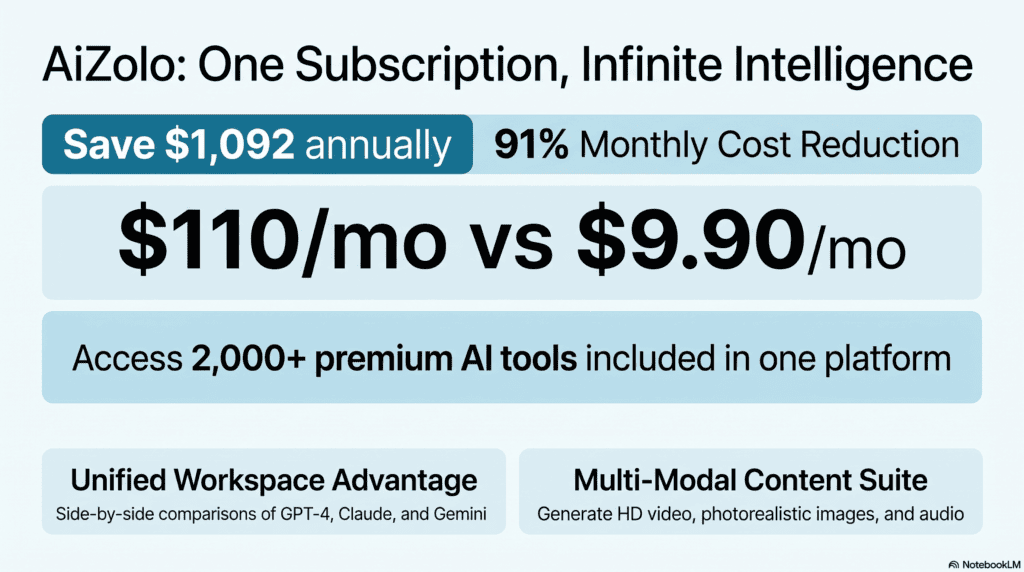
Should I use multiple AI models? Since bias can vary across models and studies, cross-checking important answers with multiple models can provide broader perspectives. Tools like AiZolo make this easier by letting you compare leading AI models side by side in one workspace.
Is any AI model completely free of bias? No model reviewed in the research cited in this article scored as fully bias-free. The realistic goal is choosing the model with documented strengths that match your specific use case, and cross-checking anything politically or factually sensitive.
Will AI bias improve over time? Hallucination rates have measurably dropped year over year according to multiple 2026 benchmarks, and labs increasingly publish more of their safety methodology. Political-lean findings, however, have stayed fairly consistent across the studies cited here, and Grok’s incident history suggests bias can also be introduced faster than it’s fixed.
Final Verdict
If you need one honest takeaway: bias in AI models isn’t solved, it isn’t hidden, and it isn’t the same across models. It’s documented, measurable, and — as shown across every study cited here — genuinely disputed even among researchers using rigorous methods.
Claude and Gemini most often land closer to centrist across the studies reviewed, though not unanimously. ChatGPT shows a consistent, well-documented left-leaning pattern. Grok is the most volatile and the most publicly troubled on safety incidents.
DeepSeek and Qwen are reliable outside China-related topics and documented as restrictive within them. Perplexity’s citations help you check its work, which matters more than any single neutrality score.
Llama and Mistral hand more control to whoever deploys them. Cohere Command sidesteps the political-bias question almost entirely by design.
The most defensible strategy isn’t picking one “winner” and trusting it blindly — it’s matching the model to the task, staying aware of each one’s documented blind spots, and cross-checking anything that actually matters.
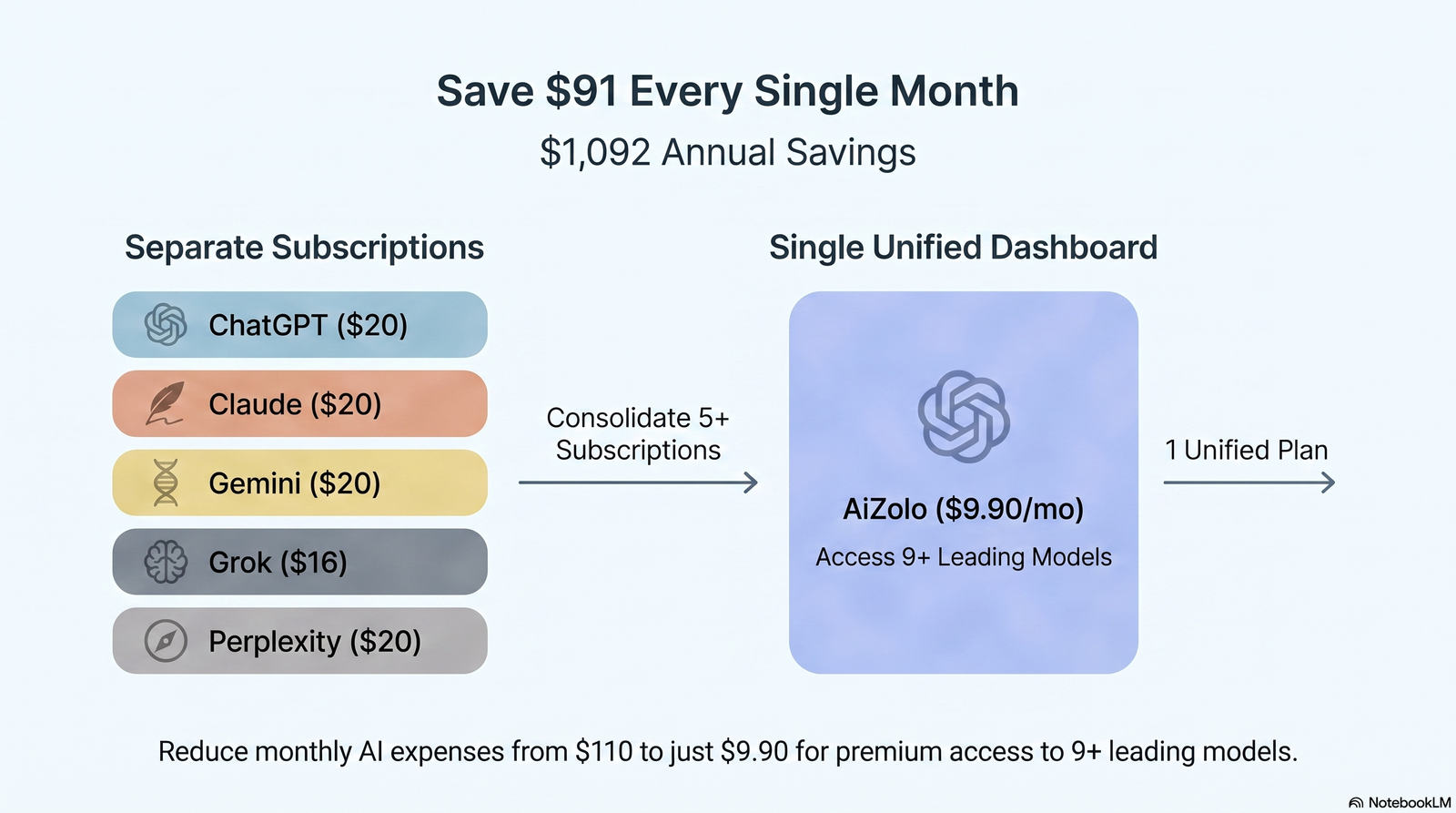
Tools like Aizolo, which let you run the same prompt across multiple leading models side by side, make that kind of comparison practical without paying for and switching between five separate subscriptions.
No model on this list has earned unconditional trust. Several have earned conditional trust for specific, well-defined tasks. That’s a more useful — and more honest — place to end up than a single ranked “best” answer.
Author Bio
Jeevesh Tripathi AI Researcher & Technical Content Specialist
Jeevesh Tripathi researches artificial intelligence, large language models, AI productivity, and emerging technology trends. His work focuses on helping readers make evidence-based decisions through practical testing, benchmark analysis, and clear technical explanations aligned with Google’s EEAT principles.
Email: jeevesh@aizolo.com