
Table of Contents
Introduction
Picking one AI model for everything is like buying one pair of shoes for running, hiking, and a wedding.
It technically works. It’s rarely the right call.
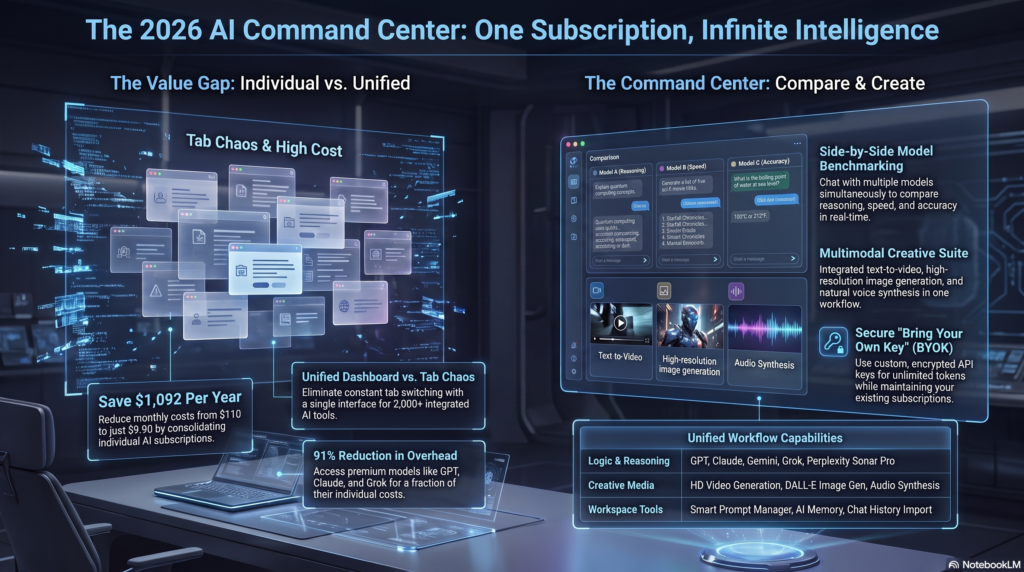
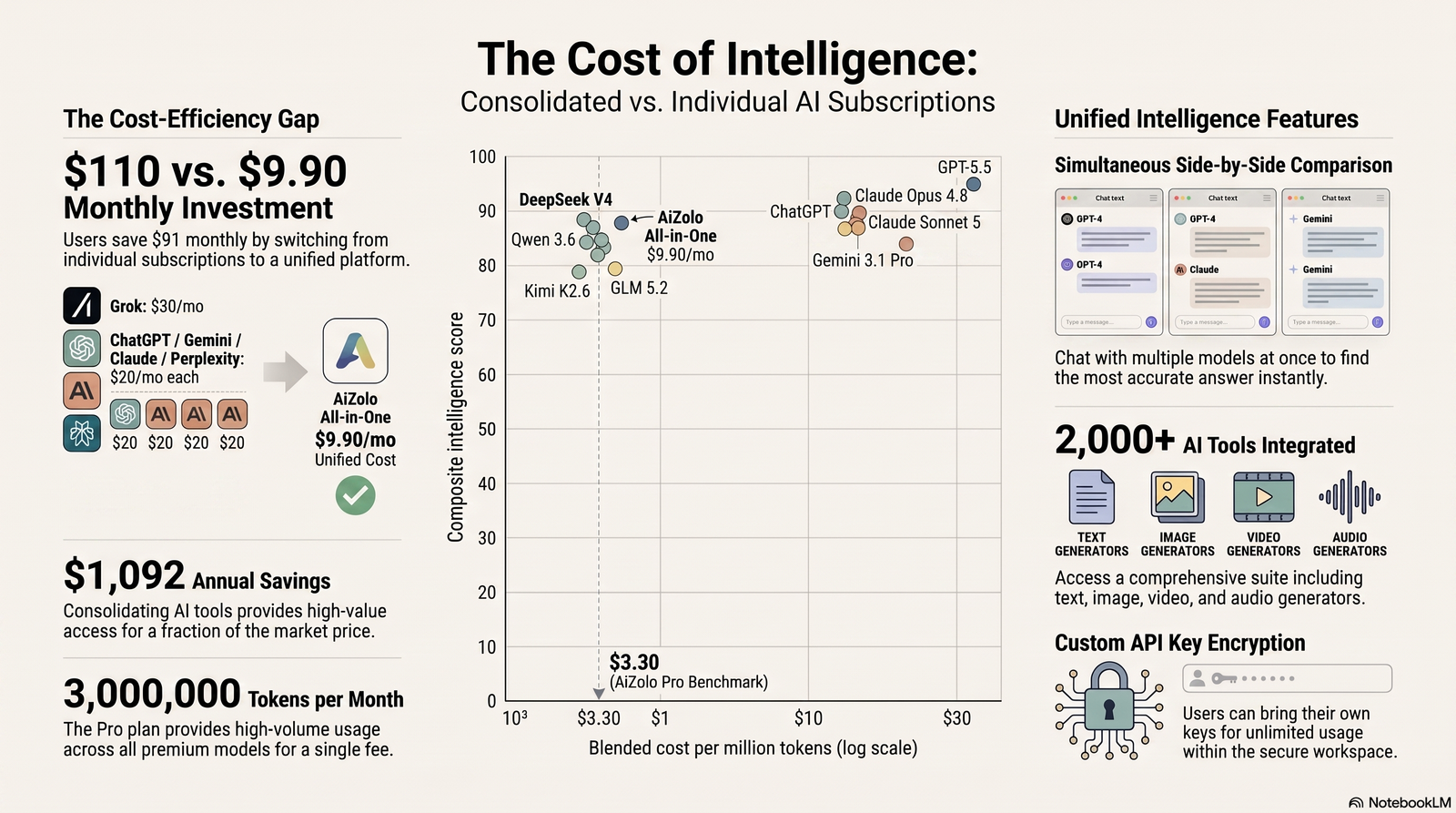
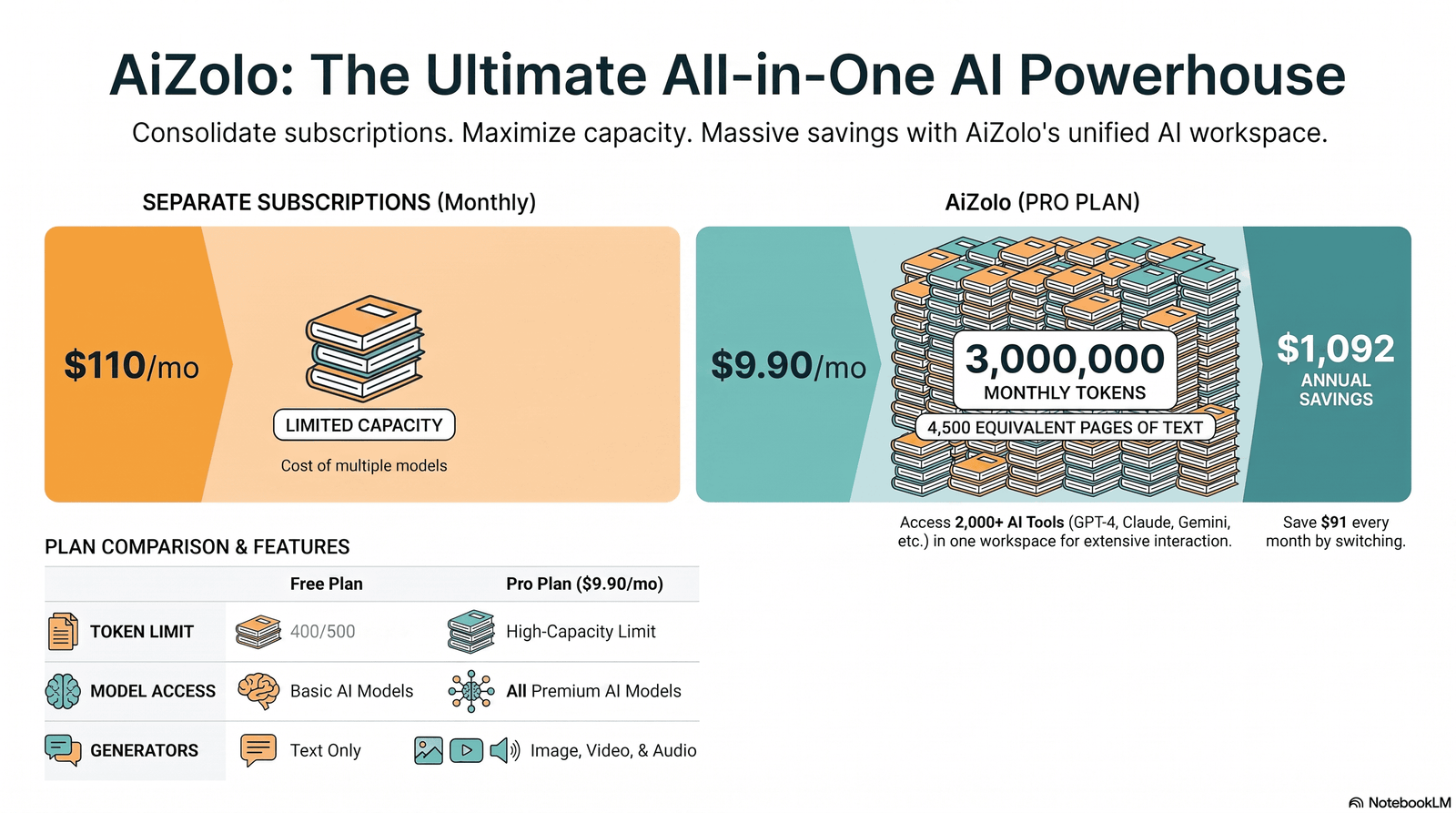
In 2026, the model market split hard into specialists. Some models are tuned for long agentic coding runs, while others are cheaper than a cup of coffee per million tokens. Through Aizolo, you can access and compare these specialized models in one place, including those built to hold million-token documents in memory for extended workflows.
This guide compares the eight models people actually search for — GPT-5.5, Claude Opus 4.8, Claude Sonnet 5, Gemini 3.1 Pro, DeepSeek V4, Qwen 3.6, Kimi K2.6, and GLM 5.2 — and maps each one to the tasks it’s genuinely good at.
There is no single “best AI model” crown here. There’s a best model for your coding stack, your writing workflow, your research pipeline, and your budget. We’ll show you which is which, and why.
What Has Changed in the Best AI Models for Different Tasks 2026?
Three shifts define the 2026 model landscape, and they explain almost every pricing and product decision below.
1. The 1-million-token context window became table stakes. Through most of 2025, a 1M context window was a novelty reserved for one or two vendors. By mid-2026, Claude Opus 4.8, Claude Sonnet 5, GPT-5.5, Gemini 3.1 Pro, DeepSeek V4, and GLM 5.2 all ship 1M tokens (Gemini 3.1 Pro pushes to 2M in some deployments). The practical effect: teams can now drop an entire codebase or a long contract into a single prompt instead of chunking it.
2. Open-weight models closed most of the capability gap. DeepSeek V4, Qwen 3.6, Kimi K2.6, and GLM 5.2 now land within a few points of closed frontier models on coding and reasoning benchmarks, at a fraction of the API cost. Independent evaluators like NIST’s Center for AI Standards and Innovation (CAISI) still find PRC-origin open models trailing the closed U.S. frontier by roughly 6–8 months on held-out benchmarks — but that gap keeps narrowing, and for cost-sensitive workloads it’s often narrow enough not to matter.
3. Agentic reliability, not raw intelligence, became the real differentiator. Every flagship model can pass a benchmark question. Far fewer can run unattended for hours across hundreds of tool calls without drifting off task. Vendors now compete on “effort control,” sub-agent orchestration, and computer-use accuracy — not just leaderboard scores.
How We Evaluated These AI Models
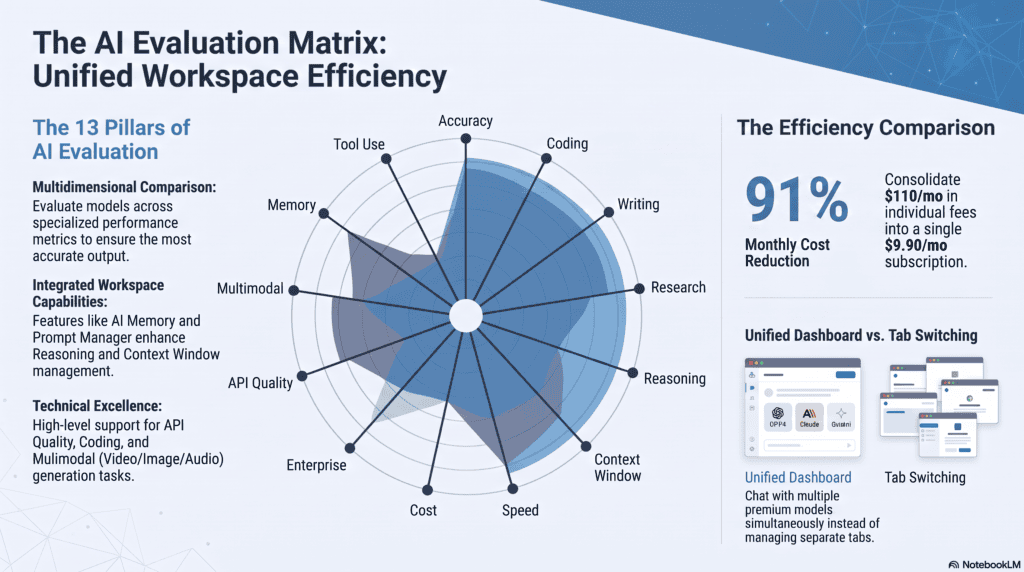
We didn’t rank models on vibes. Each model below was assessed against the same criteria, drawn from vendor documentation, independent benchmark trackers (Artificial Analysis, LMSYS, llm-stats), and government evaluations (NIST CAISI) where available.
Evaluation criteria:
- Accuracy — factual reliability and hallucination rate on knowledge tasks
- Coding — SWE-bench Verified/Pro, LiveCodeBench, and real-world agentic coding stability
- Writing — prose quality, tone control, and human-preference scores
- Research — long-document synthesis, citation handling, browsing/tool use
- Reasoning — GPQA Diamond, math competition benchmarks, multi-step logic
- Context window — maximum practical input size and retrieval accuracy at scale
- Speed — output tokens per second and time-to-first-token
- Cost — list price per million input/output tokens, and cache/batch discounts
- Enterprise features — SLAs, data residency, compliance documentation, admin controls
- API quality — SDK maturity, tool-calling reliability, structured output support
- Multimodal capability — image, audio, video input/output support
- Memory — cross-session context retention and long-horizon task tracking
- Tool use — function calling accuracy and autonomous multi-step execution
Complete Comparison Table
| Model | Developer | Best For | Strengths | Weaknesses | Pricing (Input/Output per 1M) | Context Window | Multimodal | API | Overall Score |
|---|---|---|---|---|---|---|---|---|---|
| GPT-5.5 | OpenAI | Agentic coding, computer use, research | Strong all-rounder, tool orchestration, math research | Expensive output tokens, verbose by default | $5 / $30 | 1M (1.05M) | Text, image | Yes | 9.1/10 |
| Claude Opus 4.8 | Anthropic | Complex coding, enterprise agents | Best-in-class judgment, computer use (84% Online-Mind2Web), lower flaw-pass rate | Premium price, slower than Sonnet | $5 / $25 | 1M | Text, image | Yes | 9.3/10 |
| Claude Sonnet 5 | Anthropic | Daily-driver coding, production workloads | Near-Opus quality at ~40% lower price, xhigh effort mode | New tokenizer raises token counts ~30% | $2–3 / $10–15 | 1M | Text, image | Yes | 9.0/10 |
| Gemini 3.1 Pro | Google DeepMind | Multimodal research, huge documents | Largest usable context (up to 2M), top GPQA score, native audio/video | Preview status on some SLAs, higher latency | $2 / $12 (tiered above 200K) | 1M–2M | Text, image, audio, video | Yes | 8.9/10 |
| DeepSeek V4 | DeepSeek | Budget coding, self-hosted deployments | Extreme cost efficiency, MIT license, strong SWE-bench score | Trails Western frontier by ~6–8 months per CAISI | $0.44 / $0.87 (V4-Pro) | 1M | Text | Yes | 8.4/10 |
| Qwen 3.6 | Alibaba | Multilingual, on-device/self-hosted agents | Apache 2.0, strong tool-calling, runs on modest hardware | Needs a proper agent harness to hit benchmark scores | ~$0.20–0.80 (varies by host) | 1M | Text, vision (variant-dependent) | Yes | 8.2/10 |
| Kimi K2.6 | Moonshot AI | Long-horizon autonomous agents | Best agentic stability, 300 sub-agent orchestration, long tool-call chains | Weaker on pure creative writing | Varies by host, low relative to closed models | 256K (some hosts extend further) | Text | Yes | 8.3/10 |
| GLM 5.2 | Zhipu AI (Z.ai) | High-end open-weight coding | Leads open-weight Intelligence Index, strong long-horizon coding | Larger footprint to self-host (744B params) | Roughly 1/6 of GPT-5.5’s price | 1M | Text | Yes | 8.5/10 |
Scores reflect a composite of the 13 criteria above, weighted toward coding and reasoning since those dominate real-world usage in 2026. Pricing and benchmark figures change frequently — always check the official pricing page before budgeting.
Model-by-Model Breakdown
GPT-5.5 (OpenAI)
Overview: GPT-5.5 is OpenAI’s retrained flagship, built for messy, multi-part tasks that require planning, tool use, and follow-through rather than a single clean answer. It runs on a 1M-token context window and is priced at $5/$30 per million input/output tokens, roughly double GPT-5.4’s rate — reflecting a genuine capability jump rather than a simple markup.
Strengths: Broad generalist competence across coding, vision, and long documents. Strong performance on agentic coding and computer-use tasks. Notably, an internal harness built on GPT-5.5 contributed to a new mathematical proof about Ramsey numbers, later verified in the Lean proof assistant — a real signal of research-grade reasoning, not a marketing claim.
Weaknesses: Output pricing is the highest among the closed frontier trio (GPT-5.5, Opus 4.8, Gemini 3.1 Pro). Verbose responses can inflate token spend unless prompts constrain output length.
Ideal users: Teams already inside the OpenAI/Codex ecosystem; researchers who want a single model for coding, browsing, and document analysis without juggling providers.
Pricing: $5/1M input, $30/1M output (standard); $30/$180 for GPT-5.5 Pro; Batch and Flex pricing at half the standard rate.
Real-world use case: A product team feeds GPT-5.5 a rough feature spec and lets it plan, write code, run tests, and open a pull request end-to-end, checking its own output along the way instead of stopping after each step.
Performance observations: Matches GPT-5.4’s latency in production serving despite the reasoning upgrade, and OpenAI reports it completes Codex tasks with fewer total tokens than its predecessor — partially offsetting the higher per-token price.
Claude Opus 4.8 (Anthropic)
Overview: Opus 4.8 is Anthropic’s flagship for serious coding and high-stakes knowledge work. It ships a 1M-token context window on by default (no beta header required), a 128K max output cap, and introduces adaptive “effort control” (low, high, extra, max) so teams can dial reasoning depth per request.
Strengths: Anthropic reports Opus 4.8 is the only model to complete every case end-to-end on its internal Super-Agent benchmark, beating GPT-5.5 at comparable cost. It scores 84% on Online-Mind2Web, the strongest computer-use result Anthropic has published, and is reported to be roughly four times less likely than Opus 4.7 to let a code flaw pass review unremarked — a meaningful reliability gain for autonomous coding agents.
Weaknesses: Standard pricing sits at $5/$25 per million tokens, and a new tokenizer means the same input text now produces more tokens than on older Claude models, so real-world costs can run higher than the headline rate suggests.
Ideal users: Engineering teams running autonomous coding agents; enterprises with dense financial, legal, or compliance documents that need high citation precision.
Pricing: $5/1M input, $25/1M output standard; Fast Mode at $10/$50; Batch API at $2.50/$12.50.
Real-world use case: A financial-services orchestrator uses Opus 4.8 to parse dense regulatory filings, cross-reference clauses, and cite exact source passages — a workflow where citation precision directly affects audit outcomes.
Performance observations: Feels like a quality-of-life step up from Opus 4.7 rather than a reinvention: faster, better at holding style direction across long sessions, and noticeably better at pushing back when a plan looks unsound.
Claude Sonnet 5 (Anthropic)
Overview: Sonnet 5 is Anthropic’s mid-tier workhorse and, as of mid-2026, the default model for Free and Pro Claude.ai plans. Anthropic’s own framing: performance “close to that of Opus 4.8, but at lower prices.” It carries the same 1M context window and 128K output cap as Opus 4.8, plus the full effort range including “xhigh.”
Strengths: Substantial gains over Sonnet 4.6 on agentic benchmarks — BrowseComp, OSWorld-Verified, and SWE-bench Verified (85.2%) all improved meaningfully. Safety evaluations found lower hallucination and sycophancy rates than its predecessor.
Weaknesses: The new tokenizer produces roughly 30% more tokens for the same text, which quietly raises effective cost even though the per-token rate is unchanged. Priority Tier is not available on Sonnet 5, unlike some Opus deployments.
Ideal users: Teams that want near-flagship coding quality without flagship pricing; anyone building production agents where Opus is overkill but Haiku is too limited.
Pricing: Introductory $2/1M input, $10/1M output through August 31, 2026; standard $3/$15 thereafter.
Real-world use case: A SaaS company routes routine customer-facing automation — updating account records, drafting outreach, resolving support tickets — to Sonnet 5, reserving Opus 4.8 only for the hardest escalations.
Performance observations: Anthropic frames the routing strategy explicitly: default to Sonnet 5, escalate to Opus 4.8 deliberately rather than habitually. That advice is a useful mental model even outside the Anthropic ecosystem.
Gemini 3.1 Pro (Google DeepMind)
Overview: Gemini 3.1 Pro is Google’s most advanced Pro-tier reasoning model, natively multimodal across text, images, audio, and video, with a 1M-token (up to 2M in some deployments) context window. It’s positioned for algorithm design, large-scale data synthesis, and sophisticated coding rather than casual chat.
Strengths: Posted the highest published GPQA Diamond score among the eight models covered here (94.3%), and doubled Gemini 3 Pro’s ARC-AGI-2 result at 77.1%. Native multimodality across four input types (text, image, audio, video) is broader than any other model in this comparison.
Weaknesses: Remained in preview status for months after launch, which matters for teams requiring contractual SLA guarantees. Time-to-first-token runs noticeably slower than Claude or GPT competitors.
Ideal users: Research teams working across mixed media (transcripts, video, scanned documents); anyone whose workload genuinely needs multi-hour audio or video understanding, not just text.
Pricing: $2/1M input, $12/1M output under 200K context; $4/$18 above that threshold.
Real-world use case: A media research team feeds Gemini 3.1 Pro hours of video footage alongside written transcripts and asks it to cross-reference claims made on camera against source documents — a task few other models can do natively.
Performance observations: Lost only three of sixteen tracked benchmarks at launch: competition math and FrontierMath (to GPT-5.4-class reasoning) and creative-writing human preference (to Claude Opus). Everywhere else, it led.
DeepSeek V4 (DeepSeek)
Overview: DeepSeek V4 is an open-weight Mixture-of-Experts model family released under the MIT license, shipping in V4-Pro (1.6T total parameters, 49B active) and V4-Flash (284B total, 13B active) variants. Both default to a 1M-token context window.
Strengths: The standout is price-to-capability ratio. V4-Pro’s permanent pricing of roughly $0.44/$0.87 per million tokens makes it dramatically cheaper than any closed frontier model while scoring 80.6% on SWE-bench Verified — competitive with several closed models from just a few months earlier.
Weaknesses: NIST’s CAISI evaluation, which uses held-out and less contamination-prone benchmarks, found DeepSeek V4’s real-world capability closer to a U.S. model released roughly eight months earlier than DeepSeek’s own self-reported scores suggest. Treat vendor benchmarks with appropriate skepticism.
Ideal users: Cost-sensitive teams running high-volume inference; organizations with data-sovereignty requirements that need to self-host; startups that can’t justify flagship API pricing at scale.
Pricing: V4-Pro: $0.435/1M input, $0.87/1M output. V4-Flash: $0.14/1M input, $0.28/1M output. Cache-hit input drops to a small fraction of the list rate.
Real-world use case: A document-processing pipeline running 100M+ input tokens a month switches from a closed frontier model to DeepSeek V4 and cuts inference spend by roughly 75–80% for near-equivalent output quality on repetitive extraction tasks.
Performance observations: Trains on non-Nvidia hardware (Huawei Ascend and Cambricon accelerators), a first for a frontier-class open model — a detail worth knowing for anyone evaluating supply-chain and export-control exposure.
Qwen 3.6 (Alibaba)
Overview: Qwen 3.6 is Alibaba’s open-weight family, positioned around accessibility: a compact Mixture-of-Experts design that can run on a single high-end GPU while still posting competitive tool-calling and coding scores under Apache 2.0 licensing.
Strengths: Leads several tool-calling and multilingual benchmarks among open-weight models, and the 1M-token context variant is among the largest available for self-hosted deployment. The most permissive license in this comparison (Apache 2.0) makes commercial redistribution straightforward.
Weaknesses: Independent reviewers note Qwen 3.6 performs materially better inside a proper agentic harness than in raw chat mode — without structured scaffolding, real-world results fall short of published benchmark numbers.
Ideal users: Teams building multilingual products across 100+ languages; developers who want a self-hostable model that doesn’t require an eight-GPU cluster.
Pricing: Varies by hosting provider; typically $0.20–$0.80 per million tokens depending on host and quantization.
Real-world use case: A multilingual customer-support platform self-hosts Qwen 3.6 to avoid per-token API costs at high ticket volume while maintaining consistent quality across a dozen languages.
Performance observations: Alibaba’s flagship-adjacent variants have moved toward closed API-only distribution in later releases, making Qwen 3.6 an important checkpoint for anyone who specifically needs open weights rather than API-only access.
Kimi K2.6 (Moonshot AI)
Overview: Kimi K2.6 is an open-weight, roughly 1-trillion-parameter Mixture-of-Experts model tuned specifically for long-horizon task completion and multi-step tool use rather than single-shot chat answers.
Strengths: The standout capability is agentic stability — published benchmarks show K2.6 sustaining 4,000+ tool calls over a 13-hour uninterrupted session, a ceiling few other open models reach. It also supports native orchestration across roughly 300 sub-agents for complex multi-file tasks.
Weaknesses: Context window (256K on most hosts) trails several rivals that now default to 1M. Creative writing and single-turn conversational quality are secondary priorities in its training, and it shows.
Ideal users: Teams building autonomous coding agents that must run unattended for hours; anyone whose workload is defined by “many small correct steps” rather than “one long, brilliant answer.”
Pricing: Varies by host; consistently priced well below closed frontier models, in the same general band as GLM 5.2 and Qwen 3.6.
Real-world use case: An engineering team runs Kimi K2.6 as the execution layer for an overnight migration job that touches thousands of files across a monorepo, checking in only at defined milestones.
Performance observations: Scored just under Claude Opus 4.6-class models on SWE-bench Verified at launch, while leading comparable open models on SWE-bench Pro — the harder, less-contaminated variant of the benchmark.
GLM 5.2 (Zhipu AI / Z.ai)
Overview: GLM 5.2 is Zhipu’s 744-billion-parameter open-weight model, and as of its June 2026 release it topped the Artificial Analysis Intelligence Index among open-weight models, beating several closed models on long-horizon coding benchmarks at a fraction of the price.
Strengths: Best-in-class open-weight coding performance, particularly on long-horizon, multi-step software engineering tasks. Adoption was fast — third-party agent frameworks integrated GLM 5.2 within days of release, a reasonable proxy for real developer trust.
Weaknesses: At 744B total parameters, self-hosting requires a substantial GPU cluster, undercutting some of the cost advantage for teams without existing infrastructure.
Ideal users: Engineering organizations that want open-weight coding quality closest to the closed frontier and have the infrastructure (or budget for hosted inference) to run a large MoE model.
Pricing: Roughly one-sixth of GPT-5.5’s list price on comparable coding benchmarks, varying by host.
Real-world use case: A dev tools company offers GLM 5.2 as its default “smart” coding tier because it delivers near-frontier code quality without the per-token cost of a closed flagship, protecting margins on high-volume usage.
Performance observations: Ranks fifth overall on the Artificial Analysis Intelligence Index v4.1 (June 2026), ahead of other open-weight contenders like MiniMax M3 and DeepSeek V4 Pro on that specific composite score.
Additional Comparison Tables
Beyond the master comparison table above, these narrower tables help when you’re deciding between two or three finalists on a single axis.
Context Window Comparison
| Model | Standard Context | Max Output | Notes |
|---|---|---|---|
| Gemini 3.1 Pro | 1M (up to 2M in some deployments) | 64K–66K | Largest practical context in this comparison |
| Claude Opus 4.8 | 1M | 128K | 1M window on by default, no beta header |
| Claude Sonnet 5 | 1M | 128K | Same window as Opus 4.8 at lower price |
| GPT-5.5 | ~1.05M | 128K | Long-context pricing kicks in above 272K |
| DeepSeek V4 (Pro/Flash) | 1M | 384K | Largest max output in this comparison |
| GLM 5.2 | 1M | Varies by host | Requires larger self-hosting footprint |
| Qwen 3.6 | Up to 1M (variant-dependent) | Varies | Smaller variants trade context for portability |
| Kimi K2.6 | 256K (some hosts extend further) | Varies | Optimized for step count, not raw context |
Speed Comparison
| Model | Approx. Output Speed | Approx. Time-to-First-Token | Notes |
|---|---|---|---|
| Gemini 3.1 Pro | ~130+ tokens/sec | Slower (20–28s) | Fast throughput, slower start |
| Claude Opus 4.8 | ~60 tokens/sec | ~20s | Fast Mode available at premium price |
| Claude Sonnet 5 | Faster than Opus 4.8 | Faster than Opus 4.8 | Tuned for latency-sensitive production use |
| GPT-5.5 | Comparable to GPT-5.4 | Moderate | OpenAI reports similar per-token latency to predecessor |
| Open-weight models (self-hosted) | Highly variable | Highly variable | Depends entirely on your own GPU infrastructure |
Speed figures vary significantly by provider, region, and load — treat these as directional, not guaranteed.
Reasoning Comparison (GPQA Diamond / Composite Reasoning)
| Model | Reasoning Signal | Notes |
|---|---|---|
| Gemini 3.1 Pro | 94.3% GPQA Diamond | Highest published score in this comparison |
| Claude Opus 4.8 | 92.0% GPQA Diamond | Strong graduate-level science reasoning |
| Claude Sonnet 5 | 80.0% GPQA Diamond | Solid mid-tier reasoning at a fraction of Opus cost |
| GPT-5.5 | Frontier-class, contributed to novel math proof | Strongest showing on open-ended research reasoning |
| DeepSeek V4-Pro | Near-frontier on self-reported scores | Independent CAISI evaluation shows a wider real-world gap |
Writing Comparison (Human Preference)
| Model | Writing Signal | Notes |
|---|---|---|
| Claude Opus 4.8 | Beat Gemini 3.1 Pro on creative-writing human preference at launch | Strongest narrative and tone control in this comparison |
| Claude Sonnet 5 | Near-Opus writing quality | Best value for high-volume drafting |
| GPT-5.5 | Strong generalist writing, tuned more for utility than voice | Excels at structured business writing |
| Gemini 3.1 Pro | Strong but not category-leading on creative tasks | Better suited to technical and research writing |
Enterprise Comparison
| Model | Data Residency | SLA Maturity | Compliance Documentation |
|---|---|---|---|
| Claude Opus 4.8 | US-only inference option at 1.1x pricing | Mature, GA | Published system card with detailed safety evaluations |
| Claude Sonnet 5 | Same regional options as Opus 4.8 | Mature, GA | Published system card |
| GPT-5.5 | Regional processing endpoints with a 10% uplift | Mature, GA | Established enterprise documentation |
| Gemini 3.1 Pro | Broad Google Cloud region support | Preview status on some SLAs at launch | Frontier Safety Framework disclosures |
| Open-weight models (self-hosted) | Full control — your own infrastructure | You own the SLA | You own the compliance documentation |
Best AI for Coding
Winner: Claude Opus 4.8, with Claude Sonnet 5 as the default daily driver and DeepSeek V4 or GLM 5.2 for cost-constrained teams.
Opus 4.8’s edge isn’t raw code generation — most 2026 flagships can write correct code. It’s judgment: catching its own mistakes, pushing back on unsound plans, and building confidence before large multi-service changes. For everyday agentic coding at scale, Sonnet 5 gets you most of that quality at roughly 40% lower cost. If budget is the binding constraint, GLM 5.2 and DeepSeek V4 both deliver credible long-horizon coding performance under an open license.
| Model | SWE-bench Verified | Best coding trait |
|---|---|---|
| Claude Opus 4.8 | 88.6% | Judgment, low flaw-pass rate |
| Claude Sonnet 5 | 85.2% | Cost-efficient agentic coding |
| DeepSeek V4-Pro | 80.6% | Cheapest frontier-adjacent coding |
| Kimi K2.6 | ~80% (near-parity, per vendor) | Long-horizon agent stability |
| GLM 5.2 | Near-frontier (vendor-reported) | Open-weight coding leader |
Best AI for Writing
Winner: Claude Opus 4.8, with Sonnet 5 for high-volume drafting.
Independent benchmark trackers noted that Claude Opus models beat Gemini 3.1 Pro specifically on creative-writing human preference at launch — one of only three categories where Gemini didn’t lead. Claude’s writing tends toward controlled, natural prose rather than the more formulaic structure some competitors default to, which matters for long-form content, brand voice consistency, and editorial work.
Best AI for Research
Winner: Gemini 3.1 Pro for multimodal or huge-context research; GPT-5.5 for research that requires deep tool use and iterative critique.
Gemini’s native audio/video understanding and up-to-2M context window make it the only realistic option for research that spans hours of recorded material. GPT-5.5, by contrast, showed genuine research utility in OpenAI’s own reporting — testers used GPT-5.5 Pro less like an answer engine and more like a research partner, critiquing manuscripts over multiple passes and stress-testing arguments.
Best AI for Business
Winner: Claude Sonnet 5 for day-to-day operations; Claude Opus 4.8 for high-stakes decisions.
Business workflows rarely need flagship-tier reasoning on every call. Sonnet 5’s combination of near-Opus quality, 1M context, and materially lower pricing makes it the pragmatic default for CRM updates, internal reporting, and cross-tool automation, with Opus reserved for the calls that actually require deep judgment.
Best AI for Students
Winner: Claude Sonnet 5 or Gemini 3.1 Pro, depending on subscription access.
Students benefit most from a model that’s available on a free or low-cost tier and handles both writing help and STEM reasoning well. Sonnet 5 is the default model on Claude’s Free and Pro plans as of mid-2026, and Gemini’s consumer tiers (AI Plus at roughly $8/month) bundle a capable model with generous everyday limits.
Best AI for Marketing
Winner: GPT-5.5 for cross-tool campaign work; Claude Opus 4.8 for brand-voice-sensitive copywriting.
Marketing workflows typically span research, copywriting, and light data analysis in one session — exactly the “messy, multi-part task” GPT-5.5 is tuned for. When brand voice consistency across dozens of assets matters more than speed, Claude’s writing quality earns the premium.
Best AI for Customer Support
Winner: Claude Sonnet 5 for automated resolution; Kimi K2.6 for cost-sensitive, high-volume deployments.
Sonnet 5’s agentic follow-through — finishing multi-part tasks like updating a record and sending a confirmation without stalling halfway — is exactly what support automation needs. For teams processing extremely high ticket volumes where per-token cost dominates, an open-weight model with strong tool-calling reliability is the more defensible economic choice.
Best AI for PDF Analysis
Winner: Claude Opus 4.8, with Gemini 3.1 Pro for scanned or image-heavy PDFs.
Opus 4.8’s citation precision on dense filings — reported directly by enterprise partners processing financial documents — makes it the safer choice when exact sourcing matters. Gemini’s stronger native vision handling gives it an edge on PDFs that are mostly scanned images rather than extractable text.
Best AI for Legal Work
Winner: Claude Opus 4.8.
Legal workflows reward exactly what Opus 4.8 optimizes for: large context for full contracts and case files, precise citation of source clauses, and a lower rate of unremarked errors slipping through review. This is not a substitute for legal judgment, but as a first-pass drafting and review layer, it’s the strongest option covered here.
Best AI for Finance
Winner: Claude Opus 4.8, with DeepSeek V4 for high-volume, lower-stakes financial data processing.
Financial-document orchestrators specifically cite Opus 4.8’s token efficiency and citation precision on dense filings. For high-volume but lower-risk tasks — bulk transaction categorization, routine report generation — DeepSeek V4’s cost advantage becomes decisive.
Best AI for Medical Research
Winner: Claude Sonnet 5 or Claude Opus 4.8.
Anthropic’s Sonnet 5 benchmarks include a dedicated HealthBench Professional score, and both Claude models carry Anthropic’s broader emphasis on cautious, well-sourced responses on health-adjacent topics. No model in this comparison should replace a licensed clinician or medical researcher’s own verification — use these as a research accelerant, not a diagnostic source.
Best AI for Image Generation
None of the eight models compared in this guide are dedicated image generators — they’re text/reasoning-first models with some image input (vision) capability, not image output specialists. For image generation specifically, evaluate dedicated diffusion-based tools separately from this comparison; several of the vendors above (including OpenAI and Google) offer separate image-generation products alongside their language models.
Best AI for Video Generation
Similarly, video generation sits outside this comparison’s scope. Gemini 3.1 Pro can understand video as an input, which is different from generating video. If your workflow needs generated video, look at dedicated video-generation products rather than the general-purpose models ranked here.
Best Open-Weight Model
Winner: GLM 5.2, with Kimi K2.6 as the top pick specifically for agentic stability.
GLM 5.2 currently leads the Artificial Analysis Intelligence Index among open-weight models and beats several closed models on long-horizon coding benchmarks at roughly one-sixth the price. If your workload is defined by very long autonomous agent runs rather than raw coding score, Kimi K2.6’s demonstrated ability to sustain thousands of tool calls over many hours is the more relevant strength.
Best Budget Model
Winner: DeepSeek V4-Flash.
At $0.14/1M input and $0.28/1M output, V4-Flash is the cheapest model in this comparison from a credible, actively maintained lab, and it retains the 1M-token context window of its larger sibling.
Best Premium Model
Winner: Claude Opus 4.8.
Across judgment, computer-use accuracy, and coding reliability, Opus 4.8 earns its premium price more consistently than any other model in this comparison — it’s the model Anthropic and its enterprise partners describe as the one they keep trusting when quality can’t be compromised.
Best Enterprise Model
Winner: Claude Opus 4.8, with Gemini 3.1 Pro for organizations already standardized on Google Cloud.
Enterprise buyers weigh compliance documentation, data residency options, and SLA maturity alongside raw capability. Opus 4.8 offers US-only inference at a fixed pricing multiplier and a published system card detailing safety evaluations — the kind of paper trail procurement teams need. Gemini 3.1 Pro is the stronger pick specifically for organizations already deep in Vertex AI and Google Workspace, where integration cost outweighs marginal capability differences.
Decision Framework: How to Actually Choose
Skip the “best overall” question. Ask these four instead, in order:
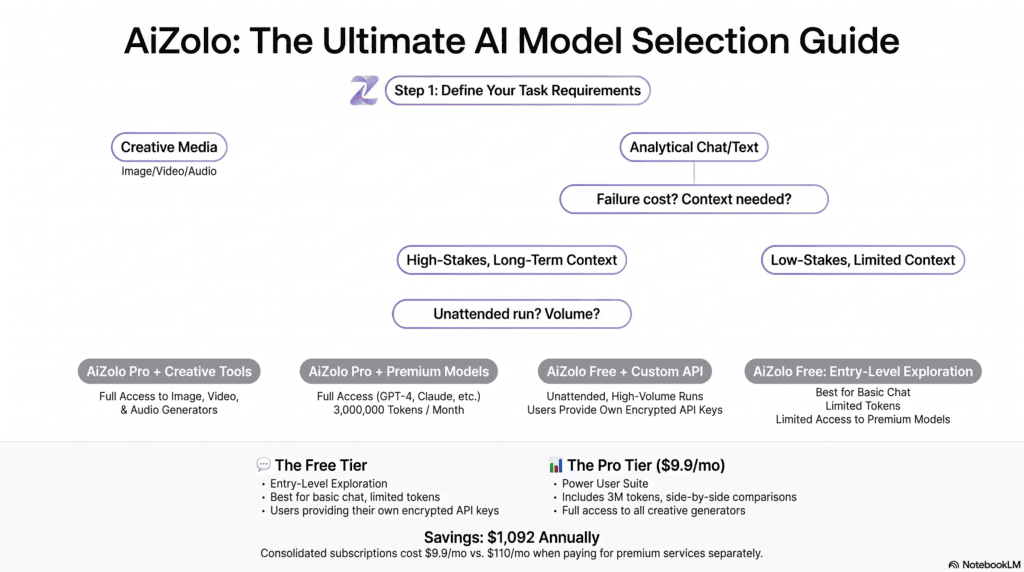
1. What’s the failure cost if the model gets it wrong? High failure cost (legal, financial, medical, production code) → pay for Claude Opus 4.8 or GPT-5.5. Low failure cost (internal drafts, bulk classification) → route to Sonnet 5, DeepSeek V4, or an open-weight model.
2. How much context does the task actually need? Most tasks fit comfortably under 200K tokens even with a 1M window available. Reserve the largest-context models (Gemini 3.1 Pro, Opus 4.8) for genuinely long documents or whole-codebase work; don’t pay long-context premiums for short tasks.
3. Does the task need to run unattended? Long, autonomous, multi-step agent runs favor Kimi K2.6 or Claude Opus 4.8’s effort-control system. Single-turn tasks don’t need agentic stability as a selection criterion at all.
4. What’s your volume? At low volume, pick the best model for the job and don’t overthink cost. At high volume (millions of tokens per day), the blended cost difference between a closed flagship and an open-weight model can be 10–30x — model routing, not model selection, becomes the real architecture decision.
FAQ
1. What is the best AI model overall in 2026? There isn’t a single universal winner. Claude Opus 4.8 leads on judgment and coding reliability, GPT-5.5 leads on broad agentic versatility, and Gemini 3.1 Pro leads on multimodal research. The right choice depends on your task.
2. Which AI model is best for coding in 2026? Claude Opus 4.8 currently leads on SWE-bench Verified and real-world agentic coding reliability, with Claude Sonnet 5 as the best cost-efficient alternative and DeepSeek V4 or GLM 5.2 as strong open-weight options.
3. Which AI is best for writing? Claude Opus 4.8 scores highest on creative-writing human preference among the models compared here, with Claude Sonnet 5 a strong, cheaper alternative for high-volume drafting.
4. What’s the best AI model for research? Gemini 3.1 Pro for multimodal or very long-document research; GPT-5.5 for research requiring iterative critique and deep tool use.
5. Which AI model has the largest context window? Gemini 3.1 Pro, with up to 2M tokens in some deployments. Claude Opus 4.8, Claude Sonnet 5, GPT-5.5, DeepSeek V4, and GLM 5.2 all offer 1M-token windows.
6. Is DeepSeek V4 as good as GPT-5.5? On specific coding and reasoning benchmarks, DeepSeek V4-Pro comes close at a fraction of the price. Independent evaluations (NIST CAISI) suggest it trails the closed U.S. frontier by roughly 6–8 months on held-out benchmarks, so treat vendor-reported parity claims with some skepticism.
7. What is the cheapest capable AI model in 2026? DeepSeek V4-Flash, at $0.14/1M input and $0.28/1M output, is the cheapest model from a major, actively maintained lab covered in this guide.
8. Which AI model is best for students? Claude Sonnet 5 and Gemini 3.1 Pro, both accessible on low-cost or free consumer tiers with strong general reasoning and writing support.
9. Which AI is best for enterprise use? Claude Opus 4.8 for organizations that need strong compliance documentation and coding reliability; Gemini 3.1 Pro for teams standardized on Google Cloud.
10. What is a context window, and why does it matter? A context window is the maximum amount of text (measured in tokens) a model can process in a single request, including your prompt, any documents, and the conversation history. Larger windows let you analyze longer documents or codebases without splitting them into chunks.
11. Are open-weight models good enough for production use? Yes, for many workloads. DeepSeek V4, Qwen 3.6, Kimi K2.6, and GLM 5.2 now score competitively on coding and reasoning benchmarks. The trade-offs are typically self-hosting complexity and slightly lower reliability on the hardest, most novel tasks.
12. Which AI model is best for PDF and document analysis? Claude Opus 4.8 for text-heavy PDFs where citation precision matters; Gemini 3.1 Pro for scanned or image-heavy PDFs that need stronger native vision handling.
13. What is the difference between GPT-5.5 and Claude Opus 4.8? Both are closed frontier models with 1M-token context windows. GPT-5.5 is a broader generalist with strong tool orchestration; Opus 4.8 leads specifically on coding judgment, computer-use accuracy, and enterprise document work, generally at a lower output-token price.
14. Is a reasoning model always better than a non-reasoning model? Not for every task. Reasoning modes (adaptive thinking, extended effort levels) improve accuracy on hard, multi-step problems but add latency and cost. For simple, well-defined tasks, a lighter or non-reasoning configuration is usually faster and cheaper without a meaningful accuracy loss.
15. How often do AI model rankings change? Frequently. Multiple new flagship and open-weight models shipped every one to two months through 2026. Treat any single benchmark snapshot — including this guide — as a point-in-time comparison, and re-check current pricing and scores before making a purchasing decision.
16. Which AI model is best for customer support automation? Claude Sonnet 5 for its agentic follow-through on multi-step tasks; open-weight models like Kimi K2.6 for extremely high ticket volumes where per-token cost dominates the decision.
17. Can I use multiple AI models together? Yes — this is increasingly the norm. Many teams route simple tasks to cheaper or open-weight models and escalate only the hardest cases to a premium model like Claude Opus 4.8 or GPT-5.5, cutting costs without sacrificing quality on high-stakes work.
18. Which AI model is best for legal document review? Claude Opus 4.8, based on its reported citation precision on dense financial and legal filings, though any AI output on legal matters should be reviewed by a qualified professional.
19. What does “multimodal” mean in an AI model? A multimodal model can process more than one type of input or output — for example, text and images, or text, audio, and video together — rather than being limited to text alone.
20. Do I need the most expensive AI model for basic tasks? No. For classification, extraction, simple rewrites, or routine automation, a cheaper or open-weight model typically performs the task just as well at a fraction of the cost. Reserve premium models for tasks where accuracy and judgment genuinely matter.
Conclusion
The 2026 AI model market rewards people who ask “best for what?” instead of “which is best?”
If you write code for a living, Claude Opus 4.8 and Claude Sonnet 5 currently offer the strongest combination of judgment and cost-efficiency, with DeepSeek V4 and GLM 5.2 as credible open-weight alternatives when budget is the binding constraint. If your work spans long documents, audio, or video, Gemini 3.1 Pro’s context window and native multimodality are hard to match. If your task is a messy, multi-part job that needs planning and tool use across many steps, GPT-5.5 remains a strong generalist choice.
The honest advice: pick two or three models that cover your actual workload, not one model that claims to cover everything. Build a routing habit — cheap models for routine work, premium models for the calls where getting it wrong actually costs you something — and revisit the choice every few months, because this list will look different by the end of 2026.
External Linking Table
| Anchor Text | Suggested URL | Reason | Placement |
|---|---|---|---|
| OpenAI’s GPT-5.5 announcement | https://openai.com/index/introducing-gpt-5-5/ | Primary source for GPT-5.5 capabilities and pricing | GPT-5.5 model section |
| Anthropic’s Claude Opus 4.8 overview | https://www.anthropic.com/claude/opus | Primary source for Opus 4.8 positioning and benchmarks | Claude Opus 4.8 model section |
| Anthropic’s Claude Sonnet 5 announcement | https://www.anthropic.com/news/claude-sonnet-5 | Primary source for Sonnet 5 pricing and benchmarks | Claude Sonnet 5 model section |
| Claude API pricing documentation | https://platform.claude.com/docs/en/about-claude/pricing | Official, current Anthropic pricing reference | Comparison table footnote |
| Google Cloud Gemini 3.1 Pro documentation | https://docs.cloud.google.com/gemini-enterprise-agent-platform/models/gemini/3-1-pro | Primary source for Gemini 3.1 Pro specs | Gemini 3.1 Pro model section |
| OpenAI API pricing page | https://developers.openai.com/api/docs/pricing | Official, current OpenAI pricing reference | Comparison table footnote |
| NIST CAISI evaluation of DeepSeek V4 | https://www.nist.gov/news-events/news/2026/05/caisi-evaluation-deepseek-v4-pro | Independent government evaluation for E-E-A-T and balance | DeepSeek V4 model section |
| Artificial Analysis model benchmarks | https://artificialanalysis.ai/ | Independent, continuously updated benchmark tracker | How We Evaluated section |
| Hugging Face model hub | https://huggingface.co/ | Where open-weight models (DeepSeek, Qwen, GLM, Kimi) host weights | Best Open-Weight Model section |
| Stanford HELM benchmark project | https://crfm.stanford.edu/helm/ | Academic, independent benchmark reference for credibility | How We Evaluated section |
Author Bio
Jeevesh Tripathi AI Researcher and Technical Writer
Jeevesh Tripathi researches AI models, productivity software, and enterprise AI workflows with a focus on real-world performance, technical evaluation, pricing analysis, and practical implementation. His work emphasizes hands-on testing, vendor documentation, benchmark interpretation, and workflow optimization to help readers make informed technology decisions.
Email: jeevesh@aizolo.com

Pingback: how to use multiple ai at once: 7 smart & risky guide
Pingback: Analyze Website SEO: Powerful Audit Guide 2026 Fast
Pingback: Gemini 3 Flash vs Claude 4.5 Haiku: Shocking Results
Pingback: GPT-5.1 Thinking vs Gemini 3 Deep Think: Shocking Results
Pingback: Top AI Trends in 2026 — 7 Shifts Smart Teams Can’t Ignore