Introduction
A mid-sized logistics company in Ohio spent eighteen months building a chatbot. By the time it launched, their competitors had already moved on to something entirely different: AI agents that book shipments, flag delays, and rewrite delivery routes without anyone typing a single prompt.
That gap, between what businesses think AI is and what it’s actually becoming, is the real story of 2026.
Artificial intelligence didn’t slow down this year. If anything, the pace picked up. Coding benchmarks that stalled at 60% a year ago now approach human-level performance. Enterprise adoption crossed 88%. And yet, most companies still describe their AI strategy as “we’re experimenting.”
That disconnect is exactly why understanding the top AI trends matters right now, not next quarter. The trends covered in this guide, from agentic AI to multimodal systems to tightening global regulation, aren’t speculative. They’re already reshaping budgets, hiring plans, and product roadmaps across industries.
At Aizolo, we track these shifts closely because our own work sits at the intersection of AI, automation, and productivity tools, and the pattern is consistent: the businesses winning right now aren’t the ones with the flashiest AI demo. They’re the ones who understood which trends were durable and which were noise, early enough to act.
In this guide, you’ll learn what’s genuinely changing in AI right now, why each trend matters for your business, real examples of companies using these shifts today, and a practical framework for deciding where to focus first.
Table of Contents
What Are AI Trends, Really?
An AI trend isn’t just a buzzword gaining traction on LinkedIn. It’s a measurable shift in how AI is built, deployed, or regulated.
Real AI trends show up in three places at once: research output, enterprise spending, and actual deployed products. Hype shows up in only one.
That distinction matters. Plenty of “trends” fade within a quarter because they never move past the demo stage.
The trends in this guide passed that test. Each one is backed by adoption data, investment figures, or documented enterprise deployments, not just predictions.
Quick Fact: According to Stanford HAI’s 2026 AI Index, organizational AI adoption reached 88% in 2025, up ten percentage points from the year before, one of the fastest technology adoption curves ever recorded.
Why AI Trends Matter for Your Business
Ignoring AI trends doesn’t mean standing still. It means falling behind competitors who are already compounding gains.
Here’s why this matters concretely:
- Productivity gaps are widening. Industries most exposed to AI are seeing productivity growth roughly four times higher than industries least exposed to it.
- Investment is accelerating, not slowing. Global corporate AI investment grew sharply year-over-year, and worldwide AI spending is projected to exceed $2.5 trillion in 2026.
- Talent costs are shifting. Workers with AI skills now command a meaningful wage premium, and that gap is growing year over year.
- Regulation is arriving whether you’re ready or not. The EU AI Act’s high-risk system rules apply from August 2026, and U.S. states are adding their own requirements.
Understanding these shifts isn’t about chasing every new tool. It’s about making informed decisions with your budget, your team, and your roadmap.
Top AI Trends in 2026

Trend 1: Agentic AI Moves From Pilot to Production
Definition: Agentic AI refers to systems that can plan, make decisions, use tools, and complete multi-step tasks with limited human input, rather than simply responding to a single prompt.
Why it matters: Unlike a chatbot that answers one question at a time, an AI agent can research a topic, draft an email, check a calendar, and schedule a follow-up, all in one uninterrupted workflow.
Business impact: Gartner named agentic AI its top strategic technology trend for 2026, projecting that 40% of enterprise applications will embed task-specific AI agents this year, up from under 5% in 2025.
Real-world example: Customer service teams are increasingly using multi-agent systems where one agent handles ticket triage, another retrieves account history, and a third drafts a response, only escalating to a human when confidence is low.
Enterprise use case: Procurement teams are piloting agents that compare vendor quotes, flag contract risks, and route approvals automatically, cutting cycle time from days to hours.
Did You Know? According to Gartner’s 2026 CIO survey, only 17% of organizations have actually deployed AI agents so far, but more than 60% expect to within two years. The gap between intent and execution is the real story here.
Benefits:
- Reduces repetitive manual work across departments
- Enables 24/7 task execution without added headcount
- Improves consistency in structured decision workflows
Limitations:
- Most deployments remain narrowly scoped; fully autonomous, unsupervised agents are still rare
- Governance and audit trails are still catching up to agent capabilities
- Multi-agent systems introduce new failure modes when handoffs break down
Future outlook: McKinsey estimates agentic AI could generate between $2.6 trillion and $4.4 trillion in annual value across the business functions it analyzed, though that value will concentrate among early, disciplined adopters rather than distribute evenly.
Expert opinion: Analysts at Forrester and Gartner both point to 2026 as the breakout year for multi-agent systems, where specialized agents collaborate under a central orchestration layer rather than working in isolation.
Actionable takeaway: Start with one narrow, well-defined workflow (like invoice matching or lead qualification) before attempting a fully autonomous, cross-functional agent deployment.
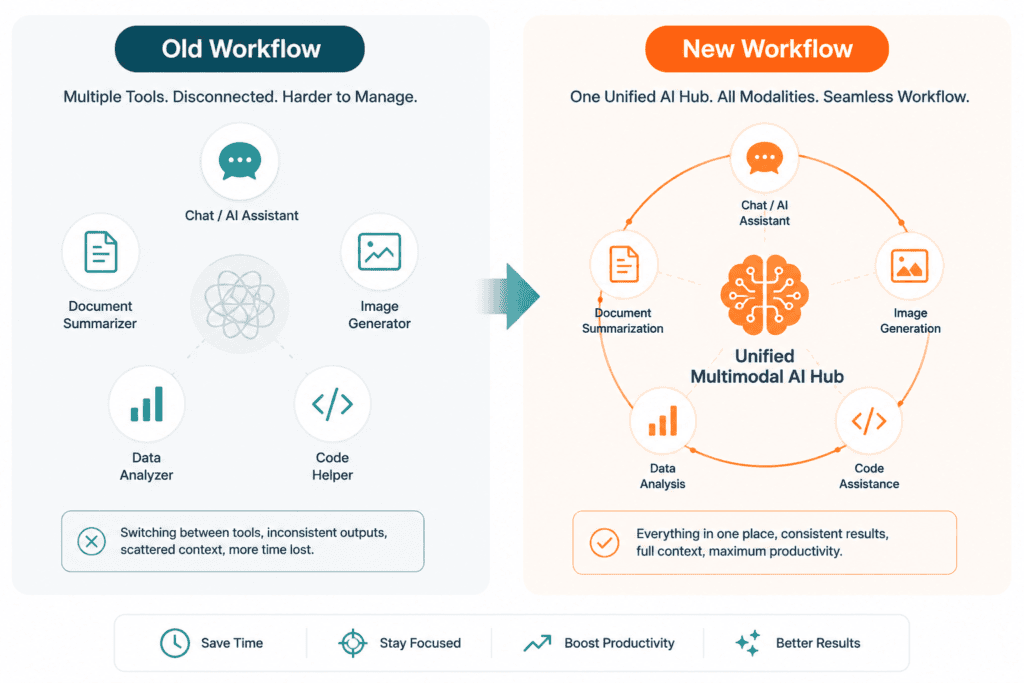
Trend 2: Multimodal AI Becomes the Default
Definition: Multimodal AI refers to models that can process and generate multiple content types together, text, images, audio, and video, within a single system rather than requiring separate tools.
Why it matters: Businesses no longer need five different tools to write a script, generate a voiceover, and produce a video. Increasingly, one multimodal pipeline handles all three.
Business impact: Marketing teams report producing significantly more video content per month without expanding headcount, by consolidating ideation, scripting, visuals, and editing into unified multimodal workflows.
Real-world example: Retail brands are using multimodal tools to generate localized product videos for different markets, automatically adjusting language, voice, and on-screen text without reshooting anything.
Enterprise use case: Training and education teams are converting static documentation into narrated, multimodal walkthroughs at a fraction of the previous production cost.
Benefits:
- Faster content production cycles
- Lower cost per content asset
- Easier localization across markets and languages
Limitations:
- Long-form video with complex continuity still requires human oversight
- IP and rights questions around training data remain unresolved in several jurisdictions
- Quality varies significantly between vendors; not all “multimodal” tools perform equally
Future outlook: Analysts expect enterprise demand for privacy-sensitive, on-brand multimodal deployment to grow faster than novelty use cases, as teams shift from experimentation to repeatable production systems.
Expert opinion: Industry commentary consistently points to a market split forming: one segment chasing viral novelty content, the other building disciplined, brand-safe production systems. The latter is where durable business value sits.
Actionable takeaway: Before adopting a multimodal tool, confirm its content provenance and licensing terms; “legal safety” is becoming a genuine purchasing criterion, not a footnote.
Trend 3: AI Governance and Regulation Get Teeth
Definition: AI governance refers to the policies, controls, and legal frameworks organizations use to manage AI risk, covering everything from data lineage to human oversight requirements.
Why it matters: 2026 is widely described by compliance analysts as the first year of “serious enforcement” for AI regulation, not just voluntary guidelines.
Business impact: The EU AI Act’s high-risk system rules and transparency requirements become applicable on August 2, 2026, affecting any organization whose AI systems are used by, or affect, people in the EU, regardless of where the company is based.
Real-world example: Companies operating in regulated sectors like hiring, credit scoring, and healthcare are now required to document data lineage, maintain human oversight checkpoints, and label systems by risk level under frameworks like the EU AI Act and NIST AI RMF.
Enterprise use case: Financial services firms are building centralized “AI inventories” that classify every deployed model by risk tier, a direct response to regulatory audit requirements.
Warning: Non-compliance with the EU AI Act’s prohibited-practice rules can carry fines up to €35 million or 7% of global annual turnover, whichever is higher.
Benefits:
- Reduces legal and reputational risk
- Builds customer and board-level trust
- Forces better data hygiene as a side effect
Limitations:
- Regulatory patchwork across the U.S. states, EU, and Asia creates real compliance complexity
- Smaller businesses often lack dedicated compliance resources
- Rules for autonomous agents crossing jurisdictions remain unsettled
Future outlook: Whether U.S. federal preemption of state AI laws gains traction, or the regulatory patchwork deepens further, remains an open question analysts are watching closely through the rest of 2026.
Expert opinion: Compliance specialists increasingly frame AI governance the same way cybersecurity was framed a decade ago: not optional, and not something legal teams can own alone.
Actionable takeaway: Conduct an AI system inventory now, classify every deployed model by risk level, before a regulator (or a customer contract) forces the exercise.
Trend 4: Open-Source AI Closes the Gap
Definition: Open-source (or open-weight) AI models are models whose weights are publicly downloadable, allowing businesses to self-host, fine-tune, and deploy them without depending on a single vendor’s API.
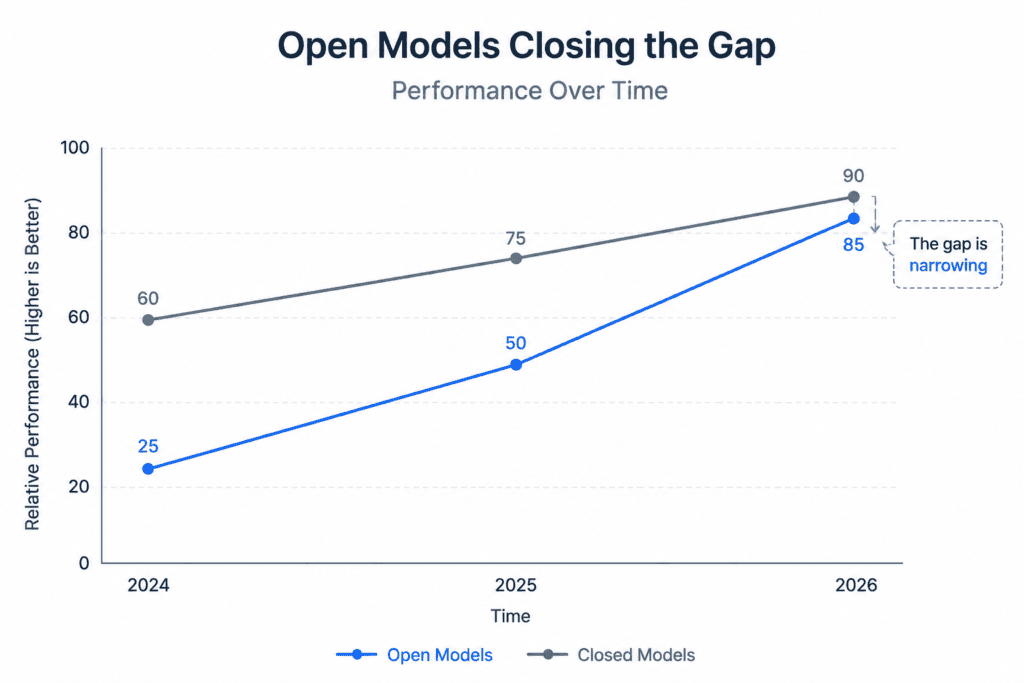
Why it matters: The performance gap between the best open and closed models narrowed dramatically, though it hasn’t fully closed and has fluctuated over time.
Business impact: Stanford’s 2026 AI Index found the leading open model trailed the leading closed model by roughly 3.3% on a major benchmark in March 2026, a gap that had briefly shrunk to under 1% in mid-2024 before widening again.
Real-world example: Enterprises with strict data sovereignty requirements, particularly in finance and healthcare, are increasingly self-hosting open-weight models to keep sensitive data from leaving their own infrastructure.
Enterprise use case: Development teams are using smaller, efficient open models for cost-sensitive, high-volume tasks (like internal document search), reserving expensive frontier models for the hardest reasoning tasks only.
Benefits:
- Lower inference costs at scale
- Full control over data residency and privacy
- No vendor lock-in for core infrastructure
Limitations:
- Self-hosting requires real DevOps and GPU infrastructure investment
- Not all open models are equally well-documented or safety-tested
- Licensing terms vary significantly and require careful legal review
Future outlook: Hugging Face’s own 2026 research notes a geographic rebalancing underway, with Western labs pushing efforts like OpenAI’s open releases and Google’s Gemma to offer competitive alternatives to the Chinese open-weight models currently leading download charts.
Expert opinion: Red Hat’s developer research describes a clear shift toward specific open models for specific use cases, rather than one general-purpose model trying to do everything.
Actionable takeaway: Match your model choice to the task. Use smaller open models for narrow, repetitive workloads, and reserve frontier proprietary models for complex reasoning where accuracy matters most.
Trend 5: The AI Infrastructure Supercycle
Definition: AI infrastructure covers the physical and technical backbone powering AI, GPUs, data centers, networking, and power supply, that makes model training and deployment possible at scale.
Why it matters: Every other trend on this list depends on this one. Agentic AI, multimodal video, and enterprise-scale deployment all require compute capacity that didn’t exist three years ago.
Business impact: Global data center capital expenditure is forecast to exceed $1 trillion in 2026, with the largest hyperscalers alone projected to spend $660–725 billion on capital expenditures this year.
Real-world example: Cloud providers are increasingly investing in custom silicon (like in-house chips) specifically to reduce dependence on any single GPU supplier and control long-term infrastructure costs.
Enterprise use case: Mid-sized companies without hyperscaler budgets are turning to managed inference platforms and “neoclouds” to access GPU capacity without owning physical infrastructure.
Benefits:
- Falling inference costs make advanced AI more accessible to smaller businesses
- Expanding capacity reduces the “waitlist” bottleneck that limited access in 2023–2024
- Competition among chip suppliers is starting to diversify the market beyond one dominant vendor
Limitations:
- Power availability, not chip supply, is becoming the primary bottleneck
- The scale of capital spending has raised sustainability and financing sustainability questions among analysts
- Smaller businesses still face real cost barriers for training (not just running) large models
Future outlook: Industry estimates suggest data center electricity consumption could nearly double by 2030, with AI-focused consumption growing faster than the overall category, making energy strategy a board-level AI conversation, not just an IT one.
Expert opinion: Analysts increasingly frame this as a structural shift in the entire semiconductor industry, where data center and AI-related chips, not consumer electronics, are now the primary demand driver.
Actionable takeaway: Don’t assume compute costs will keep falling indefinitely for every workload; budget infrastructure costs by use case, not as one blanket AI line item.
Trend 6: Enterprise AI Shifts From Adoption to ROI
Definition: This trend describes the shift in enterprise focus from simply deploying AI tools to proving measurable business return on that investment.
Why it matters: Adoption is no longer the challenge. Value realization is. Most companies have already adopted AI in some form; far fewer can point to clear financial impact.
Business impact: Research suggests companies realize an average return in the range of $3.50–$3.70 for every $1 invested in AI, though 70–85% of AI initiatives still fail to meet their expected outcomes, and only around 39% of organizations report enterprise-level financial impact.
Real-world example: Deloitte’s 2026 enterprise research found that nearly half of organizations introduced AI without redesigning the workflows or roles it sits within, a strong predictor of underwhelming results.
Enterprise use case: Companies that redesigned entire workflows around AI, rather than bolting AI onto existing processes, are the ones reporting board-level, strategic value measurement.
Key Takeaway: Deploying AI and transforming a business with AI are two different projects. Most companies are still doing the first one and calling it the second.
Benefits:
- Clearer ROI justifies continued and expanded investment
- Workflow redesign often surfaces broader process inefficiencies worth fixing anyway
- Sets realistic expectations with boards and stakeholders
Limitations:
- Workflow redesign is slower and more disruptive than simply adding a tool
- ROI often takes 12–24 months to materialize, testing organizational patience
- Measuring AI’s contribution separately from other operational changes is genuinely difficult
Future outlook: Expect 2026–2027 to be defined by a “pilot purgatory” shakeout, where organizations that never moved past small pilots either commit to full redesign or quietly deprioritize AI initiatives.
Expert opinion: Deloitte’s research frames the core issue plainly: the gap between AI deployment and genuine AI transformation is real, and wider than most leadership teams currently assume.
Actionable takeaway: Before scaling any AI pilot, ask whether it required redesigning a workflow or role. If it didn’t, it’s unlikely to show up in your ROI numbers.
Trend 7: AI-Native Workplaces and the Skills Premium
Definition: This trend describes how work itself is being restructured around AI tools, and how the labor market is pricing AI fluency as a distinct, valuable skill.
Why it matters: The wage gap between AI-fluent and non-AI-fluent workers is widening fast, and it’s reshaping hiring, training budgets, and career paths.
Business impact: Workers with AI skills reportedly earn a wage premium in the range of 60%+ on average in 2026, up sharply from prior years, and considerably higher in some consumer-facing markets.
Real-world example: Adoption within companies isn’t even. OpenAI’s own usage data shows the top ~5% of “frontier workers” by AI adoption intensity sending roughly six times more AI messages than the median employee, a productivity gap forming inside single organizations, not just between companies.
Enterprise use case: Forward-looking employers are building internal AI literacy programs and certifications rather than waiting for the labor market to supply pre-trained talent.
Benefits:
- Upskilling existing staff is often faster and cheaper than external hiring
- AI-fluent teams report meaningfully higher self-reported productivity gains
- Reduces reliance on scarce, expensive specialist AI hires for everyday tasks
Limitations:
- Employment for early-career workers in some technical fields has reportedly declined as AI absorbs entry-level tasks
- Not all roles benefit equally; the productivity gains are concentrated where processes are already well-defined
- Training programs require ongoing investment as tools change quickly
Future outlook: Expect AI literacy to increasingly appear as a formal hiring and promotion criterion, not just a nice-to-have, particularly in knowledge-work roles.
Expert opinion: Analysts increasingly describe this less as “AI replacing jobs” and more as “AI-fluent workers replacing non-AI-fluent workers doing the same job,” a more precise, if uncomfortable, framing.
Actionable takeaway: Invest in structured AI training for your existing team before assuming you need to hire externally for AI capability.
Trend 8: Responsible AI and Trust Become Competitive Differentiators
Definition: Responsible AI refers to practices around transparency, bias mitigation, safety, and explainability that build public and customer trust in AI systems.
Why it matters: Public trust in AI has not kept pace with its capabilities. That trust gap is becoming a genuine business risk, and a genuine differentiator for companies that get it right.
Business impact: Stanford’s 2026 AI Index frames the current moment as “accelerating capabilities vs. lagging governance,” noting that AI capability advances are outpacing the safety, transparency, and public-trust infrastructure meant to keep pace with them.
Real-world example: Companies that publish clear AI usage disclosures and content provenance labeling (particularly in AI-generated video and marketing) report fewer trust-related customer complaints than those that don’t.
Enterprise use case: Regulated industries are adopting “human-in-the-loop” checkpoints for any AI decision that affects a customer’s financial, employment, or legal outcomes, both for compliance and trust reasons.
Benefits:
- Builds durable customer and stakeholder trust
- Reduces regulatory and reputational exposure
- Often improves system quality as a byproduct of better oversight
Limitations:
- Responsible AI practices add real time and cost to deployment
- Standards are still evolving; “best practice” today may not match tomorrow’s requirements
- Smaller companies often lack dedicated resources for formal AI ethics review
Future outlook: Watch for growing divergence in public trust by country and demographic, an issue Stanford’s 2026 report flags as a structural, not temporary, challenge for the industry.
Expert opinion: Researchers increasingly argue that trust, not raw capability, will determine which AI products actually get adopted at scale by cautious, risk-averse enterprise buyers.
Actionable takeaway: Treat AI transparency and disclosure as a product feature, not a legal afterthought. It’s increasingly a genuine purchasing factor for enterprise buyers.
Trend Comparison Tables
Trend vs. Business Value
| Trend | Primary Business Value | Time to Realize Value |
|---|---|---|
| Agentic AI | Workflow automation, reduced manual work | 6–18 months |
| Multimodal AI | Faster, cheaper content production | 1–6 months |
| AI Governance | Risk reduction, market access | Ongoing |
| Open-Source AI | Cost control, data sovereignty | 3–12 months |
| AI Infrastructure | Enables all other AI capability | Long-term (years) |
| Enterprise ROI Focus | Justifies and directs future investment | 12–24 months |
| AI-Native Workplace | Productivity gap closure | 6–12 months |
| Responsible AI | Trust, compliance, brand differentiation | Ongoing |
Trend vs. Adoption Level (2026)
| Trend | Current Adoption Level |
|---|---|
| Generative AI (general use) | Very High (81%+ of organizations) |
| Enterprise AI (any function) | Very High (88% of organizations) |
| Agentic AI (deployed) | Early (17% deployed, 60%+ planning) |
| Open-Source AI (self-hosted) | Moderate, growing fast |
| Formal AI Governance Programs | Moderate, accelerating under regulation |
Trend vs. Cost to Implement
| Trend | Relative Implementation Cost |
|---|---|
| Multimodal content tools | Low–Moderate |
| Agentic AI workflows | Moderate–High |
| Open-source self-hosting | Moderate (infrastructure-dependent) |
| Frontier proprietary models via API | Low to start, scales with usage |
| Full AI governance program | Moderate–High (ongoing) |
Trend vs. Industry Relevance
| Trend | Most Relevant Industries |
|---|---|
| Agentic AI | Finance, customer service, logistics, procurement |
| Multimodal AI | Marketing, media, education, e-commerce |
| AI Governance | Financial services, healthcare, HR, insurance |
| Open-Source AI | Healthcare, finance, government, defense |
| AI Infrastructure | Cloud providers, telecom, data-heavy enterprises |
Trend vs. Future Potential
| Trend | 3–5 Year Outlook |
|---|---|
| Agentic AI | Could handle a meaningful share of routine business decisions autonomously |
| Multimodal AI | Likely becomes the default mode for most content creation tools |
| AI Governance | Will likely mature into a standardized global baseline, unevenly enforced |
| Open-Source AI | Expected to expand into robotics and scientific domains beyond text/image |
| AI Infrastructure | Power availability, not chip supply, becomes the primary constraint |
Business Impact Across Industries
Retail and E-commerce: AI-driven personalization engines and demand forecasting are boosting sales through more targeted recommendations, while also reshaping inventory management and supply chain planning.
Financial Services: Fraud detection, credit risk scoring, and now agentic workflows for compliance checks are among the fastest-growing use cases, closely watched by regulators.
Healthcare: Multimodal AI is being used for diagnostic support and documentation, though adoption remains cautious given the regulatory and safety stakes involved.
Marketing and Media: Multimodal video and content generation are compressing production timelines dramatically, with creative teams reporting output gains without proportional headcount growth.
Software Development: AI coding tools are now used daily by roughly half of developers, rising to about two-thirds in top-performing organizations, fundamentally changing how software gets built.
Best Practice: Don’t evaluate AI trends generically. Ask which trend maps to your specific industry’s cost structure, regulatory exposure, and customer expectations before prioritizing investment.
Common Mistakes Businesses Make With AI Trends
Even well-resourced companies stumble in predictable ways. Here are the patterns worth avoiding.
Chasing every new tool. Adopting the newest model or feature without a clear use case usually produces demos, not results.
Bolting AI onto old workflows. As Deloitte’s research shows, adding AI without redesigning the underlying process rarely delivers measurable ROI.
Ignoring governance until forced to. Waiting for a regulator or a customer contract to force compliance is more expensive than building it in from the start.
Treating open-source and proprietary models as interchangeable. Cost, licensing, and support differ significantly; the wrong choice for your use case creates hidden long-term costs.
Underinvesting in training. Tools without trained people behind them rarely produce the productivity gains vendors promise.
How Businesses Should Prepare
- Audit before you adopt. Inventory existing AI use across your organization, including unofficial, employee-driven tool usage, before adding anything new.
- Pick one workflow, not one tool. Choose a specific, measurable process to redesign around AI rather than deploying a general-purpose tool company-wide.
- Build governance in parallel, not after. Classify AI systems by risk level from day one; retrofitting compliance is significantly more expensive.
- Invest in people alongside tools. Budget for training with the same seriousness as the software license itself.
- Measure ROI on a defined timeline. Set a 12–24 month evaluation window with clear success metrics before scaling any pilot further.
Future Predictions Beyond 2026
Looking past this year, a few directional shifts appear likely based on current research trajectories, though it’s worth being honest that some of these remain genuinely uncertain.
- Multi-agent orchestration matures. Analysts expect coordination layers for multiple specialized agents to become as foundational to enterprise software as container orchestration was for cloud computing.
- Autonomous decision-making expands cautiously. Gartner projects a meaningful, though still modest, share of routine business decisions being made autonomously by AI agents by 2028.
- Regulatory convergence, eventually. Whether through U.S. federal action or market pressure, some analysts expect today’s fragmented global rules to consolidate over the next few years, though this remains far from settled.
- Energy becomes the real constraint. As compute capacity keeps expanding, power availability, not chip supply, is likely to become the binding constraint on how fast AI can scale.
It’s worth noting: benchmark performance and real-world reliability don’t always move together. Several 2026 industry reports flag a growing gap between how models perform on tests and how they perform in messy, real production environments, a gap worth watching rather than assuming away.
Expert Tips
Expert Tip: Don’t evaluate an AI vendor solely on model quality. Evaluate their governance, documentation, and licensing terms with equal weight; that’s where hidden costs and risks usually live.
Expert Tip: When piloting agentic AI, start with a workflow where mistakes are cheap and reversible. Save high-stakes, irreversible decisions for after you’ve built operational trust in the system.
Expert Tip: Track adoption inside your organization, not just across it. A small group of power users can skew your sense of overall AI maturity.
Frequently Asked Questions
1. What are the top AI trends in 2026? The leading trends include agentic AI, multimodal AI, tightening AI governance and regulation, open-source model growth, the AI infrastructure buildout, a shift from AI adoption to measurable ROI, AI-driven workplace changes, and responsible AI as a trust differentiator.
2. What is agentic AI in simple terms? Agentic AI refers to AI systems that can plan and complete multi-step tasks with limited human input, rather than just responding to a single prompt like a traditional chatbot.
3. Is generative AI still relevant, or has agentic AI replaced it? Generative AI hasn’t been replaced. Agentic AI typically builds on generative AI capabilities, adding planning and tool-use on top of content generation.
4. How is AI regulation changing in 2026? The EU AI Act’s high-risk system rules become applicable in August 2026, and U.S. states continue adding their own AI laws, creating a more complex, enforced compliance landscape than in prior years.
5. Are open-source AI models good enough for enterprise use? Many are, particularly for well-defined, high-volume tasks. For the most complex reasoning tasks, leading proprietary models generally still hold a measurable, if narrowing, performance edge.
6. What’s driving the AI infrastructure boom? Massive hyperscaler capital spending on data centers, GPUs, and networking, driven by demand for training and running increasingly capable models at scale.
7. Why do most AI projects fail to show ROI? Research suggests the most common reason is that AI is added to existing workflows without redesigning the underlying process or roles around it.
8. How much does AI skill affect salary in 2026? Workers with strong AI skills reportedly earn a significant wage premium compared to peers without those skills, and that gap has been widening year over year.
9. What industries are adopting AI fastest? Software development, financial services, marketing, and retail currently show some of the highest AI adoption and measurable productivity impact.
10. Is AI adoption slowing down in 2026? No. Adoption and investment both continued accelerating through 2025 into 2026, though the focus has shifted from initial adoption toward proving measurable business value.
11. What is “responsible AI” and why does it matter for business? Responsible AI covers practices like transparency, bias mitigation, and human oversight. It matters because trust gaps are increasingly a business risk, not just an ethical consideration.
12. Should small businesses worry about AI regulation? Yes, if their AI systems affect EU residents or operate in regulated U.S. states, the extraterritorial reach of frameworks like the EU AI Act applies regardless of company size or location.
13. What’s the difference between AI adoption and AI transformation? Adoption means using AI tools somewhere in the business. Transformation means redesigning workflows and roles around AI, which research shows is where most measurable value actually comes from.
14. How is multimodal AI different from generative AI? Multimodal AI can process and generate multiple content types, text, image, audio, video, within a single system, rather than requiring separate specialized tools for each format.
15. What should a business do first when starting with these AI trends? Audit current AI usage across the organization, then choose one specific, measurable workflow to redesign, rather than attempting a broad, unfocused AI rollout.
Final Thoughts
The top AI trends in 2026 share a common thread: capability is no longer the bottleneck. Execution, governance, and measurable value are.
Businesses that treat AI as a single tool to buy will keep struggling to show results. Businesses that treat it as an ongoing shift in how work gets structured, governed, and measured are the ones pulling ahead.
None of this requires chasing every headline or adopting every new model the moment it launches. It requires picking the trends most relevant to your business, testing them deliberately, and building the governance and training to support them properly.
That’s the approach we take at Aizolo when evaluating which AI developments are worth acting on and which are still just noise. The businesses that get this right in 2026 won’t necessarily be the ones using the most AI. They’ll be the ones using it most deliberately.
Author Bio
Jeevesh Tripathi Email: jeevesh@aizolo.com
Jeevesh Tripathi writes on AI, automation, and productivity tools for Aizolo, focusing on how enterprises adopt emerging technology in practice rather than in theory. His work centers on translating fast-moving AI research and industry reports, from Stanford’s AI Index to Gartner’s enterprise forecasts, into practical guidance for business leaders, developers, and decision-makers navigating AI adoption. He draws on ongoing coverage of enterprise AI adoption, governance, and emerging technology trends to help readers separate durable shifts from short-lived hype.