Executive Summary
Most AI professionals now pay for more than one AI tool. Individually, each subscription looks affordable—usually around $20 a month—but platforms like Aizolo show there’s a more cost-effective way to access multiple AI models.
Stacked together, they add up fast.
Key finding: A typical power user running ChatGPT Plus, Claude Pro, Gemini/Google AI Pro, and one coding assistant spends $70–$110 a month on subscriptions alone. That is before counting API overages, duplicate tool features, or the time lost switching between apps.
This article breaks down the hidden cost of multiple AI subscriptions in 2026 — not just the sticker price, but the layered costs of overlap, context switching, security risk, and productivity loss that most cost calculators ignore.
Key Takeaway: The real cost of running multiple AI subscriptions isn’t the monthly bill. It’s the compounding cost of duplication, fragmented context, and unmanaged usage-based billing that most individuals and teams never actually measure.
Table of Contents
Introduction
Type “the hidden cost of multiple AI subscriptions in 2026” into a search bar and you’ll find dozens of pricing comparison pages. Most of them stop at the subscription price tag.
That’s not the full picture.
AI tools have become as common in daily work as email or Slack. Developers use one for code, writers use another for drafts, marketers use a third for images, and almost everyone has at least one general-purpose chatbot open in a browser tab.
The problem isn’t any single AI subscription. The problem is what happens when you stack three, four, or five of them together — a pattern that’s now the norm rather than the exception across startups, agencies, and enterprise teams.
This guide walks through every layer of that cost: the obvious monthly fees, the overlapping features you’re paying for twice, the API bills hiding behind “just one more integration,” and the productivity tax of constant context switching.
By the end, you’ll have a framework for auditing your own AI stack — and a clear answer to whether consolidating into a unified platform like Aizolo actually makes financial sense for your situation.
If you haven’t picked a subscription yet, our cheapest AI subscription comparison breaks down all 12 major plans side by side before you read the cost analysis below.
The Problem: Why AI Subscriptions Are Quietly Draining Budgets
The $20 illusion
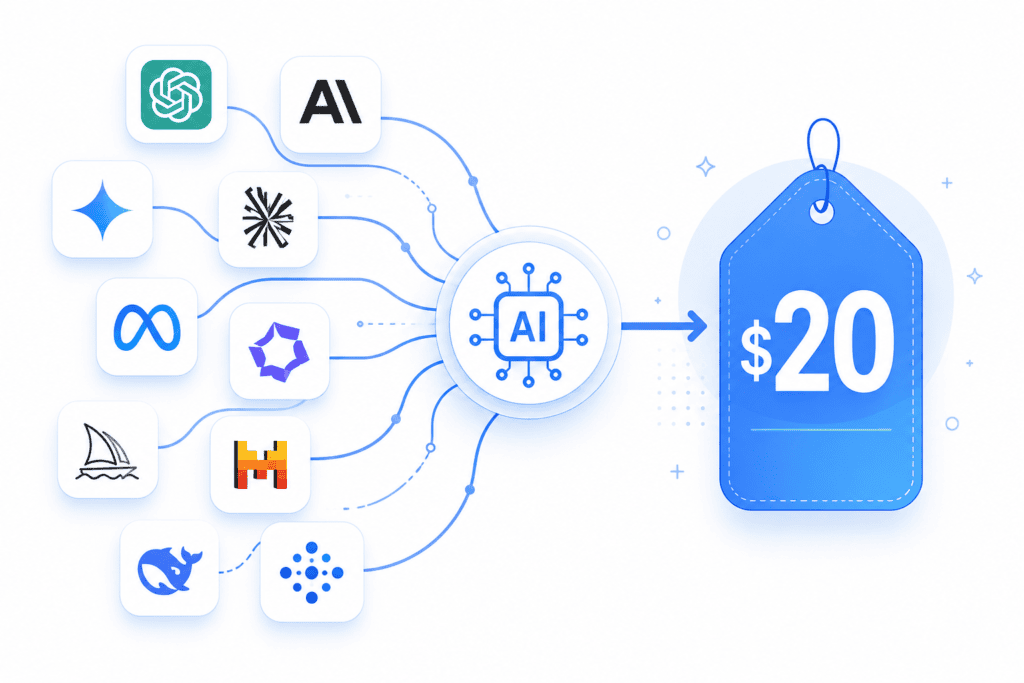
Every major AI provider has converged on roughly the same headline price. Industry pricing trackers confirm that ChatGPT Plus, Claude Pro, and Gemini Advanced (now Google AI Pro) all sit at essentially $20 a month, and Perplexity Pro matches that same $20 price point.
That consistency makes each individual subscription feel like a reasonable, almost trivial expense.
The problem is that “reasonable” doesn’t stay reasonable once you’re paying it four or five times over for tools that partially overlap in what they do.
Why professionals end up with more than one AI tool
Nobody sets out to run five AI subscriptions. It happens gradually:
- A developer adds Cursor or GitHub Copilot for in-editor coding help
- A marketer signs up for Midjourney for visuals
- A researcher adds Perplexity for cited web search
- Everyone keeps ChatGPT or Claude open for general writing and reasoning
- A team lead adds Gemini because it’s bundled with Google Workspace
If you’re just starting to build your AI stack, our AI tool subscription guide for beginners walks through how to pick your first one or two tools before overlap becomes a problem.
What most people overlook
What most people overlook: The monthly subscription total is usually the smallest line item. Context-switching time, duplicate work, and unmanaged API usage typically cost 2–4x more than the subscriptions themselves, according to enterprise SaaS cost research.
Zylo’s 2026 SaaS Management Index found that organizations spent an average of $1.2 million on AI-native apps, a 108% year-over-year increase, and that 78% of IT leaders reported unexpected charges tied to usage-based or AI pricing models. Individuals are experiencing a smaller-scale version of the exact same problem.
2026 Market Trends: Why AI Pricing Is Shifting
The subsidized-pricing era is ending
Industry analysts have flagged that today’s consumer AI pricing doesn’t reflect the true cost of running these models. One widely-cited estimate put OpenAI’s 2024 operating losses at roughly $5 billion against about $3.7 billion in revenue — a gap that venture funding has covered, not sustainable unit economics.
That gap matters because it explains why prices are creeping upward through side doors: usage caps, tiered models, and premium add-ons, rather than one dramatic price hike.
Reasoning models cost more to run
More capable “thinking” models use dramatically more compute per response. Analysts have noted that OpenAI’s reasoning models can use 10 to 100 times more compute per query than a standard response, and that Anthropic’s extended-thinking Claude models follow a similar pattern. As users lean on these stronger modes for everyday tasks, the real cost per conversation keeps climbing even while headline subscription prices stay flat.
Usage-based billing is spreading fast
2026 has already seen a major shift away from flat, predictable pricing. GitHub Copilot, for example, moved to AI-credit billing on June 1, 2026, where Pro costs $10/month for $15 worth of usage credits. Once you exceed the included allotment, overages bill like a raw API invoice.
This mirrors a broader shift Zylo has tracked across the SaaS market, wherehybrid pricing models combining subscription fees with usage- or value-based charges now appear in roughly 31% of AI vendor contracts.
Enterprise pricing already reveals where consumer pricing is headed
Enterprise AI tiers show what “real” pricing looks like once subsidies are stripped away. Microsoft Copilot for enterprise customers is priced at $30 per user per month, and only if the buyer already holds a Microsoft 365 license — meaning the effective cost is considerably higher.
Key 2026 pricing snapshot
Most flagship AI subscriptions still cluster around $20/month — ChatGPT Plus, Claude Pro, and Google AI Pro among them — while coding and creative tools range from $10 to $200 depending on usage tier. Pricing structures are shifting faster than the sticker prices are, though, as usage credits and tiered access quietly change what that $20 actually buys you.
For the full, current price table across all 12 major AI plans — including budget tiers, power-user tiers, and bundled alternatives — see our complete 2026 AI subscription pricing comparison.
Detailed Cost Breakdown: What You’re Really Paying
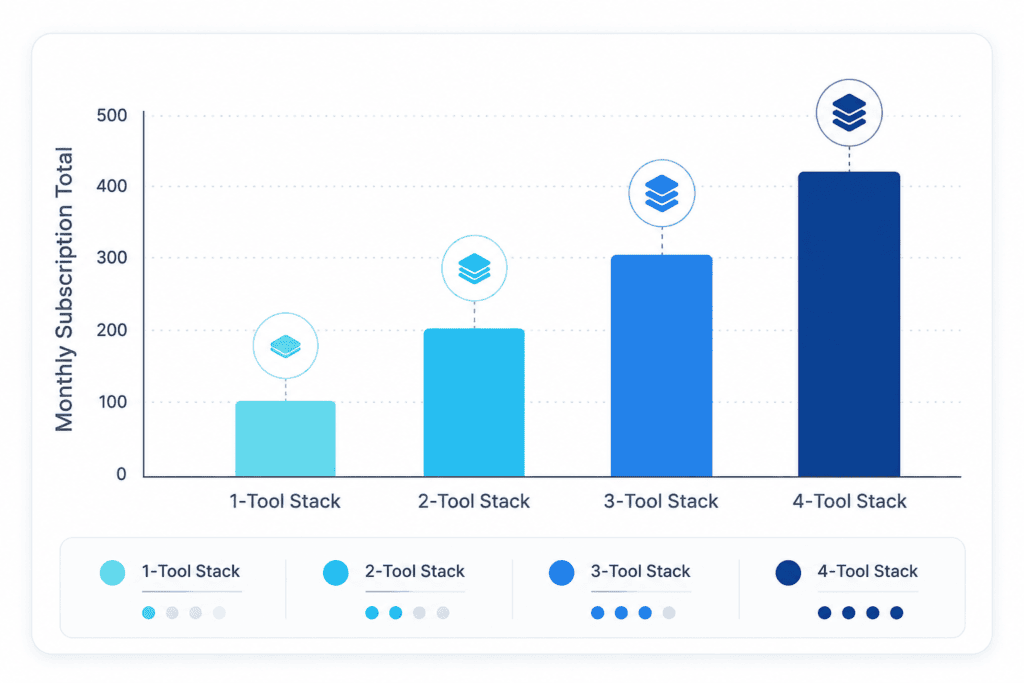
A typical 4-tool stack — chatbot, research assistant, coding tool, and image generator — runs $70–$110 a month, or roughly $1,080 a year for a single power user. A four-person team running the same stack per person crosses $4,000 a year before a single API call is made.
We’ve broken the full monthly and annual math down tool-by-tool, plan-by-plan, in our cheapest AI subscription comparison — including where the budget tiers actually save money and where they fall short.
Where the real spend hides
Zylo’s benchmark data shows this pattern scaling at the enterprise level too. Annual SaaS spend rose 8% while the total number of applications stayed effectively flat — meaning the growth is coming from pricing mechanics, not new tool sprawl. The same forces apply whether you’re managing one seat or one thousand.
The Hidden Costs Beyond the Monthly Bill
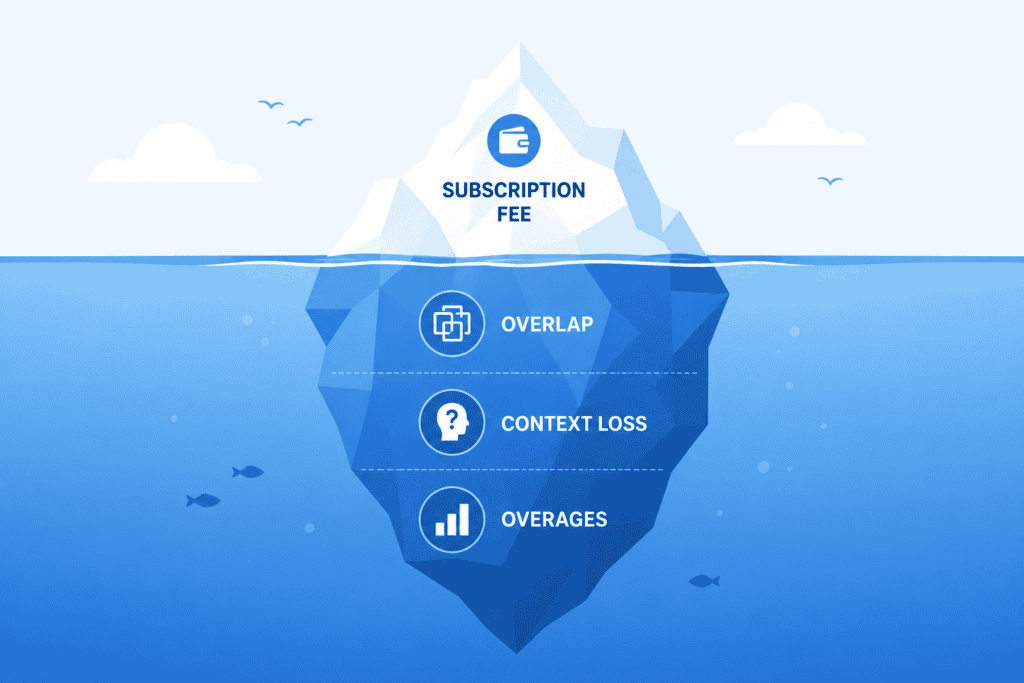
The subscription fee is the visible cost. Here’s what sits underneath it.
1. Feature overlap you’re paying for twice
Most general-purpose AI subscriptions now include overlapping capabilities: chat, coding help, image generation, and document analysis. Paying for two or three of them means paying multiple times for largely the same core functionality.
2. Context loss between tools
Every time you copy a conversation from one AI tool into another, you lose the model’s memory of your project, your tone preferences, and your prior instructions. You end up re-explaining context that a single, unified thread would have retained.
3. Duplicate billing across teams
Without centralized tracking, two people on the same team often subscribe to the same tool independently — sometimes on personal cards, sometimes on company cards — creating invisible duplicate spend.
4. Idle or underused licenses
Zylo’s research found AI capabilities frequently sit idle or underused because of limited enablement or unclear ROI tracking. A $20/month seat that’s opened twice a month isn’t a $20 tool — it’s a $10-per-use tool with a subscription wrapper.
5. Usage-based overage shocks
One widely-shared example from the GitHub Copilot billing shift illustrates this well: under the old flat-rate system a user’s bill was $28, but under usage-based billing the same usage pattern would have cost roughly $700 once metered properly.
Key Takeaway: Add up feature overlap, idle licenses, and overage risk, and the “hidden” layer of AI subscription cost is often larger than the subscription line item itself.
Comparison of Popular AI Tools (2026 Pricing)
Feature overlap table
| Feature | ChatGPT | Claude | Gemini | Perplexity | Cursor/Copilot |
|---|---|---|---|---|---|
| General chat/writing | ✅ | ✅ | ✅ | ✅ (cited) | ❌ |
| Code generation | ✅ | ✅ | ✅ | Limited | ✅ (specialized) |
| Image generation | ✅ | ❌ | ✅ | ❌ | ❌ |
| Web-cited research | Limited | Limited | ✅ | ✅ (core feature) | ❌ |
| Long-context documents | ✅ | ✅ | ✅ (1M tokens) | Limited | N/A |
| IDE integration | Via plugins | Via Claude Code | Via plugins | ❌ | ✅ (native) |
Cost vs. value: the short version
Not every $20/month tool delivers equal value. Perplexity Pro and Cursor/Copilot score well because they solve genuinely distinct problems with low overlap risk. ChatGPT Plus and Claude Pro, by contrast, carry high overlap risk with each other — you’re often paying twice for the same general-purpose chat capability.
For a full breakdown of which providers deliver the strongest value at each price tier, see which AI companies offer the best value for money.
Separate subscriptions vs. unified platform
| Approach | Monthly Cost | Context Retention | Admin Overhead |
|---|---|---|---|
| 4 separate subscriptions | $70–$110 | None between tools | High — 4 logins, 4 invoices |
| Unified AI platform (e.g., Aizolo) | Single flat fee | Shared context across models | Low — one login, one invoice |
Expert Insight: Perplexity and dedicated coding tools have genuinely low overlap with general chatbots — they solve different problems. The real waste is almost always in running two or more general-purpose chatbots side by side.
Subscription Overlap: Paying Twice for the Same Thing
The overlap audit most people never do
Ask yourself honestly: in the last 30 days, did you use ChatGPT and Claude for genuinely different tasks — or did you open whichever tab was closest and use them interchangeably?
If it’s the second answer, you’re not running two tools. You’re running one tool twice, at double the price.
A simple overlap test
- List every AI subscription you or your team pays for
- Tag each one by its primary use case (writing, code, image, research, video)
- Flag any two tools sharing the same primary tag
- Cancel or consolidate the weaker performer in each overlapping pair
Mini scenario: the marketing team
A 6-person marketing team had ChatGPT Plus (3 seats), Claude Pro (2 seats), and Midjourney (1 seat). An audit found the ChatGPT and Claude seats were used for nearly identical drafting tasks.
Consolidating to one general chatbot and keeping Midjourney separate cut the team’s AI spend by roughly 40% with no measurable drop in output quality.
This kind of overlap isn’t limited to AI-vs-AI stacking — the same audit logic applies to AI tools replacing standalone SaaS. See our full AI subscription savings vs. individual SaaS tools breakdown for realistic replacement percentages.
Workflow Inefficiencies and Context Switching
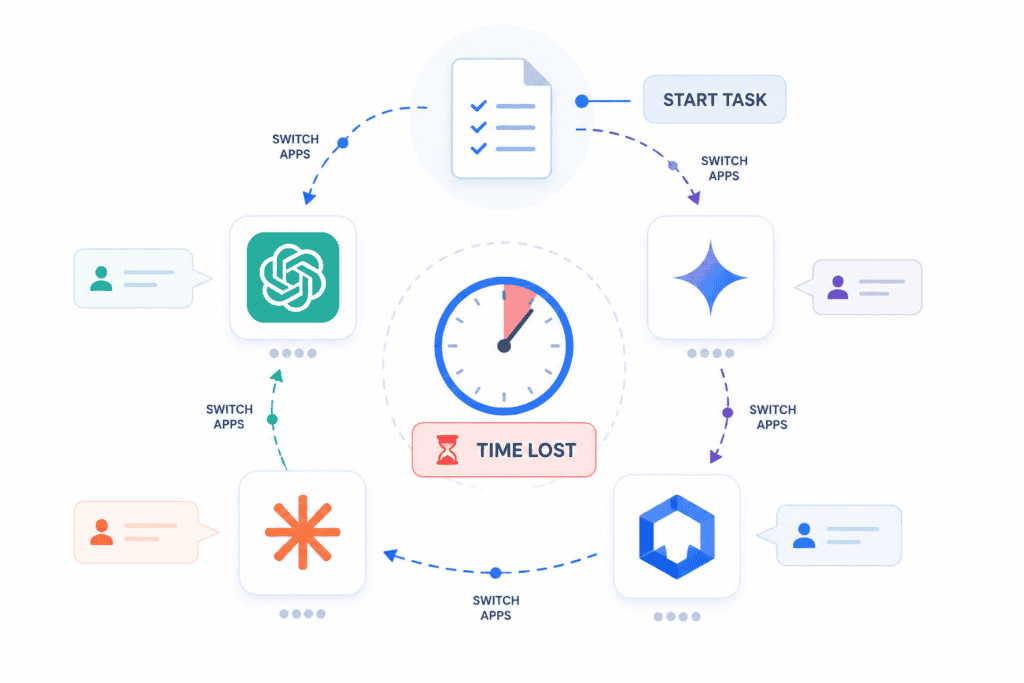
The real cost of tab-hopping
Every switch between AI tools carries a re-orientation cost: re-pasting context, re-explaining tone or formatting preferences, and re-checking which tool gave which answer.
Cognitive science research on task-switching consistently shows that context switches carry a measurable time and error cost — even small interruptions reduce the quality of the work that follows.
A realistic daily workflow breakdown
| Task | Tool Used | Switching Cost |
|---|---|---|
| Draft blog outline | ChatGPT | — |
| Fact-check a claim | Perplexity | Re-paste context |
| Polish final copy | Claude | Re-paste context again |
| Generate header image | Midjourney | New tab, new prompt language |
Four tools, four separate context resets, for one piece of content.
Checklist: signs your AI workflow is fragmented
- [ ] You regularly copy-paste the same background info into multiple tools
- [ ] You’ve lost track of which tool a specific answer came from
- [ ] You keep 4+ AI tabs open “just in case”
- [ ] Your team has no shared record of AI-assisted work
- [ ] You’ve paid for a tool you used fewer than 5 times last month
Business, Developer, and Enterprise Costs
Business, Developer, and Enterprise Costs
Subscription overlap isn’t just an individual problem — it scales with headcount. A four-person startup team running the same 4-tool stack per person crosses $4,000 a year before a single API call is made, and enterprise contracts add integration, training, and support costs on top of the visible subscription line.
For the full team-by-team math — freelancer, startup, and marketing-team examples with before/after consolidation numbers — see our AI subscription savings vs. individual SaaS tools breakdown.
Security and Compliance Costs
Shadow AI is a real financial risk
When employees expense AI tools individually rather than through procurement, IT and security teams lose visibility. Zylo describes this pattern directly: tools get purchased outside of procurement, disconnected from centralized license management, and lacking usage governance or security review.
What this costs in practice
- Data exposure risk — sensitive prompts entered into unapproved tools
- Compliance gaps — no audit trail for regulated industries (finance, healthcare, legal)
- Duplicate security reviews — every new tool needs its own vetting process
- Incident response complexity — more tools mean more potential breach surfaces
Pros and cons of a consolidated AI stack for security
Pros:
- Single point of access control
- Centralized audit logs
- Easier compliance documentation
- Fewer vendor risk assessments
Cons:
- Vendor lock-in risk if the platform lacks model flexibility
- Requires upfront migration effort
- Team retraining on a new interface
API Costs: The Hidden Multiplier
Why API costs sneak up on teams
Subscription pricing is predictable. API pricing is not. As usage scales, costs compound in ways most teams don’t model in advance.
MindStudio’s analysis of enterprise AI spending put this plainly: a workflow that costs $50 a month at 1,000 runs can become $5,000 a month at 100,000 runs — a jump many businesses never planned for when they first adopted the tool.
API cost triggers to watch
| Trigger | Cost Impact |
|---|---|
| Switching to a reasoning/thinking model | 10–100x compute per query |
| Scaling from pilot to production | Costs scale linearly (or worse) with volume |
| Embedded AI features in other SaaS tools | Marked-up pricing on top of raw API cost |
| No usage caps or alerts | Silent overage accumulation |
Expert Tip
Expert Tip: Route simple tasks (formatting, basic Q&A, classification) to smaller, cheaper models and reserve frontier models for genuinely complex reasoning. Analysts estimate this kind of routing strategy can cut AI costs by 40–60% with no visible quality loss.
Productivity and Psychological Costs
Subscription fatigue is a documented phenomenon
Managing five logins, five billing cycles, and five sets of usage limits creates a low-grade cognitive load that compounds over weeks and months. This mirrors “subscription fatigue” seen across the broader SaaS and streaming markets, where consumers report feeling overwhelmed by the sheer number of recurring payments they track.
The decision fatigue tax
Every task now starts with a small, invisible decision: which AI tool should I use for this? Multiply that decision by dozens of tasks a day, and the mental overhead becomes a real, if unmeasured, productivity cost.
Signs of AI subscription fatigue
- Forgetting which tools you’re actively paying for
- Renewing a subscription out of habit rather than active use
- Feeling anxious about “wasting” a subscription you rarely open
- Avoiding cancellation because comparing alternatives feels like more work than it’s worth
Key Takeaway: Psychological cost doesn’t show up on an invoice, but it shows up in decision quality, output speed, and how often a team defaults to “good enough” instead of comparing tools properly.
Financial Examples and ROI Calculations
Example 1: Freelancer
- Stack: ChatGPT Plus + Claude Pro + Midjourney = $50/month
- Annual cost: $600
- Usage overlap: ChatGPT and Claude both used for client copywriting
- Potential savings from consolidation: ~$240/year (cutting one general chatbot)
Example 2: 10-person agency
- Stack: 10x ChatGPT Plus + 5x Claude Pro + 3x Midjourney + 2x Cursor = $370/month
- Annual cost: $4,440
- Overlap identified: 5 of the ChatGPT seats duplicate Claude Pro use cases
- Potential savings from consolidation: ~$1,200/year
Example 3: 50-person enterprise team
- Stack: Mixed chatbot licenses + coding tools + embedded AI features across SaaS tools
- Estimated annual AI-native spend: Zylo’s index puts average organizational AI-native spend at $1.2 million annually, though this scales heavily with company size and use case.
- ROI driver: McKinsey research cited in industry cost analysis found companies using AI effectively see efficiency gains of 20 to 30 percent — but only when usage is tracked and tied to specific outcomes.
Simple ROI framework
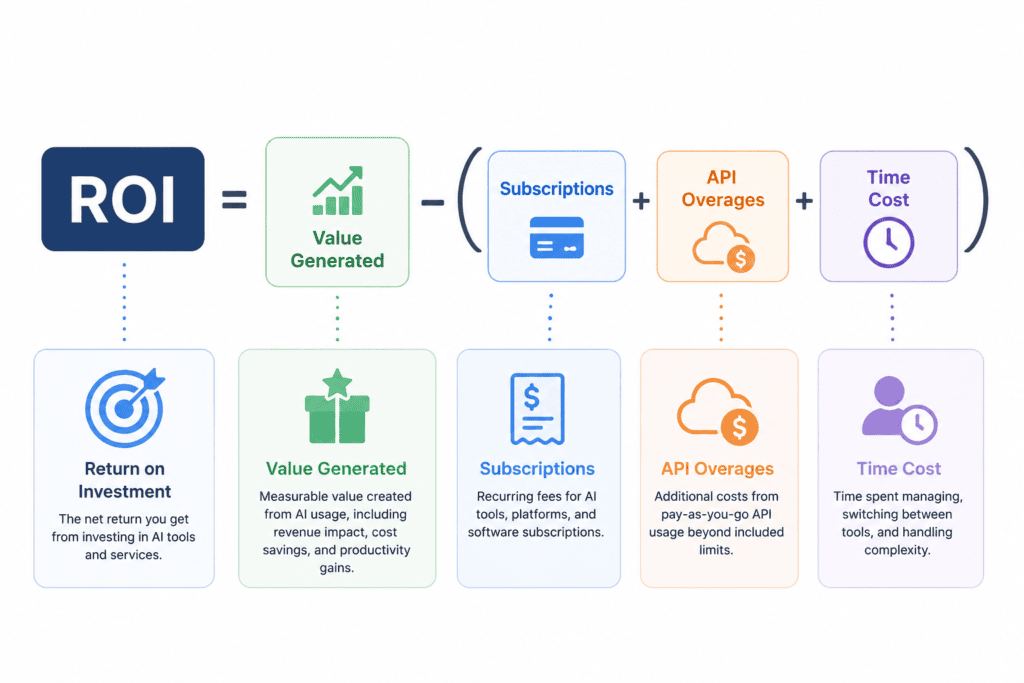
ROI = (Value Generated − Total AI Cost) / Total AI Cost

Where Total AI Cost = Subscriptions + API Overages +
                       Admin Time + Context-Switching Time
Most teams only calculate the numerator (value) against the subscription price — leaving out API overages and time costs, which inflates perceived ROI.
Real-World Case Study
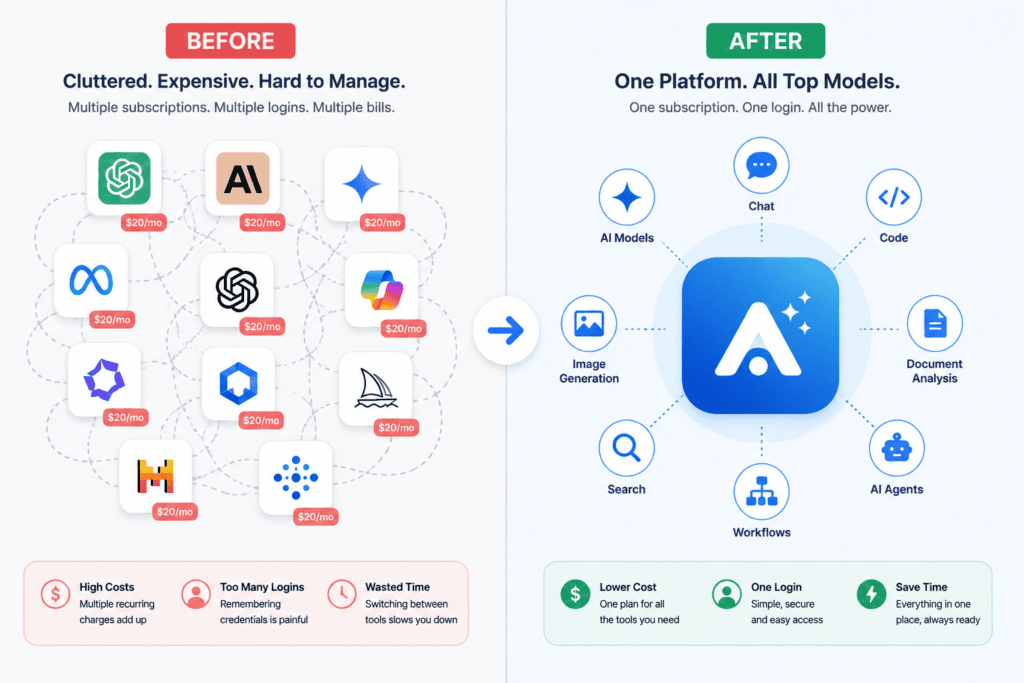
Scenario: A 12-person content and marketing agency
Before: The agency ran ChatGPT Plus for every team member ($240/mo), Claude Pro for the 4-person editorial team ($80/mo), Midjourney for 2 designers ($20–$60/mo), and Perplexity Pro for 3 researchers ($60/mo). Total: ~$420–$460/month, or roughly $5,000–$5,500/year.
The audit: A quarterly spend review found:
- 6 of 12 ChatGPT seats had fewer than 10 logins in the previous month
- The editorial team’s Claude usage overlapped almost entirely with ChatGPT tasks
- Perplexity was the only tool with consistently high, distinct usage
After consolidation: The agency moved general writing and editing to a single shared platform, kept Perplexity separate for its distinct research function, and kept Midjourney for design. Reported result: spend dropped by roughly 35%, with editorial turnaround times improving because writers stopped bouncing between two overlapping chatbots.
What most people overlook: The case study savings didn’t come from finding a cheaper tool. They came from discovering that half the “different” tools were being used for the exact same task.
Best Practices to Cut AI Subscription Costs
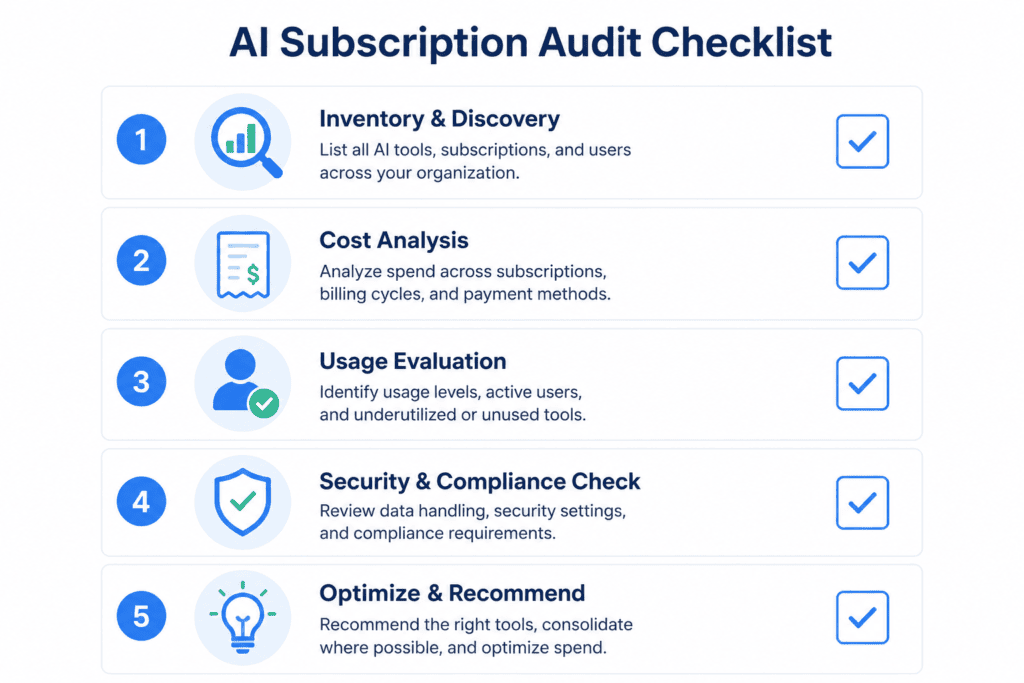
Step-by-step cost audit
- List every AI tool currently expensed by you or your team
- Tag each tool by primary function (chat, code, image, video, research)
- Pull usage logs where available — logins, messages sent, credits used
- Flag tools with under 30% weekly active usage
- Identify true overlaps — two tools solving the same problem
- Consolidate or cancel the weaker-performing overlap
- Set a recurring quarterly review — AI pricing changes fast in 2026
Checklist: is a tool worth keeping?
- [ ] Used at least weekly by the person paying for it
- [ ] Solves a problem no other tool in the stack solves
- [ ] Cost is known and predictable (not open-ended usage billing)
- [ ] Has a clear owner accountable for the subscription
- [ ] Was reviewed in the last 90 days
Pros and cons: separate tools vs. unified platform
Separate best-in-class tools
- ✅ Access to each provider’s absolute newest models first
- ✅ No dependency on a single vendor’s roadmap
- ❌ Multiple invoices, logins, and context resets
- ❌ Higher total monthly cost
Unified AI platform
- ✅ Single subscription, single context, lower total cost
- ✅ Easier budgeting and admin
- ❌ Slight lag before the newest individual models are added
- ❌ Requires trusting one vendor’s infrastructure
Expert Recommendations
- Audit before you subscribe to anything new. Most stacks grow by accident, one “just try it” signup at a time.
- Match model capability to task complexity. Not every task needs a frontier reasoning model — this is one of the biggest cost levers available, per MindStudio’s enterprise cost analysis.
- Track usage, not just cost. A $20 tool used twice a month is a worse deal than a $30 tool used daily.
- Separate genuinely distinct tools from overlapping ones. Research tools like Perplexity and coding tools like Cursor rarely overlap with general chatbots — keep those. Multiple general chatbots almost always overlap — consolidate those.
- Consider a unified platform for the overlapping layer. Where multiple subscriptions exist purely to access “a good general-purpose AI,” a platform like Aizolo that centralizes model access under one subscription can remove the overlap cost without losing capability — while purpose-built tools for coding, image, or video can stay separate where they add distinct value.
Once you’ve run this audit, compare your remaining shortlist against our cheapest AI subscription guide to make sure you’re not overpaying for whatever you decide to keep.
Frequently Asked Questions
How much does the average person spend on AI subscriptions in 2026?
Power users typically spend $70–$110 a month across three to five overlapping AI subscriptions, according to current 2026 pricing data across ChatGPT, Claude, Gemini, Perplexity, and coding tools.
Why do AI subscriptions all cost around $20 a month?
Providers have converged on roughly the same consumer price point — ChatGPT Plus, Claude Pro, and Gemini Advanced are all priced at approximately $20/month — largely because that price has proven to be the market’s accepted entry point for flagship model access.
What is the biggest hidden cost of multiple AI subscriptions?
Feature overlap. Running two or more general-purpose chatbots for the same tasks means paying twice for functionally identical capability, compounded by the time cost of switching context between them.
Is it cheaper to use one AI platform instead of several?
Usually, yes — specifically for the overlapping “general assistant” layer of your stack. Distinct-purpose tools (dedicated coding assistants, dedicated research tools) are worth keeping separate since they solve problems a general chatbot doesn’t.
How do I know if I’m overpaying for AI tools?
Run a 30-day usage audit: list every AI subscription, tag its primary use case, and flag any two tools sharing the same tag. If usage logs show under 30% weekly activity for a tool, it’s a strong cancellation candidate.
Are API costs really more expensive than subscriptions?
They can scale far higher. Analysts note that a workflow costing $50/month at low volume can reach $5,000/month once usage scales to 100,000 runs — a jump many teams don’t anticipate.
Will AI subscription prices go up in 2026 and 2027?
Multiple industry analyses point that direction. Pressure is building from the shift toward for-profit corporate structures, investor expectations after major funding rounds, and the rising compute cost of newer reasoning models — though most current increases are appearing as usage caps and tiered access rather than headline price hikes.
Does GitHub Copilot’s usage-based billing change affect cost planning?
Yes, significantly. Since June 1, 2026, Copilot Pro costs $10/month for $15 worth of AI credits, and heavier usage bills like a metered API rather than a flat fee — a real shift teams need to model into budgets.
What’s the difference between subscription overlap and legitimate multi-tool use?
Legitimate multi-tool use means each tool solves a distinct problem — for example, a coding assistant and a research tool. Overlap means two tools solve the same problem, like running ChatGPT and Claude for identical drafting tasks.
Does a unified AI platform mean losing access to the best individual models?
Not necessarily. Platforms built around multi-model access, like Aizolo, aim to give users a way to reach multiple underlying models through one subscription — reducing the overlap cost without forcing a choice between providers.
Final Verdict
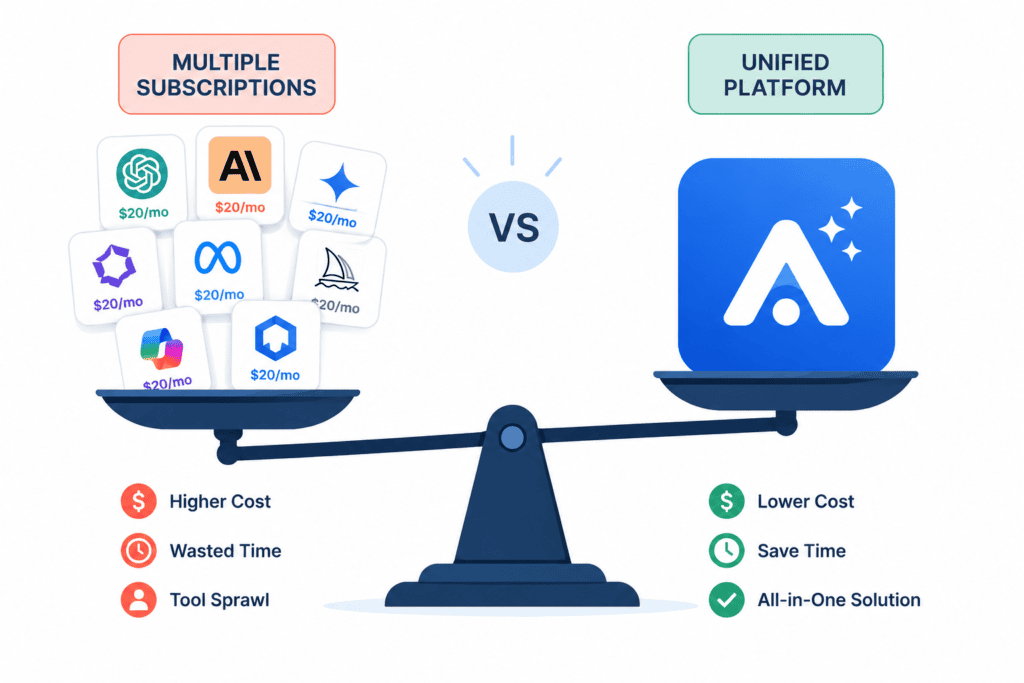
Multiple AI subscriptions aren’t inherently wasteful. Unaudited multiple AI subscriptions are.
The data is consistent across every source examined for this article: individuals and businesses are spending significantly more than the visible subscription total once overlap, context-switching time, and usage-based overages are counted.
For most individuals and small teams, the fix isn’t dramatic. It’s a quarterly audit, a willingness to cancel the weaker tool in any overlapping pair, and — for the general-purpose “chat and reasoning” layer specifically — genuine consideration of a unified platform that removes duplicate spend without removing capability.
Conclusion
The hidden cost of multiple AI subscriptions in 2026 isn’t a mystery once you break it down: it’s overlap, fragmented context, unmanaged usage billing, and the quiet productivity tax of switching between tools that mostly do the same thing.
None of that shows up clearly on a single invoice. That’s exactly why it goes unmanaged for so long.
Start with the audit checklist in this article. List every tool. Tag its purpose. Flag the overlaps. You’ll likely find, as most teams do, that the real savings were never about finding a cheaper AI tool — they were about noticing you didn’t need two of the same one.
Author Bio
Jeevesh Tripathi is an AI industry researcher and content strategist at Aizolo, focused on AI tools, SaaS platform economics, and enterprise software adoption trends. His writing centers on translating complex AI pricing models and productivity technology into practical guidance for professionals, startups, and enterprise buyers navigating an increasingly fragmented AI tool landscape. Contact: jeevesh@aizolo.com