
If you want to explore multiple AI models without constantly switching between platforms, AiZolo brings different models together in one workspace. You can compare responses, test models for different tasks, and keep your workflow organized from one place—making it easier to find the right AI model for each project.
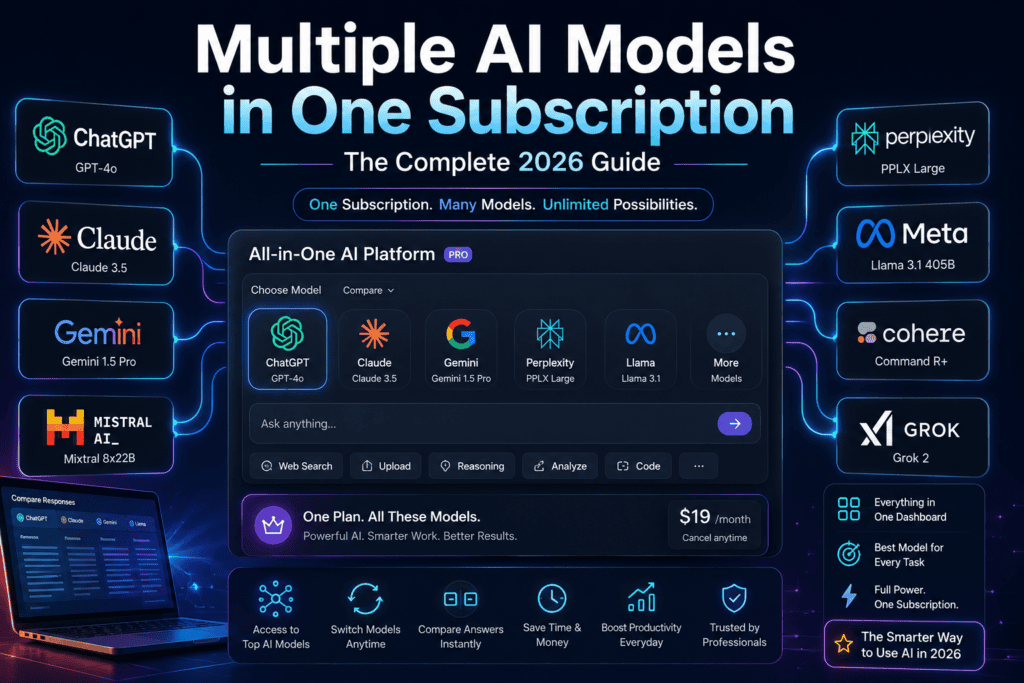
Table of Contents
Quick Answer
If you only read one section, read this one.
Yes, you can access multiple AI models in one subscription. The best-known options in 2026 are Perplexity Pro ($20/month) for research-heavy work with model switching, Poe (from $4.99/month, most commonly $19.99/month) for the widest catalog of models, and Merlin AI ($19–29/month) for a browser-based assistant that layers GPT, Claude, and Gemini onto any website. Each swaps one AI company’s $20/month lock-in for a single bill that touches several.
The trade-off is real, though: these platforms almost never give you unlimited native access to every flagship model. They ration usage through points, credits, or fair-use caps, and they’re usually a step behind the official apps on brand-new features (voice mode, native agents, deep product integrations).
For most people who genuinely bounce between two or three AI tools weekly, a multi-model subscription saves money. For someone who lives inside one model’s ecosystem daily, a direct subscription is often still the better deal.
We’ll walk through the full reasoning, the real numbers, and which platform fits which kind of user — including who should skip aggregators entirely.
Who This Guide Is For
This guide is for you if:
- You currently pay for two or more AI subscriptions (say, ChatGPT Plus and Claude Pro) and want to know if consolidating saves money.
- You’re AI-curious and want to try GPT, Claude, Gemini, and others before committing to one.
- You’re a student, freelancer, or small business owner trying to keep software costs predictable.
- You want to compare answers from multiple models side by side, rather than trusting a single AI’s output.
It’s not the right guide if you’re building a product on top of AI models — for that, you want direct API access from each provider (we cover why in the developer section), not a consumer chat subscription.
What Is a Multi-Model AI Platform?
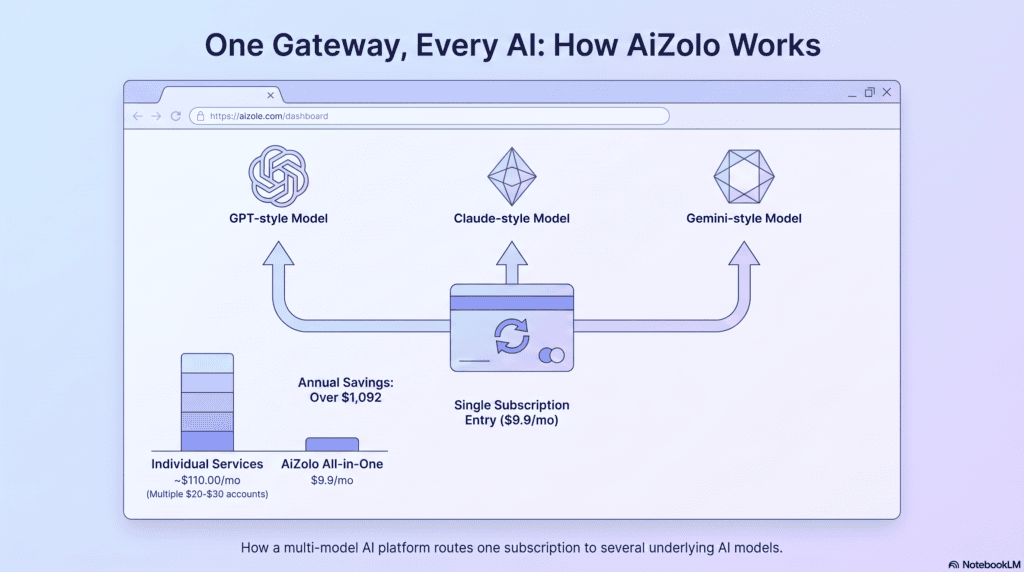
A multi-model AI platform (sometimes called an AI aggregator or all-in-one AI platform) is a single product — a website, browser extension, or app — that gives you access to AI models from more than one company under one login and one bill.
Instead of maintaining separate accounts for OpenAI’s ChatGPT, Anthropic’s Claude, and Google’s Gemini, you open one interface and pick which model answers your question from a dropdown or model selector. Some platforms let you run the same prompt across several models simultaneously so you can compare the answers side by side.
Under the hood, these platforms work in one of three ways:
- Licensed access at scale. The platform pays each AI provider (OpenAI, Anthropic, Google, xAI, Mistral, DeepSeek, and others) for API access, then resells that access to you, wrapped in a simpler interface and a flat monthly price.
- Routing/orchestration. Some platforms (Perplexity’s Model Council is a good example) send your question to several models at once and synthesize the differences into one answer.
- Bring-your-own-key (BYOK). A smaller category of tools (desktop apps like TypingMind or browser tools like ChatHub) doesn’t resell model access at all — you plug in your own OpenAI, Anthropic, and Google API keys, and the tool is just a shared interface. This suits developers who want a unified chat UI without paying an aggregator’s markup, but it means you’re billed by usage, not a flat subscription.
Understanding which model your aggregator uses matters, because it changes both the economics and the honesty of the “unlimited” claims you’ll see in marketing copy.
Why People Want One AI Subscription
Three forces are pushing people toward consolidated AI subscriptions in 2026:
1. Subscription fatigue is real. The standard tier for ChatGPT, Claude, and Google’s Gemini plans (branded Google AI Pro) has converged on roughly the same price point — ChatGPT Plus, Claude Pro, Gemini AI Pro, and Perplexity Pro all cost $19.99-$20 per month with similar feature sets. Stack three of those and you’re at $60/month before you’ve paid for a single image generator, coding tool, or voice assistant.
2. No model wins at everything. ChatGPT Plus tends to deliver the highest message volume per dollar, Claude Pro leads on coding and long-form writing, Google AI Pro offers the largest context window, and Grok-based plans focus on real-time social data — meaning a person who wants the best tool for each job naturally ends up wanting more than one model.
3. Model quality shifts fast. A model that’s the best coder this quarter might not be next quarter. Locking into one $20/month plan means betting on one company’s roadmap. A multi-model subscription hedges that bet.
Benefits and Drawbacks
Benefits
- Lower combined cost than paying for two or three direct subscriptions, in most realistic usage patterns.
- One login, one bill, one interface — less tab-switching, less password fatigue.
- Faster comparison shopping. You can test how GPT-style, Claude-style, and Gemini-style models each handle the same prompt without signing up for three trials.
- Access to models you wouldn’t otherwise pay for individually, including smaller or open-source models like DeepSeek or Llama variants that most people wouldn’t subscribe to on their own.
- A safety net against a single provider’s outage, rate limit, or policy change.
Drawbacks
- Usage caps are usually stricter than native limits. A native ChatGPT Plus subscription and a “GPT access” slice of an aggregator plan are not the same allowance — aggregators ration compute through credits or points that run out faster than most people expect.
- You’re often one step behind on new features. Native voice modes, canvas/artifact tools, memory features, and agent integrations tend to ship on the official app first, sometimes exclusively.
- “Unlimited” rarely means unlimited. Several platforms cap usage through an invisible fair-use ceiling — Merlin’s “unlimited” Pro plan runs on a fair-use credit system that reportedly caps around $100 of usage a month, and that cap shrinks if the plan was purchased at a discount.
- Data handling adds a middleman. Your prompt travels through the aggregator’s servers before it reaches OpenAI, Anthropic, or Google, which is an extra party with access to your data (more in the privacy section).
- Not built for production use. Most aggregators are chat interfaces, not development platforms — Poe is a chat aggregator, not an agent platform, and isn’t designed for deploying AI to customers or business operations.
How Multi-Model Platforms Actually Work
Every multi-model platform needs to answer three engineering and business questions, and the answers explain almost everything about how the product feels to use.
How is usage measured? Most platforms use a points or credits system rather than a simple message count, because different models cost the platform wildly different amounts to run. Poe grants flexible daily or monthly compute points that you spend across different models, and if you need more, you can purchase additional points.
That’s more transparent than it sounds — it means an expensive reasoning model burns through your monthly allotment faster than a lightweight chat model.
How current is the model list? Aggregators live or die on how quickly they add new models. Poe says new bots are added regularly, and when a company releases a new model, it’s typically added the same day. That’s a genuine advantage over waiting for a native app update, but it also means the “best” model in the lineup keeps changing — comparison articles (including this one) age quickly.
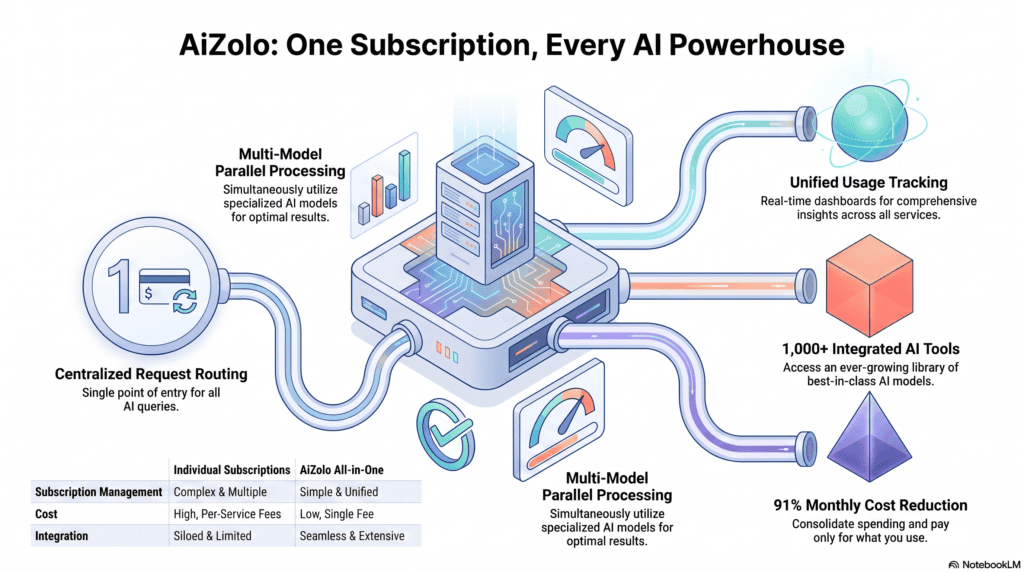
Where does synthesis happen? A few platforms go beyond “pick a model from a list” and actually blend answers. Perplexity’s approach is the most developed example: Max subscribers get Model Council, a feature that runs a query simultaneously across three frontier models and synthesizes an answer that shows where the models agree and diverge.
That’s meaningfully different from a simple model switcher, and it’s the clearest sign of where multi-model platforms are heading — treating models as a panel of experts rather than a single source of truth.
Multi-Model Platforms vs. Individual AI Subscriptions
Here’s the honest version of this comparison, not the marketing version.
| Individual Subscriptions (e.g., ChatGPT Plus + Claude Pro) | Multi-Model Platform (e.g., Poe, Perplexity Pro) | |
|---|---|---|
| Monthly cost for 2–3 models | $40–$60+ | $15–$25 typically |
| Usage limits | Provider-set, generally generous at $20/month | Points/credits — can feel tighter under heavy use |
| New feature access | First, often exclusive | Delayed, sometimes never (e.g., native voice mode) |
| Interface consistency | Different UI per provider | One consistent UI |
| Best for | Heavy daily use of 1 model | Regular use across 2+ models |
| Ecosystem perks | Deep integration (Docs, Gmail, IDE plugins) | Rarely matched |
| Data flow | Direct to the provider | Passes through an intermediary |
The practical rule most experienced users land on: if you’re a power-user of one model, going direct is usually cheaper and gets you the newest features first; if you’re switching between models regularly, a multi-model platform consolidates that into one subscription at a lower total cost.
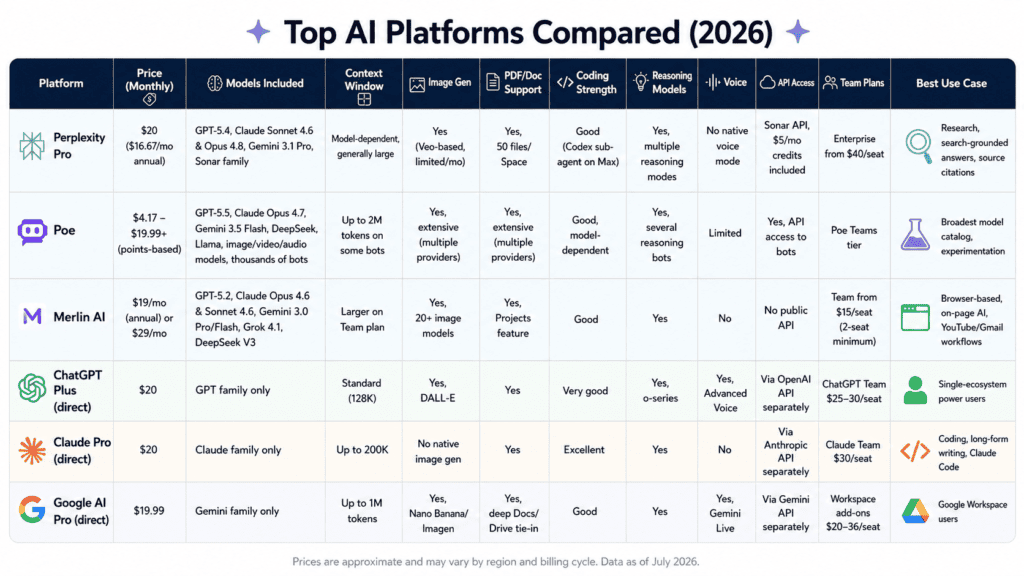
Full Comparison Table
Prices verified as of July 2, 2026. Always confirm current pricing on the platform’s own pricing page before subscribing.
| Platform | Price (Monthly) | Models Included | Context Window | Image Gen | PDF/Doc Support | Coding Strength | Reasoning Models | Voice | API Access | Team Plans | Best Use Case |
|---|---|---|---|---|---|---|---|---|---|---|---|
| Perplexity Pro | $20 ($16.67/mo annual) | GPT-5.4, Claude Sonnet 4.6 & Opus 4.8, Gemini 3.1 Pro, Sonar family | Model-dependent, generally large | Yes (Veo-based, limited/mo) | Yes, 50 files/Space | Good (Codex sub-agent on Max) | Yes, multiple reasoning modes | No native voice mode | Sonar API, $5/mo credits included | Enterprise from $40/seat | Research, search-grounded answers, source citations |
| Poe | $4.17–$19.99+ (points-based) | GPT-5.5, Claude Opus 4.7, Gemini 3.5 Flash, DeepSeek, Llama, image/video/audio models, thousands of bots | Up to 2M tokens on some bots | Yes, extensive (multiple providers) | Yes, per-bot limits | Good, model-dependent | Yes, several reasoning bots | Limited | Yes, API access to bots | Poe Teams tier | Broadest model catalog, experimentation |
| Merlin AI | $19/mo (annual) or $29/mo | GPT-5.2, Claude Opus 4.6 & Sonnet 4.6, Gemini 3.0 Pro/Flash, Grok 4.1, DeepSeek V3 | Larger on Team plan | Yes, 20+ image models | Yes, Projects feature | Good | Yes | No | No public API | Team from $15/seat (2-seat minimum) | Browser-based, on-page AI, YouTube/Gmail workflows |
| ChatGPT Plus (direct) | $20 | GPT family only | Standard (128K) | Yes, DALL-E | Yes | Very good | Yes, o-series | Yes, Advanced Voice | Via OpenAI API separately | ChatGPT Team $25–30/seat | Single-ecosystem power users |
| Claude Pro (direct) | $20 | Claude family only | Up to 200K | No native image gen | Yes | Excellent | Yes | No | Via Anthropic API separately | Claude Team $30/seat | Coding, long-form writing, Claude Code |
| Google AI Pro (direct) | $19.99 | Gemini family only | Up to 1M tokens | Yes, Nano Banana/Imagen | Yes, deep Docs/Drive tie-in | Good | Yes | Yes, Gemini Live | Via Gemini API separately | Workspace add-ons $20–36/seat | Google Workspace users |
Note: Poe’s pricing is points-based rather than a single flat number — plans start at $4.99/month with flexible daily or monthly compute points that can be topped up if needed, so effective cost varies with which models you use most.
Best Platforms for Multiple AI Models in One Subscription
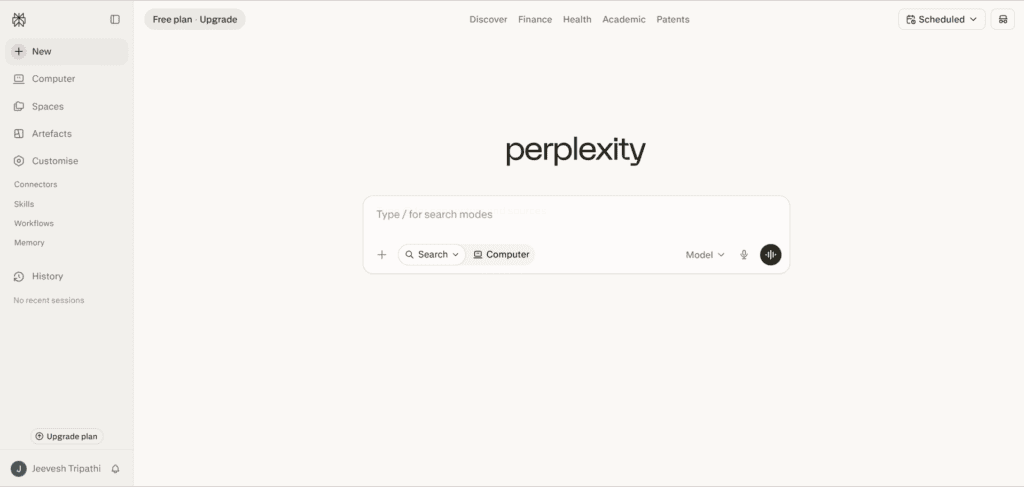
1. Perplexity Pro — Best for Research & Source-Backed Answers
Overview
Perplexity started as an AI-powered search engine and has grown into the most credible research-first multi-model platform. Its core promise is different from a pure chat aggregator: every answer is grounded in live web sources with inline citations, and you can choose which model does the synthesizing.
Supported Models
Pro subscribers can toggle between GPT-5.4, Claude Sonnet 4.6, Claude Opus 4.8, Gemini 3.1 Pro, Nemotron 3 Super, Kimi K2.5 Thinking, and Perplexity’s own Sonar family of models.
Features
Pro includes unlimited Pro Search, 20 Deep Research queries per day for long-form research reports with citations, 50 Labs queries per month for spreadsheets and mini-apps, 3 video generations per month, 50 file uploads per Space, and $5/month of Sonar API credits, plus Comet Plus for premium publisher content.
On the Max tier, Perplexity Computer orchestrates 19 different AI models as specialized sub-agents, automatically routing coding tasks to a coding-specialized sub-agent and research tasks to Sonar Pro, and Model Council dispatches a single query to three frontier models simultaneously, producing a synthesis output that surfaces agreement, disagreement, and unique insights.
Pricing
Perplexity Pro is $20/month or $200/year (about $16.67/month), a 17% discount for annual billing. Education Pro is available at 50% off the standard Pro price with SheerID academic verification. Max costs $200/month, and Enterprise tiers range from roughly $40 to $325 per seat.
Pros
- Every answer is source-cited by default — useful for anyone who needs to verify claims.
- Genuine model diversity from major frontier labs, not just Perplexity’s own model.
- Model Council (Max) is the most sophisticated “compare AI models” feature currently on the market.
- Same price as a single direct subscription.
Cons
- Deep Research access dropped sharply in early 2026, from hundreds of queries per day to roughly 20 per month — a meaningful downgrade for heavy researchers.
- Weaker for pure creative writing and long-form drafting than a dedicated writing-focused model.
- Model Council is Max-only ($200/month), out of reach for casual users.
Best For
Students, journalists, analysts, and knowledge workers who want AI answers they can verify, plus the flexibility to pick a specific model for specialized questions.
Limitations
Not built for extended creative writing sessions or agentic coding workflows the way a dedicated coding assistant is; the free tier is genuinely limited for daily research use.
Verdict: The best all-around pick if research quality and source-checking matter as much as raw chat flexibility to you.
Platform Rating: 4.5 / 5
2. Poe — Best for Model Variety & Experimentation
Overview
Poe, created by Quora co-founder Adam D’Angelo and launched in 2023, is a chatbot aggregator that lets you interact with multiple AI models — GPT, Claude, Gemini, and more — all in one interface. It has the widest model catalog of any platform in this guide, spanning text, image, video, and audio generation.
Supported Models
Poe gives access to GPT-5.5, Claude-Opus-4.7, Gemini-3.5-Flash, Nano-Banana-Pro, Veo-3.1, and thousands of other AI models, including open models like DeepSeek and Llama variants.
Features
New bots are typically added the same day a company releases a new model. You can chat with and compare multiple AI models within the same thread, and Poe supports custom bot-building, unlocking full context length for each bot — up to 2 million tokens on some models.
Pricing
Plans start at $4.17/month, with up to 8.3 million points per month on higher tiers. Most reviewers land on the standard $19.99/month subscription as the practical entry point for full model access, with a Poe Teams tier for organizations.
Pros
- The largest and fastest-updated model catalog of any aggregator.
- Multibot chat lets you compare several models’ answers in one thread.
- Custom bot creation and a creator monetization program.
- Consolidates comparing Claude on writing, GPT on reasoning, and Gemini on long context into one subscription, often at lower total cost than stacking individual subscriptions.
Cons
- Response latency is measurably slower through Poe than at each model’s native interface.
- Points/credits can run out faster than expected on heavier models, and unused credits don’t roll over.
- Some users report frustration with customer support responsiveness around refunds and cancellations — worth reading current reviews before committing to an annual plan.
- Mobile app trails the web version in features.
Best For
Anyone who wants to sample as many models as possible without juggling logins, or who values comparing multiple answers to the same prompt.
Limitations
Not built for deploying AI to customers or business operations — there’s no agent runtime or CRM/knowledge-base integration layer.
Verdict: The default choice if breadth of model access is your top priority.
Platform Rating: 4.2 / 5
3. Merlin AI — Best for Browser-Based, On-Page AI
Overview
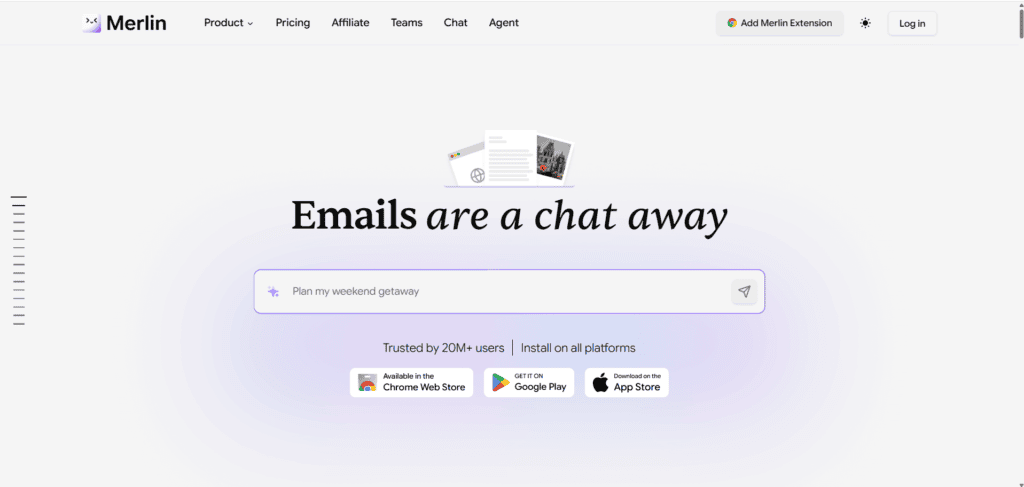
Merlin is different from Poe and Perplexity in one key way: it lives in your browser as an extension, not as a destination site. Press Ctrl/Cmd+M on any website — Gmail, YouTube, LinkedIn, Google Search — and a sidebar opens with AI assistance that can see the page you’re on.
Supported Models
One subscription bundles GPT-5.2, Claude Opus 4.6, Gemini 3.0, and 10+ other models, and Merlin specifically supports GPT-5.2, GPT-5.2 High Reasoning, Claude Opus 4.6, Claude Sonnet 4.6, Claude Haiku 4.5, Gemini 3.0 Pro, Gemini 3.0 Flash, Grok 4.1, Kimi K2.5 Thinking, GPT-5 Mini, and DeepSeek V3.
Features
Merlin generates YouTube video summaries, drafts and replies to emails in Gmail, writes and suggests LinkedIn and X posts, translates into 25+ languages, and generates images with 20+ image models. Projects let you upload PDFs or lecture notes to build reusable context, and a Crafts tool generates flowcharts and infographics from a text prompt.
Pricing
Merlin’s 2026 pricing is a Free plan, a Pro plan at $19/month (billed annually; $29/month billed monthly), and a Teams plan at $15 per seat/month with a 2-seat minimum. The free tier includes 102 queries per day.
Pros
- Genuinely useful on-page integration — no copy-pasting between tabs.
- Works in regions where some AI chatbots are restricted.
- Strong free tier for casual daily use.
- Cheaper than stacking ChatGPT Plus and Claude Pro individually.
Cons
- The “unlimited” Pro plan runs on an invisible fair-use credit system that reportedly caps around $100 of usage a month, and that cap shrinks proportionally if the plan was bought at a discount — hit it and your account pauses until the next billing cycle.
- No conversation organization features — you can’t create folders or easily search past chat history.
- Chrome-first; no native Safari, Firefox, or Edge extension, though the web app works in any browser.
- Requires broad website-access permissions as a browser extension, which some users are understandably cautious about.
Best For
Content creators, marketers, and students who want AI assistance woven directly into their everyday browsing — Gmail, YouTube, LinkedIn, and search — rather than a separate destination app.
Limitations
Not a good fit for teams needing predictable, always-on AI capacity, since the fair-use cap can pause access mid-cycle without warning.
Verdict: The strongest pick if your AI usage is scattered across everyday browsing rather than concentrated in long chat sessions.
Platform Rating: 4.0 / 5
Honorable Mention: You.com and BYOK Tools
You.com built its early reputation as a privacy-focused search engine with multi-AI model access to GPT-4, Claude, and Gemini for tasks ranging from writing assistance to code generation.
However, its public positioning has shifted significantly toward developer and enterprise infrastructure — its current pricing is largely usage-based and pay-as-you-go, aimed at grounding AI agents and RAG pipelines rather than serving as a consumer chat subscription, and much of its pricing is now quote-based, requiring direct sales contact.
If you’re a consumer looking for a straightforward multi-model chat subscription, treat You.com as a platform in transition rather than a like-for-like alternative to Poe or Perplexity right now — verify its current consumer offering directly before subscribing.
For developers specifically, bring-your-own-key (BYOK) tools like TypingMind and ChatHub are worth knowing about as a separate category: instead of paying an aggregator a markup, you connect your own API keys from OpenAI, Anthropic, and Google, and the tool is simply a shared chat interface.
This removes the aggregator’s usage caps entirely, but it also means you’re billed by token usage rather than a flat monthly fee — better suited to people already comfortable managing API costs.
Buying Guide & Decision Tree
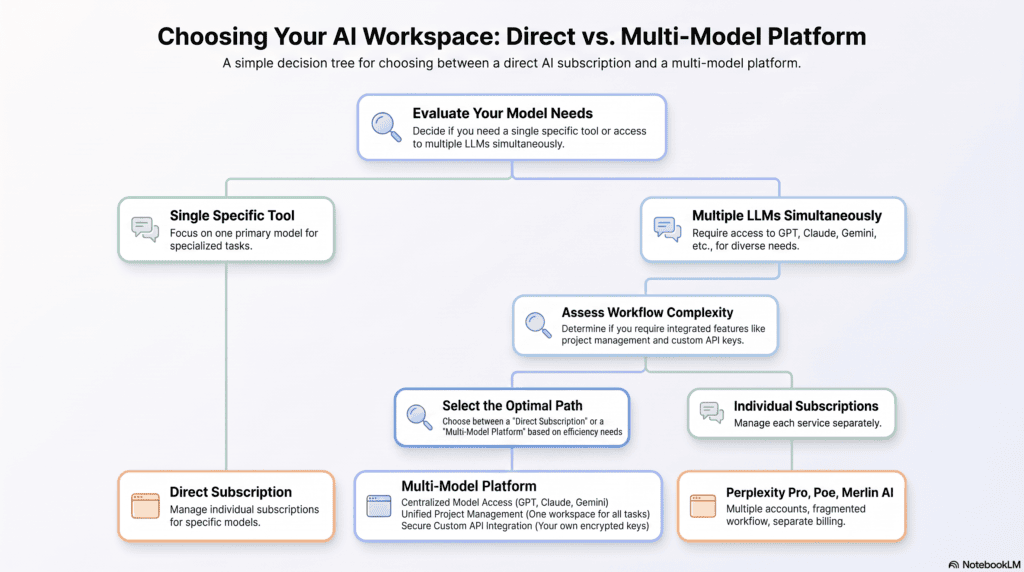
Use this simple decision tree before you subscribe to anything:
Step 1: How many AI models do you actually use in a typical week?
- Just one, heavily → Skip aggregators. A direct subscription (ChatGPT Plus, Claude Pro, or Google AI Pro) gives you the highest native usage limits and first access to new features.
- Two or three, occasionally → A multi-model platform will likely save you money.
Step 2: What’s your primary use case?
- Research, fact-checking, source citations → Perplexity Pro.
- Comparing model answers, trying new models fast, image/video generation variety → Poe.
- Everyday browsing, email, YouTube, on-page assistance → Merlin AI.
- Building a product or app with AI → Skip consumer subscriptions entirely; use direct provider APIs or a best ai api subscription services 2026 comparison instead.
Step 3: How much does “unlimited” actually matter to you?
- If you’re a genuinely heavy user (hundreds of messages daily on a demanding model), test the aggregator’s free tier first and track how fast you burn through the allotment before committing to an annual plan.
When One Subscription Is Not Enough
If your work depends on a single model’s most advanced capability — Claude’s coding performance in an IDE, ChatGPT’s native voice mode, or Gemini’s deep Google Workspace integration — an aggregator will feel like a downgrade, not an upgrade. Aggregators optimize for breadth, not for squeezing every feature out of one model.
When Direct Subscriptions Are Better
If you use one model daily for hours at a time — heavy coding sessions, long writing projects, or agentic workflows — the native $20/month plan’s usage ceiling is almost always higher than an aggregator’s equivalent slice, because the aggregator has to divide compute costs across every model in its catalog, not just one.
Why Some AI Aggregators Can’t Expose Every Feature
Native features like OpenAI’s Advanced Voice Mode, Claude’s Artifacts, or Gemini’s deep Gmail/Docs integration require direct engineering partnerships and platform-level access that a third-party aggregator simply doesn’t have. Expect aggregators to lag by weeks or months on flashy new features, if they ever ship them at all.
How Model Updates Affect Your Subscription
When a provider releases a new flagship model, aggregators typically add it within days, but your existing point/credit allotment doesn’t grow to match the new model’s higher compute cost. In practice, this means the “same” subscription can feel like it covers less as models get more capable and more expensive to run — something to watch for in your first two or three billing cycles after signing up.
Real Cost Analysis
Let’s run actual numbers using verified pricing.
Scenario: You currently want access to a GPT-style model, a Claude-style model, and a Gemini-style model.
| Approach | Monthly Cost | Annual Cost |
|---|---|---|
| Three direct subscriptions (ChatGPT Plus + Claude Pro + Google AI Pro) | $20 + $20 + $19.99 ≈ $60/month | ≈ $720/year |
| Perplexity Pro (annual) | ≈ $16.67/month | $200/year |
| Poe (standard tier) | ≈ $19.99/month | ≈ $240/year |
| Merlin AI (annual) | $19/month | $228/year |
At face value, that’s a savings of roughly $480–$520 per year by consolidating into one multi-model platform instead of three direct subscriptions.
The honest caveat: that comparison only holds if your usage fits inside the aggregator’s points or fair-use cap. Merlin’s Pro plan caps around $100 of usage-equivalent per month — for light-to-moderate users that’s plenty, but a genuinely heavy daily user could hit the ceiling and either get throttled or need to buy top-up credits, eroding some of the savings. The same logic applies to Poe’s points system.
Long-term value: for most individuals — casual-to-moderate users who touch two or three models a week rather than living inside one model for hours daily — a multi-model subscription is the better long-term financial decision. For heavy single-model power users, especially developers and daily coders, direct subscriptions (or even direct API billing) usually win on both cost-per-use and feature access.
Privacy Considerations
Every multi-model platform adds an intermediary between you and the AI provider. That has real implications worth understanding before you paste anything sensitive into a chat box:
- Your data passes through the aggregator’s servers first. Poe notes that messages travel to the underlying AI companies (like OpenAI) to generate responses, and explicitly advises against sending banking information or passwords in chat.
- Retention and training policies vary by platform, and are often less detailed publicly than the retention policies published directly by OpenAI, Anthropic, or Google. If you handle regulated data (health records, legal documents, financial statements), read the aggregator’s specific data-handling policy — don’t assume it matches the underlying model provider’s policy.
- Browser-extension tools carry an extra consideration.Extension-based assistants like Merlin require broad permissions to read content on the websites you visit, which is a meaningfully different privacy posture than a standalone chat app you have to actively open.
- Enterprise-grade options exist. Team-tier plans on some platforms add SOC2, GDPR, and ISO 27001 compliance features not present on individual plans — if privacy compliance matters for your organization, don’t default to the consumer tier.
The practical rule: treat any multi-model aggregator the way you’d treat a new SaaS vendor — read the privacy policy, avoid pasting anything you wouldn’t want stored twice, and use opt-out settings for model training where available.
Enterprise, Student, and Developer Recommendations
Enterprise Considerations
Teams evaluating a multi-model platform should weigh predictability over sticker price. Fair-use credit caps that quietly pause an individual account are a bigger problem at company scale — a paused account mid-project is a business risk, not just an inconvenience. Look specifically for:
- Published (not “fair use”) usage limits per seat.
- SOC 2, ISO 27001, or GDPR compliance documentation.
- Centralized billing and admin dashboards.
- SSO/SCIM support for larger teams.
Perplexity’s Enterprise tier and Merlin’s Teams tier both publish some of these details; verify current terms directly before signing a company-wide contract.
Student Recommendations
Students are usually the best-fit users for multi-model platforms, because coursework genuinely spans use cases — research citations for one assignment, code debugging for another, creative writing for a third — without the budget for three $20/month subscriptions.
Some platforms even offer dedicated education discounts, and Perplexity’s Education Pro tier offers 50% off standard Pro pricing with academic verification. Start with free tiers across two or three platforms before committing to a paid plan — most have generous enough free access to cover a semester of light use.
Developer Recommendations
If you’re writing code that calls AI models — not just chatting with them — a consumer multi-model subscription is almost never the right tool. Direct API access from each provider gives you predictable per-token billing, no fair-use surprises, and access to the full parameter set (temperature, system prompts, function calling) that consumer chat interfaces hide. Reserve multi-model subscriptions for personal daily-driver chat use, and reserve API keys for anything you’re building.
The Future of Multi-Model AI Platforms
A few trends look durable heading into the rest of 2026 and beyond:
- Synthesis over selection. Features like Perplexity’s Model Council — running one query across several models and highlighting where they disagree — represent where the category is heading. The value isn’t just “pick a model,” it’s “let multiple models check each other’s work.”
- Agentic routing. Automatically routing a task to the best-suited model — coding to a coding sub-agent, research to a research-optimized model — without the user manually choosing is becoming a standard feature on premium tiers rather than a novelty.
- Pricing pressure from both directions. As direct-provider prices have converged around $20/month, aggregators are under pressure to prove their bundled price beats that ceiling meaningfully — expect continued competition on price and on how “unlimited” claims are actually enforced.
- Browser-native AI. Tools like Merlin suggest AI assistance is moving from “a site you visit” to “a layer that sits on every site you already use,” a trend likely to accelerate as browser vendors themselves build in more native AI features.
FAQ
1. Can I really access multiple AI models with one subscription? Yes. Platforms like Perplexity Pro, Poe, and Merlin AI all bundle access to models from OpenAI, Anthropic, Google, and others under a single monthly subscription.
2. Is a multi-model AI subscription cheaper than paying for ChatGPT, Claude, and Gemini separately? In most cases, yes — three separate $20/month subscriptions total roughly $60/month, while multi-model platforms typically run $15–$25/month. The savings shrink if you’re a very heavy user who hits the platform’s usage cap.
3. What’s the difference between an AI aggregator and a direct AI subscription? A direct subscription (ChatGPT Plus, Claude Pro, Google AI Pro) gives you access to one company’s models with that company’s native usage limits. An aggregator resells access to multiple companies’ models through one interface, usually with its own usage rationing system.
4. Which platform has the most AI models? Poe has the broadest catalog, including thousands of models and community-built bots spanning text, image, video, and audio generation.
5. Which platform is best for research and citations? Perplexity Pro, because every answer draws on AI models from OpenAI, Anthropic, and other companies while grounding responses in cited web sources.
6. Is Poe’s free plan good enough to try before paying? Poe’s free tier includes basic models and roughly 150 free messages or 3,000 points per day, enough to test the multi-model workflow before subscribing.
7. Does Merlin AI work on all browsers? Merlin’s extension is Chrome-only, though its web app works in any browse.
8. What happens if I hit my usage cap on a multi-model plan? Depending on the platform, you’re either throttled to a lighter model, asked to wait until the next billing cycle, or offered the option to buy top-up credits.
9. Are multi-model platforms safe to use for sensitive data? Treat them cautiously. Your messages pass through the aggregator to reach the underlying AI provider, so avoid pasting passwords, financial details, or regulated data unless you’ve confirmed the platform’s specific compliance certifications.
10. Can I use a multi-model subscription for coding? Yes, though a dedicated coding-focused subscription (like Claude Pro with Claude Code) will generally offer higher native usage limits for long coding sessions than an aggregator’s shared allotment.
11. Do multi-model platforms get new AI models as fast as the official apps? Often yes — Poe adds new bots the same day a company releases a model, in many cases — but native features tied to that model (voice modes, specific integrations) usually lag.
12. Is there a free way to access multiple AI models? Yes, most platforms in this guide offer functional free tiers: Merlin’s free plan includes 102 queries per day, and Poe and Perplexity both offer usable free access with daily limits.
13. What is Model Council on Perplexity? A Max-exclusive feature that dispatches one query to three frontier models simultaneously and produces a synthesis showing where they agree, disagree, and offer unique insights.
14. Are multi-model subscriptions good for students? Generally yes — coursework spans use cases, and education discounts like Perplexity’s 50%-off Education Pro tier make them even more affordable.
15. Can businesses rely on a multi-model platform for daily operations? With caution. Fair-use caps that pause accounts mid-cycle make consumer-tier plans risky for business-critical workflows; look for published limits and Team/Enterprise tiers instead.
16. Do I need an API key to use these platforms? No — Perplexity Pro, Poe, and Merlin AI are subscription-based and don’t require you to bring your own API keys. BYOK tools like TypingMind or ChatHub are the exception, requiring your own provider keys.
17. What does “context window” mean, and why does it matter when comparing models? It’s how much text (measured in tokens) a model can consider at once. Larger context windows, like Gemini’s 1M-token capacity, let you paste entire documents or books into a single conversation, which matters most for long-document analysis.
18. Is Grok included in multi-model platforms? Some do include it — Merlin lists Grok 4.1 among its supported models — but availability varies by platform and changes as licensing agreements shift.
19. How often should I re-check pricing on these platforms? Every few months at minimum. AI subscription pricing has changed multiple times within 2026 alone, including new tiers, rebranded plans, and rate-limit adjustments announced with little notice.
20. What’s the best multi-model platform for beginners? Poe or Merlin’s free tiers are the easiest starting points, since neither requires understanding API keys or technical setup — just create an account and start chatting.
21. Can I compare two models’ answers to the exact same prompt? Yes — Poe supports multibot chat, letting you compare multiple AI models within the same thread, and Perplexity’s Model Council does this automatically on the Max tier.
22. Do multi-model platforms support image generation? Most do. Merlin offers 20+ image generation models, and Poe includes access to state-of-the-art image and video models from providers like Google DeepMind and Black Forest Labs.
23. Is it worth paying for both a multi-model platform and a direct subscription? For some power users, yes — a common pattern is a direct subscription for your primary daily-driver model plus a multi-model platform for occasional access to everything else, though this defeats some of the cost-saving logic if not managed carefully.
24. Will multi-model platforms replace direct AI subscriptions entirely? Unlikely in the near term. As long as providers keep shipping platform-exclusive features (voice modes, agent tools, ecosystem integrations), there will be a reason for heavy users to subscribe directly, even as multi-model platforms keep growing for everyone else.
Final Verdict
If you’re switching between AI models regularly and want to stop paying for two or three separate $20/month subscriptions, a multi-model platform is very likely the right move — Perplexity Pro for research and citations, Poe for the widest model catalog, and Merlin AI for browser-native, on-page assistance are the three most credible options verified for this guide as of July 2026.
If you’re a heavy daily user of one specific model — especially for coding, agentic workflows, or features exclusive to one provider’s native app — stick with that provider’s direct subscription. The usage ceiling and feature access will almost always be better than what any aggregator can offer for the same price.
Before you subscribe to anything, compare AI subscriptions side by side using current, verified pricing rather than a search-engine snapshot, since this is one of the fastest-changing corners of software pricing in 2026.
Conclusion
Multiple AI models in one subscription isn’t a gimmick anymore — it’s a mature, competitive product category with real trade-offs on both sides. The right choice depends less on which platform has the flashiest marketing and more on your actual weekly usage pattern: how many models you touch, how heavily you use each one, and how much you value native features versus breadth of access. Use the decision tree and cost analysis above to make that call with real numbers instead of guesswork, and re-verify pricing before you commit — this space moves fast.
About the Author
Jeevesh Tripathi — AI Researcher & SaaS Technology Writer 📧 jeevesh@aizolo.com
Jeevesh Tripathi is an AI researcher and SaaS technology writer who focuses on evaluating AI platforms, large language model performance, and the economics of AI subscriptions. His work centers on evidence-based comparisons of AI tools — testing pricing structures, usage limits, and feature sets directly against official provider documentation rather than relying on secondhand claims.
He has spent years tracking the AI productivity software market as it has evolved from single-model chatbots into today’s multi-model ecosystem, with particular attention to how subscription pricing, context windows, and model routing affect real-world value for individuals, students, developers, and enterprise teams. His guides prioritize verified, dated pricing information and practical decision frameworks over marketing claims, reflecting a research-first approach to a market that changes on a near-weekly basis.
Pingback: The Best All in One AI Platform in 2026 | AiZolo
Pingback: How to Chat with Multiple AI Models: Proven Guide 2026
Pingback: how long does perchance video generator take shocking (2026)
Pingback: Replace 10 Paid AI Tools with AI Zolo & Save $2,400+
Pingback: Analyze Website SEO: Powerful Audit Guide 2026 Fast
Pingback: Cheap AI Subscription for Multiple Models: Switch Multiple AI Models Mid Conversation Tool in 2026
Pingback: 7 AI Tools Bundle for Agencies Love Under $30 (2026)
Pingback: Group Chat with Multiple AI Models: 7 Powerful Replies
Pingback: Best AI Aggregators 2026: Complete Guide (Ft. Aizolo)
555