
Introduction
Most agencies don’t have an AI problem. They have an AI sprawl problem.
One team is paying for ChatGPT Plus. Another swears by Claude. Someone in design bought a Midjourney seat nobody else can access.
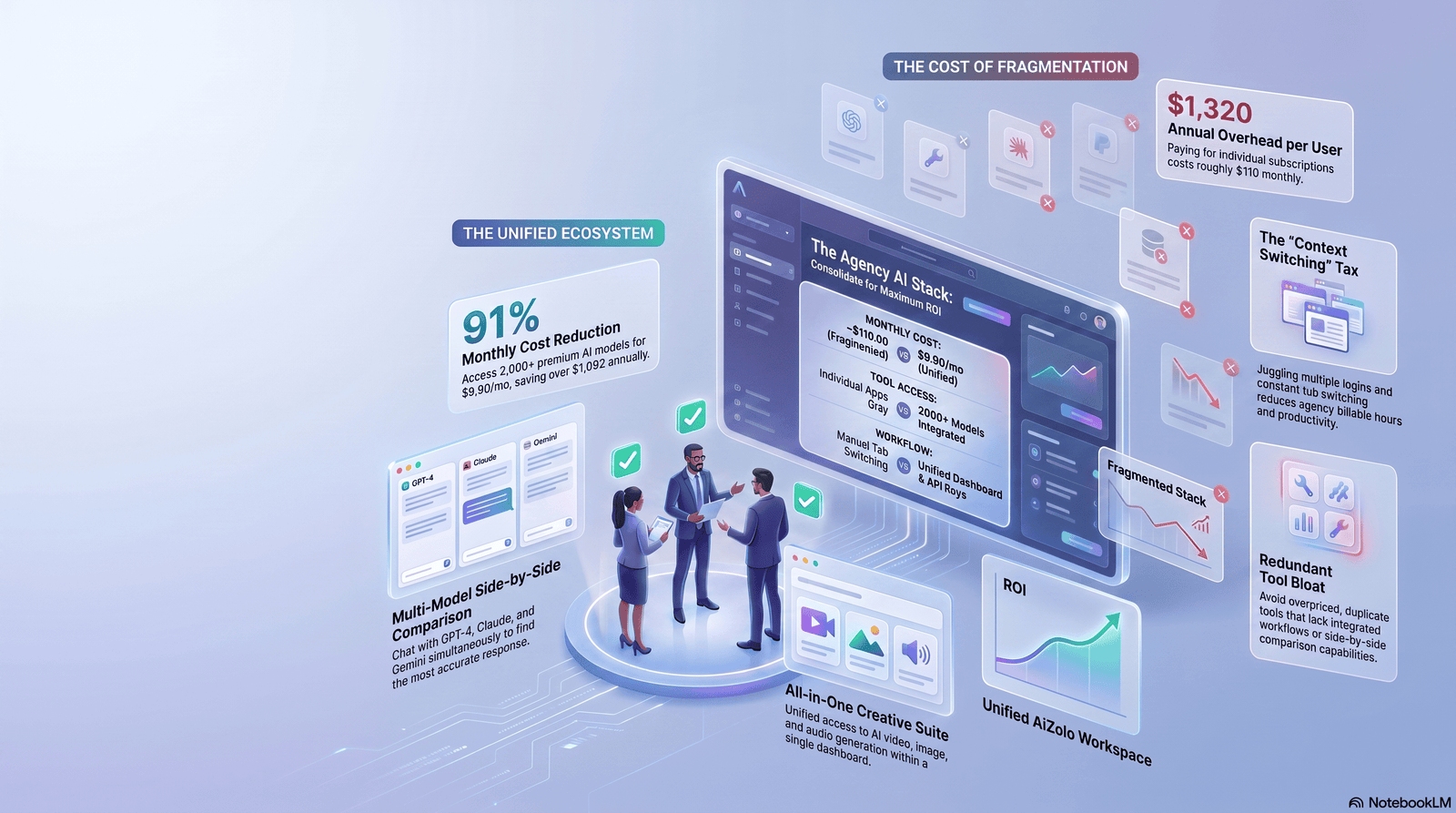
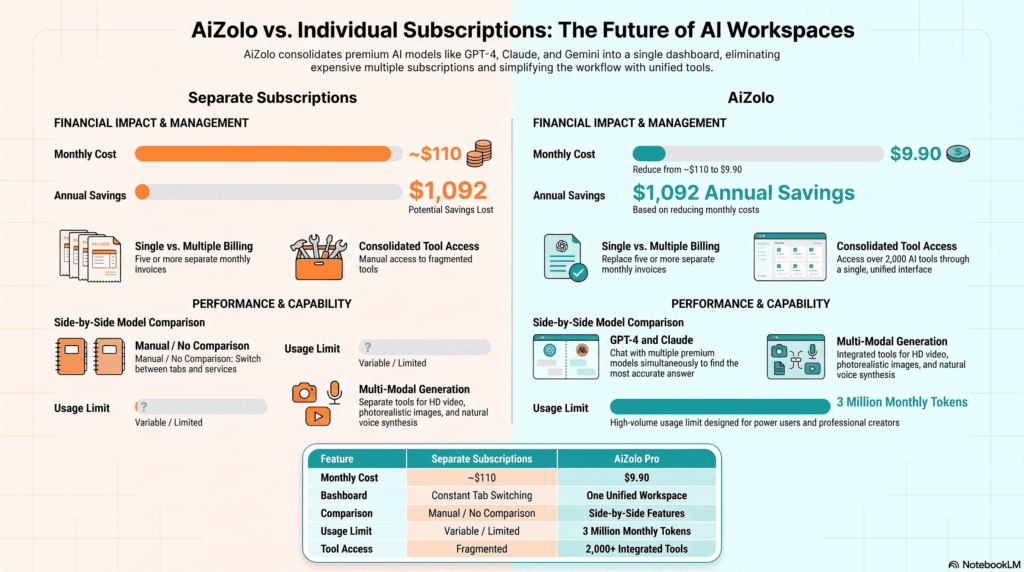
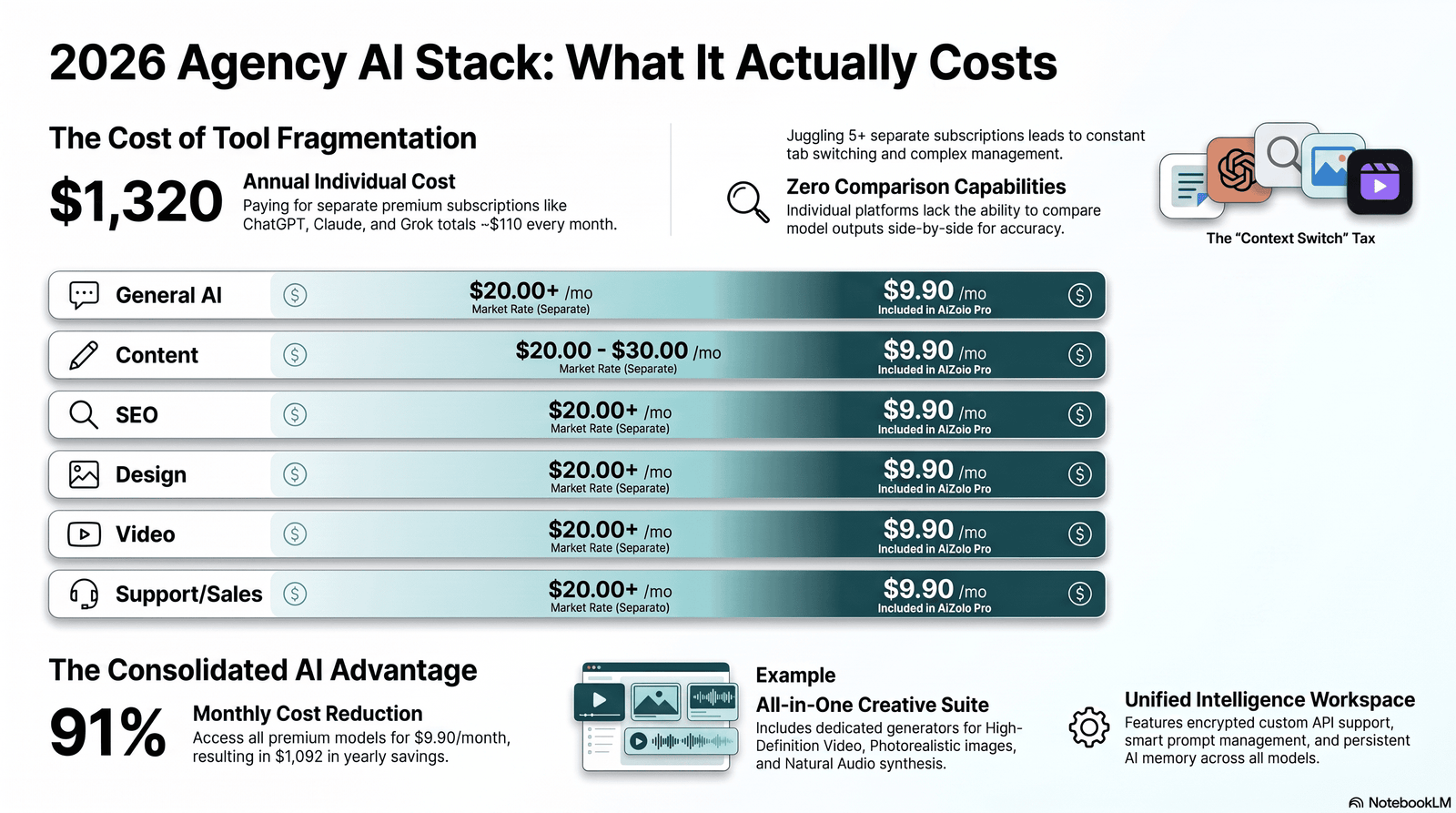
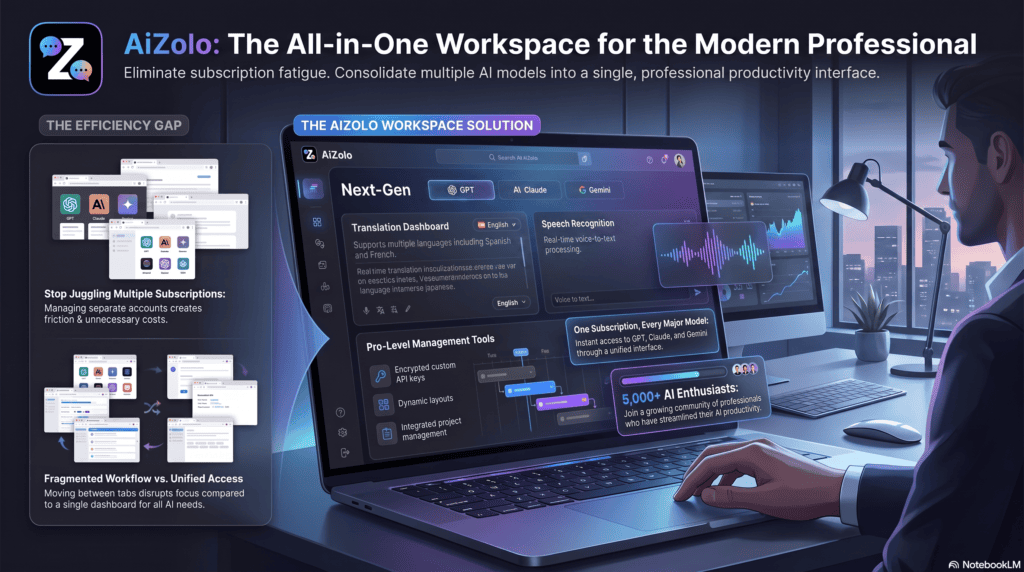
Add an SEO tool, a video generator, and a chatbot platform, and you’re suddenly running six invoices for tools that barely talk to each other. Aizolo brings them together under one workspace, making agency workflows simpler and more cost-effective.
That’s exactly why the idea of an AI tools bundle for agencies has taken off in 2026. Instead of stitching together random subscriptions, agencies are building a deliberate stack — one that covers content, SEO, design, video, sales, and support without duplicating spend.
Key Takeaway: A good AI tools bundle isn’t about owning the most software. It’s about owning the right five or six tools that map to how your agency actually delivers work — pitch, plan, produce, deliver, and report.
In this guide, you’ll learn:
- What actually counts as an AI tools bundle in 2026, and how it differs from a single AI subscription
- The core categories every agency stack needs — and which ones you can skip
- Real, current pricing for the tools agencies use most
- A decision framework based on agency size, client mix, and budget
- Common mistakes agencies make when adopting AI toolkits
- Answers to the questions agency owners actually search for
This isn’t a rehash of “top 10 AI tools” listicles. It’s a practical breakdown built around how agencies actually get paid: by shipping client work on time, at a margin that holds up.
Table of Contents
What Is an AI Tools Bundle for Agencies?
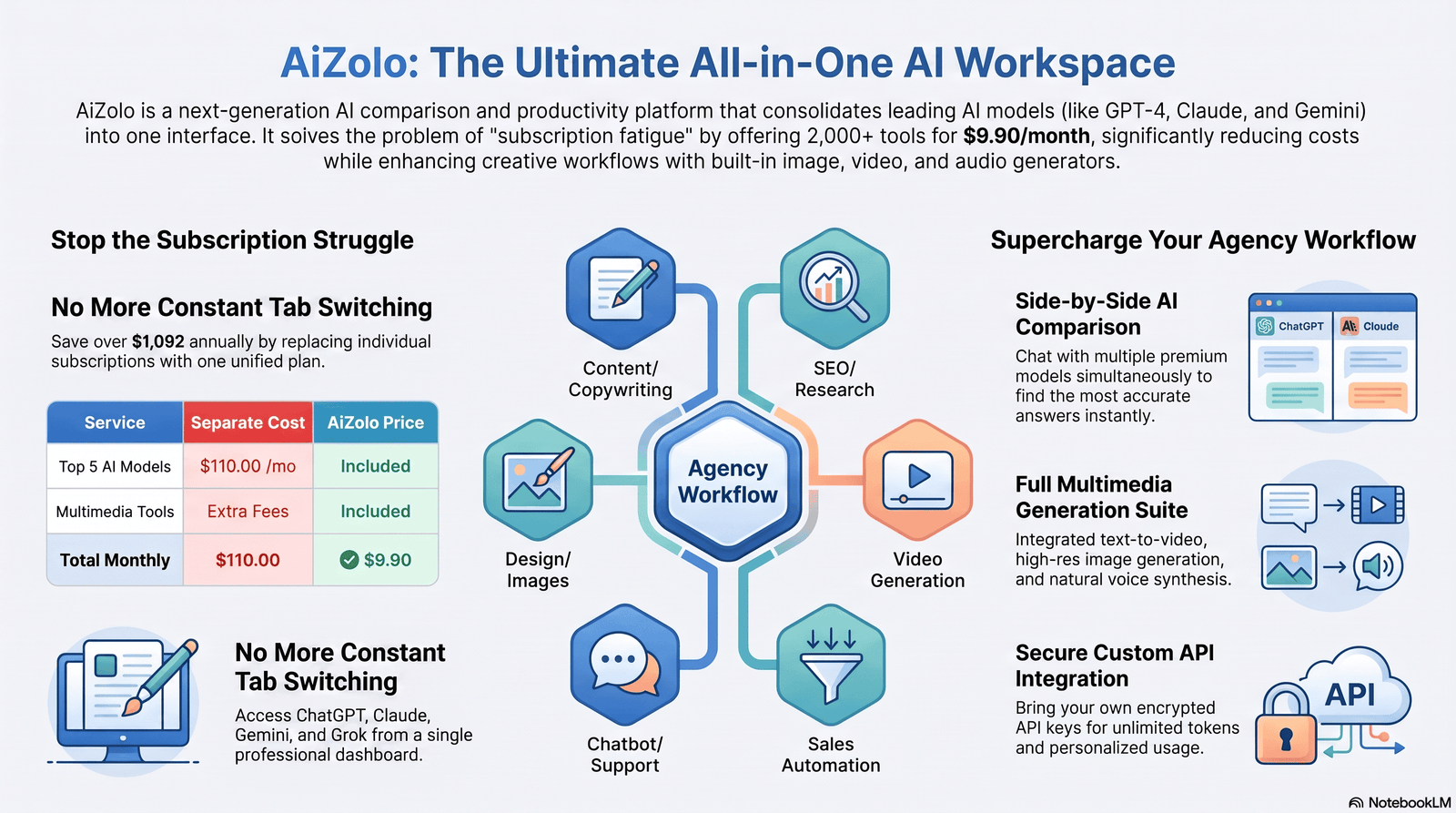
An AI tools bundle for agencies is a curated set of AI-powered software — usually spanning content, SEO, design, and operations — chosen to cover an agency’s full delivery workflow instead of just one task.
It’s different from a single AI subscription in one important way.
ChatGPT Plus or Claude Pro alone can write, summarize, and brainstorm. But they can’t audit a technical SEO issue, generate on-brand video ads, or route a support ticket for a client’s e-commerce store.
An agency bundle fills those gaps deliberately.
In many agency workflows, the stack looks less like “one AI tool” and more like a small set of specialists: a general-purpose assistant for drafting and strategy, a content or SEO platform for optimization, a design or video tool for creative production, and an automation layer that connects everything to the client’s CRM or ticketing system.
Why Agencies Are Adopting AI Toolkits in 2026
The shift isn’t hype-driven anymore. It’s operational.
Client expectations have changed. Clients increasingly use generative AI themselves, so they notice when an agency’s turnaround times don’t reflect it.
Margins are under pressure. Hourly billing punishes agencies for getting faster, which pushes many toward productized, AI-assisted retainers instead.
Talent is expensive and hard to scale. An AI toolkit lets a lean team produce output that used to require several specialist hires.
The data behind the shift
Adoption numbers back this up. Recent industry research puts marketing agency AI adoption at roughly 91%, and more broadly, close to nine in ten marketers now use generative AI in at least one regular workflow.
Expert Tip: Don’t chase every new AI tool that launches. One limitation we’ve consistently noticed is that agencies who adopt too many overlapping tools end up with lower utilization per seat — and worse ROI — than agencies running three well-integrated tools at full capacity.
The Six Categories Every Agency AI Stack Needs
Before comparing individual products, it helps to think in categories, not brand names.
| Category | What It Solves | Skip If… |
|---|---|---|
| AI content creation | Blog posts, ad copy, email, social captions | You have a strong in-house writing team with no capacity issue |
| AI SEO tools | Keyword research, technical audits, AI-search visibility | You don’t run organic search as a service line |
| AI design tools | Social graphics, ad creative, brand assets | Design is fully outsourced to freelancers |
| AI video generation | Short-form ads, explainer videos, UGC-style content | Video isn’t part of your service offering |
| AI chatbot / support | Client-facing support, lead qualification | You don’t manage post-sale support for clients |
| AI sales automation | Lead scoring, outreach, CRM enrichment | Business development isn’t AI-augmented yet |
Small agencies typically benefit from picking two or three categories that map directly to their core service line, rather than trying to cover all six at once.
Best AI Content Creation Tools for Agencies
Content is where most agencies start, because it’s the highest-volume, most repeatable workflow.
General-purpose assistants
ChatGPT, Claude, and Gemini have converged on pricing, with their Pro-level consumer tiers all landing around $20 per month, though each has carved out a different strength.
Claude tends to hold up best for long-form documents and client-facing strategy work because of its longer context window. ChatGPT tends to get new models first and has the broadest plugin ecosystem. Gemini’s advantage shows up mainly for agencies already inside Google Workspace, since its Advanced tier bundles in extra cloud storage.
Pros & Cons: General-Purpose AI Assistants
| Tool | Pros | Cons |
|---|---|---|
| ChatGPT Plus | Fast model updates, strong plugin ecosystem, image + voice | Can feel generic without heavy prompting |
| Claude Pro | Excellent for long documents, strong reasoning and tone control | Smaller plugin/integration ecosystem |
| Gemini Advanced | Deep Google Workspace integration, bundled storage | Less differentiated for non-Google shops |
Purpose-built marketing content platforms
Tools like Jasper sit on top of general models but add brand-voice training, content templates, and team workflows. Jasper’s Pro tier runs in the $59–$69/month range per seat (with annual discounts), while its Business tier is custom-priced for larger teams needing API access and governance controls.
Common Mistake: Buying a premium content platform like Jasper before your team has a documented brand voice or content workflow. The templates and brand-voice engine are only valuable once there’s a process to plug them into.
Best AI SEO Tools for Agencies
SEO is where AI has changed the most in the last 18 months, mainly because of AI-search visibility tracking — monitoring how a brand appears inside ChatGPT, Gemini, Perplexity, and Google’s AI Overviews, not just traditional rankings.
Semrush vs. Ahrefs for agencies
These remain the two most common picks, and agencies frequently run both rather than choosing one.
Semrush leans into breadth: SEO, PPC research, content tools, and AI-visibility tracking bundled into its Semrush One plans. Ahrefs leans into depth: a larger backlink index and a cleaner interface, with AI-visibility tracking available as a paid Brand Radar add-on.
Comparison Table: Semrush vs. Ahrefs for Agencies
| Feature | Semrush | Ahrefs |
|---|---|---|
| Entry price | $139.95/mo (Pro) | ~$108–129/mo (Lite, annual) |
| Mid-tier (agency) price | $249.95/mo (Guru) | ~$249–449/mo (Standard) |
| AI-search visibility tracking | Bundled into Semrush One plans | Add-on (Brand Radar), ~$199/mo |
| Backlink database size | Large, updated ~every 15 min | Larger index, faster crawl refresh |
| Content/writing tools | SEO Writing Assistant, ContentShake AI | Content Explorer (research only) |
| Best for | All-in-one agencies managing multiple channels | Agencies whose core service is link building |
| Reporting/white-label | Strong, agency-oriented | Available, less extensive |
Warning: Ahrefs moved to mandatory per-seat pricing in 2026, which meaningfully raised costs for small teams sharing one login. Budget for per-seat pricing on both platforms, not the old shared-account rate you may have seen in older comparisons.
Best AI Design and Image Generation Tools
For creative and social-first agencies, AI image tools have moved from novelty to daily production tool.
Midjourney remains a strong choice for high-quality creative output, with its entry Basic tier priced around $10/month. Leonardo AI has positioned itself as a budget-friendly alternative, with a usable free tier and an Essential paid tier around $12/month for daily image work — and it’s frequently bundled at no extra cost inside Canva’s higher business tiers.
Feature Comparison: AI Design Tools for Agencies
| Tool | Best For | Starting Price | Learning Curve |
|---|---|---|---|
| Midjourney | High-end creative/campaign visuals | ~$10/mo | Moderate — prompt-driven |
| Leonardo AI | Daily marketing image production | Free tier; ~$12/mo paid | Low |
| Canva (with AI features) | Templated social/brand assets at scale | Varies by plan | Very low |
One limitation we’ve consistently noticed with prompt-based image generators: they’re excellent for concept exploration but weak at pixel-perfect brand compliance without a human design pass. Budget for a review step, not a fully automated pipeline.
Best AI Video Generation Tools
Short-form, AI-assisted video has become a real line item for agencies running paid social or UGC-style campaigns.
The category is moving fast, and pricing changes often, so agencies should treat any specific video-tool price as a starting point to verify before signing a contract rather than a fixed number.
Best Practice: Before adopting an AI video tool agency-wide, run one real client brief through it first. Video quality varies enormously by use case — product demos, talking-head ads, and animated explainers are not equally well-served by the same tool.
Best AI Chatbot and Customer Support Tools
If an agency manages ongoing client support — not just campaign delivery — an AI chatbot layer is one of the highest-ROI additions to a bundle.
Newer entrants in this category run on usage-based pricing rather than flat seat costs, meaning agencies pay per resolved conversation or action instead of per user. This model tends to suit agencies managing support for multiple small clients, since it scales with actual ticket volume instead of headcount.
For agencies whose clients already run on HubSpot, HubSpot’s Breeze AI layer is worth evaluating directly, since it’s woven into the CRM, marketing, and service hubs the client is already paying for. Its own AI agents have also shifted toward outcome-based pricing — priced per resolved conversation rather than a flat fee.
Pros & Cons: AI Chatbot Platforms for Agencies
| Model | Pros | Cons |
|---|---|---|
| Usage-based (pay per resolution) | Scales naturally with client size, no wasted seats | Costs can spike during high-volume periods |
| Seat-based, CRM-native | Deep context from existing client data | Only valuable if the client already uses that CRM |
| Standalone chatbot builder | Flexible, works across any client stack | Requires more setup time per client |
Best AI Sales Automation Tools
For agencies running lead generation or business development as a service, AI-powered visitor identification and outreach tools have become a meaningful upsell.
Platforms in this space typically combine website visitor identification with AI-drafted outreach sequences, letting agencies show clients a concrete lift in qualified leads without adding headcount. Entry-level plans are often free or low-cost, with business tiers scaling into four figures per month based on identified visitor volume — so it’s worth sizing the plan to the client’s actual traffic before committing.
Pro Insight: Agencies that bundle AI sales automation into a retainer (rather than billing it as a pass-through cost) tend to see stronger renewal rates, because the tool becomes part of the agency’s differentiated offer rather than a line item the client could buy directly.
Full Pricing Comparison Table
Here’s a consolidated view of where 2026 pricing actually sits across categories. Treat these as directional — most vendors update pricing multiple times a year.
| Tool | Category | Entry Price | Agency-Tier Price | Notes |
|---|---|---|---|---|
| ChatGPT Plus | General AI | $20/mo | $200/mo (Pro) | $8/mo “Go” tier now available |
| Claude Pro | General AI | $20/mo | $200/mo (Max) | Longest context window in category |
| Gemini Advanced | General AI | ~$20/mo | — | Bundles 2TB Google storage |
| Jasper | Content platform | $59–69/mo/seat | Custom (Business) | Seat pricing jumps sharply past 1 user |
| Semrush | SEO/marketing suite | $139.95/mo | $249.95–499.95/mo | AI visibility bundled in Semrush One |
| Ahrefs | SEO | ~$108–129/mo | $249–449/mo | Now per-seat as of 2026 |
| Midjourney | AI image | ~$10/mo | — | Best for high-end creative |
| Leonardo AI | AI image | Free–$12/mo | — | Often bundled with Canva |
| GitHub Copilot | AI coding | $10/mo | — | Relevant for agencies with dev teams |
| Notion AI | Knowledge base/SOPs | Bundled in Business, $20/user/mo (annual) | — | Standalone add-on retired in 2025 |
| HubSpot Breeze | CRM-native AI | Included with Marketing Hub Pro (~$800/mo) | Outcome-based add-ons | Only valuable for HubSpot clients |
Decision Framework: Which Bundle Fits Your Agency
Use this three-question framework before signing any new AI contract.
1. What’s the actual bottleneck?
If it’s content volume, start with a general-purpose assistant plus a content platform. If it’s visibility, start with SEO. If it’s client support, start with a chatbot layer.
2. Who will actually use the seat every week?
Per-seat AI tools only pay off with regular, weekly use. If usage will be occasional, favor usage-based pricing over flat seat costs.
3. Does this tool need to talk to the client’s systems?
CRM-native tools like HubSpot Breeze only earn their cost when the client is already on that platform. Otherwise, a standalone tool with broader integrations is safer.
Decision Framework Table
| If your bottleneck is… | Start with… | Avoid… |
|---|---|---|
| Content volume | General AI assistant + content platform | Video tools you won’t use weekly |
| Search visibility | Semrush or Ahrefs (AI visibility add-on) | Standalone chatbot builders |
| Client support load | Usage-based AI chatbot | Seat-heavy content platforms |
| New business / lead gen | AI sales automation | Premium design tools with low usage |
| Internal knowledge chaos | Notion AI or similar workspace AI | Adding a fourth SEO tool |
Buying Guide by Agency Size
Solo consultants and freelancers (1 person)
A single general-purpose assistant (Claude Pro or ChatGPT Plus) plus one specialist tool for your core service line is usually enough. Skip seat-based platforms entirely — the per-seat premium doesn’t pay off at this scale.
Small agencies (2–10 people)
This is where a real bundle starts to matter: one general AI assistant per person, one shared SEO or content platform, and one design or video tool. Watch per-seat add-on costs closely — they compound faster than the headline price suggests.
Mid-size agencies (10–50 people)
Worth negotiating enterprise or Business tiers directly with vendors rather than accepting list pricing, especially for SEO suites and content platforms. Multi-year commitments and prepayment are common negotiation levers.
Large agencies and holding-company shops (50+ people)
Governance becomes the real cost center — audit logs, prompt review, and data-handling compliance. Budget roughly 1.3–1.5x the sticker price once integration and governance overhead are included.
Common Mistakes Agencies Make
Buying tools before mapping the workflow. A tool without a documented process to plug into rarely gets used past month one.
Paying for redundant capability. Semrush and Jasper both offer content tools; running both at full price without a clear division of labor wastes budget.
Ignoring per-seat scaling. A platform priced attractively for one user can double or triple in cost the moment a second team member is added.
Skipping the trial period. Nearly every tool in this guide offers a trial or free tier — using it on a real client brief, not a test prompt, reveals far more than the features page.
Treating AI tools as a cost center instead of a billable capability. Agencies that fold AI tool costs into retainers as part of the value delivered retain clients better than those who treat the tools purely as internal overhead.
Warning: Group-buy or shared-account AI subscriptions may violate the vendor’s terms of service and risk account termination without warning. For client-facing work, this risk isn’t worth the savings.
Expert Tips for Rolling Out an AI Stack
- Start with one client, not the whole roster. Pilot any new tool on a single account before rolling it agency-wide.
- Assign an internal owner per tool. Tools without a clear owner tend to get underused and eventually cancelled at renewal.
- Track utilization, not just output. A tool generating impressive demos but used by only 20% of the team isn’t earning its cost.
- Revisit the stack quarterly. Pricing and features in this category shift fast enough that a stack built in January can be outdated by summer.
- Separate “nice to have” from “core workflow.” Video and design tools are easier to cut in a budget crunch than the SEO or content platform your delivery depends on.
FAQs
1. What’s the difference between an AI tools bundle and a single AI subscription?
A single subscription (like ChatGPT Plus) covers general-purpose tasks. A bundle combines several specialized tools — SEO, design, video, support — chosen to cover an agency’s full delivery workflow.
2. How much should a small agency budget for an AI tools bundle?
Most small agencies (2–10 people) land somewhere between $300 and $900 per month once seat costs and one or two specialist platforms are included, though this varies heavily by service mix.
3. Are AI tool bundles worth it for solo freelancers?
Often not in the traditional sense. Solo operators usually get more value from one strong general assistant plus a single specialist tool than from a full multi-category bundle.
4. Do AI tools bundles include both SEO and content tools?
Some platforms, like Semrush, bundle SEO and content tools together. Others, like Jasper, are content-only and need to be paired with a separate SEO tool.
5. Is it safe to use group-buy or shared-account AI subscriptions for client work?
No. These commonly violate vendor terms of service and put client-facing work at risk if the account is suspended without notice.
6. Which AI tool is best for agency SEO reporting?
Semrush is generally stronger for agencies needing white-label, client-ready reporting across SEO, PPC, and AI-search visibility in one dashboard.
7. Can AI tools replace an agency’s writers or designers?
No — they change the role rather than eliminate it. AI tools speed up drafts and concepts, but brand judgment, strategic framing, and final quality control still require a human reviewer.
8. What is AI-search visibility tracking, and does my agency need it?
It tracks how often and how favorably a brand appears inside AI answer engines like ChatGPT and Google AI Overviews. Any agency running SEO as a service line should be tracking this alongside traditional rankings.
9. How do I know if a tool is worth its per-seat price?
If a tool isn’t used at least weekly by the person holding the seat, it’s rarely worth the ongoing cost — usage-based pricing is usually the better fit for occasional use.
10. What’s the biggest hidden cost in an AI tools bundle?
Per-seat scaling and required add-ons. A platform’s advertised entry price frequently excludes extra seats, AI-visibility add-ons, or content modules that push the real monthly cost well past the headline number.
11. Should agencies use the same AI stack across every client?
Mostly yes for internal tools (content, SEO, design), but chatbot and CRM-native AI tools should match whatever platform the specific client already runs on.
12. How often should an agency re-evaluate its AI tools bundle?
Quarterly is a reasonable cadence given how fast pricing and feature sets change in this category.
13. Are free AI tools good enough for client work?
Free tiers are fine for testing and light internal use, but most lack the reliability, output limits, and brand-control features needed for consistent client deliverables.
14. What agency size justifies negotiating custom enterprise pricing?
Once a platform’s list price for adding seats starts approaching $1,000+/month, most vendors are open to negotiated volume or multi-year pricing — worth raising proactively rather than accepting sticker price.
15. Does an AI tools bundle help with client retention?
Indirectly, yes. Agencies that turn faster AI-assisted turnaround into visible client results — not just internal efficiency — tend to see stronger renewal rates.
Conclusion and Final Recommendation
There’s no single “best” AI tools bundle for agencies, because the right stack depends entirely on what your agency actually sells.
What’s consistent across agencies that get real ROI from AI: they start with the bottleneck, not the tool list. They pilot before rolling out agency-wide. And they revisit the stack often enough to avoid paying for capability nobody’s using.
If you’re starting from zero, a defensible baseline for most small-to-mid agencies is: one general-purpose AI assistant per team member, Semrush (or Ahrefs, if link building is your core service) for SEO, a content platform if volume demands it, and a usage-based chatbot if you manage client support.
Build from there — one category at a time, one pilot client at a time.
Author Bio
Jeevesh Tripathi Email: jeevesh@aizolo.com
Jeevesh Tripathi researches and writes about AI tools, digital productivity, and marketing automation, with a focus on helping agencies evaluate software honestly — features, pricing, and real-world limitations included, not just vendor marketing claims. His work covers AI content creation, SEO technology, and workflow automation for growing teams, with an emphasis on practical, decision-ready guidance over generic tool roundups.
Pingback: Compare Grok 4.1 and Claude 4.5 for Creative Risk | 2026 Guide
Pingback: best ai aggregator with priority enterprise support: 5x Faster 2026
Pingback: Top 7 Generative AI Tools: Boost Productivity 2026 Fast
Pingback: How to Automate Daily Business Tasks Using AI & Save 20+ Hours Fast
Pingback: prompt to test and compare ai models: 5x Faster Insights 2026