Your login form either works or it doesn’t. Your AI feature can be confidently, fluently wrong — and pass every existing test you have.
That’s the uncomfortable truth most engineering teams are running into right now. Aizolo shows that a model can return a response in under a second, format it beautifully, and still fabricate a fact, leak a system prompt, contradict its own retrieved context, or quietly drift off a safety boundary.
Traditional assertions never catch any of it, because they were built for deterministic code, not probabilistic output.
Testing frameworks for AI tools exist to close that gap. They replace binary pass/fail thinking with graded evaluation, they test behavior across hundreds of input variations instead of one hardcoded case, and they treat an LLM response the way it actually behaves in production: as a distribution of possible outputs, not a single predictable string.
This guide is written for the engineers actually shipping this stuff — not a marketing overview of “AI testing” as a buzzword. We’ll walk through why conventional automation breaks, what a real AI testing framework needs to contain, how the leading tools stack up, and how to build a layered pipeline that catches problems before your users do.
Table of Contents
What Are Testing Frameworks for AI Tools?
Testing frameworks for AI tools are software systems purpose-built to evaluate, validate, and monitor applications built on machine learning models — particularly large language models, retrieval-augmented generation (RAG) pipelines, and autonomous agents.
Unlike conventional test frameworks, they don’t just check whether code executes correctly. They score output quality against dimensions like factual accuracy, groundedness, relevance, safety, and task completion, usually using a combination of rule-based checks, statistical metrics, and “LLM-as-a-judge” scoring.
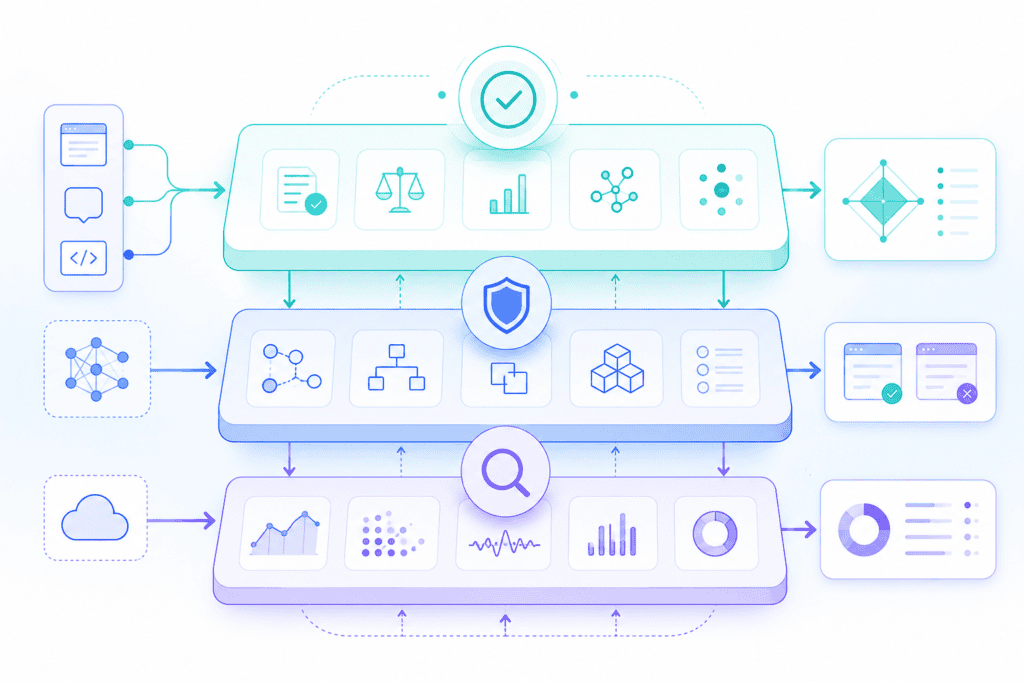
A mature AI testing framework typically spans three layers: pre-deployment evaluation, CI/CD regression gates, and post-deployment observability. Most teams only build the first layer and stop, which is exactly why AI failures keep reaching production undetected.
Why AI Applications Need Different Testing
Conventional software has a fixed input-output contract. Given the same input, a function returns the same output every time, so a single assertion is enough to validate it forever.
AI systems don’t behave that way. The same prompt can produce different phrasings, different reasoning paths, and occasionally a completely different answer, even at low temperature settings. That single-input, single-expected-output model of testing simply doesn’t map onto probabilistic systems.
There’s also a second failure surface that traditional QA was never built to catch: the model can be technically “working” — no errors, no crashes, fast response time — and still be wrong in a way that only a domain expert or an evaluation metric would notice. A support bot that invents a refund policy is not a bug in the conventional sense. It’s a correctness failure with no stack trace.
Key Takeaway: In AI testing, “it ran successfully” and “it was correct” are two completely different claims. Most legacy QA tooling only verifies the first one.
Traditional Testing vs AI Testing
| Dimension | Traditional Software Testing | AI Tool Testing |
|---|---|---|
| Output behavior | Deterministic, repeatable | Probabilistic, variable across runs |
| Pass/fail model | Binary assertion | Graded score against a threshold |
| Test case design | Fixed input/output pairs | Distributions of inputs, edge cases, adversarial prompts |
| What’s validated | Logic, control flow | Factuality, relevance, safety, tone, groundedness |
| Regression risk | Code changes | Code changes + model updates + prompt changes + data drift |
| Primary tooling | JUnit, Selenium, Cypress | DeepEval, Ragas, Promptfoo, Arize Phoenix, Giskard |
| Failure detection | Compiler/runtime errors | Human review, LLM-as-judge, statistical drift detection |
Core Components of an AI Testing Framework
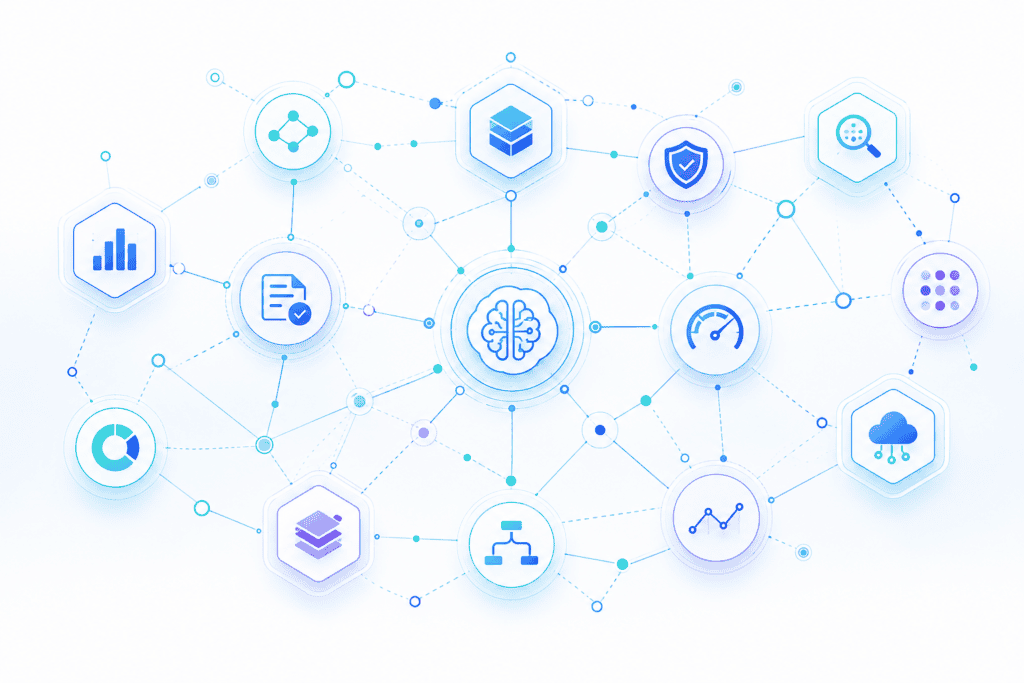
A framework that only checks one of these layers will miss entire categories of failure. The strongest setups combine all five.
Test case generation. Synthetic and human-curated prompts covering common paths, edge cases, and adversarial inputs, so coverage isn’t limited to what a QA engineer thought to type manually.
Evaluation metrics. Quantitative scoring for factual accuracy, relevance, coherence, faithfulness (for RAG), and tool-call correctness (for agents), instead of a single vague “good/bad” label.
Regression pipelines. Automated comparison between a new model version, prompt, or retrieval config and a known-good baseline, run inside CI/CD before merge.
Human-in-the-loop review. A workflow for routing ambiguous or high-risk outputs to a human reviewer, because no automated metric is perfect for nuanced judgment calls.
Production observability. Continuous scoring of live traffic to catch drift, degradation, and emerging failure patterns that pre-deployment testing never surfaced.
The 7 Essential Features of Modern Testing Frameworks
1. Cross-Browser and Cross-Platform Support
Modern applications need to work flawlessly across Chrome, Firefox, Safari, and Edge, as well as different operating systems and device types. A strong testing framework runs the same test suite across all these environments without requiring separate codebases for each.
2. Parallel Test Execution
As test suites grow, running tests sequentially becomes a bottleneck. Leading frameworks support parallel execution across multiple workers or machines, cutting total run time from hours to minutes.
3. Robust Element Locators and Auto-Waiting
Flaky tests often stem from timing issues — a test tries to interact with an element before it’s ready. Modern frameworks build in smart waiting mechanisms and resilient selectors that reduce false failures caused by timing rather than actual bugs.
4. Rich Debugging and Reporting Tools
When a test fails, developers need to know why — fast. Features like screenshots on failure, video recordings, trace viewers, and step-by-step execution logs turn debugging from guesswork into a quick diagnosis.
5. API and Component-Level Testing Support
End-to-end tests are valuable but expensive to run and maintain. The best frameworks also support testing at the API and component level, letting teams catch issues earlier and keep their test pyramid balanced.
6. Extensibility Through Plugins and Custom Integrations
Every team’s stack is different. Modern frameworks are built to be extended — supporting custom reporters, third-party integrations, and plugins that adapt the tool to a team’s specific workflow rather than forcing teams to adapt to the tool.
7. Seamless CI/CD Integration
Automated testing that fits naturally into your deployment pipeline, providing quality feedback within minutes of code commits.
If your team runs Playwright in CI, TestDino provides a dedicated reporting and intelligence layer on top of your pipeline, aggregating Playwright test runs, auto-detecting flaky tests, and delivering AI-powered failure insights directly from GitHub Actions or GitLab CI.
Types of AI Testing
Prompt Testing
Prompt testing validates that a specific prompt template produces reliable, on-task output across many input variations — not just the one example that looked good in a demo.
LLM Evaluation
LLM evaluation is the umbrella discipline for scoring model output quality using automated metrics, reference-based comparison, or LLM-as-a-judge scoring against a rubric.
Hallucination Detection
Hallucination detection identifies claims in a response that aren’t supported by the source material or ground truth, which matters most in RAG and enterprise knowledge-retrieval use cases. Even frontier models in 2026 still hallucinate at non-trivial rates on unfamiliar or ambiguous queries, which is why this layer can’t be skipped.
Bias Testing
Bias testing probes whether a model treats different demographic groups, phrasings, or protected categories unevenly, using paired prompts designed to isolate the variable being tested.
Safety Testing
Safety testing checks whether a model refuses genuinely harmful requests, resists jailbreak attempts, and avoids generating disallowed content, typically benchmarked against frameworks like the OWASP LLM Top 10.
Security Testing
Security testing for AI tools covers prompt injection, data exfiltration through tool calls, insecure output handling, and unauthorized access to connected systems — attack surfaces that don’t exist in traditional web apps.
Performance Testing
Performance testing measures whether the system meets latency and throughput requirements under realistic load, which is harder for LLM apps because model inference time is variable and provider-dependent.
SaaS-Specific Scalability Testing for AI Applications
AI applications embedded in SaaS products introduce scalability problems that standard AI evaluation may not reveal. A model can produce accurate responses in a controlled test while the surrounding application fails when thousands of tenants, concurrent requests, third-party APIs, and distributed infrastructure are placed under pressure.
Multi-Tenant Load Testing
For multi-tenant SaaS applications, scalability tests should simulate traffic patterns across multiple customers rather than treating all users as a single workload. Test scenarios should include uneven tenant activity, sudden traffic spikes from one large customer, concurrent model requests, and shared-resource contention.
The goal is to verify that one tenant’s workload does not create unacceptable latency, errors, or resource starvation for other customers.
Multi-Region and Multi-Cloud Testing
AI-powered SaaS products often serve users across different geographic regions. Load testing should therefore account for regional latency, network variability, cloud-provider differences, and traffic distribution.
Testing from multiple regions can reveal problems that remain hidden when all requests originate from a single location. This is particularly important for applications that depend on external model APIs, distributed databases, CDNs, or region-specific infrastructure.
Capacity and Scaling-Limit Testing
Capacity testing determines how far an AI SaaS application can scale before response times, error rates, or resource utilization cross an acceptable threshold. Test progressively increasing workloads rather than only testing the expected peak.
Measure metrics such as concurrent users, requests per second, model inference latency, throughput, CPU and memory utilization, database performance, queue depth, and API rate-limit errors. The resulting capacity baseline can help engineering teams determine when additional infrastructure or architectural changes are required.
Predictive Capacity Planning
AI can extend scalability testing beyond measuring what happens today. Historical traffic, seasonal demand, release schedules, and infrastructure metrics can be analyzed to estimate when the application may approach its capacity limits.
This allows teams to plan scaling decisions before a traffic surge occurs instead of reacting after performance has already degraded.
Cost-Performance Testing
Scalability is not only about supporting more users. AI SaaS applications must also maintain a reasonable relationship between infrastructure cost and application performance.
Test different configurations to identify where additional compute, caching, database capacity, model selection, or concurrency produces meaningful performance improvements. This helps teams avoid both under-provisioning, which causes failures, and over-provisioning, which increases operating costs without delivering proportional benefits.
Real-User Data and Production-Informed Testing
Synthetic load tests are useful, but they can miss the patterns that occur in real production traffic. Where privacy and security requirements allow, teams can use aggregated real-user monitoring data to make test scenarios more representative.
Production-informed testing can account for geographic distribution, common user journeys, peak usage periods, request sizes, API dependencies, and changing traffic patterns. These scenarios can then be incorporated into recurring scalability tests.
Key Takeaway: For AI-powered SaaS applications, scalability testing should evaluate the entire system—not just the model endpoint. Multi-tenancy, geographic distribution, external AI APIs, infrastructure capacity, cost, and real-user behavior can all become bottlenecks as usage grows.
Latency Testing
Latency testing isolates response time specifically, since a correct answer delivered five seconds late can still fail the user experience bar for chat-style interfaces.
Load Testing
Load testing simulates concurrent users hitting the model endpoint simultaneously, surfacing rate-limit failures, queueing behavior, and cost spikes before they hit production.
Regression Testing
Regression testing re-runs a fixed evaluation suite every time the prompt, model version, or retrieval logic changes, catching silent quality drops that a model provider update can introduce overnight.
Agent Testing
Agent testing validates that an autonomous agent selects the correct tools, passes correct arguments, and completes multi-step tasks without looping, stalling, or taking unauthorized actions.
Multi-Agent Testing
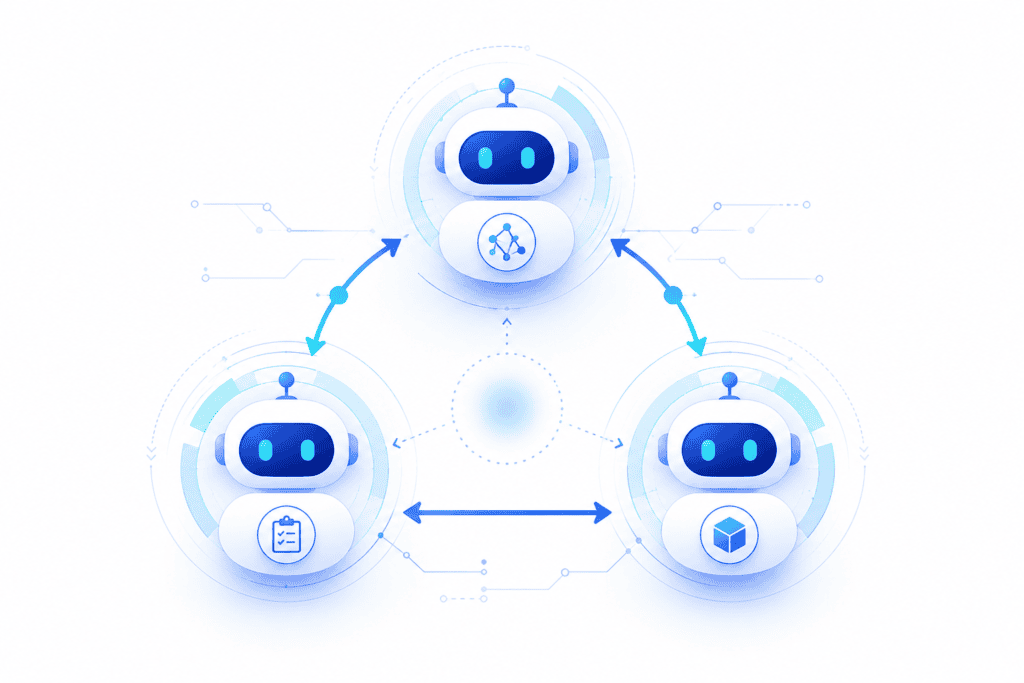
Multi-agent testing extends this to systems where several agents coordinate — validating handoffs, shared state consistency, and whether one agent’s error cascades into another’s decision.
RAG Testing
RAG testing separates retrieval quality (did the system find the right documents?) from generation quality (did the model use those documents correctly?), because a failure in either stage produces the same symptom: a wrong answer.
Vector Database Validation
Vector database validation checks embedding quality, index freshness, and retrieval relevance at the infrastructure level, since a stale or poorly-tuned index will quietly degrade every downstream RAG response.
Model Drift
Model drift testing tracks whether output quality degrades over time due to upstream model updates, changing user behavior, or shifting data distributions — a risk unique to systems built on third-party model APIs.
Evaluation Pipelines
Evaluation pipelines automate the full test-score-report loop so evaluation runs on every pull request rather than only when someone remembers to check manually.
Human-in-the-Loop Testing
Human-in-the-loop testing routes a sampled percentage of outputs — or anything below a confidence threshold — to human reviewers, closing the gap that automated metrics can’t fully cover.
Synthetic Data Testing
Synthetic data testing uses AI-generated test cases to expand coverage far beyond what a QA team could hand-write, particularly useful for stress-testing edge cases and rare user intents.
Observability
Observability captures traces of every model call, retrieval step, and tool invocation in production, giving teams the debugging context that a single pass/fail result never provides.
Benchmarking
Benchmarking compares model or pipeline performance against standardized datasets and leaderboards, useful for provider selection but not a substitute for testing your own application-specific prompts.
AI-Assisted Chaos and Resilience Testing
Scalability failures do not always occur because an application reaches its maximum user capacity. AI SaaS systems can also fail when dependencies become unavailable, network latency increases, an external model API reaches its rate limit, or individual services fail during periods of heavy traffic.
AI-assisted chaos testing can help teams generate and prioritize failure scenarios based on the architecture and historical failure patterns. Instead of randomly injecting failures, teams can test combinations that are most likely to expose weaknesses in their particular system.
Useful scenarios include temporarily disabling an external AI provider, increasing API latency, exhausting connection pools, introducing database delays, simulating regional outages, and testing recovery after sudden traffic spikes.
The objective is not simply to prove that the system survives failure. It is to measure whether the application degrades gracefully, automatically recovers, protects tenant isolation, and maintains acceptable user experience when individual components become unavailable.
Common Mistake: Relying only on public benchmarks like MMLU or general leaderboards. Those measure the underlying model’s raw capability — not whether your prompts, your retrieval pipeline, and your data behave correctly.
Top AI Testing Frameworks in 2026
DeepEval is an open-source, pytest-style Python framework with a broad metric library covering RAG, agents, chatbots, and safety, making it a strong default for engineering teams that want evaluation inside their existing CI setup.
Ragas focuses specifically on RAG evaluation — context precision, context recall, faithfulness, and answer relevance — but doesn’t extend to agent or safety testing.
Promptfoo is a YAML-based, CI-native tool for regression testing prompts, popular with teams that want lightweight evaluation without standing up a hosted platform.
Arize Phoenix is a source-available observability and evaluation platform built on OpenTelemetry, combining tracing, embedding-level drift analysis, and RAG evaluation in one self-hostable tool.
Giskard emphasizes vulnerability scanning for bias, robustness, and security issues, positioning itself closer to an AI red-teaming tool than a pure evaluation library.
Galileo ships dozens of built-in metrics powered by small, purpose-tuned evaluation models, enabling low-latency inline scoring that’s fast enough for runtime guardrails, not just offline testing.
Confident AI pairs with DeepEval to add a collaboration layer, letting product managers and QA staff participate in evaluation workflows without writing code.
Playwright’s AI agent layer (Planner, Generator, Healer) extends browser automation itself, using the accessibility tree instead of brittle CSS selectors so UI tests can self-heal when the interface changes.
MLflow brings experiment tracking and evaluation logging to the AI testing stack, useful for teams that already use it for traditional ML lifecycle management.
LangSmith, from the LangChain ecosystem, focuses on tracing and evaluation for LangChain-based applications specifically, with tight integration for teams already inside that framework.
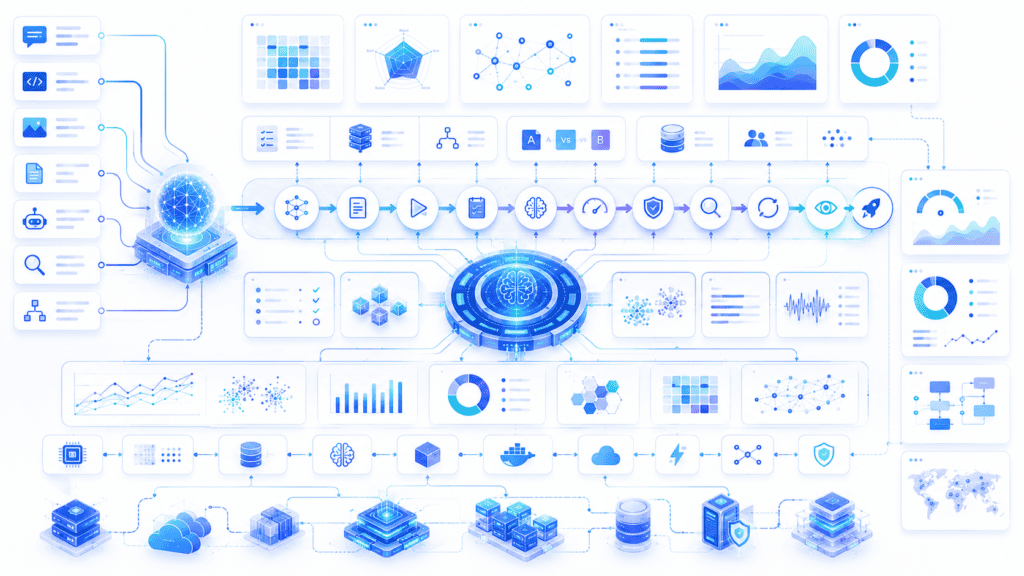
[IMAGE 2 — see Image Recommendations section]
Comparison Table: Framework Feature Matrix
| Framework | Primary Focus | RAG Eval | Agent Eval | Safety/Security | CI/CD Native | Self-Hosted Option |
|---|---|---|---|---|---|---|
| DeepEval | General LLM evaluation | Yes | Yes | Yes | Yes | Yes |
| Ragas | RAG-only evaluation | Yes | No | No | Partial | Yes |
| Promptfoo | Prompt regression testing | Partial | Partial | Yes | Yes | Yes |
| Arize Phoenix | Observability + evaluation | Yes | Yes | Partial | Partial | Yes |
| Giskard | Vulnerability & bias scanning | Partial | No | Yes | Partial | Yes |
| Galileo | Runtime guardrails + RAG | Yes | Partial | Yes | Partial | No (managed) |
| Confident AI | Team collaboration on evals | Yes | Yes | Yes | Yes | No (managed) |
| Playwright AI Agents | UI/E2E test automation | No | N/A | No | Yes | Yes |
Open Source vs Commercial Testing Frameworks
| Factor | Open Source (DeepEval, Ragas, Promptfoo, Phoenix) | Commercial (Galileo, Confident AI, Braintrust) |
|---|---|---|
| Upfront cost | Free, infra cost only | Subscription or usage-based pricing |
| Setup time | Higher — manual integration | Lower — guided onboarding |
| Customization | Full control over metrics and code | Constrained to vendor’s metric library, extensible via SDK |
| Team accessibility | Engineer-focused, code-first | Broader — PMs and QA can participate via UI |
| Support | Community, GitHub issues | SLA-backed vendor support |
| Data residency | Fully self-hosted, easier for compliance | Depends on vendor — check data handling terms |
| Best fit | Engineering-heavy teams, cost-sensitive, compliance-strict | Teams that want speed to value and cross-functional visibility |
Pro Insight: Most mature engineering orgs don’t pick one side exclusively. They use an open-source library like DeepEval inside CI for regression gates, and layer a commercial observability platform on top for production monitoring — because pre-deployment testing and live-traffic monitoring solve different problems.
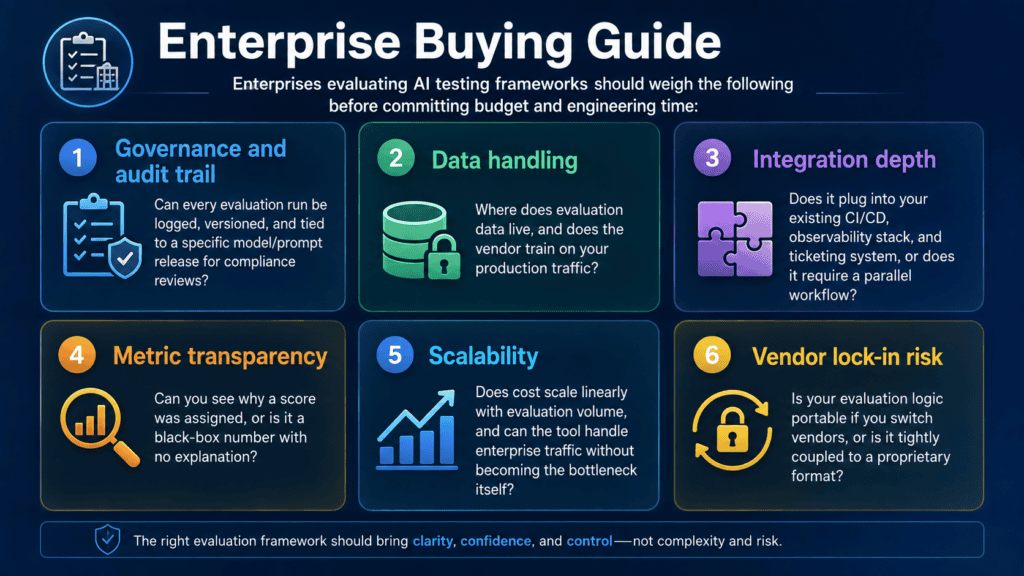
Enterprise Buying Guide
Enterprises evaluating AI testing frameworks should weigh the following before committing budget and engineering time:
- Governance and audit trail. Can every evaluation run be logged, versioned, and tied to a specific model/prompt release for compliance reviews?
- Data handling. Where does evaluation data live, and does the vendor train on your production traffic?
- Integration depth. Does it plug into your existing CI/CD, observability stack, and ticketing system, or does it require a parallel workflow?
- Metric transparency. Can you see why a score was assigned, or is it a black-box number with no explanation?
- Scalability. Does cost scale linearly with evaluation volume, and can the tool handle enterprise traffic without becoming the bottleneck itself?
- Vendor lock-in risk. Is your evaluation logic portable if you switch vendors, or is it tightly coupled to a proprietary format?
Enterprise Readiness Checklist
| Requirement | Why It Matters | Typical Gap |
|---|---|---|
| SOC 2 / ISO compliance | Required for regulated industries | Many OSS tools lack formal certification |
| Role-based access control | Prevents unauthorized eval/config changes | Common gap in early-stage tools |
| Audit logging | Needed for regulatory review (e.g., NIST AI RMF alignment) | Often missing or shallow in OSS |
| Multi-model support | Enterprises rarely run a single model provider | Some tools are provider-locked |
| On-prem/VPC deployment | Data residency and security requirements | Managed-only vendors can’t offer this |
| Cost predictability | LLM-as-judge evaluation can get expensive at scale | Token costs scale with test volume |
How to Choose the Right Framework
Choosing the right framework isn’t about picking the “best” tool in the abstract — it’s about matching the tool to your architecture, team size, and risk profile.
Start by identifying what you’re actually testing: a chatbot, a RAG pipeline, an autonomous agent, or a UI layer built around AI features. Each of those points toward a different primary tool, even though they can share an evaluation backbone.
Next, weigh build-vs-buy honestly. A two-person engineering team rarely benefits from a full enterprise observability platform on day one — an open-source library wired into CI often delivers 80% of the value for a fraction of the setup cost.
Finally, plan for layering from the start. Pre-deployment evaluation, CI regression gates, and production observability are three separate problems, and no single tool solves all three equally well.
Common Mistakes
- Treating evaluation as a one-time checklist instead of a continuous pipeline that runs on every prompt, model, or data change.
- Using only public benchmarks to validate application-specific behavior, when those benchmarks measure the model, not your product.
- Skipping human review entirely because automated metrics feel “good enough,” even for high-risk or ambiguous outputs.
- Ignoring cost at scale. LLM-as-a-judge evaluation adds real token cost, and teams often discover this only after volume grows.
- Testing only the happy path, leaving adversarial prompts, edge cases, and multi-turn conversations uncovered.
Implementation Best Practices
Build your evaluation suite incrementally, starting with the five or ten failure modes that would hurt users most, rather than trying to cover every dimension on day one.
Wire evaluation into CI/CD so a regression is caught before merge, not discovered by a user in production days later.
Maintain a “golden dataset” of known-good input/output pairs that gets reviewed and updated quarterly, since static test sets go stale as your product and user base evolve.
Combine automated scoring with a sampling-based human review process — even 5% manual review of production traffic catches issues automated metrics consistently miss.
Track evaluation results over time, not just per-run, so gradual quality drift is visible before it becomes a customer-facing incident.
Best Practice: Version your prompts and evaluation datasets together, the same way you version code and tests. A prompt change without a corresponding evaluation re-run is a regression risk you’re choosing to accept.
Cost and Maintenance Considerations
LLM-as-a-judge evaluation isn’t free — every scored output consumes tokens, and that cost compounds at CI scale if every pull request triggers a full regression suite.
Teams that don’t plan for this end up either throttling test frequency (defeating the purpose) or facing surprise bills. A practical middle ground is running a lightweight rule-based check on every commit, with the full LLM-judge suite reserved for merges to main or nightly runs.
Maintenance cost is often underestimated too. Evaluation datasets, like test suites, require ongoing curation — stale golden datasets produce false confidence, and nobody notices until a regression slips through anyway.
Governance Practices
Enterprises operating under regulatory scrutiny should map their testing pipeline against a recognized framework, such as the NIST AI Risk Management Framework, rather than building governance criteria from scratch.
Maintain clear ownership: someone specific should be accountable for reviewing failed evaluations, not a vague “the team will look at it” arrangement that lets flagged issues sit unresolved.
Document the reasoning behind evaluation thresholds — why a faithfulness score below 0.8 blocks a release, for example — so governance decisions are defensible in an audit rather than arbitrary.
Future of AI Testing
Expect evaluation to move further left into the development loop, with real-time scoring inside IDEs and coding assistants rather than a separate post-hoc step.
Multi-agent systems will push testing frameworks to model coordination failures, not just single-model output quality, since the hardest bugs in 2026-era systems increasingly come from agent handoffs rather than individual model responses.
Runtime guardrails — inline blocking of risky output before it reaches a user — will become standard rather than optional, especially as regulatory frameworks mature and enforcement increases.
Expect consolidation too. The current landscape of dozens of point solutions (RAG-only, agent-only, safety-only) will likely narrow as platforms expand horizontally to cover more of the pipeline in one tool.
Expert Recommendations
For small teams shipping a single LLM feature, start with an open-source, pytest-style framework wired directly into existing CI — it’s the fastest path to real coverage without new infrastructure.
For teams running RAG in production, treat retrieval and generation as two separate test surfaces from day one; conflating them is the single most common reason RAG failures go undiagnosed.
For enterprises with compliance obligations, prioritize audit logging and self-hosting capability over flashy dashboards — governance requirements will outlast any UI preference.
For teams building agents, invest early in multi-step task evaluation rather than single-turn scoring, since agent failures compound across steps in ways single-response metrics can’t detect.
Final Verdict
There’s no single “best” testing framework for AI tools — there’s a best-fit combination based on what you’re building and how much risk you’re carrying.
A pragmatic default for most engineering teams in 2026: an open-source evaluation library for CI-gated regression testing, paired with an observability layer for production monitoring, and a lightweight human review process for the outputs that matter most. Layer these three, and you’ll catch the overwhelming majority of failures that traditional QA was never built to see.
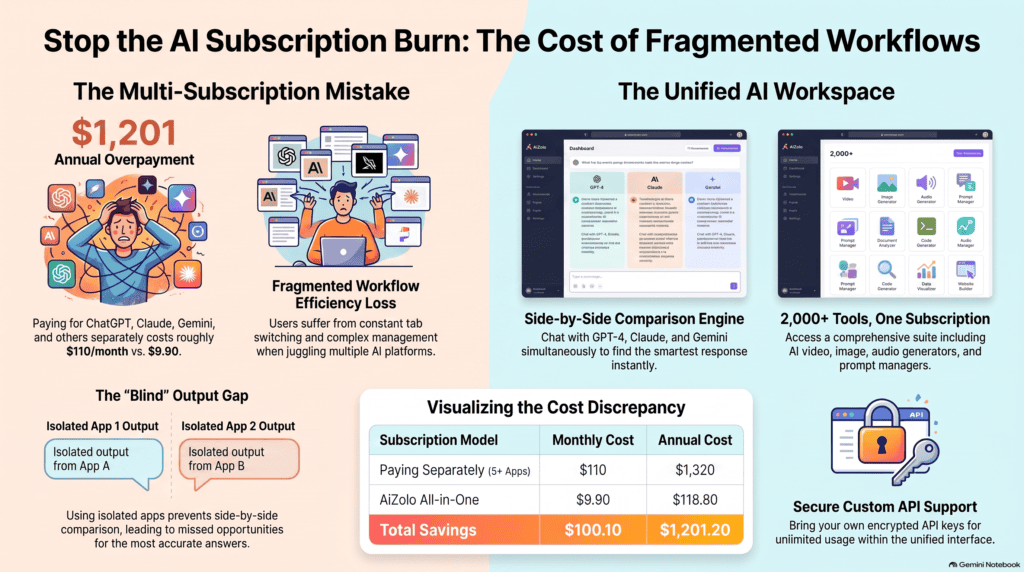
If your team is also managing access to multiple AI models across providers for building and testing these pipelines, comparing subscription costs across AI providers can meaningfully affect your evaluation budget — since LLM-as-a-judge testing runs through the same paid model APIs your product uses.
Frequently Asked Questions
1. What is the difference between AI testing and traditional QA? Traditional QA validates deterministic logic with fixed pass/fail assertions. AI testing scores probabilistic output against graded metrics like accuracy, groundedness, and safety, because the same input can produce different — sometimes still-correct — outputs.
2. Do I need a dedicated AI testing framework if I’m only using a third-party model API? Yes. Even without training your own model, you’re responsible for validating your prompts, retrieval logic, and output handling — the model provider is only responsible for the underlying model’s general capability.
3. Can I use Selenium or Cypress to test AI features? You can use them for UI-level interactions, but they can’t score output correctness, factuality, or hallucination. Pair them with a dedicated evaluation framework for the AI-specific layer.
4. How much does AI evaluation typically cost at scale? Costs scale with evaluation volume, since LLM-as-a-judge scoring consumes tokens per test case. Teams typically manage this by running lightweight checks on every commit and full evaluation suites only on merges or nightly builds.
5. What’s the difference between RAG evaluation and general LLM evaluation? RAG evaluation specifically separates retrieval quality (did the system find the right documents?) from generation quality (did the model use them correctly?). General LLM evaluation doesn’t isolate that retrieval step.
6. Is open-source or commercial better for enterprise AI testing? Neither is universally better. Open-source offers control and cost efficiency; commercial platforms offer faster setup and cross-functional accessibility. Many enterprises use both together.
7. How do I test AI agents differently from chatbots? Agent testing validates tool selection, argument correctness, and multi-step task completion, not just single-turn response quality. A chatbot test suite alone won’t catch an agent calling the wrong API with the wrong parameters.
8. What is hallucination testing, exactly? It’s the process of checking whether a model’s claims are supported by its source material or ground truth, typically using groundedness scoring or LLM-as-a-judge comparison against retrieved context.
9. How often should I re-run my evaluation suite? On every prompt or code change through CI, and additionally on a schedule (daily or weekly) to catch drift caused by upstream model provider updates you didn’t initiate.
10. What is self-healing testing? It refers to AI-driven test automation — most notably in newer Playwright workflows — where an agent detects a broken UI locator and automatically proposes or applies a fix, reducing the maintenance burden of brittle selector-based tests.
11. Do I need human reviewers if I already have automated evaluation metrics? Yes, for high-risk or ambiguous outputs. Automated metrics are strong at scale but imperfect at nuance — a sampling-based human review process closes that gap.
12. What’s model drift, and how is it different from a regression? A regression is typically caused by a change you made (prompt, code, retrieval config). Drift is a quality change caused by external factors — an upstream model update, shifting user behavior, or stale data — that you didn’t directly trigger.
13. Which framework should a solo developer start with? An open-source, CI-native tool like DeepEval or Promptfoo is usually the fastest path — low setup overhead, direct integration with existing test pipelines, and no vendor cost.
14. Does AI testing replace the need for traditional software tests? No. AI testing adds a new layer for output quality; you still need traditional unit, integration, and UI tests for the deterministic parts of your application (auth, data handling, API contracts).
Conclusion
Testing frameworks for AI tools aren’t an optional add-on to your QA process anymore — they’re the layer that determines whether your AI features are trustworthy enough to ship. The teams getting this right aren’t using a single silver-bullet tool; they’re layering pre-deployment evaluation, CI-gated regression testing, and production observability into one pipeline, with human review reserved for the cases that actually need judgment.
Start small, pick tools that match your architecture rather than the loudest marketing claims, and treat your evaluation suite with the same discipline you’d apply to your codebase: versioned, reviewed, and continuously maintained.
Author
Author: Jeevesh Email: jeevesh@aizolo.com
Jeevesh is an AI and software engineering specialist focused on evaluation infrastructure, enterprise AI tooling, and search-optimized technical content. With hands-on experience building and testing production LLM applications, he writes about the practical realities of shipping reliable AI systems — from RAG pipelines to autonomous agents — rather than theoretical best practices. His work bridges software engineering, QA methodology, and applied AI, helping engineering teams and technical decision-makers choose infrastructure that holds up under real production load. He also covers the broader AI tooling and subscription landscape for Aizolo, helping technical teams navigate model access and platform costs.
Image 3
- Placement: Within “Agent Testing” / “Multi-Agent Testing” section
- AI Image Prompt: Flat vector editorial illustration, modern SaaS style, white background, blue gradient, three abstract robot-like agent icons in a triangular formation with connecting arrows indicating handoff and coordination, minimal and premium, no text, no watermark, futuristic enterprise style consistent with prior images
- Caption: Multi-agent testing validates coordination and handoffs between autonomous AI agents
- Alt Text: Multi-agent AI testing diagram showing agent coordination and task handoff
- Filename: multi-agent-ai-testing-diagram.png