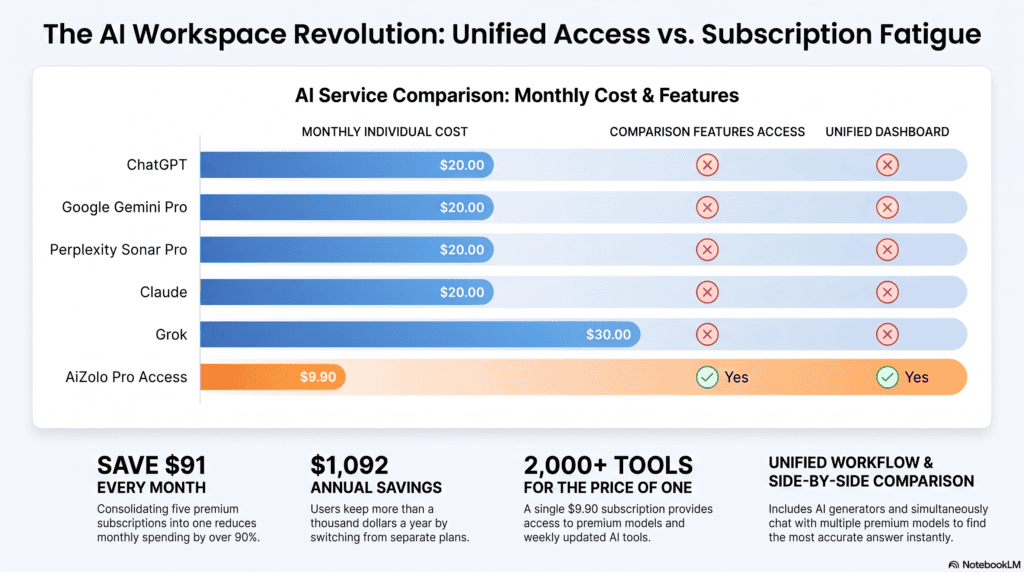
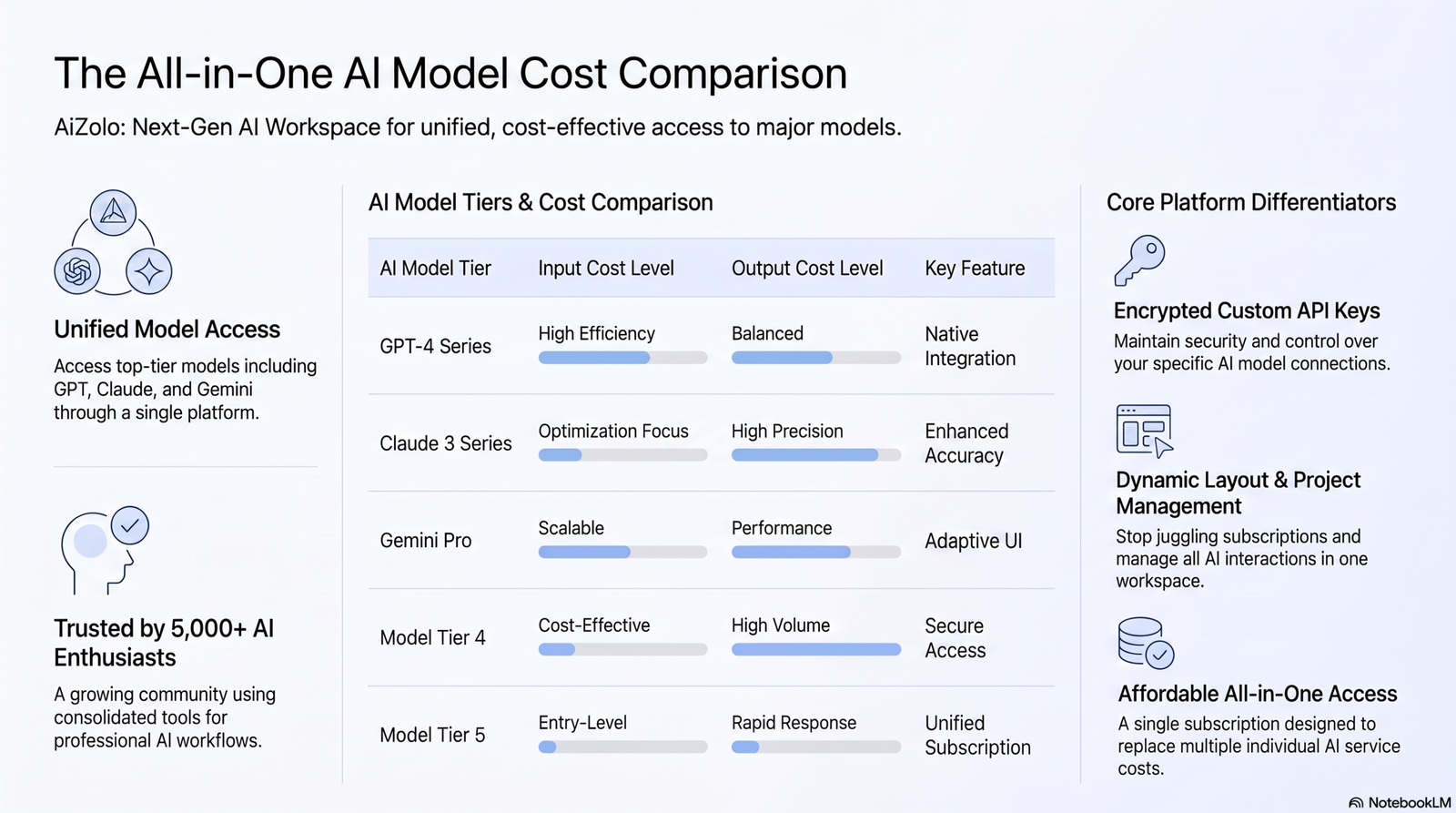
Every major AI buying decision in 2026 eventually runs into the same question: does it make sense to build on an American model, or is there a credible alternative? That question is why so many teams now research Mistral AI strengths weaknesses 2026 before committing budget to an API. Platforms like Aizolo also make this comparison easier by giving users access to multiple leading AI models from a single workspace.
Mistral AI, the Paris-based lab founded by former Meta and Google DeepMind researchers, has spent the last two years proving that frontier-adjacent AI doesn’t have to originate in California. Its open-weight releases, aggressive pricing, and EU-hosted infrastructure have made it a serious shortlist item for developers, startups, and regulated enterprises alike.
Open-weight models have also become a mainstream procurement category rather than a hobbyist curiosity. Enterprises now weigh licensing terms, self-hosting costs, and data control alongside raw benchmark scores — and Mistral sits at the center of that shift.
That’s also why Mistral keeps getting compared against GPT, Claude, and Gemini. It isn’t trying to out-benchmark the very top of the leaderboard on every task. Instead, it competes on cost, deployment flexibility, and European data sovereignty — a different value proposition that deserves its own honest evaluation.
This guide breaks down Mistral AI’s real strengths and weaknesses in 2026, backed by benchmark data, pricing research, and documented enterprise use, so you can decide whether it belongs in your stack.
Table of Contents
What Is Mistral AI Latest Model?
The Open-Weight Philosophy
Mistral has consistently released open-weight models alongside its commercial API offerings. This dual-track approach — free weights for self-hosting, paid API access for convenience — is central to its identity and a key differentiator from OpenAI, Anthropic, and Google, none of which release flagship model weights.
Latest Models in 2026
By mid-2026, Mistral’s lineup has expanded well beyond its original 7B model. The current family spans several tiers:
| Model | Role | Notes |
|---|---|---|
| Mistral Large 3 | Flagship, open-weight MoE | 675B total parameters, ~41B active per token; released December 2025 |
| Mistral Medium 3.5 | Balanced enterprise model | Dense 128B model combining reasoning, coding, and multimodal input |
| Mistral Small 4 | Efficient hybrid model | Instruct, reasoning, and coding in one budget-tier model |
| Ministral 3 (3B/8B/14B) | Edge and on-device | Targets phones, laptops, and embedded hardware |
| Magistral | Dedicated reasoning family | Competes with OpenAI’s o-series reasoning models |
| Devstral 2 / Codestral | Coding-focused models | Devstral 2 targets autonomous coding agents; Codestral targets IDE completion |
| Voxtral | Speech (TTS and transcription) | Newer addition expanding Mistral beyond text |
Mistral also operates Le Chat (its consumer assistant, sometimes marketed under the “Vibe” branding for agentic workflows) and Forge, an enterprise platform for training custom models on proprietary data.
Why Mistral AI Became Popular
Several factors converged to push Mistral into serious enterprise conversations rather than niche developer circles.
Open-source ecosystem. Mistral’s willingness to release weights — even for near-frontier models — gave developers something OpenAI and Anthropic don’t offer: the ability to inspect, fine-tune, and self-host.
Lower cost. Mistral’s API pricing has consistently undercut GPT and Claude flagship tiers, sometimes dramatically, making it attractive for high-volume production workloads.
European AI ecosystem. As data sovereignty regulation tightened across the EU, Mistral positioned itself as the default choice for organizations needing GDPR-aligned, EU-hosted infrastructure.
Enterprise deployment flexibility. On-premises deployment and private cloud options matter enormously to regulated industries like finance, healthcare, and defense — sectors where sending data to a US-based API is a non-starter.
Mistral AI Strengths and Weaknesses 2026 (Full Breakdown)
This is the core of any honest Mistral AI strengths weaknesses 2026 analysis — the trade-offs that actually determine whether Mistral fits your use case.
Strengths
1. Fast, efficient inference. Mistral’s mixture-of-experts architecture activates only a fraction of total parameters per token, keeping inference costs and latency lower than dense models of comparable capability — though independent testing has shown Large 3 can lag behind Gemini on raw response speed in some benchmarks.
2. Strong coding ability for scoped tasks. Devstral and Codestral perform well on single-file coding, scaffolding, test generation, and IDE-style code completion, with Devstral’s smaller variant scoring competitively on SWE-bench Verified against other open-source models.
3. Open-weight models. Mistral remains one of the only labs releasing genuinely capable open-weight models at multiple size tiers, giving developers a self-hosting option that OpenAI, Anthropic, and (for flagship models) Google don’t provide.
4. On-premises and private deployment. Enterprises with strict compliance requirements can deploy Mistral models inside their own infrastructure rather than relying solely on a hosted API.
5. Enterprise privacy and EU data residency. Mistral’s EU-hosted API and French headquarters make it the practical default for European organizations navigating GDPR.
6. Lower infrastructure costs. Smaller, efficient models like Small 4 and the Ministral family can run on modest hardware, reducing both cloud and on-device costs.
7. API flexibility. Mistral supports function calling, structured outputs, and a broad set of integration patterns aimed squarely at developer workflows.
8. Fine-tuning capability. Open weights make custom fine-tuning straightforward for teams with the ML expertise to do it, and Forge extends this into full custom model training on proprietary data.
9. Multilingual support. Mistral Large’s performance in French, German, Spanish, and Italian is consistently competitive with — and in some evaluations ahead of — models trained predominantly on English data.
10. Efficient small models. The Ministral family targets edge and embedded deployment, an area where GPT and Claude have limited presence.
Weaknesses
1. Trails the very top on hardest reasoning benchmarks. Independent evaluations put Mistral Large 3 meaningfully behind Gemini 3.1 Pro, GPT-5.x, and Claude Opus on the toughest reasoning tests like GPQA Diamond, even though it holds up well on MMLU-Pro and MATH-500.
2. Smaller ecosystem and fewer integrations. Compared to OpenAI’s plugin and integration marketplace, Mistral’s third-party tooling ecosystem is considerably thinner, which often means more custom development work.
3. Less polished consumer product. Le Chat lags behind ChatGPT and Claude’s consumer apps in feature completeness, and several reviewers note it’s less forgiving of loosely worded prompts.
4. Multi-file coding limitations. While single-file coding is a genuine strength, several independent tests found Mistral’s coding models struggle to maintain consistency across multi-file, interdependent codebases — a gap where Claude and GPT-4/GPT-5-class models still lead.
5. Benchmark and pricing inconsistency across trackers. Third-party sources frequently disagree on Mistral’s exact pricing and even some benchmark figures, partly a byproduct of Mistral’s rapid release cadence — always verify current numbers directly on mistral.ai before budgeting.
6. Smaller context windows on some models. Mistral Large 3 tops out at 256K tokens, while GPT, Claude, and Gemini flagships have converged around 1-million-token context windows — a real disadvantage for massive document analysis.
7. Limited creative writing polish. Several reviews report that Mistral’s output for fiction, marketing copy, and other creative tasks feels more condensed and less imaginative than GPT’s.
8. Support responsiveness. Multiple independent reviews describe Mistral’s customer support as slow, which matters more for teams without in-house AI infrastructure expertise.
9. Steep learning curve for self-hosting. Getting real value from the open-weight models typically requires a dedicated infrastructure team — it’s a raw engine, not a finished product, as several reviewers put it.
10. Smaller plugin/agent ecosystem. Vibe (Mistral’s agent platform) is newer and less mature than the agent tooling built around OpenAI and Anthropic’s ecosystems.
Strength vs Weakness Quick-Reference Table
| Dimension | Mistral’s Position |
|---|---|
| Cost efficiency | Strong advantage |
| Open-weight availability | Strong advantage |
| EU data residency | Strong advantage |
| Multilingual (European languages) | Strong advantage |
| Single-file coding | Competitive |
| Multi-file / complex coding | Behind Claude and GPT |
| Hardest reasoning benchmarks | Behind Gemini, GPT, Claude |
| Context window | Behind (256K vs ~1M for rivals) |
| Ecosystem / integrations | Behind OpenAI |
| Creative writing | Behind GPT |
| Consumer app polish | Behind ChatGPT and Claude |
Performance Benchmarks: Mistral vs GPT, Claude, Gemini, Llama, DeepSeek
Quick answer (featured snippet target): Mistral Large 3 performs competitively with mid-tier GPT and Claude models on general reasoning and coding benchmarks, but trails the top-ranked Claude Opus, GPT-5.x, and Gemini 3.1 Pro models on the hardest reasoning tests, while offering substantially lower API pricing and open weights.
General Benchmark Comparison
| Model | MMLU-Pro / Knowledge | Hardest Reasoning (GPQA-class) | Coding (SWE-bench-class) | Context Window | Open Weights |
|---|---|---|---|---|---|
| Mistral Large 3 | ~73% | ~44% | Competitive on scoped tasks | 256K | Yes |
| GPT-5.x (flagship) | Frontier-tier | Leads or near-leads | Strong | ~1M | No |
| Claude Opus (latest) | Frontier-tier | Leads on many reasoning tasks | Leads on SWE-bench-class tests | ~1M | No |
| Gemini 3.1 Pro | Frontier-tier | Leads on GPQA Diamond | Strong, especially multimodal | ~1M | Partial (Gemma only) |
| DeepSeek V4 Pro | Near-frontier | Competitive | Competitive | Large | Yes |
| Llama 4 (Meta) | Strong | Competitive | Strong | Up to 10M (Scout) | Yes |
Benchmark figures shift frequently as labs release new versions; treat this table as directional and verify current scores against Artificial Analysis, LMSYS/LMArena, or each vendor’s official model card before making procurement decisions.
What the Numbers Actually Mean
Static leaderboard scores tell you a model’s ceiling, not how it will behave on your specific workload. Frontier models have converged close enough on public benchmarks that real differentiation now shows up in tool-calling reliability, long-horizon task recovery, and cost at scale — none of which a single MMLU number captures.
Mistral’s own testing and third-party evaluations agree on one pattern: it competes well on general knowledge and mathematics but falls further behind on the very hardest reasoning benchmarks, where labs with larger training budgets still hold an edge.
Best Use Cases for Mistral AI
| Use Case | Fit | Notes |
|---|---|---|
| Coding (scaffolding, single-file, IDE completion) | Strong | Devstral/Codestral excel here |
| Coding (complex multi-file production systems) | Weaker | Claude/GPT still preferred |
| Customer support automation | Strong | Cost-efficient at high volume |
| RAG (retrieval-augmented generation) | Strong | Efficient inference suits high query volume |
| Enterprise search | Strong | Multilingual strength helps |
| Legal document review | Moderate | Verify accuracy on nuanced clauses |
| Healthcare (non-diagnostic support) | Moderate | Data residency is a genuine advantage |
| Education | Strong | Cost-efficient for high-volume tutoring apps |
| Content generation (structured) | Strong | Reports, summaries, structured copy |
| Content generation (creative) | Weaker | GPT rated ahead for fiction/marketing tone |
| Autonomous agents | Growing | Vibe platform is newer than rivals |
Mistral AI Pricing in 2026
Mistral’s pricing has changed several times across 2025–2026 as new model generations shipped, and third-party trackers currently disagree on exact figures for some models — a symptom of how fast Mistral’s release cadence has moved. Always confirm current rates on mistral.ai/pricing before finalizing a budget.
Approximate API Pricing (per 1M tokens, USD)
| Model | Input | Output | Context |
|---|---|---|---|
| Ministral 3B/8B | ~$0.04–$0.10 | ~$0.04–$0.10 | Edge-optimized |
| Mistral Small 4 | ~$0.15–$0.20 | ~$0.60 | Budget general-purpose |
| Codestral | ~$0.30 | ~$0.90 | 32K, code-focused |
| Mistral Large 3 | ~$0.50–$2.00* | ~$1.50–$6.00* | 256K |
| Mistral Medium 3.5 | ~$1.50 | ~$7.50 | Flagship-adjacent |
| Magistral Medium (reasoning) | ~$2.00 | ~$5.00 | Reasoning-tuned |
*Trackers disagree meaningfully on Large 3’s exact rate; figures as low as $0.50/$1.50 and as high as $2.00/$6.00 both appear in current pricing guides. Verify directly with Mistral before budgeting.
How Mistral Compares on Cost
- Against Claude and GPT flagship tiers, Mistral’s output pricing is typically a fraction of the cost — multiple trackers cite savings in the range of 60–90% on output tokens.
- Against DeepSeek, the comparison is closer: DeepSeek’s budget tier often undercuts Mistral’s equivalent tier, while Mistral’s edge is EU data residency rather than being the absolute cheapest option.
- A free tier exists for experimentation, and batch API pricing offers roughly 50% savings for non-latency-sensitive workloads.
Deployment Options
| Option | Description |
|---|---|
| La Plateforme (hosted API) | Pay-as-you-go, EU-hosted |
| Open-weight self-hosting | Free weights, your own infrastructure/GPU costs |
| Forge | Enterprise platform for custom model training |
| Cloud marketplaces | Available via major cloud partners for enterprise procurement |
Mistral AI vs GPT
Quick answer: GPT remains the more polished, broadly capable, and better-integrated option for general consumer use and complex multi-file coding, while Mistral wins on price, open-weight flexibility, and EU data control.
| Factor | Mistral | GPT |
|---|---|---|
| Reasoning ceiling | Behind on hardest benchmarks | Leads or near-leads |
| Coding (complex) | Weaker on multi-file work | Stronger |
| Pricing | Significantly cheaper | Premium |
| Open weights | Yes | No |
| Ecosystem/integrations | Smaller | Much larger |
| Data residency (EU) | Native advantage | Limited by comparison |
| Creative writing | Weaker | Stronger |
Mistral AI vs Claude
Quick answer: Claude generally leads on complex coding and nuanced reasoning tasks, while Mistral offers dramatically lower cost per token and the option to self-host — a trade-off between raw capability and cost/control.
| Factor | Mistral | Claude |
|---|---|---|
| Complex coding (multi-file, agentic) | Weaker | Stronger, especially on SWE-bench-class tests |
| Cost per output token | Much lower | Premium |
| Open weights | Yes | No |
| Long-context handling | 256K ceiling | Larger context windows |
| Enterprise deployment | On-prem available | API/cloud-focused |
Mistral AI vs Gemini
Quick answer: Gemini leads on native multimodal capability (text, image, audio, video in one API) and inference speed, while Mistral’s advantages are cost, open weights, and portability across infrastructure.
| Factor | Mistral | Gemini |
|---|---|---|
| Multimodal breadth | Narrower | Broadest (text/image/audio/video) |
| Inference speed | Slower in independent tests | Notably fast |
| Cost | Lower | Competitive but higher at flagship tier |
| Portability/self-hosting | Yes | No |
| Google ecosystem integration | None | Deep |
Mistral AI vs DeepSeek
Quick answer: Both are open-weight-friendly and budget-conscious, but Mistral’s differentiator is EU data residency and GDPR alignment, while DeepSeek frequently undercuts Mistral on raw price and offers a China-based hosting model that raises separate data-sovereignty questions for Western enterprises.
| Factor | Mistral | DeepSeek |
|---|---|---|
| Pricing | Competitive | Often cheaper at equivalent tiers |
| Data residency | EU-hosted | China-based |
| Open weights | Yes | Yes |
| Enterprise trust (regulated EU industries) | Strong | Limited by geography |
| Reasoning benchmarks | Competitive | Competitive, sometimes ahead at budget tier |
Who Should Use Mistral AI?
- Developers who want a capable, self-hostable open-weight model for local development or fine-tuning.
- Startups that need to control API costs while scaling usage.
- Researchers working with model internals, requiring open weights for experimentation.
- European businesses with GDPR or data-residency requirements.
- Multilingual products, particularly those serving French, German, Spanish, or Italian-speaking markets.
- Students and learners exploring open-source AI without needing enterprise budgets.
Who Should Avoid It?
Being honest about fit matters as much as listing strengths.
- Teams needing frontier-level reasoning for the hardest analytical tasks may be better served by Claude Opus, GPT-5.x, or Gemini 3.1 Pro.
- Teams building complex, multi-file production codebases may find Claude or GPT more reliable today.
- Applications requiring very long context (multi-hundred-page documents, large codebases in a single pass) will hit Mistral’s 256K ceiling sooner than rivals near 1M tokens.
- Teams without dedicated infrastructure expertise may struggle to get full value from self-hosted open-weight deployment.
- Projects requiring polished creative writing output may prefer GPT or Claude for tone and originality.
Real-World Examples and Enterprise Adoption
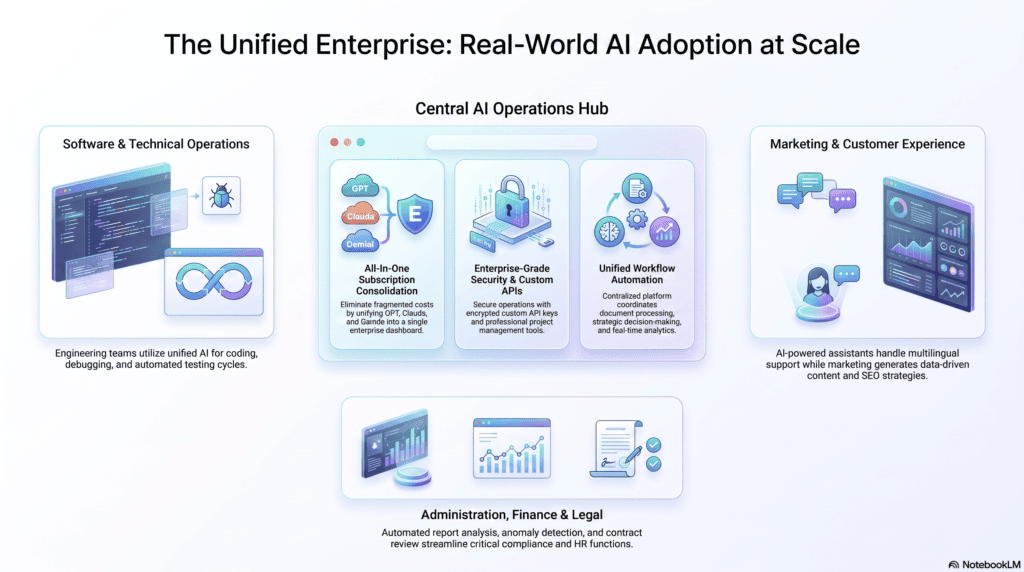
Mistral’s enterprise traction has moved well past pilot projects. Organizations across finance, industrial manufacturing, and logistics have adopted Mistral models in production, drawn by a combination of EU data residency, cost efficiency, and the option to deploy on-premises for sensitive workloads.
The company’s Forge platform extends this further, letting enterprises train fully custom models on proprietary data rather than relying solely on fine-tuning a general-purpose model — a meaningful differentiator for organizations with large, unique datasets.
On the developer side, Mistral’s coding models are commonly used inside agent scaffolds for scoped automation tasks — test generation, boilerplate creation, and single-file refactors — rather than as the sole engine behind fully autonomous, multi-repository coding agents.
Common Mistakes When Evaluating Mistral AI
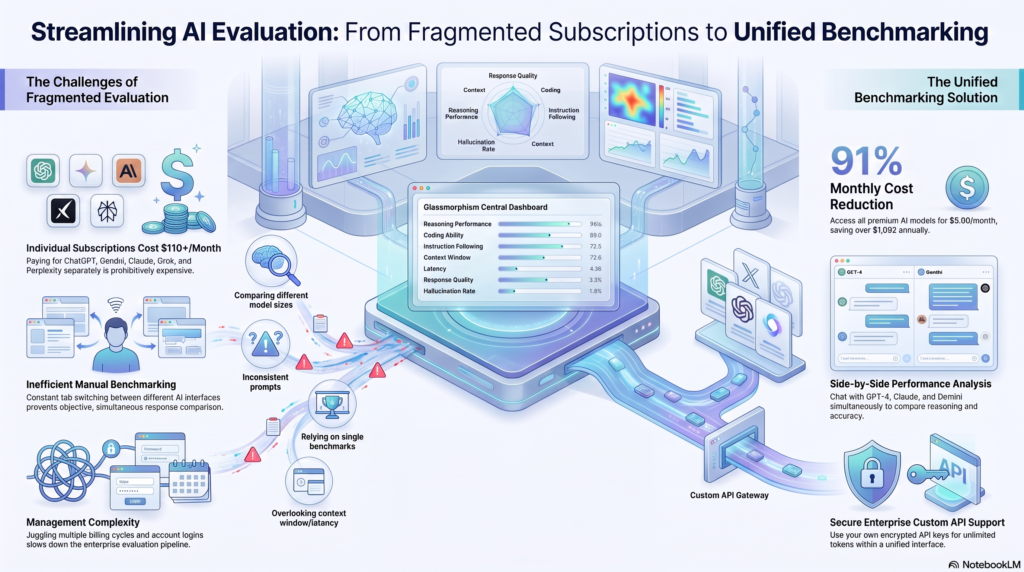
- Comparing only benchmark scores without testing on your actual workload — leaderboard rank rarely predicts production performance.
- Assuming open weights mean zero cost — self-hosting shifts cost to GPU infrastructure and engineering time.
- Ignoring context window limits when planning long-document or large-codebase use cases.
- Using outdated pricing figures — Mistral’s pricing has changed multiple times across 2025–2026, and third-party trackers often lag.
- Assuming EU hosting alone satisfies compliance — always verify specific regulatory requirements with legal counsel.
- Expecting multi-file coding parity with Claude or GPT without validating output on real, interdependent codebases first.
Frequently Asked Questions
Is Mistral AI good in 2026? Mistral AI is a strong, cost-efficient choice for developers, multilingual applications, and EU-based enterprises, though it trails GPT, Claude, and Gemini on the hardest reasoning benchmarks and complex multi-file coding tasks.
What is Mistral AI best used for? Mistral AI performs best for coding scaffolding, customer support automation, retrieval-augmented generation (RAG), enterprise search, and multilingual content — use cases where cost efficiency and speed matter as much as peak reasoning capability.
Is Mistral AI free to use? Mistral offers a free experimentation tier on its API plus fully free, open-weight models that can be self-hosted at zero licensing cost, though self-hosting still requires paying for compute infrastructure.
How does Mistral AI compare to ChatGPT? ChatGPT/GPT generally leads on complex reasoning, multi-file coding, and creative writing, while Mistral offers significantly lower API pricing and open-weight self-hosting that GPT does not provide.
Does Mistral AI have a context window limitation? Yes — Mistral Large 3 tops out around 256K tokens, while GPT, Claude, and Gemini flagship models have converged near 1 million tokens, making Mistral less suited to extremely long documents or codebases.
Is Mistral AI good for coding? Mistral’s Codestral and Devstral models perform well on single-file coding, scaffolding, and IDE completion, but independent testing shows weaker consistency on complex, multi-file production coding tasks compared to Claude and GPT.
Why do European companies prefer Mistral AI? Mistral is headquartered in Paris and hosts its API within the EU, giving it a structural advantage for GDPR compliance and data-residency requirements that US-based providers cannot match as directly.
Is Mistral AI open source? Mistral releases many of its models as open weights, including flagship-class releases like Large 3, though not every model in its lineup is open — some commercial-tier models remain API-only.
How much does Mistral AI cost compared to Claude and GPT? Mistral’s output pricing is typically a fraction of Claude and GPT flagship rates — often cited as 60–90% cheaper — though exact current pricing should always be verified directly on Mistral’s official pricing page.
What are Mistral AI’s biggest weaknesses? Mistral’s main weaknesses in 2026 are a smaller integration ecosystem, weaker performance on the hardest reasoning benchmarks, limited multi-file coding reliability, a smaller context window than rivals, and less polished creative writing output.
Can Mistral AI be deployed on-premises? Yes — Mistral’s open-weight models and enterprise offerings support on-premises and private cloud deployment, which is a significant advantage for regulated industries handling sensitive data.
Is Mistral AI a good alternative to DeepSeek? Mistral and DeepSeek are both open-weight-friendly and budget-conscious, but Mistral’s EU hosting makes it the preferred option for Western enterprises with data-sovereignty concerns, while DeepSeek is often cheaper at equivalent capability tiers.
Final Verdict
Mistral AI in 2026 isn’t trying to win every benchmark — and it doesn’t need to. Its real pitch is the combination of open weights, EU data sovereignty, efficient inference, and consistently aggressive pricing, which is exactly why it has become the default choice for a specific, growing segment of the market.
For teams prioritizing raw reasoning ceiling, complex multi-file coding, or the most polished consumer experience, GPT, Claude, or Gemini currently hold an edge. For teams prioritizing cost control, data residency, multilingual performance, or deployment flexibility, Mistral is a genuinely strong — and often underrated — option.
The honest takeaway from any fair look at Mistral AI strengths weaknesses 2026 is that there is no universal “best” model in 2026. There is only the model that fits your constraints, and for a meaningful share of real-world use cases, that model is Mistral.
Author Bio
Jeevesh Tripathi AI Researcher & Technical Content Writer Email: jeevesh@aizolo.com
Jeevesh Tripathi is an AI researcher and technical content writer specializing in large language models, enterprise AI platforms, and SEO-driven technical research. His work focuses on translating benchmark data and vendor documentation into balanced, practical guidance for developers and businesses evaluating AI tools.