
Table of Contents
Introduction
If you tried to track every Mistral AI model release in the first half of 2026, you probably lost count. That’s not an exaggeration — the Paris-based lab has shipped a new model roughly every ten weeks since its 2023 debut, and the pace only accelerated this year.
That speed is exactly why so many developers, founders, and IT teams feel stuck. Which Mistral AI models 2026 actually matter? Which ones are safe to retire from your stack? And which model genuinely fits your budget, your latency needs, or your compliance requirements?
This guide answers all three questions in one place. You’ll get a full model-by-model breakdown, real benchmark context, pricing details, self-hosting instructions, and side-by-side comparisons against GPT, Claude, Gemini, and Llama — so you can make a confident decision without reading ten different blog posts.
What Is Mistral AI?
Mistral AI is a French AI lab founded in April 2023 by Arthur Mensch, Guillaume Lample, and Timothée Lacroix — engineers who previously worked at Google DeepMind and Meta. The three met as students at École Polytechnique before founding the company.
The lab built its reputation on a simple bet: open-weight models could compete with closed frontier labs, not just imitate them. Mistral 7B, its first release, punched well above its parameter count and set the tone for everything that followed.
That open-weight philosophy is still Mistral’s clearest differentiator in 2026. Many of its flagship models — including Mistral Large 3 and Mistral Small 4 — ship under the Apache 2.0 license, meaning developers can download, modify, and self-host them without per-token fees.
Developers gravitate toward Mistral for three practical reasons: cost efficiency, European data residency, and an API that mirrors OpenAI’s format closely enough to swap in with minimal code changes.
By early 2026, that strategy was paying off commercially. Mistral’s annual recurring revenue reportedly jumped from around $20 million to roughly $400 million within a year, alongside a valuation near $14 billion.
Why Mistral AI Models Matter in 2026
Enterprise adoption of Mistral has moved well past pilot projects. Companies like ASML, HSBC, BMW, and CMA CGM now use Mistral models in production, and Mistral’s Forge platform lets enterprises train fully custom models on proprietary data rather than relying on fine-tuning alone.
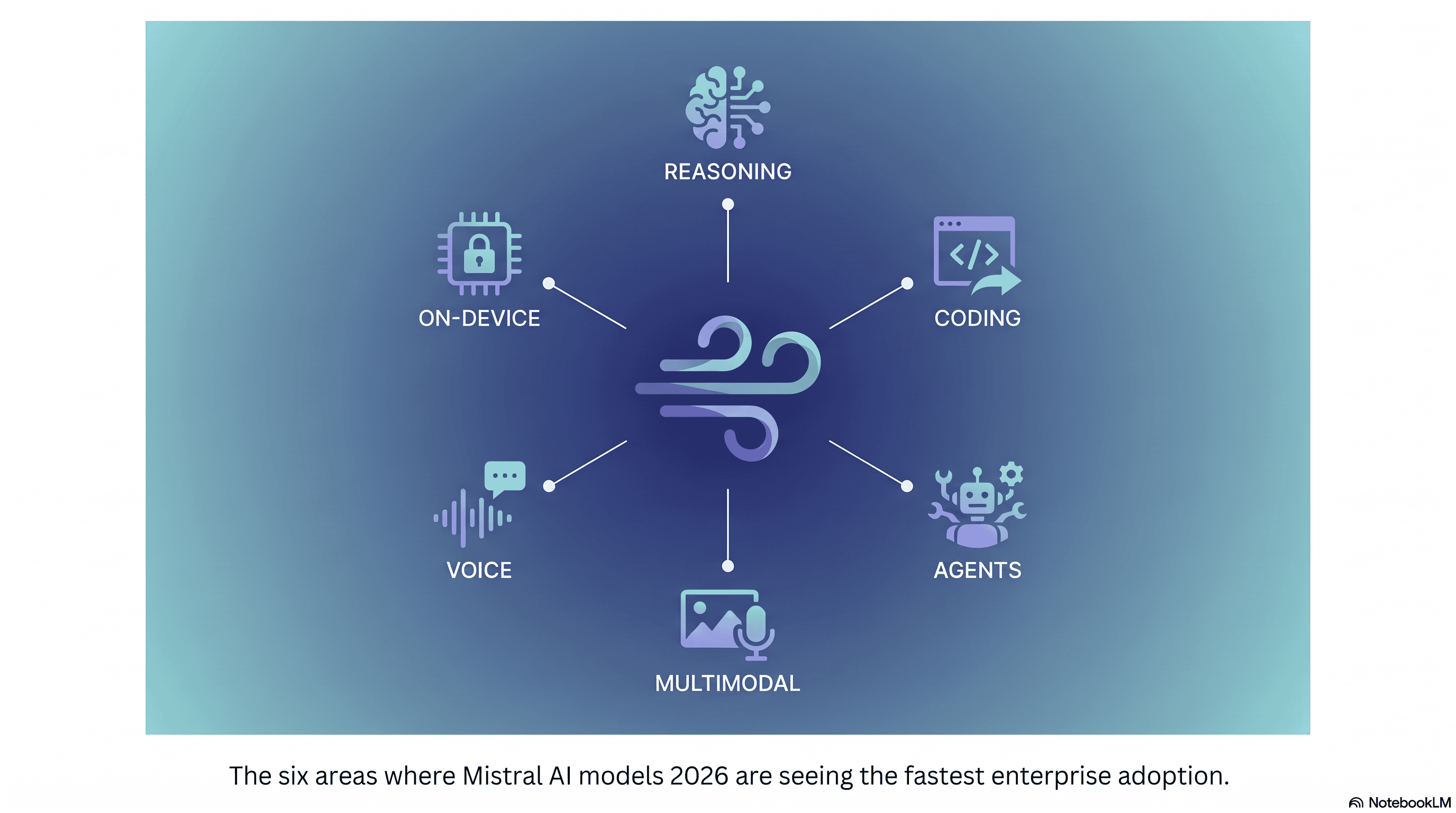
Where Mistral AI models 2026 are showing up most:
- Coding — Devstral 2 and Codestral power in-IDE completion and autonomous coding agents.
- Reasoning — Magistral and the reasoning-enabled Mistral Medium 3.5 handle multi-step logic and math.
- Agents — Mistral’s Vibe platform (the renamed Le Chat) orchestrates tool-calling agent workflows.
- Multimodal — Pixtral-derived capabilities are now folded into Small 4 and Medium 3.5.
- On-device AI — The Ministral 3 family (3B, 8B, 14B) targets phones, laptops, and embedded hardware.
- Voice — Voxtral TTS and Voxtral transcription models cover speech generation and understanding.
The open-source ecosystem around Mistral has also matured. Community fine-tunes, GGUF conversions, and Ollama-ready builds typically appear within days of an official release, which shortens the gap between “Mistral ships it” and “you can run it locally.”
Complete List of Mistral AI Models in 2026
Here is the current, official lineup as listed on Mistral’s own models page, current as of mid-2026.
| Model | Release Date | Parameters | Context Window | Open Weight | License | Best Use Case |
|---|---|---|---|---|---|---|
| Mistral Large 3 | Dec 2, 2025 | 675B total / 41B active (MoE) | 262K | Yes | Apache 2.0 | Flagship general-purpose + multilingual work |
| Mistral Medium 3.5 | Apr 29, 2026 | Not fully disclosed | 262K | Partially | Mixed | Enterprise reasoning, coding, agentic tasks |
| Mistral Small 4 | Mar 16, 2026 | 119B total / ~6B active (MoE) | 262K | Yes | Apache 2.0 | Configurable reasoning + multimodal on a budget |
| Devstral 2 | Dec 9–10, 2025 | 123B (Small 2: 24B) | 262K | Yes | Apache 2.0 | Autonomous, agentic software engineering |
| Codestral | Ongoing releases | Not disclosed | 32K–256K (version-dependent) | Premier | Mistral commercial | Low-latency code completion in IDEs |
| Ministral 3 (3B/8B/14B) | Dec 2, 2025 | 3B / 8B / 14B | 131K–262K | Yes | Apache 2.0 | Edge and on-device deployment |
| Magistral (Small/Medium) | Jun 10, 2025 | 24B (Small) | Varies | Small: Yes | Apache 2.0 (Small) | Dedicated multilingual reasoning |
| Voxtral TTS | Mar 23, 2026 | Built on Ministral 3B | N/A | Yes | CC BY-NC 4.0 | Text-to-speech, voice cloning |
| Voxtral Mini Transcribe / Small | 2026 | Not disclosed | N/A | Mostly Yes | Mixed | Speech-to-text, audio understanding |
| OCR 4 | 2026 | Not disclosed | N/A | Premier | Mistral commercial | Document extraction and understanding |
| Codestral Embed | 2026 | Not disclosed | N/A | Premier | Mistral commercial | Code + text embeddings |
| Leanstral | Mar 16, 2026 | Not disclosed | N/A | Labs | Mistral Labs | Formal proof engineering (Lean 4) |
| Mistral NeMo | Earlier release, still active | 12B | 128K | Yes | Apache 2.0 | Lightweight legacy coding/general tasks |
| Mistral Embed | Ongoing | Not disclosed | N/A | Premier | Mistral commercial | Semantic search embeddings |
Note on accuracy: Exact parameter counts for Medium 3.5 and several specialist models are not fully published by Mistral. Where data is unconfirmed, treat third-party figures as estimates rather than official specs.
Detailed Review of Every Important Model
Mistral Large 3
Overview: Mistral Large 3 is Mistral’s flagship open-weight model, released December 2, 2025. It’s a sparse mixture-of-experts (MoE) design with 675 billion total parameters, of which only 41 billion activate per token.
Architecture: The MoE approach means Large 3 delivers frontier-scale capacity while keeping inference costs closer to a much smaller dense model — a major reason it remains cost-competitive against proprietary rivals.
Performance: Independent evaluations report roughly 73% on MMLU-Pro and around 93.6% on MATH-500, putting it among the strongest open-weight models on these benchmarks.
Pros: Fully open weights under Apache 2.0, strong multilingual support, massive 262K context window, competitive academic benchmark scores.
Cons: As a non-reasoning model, it trails purpose-built reasoning models on the hardest logic benchmarks, and its output speed (reportedly around 38 tokens/sec in third-party testing) is slow for its class.
Who should use it: Teams that need a capable, self-hostable generalist for long-document analysis, enterprise search, or multilingual production workloads.
Mistral Medium 3.5
Overview: Released April 29, 2026, Medium 3.5 is positioned as Mistral’s balance point — strong performance without Large 3’s infrastructure demands.
Architecture: Mistral markets it around simplified enterprise deployment, combining reasoning, coding, agentic tool-use, and multimodal input in a single model family.
Performance: Mistral’s own pricing FAQ recommends Medium 3.5 specifically for coding tasks, suggesting it’s tuned to compete directly with coding-focused rivals rather than being a pure generalist.
Pros: Broad capability set in one model, easier enterprise integration, positioned as the practical default for coding-heavy teams.
Cons: Mistral hasn’t published the same level of open benchmark detail for this model as it has for Large 3, so third-party verification is thinner.
Who should use it: Businesses that want one model to cover coding, reasoning, and agent workflows without juggling separate specialist APIs.
Mistral Small 4
Overview: Released March 16, 2026, Small 4 unifies what used to be three separate products — Magistral’s reasoning, Pixtral’s multimodal vision, and Devstral’s agentic coding — into a single configurable model.
Architecture: It’s a 119-billion-parameter MoE model, but only about 6 billion parameters activate per token, which keeps latency and cost low despite the large total footprint.
Performance: Mistral reports roughly 40% faster end-to-end completion and about 3x more requests per second compared to the previous Small 3 generation.
Pros: A single reasoning_effort parameter lets developers dial reasoning depth up or down at runtime — “none” for fast chat, “high” for Magistral-level depth — without switching models. Pricing around $0.15 per million input tokens makes it one of the cheapest multimodal-reasoning options on the market.
Cons: At the “none” setting it’s a lightweight model, so don’t expect frontier-level reasoning without turning the effort dial up (which raises latency and cost accordingly).
Who should use it: Developers who want one flexible endpoint instead of managing three separate specialist models.
Devstral 2 (and Devstral Small 2)
Overview: Released in December 2025, Devstral 2 is Mistral’s dedicated agentic coding model, built in collaboration with All Hands AI. Devstral Small 2 (24B) is the self-hostable companion model.
Architecture: Devstral integrates with coding agent scaffolds such as OpenHands and SWE-Agent, giving it a genuine interface into a live codebase rather than just generating isolated code snippets.
Performance: Devstral Small reportedly scores around 46.8% on SWE-Bench Verified — a meaningful result for a model small enough to run on a single RTX 4090 or a 32GB Mac.
Pros: Strong tool-calling reliability for multi-step agent runs, genuinely local deployment with zero API costs at the Small tier.
Cons: Specialization has a cost — Devstral underperforms Large or Medium on general, non-coding reasoning tasks.
Who should use it: Teams building autonomous coding agents, or any developer who wants a self-hosted coding assistant with no per-token bill.
Codestral
Overview: Codestral is Mistral’s low-latency completion model, purpose-built for IDE-style fill-in-the-middle and code generation rather than long agentic runs.
Performance: It’s optimized for speed over reasoning depth, which is exactly what autocomplete-style workflows need.
Pros: Fast, cheap, and widely supported across IDE plugins and third-party coding tools.
Cons: Not designed for multi-step agentic tasks — pair it with Devstral or Medium 3.5 for that.
Who should use it: Developers who want responsive in-editor code completion rather than a full coding agent.
Ministral 3 Family (3B, 8B, 14B)
Overview: Released December 2, 2025, the Ministral 3 family targets edge and on-device deployment, from mobile apps to embedded systems.
Performance: Third-party testing places Ministral 8B roughly on par with other small efficient models like GLM-4.7 Flash on simple tasks, while the 14B variant offers a meaningful step up for a modest price increase.
Pros: Extremely cheap (roughly $0.10–$0.20 per million tokens depending on size), runs comfortably on consumer hardware via Ollama.
Cons: Not built for complex reasoning or long tool-calling chains — these are lightweight models by design.
Who should use it: Mobile app developers, hobbyists, and anyone running inference on constrained hardware.
Magistral (Small & Medium)
Overview: Launched June 10, 2025, Magistral was Mistral’s first dedicated reasoning family, built for transparent, multi-step chain-of-thought across multiple languages including English, French, Spanish, German, Arabic, and Chinese.
Pros: Magistral Small is free to self-host under Apache 2.0 — a real differentiator against closed reasoning models that require API access only.
Cons: On raw math benchmarks, third-party comparisons still favor some proprietary reasoning models on the hardest problems.
Who should use it: Teams that want dedicated, transparent reasoning without vendor lock-in — though note that much of this capability has since been folded into Small 4 and Medium 3.5.
Voxtral TTS and Voxtral Transcribe
Overview: Voxtral TTS, released March 23, 2026, is Mistral’s first open-weight text-to-speech model, built on the Ministral 3B backbone and supporting nine languages.
Performance: It supports zero-shot voice cloning from as little as three seconds of reference audio and cross-lingual generation — producing English speech from a French voice sample, for instance.
Pros: Compact footprint (as low as ~3GB quantized), competitive pricing against ElevenLabs-style providers.
Cons: Voxtral TTS is licensed under CC BY-NC 4.0 — non-commercial only — making it the one major 2026 release that isn’t Apache 2.0. Commercial use requires a separate agreement.
Who should use it: Hobbyists and researchers first; commercial voice-agent builders will need to negotiate licensing.
OCR 4
Overview: OCR 4 is Mistral’s document extraction and understanding model, positioned as a premier (paid, non-open) offering.
Who should use it: Businesses processing large volumes of scanned documents, contracts, or forms that need structured extraction.
Best Mistral Models for Coding
| Model | Best For | Context | Notes |
|---|---|---|---|
| Devstral 2 | Autonomous agentic coding | 262K | Best tool-calling reliability in the lineup |
| Devstral Small 2 | Local, self-hosted coding agents | 262K | Runs on a single consumer GPU |
| Codestral | Fast IDE completion | Version-dependent | Optimized for latency, not deep reasoning |
| Mistral Medium 3.5 | General coding + reasoning combined | 262K | Mistral’s own recommendation for coding tasks |
For IDE integration, Codestral plugs into most major editors through community and official extensions, while Devstral is better suited to command-line agent scaffolds like OpenHands. On SWE-Bench-style benchmarks, Devstral consistently outperforms general-purpose models like Large 3 on coding-specific tasks, though it gives up some ground on general reasoning.
Best Mistral Models for Reasoning
Magistral remains Mistral’s reasoning specialist brand, but its capability now lives inside two products: standalone Magistral Small/Medium, and the reasoning_effort="high" mode inside Mistral Small 4.
For budget-conscious, self-hosted reasoning, Magistral Small (Apache 2.0) is the standout — it’s genuinely free to run and supports transparent, multilingual chain-of-thought. For enterprise reasoning without self-hosting, Mistral Medium 3.5 is the more practical default.
Best Models for Agents
Mistral’s agent story runs through Vibe (the renamed Le Chat) and Vibe for Code, which orchestrate tool-calling, connectors, and remote coding agents. Underneath, Devstral 2 and Medium 3.5 do the heavy lifting for multi-step tool chains.
Key agentic capabilities available in 2026: connectors (including custom MCP connectors), workflows, hooks, remote coding agents, and remote agent observability — all available starting at the Pro tier.
Best Open-Source Models
| Model | License | Why It Matters |
|---|---|---|
| Mistral Large 3 | Apache 2.0 | Largest open-weight MoE model from a major lab |
| Mistral Small 4 | Apache 2.0 | Best cost-to-capability ratio in the open lineup |
| Devstral Small 2 | Apache 2.0 | Genuinely free, local coding agent |
| Magistral Small | Apache 2.0 | Free, self-hosted reasoning |
| Ministral 3 (all sizes) | Apache 2.0 | Free edge deployment |
| Mistral NeMo | Apache 2.0 | Lightweight legacy option, still usable |
The consistent thread across Mistral’s open releases is Apache 2.0 licensing — permissive enough for most commercial use without per-token fees, provided you’re self-hosting.
Mistral vs GPT vs Claude vs Gemini vs Llama
Mistral vs GPT
| Factor | Mistral | GPT (OpenAI) |
|---|---|---|
| Open weights | Yes, on flagship models | No |
| Data residency | EU-based, strong for compliance | US-based |
| Pricing | Generally lower | Premium tier pricing |
| Hardest reasoning benchmarks | Competitive, not leading | Often leads on frontier reasoning |
Mistral vs Claude
| Factor | Mistral | Claude (Anthropic) |
|---|---|---|
| Open weights | Yes | No |
| Coding agent ecosystem | Devstral + OpenHands/SWE-Agent | Claude Code |
| Self-hosting | Fully supported on open models | Not available |
| Long-context reasoning depth | Strong but not class-leading | Frequently benchmarks near the top |
Mistral vs Gemini
| Factor | Mistral | Gemini (Google) |
|---|---|---|
| Multimodal integration | Unified in Small 4 / Medium 3.5 | Deeply integrated across Google’s ecosystem |
| Cost | Very competitive at small-model tier | Gemini Flash-Lite is even cheaper on raw input pricing |
| Ecosystem lock-in | Minimal | Tighter Google Cloud integration |
Mistral vs Llama
| Factor | Mistral | Llama (Meta) |
|---|---|---|
| Licensing | Apache 2.0 (most models) | Meta’s own license, with usage restrictions at scale |
| Model cadence | Very frequent releases | Less frequent major releases |
| Commercial API | Native (Mistral Studio) | Requires third-party hosting |
Honest takeaway: Mistral isn’t the cheapest option available — some Chinese open-weight labs undercut it — and it isn’t the top scorer on the hardest reasoning benchmarks either. Its real strength is the combination of decent quality, EU data residency, strong multilingual performance, and genuine open-weight self-hosting.
Benchmarks Explained
| Benchmark | What It Measures | Mistral’s Relevant Model |
|---|---|---|
| MMLU-Pro | Broad academic/professional knowledge | Large 3 (~73%) |
| MATH-500 | Mathematical problem-solving | Large 3 (~93.6%) |
| SWE-Bench Verified | Real-world software engineering tasks | Devstral Small (~46.8%) |
| AIME | Competition-level math reasoning | Reasoning-tuned Ministral variants score notably higher than non-reasoning Large 3 |
| GPQA Diamond | Graduate-level science reasoning | Non-reasoning models trail dedicated reasoning models here |
Expert tip: Don’t compare a non-reasoning flagship (like base Large 3) against a dedicated reasoning model on AIME or GPQA — it’s not an apples-to-apples comparison. Always check whether reasoning mode was enabled during testing.
Warning: Mistral has not published official AIME or GPQA Diamond scores for Large 3 itself; the strong reasoning scores you’ll see cited elsewhere typically belong to reasoning-tuned variants, not the base flagship.
Pricing Comparison & API Availability
Le Chat / Vibe Consumer Plans
| Plan | Price | Highlights |
|---|---|---|
| Free | $0 | Limited messages, web search, coding sessions, 100+ connectors |
| Pro | $14.99/mo | Up to 6x more messages, all-day coding, more image generations |
| Team | $24.99/user/mo | Up to 30GB storage/user, domain verification, data export |
| Education | $5.99/mo | Same as Pro, discounted for verified students |
| Enterprise | Custom | Custom models, SAML SSO, white label, audit logs |
API Pricing Reference Points
Mistral charges per million tokens for both input and output, with batch processing offering a roughly 50% discount. As a reference point, Mistral Large pricing sits around $2/M input and $6/M output tokens, while smaller models like Ministral run closer to $0.10–$0.20/M tokens in both directions.
Providers and endpoints: Models are accessible via Mistral’s own Studio/API platform, and several are also available through major cloud marketplaces for teams that prefer to stay within existing cloud billing relationships.
Running Mistral Locally
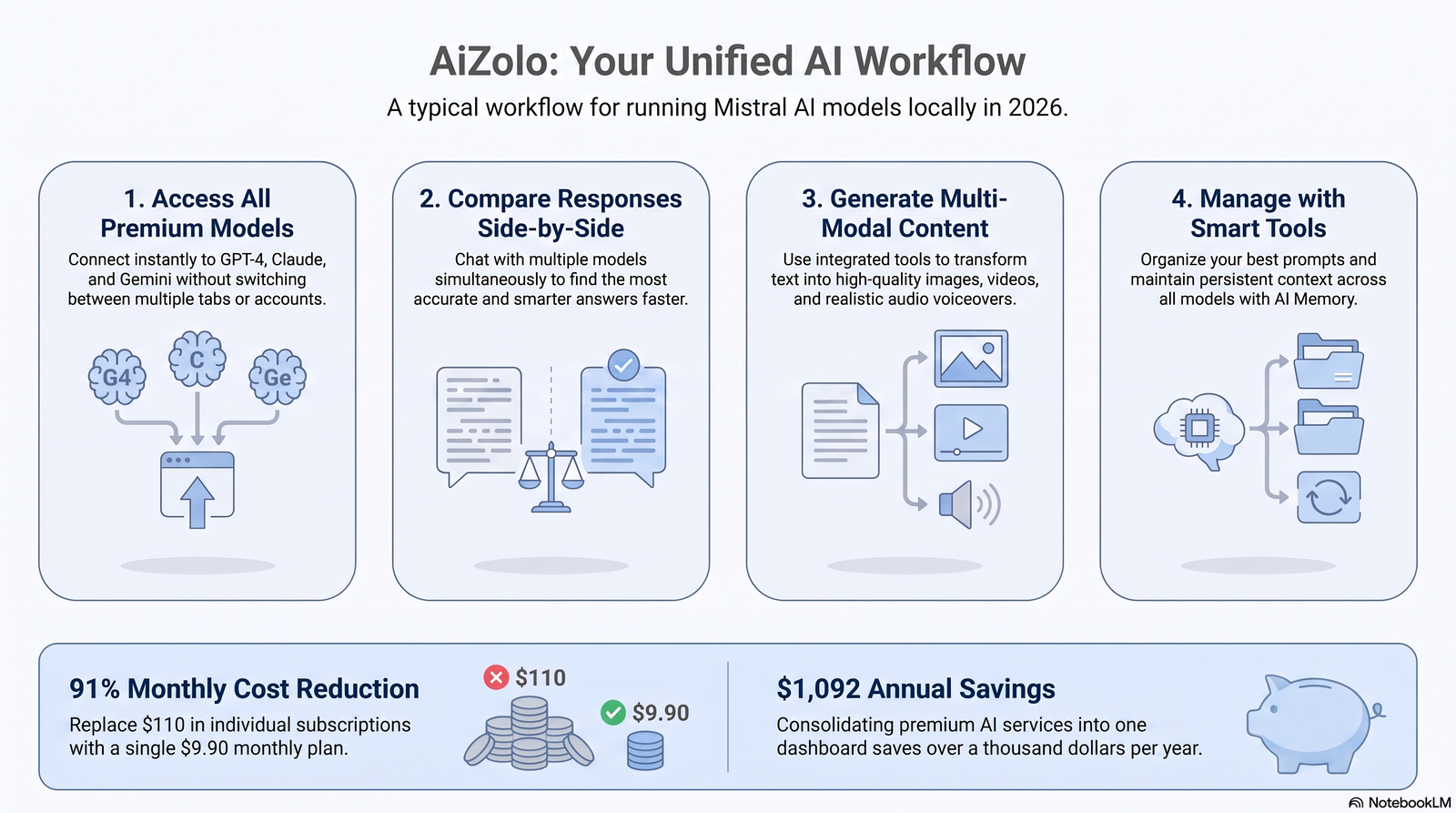
Self-hosting is one of Mistral’s biggest differentiators, since so many of its models ship as genuinely open weights.
Recommended hardware by model tier:
- Ministral 3B / Magistral Small — runs on modest consumer GPUs (8–16GB VRAM) or even capable laptops.
- Devstral Small 2 (24B) — comfortably fits a single RTX 4090 or a 32GB Apple Silicon Mac.
- Mistral Small 4 (119B total, ~6B active) — the MoE design keeps active-parameter VRAM needs manageable despite the large total size, though full-precision total-parameter storage still requires substantial disk and RAM.
- Mistral Large 3 (675B total) — realistically requires multi-GPU or high-memory server-class hardware, or heavy quantization, for local use.
Recommended tools:
- Ollama — the fastest path to running smaller Mistral models locally with a single command.
- LM Studio — a GUI option that’s friendlier for non-technical experimentation.
- Open WebUI — pairs well with Ollama for a ChatGPT-style local interface.
- Docker — useful for reproducible, containerized deployments in team environments.
Expert tip: Start with a quantized GGUF build before committing to full-precision weights — it dramatically lowers the VRAM bar with a modest, often acceptable, quality trade-off.
Best Use Cases by Audience
| Audience | Recommended Model(s) | Why |
|---|---|---|
| Developers | Devstral 2, Codestral | Agentic coding + fast completion |
| Students & researchers | Magistral Small, Ministral 3B (free, self-hostable) | Zero cost, decent capability |
| Businesses | Mistral Medium 3.5, Large 3 | Enterprise-ready reasoning and coding |
| Content creators | Mistral Small 4 | Cheap, multimodal, configurable reasoning |
| RAG pipelines | Mistral Embed, Codestral Embed | Purpose-built embeddings |
| Automation/agent builders | Devstral 2 + Vibe workflows | Native connector and hook support |
Advantages and Limitations
Advantages:
- Genuinely open-weight flagship models under Apache 2.0
- Strong price-to-performance ratio, especially at the small-model tier
- EU-based data residency, appealing for regulated industries
- Native multilingual strength across major European and several Asian languages
- Fast release cadence — new capability arrives roughly every 10 weeks
Limitations:
- Trails top proprietary models on the hardest reasoning benchmarks (AIME, GPQA Diamond)
- Some specialist releases (like Voxtral TTS) use non-commercial licenses, complicating production use
- Large 3’s output speed is comparatively slow given its size
- Documentation on exact parameter counts is incomplete for some newer releases like Medium 3.5
Future Roadmap
Based on release cadence (a new model roughly every 71 days, per third-party tracking) and Mistral’s public infrastructure investments, expect the following trends through the rest of 2026:
- Continued expansion of the “unified configurable model” approach seen in Small 4, likely extending to Large and Medium tiers.
- More voice and multimodal releases, building on Voxtral TTS and OCR 4.
- Expanded enterprise custom-training options through Forge, following early adopters like ASML and the European Space Agency.
- Additional European compute capacity coming online, including the Bruyères-le-Châtel datacenter and Swedish facilities, which should support larger future training runs.
Expert prediction: Given the unification pattern already visible in Small 4, a reasoning-enabled variant of Large 3 is a reasonable near-term expectation, though Mistral has not officially confirmed a release date.
Frequently Asked Questions
1. What is the best Mistral AI model in 2026? For most general-purpose tasks, Mistral Large 3 is the flagship recommendation. For coding-heavy workflows, Mistral itself recommends Medium 3.5.
2. Which Mistral model is free to use commercially? Most Apache 2.0 models — including Large 3, Small 4, Devstral Small 2, Magistral Small, and the Ministral family — are self-hostable without per-token licensing fees, though commercial deployment terms can still apply depending on scale.
3. Is Mistral AI open source? Many of Mistral’s models are open-weight under Apache 2.0, though not all — some, like OCR 4 and Codestral, are “Premier” commercial-only models, and Voxtral TTS uses a non-commercial license.
4. How does Mistral Large 3 compare to GPT and Claude? It’s competitive on broad academic benchmarks like MMLU-Pro and MATH-500, but proprietary reasoning models still tend to lead on the hardest reasoning benchmarks like GPQA Diamond.
5. What is Mistral Small 4’s biggest advantage? Its configurable reasoning_effort parameter lets one model serve as both a fast chatbot and a Magistral-level reasoner, cutting deployment complexity.
6. Can I run Mistral models on my own hardware? Yes — smaller models like Ministral 3B or Devstral Small 2 run comfortably on consumer GPUs, while Large 3 realistically needs server-class or heavily quantized setups.
7. What replaced Le Chat? Le Chat was renamed Vibe in late May 2026, alongside new feature additions.
8. Which Mistral model is best for coding agents? Devstral 2 (or Devstral Small 2 for self-hosting) is purpose-built for agentic, multi-step coding workflows.
9. Does Mistral have a text-to-speech model? Yes — Voxtral TTS, released March 2026, supports nine languages and zero-shot voice cloning, though it’s licensed CC BY-NC 4.0 (non-commercial).
10. How much does the Mistral API cost? Pricing varies by model — smaller models like Ministral run around $0.10–$0.20 per million tokens, while Large sits around $2/M input and $6/M output, with a roughly 50% discount for batch processing.
11. What is Mistral Forge? Forge is Mistral’s enterprise platform for full custom model training — pre-training, post-training, and reinforcement learning — on a company’s own data, rather than relying purely on fine-tuning.
12. Is Mistral good for multilingual use cases? Yes, multilingual performance (especially across French, Spanish, German, Arabic, and other languages) is one of Mistral’s most consistent strengths across its model lineup.
13. What’s the difference between Devstral and Codestral? Codestral is optimized for fast, low-latency code completion inside an IDE; Devstral is built for autonomous, multi-step agentic coding tasks.
14. What is Leanstral used for? Leanstral is Mistral’s open-source agent for Lean 4 formal proof engineering — generating both code and machine-checkable mathematical proofs.
15. Are Mistral models good for RAG (retrieval-augmented generation)? Yes — Mistral Embed and Codestral Embed are purpose-built embedding models designed to support semantic search and RAG pipelines.
16. How often does Mistral release new models? Historically, about once every 71 days on average, based on third-party release tracking — though the actual pace has been considerably faster during some stretches of 2026.
Conclusion
Mistral’s 2026 lineup isn’t just bigger — it’s more coherent. What used to require juggling separate Magistral, Pixtral, and Devstral endpoints is now converging into unified, configurable models like Small 4 and Medium 3.5.
If you need one takeaway: start with Large 3 or Medium 3.5 for general enterprise work, Devstral for coding agents, and Ministral for anything running on constrained hardware. Layer in Magistral or reasoning-mode Small 4 whenever a task genuinely needs deeper logic.
No single Mistral model wins every benchmark against GPT, Claude, or Gemini — and Mistral doesn’t pretend otherwise. Its real pitch is the combination of open weights, EU data residency, and consistently competitive pricing, which is exactly why it’s become the default “second model” for so many teams running multi-provider AI stacks.
About the Author
Jeevesh Tripathi AI Researcher & Technical Content Writer Email: jeevesh@aizolo.com
Jeevesh Tripathi is an AI researcher and technical content writer specializing in large language models, generative AI platforms, and model benchmarking. His work focuses on hands-on testing of emerging AI tools — from open-weight LLMs to enterprise AI platforms — with an emphasis on producing accurate, practical, and trustworthy content that helps developers and businesses make informed decisions. He writes with Google’s EEAT principles in mind: verifying claims against primary sources, disclosing limitations honestly, and prioritizing reader usefulness over search-engine optimization for its own sake.
Wow, awesome blog layout! How lengthy have you ever been running a blog
for? you made blogging look easy. The total look of your site is excellent, as smartly as the content material!