
In this OpenAI vs Mistral AI comparison 2026, OpenAI’s GPT-5.6 family leads on raw reasoning, coding, and multimodal benchmarks, while Mistral AI wins on price, EU data residency, and open-weight flexibility. If you’re comparing both models in one workspace, Aizolo lets you access and evaluate multiple leading AI models side by side. Choose OpenAI for maximum capability and ecosystem reach, or choose Mistral for cost-sensitive, GDPR-bound, or self-hosted deployments.

Key Takeaways
- GPT-5.6 (Sol, Terra, Luna) is OpenAI‘s current flagship family, released July 9, 2026, with a 1.05M-token context window.
- Mistral Large 3 is Mistral’s flagship commercial model, priced far below GPT-5.6 on a per-token basis but with a smaller context window.
- Mistral is the only one of the two with a full open-weight model family available for self-hosting.
- OpenAI has broader third-party ecosystem support across coding tools, enterprise platforms, and agent frameworks.
- Mistral is EU-headquartered and not subject to the US CLOUD Act, which matters for GDPR and EU AI Act compliance.
- Neither vendor is “better” in absolute terms — the right choice depends on budget, region, and workload.
Table of Contents
Introduction
Every OpenAI vs Mistral AI comparison in 2026 runs into the same problem: both companies ship new models so often that last quarter’s numbers are already stale.
This article was researched and updated in July 2026, right after OpenAI’s GPT-5.6 launch and against Mistral’s current Large 3 and Medium 3.5 lineup.
The goal isn’t to crown a universal winner. It’s to give you the specific numbers, tradeoffs, and decision points you need to pick the right platform for your actual workload.
OpenAI built the market’s most recognizable AI brand and the deepest developer ecosystem. Mistral built a leaner, EU-based alternative with open-weight models and pricing that undercuts nearly every US competitor.
Both are legitimate choices in 2026. Which one wins depends entirely on what you’re optimizing for.
Company Snapshots
OpenAI is a US-based AI research lab, best known for ChatGPT and the GPT model family. It runs the largest third-party API ecosystem of any AI lab and dominates consumer mindshare.
Mistral AI is a Paris-based lab founded by former Meta and DeepMind researchers. It differentiates on open-weight releases, aggressive pricing, and EU data sovereignty rather than trying to out-benchmark OpenAI at every tier.
Mistral AI is a Paris-based lab built on open-weight models and EU data sovereignty — see our full Mistral vs Claude comparison for a deeper look at how it stacks up against Anthropic.
| OpenAI | Mistral AI | |
|---|---|---|
| Headquarters | San Francisco, USA | Paris, France |
| Flagship model (July 2026) | GPT-5.6 Sol | Mistral Large 3 |
| Open-weight models | No (research releases only) | Yes, several under Apache 2.0 |
| Primary chat product | ChatGPT | Le Chat |
| Data residency | US-based by default, EU options for enterprise | EU-native by design |
| Subject to US CLOUD Act | Yes | No |
Model Lineups Compared
OpenAI’s 2026 Lineup
OpenAI’s current API lineup is led by the GPT-5.6 family, launched July 9, 2026, with three tiers sharing a 1.05M-token context window and 128K maximum output.
- GPT-5.6 Sol — the flagship, built for difficult coding, research, cybersecurity, and complex agent tasks.
- GPT-5.6 Terra — the balanced, everyday-production tier for assistants, document work, and standard coding.
- GPT-5.6 Luna — the fastest and cheapest tier, aimed at extraction, classification, and high-volume routing.
OpenAI also keeps older families live for teams that haven’t migrated: GPT-5.5, GPT-5.4 (with mini and nano variants), and legacy GPT-4.1 models remain accessible through the API for workloads where the upgrade hasn’t been evaluated yet.
Mistral AI’s 2026 Lineup
Mistral organizes its catalog into generalist, reasoning, code, edge, and multimodal tracks.
- Mistral Large 3 — the flagship generalist and reasoning model, with a 256K context window.
- Mistral Medium 3.5 — a balanced mid-tier model tuned for enterprise agents and coding, reportedly scoring well on SWE-Bench-style coding evaluations.
- Mistral Small 4 — a lightweight, high-throughput model for cost-sensitive production.
- Magistral Small / Medium — dedicated reasoning models with step-by-step chain-of-thought behavior.
- Codestral — a specialized coding model with fill-in-the-middle support for IDE integration.
- Pixtral — vision and multimodal models.
- Ministral 3B / 8B / 14B — small, edge-deployable models designed to run on-device.
The open-weight tier — including Small models, Ministral, and select Devstral and Codestral variants — is available under Apache 2.0 or the Mistral Research License, meaning teams can self-host with zero per-token API cost.
Full Feature Comparison Matrix
| Feature | OpenAI (GPT-5.6 Sol) | Mistral AI (Large 3) |
|---|---|---|
| Release | July 9, 2026 | December 2025 |
| Context window | 1.05M tokens | 256K tokens |
| Max output | 128K tokens | Model-dependent, typically 32K–128K |
| Reasoning | Very strong, frontier-tier | Strong, competitive at mid-tier cost |
| Coding | Excellent, strong on agentic coding | Very good, Codestral specializes further |
| Writing | Excellent, highly fluent English | Strong, notably good multilingual/European language output |
| Vision | Yes, native multimodal | Yes, via Pixtral models |
| Multimodal | Text, image, some audio via Whisper/Realtime | Text, image (Pixtral), audio (Voxtral) |
| API | REST, streaming, Batch, Priority | REST via La Plateforme, streaming |
| Speed | Fast, varies by reasoning depth | Generally fast, smaller models are near-instant |
| Cost | Higher, especially at flagship tier | Lower across nearly every tier |
| Enterprise features | Extensive: SSO, audit logs, admin console, data controls | Growing: SSO, audit logs, on-prem/hybrid deployment |
| Open source | No | Yes, several models under Apache 2.0 |
| Deployment | Cloud API only (Azure OpenAI for enterprise hosting) | Cloud API, on-premise, hybrid, self-hosted |
| Fine-tuning | Yes, supported on select models | Yes, including on open-weight models via Mistral Forge |
| Function calling | Yes, mature tool-use support | Yes, structured outputs and tool use supported |
| MCP support | Yes | Growing MCP and agent tooling support |
| Best for | Maximum capability, broadest ecosystem | Budget-conscious, EU-regulated, or self-hosted workloads |
Prices, context windows, and specifications change frequently. Always confirm current numbers on the official OpenAI and Mistral AI pricing pages before making a purchasing decision.
Pricing Comparison
Price is where this OpenAI vs Mistral AI comparison diverges the most sharply.
OpenAI’s GPT-5.6 family prices per 1M tokens as follows: Sol at $5.00 input / $30.00 output, Terra at $2.50 / $15.00, and Luna at $1.00 / $6.00. Cached-input reads get a 90% discount, while cache writes are billed at 1.25x the standard input rate.
Mistral’s flagship, Large 3, is priced at roughly $0.50 input / $1.50 output per 1M tokens — a fraction of GPT-5.6 Sol’s rate. Mistral Small 4 comes in around $0.15 / $0.60, and Magistral Medium, the dedicated reasoning model, runs about $2.00 / $5.00.
This gap isn’t small. Depending on which OpenAI tier you compare against, Mistral’s equivalent model can cost anywhere from 3x to 10x less per million tokens.
That said, price per token isn’t the same as price per outcome. If GPT-5.6 Sol solves a task in fewer retries or shorter completions, the effective cost gap narrows. Always benchmark on your own workload before assuming the cheaper sticker price wins.
Pricing Table
| Tier | OpenAI Model | Input ($/1M) | Output ($/1M) | Mistral Model | Input ($/1M) | Output ($/1M) |
|---|---|---|---|---|---|---|
| Flagship | GPT-5.6 Sol | $5.00 | $30.00 | Mistral Large 3 | $0.50 | $1.50 |
| Balanced | GPT-5.6 Terra | $2.50 | $15.00 | Mistral Medium 3.5 | ~$0.40 | ~$2.00 |
| Budget | GPT-5.6 Luna | $1.00 | $6.00 | Mistral Small 4 | $0.15 | $0.60 |
| Reasoning specialist | GPT-5.4 (o-series successor) | Varies | Varies | Magistral Medium | $2.00 | $5.00 |
| Coding specialist | GPT-5.6 Sol / Codex tier | Varies | Varies | Codestral | $0.30 | $0.90 |
Both platforms offer batch discounts for non-time-sensitive workloads: OpenAI’s Batch API cuts costs by roughly 50%, and Mistral offers a free experimentation tier on La Plateforme for prototyping before production spend begins.
Curious how these same Mistral tiers compare against Claude’s or ChatGPT’s pricing? See our Mistral vs Claude and Mistral vs ChatGPT 2026 breakdowns.
Benchmarks and Real-World Performance

Public benchmarks are a useful starting point, but they compress a lot of nuance into single numbers. Treat them as directional, not definitive.
On general reasoning and knowledge benchmarks, GPT-5.6 Sol sits at or near the top of most independent leaderboards, consistent with OpenAI’s positioning of Sol as its hardest-task tier.
Mistral’s Large 3 and Medium 3.5 trail the very top frontier models on the hardest reasoning benchmarks but remain competitive with mid-tier models from every other major lab, including older GPT generations.
Where Mistral tends to close the gap is coding. Independent evaluators have reported Mistral Medium 3.5 scoring around 77.6% on SWE-Bench-style coding tasks, putting it within range of several higher-priced competitors.
Multilingual performance is another area where Mistral has historically punched above its price point, particularly for French, German, Spanish, and other European languages, reflecting its EU-first training priorities.
For the most current, independently verified numbers, check Stanford HELM, Artificial Analysis, and LMSYS Chatbot Arena rather than vendor-published benchmarks alone. Vendors selectively highlight favorable results, and third-party evaluators apply more consistent methodology.
What the benchmarks don’t tell you
- Benchmark scores rarely reflect latency under real production load.
- They don’t capture how a model handles your specific domain vocabulary.
- They say nothing about how a vendor’s pricing or context window fits your architecture.
API and Developer Experience
Both platforms expose REST APIs with streaming support, but the surrounding ecosystem differs substantially.
OpenAI’s API has the deepest third-party integration coverage of any AI provider. Most SDKs, agent frameworks, IDE plugins, and enterprise platforms build OpenAI compatibility first, then extend to other providers.
Mistral’s API, hosted on La Plateforme, is intentionally OpenAI-compatible in its request format for many endpoints, which lowers the switching cost for developers who already have OpenAI-based code.
Documentation quality is strong on both sides, though OpenAI’s docs benefit from a larger community generating tutorials, Stack Overflow answers, and third-party guides.
| Developer Experience Factor | OpenAI | Mistral AI |
|---|---|---|
| SDK language coverage | Very broad (Python, Node, Java, Go, more) | Broad (Python, JS/TS, community SDKs) |
| API compatibility | Native format, widely adopted as a de facto standard | OpenAI-compatible endpoints for easier migration |
| Community resources | Extensive | Growing, smaller than OpenAI’s |
| Rate limits | Tiered by usage history and spend | Tiered, generous free experimentation tier |
| Playground / testing UI | Yes | Yes, via La Plateforme console |
Coding Ability Compared
Coding is one of the highest-value use cases for both platforms, and it’s where the price-to-performance conversation matters most.
GPT-5.6 Sol is built explicitly for difficult coding tasks, complex tool use, and agentic workflows that touch multiple files or systems. It’s the stronger choice for large, unfamiliar codebases or tasks requiring deep multi-step reasoning.
Codestral and Mistral Medium 3.5 target a different point on the curve: strong coding output at a fraction of the cost, well-suited to IDE autocomplete, routine pull request generation, and repository search.
For teams running high-volume coding assistants — think thousands of completions per day across an engineering org — Mistral’s pricing advantage compounds quickly. For teams solving genuinely hard, one-off engineering problems, GPT-5.6 Sol’s extra reasoning depth is often worth the premium.
A pragmatic pattern many engineering teams use in 2026: route routine completions to Codestral or GPT-5.6 Luna, and escalate only the hardest tasks to GPT-5.6 Sol or Mistral Large 3.
Multimodal and Vision Capabilities
OpenAI’s GPT-5.6 family supports native image input alongside text, building on a multimodal architecture that has matured over several GPT generations.
Mistral covers multimodal needs through separate specialized models: Pixtral for vision and image understanding, and Voxtral for audio and speech-to-text.
The practical difference is architectural. OpenAI leans toward one model handling multiple modalities natively. Mistral leans toward composable, purpose-built models you combine as needed.
Neither approach is strictly better. A single natively multimodal model simplifies integration. A composable stack can be cheaper if you only need vision occasionally, since you’re not paying flagship-model rates for every request.
Deployment Options
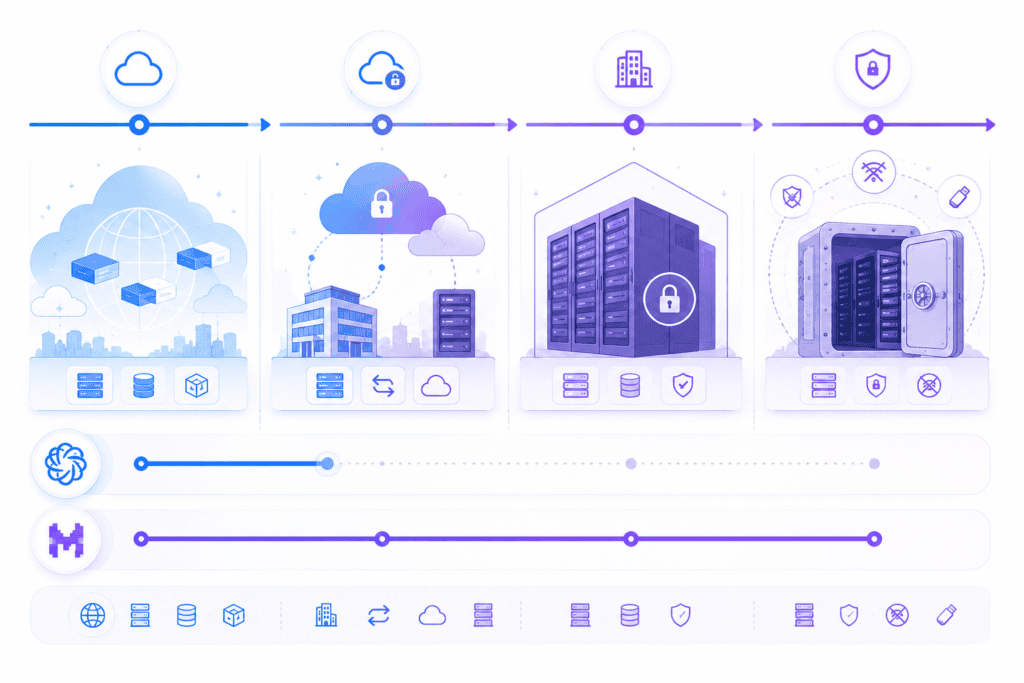
Deployment flexibility is one of the clearest differentiators in this OpenAI vs Mistral AI comparison.
For more on Mistral’s open-weight self-hosting model versus a fully closed alternative, see Mistral vs ChatGPT 2026: Open Source vs Proprietary.
This matters most for regulated industries — manufacturing, healthcare, defense, and financial services — where data cannot leave a specific jurisdiction or network boundary under any circumstances.
| Deployment Option | OpenAI | Mistral AI |
|---|---|---|
| Public cloud API | Yes | Yes |
| Enterprise cloud hosting | Azure OpenAI Service | Standard La Plateforme enterprise tier |
| Hybrid cloud | Limited, primarily via Azure | Yes |
| On-premise | Not available for flagship models | Yes, for open-weight models |
| Air-gapped | No | Yes, for self-hosted open models |
| Self-hosting cost | Not applicable | GPU compute only, no per-token fee |
Security and Enterprise Compliance
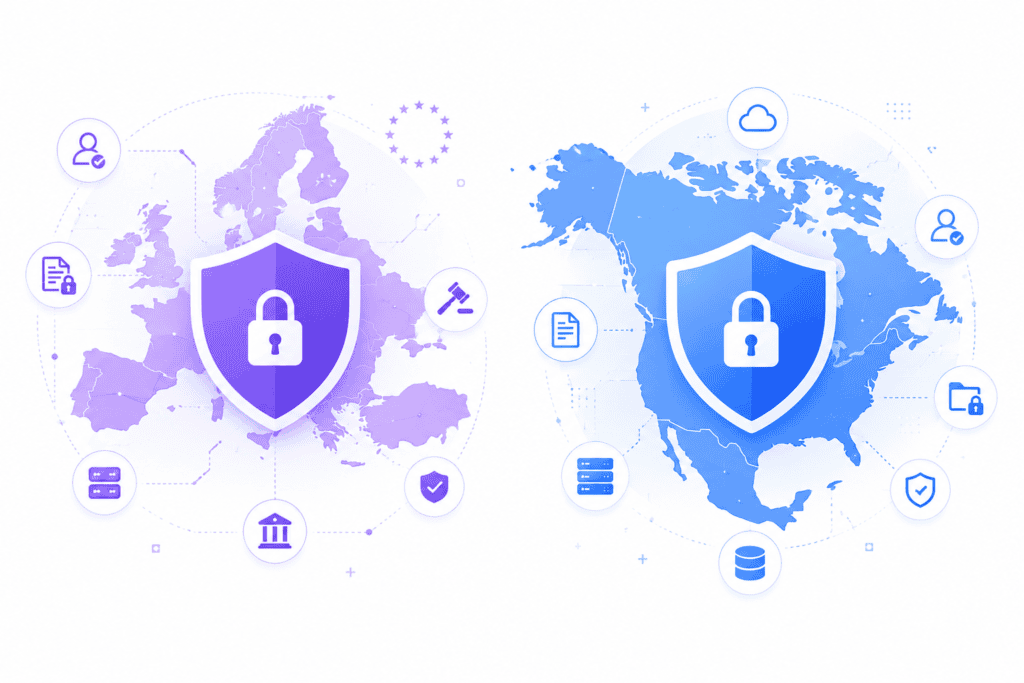
Security posture is where jurisdiction, not just technology, drives the decision.
OpenAI offers enterprise-grade controls: SSO, role-based access, audit logging, data retention policies, and SOC 2 compliance. For organizations already standardized on US cloud infrastructure, this is more than sufficient.
Mistral offers comparable enterprise controls, but adds a structural advantage for EU organizations: as a French company, Mistral is not subject to the US CLOUD Act, which can compel US companies to disclose data stored anywhere in the world, including EU data centers.
For a full breakdown of Mistral’s compliance posture against Claude’s enterprise program, read Mistral vs Claude: Enterprise Comparison.
None of this means OpenAI is insecure. It means the compliance calculus is different depending on where your users and data live.
Fine-Tuning and Customization
Both platforms support fine-tuning, but the flexibility ceiling differs.
OpenAI allows fine-tuning on select models through its API, letting teams adapt outputs to a specific tone, format, or narrow domain without full retraining.
Mistral supports fine-tuning through its Forge platform, and because several of its models are open-weight, teams can go further than API-level fine-tuning — they can retrain or modify the underlying weights entirely, subject to license terms.
For most commercial use cases, API-level fine-tuning on either platform is sufficient. Full weight access matters most for organizations building genuinely proprietary, defensible models on top of an open base.
Function Calling, MCP, and AI Agents
Function calling and tool use are now table stakes for any serious LLM provider, and both OpenAI and Mistral support structured tool-calling in their APIs.
OpenAI has invested heavily in agentic workflows, with GPT-5.6 Sol explicitly positioned for complex, multi-step tool use and agent orchestration.
Mistral has been expanding its own agent tooling, including agent-builder features inside Le Chat Enterprise for tasks like invoice processing, meeting summarization, and expense reporting.
Model Context Protocol (MCP) support is increasingly standard across the industry, and both ecosystems have MCP-compatible integration paths, though OpenAI’s broader third-party tooling means MCP servers built for OpenAI-first workflows are more common today.
For teams building AI agents and automation pipelines, the practical decision usually comes down to which ecosystem your existing tools already integrate with, rather than a fundamental capability gap.
Real-World Use Cases

Startup building a consumer chatbot on a tight budget Mistral’s Small or Medium tier keeps per-token costs low while remaining capable enough for most conversational use cases.
Enterprise SaaS company scaling a coding assistant A mixed approach works well: GPT-5.6 Luna or Mistral Small for routine completions, escalating to GPT-5.6 Sol or Mistral Large 3 for complex refactors.
European healthcare provider processing patient records Mistral, self-hosted or deployed on EU infrastructure, addresses GDPR and EU AI Act requirements more directly than a US-hosted alternative.
US enterprise already standardized on Azure Azure OpenAI Service offers the path of least resistance, with GPT-5.6 available inside existing Azure compliance and billing frameworks.
Manufacturing company needing air-gapped, real-time inference Mistral’s open-weight models, self-hosted on local infrastructure, support the sub-50ms latency and offline operation that cloud APIs structurally cannot guarantee.
Content team generating high volumes of marketing copy Mistral’s output-heavy pricing advantage compounds significantly at scale, since output tokens are typically the larger cost driver in long-form generation.
Decision Framework
Use this quick framework to narrow your choice.
Choose OpenAI if:
- You need the highest available reasoning and coding capability regardless of cost.
- Your team already builds on OpenAI-first tooling and agent frameworks.
- You’re standardized on Azure and want native enterprise integration.
- Multimodal capability inside a single model matters more than composability.
Choose Mistral AI if:
- Cost per token is a primary constraint, especially for output-heavy workloads.
- You operate under GDPR or the EU AI Act and need EU-native data residency.
- You need on-premise, hybrid, or air-gapped deployment.
- You want the option to self-host or fine-tune open weights directly.
Consider both if:
- You’re running a large-scale application where routing different tasks to different providers based on cost and difficulty makes sense.
Also comparing Claude? Our companion guide, Mistral vs Claude: The Honest 2026 Comparison, covers coding, pricing, and enterprise fit head-to-head.
Future Outlook
OpenAI’s release cadence has accelerated through 2026, moving from GPT-5.4 to GPT-5.5 to the GPT-5.6 family within months. Expect continued investment in agentic capability, longer context windows, and tighter enterprise integration through Azure.
Mistral’s trajectory points toward deeper enterprise sovereignty positioning. Reported investment activity, including European infrastructure funding and data center financing, suggests Mistral is doubling down on being the default choice for EU-regulated AI rather than chasing OpenAI benchmark-for-benchmark at every tier.
Expect the price gap between the two to persist. OpenAI’s flagship tier will likely keep commanding a premium tied to raw capability, while Mistral continues to compete on efficiency, openness, and jurisdiction.
The more interesting shift to watch is whether Mistral’s mid-tier models keep closing the coding and reasoning gap against OpenAI’s mid-tier, since that’s where most production workloads actually run.
Conclusion
There’s no universal winner in this OpenAI vs Mistral AI comparison for 2026, and any article that tells you otherwise is oversimplifying.
OpenAI’s GPT-5.6 family delivers the strongest raw reasoning and coding performance available today, backed by the industry’s deepest developer ecosystem. If your priority is maximum capability and you have the budget for it, OpenAI remains the safer default.
Mistral AI wins decisively on price, deployment flexibility, and EU regulatory fit. For cost-sensitive teams, self-hosting requirements, or GDPR-bound organizations, Mistral is frequently the more practical choice — sometimes the only viable one.
The most sophisticated teams in 2026 aren’t choosing one exclusively. They’re routing workloads to whichever platform fits the task, the budget, and the jurisdiction — and revisiting that decision every few months, because both companies are still moving fast.
FAQs
1. Which AI model is best in 2026, OpenAI or Mistral? Neither is universally best. OpenAI’s GPT-5.6 leads on raw reasoning and coding benchmarks, while Mistral leads on price, deployment flexibility, and EU compliance. The right choice depends on your specific priorities.
2. Which API is cheaper, OpenAI or Mistral? Mistral is consistently cheaper across comparable tiers, often by 3x to 10x per million tokens, particularly on output pricing.
3. Which is faster, OpenAI or Mistral? Smaller Mistral models like Small 4 and Ministral tend to have very low latency due to their size. At the flagship tier, speed depends heavily on reasoning depth and specific workload, so benchmark both on your own use case.
4. Which is more accurate for complex reasoning tasks? GPT-5.6 Sol generally leads on the hardest reasoning benchmarks. Mistral Large 3 and Medium 3.5 are competitive at the mid-tier but trail at the frontier edge.
5. Which is better for coding, OpenAI or Mistral? GPT-5.6 Sol handles complex, multi-file, agentic coding tasks well. Mistral’s Codestral and Medium 3.5 offer strong coding performance at a much lower cost for routine development work.
6. Which is better for enterprise use? Both offer enterprise-grade security controls. OpenAI has a larger ecosystem and Azure integration; Mistral offers EU-native compliance and on-premise deployment that OpenAI cannot match.
7. Which platform supports on-premise deployment? Mistral supports on-premise and air-gapped deployment of its open-weight models. OpenAI does not offer on-premise deployment of its flagship models; Azure OpenAI Service is the closest enterprise-hosting option.
8. Which is more secure, OpenAI or Mistral? Both meet standard enterprise security certifications. Mistral’s EU jurisdiction means it isn’t subject to the US CLOUD Act, which is a meaningful factor for GDPR-bound organizations specifically, not a general security superiority claim.
9. Should startups choose OpenAI or Mistral AI? Budget-conscious startups often start with Mistral for cost efficiency, then selectively use OpenAI’s flagship tier for tasks that genuinely require maximum capability.
10. Does OpenAI offer anything comparable to Mistral’s open-weight models? Yes. Several Mistral models, including smaller Small-tier and Ministral models, are released under Apache 2.0 or the Mistral Research License, allowing self-hosting and modification.
11. Does OpenAI offer open-source models? No. OpenAI’s current flagship models are closed-source and accessible only through its API or Azure OpenAI Service.
12. What is the context window difference between GPT-5.6 and Mistral Large 3? GPT-5.6 offers a 1.05M-token context window. Mistral Large 3 offers 256K tokens — smaller, but sufficient for the large majority of production use cases.
13. Can I use both OpenAI and Mistral in the same application? Yes, and many production teams do. Routing simple tasks to cheaper models and complex tasks to higher-capability models is a common cost-optimization pattern in 2026.
14. Is Mistral AI GDPR compliant? Mistral’s infrastructure and EU headquarters make GDPR compliance more straightforward, but compliance ultimately depends on how you configure data handling, retention, and processing agreements, not the model alone.
15. How often do OpenAI and Mistral update their pricing? Both companies update pricing multiple times per year as new model generations launch. Always confirm current rates on the official OpenAI and Mistral pricing pages before budgeting.
Author Bio
Jeevesh Tripathi Email: jeevesh@aizolo.com
Jeevesh Tripathi is an AI researcher and technology writer specializing in large language model evaluation, enterprise AI procurement, and API cost analysis. His work focuses on independently verifying vendor claims against benchmark data, official documentation, and real production usage, helping technical teams and business leaders make evidence-based decisions about AI infrastructure. He covers frontier model releases, AI productivity tooling, and the enterprise AI landscape across OpenAI, Mistral AI, Anthropic, and other leading labs.

Pingback: Best AI Model in the World 2026 (Honest Guide)
Pingback: Top 5 AI Models in the World 2026 (Honest Breakdown)
Pingback: GPT-5.1 Thinking vs Gemini 3 Deep Think: Shocking Results