You ask a chatbot like Aizolo to write a poem, and thirty seconds later your bank blocks a suspicious card transaction using a completely different kind of AI. Both get called “AI.” Only one of them is generative.
That mismatch is where most of the confusion starts. People hear “AI” in the news and picture a chatbot, then get confused when a vendor talks about “rule-based AI” or “classical AI” powering their fraud detection system.
These aren’t competing buzzwords — they’re different names for the same underlying category of technology, and that category predates ChatGPT by more than 60 years.
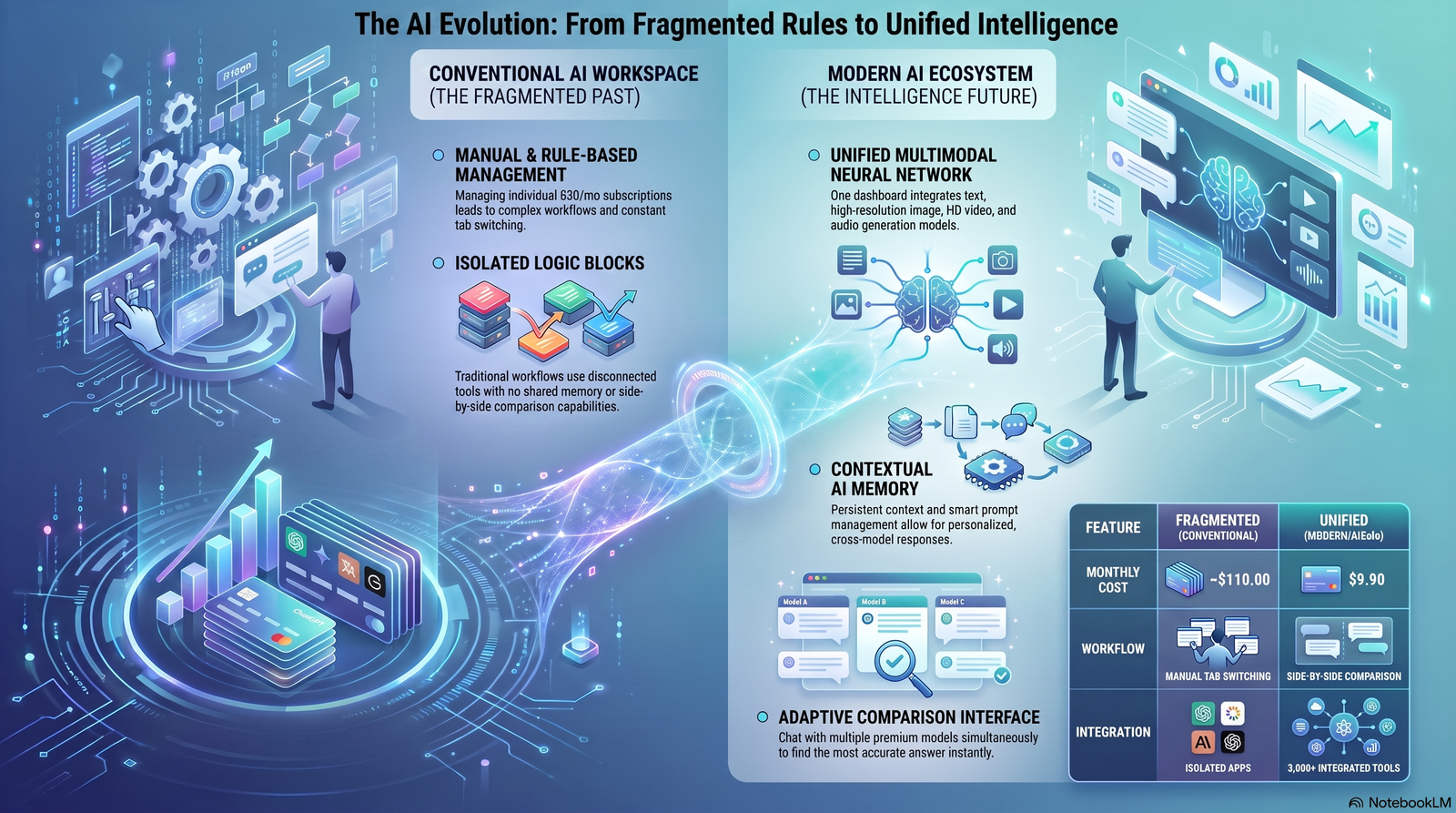
So, what is conventional AI also known as? Conventional AI is also known as traditional AI, classical AI, symbolic AI, rule-based AI, and — when built for a specific domain — an expert system. All of these terms describe AI that follows explicit, human-written rules and logic to reach a decision, rather than generating new content from learned patterns the way generative AI does.
This guide covers every name conventional AI goes by, why each name exists, how the technology actually works, where it’s still used today, and how it compares to the generative AI that now dominates headlines.
Table of Contents
What Is Conventional AI Also Known As?
Quick answer: Conventional AI is also known as traditional AI, classical AI, symbolic AI, and rule-based AI. When it’s built to replicate a human expert’s judgment in a narrow field — like diagnosing a specific illness or approving a loan — it’s called an expert system.
These names aren’t strict synonyms in every technical paper, but in practice they’re used interchangeably to describe AI systems that:
- Follow predefined rules and logic written by humans
- Use structured, labeled data
- Produce consistent, deterministic outputs — the same input always gives the same result
- Do not generate new content, images, or text on their own
That last point is the one that trips people up. Conventional AI can predict, classify, sort, flag, and recommend. It cannot write you an essay or paint you a picture. That job belongs to generative AI.
Why Is Conventional AI Called Traditional AI?
It’s called “traditional” simply because it came first. Before machine learning and neural networks became mainstream, AI research was built almost entirely on logic, symbols, and hand-coded rules. That approach became the tradition — the default way of building AI — for roughly the first four decades of the field’s existence.
When generative AI and modern deep learning arrived and started dominating the conversation, the industry needed a way to distinguish the older approach from the new one. “Traditional AI” became the natural label, much like “traditional media” became a way to distinguish newspapers and TV from digital and social platforms.
Different Names of Conventional AI Explained
Each name for conventional AI tends to get used in a slightly different context. Here’s when each one is appropriate.
Classical AI
Used mostly in academic and historical contexts, referring to the foundational approaches from AI’s early decades — search algorithms, logic-based reasoning, and planning systems.
Symbolic AI
The most technically precise term. It refers specifically to AI that represents knowledge using symbols (words, categories, relationships) and manipulates those symbols with formal logic. These systems operate within a rigid framework of human-defined guidelines and are adept at tasks like data classification, anomaly detection, and decision-making processes based on historical data.
Rule-Based AI
Describes systems built around if-then logic: if a transaction exceeds a threshold and originates from an unusual location, then flag it for review. This is the most common term in business and software engineering contexts.
Expert Systems
A specific application of rule-based AI, designed to replicate the judgment of a human expert in a narrow domain — for example, an early system that helped diagnose bacterial infections, or one that configured computer hardware orders.
Predictive AI
A slightly different angle on the same family — conventional AI models trained on historical data to forecast outcomes, like predicting equipment failure or customer churn. Predictive AI usually relies on statistical machine learning rather than pure symbolic logic, but it shares conventional AI’s core trait: it produces a decision or forecast, not new content.
Narrow AI or Weak AI
Traditional AI, also known as Narrow AI or Weak AI, forms the basis of automated decision-making systems that have advanced industries since the 1950s. This name emphasizes scope rather than method — it’s “narrow” because each system is built for one specific task and can’t generalize beyond it.
History of Conventional AI
| Era | Development |
|---|---|
| 1950s–1960s | Early AI research focuses on logic, search, and symbolic reasoning; the term “artificial intelligence” is coined in 1956 |
| 1970s–1980s | Expert systems emerge, encoding specialist knowledge into if-then rule sets for medicine, chemistry, and engineering |
| Late 1980s–1990s | Rule-based systems hit scaling limits; maintaining huge rule sets becomes unmanageable, contributing to the “AI winter” |
| 1990s–2010s | Statistical machine learning grows — systems learn patterns from data instead of relying solely on hand-written rules |
| 2012–2020 | Deep learning and neural networks drive breakthroughs in image recognition, speech, and translation |
| 2020s | Generative AI and large language models go mainstream, creating the need to distinguish “conventional” AI from “generative” AI |
| 2025–2026 | Hybrid and neuro-symbolic approaches gain traction, combining rule-based reliability with generative flexibility |
Conventional AI’s biggest historical stumble came from a scaling problem. Rule-based systems failed at two scales: knowledge-acquisition, since encoding every rule a domain expert uses exhausts the experts faster than the system reaches usefulness, and brittleness, since these systems handle the cases the rules cover and fail abruptly on cases just outside those rules. That brittleness is a big part of why generative, learning-based approaches eventually took over the spotlight.
How Conventional AI Works
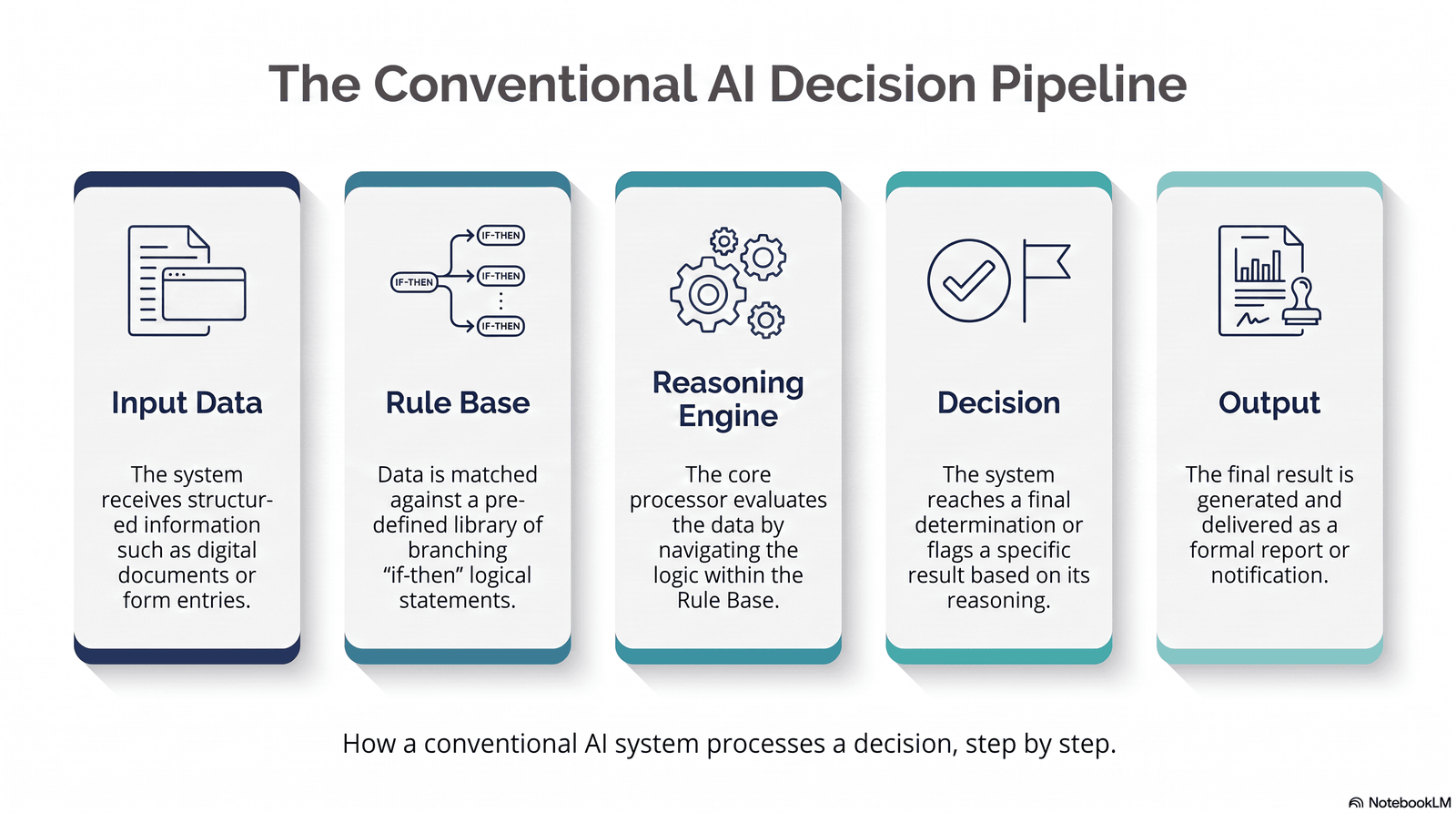
Conventional AI systems generally follow a straightforward pipeline:
- Input – structured data enters the system (a transaction record, a sensor reading, a form submission).
- Rules or knowledge base – a set of human-defined if-then rules, decision trees, or logical relationships that the system applies to that input.
- Algorithm/reasoning engine – the system evaluates the input against the rules, often using decision trees, search algorithms, or statistical scoring.
- Prediction or classification – the system reaches a conclusion: approve/deny, fraud/not fraud, defective/acceptable.
- Output – a decision, score, label, or recommendation is returned, typically with a traceable explanation of which rule fired.
Because every step is explicit, a human can usually trace exactly why the system reached a given conclusion — a major advantage in regulated industries.
Conventional AI vs Generative AI
| Factor | Conventional AI | Generative AI |
|---|---|---|
| Purpose | Classify, predict, or decide | Create new content (text, images, audio, code) |
| Learning approach | Rule-based logic or statistical training on labeled data | Deep learning on massive, often unlabeled datasets |
| Output | Fixed categories, scores, or decisions | Original, novel content |
| Training data | Structured, labeled data | Large, diverse, often unstructured data |
| Flexibility | Narrow, task-specific | Broad, adaptable across many tasks |
| Creativity | None — deterministic outputs | High — generates novel combinations |
| Business use | Compliance, fraud detection, forecasting | Content creation, coding assistance, chat support |
| Accuracy on defined tasks | Very high and consistent | Can vary; outputs may need review |
| Explainability | High — decisions are traceable | Lower — often a “black box” |
| Cost to build/run | Generally lower | Generally higher (compute-intensive) |
| Examples | Spam filters, credit scoring, expert systems | ChatGPT, image generators, code assistants |
The two aren’t rivals so much as tools for different jobs. The productive AI systems in 2026 often compose both approaches — using symbolic components for verifiable, rule-governed reasoning and neural components for perception and generalization.
Examples of Conventional AI
- Spam filters – classify emails using rule-based and statistical scoring
- Recommendation systems – rank products or content using structured user data
- Fraud detection – flag transactions that break predefined risk rules
- Medical diagnosis support – early expert systems mapped symptoms to likely conditions
- Industrial automation – robots and machinery follow programmed logic on factory floors
- Navigation systems – route-finding uses search algorithms like Dijkstra’s or A*
- Search ranking – early search engines ranked pages with rule-based scoring
- Credit scoring – lenders apply fixed criteria to assess creditworthiness
- Inventory forecasting – predictive models project stock needs from historical sales
- Predictive maintenance – sensors and threshold rules flag equipment likely to fail
Advantages of Conventional AI
| Advantage | Why It Matters |
|---|---|
| Predictable, consistent outputs | Same input always produces the same result |
| Explainable decisions | Regulators and auditors can trace exactly why a decision was made |
| Lower compute cost | Doesn’t require massive GPU clusters to run |
| Strong performance on narrow tasks | Excels when the problem space is well-defined |
| Easier to validate and test | Rules can be checked individually for correctness |
Limitations of Conventional AI
| Limitation | Impact |
|---|---|
| Brittle outside its rules | Struggles with inputs it wasn’t explicitly designed to handle |
| Expensive to maintain at scale | Every new scenario may require a new rule |
| No creativity | Cannot generate new content or ideas |
| Poor with unstructured data | Struggles with raw text, images, or audio without heavy preprocessing |
| Doesn’t generalize well | A system built for one task rarely transfers to another |
Real Business Use Cases
Healthcare – Clinical decision-support tools apply established medical rules to flag drug interactions or abnormal lab results.
Finance – Credit scoring, transaction monitoring, and algorithmic trading rules that must remain auditable for regulators.
Manufacturing – Programmable logic controllers and predictive maintenance systems keep production lines running with minimal downtime.
Retail – Inventory forecasting and dynamic pricing engines built on historical sales rules.
Education – Adaptive testing systems that route students to harder or easier questions based on fixed scoring logic.
Cybersecurity – Intrusion detection systems that flag network activity violating defined security rules.
Logistics – Route optimization engines that solve delivery scheduling using search and constraint-based algorithms.
Customer support – Rule-based chat routing and ticket triage systems that direct queries to the right team.
Is Conventional AI Still Used Today?
Yes — and it isn’t going away. Regulated industries like banking, insurance, and healthcare often need decisions that are fully explainable, auditable, and consistent, which is exactly what conventional AI delivers. Generative AI’s probabilistic, sometimes-unpredictable outputs make it a poor fit for tasks like final loan approval, even if it’s useful for drafting a loan officer’s explanation letter.
Many “AI-powered” enterprise products in 2026 quietly run on conventional AI under the hood, simply because it’s cheaper, faster, and more reliable for narrow, well-defined tasks.
Future of Conventional AI
Conventional AI isn’t disappearing — it’s merging. The clearest trend heading through 2026 is hybrid, neuro-symbolic AI: systems that pair a neural front-end (for handling messy, real-world input) with a symbolic reasoning layer (for verifiable, rule-governed decisions).
In this pattern, a neural front-end extracts structured representations from messy inputs, a symbolic reasoner operates on those structured representations, and the result combines the generalization of the neural part with the verifiability of the symbolic part.
Expect conventional AI to keep powering the parts of a system that must be predictable, explainable, and compliant, while generative AI handles the parts that require flexibility, language, and creativity.
Frequently Asked Questions
1. What is conventional AI also known as? Conventional AI is also known as traditional AI, classical AI, symbolic AI, and rule-based AI, or an expert system when built for a specific domain.
2. Is conventional AI the same as symbolic AI? Symbolic AI is one specific type of conventional AI — it represents knowledge with symbols and formal logic. All symbolic AI is conventional AI, but not all conventional AI (like some predictive, statistical models) is strictly symbolic.
3. Is conventional AI the same as machine learning? Not exactly. Some conventional AI is purely rule-based with no learning involved. Other conventional AI uses classical machine learning (like decision trees or regression) trained on structured data — which is different from the deep learning behind generative AI.
4. What’s the main difference between conventional AI and generative AI? Conventional AI classifies, predicts, or decides using rules or learned patterns from structured data. Generative AI creates new content — text, images, audio — by learning patterns from massive datasets.
5. Why is conventional AI called “traditional” AI? Because it represents the original, foundational approach to AI research that dominated the field for decades before generative and deep learning methods became mainstream.
6. What is an expert system in AI? An expert system is a type of conventional AI designed to mimic a human specialist’s decision-making in a narrow domain, using a knowledge base of rules built with input from real experts.
7. Is conventional AI outdated? No. It’s still widely used in industries that require explainable, auditable, and consistent decisions, such as banking, healthcare, and manufacturing.
8. Can conventional AI and generative AI work together? Yes. Hybrid, neuro-symbolic systems increasingly combine both — using generative AI for language and perception tasks and conventional AI for rule-governed, verifiable decisions.
9. What are some real-world examples of conventional AI? Spam filters, fraud detection systems, credit scoring models, industrial automation controllers, and navigation route-finding algorithms.
10. Does conventional AI use neural networks? Not typically. Classic conventional AI relies on rules, logic, and search algorithms rather than the neural networks that power modern generative and deep learning systems. Some hybrid or predictive AI systems do incorporate simpler neural network models.
11. Why did conventional AI struggle in the 1990s? Rule-based systems became difficult to scale — every new scenario required new rules, and the systems failed abruptly outside their defined rule sets, a problem often referred to as brittleness.
12. Is rule-based AI more accurate than generative AI? For narrow, well-defined tasks with structured data, rule-based AI is often more accurate and consistent. For open-ended tasks involving language or creativity, generative AI performs better.
Conclusion
Conventional AI goes by several names — traditional AI, classical AI, symbolic AI, rule-based AI, and expert systems — but they all describe the same core idea: AI that follows explicit, human-defined logic to reach consistent, explainable decisions. It’s the technology quietly running fraud detection, credit scoring, and industrial automation behind the scenes, even as generative AI dominates the public conversation.
Key Takeaways
- Conventional AI is also known as traditional, classical, symbolic, or rule-based AI, and expert systems.
- It relies on predefined rules and structured data, producing consistent, explainable outputs.
- It differs from generative AI, which creates new content by learning patterns from massive datasets.
- Conventional AI remains widely used in regulated, high-stakes industries because of its predictability and traceability.
- The future points toward hybrid, neuro-symbolic systems that combine conventional AI’s reliability with generative AI’s flexibility.
Author Bio
Jeevesh Tripathi AI Researcher & Technical Content Specialist jeevesh@aizolo.com
Jeevesh Tripathi researches and writes about artificial intelligence systems, enterprise AI adoption, and the practical differences between AI approaches, with a focus on translating technical AI concepts into clear, accurate, and actionable guidance for business and technical readers.