
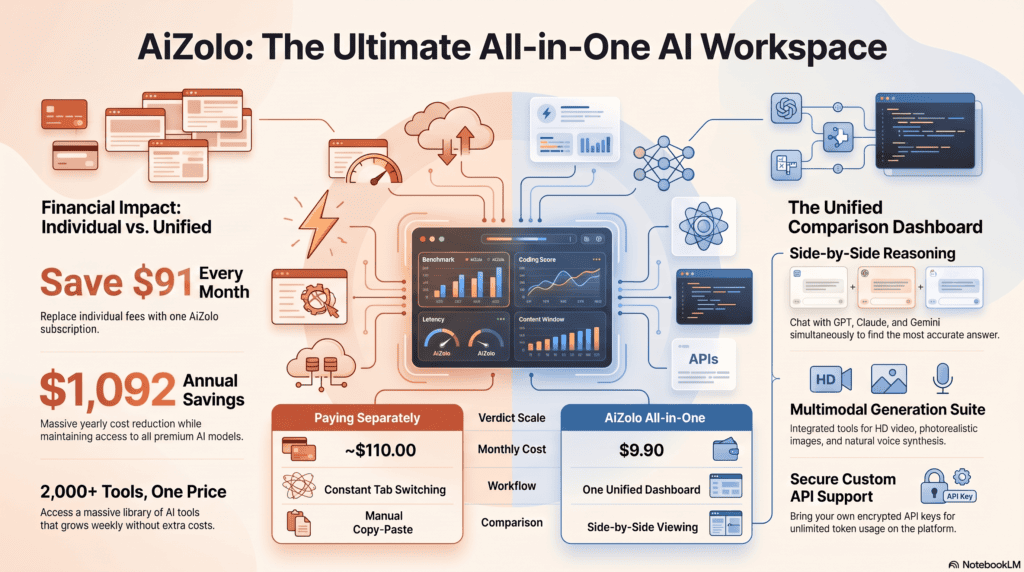
Are you tired of paying $200+ every month for separate AI subscriptions? Switching between ChatGPT, Claude, Gemini, and other platforms like AiZolo just to compare answers? There’s a better way.
All-in-one AI platforms let you access multiple cutting-edge AI models from a single interface—saving you time, money, and the hassle of managing multiple accounts. In this guide, we’ll explore the top 5 platforms that give you the best value, features, and flexibility in 2026.
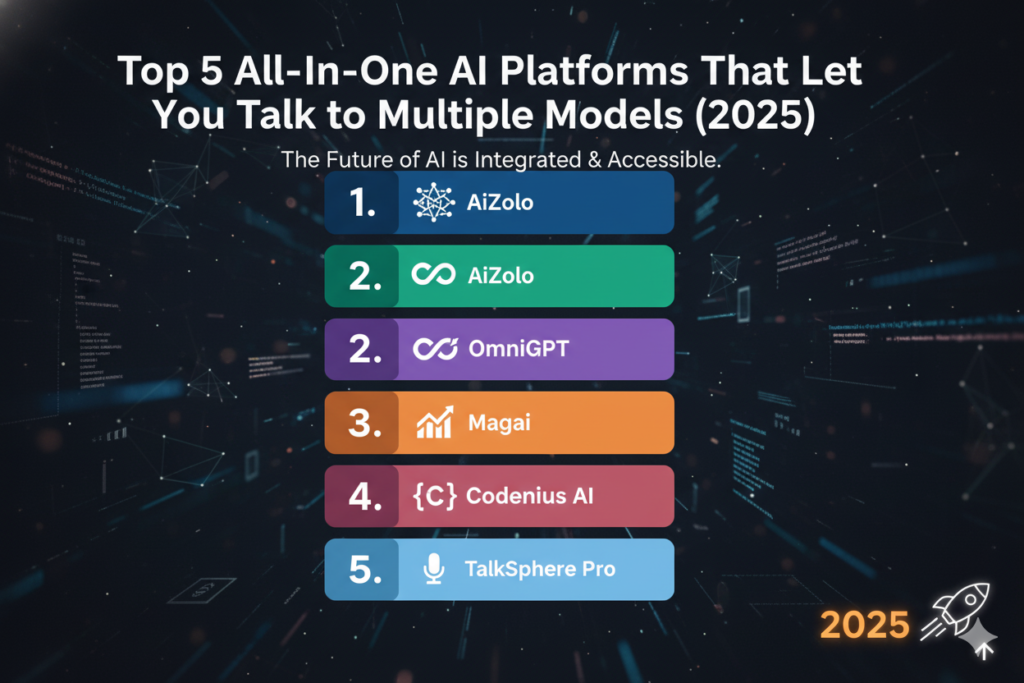
Table of Contents
What Are All-In-One AI Platforms?
All-in-one AI platforms are unified interfaces that provide access to multiple large language models (LLMs) from different providers. Instead of subscribing to OpenAI, Anthropic, Google, and Meta separately, you get them all in one place.
Key Benefits:
- Cost savings: One subscription instead of multiple
- Time efficiency: No need to switch tabs or apps
- Easy comparison: Test different models side-by-side
- Centralized workflow: Keep all your AI conversations organized
Let’s dive into the top 5 platforms that deliver on these promises.
What Makes an AI Platform “All-in-One”?
Many tools claim to be all-in-one, but the label only makes sense when several capabilities are available inside one account.
A practical all-in-one AI platform usually includes:
- Access to multiple language models
- One shared chat and file workspace
- Image generation tools
- Document upload and analysis
- Prompt history and saved projects
- Cross-model comparison or side-by-side testing
- A single billing plan
If a tool offers only one model with extra features, it is better described as an AI assistant rather than a full all-in-one platform.
Why Juggling AI Subscriptions Costs More Than You Think
Before comparing platforms, it helps to name the actual problems an all-in-one platform is solving. Most people can guess “it saves money,” but the deeper costs are less obvious.
1. The Guessing Problem Every time you send a prompt to one model, you’re implicitly betting it’s the best model for that job. Unless you test the same prompt across two or three models side-by-side, you never actually know whether GPT, Claude, or Gemini would have given you a better answer — you just got an answer.
2. The Lost Conversation Problem You solved a tricky problem in a chat three weeks ago. Which app was it in? Which account? What was the exact prompt? Scattering your AI work across five separate tools turns your own past insights into something you have to go dig for.
3. The Wrong-Tool Problem Different models genuinely have different strengths — reasoning, creative writing, multimodal analysis, real-time research — but knowing which to reach for takes expertise most people haven’t built. The default response is to just use whichever app is already open, which is rarely the optimal choice.
4. The Privacy Trade-off To get real value from AI, you often need to feed it real work: client data, proprietary code, internal strategy documents. Every additional tool you paste that into is another place your sensitive information now lives. Platforms that support your own API keys, with encrypted storage and no prompt logging, solve this without asking you to use AI less.
An all-in-one platform doesn’t just consolidate billing — it’s meant to remove these four specific frictions. Keep them in mind as you compare the options below.
What’s the Best All in One AI Platform in 2026?
There’s no single “best” — it depends on whether you want an aggregator, a workspace, or a research tool. But across pricing, model access, and reliability, AiZolo comes out ahead for most users comparing all-in-one AI platforms today, with Poe and You.com as strong runners-up depending on your use case. The full breakdown is below.
Looking for options that don’t require a paid subscription? See our dedicated free-tier comparison for free all-in-one AI platforms.
All In One AI Tools List For 2026
1. AiZolo.com – The Ultimate Free AI Comparison Platform
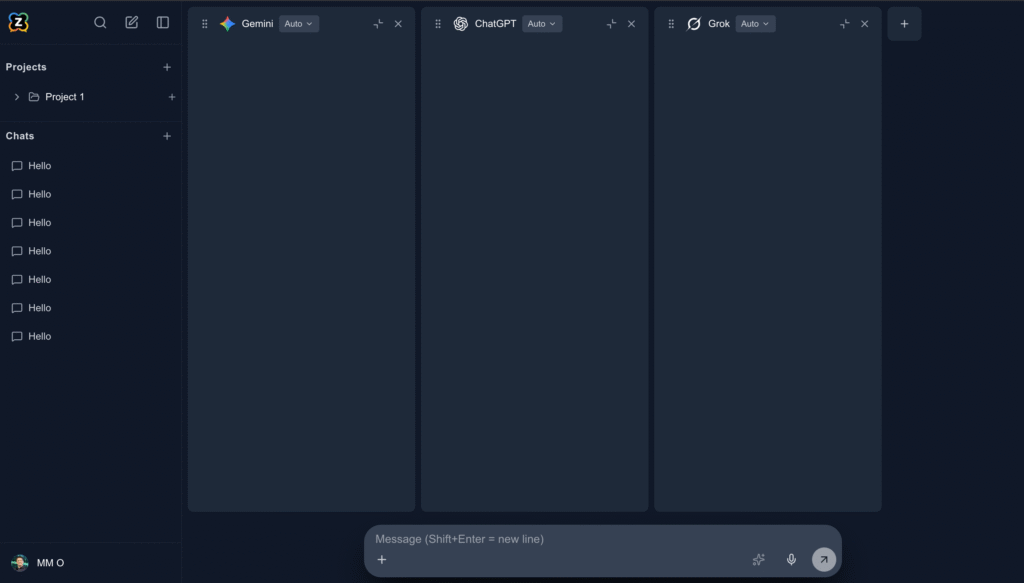
Why It Leads the Pack: AiZolo.com stands out as the most advanced AI comparison platform that’s completely free to start. Unlike other platforms that limit free users, AiZolo offers genuine multi-model comparison with professional-grade features.
Key Features For All-In-One AI Platforms:
- Simultaneous Multi-Model Chat: Chat with multiple AI models at the same time in a single interface
- Real-Time Response Comparison: Compare answers from different models instantly
- Bring Your Own API Keys: Use your own API keys to access premium models without limitations
- Advanced Workspace Controls: Resize, rearrange, minimize, and customize chat windows to fit your workflow
- Custom Projects: Create projects with custom system prompts and organize conversations efficiently
- Latest Models: Access the newest AI models as soon as they’re released
- Optimized Performance: Get instant responses with reliable, fast performance
Models Available:
Access all major AI models including GPT from OpenAI, Claude from Anthropic, Gemini from Google, LLaMA from Meta, and more—all with your own API keys for unlimited usage.
Who Should Use AiZolo?
AiZolo is especially useful for users who want access to multiple leading AI models without juggling separate subscriptions. It fits freelancers, agencies, startup teams, and power users who frequently compare model outputs for writing, coding, research, and brainstorming.
The main advantage is workflow consolidation: one login, one workspace, and one subscription for several AI models.
Pricing:
- Free Plan: Start free with basic features
- Pro Plan: For power users and professionals (scalable pricing)
- Annual Plan: Best value for committed users
- No hidden fees, cancel anytime
Why Choose AiZolo: If you want the most flexible, powerful, and cost-effective solution with no vendor lock-in, AiZolo is your best choice. The ability to use your own API keys means you only pay for what you use directly to AI providers.
Try AiZolo
2. Poe.com – The Conversation Hub by Quora
Why It Stands Out: Created by Quora, Poe excels as an AI chatbot aggregator with a focus on conversational experiences and community-driven custom bots.
Key Features:
- Side-by-Side Multibot Conversations: Compare responses from different models simultaneously
- Create and Share Custom Bots: Build your own AI assistants and share them with the community
- Clean Chat Interface: Designed specifically for seamless conversation switching
- Community Marketplace: Access custom bots created by other users
Models Available:
GPT-6 Astra, Claude Sonnet 5, DeepSeek V4 / V4.1, Runway, Kling, Cartesia, ElevenLabs, and more.
Best For:
Writers, researchers, and decision-makers who value conversation quality and want to compare model responses in real-time without technical setup.
Pricing:
- Free Tier: 150 messages/month or 3,000 points (20 points per message)
- Monthly Plan: $19.99/month ($239.88/year)
- Yearly Plan: $199.99/year (averages to $16.67/month)
3. You.com – The Privacy-First AI Productivity Suite
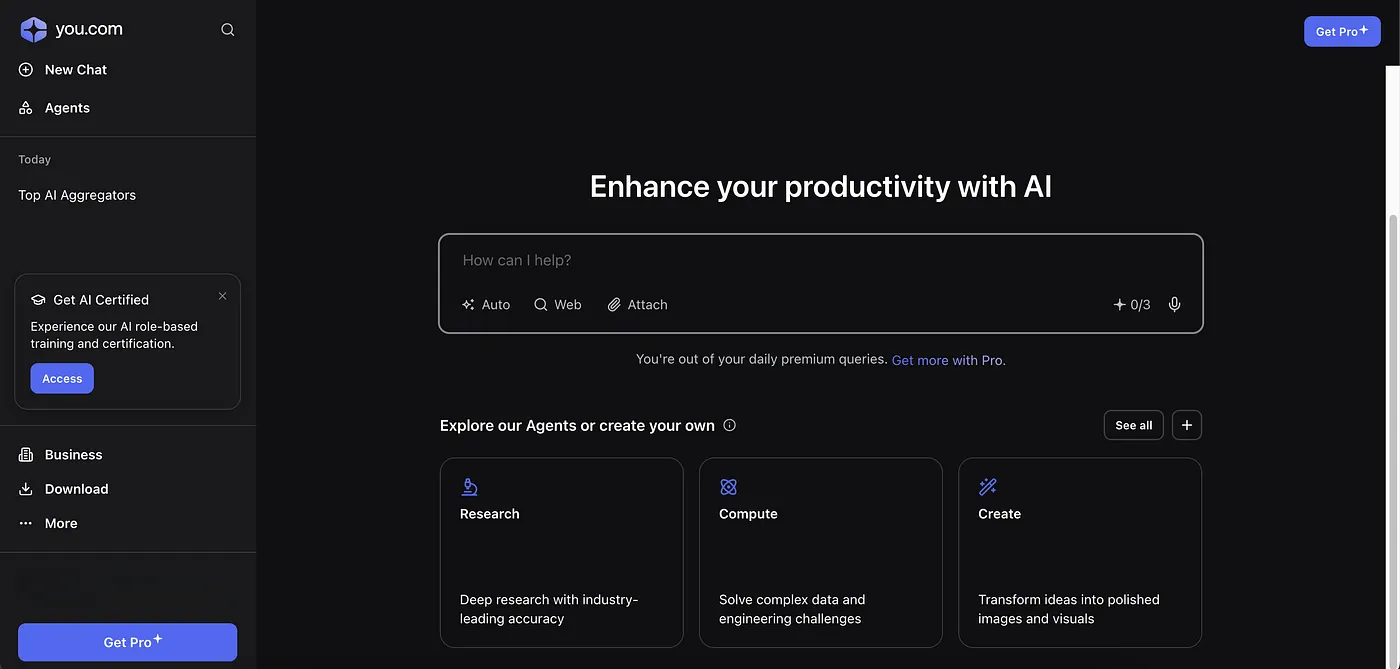
Why It Stands Out: You.com combines AI search with productivity tools while maintaining a strong focus on privacy. With access to over 25 models and specialized AI agents, it’s built for serious professionals.
Key Features:
- 25+ AI Models: GPT, Claude, Gemini, LLaMA, Mistral, xAI, Alibaba’s reasoning models, and more
- Specialized AI Agents: Research, Compute, and Create agents for specific tasks
- YouWrite: AI-powered writing assistance
- YouCode: Coding help and development support
- YouImagine: AI image generation
- Custom AI Agents: Create personalized agents for specific workflows
- Privacy-Focused: No tracking, privacy-first architecture
Models Available:
Over 25 models including GPT from OpenAI, Claude from Anthropic, xAI’s bots, Alibaba’s reasoning models, Google’s Gemini, Meta’s LLaMA, and Mistral. Premium models available on Pro plan.
Best For:
Professionals, developers, and teams who need specialized tools beyond basic chat. Ideal for those who value privacy and want an all-in-one productivity solution.
Pricing:
- Free Plan: Limited access to premium models
- Pro Plan: $20/month (includes Research and Custom Agents)
- Team Plan: $30/person/month
4. Magai.co – The Feature-Rich AI Writing Platform
Why It Stands Out: Magai is specifically designed for marketers, writers, and entrepreneurs who need advanced writing tools combined with multi-model access.
Key Features:
- 40+ Custom Personas: Pre-built writing personas for different content styles
- Team Collaboration Tools: Workspace features for team projects
- Brand Voice Management: Maintain consistent brand voice across content
- Image Generation: Integrated image creation tools
- Prompt Templates: Extensive library of writing prompts
Models Available:
LLMs: Latest models from ChatGPT, Claude, Gemini, Meta, Grok, Perplexity, and Mistral. Image Generation: DALL-E 3, Stable Diffusion XL, and Leonardo.ai.
Best For:
Content marketers, copywriters, and creative professionals who need specialized writing tools and team collaboration features.
Pricing:
- Solo: €20/month (approximately $22/month)
- Team: €40/month (approximately $44/month) – includes 5 users
5. TypingMind.ai – The Customizable API Key Platform
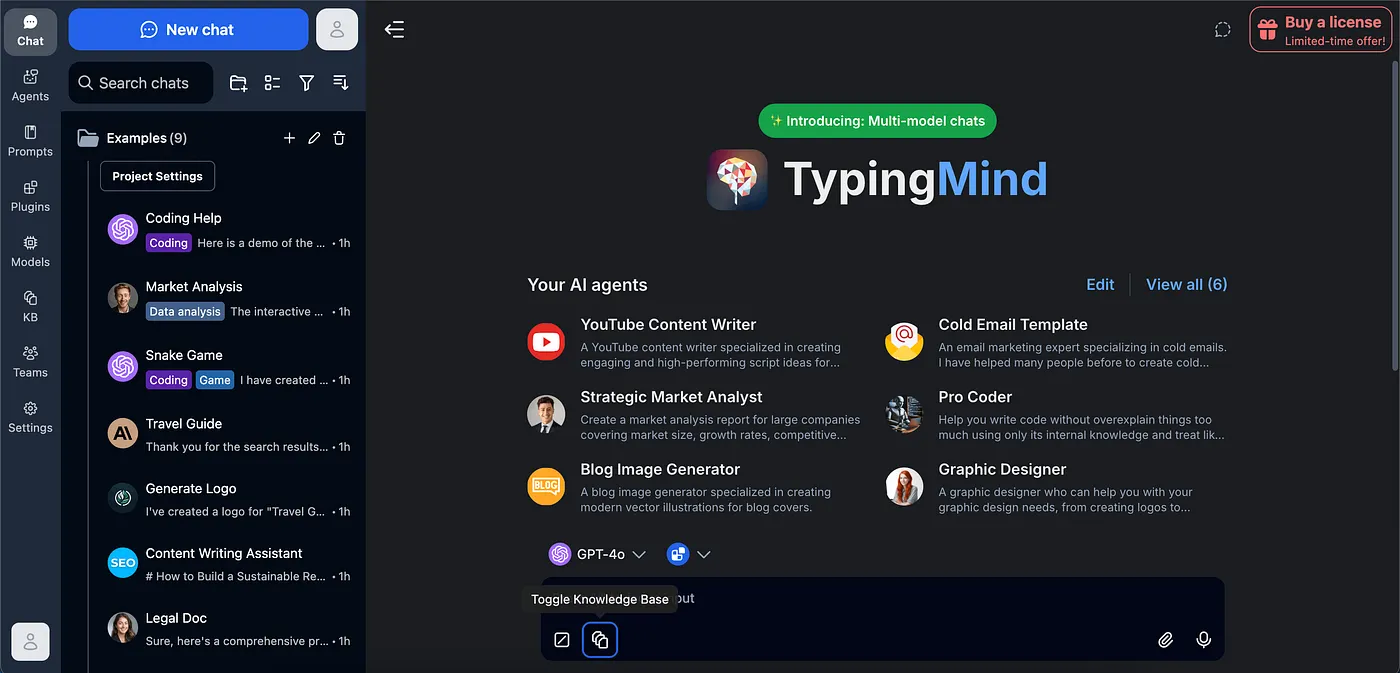
Why It Stands Out: TypingMind offers a one-time payment model and complete customization using your own API keys—no monthly subscriptions required after initial purchase.
Key Features:
- Use Your Own API Keys: Connect OpenAI, Anthropic, Google, and custom models
- One-Time Payment: No recurring subscription fees
- Custom AI Agent Creation: Build specialized assistants
- Chat Organization: Folders and powerful search functionality
- Prompt Library: Pre-built and custom prompt templates
- Plugin Store: Extend functionality with plugins
- Knowledge Base: Upload documents for context-aware conversations
Models Available:
OpenAI, Anthropic, Google, and support for custom models via API integration.
Best For:
Users who prefer one-time payments over subscriptions and want complete control through their own API keys. Ideal for developers and power users.
Pricing:
- Free Trial: Test before purchasing
- Standard License: $39 (one-time payment)
- Extended License: $79 (one-time payment)
- Premium License: $99 (one-time payment)
6. OpenRouter — The Developer’s API Aggregator
Why It Stands Out: OpenRouter isn’t a consumer chat app — it’s an API layer. One API key gives you programmatic access to 100+ models, with transparent per-token pricing and automatic fallback if a provider’s API goes down.
Key Features:
- 100+ Models: Broadest model coverage of any platform on this list, including niche and experimental models
- OpenAI-Compatible Format: Any app built for the OpenAI API can point to OpenRouter with a one-line config change
- Pay-Per-Use: No subscription — you pay exactly what you use, per model, per token
- Provider Fallback Routing: Automatically reroutes if an upstream API is down
- Cost Leaderboard: See exactly which model is cheapest for a given capability
Models Available:
GPT-6 Astra , Claude 5.1 Fable, Gemini 3.1 Pro, Grok, Mistral Large, DeepSeek V4/R1, Llama 3.1 405B, and dozens more.
Best For:
Developers building AI-powered applications who want model flexibility without juggling five separate API keys and billing accounts. Not built for non-technical users — there’s no consumer chat interface.
Pricing:
- Free tier: Generous daily limits on select models
- Pay-as-you-go: From $0.00014/1K tokens depending on model
- No monthly subscription required
If you’re primarily interested in API access, BYOK, and developer-focused options, see our full API-platform guide.
7. Perplexity — The Research-First AI
Why It Stands Out: Every Perplexity answer comes with cited sources, making it the most trust-optimized option on this list for anything where you need to verify where information came from.
Key Features:
- Real-Time Web Search with Citations: Every response links back to its sources
- Focus Modes: Academic, Writing, Reddit, YouTube, and more
- Spaces: Collaborative research folders for teams
- Multiple Models: GPT-6 Astra, Claude 5 Sonnet, and Perplexity’s own Sonar models
Best For:
Researchers, students, journalists, and analysts who need AI answers they can actually verify — not just fast answers.
Pricing:
- Free: 5 Pro searches/day, unlimited standard searches
- Pro: $20/month — 300+ Pro searches/day, all models
8. Abacus AI — The Enterprise Option
Why It Stands Out: Abacus AI goes past chat into actual AI infrastructure — agent building, RAG pipelines, and enterprise security certifications (SOC 2, HIPAA-eligible plans).
Key Features:
- AI Agent Builder: Chain models together for multi-step workflows
- RAG Pipelines: Retrieval-augmented generation for grounding answers in your own documents
- Enterprise Security: SOC 2 and HIPAA-compliant options available
- ChatLLM Teams: Business collaboration layer on top of model access
Best For:
Companies evaluating AI platforms for organizational deployment rather than individual use — teams that will eventually need agents and data pipelines, not just chat.
Pricing:
- Starter: ~$10/month
- Teams / Enterprise: Custom pricing
Complete All-in-One AI Platform List (2026)
Beyond our top five picks, the market now includes research assistants, enterprise AI hubs, creative suites, and developer-focused workspaces. Examples include AiZolo, Poe, Perplexity, You.com, Microsoft Copilot, Gemini for Workspace, Canva AI, and Cursor.
The key difference is that a true all-in-one platform lets you switch between models such as GPT, Claude, Gemini, and DeepSeek from a single interface instead of managing separate subscriptions.
Detailed Comparison Table
| Platform | Starting Price | Free Tier | Own API Keys | Best Feature |
|---|---|---|---|---|
| AiZolo.com | Free/9/mo | Yes | Yes ✓ | Multi-model simultaneous chat |
| Poe.com | Free/19.99/mo | Yes | No | Side-by-side comparison |
| You.com | Free/20/mo | Yes | No | Privacy + 25+ models |
| Magai.co | €20/mo | No | No | Writing personas + team tools |
| TypingMind.ai | $39 one-time | Trial | Yes ✓ | One-time payment model |
A Simple Evaluation Checklist
Before committing to any AI platform, test these seven points:
- Can you access more than one major model?
- Is file upload included?
- Are chats searchable?
- Can you compare outputs side by side?
- Does the free plan have meaningful limits?
- Can you export your work?
- Is pricing transparent for monthly and annual plans?
A platform that scores well on most of these questions is usually a safer long-term choice than one that excels in only a single feature.
Which Platform Gives You Which AI Model?
| Platform | GPT-6 Astra | Claude | Gemini | Grok | Mistral | DeepSeek | Llama | Own API Keys |
|---|---|---|---|---|---|---|---|---|
| AiZolo | ✅ | ✅ | ✅ | ✅ | ✅ | ✅ | ✅ | ✅ |
| Poe | ✅ | ✅ | ✅ | ❌ | ✅ | ❌ | ✅ | ❌ |
| You.com | ✅ | ✅ | ✅ | ✅ | ✅ | ❌ | ❌ | ❌ |
| Magai | ✅ | ✅ | ✅ | ✅ | ✅ | ❌ | ❌ | ❌ |
| TypingMind | ✅ | ✅ | ✅ | ❌ | ❌ | ❌ | ❌ | ✅ |
| OpenRouter | ✅ | ✅ | ✅ | ✅ | ✅ | ✅ | ✅ | ✅ (required) |
| Perplexity | ✅ | ✅ | ❌ | ❌ | ❌ | ❌ | ❌ | ❌ |
| Abacus AI | ✅ | ✅ | ✅ | ❌ | ❌ | ✅ | ✅ | ❌ |
No single model wins at everything — the point of any platform on this list is letting you route each task to whichever model handles it best, without paying for five separate subscriptions to do it.
Before You Choose: A 3-Step Audit
Step 1 — Add up what you’re actually paying today. List every AI subscription you currently have, active or half-forgotten, and total the monthly cost. Most people underestimate this until they write it down.
Step 2 — Name your top 3 use cases. Coding, long-form writing, research, image generation, data analysis? Be specific — “I use AI for work stuff” won’t tell you which platform fits. Match your top use cases against the “Best For” line in each platform section above.
Step 3 — Run one real test before committing. Take an actual task you’re working on this week and run it through a free tier or trial. Don’t test with a toy prompt — bring the messy, real thing you’d normally hand to ChatGPT or Claude. The platform that handles your actual work best is the right answer, not the one with the longest feature list.
How to Choose the Right Platform for You
Choose AiZolo.com if:
- You want complete flexibility with your own API keys
- You need to compare multiple models simultaneously
- You prefer paying only for actual API usage
- You want advanced workspace customization
- You’re a developer or power user who needs control
For a deeper look at the platform from a real-world usage perspective, read a hands-on productivity suite review.
Choose Poe.com if:
- You want a simple, user-friendly interface
- You value the free tier for testing
- You’re interested in community custom bots
- You don’t want to manage API keys
Choose You.com if:
- Privacy is your top priority
- You need specialized AI agents for research and productivity
- You want 25+ models in one place
- You need integrated search functionality
Choose Magai.co if:
- You’re a content creator or marketer
- You need team collaboration features
- You want pre-built writing personas
- Image generation is important to you
Choose TypingMind.ai if:
- You prefer one-time payments over subscriptions
- You want to use your own API keys
- You need extensive customization options
- You value the plugin ecosystem
The Bottom Line: Stop Paying for Multiple AI Subscriptions
The era of juggling multiple AI subscriptions is over. Whether you’re looking for:
- Maximum flexibility: AiZolo.com with your own API keys
- Ease of use: Poe.com’s clean interface
- Privacy focus: You.com’s 25+ models
- Writing tools: Magai.co’s specialized features
- One-time payment: TypingMind.ai’s no-subscription model
There’s an all-in-one platform that perfectly fits your needs and budget.
Our Recommendation:
Start with AiZolo.com if you want the most cost-effective and flexible solution. The ability to use your own API keys means you’re never locked into platform pricing, and the simultaneous multi-model chat feature is unmatched for comparison work.
For users who prefer managed solutions without API setup, Poe.com offers the best free tier and user experience, while You.com provides the most comprehensive feature set with strong privacy guarantees.
Frequently Asked Questions
Q: Can I really save money with these platforms? Yes! Instead of paying $20/month for ChatGPT Plus + $20/month for Claude Pro + $20/month for other services, you can access all models through one platform—or use your own API keys with platforms like AiZolo for even greater savings.
Q: Are the AI responses different on these platforms? No. The models themselves are the same. You’re accessing the same GPT-6 Astra, Claude, and Gemini models you’d get from the original providers.
Q: What does “use your own API keys” mean? It means you can connect your own accounts directly from OpenAI, Anthropic, etc., and pay them directly for usage. Platforms like AiZolo and TypingMind facilitate this, giving you more control and often lower costs.
Q: Which platform has the best free tier? AiZolo.com offers the most flexible free option, especially if you use your own API keys. Poe.com has a generous 150 messages/month free tier if you prefer not to manage API keys.
Q: What does an “all-in-one AI models” platform actually mean?
A: It means one subscription or account gives you access to multiple underlying AI models — like GPT-6 Astra, Claude, Gemini, and Llama — instead of paying separately for each provider’s app.
The platform handles routing your prompt to whichever model you select, so you’re not managing five different logins and five different bills.
Q: Will I lose response quality by using an aggregator instead of the official app? No. Aggregators like AiZolo, Poe, and OpenRouter connect to the same underlying models through official APIs.
You’re getting the same GPT-6 Astra or Claude 5 Sonnet you’d get going directly to OpenAI or Anthropic — the platform adds interface and organization on top, it doesn’t change the model.
Q: Do these platforms get new models as fast as the official apps? Usually not immediately. When a new model version ships, the official app updates first; aggregators typically catch up within days to a few weeks depending on how actively they’re maintained. If bleeding-edge access matters to you, check a platform’s update cadence before committing.
Q: Is my data safe going through a third-party platform? It depends on the platform and plan. Your prompts pass through the aggregator’s servers before reaching the model’s API, so you’re trusting their data retention policy.
For sensitive professional work, look specifically for platforms offering zero-data-retention, encrypted custom API key support (so your keys — and by extension, the platform — never touch your raw conversation data), or a documented data processing agreement.
Q: What’s the difference between an “aggregator” and a “workspace”? An aggregator (like OpenRouter) is essentially a router — you pick a model, it sends your prompt to that model’s API, you get a response back.
A workspace (like AiZolo, TypingMind, or LibreChat) adds project organization, persistent context, prompt libraries, and team features on top of that routing. Most people looking for an “all-in-one AI platform” actually want a workspace, not a bare aggregator.
If you want a deeper look at aggregator-style platforms, BYOK options, and self-hosted tools, see our extended multi-model access comparison.
Q: Can I mix approaches — use one platform plus a couple of specialized tools? Yes, and many power users do. An all-in-one platform typically covers 80% of daily needs; it doesn’t have to replace a specialized tool you already rely on for one specific task (e.g., Perplexity for research citations, or a dedicated coding assistant).
Q: Is an all-in-one AI platform cheaper than separate subscriptions? Often yes. If you use more than one major AI model regularly, a multi-model platform can reduce total monthly cost by combining access under one plan.
Q: Can I use ChatGPT, Claude, and Gemini from one dashboard? Some multi-model AI platforms provide access to all three from a single interface, allowing you to switch models without opening separate apps.
Q: Which all-in-one AI platform is best for startups? Startups usually benefit most from platforms that offer shared workspaces, predictable pricing, and access to several models under one subscription.
Q: Do all-in-one AI platforms include image generation? Not all of them. Check whether image generation is included in the base plan or requires a separate credit system.
Q: What should I test before paying for an AI platform? Test model quality, file upload limits, export options, search inside chat history, collaboration features, and whether the free plan is sufficient for your typical workload.
Start Saving Today
Ready to simplify your AI workflow and stop paying for multiple subscriptions?
👉 Try AiZolo.com for free and experience the power of simultaneous multi-model comparison with your own API keys.
Whether you’re a developer, content creator, researcher, or business professional, these all-in-one AI platforms give you access to the world’s best AI models without the complexity and cost of managing multiple subscriptions.
The future of AI is unified. Start today!
Reviewed and updated for 2026. Platform pricing, model access, and features are checked periodically as providers update their offerings — if you spot something that’s changed, let us know at support@aizolo.com.

mshoeb
Hi how to learn ai from basic to advance
Visit AiZOLO Website Link is here :- AI Zolo
Pingback: best ai tools for generating creative fiction stories: 7x Ideas Fast
Pingback: prompt to test and compare ai models: 5x Faster Insights 2026
Pingback: How to Automate Daily Business Tasks Using AI & Save 20+ Hours Fast
Pingback: Most Powerful AI in the World 2025: Access GPT-5, Claude 4 & Gemini 3 | Save $1000+
Valuable info. Lucky me I discovered your web site by accident,
and I am surprised why this accident didn’t took place
in advance! I bookmarked it.