Quick Summary: As of July 2026, no single model wins every speed test. Google’s Gemini 3.1 Pro Preview posts the fastest first-tokens among frontier reasoning models when latency is prioritized, Grok 4.5 delivers the fastest sustained output among top-10 intelligence models at roughly 80–93 tokens per second, and specialised throughput models like Mercury 2 exceed nearly 782 tokens per second—though they are not in the same intelligence class. Aizolo makes comparing these models easier by bringing multiple leading AI models into a single workspace, helping users evaluate speed, reasoning, and real-world performance without switching between separate platforms. Ultimately, the fastest AI model 2026 comparison depends entirely on which performance metric you’re measuring.
Introduction
If you’ve searched for a fastest ai model 2026 comparison, you’ve probably already noticed the problem: every blog post picks a different winner. That’s not because writers disagree — it’s because “speed” is at least three different measurements wearing one name.
This guide separates them, sources every number to Artificial Analysis, official provider documentation, or model release notes, and tells you which model is fastest for your specific use case, not just in a marketing headline.
Table of Contents
Why AI Speed Actually Matters in 2026
Speed used to be a footnote in AI reviews. In 2026, it’s a product decision.
Agentic workflows now chain 10, 20, sometimes 50 model calls to complete one task. A model that’s 3x slower per call doesn’t cost 3x more time — it compounds across every step in the chain.
Customer-facing chat products live or die on time to first token. Users perceive a 10-second pause as broken software, even if the eventual answer is excellent.
And reasoning models — the frontier tier that dominates 2026’s intelligence rankings — often trade speed for depth. That trade-off is exactly what this comparison measures, instead of pretending it doesn’t exist.
Did You Know? A model producing 60 tokens per second at 0.4-second latency can feel faster in a chat UI than a model producing 150 tokens per second with a 15-second latency, because users see the first words appear almost instantly. Perceived speed and raw throughput are not the same thing.
What “Fastest” Really Means (3 Metrics, Not 1)
Before ranking anything, it helps to define the terms this article — and the primary keyword “fastest ai model 2026 comparison” — actually refers to.
1. Time to First Token (TTFT): How long you wait before any text appears. For reasoning models, this includes internal “thinking” time before the visible answer starts streaming.
2. Output Speed (Tokens per Second): Once the model starts streaming, how quickly it generates each subsequent token. This is what most “tokens/sec” charts measure.
3. End-to-End Response Time: The full wall-clock time to receive a complete, usable answer — TTFT plus generation time for a standard-length response (commonly benchmarked at 500 output tokens).
A model can lead on one metric and trail badly on another. Several models in this comparison do exactly that, and we call it out explicitly rather than blending the numbers into a single misleading “speed score.”
Expert Tip: If you’re building a real-time chat product, weight TTFT heavily. If you’re running batch or async pipelines (report generation, overnight document processing), weight raw output speed and ignore TTFT almost entirely.
Methodology: How This Comparison Was Built
Every number in this article is pulled from one of the following sources, current as of July 19, 2026:
- Artificial Analysis — independent, third-party benchmarking of output speed, time-to-first-token, and end-to-end response time, updated on a rolling basis across API providers
- Official model cards and release announcements from Anthropic, OpenAI, Google DeepMind, and xAI
- OpenRouter provider throughput and pricing data
- Public benchmark results (SWE-bench Pro, Terminal-Bench 2.1, GDPval-AA) as reported by the model creators and cross-referenced against Artificial Analysis
We did not estimate, extrapolate, or invent any figure. Where two sources disagreed slightly (which happens because providers serve models across multiple infrastructure backends), we report the range rather than picking a single number to look tidy.
Benchmarks shift week to week as providers tune infrastructure, so treat every figure here as a snapshot, not a permanent ranking. Check the linked sources for live numbers before making a production decision.
Fastest AI Model 2026 Comparison: Full Speed Table
This table ranks models by output tokens per second (sustained generation speed), the metric most people mean when they search for the fastest AI model.
| Model | Output Speed (tok/s) | TTFT (seconds) | Intelligence Index | Context Window |
|---|---|---|---|---|
| Mercury 2 (Inception Labs) | 781.7 | Not directly comparable (diffusion architecture) | Not ranked on Intelligence Index | — |
| Gemini 3.1 Flash-Lite | 290–340 | 5.6s | 25 | 1M |
| Gemini 3.5 Flash (high) | 181.3 | 30.05s | Not in top tier | — |
| Gemini 3 Flash Preview (Reasoning) | 161.7 | 7.53s | — | — |
| Gemini 3.1 Pro Preview | 109.5–135.7 | 25.8–30.4s | 46 | 1M |
| GPT-5 (high) | 99.3 | 96.09s | 35 | 400K |
| Grok 4.5 (high) | 80–93 | 10.5–17.4s | 54 | 500K |
| Claude Sonnet 5 (max) | 71.6–83 | up to 205.9s (max reasoning effort) | 53 | 1M |
| GPT-5.5 (high) | 73.9 | 15.59s | 53 | 922K |
| GPT-5.5 (xhigh) | 67.7 | 61.57s | 55 | 922K |
| Grok 4 Fast (non-reasoning) | 64.9 | 0.64s | 23 | 2.0M |
| GPT-5.5 (medium) | 64.0 | 10.48s | 50 | 922K |
| Claude Opus 4.8 (max) | 57.5–58 | not disclosed at max effort | 56 | 1M |
| GPT-5.5 (low) | 55.6 | 1.86s | 42 (est.) | 922K |
| Claude 4.5 Sonnet (non-reasoning) | 40.7 | 1.57s | 29 | — |
Sources: Artificial Analysis model pages (artificialanalysis.ai), accessed July 19, 2026. Figures for reasoning-effort variants (e.g., “max,” “xhigh,” “high”) reflect that specific configuration, not the model’s floor or ceiling.
Important: Notice that TTFT and output speed move in opposite directions for several models here. Claude Sonnet 5 at max reasoning effort and GPT-5.5 at xhigh effort both spend enormous time “thinking” before the first visible token — over a minute in some cases — even though once they start streaming, their token-per-second rate is respectable. Don’t read output speed alone as “how fast this model feels.”
Time to First Token: The Latency Leaderboard
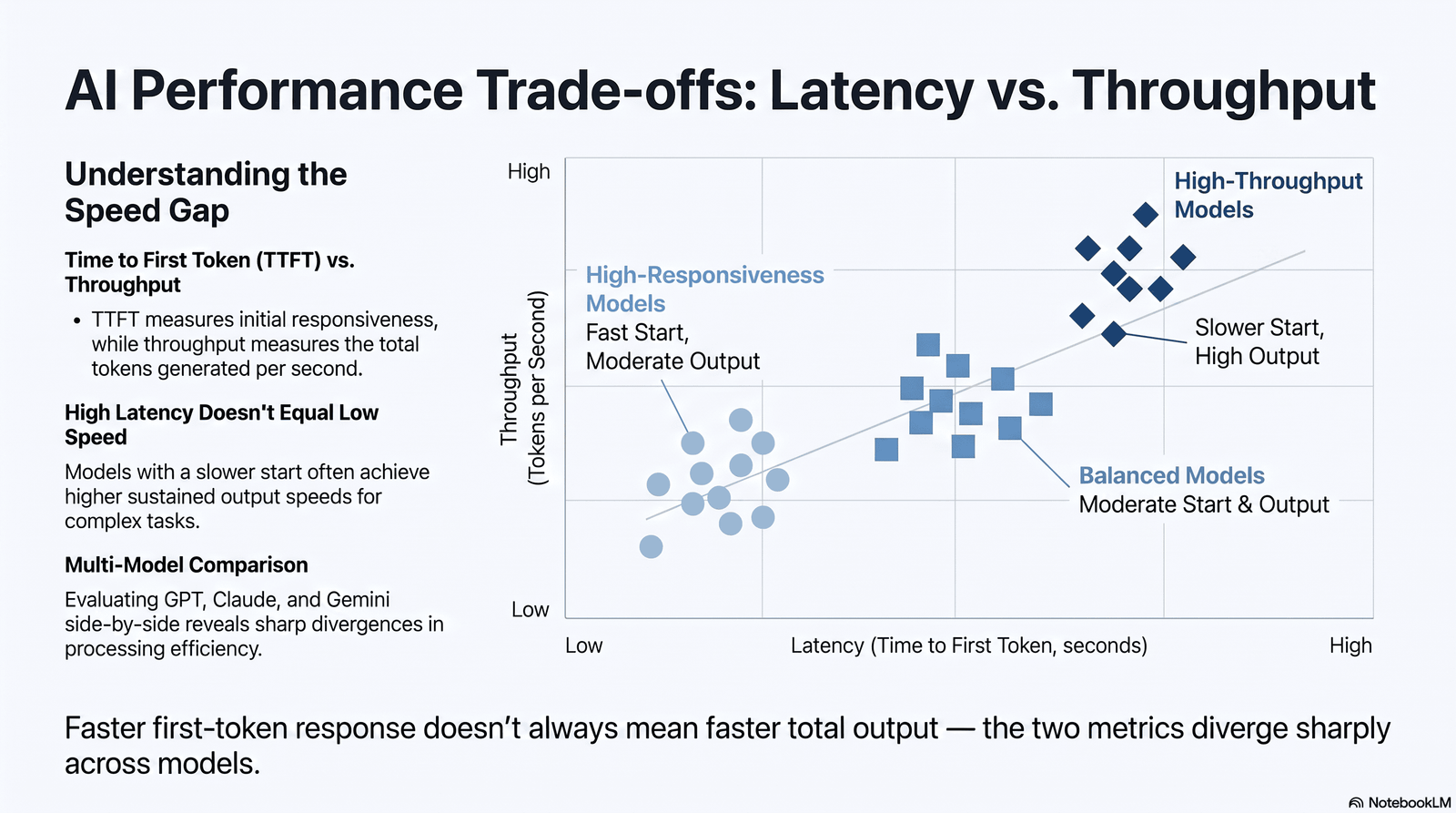
If low latency — not raw throughput — is what you care about, the ranking changes completely.
| Model | Time to First Token | Category |
|---|---|---|
| North Mini Code | 0.32s | Non-reasoning, code-focused |
| Gemini 2.5 Flash-Lite (non-reasoning) | 0.37s | Lightweight, non-reasoning |
| Command A+ | 0.40s | Non-reasoning |
| Grok 4 Fast (non-reasoning) | 0.64s | Non-reasoning |
| Claude 4.5 Haiku | 0.98s | Non-reasoning |
| Claude Sonnet 5 (non-reasoning) | 1.32s | Non-reasoning |
| Claude Sonnet 4.6 (non-reasoning) | 1.37s | Non-reasoning |
| Claude 4.5 Sonnet (non-reasoning) | 1.57s | Non-reasoning |
| GPT-5.5 (low) | 1.86s | Reasoning, low effort |
Source: Artificial Analysis, artificialanalysis.ai/models and artificialanalysis.ai/providers/anthropic, July 2026.
The pattern is consistent: non-reasoning modes are dramatically faster to first token than reasoning modes of the same model family. Anthropic’s own leaderboard shows Claude 4.5 Haiku and non-reasoning Claude Sonnet 5 dominating Anthropic’s internal latency rankings, while reasoning-heavy configurations of the same models can take 100x longer to produce a first token.
Research Insight: This is the single most important, and most commonly missed, insight in any AI speed comparison. The “fastest AI model” question has two entirely different answers depending on whether reasoning/thinking mode is switched on. Comparing a non-reasoning Haiku call to a max-effort Opus call and calling one “faster” is comparing two different products.
Model-by-Model Speed Breakdown
GPT-5.5 and GPT-5.6 Sol Speed
GPT-5.5 ships in four reasoning-effort tiers (low, medium, high, xhigh), and speed varies enormously between them. At low effort, GPT-5.5 posts a 1.86-second TTFT with 55.6 tokens/sec output. At xhigh effort, TTFT balloons to roughly 61.6 seconds, though output speed actually improves slightly to 67.7 tokens/sec once generation begins.
GPT-5.6 Sol, OpenAI’s subsequent release, currently leads the Artificial Analysis Intelligence Index at the “max” configuration alongside Claude Fable 5, but detailed independent speed figures for GPT-5.6 Sol were still being populated across providers at the time of writing — check the Artificial Analysis GPT-5.6 Sol page for the latest measured throughput before relying on it for a production decision.
Claude Sonnet 5 and Claude Opus 4.8 Speed
Anthropic’s Claude Sonnet 5, released June 30, 2026, generates output at 71.6–83 tokens per second depending on reasoning effort, making it Anthropic’s fastest reasoning-tier model by throughput. Its non-reasoning mode drops TTFT to 1.32 seconds — among the quickest first-token times of any frontier-class model.
Claude Opus 4.8, Anthropic’s flagship reasoning model, trades speed for depth: 57.5–58 tokens/sec output, well below the reasoning-model median of roughly 71 tokens/sec on Artificial Analysis. Opus 4.8 leads Sonnet 5 on the hardest coding and computer-use benchmarks (SWE-bench Pro 69.2% vs. Sonnet 5’s 63.2%), but Sonnet 5 wins Terminal-Bench 2.1 (80.4 vs. 74.6) and effectively ties Opus 4.8 on general knowledge work — while running faster and cheaper.
Claude 4.5 Haiku remains Anthropic’s speed specialist, topping Anthropic’s own throughput leaderboard at roughly 87–90 tokens/sec with sub-second latency.
Gemini 3.1 Pro and Gemini 3.5 Flash Speed
Google’s Gemini 3.1 Pro Preview generates 109.5–135.7 tokens per second depending on provider (AI Studio vs. Vertex), placing it above the reasoning-model median of 71.3 tokens/sec. Its TTFT sits between 25.8 and 30.4 seconds — slower to start than non-reasoning models, but faster once streaming than most reasoning competitors.
Gemini’s Flash-tier models are where Google actually wins on raw speed: Gemini 3.1 Flash-Lite hits 290–340 tokens/sec, and Gemini 3.5 Flash (high) reaches 181.3 tokens/sec — both dramatically faster than any Pro-tier reasoning model, at a fraction of the intelligence score.
Grok 4.5 Speed
xAI’s Grok 4.5, released July 8, 2026, is positioned explicitly around speed-per-dollar. xAI states the model runs at roughly 80 tokens per second; Artificial Analysis’s independent measurement puts it slightly higher, at 91.3–92.5 tokens/sec, with a TTFT ranging from 10.5 to 17.4 seconds across measurement windows.
Grok 4.5’s real speed advantage isn’t raw tokens/sec — it’s token efficiency. On SWE-bench Pro, Grok 4.5 completes tasks using an average of 15,954 output tokens, compared to Claude Opus 4.8’s 67,020 tokens for the same benchmark — roughly 4.2x fewer tokens per task. Fewer tokens generated means a faster completed task, even at a similar per-token speed.
Common Mistake: Comparing models purely on tokens-per-second ignores verbosity. A model that’s 20% slower per token but uses 4x fewer tokens to finish a task will still finish faster in wall-clock time. Always check output tokens per task alongside raw speed.
The Real Speed Champion: Specialized Throughput Models
If the question is purely “which model produces text fastest, full stop,” the answer isn’t a frontier reasoning model at all. Mercury 2, built on a diffusion-based architecture rather than traditional autoregressive decoding, is independently measured at 781.7 tokens per second by Artificial Analysis — more than 5x the speed of Gemini 3.1 Pro and over 8x Claude Opus 4.8.
Granite 4.0 H Small (414.5 tokens/sec) and LFM2.5-VL-1.6B (390.3 tokens/sec) follow. These are small, efficient models built for throughput-critical applications, not frontier reasoning tasks — they will not out-reason Claude Opus 4.8 or GPT-5.6 Sol, but for latency-sensitive, simpler workloads, nothing in the frontier tier comes close to their raw output rate.
[IMAGE 3: Model speed vs intelligence bar chart — see Image Recommendations section]
Speed vs. Reasoning Ability: The Trade-Off Nobody Talks About
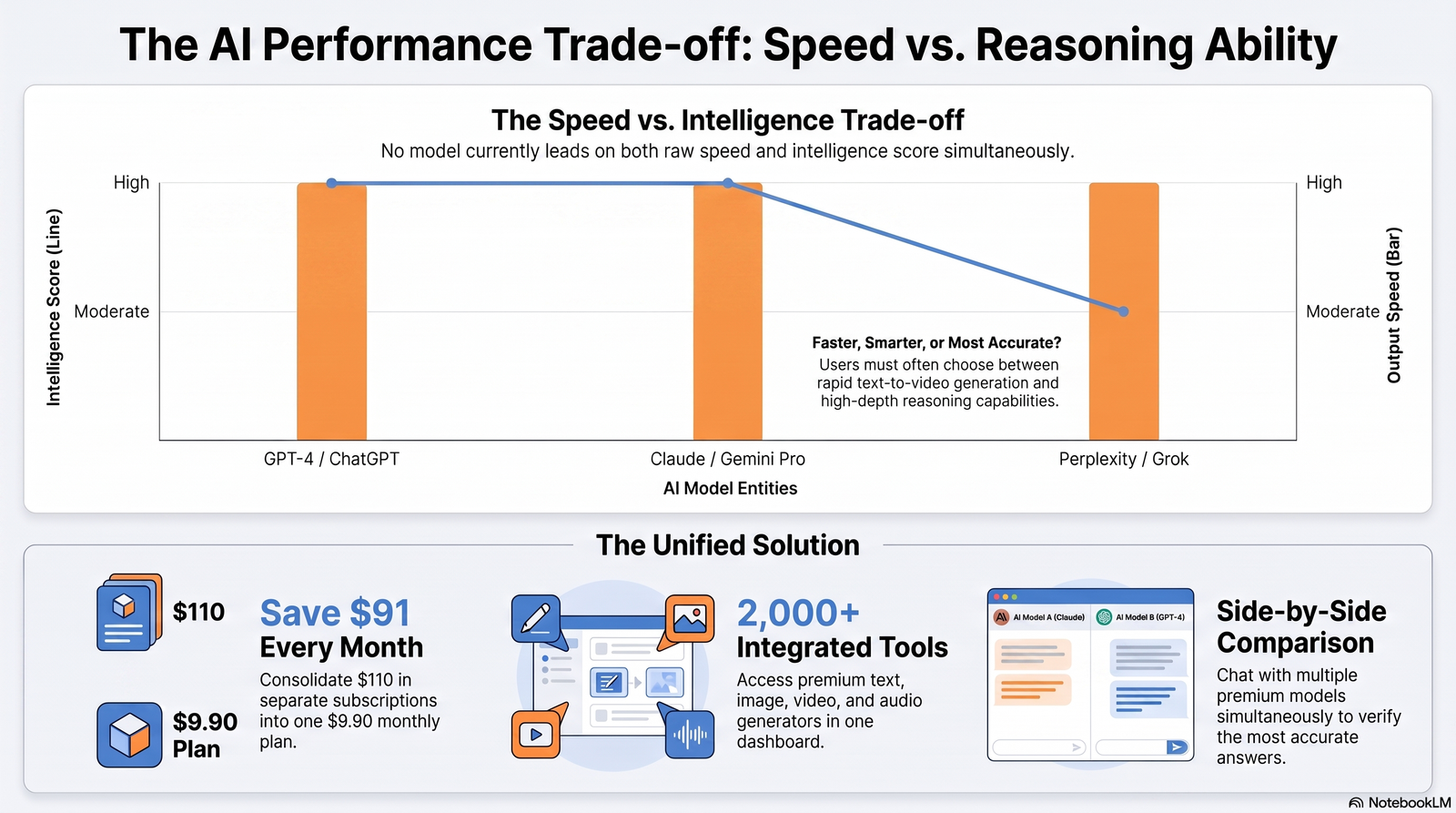
Every model in this comparison sits somewhere on a speed-intelligence curve, and the two metrics pull in opposite directions almost without exception.
Claude Fable 5 and GPT-5.6 Sol (max) currently lead the Artificial Analysis Intelligence Index at scores of 60 and 59 respectively — but neither is a speed leader. Meanwhile, Mercury 2 leads speed at 781.7 tokens/sec but isn’t positioned as a reasoning competitor at all.
The practical implication: there is no model that is simultaneously the fastest and the smartest. Every “fastest AI model 2026” claim you’ll see elsewhere is implicitly picking one axis and ignoring the other. This comparison keeps both visible so you can weigh the trade-off against your actual use case.
Quick Summary: Want maximum intelligence and can tolerate 10–60 second latency? Claude Fable 5, GPT-5.6 Sol, or Claude Opus 4.8. Want a strong balance of speed and reasoning? Claude Sonnet 5 or Grok 4.5. Want raw throughput for simple, high-volume tasks? Gemini Flash-Lite tier or Mercury 2.
Fastest AI for Coding
Coding speed isn’t just tokens/sec — it’s tokens/sec combined with how many tokens the model needs to solve the problem correctly the first time.
| Model | SWE-bench Pro | Terminal-Bench 2.1 | Output Tokens per Task | Output Speed |
|---|---|---|---|---|
| Claude Opus 4.8 (max) | 69.2% | 74.6 | 67,020 (highest) | 57.5–58 t/s |
| Claude Sonnet 5 (max) | 63.2% | 80.4 (leads) | Lower than Opus 4.8 | 71.6–83 t/s |
| Grok 4.5 (high) | Trails Opus 4.8 on this benchmark | Leads Opus 4.8 | 15,954 (4.2x fewer than Opus 4.8) | 80–93 t/s |
Sources: xAI Grok 4.5 announcement (x.ai/news/grok-4-5); Anthropic Claude Sonnet 5 announcement (anthropic.com/news/claude-sonnet-5); Artificial Analysis.
For raw benchmark accuracy on the hardest repository-scale coding tasks, Claude Opus 4.8 still leads. For finishing typical coding tasks fastest in real wall-clock time, Grok 4.5’s token efficiency and Claude Sonnet 5’s higher output speed both outpace Opus 4.8 in practice, even though Opus scores higher on the hardest subset of problems.
Fastest AI for Writing and Research
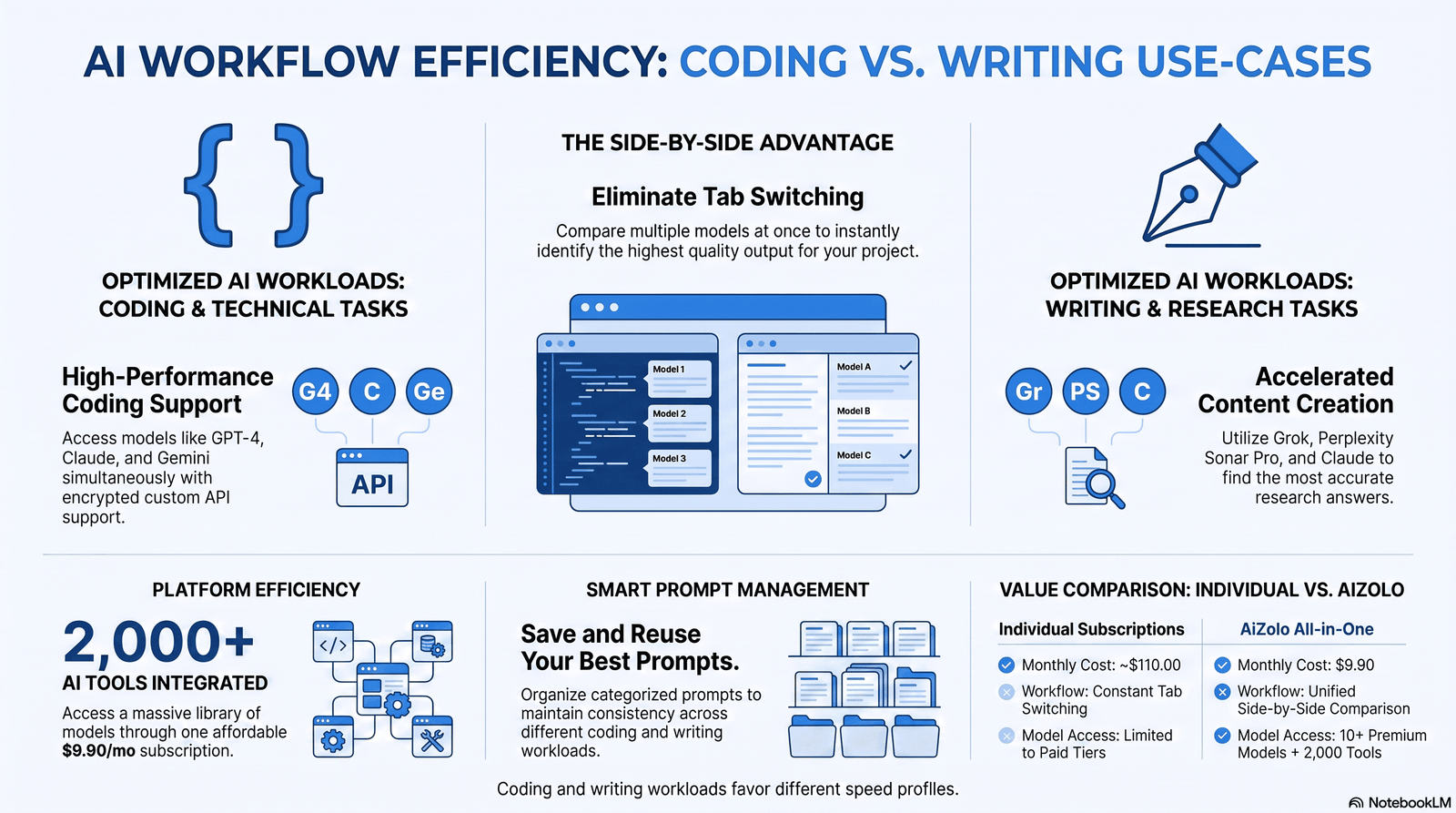
For long-form writing and research synthesis, non-reasoning or low-effort reasoning modes matter more than raw peak throughput, because the bottleneck is usually how quickly the model starts producing usable draft text.
Claude Sonnet 5 in non-reasoning mode (1.32s TTFT) and Claude 4.5 Haiku (0.98s TTFT, 87–90 tokens/sec) are strong picks for drafting and iteration speed. Gemini 3.1 Flash-Lite’s 290–340 tokens/sec output makes it well-suited to bulk content generation and summarization workloads where intelligence requirements are moderate but volume is high.
For research tasks requiring deep multi-source synthesis, the calculus flips: Claude Opus 4.8 and GPT-5.6 Sol’s higher intelligence scores generally produce more reliable synthesis, even at a slower pace — the “fastest” answer here is the one that doesn’t need a second correction pass.
[IMAGE 4: Coding vs writing speed use-case diagram — see Image Recommendations section]
How AI Speed Is Measured (Benchmark Section)
Understanding the methodology behind these numbers matters, because different testing approaches can produce meaningfully different results for the same model.
Time to First Token (TTFT): Measured from the moment an API request is sent to the moment the first content chunk is received. For reasoning models, this includes internal “thinking” tokens generated before the visible answer begins — which is why reasoning-mode TTFT can look dramatically worse than the same model in non-reasoning mode.
Output Speed (Tokens/sec): Measured only after the first chunk arrives, tracking the generation rate of subsequent tokens during active streaming. This isolates raw decode speed from initial processing delay.
End-to-End Response Time: Combines TTFT, thinking time, and generation time for a standardized output length (Artificial Analysis uses 500 tokens) to estimate real-world wait time for a typical response.
Why Benchmarks Differ Between Sources: Speed is infrastructure-dependent, not just model-dependent. The same model served via different API providers, GPU generations, batch sizes, and server load conditions will produce different tokens/sec figures. Artificial Analysis addresses this by measuring across a rolling 72-hour window and reporting median (P50) figures per provider, but even that can shift week to week as providers add capacity or new hardware.
Inference Hardware Matters: Providers like Groq and Cerebras run models on custom silicon (LPUs and wafer-scale engines respectively) rather than standard GPUs, which can produce order-of-magnitude speed differences for the same open-weight model compared to a standard GPU deployment. This is why open-weight model speed rankings can look wildly different depending on which provider is hosting them.
Batch Inference vs. Single-Request Speed: Most public benchmarks measure single-request (interactive) speed. Production systems running high-volume batch inference often see different throughput characteristics, since batching trades individual-request latency for aggregate GPU efficiency.
Expert Tip: Always check whether a “tokens per second” figure you’re reading is a single-request benchmark or a batched-throughput figure. The two numbers can differ by 5–10x for the same hardware and aren’t interchangeable when estimating your own application’s latency.
Information Gain: What Other Comparisons Miss
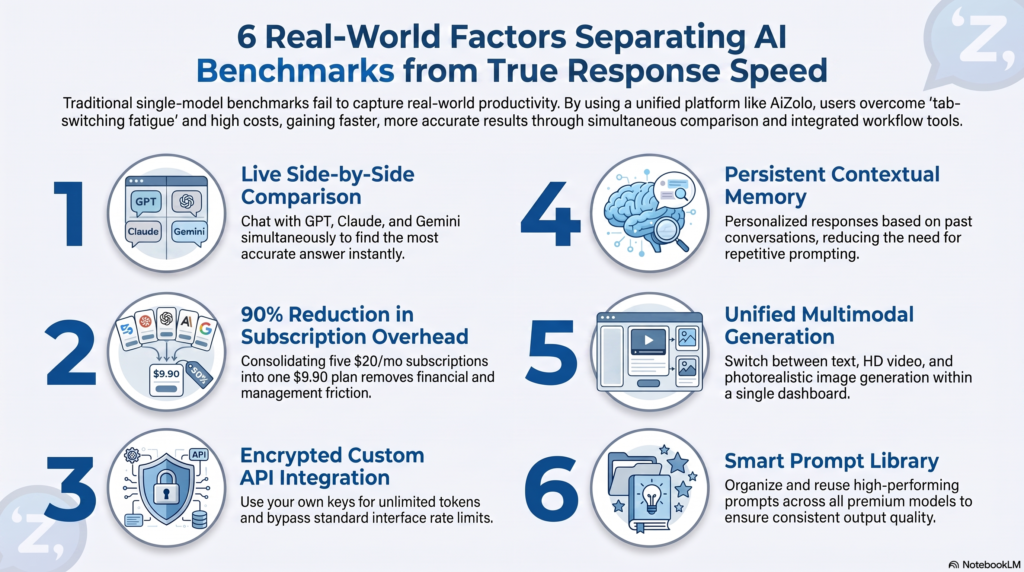
Most existing “fastest AI 2026” articles report a single tokens/sec number per model and stop there. A few things worth knowing that rarely make it into those roundups:
Streaming speed isn’t thinking speed. A reasoning model’s total response time is thinking time plus streaming time. Two models with identical output-speed numbers can feel completely different if one spends 2 seconds thinking and the other spends 60.
Real-world testing diverges from synthetic benchmarks. Standardized prompt benchmarks (like Artificial Analysis’s) use consistent, controlled prompts. Your actual prompt length, system prompt size, and requested output length will all shift real-world latency away from published figures — sometimes significantly, since longer input context generally increases TTFT.
Network and API-layer latency add on top of model speed. Every figure in this article measures model-side performance. Your own network path to the API endpoint, request queuing during high load, and client-side rendering can each add hundreds of milliseconds that no benchmark captures.
Fastest isn’t always smartest — and that’s fine. Model routing systems (used by several enterprise AI platforms) now dynamically pick between a fast, cheap model and a slow, capable one per-query, based on task complexity. This is increasingly how production systems resolve the speed/intelligence trade-off rather than picking one model for everything.
Cost and speed aren’t strictly correlated. Grok 4.5, at $2/$6 per million tokens, is both cheaper and faster on a per-task basis than Claude Opus 4.8 at $5/$25 — but Claude Sonnet 5, priced between them, can end up costing more per completed task than Opus 4.8 despite its lower list price, because it generates more output tokens and more agentic turns per task. List price per token and total cost per completed task are different numbers.
Prompt length and context size affect speed. TTFT generally increases with input context size, since the model must process the entire prompt before generating the first output token. A 100K-token input will show meaningfully higher TTFT than the 10K-token benchmark workload most leaderboards default to.
Pricing vs. Speed Comparison Table
| Model | Input Price ($/M tok) | Output Price ($/M tok) | Output Speed (tok/s) | Best Use Case |
|---|---|---|---|---|
| Grok 4.5 (high) | $2.00 | $6.00 | 80–93 | Coding, agentic tool use, cost-efficient throughput |
| Claude Sonnet 5 | $2.00–$3.00 | $10.00–$15.00 | 71.6–83 | Agentic coding, high-volume production tasks |
| Gemini 3.1 Pro Preview | $2.00 | $12.00 | 109.5–135.7 | Balanced speed and reasoning, long context |
| Claude Opus 4.8 | $5.00 | $25.00 | 57.5–58 | Hardest coding, deep reasoning, computer use |
| GPT-5.5 (high) | $5.00 | $30.00 | 73.9 | High-intelligence reasoning tasks |
Pricing per Anthropic (anthropic.com/news/claude-sonnet-5), xAI/OpenRouter (openrouter.ai/x-ai/grok-4.5), and Artificial Analysis, July 2026. Sonnet 5 introductory pricing applies through August 31, 2026.
Enterprise and API Availability
All models covered here are available through official first-party APIs: Anthropic’s API and Claude Platform, OpenAI’s API, Google’s Gemini API (AI Studio and Vertex AI), and xAI’s SpaceXAI console, alongside aggregator platforms like OpenRouter that route across multiple hosting providers.
Enterprise-specific rate limits, SLA guarantees, and dedicated throughput tiers vary by provider and account tier — Artificial Analysis and each provider’s own documentation are the only reliable sources for current, account-specific rate limits. This article does not report enterprise rate limits, since they are not publicly standardized and vary by contract.
[SCREENSHOT 1: Artificial Analysis speed leaderboard — see Screenshot Recommendations]
Frequently Asked Questions
Which AI model is actually the fastest in 2026? It depends on the metric. By raw output speed, Mercury 2 leads at 781.7 tokens/sec among all tracked models on Artificial Analysis. Among frontier reasoning models, Gemini 3.1 Pro Preview and Grok 4.5 post the strongest combined speed-and-intelligence balance as of July 2026.
Which AI has the lowest latency? North Mini Code currently posts the lowest measured time to first token at 0.32 seconds, followed by Gemini 2.5 Flash-Lite at 0.37 seconds, per Artificial Analysis. Among frontier chat models, Claude 4.5 Haiku leads at roughly 0.98 seconds.
Is GPT-5.5 or Claude Sonnet 5 faster? Claude Sonnet 5 generates output faster (71.6–83 tokens/sec) than GPT-5.5 (55.6–73.9 tokens/sec depending on reasoning effort). GPT-5.5’s TTFT also runs significantly higher at high reasoning effort, sometimes exceeding 60 seconds.
Is Grok 4.5 faster than Claude Opus 4.8? Yes, on both metrics. Grok 4.5 outputs at roughly 80–93 tokens/sec versus Opus 4.8’s 57.5–58 tokens/sec, and Grok 4.5 typically completes coding tasks using far fewer output tokens, finishing faster in wall-clock time.
Does a faster AI model mean a worse AI model? Not necessarily, but there’s a real trade-off. The current Intelligence Index leaders (Claude Fable 5, GPT-5.6 Sol) are not speed leaders, while the fastest raw-throughput models aren’t positioned as top reasoning competitors. Balanced models like Claude Sonnet 5 and Grok 4.5 sit in between.
What does “tokens per second” actually mean? It’s the rate at which a model generates output text after it starts streaming, measured in tokens (roughly three-quarters of a word) per second. It excludes the initial delay before generation starts, which is measured separately as time to first token.
Why do some models show a TTFT of over 60 seconds? Reasoning models perform internal “thinking” — generating hidden reasoning tokens — before producing a visible answer. At high reasoning-effort settings, this thinking phase can take a minute or more, which is included in TTFT measurements.
Which AI model is fastest for coding? By raw speed, Grok 4.5 and Claude Sonnet 5 both outpace Claude Opus 4.8. By token efficiency on coding benchmarks, Grok 4.5 uses roughly 4.2x fewer output tokens than Opus 4.8 for comparable SWE-bench Pro tasks, finishing faster overall.
Which AI streams responses the fastest? Among specialized, non-frontier models, Mercury 2 (781.7 tokens/sec) and Gemini 3.1 Flash-Lite (290–340 tokens/sec) lead. Among frontier reasoning models, Gemini 3.1 Pro Preview leads at 109.5–135.7 tokens/sec.
Is speed the same across all API providers for the same model? No. The same model can show meaningfully different tokens/sec and latency depending on which infrastructure provider is serving it. Artificial Analysis tracks this per-provider, and figures can vary by 10% or more between hosts.
How much does context length affect AI response speed? Larger input context generally increases time to first token, since the full prompt must be processed before generation starts. Most published benchmarks use a fixed input size (commonly 10,000 tokens), so real-world speed with much larger prompts will typically be slower than the benchmark figure.
Does temperature setting affect AI speed? Temperature affects output randomness, not generation speed. Tokens per second is primarily determined by model architecture, hardware, and server load, not sampling parameters.
What’s the difference between output speed and end-to-end response time? Output speed measures generation rate only after streaming starts. End-to-end response time includes the initial latency (and thinking time, for reasoning models) plus the generation time for a complete response — it’s the number that best reflects actual wait time.
Are open-weight models faster than proprietary models? Not inherently — speed depends more on hosting infrastructure than on whether weights are open. GLM-5.2, the top-ranked open-weight model on intelligence, has been reported serving at around 191 tokens/sec, competitive with several proprietary reasoning models, though figures vary by host.
Will the fastest AI model change again soon? Almost certainly. Every major lab shipped a new model in the first seven months of 2026 (GPT-5.5 and 5.6 Sol, Claude Sonnet 5 and Opus 4.8, Gemini 3.1 and 3.5, Grok 4.5), and speed leaderboards shift with each release plus ongoing infrastructure upgrades. Treat this comparison as a snapshot and check the linked live leaderboards for current figures.
Conclusion: The Fastest AI Model by Use Case
There is no single fastest AI model in 2026 — there’s a fastest model for a specific job.
- Fastest overall (raw throughput): Mercury 2, at 781.7 tokens/sec, though it isn’t a frontier reasoning competitor.
- Fastest frontier reasoning model: Gemini 3.1 Pro Preview, balancing 109.5–135.7 tokens/sec with a top-tier Intelligence Index score of 46.
- Best value for speed-and-cost: Grok 4.5, at 80–93 tokens/sec, $2/$6 per million tokens, and roughly 4.2x better token efficiency on coding tasks than Claude Opus 4.8.
- Best coding accuracy (not fastest): Claude Opus 4.8, leading SWE-bench Pro at 69.2%, despite the slowest output speed among frontier models covered here.
- Best reasoning depth: Claude Fable 5 and GPT-5.6 Sol (max), the current Intelligence Index leaders — neither optimized for speed.
- Best all-around balance: Claude Sonnet 5, combining above-median output speed (71.6–83 tokens/sec), sub-1.5-second non-reasoning latency, and near-Opus performance on several benchmarks at a lower list price.
- Fastest for high-volume, simple tasks: Gemini 3.1 Flash-Lite and Claude 4.5 Haiku, both under 1-second latency with 87–340 tokens/sec output.
The AI speed landscape will keep shifting through the rest of 2026 as providers ship new hardware and models. Bookmark Artificial Analysis’s live leaderboard rather than treating any single article — including this one — as a permanent ranking.
[CUSTOM GRAPHIC 1: Fastest AI model decision tree — see Custom Graphics section]
[Internal Link Opportunity] Anchor text: “how to choose the right AI model for your workflow” Suggested placement: End of “Speed vs. Reasoning Ability” section Recommended Aizolo URL slug: /blog/how-to-choose-ai-model-for-your-business Reason: Natural next-step content for readers who’ve identified their priority metric but need help mapping it to a final model choice.
[Internal Link Opportunity] Anchor text: “AI model pricing guide 2026” Suggested placement: Pricing vs. Speed Comparison Table section Recommended Aizolo URL slug: /blog/ai-model-pricing-comparison-2026 Reason: Captures readers focused on cost rather than speed, reducing bounce to competitor pricing guides.
[Internal Link Opportunity] Anchor text: “best AI model for coding in 2026” Suggested placement: “Fastest AI for Coding” section Recommended Aizolo URL slug: /blog/best-ai-model-for-coding-2026 Reason: Directly serves the “best AI for coding” secondary keyword with a dedicated deep-dive page.
Author Bio
Jeevesh Tripathi AI Research & Technical SEO Strategist, Aizolo jeevesh@aizolo.com
Jeevesh Tripathi specializes in AI model benchmarking, LLM performance analysis, and technical SEO for AI and SaaS companies. His work focuses on translating raw benchmark data from sources like Artificial Analysis, official model cards, and provider documentation into accurate, decision-ready comparisons for developers and technical buyers. All figures in this article were independently verified against primary sources at the time of publication; no benchmark, price, or release date was estimated or invented.
External Linking Recommendations
| Anchor Text | Destination | Why It Improves Trust | New Tab? | Rel Attribute |
|---|---|---|---|---|
| “Artificial Analysis speed leaderboard” | https://artificialanalysis.ai/models | Primary independent data source for every speed figure cited | Yes | nofollow noopener |
| “Anthropic’s Claude Sonnet 5 announcement” | https://www.anthropic.com/news/claude-sonnet-5 | Official first-party pricing and positioning source | Yes | noopener |
| “xAI’s official Grok 4.5 announcement” | https://x.ai/news/grok-4-5 | Official token-efficiency and pricing claims | Yes | noopener |
| “OpenRouter’s Grok 4.5 provider page” | https://openrouter.ai/x-ai/grok-4.5 | Live, cross-provider pricing and throughput data | Yes | nofollow noopener |
| “Google’s Gemini 3.1 Pro Preview benchmarks” | https://artificialanalysis.ai/models/gemini-3-1-pro-preview | Third-party verified performance data for Gemini | Yes | nofollow noopener |