Table of Contents
Creating content consistently is rarely a writing problem. The harder problem is getting ideas through the research, briefing, drafting, reviewing, repurposing, publishing, and measuring workflow without losing context at every stage.
That’s where a marketing content pipeline helps. A content pipeline turns content marketing from a collection of disconnected tasks into a repeatable Process.
Your team doesn’t have to ask themselves, “What should we be publishing this week?” Because they know what goes into the pipeline, who is responsible for what, what the end result of each stage should be, and when something is ready to move on to the next step.
AI can make this process more efficient, but shouldn’t be the pipeline itself.
Research from Ahrefs discovered that 87% of respondents using AI for content creation or assistance and 97% who edit or review content generated by artificial intelligence.
This implies that the opportunity for eliminating humans from the production process is not in replacing people but in accelerating research, ideation, outlining, drafting, editing, and other cyclical operations while ensuring that people are held accountable for judgment and quality.
Google likewise emphasizes helpful, reliable, people-first content and warns against using automation primarily to produce large amounts of low-value content for search engines.
So the goal is simple:
Build the workflow first. Then decide where AI belongs.
What Is a Marketing Content Pipeline?
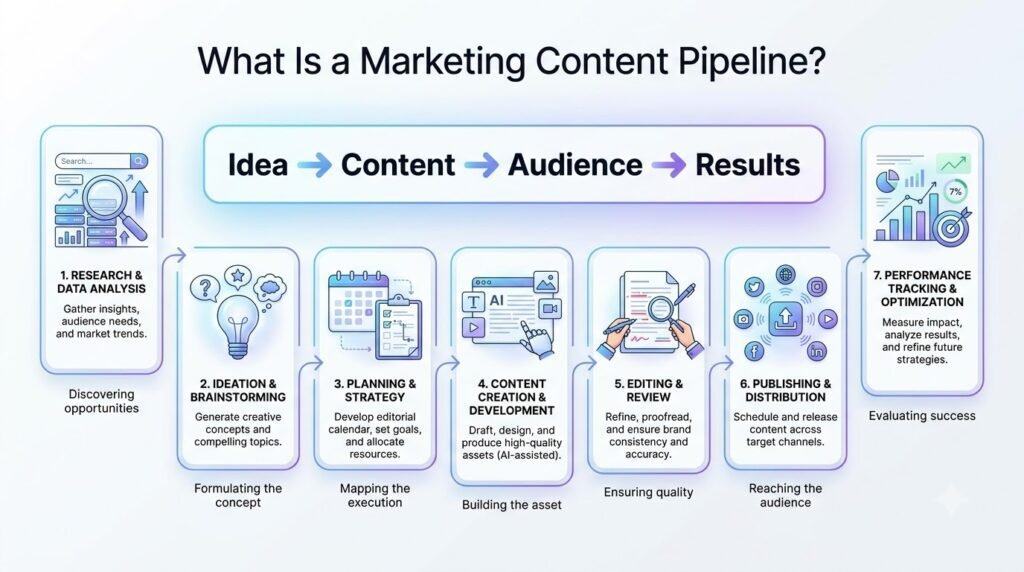
A marketing content pipeline is the sequence of stages that moves a content idea from initial research to a finished, published, and measured asset.
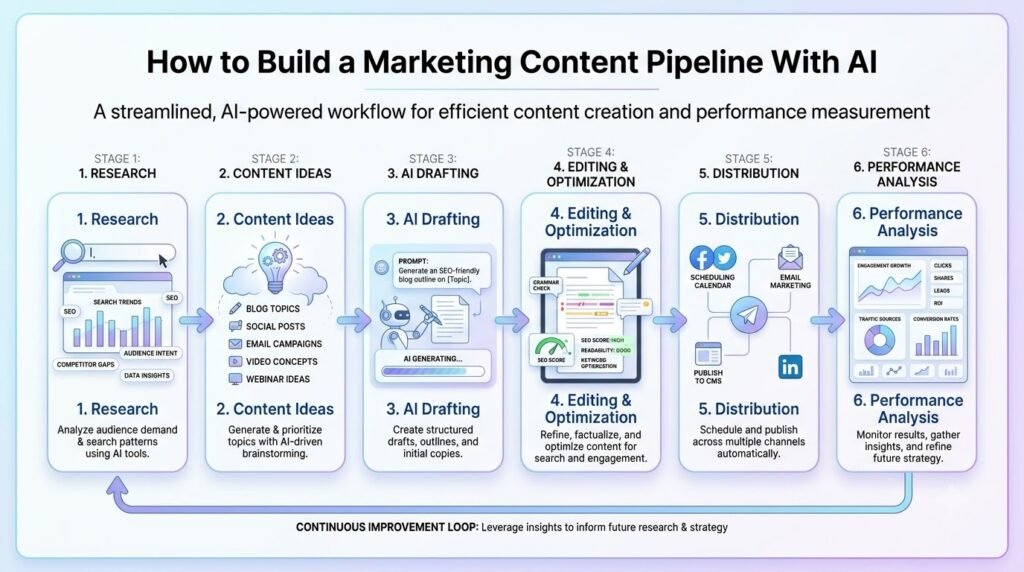
A basic pipeline might look like this:
Research → Ideation → Keyword Research → Brief → Draft → Review → Publish → Measure → Refresh
For example research gathers information about the audience and topic. The brief turns that information into a meaningful assignment; writing produces the first asset.
Review ensures accuracy, value, brand fit, and relevance to search intent. Publishing distributes the content, measurement decides what to do next.
This is different from a content calendar. A calendar tells you when something is scheduled. A pipeline explains how it gets produced.
It is also different from CMS. The CMS mainly stores and publishes the content; meanwhile, the content workflow is managing the work that needs to be done before publishing.
HubSpot also defines the content workflow as the processes that have to be done to get the content from creation to publishing, which includes people, tools, resources, roles, goals, timelines, and more.
Content Pipeline vs Content Calendar
Think of them as two connected systems.
| Content Calendar | Content Pipeline |
| What gets published | How content gets produced |
| Dates | Stages |
| Topics | Tasks |
| Deadlines | Owners |
| Publishing schedule | Review and approval |
| Distribution timing | Production status |
A calendar without a pipeline can leave writers struggling before deadlines.
A pipeline without a calendar can produce lots of completed drafts without a clear publishing strategy.
You need both.
Why AI Tools Alone Don’t Create a Pipeline
Buying ChatGPT, Claude, Gemini, an SEO platform, an image generator, and an automation tool does not automatically create a content system.
In fact, adding more tools is the perfect way to get a fragmented workflow.
You can do research in one tool, make an outline in another, write the article in a third, fact-check it in a fourth, and have to copy everything into your project management system.
The tools are great, but the whole process is very manual.
A good pipeline connects the necessary steps in a logical chain of command.
Map the Pipeline Before Choosing Your AI Tools
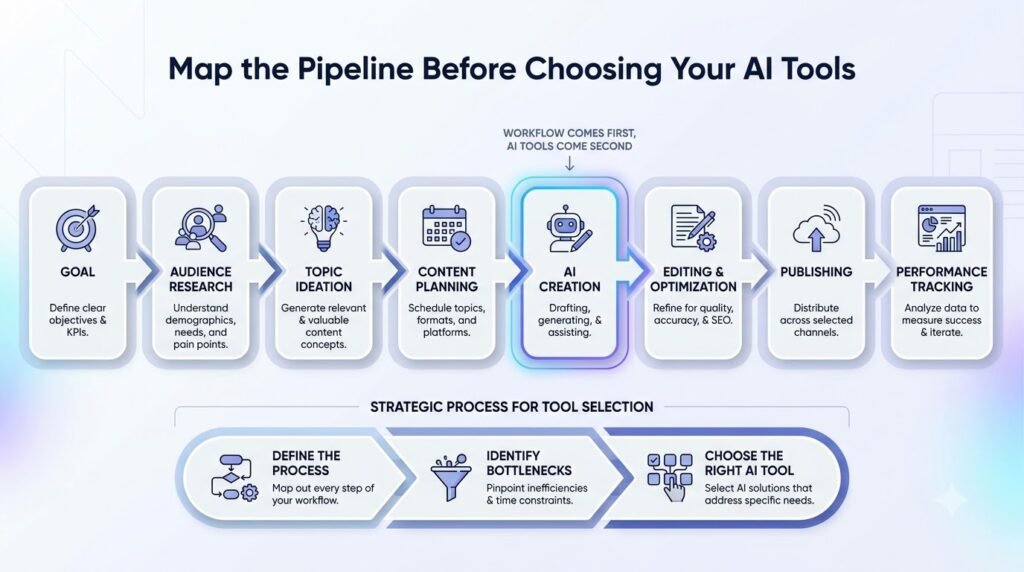
The common mistake is starting with a list of AI tools.
Instead, start with the content operation.
Ask:
- What are we trying to achieve?
- What content formats do we produce?
- What information is need before writing?
- Which tasks require human judgment?
- Which tasks are repetitive enough for AI?
- Who approves the final output?
- What happens after publication?
AboutMarTech’s research makes a similar distinction: a real content pipeline is one with defined stages, owners, outputs and workflow rules, not just the addition of an AI writer to the process.
Define the Content Goal
Every pipeline should begin with an objective.
For example:
- Generate organic traffic
- Support a product launch
- Educate prospects
- Build topical authority
- Generate leads
- Support sales conversations
- Increase product adoption
The goal affects the entire workflow.
A product-launch article may require product information, customer pain points, messaging guidelines, and approval from the product team.
An SEO article may need keyword research, SERP analysis, competitor research, source verification, internal links, and a content refresh plan.
Assign an Owner to Each Stage
A stage should never exist without responsibility.
For a small team, one person may own several stages.
For a larger team, responsibilities could look like:
| Stage | Owner |
| Topic selection | Content strategist |
| Research | Content researcher |
| Brief | SEO/content strategist |
| Draft | Writer + AI |
| Fact-checking | Researcher |
| Editorial review | Editor |
| Approval | Marketing/product owner |
| Publishing | SEO/content manager |
| Measurement | SEO/marketing analyst |
This makes bottlenecks easier to identify.
Define the Output and Approval Criteria
Each stage should produce something usable by the next stage.
For example:
Research stage → source notes
Ideation stage → selected topic and angle
Brief stage → approved content brief
Draft stage → complete first draft
Review stage → corrected, approved content
Publishing stage → live URL
This is one of the easiest ways to make a content pipeline more reliable.
The 8 Stages of a Repeatable Marketing Content Pipeline
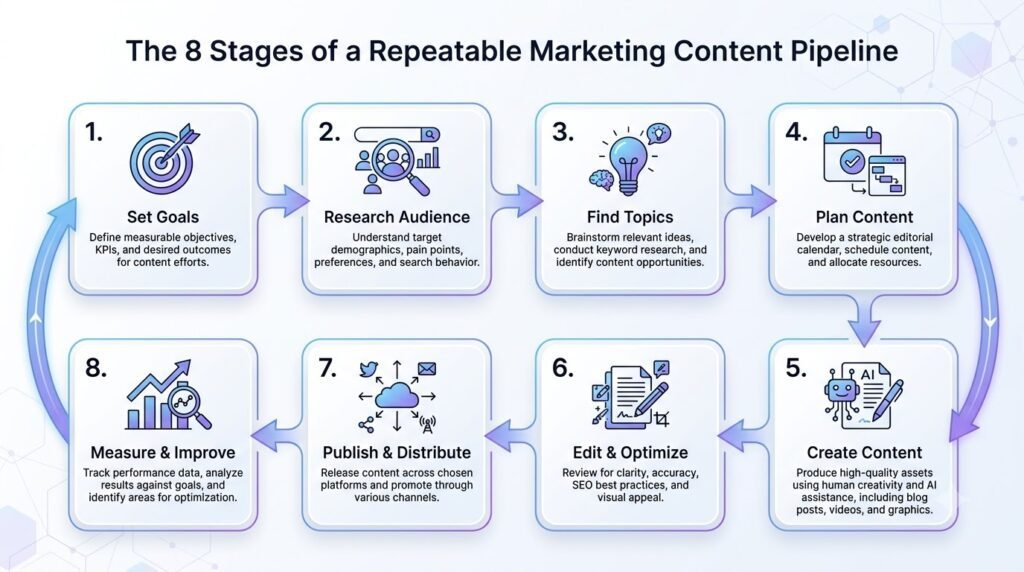
1. Topic and Audience Research
Start by understanding what your audience actually needs.
Look at:
- Customer questions
- Search queries
- Sales conversations
- Product feedback
- Existing content gaps
- Competitor coverage
- Industry developments
- Existing traffic and conversion data
AI can accelerate this stage by organizing research, clustering ideas, identifying themes, and generating research questions.
But do not let the model decide the entire editorial strategy without human review.
The best inputs are often generated by your own customers, product knowledge, and analytics, as well as first-hand experience.
2. Content Ideation
Once you’ve gathered audience and market information, turn it into potential content topics.
Instead of asking an AI model:
“Give me 20 blog topics.”
Give it context:
“We sell project-management software to five- to 50-person SaaS teams. Customers have issues with unclear or lack of ownership, missed deadlines, and fragmented communication.
Generate content opportunities for readers at awareness, consideration, and decision stages. Separate educational topics from product-led topics.”
The second prompt gives the model a job.
You can also use multiple AI models for ideation.
For example:
- Model A: generate broad creative angles
- Model B: identify audience pain points
- Model C: challenge the ideas and identify missing topics
Then combine the strongest insights.
This is more useful than asking three models to independently generate 50 generic titles.
3. Keyword and Search Research
The next step is deciding how the topic should be positioned for search.
Research:
- Primary keyword
- Secondary keywords
- Search intent
- Related questions
- Competitor coverage
- Supporting entities
- Internal-link opportunities
- Content format expected by searchers
AI can help organize keyword lists and turn research into clusters.
However, keyword tools and actual search results should remain important inputs. AI should not be treated as a replacement for live search data.
Google’s current guidance also emphasizes creating content that is useful and unique to the audience rather than producing pages simply because a keyword appears to have search potential.
4. Build the Content Brief
The brief is the bridge between strategy and production.
A useful brief can include:
- Target audience
- Search intent
- Primary keyword
- Secondary topics
- Content objective
- Recommended angle
- H1
- H2/H3 structure
- Key questions to answer
- Sources to review
- Internal links
- CTA
- Tone
- Examples to include
- Things to avoid
A strong brief prevents AI or writers from interpreting the assignment differently.
It also makes scaling easier because every content asset follows a consistent starting framework.
5. Create the First Draft
Now AI becomes particularly useful.
Instead of asking an AI model to “write the full article,” give it the approved brief and supporting research.
For example:
Write Section 3 from the approved brief. Use the supplied research only for factual claims. Explain the concept with one practical example. Keep paragraphs short. Do not introduce statistics that aren’t included in the research.
This creates a controlled drafting environment. You can also divide responsibilities across models.
One model might help develop the structure. Another can produce a detailed draft. A third can review the draft for missing arguments.
The objective is not to make AI produce the entire article without supervision.
The objective is to reduce repetitive production work while preserving editorial control.
6. Review, Fact-Check, and Edit
This stage should never be optional.
Ahrefs’ survey of 879 marketers found that 97% edit or review AI content, while 80% manually review AI content for accuracy.
Create separate review passes rather than asking one model:
“Is this article good?”
A better review system might include:
Accuracy Review
Check:
- Statistics
- Dates
- Product specifications
- Pricing
- Quotes
- Research claims
- Names
- URLs
Search Intent Review
Ask:
- Does the introduction answer the query?
- Does every major section solve a reader problem?
- Is anything important missing?
- Is the article more useful than a generic summary?
Editorial Review
Check:
- Repetition
- Sentence clarity
- Tone
- Transitions
- Examples
- Unsupported claims
Human Review
Finally, someone who understands the audience should read the content as a reader—not simply as an editor.
7. Repurpose and Distribute
One finished article can become several useful assets.
For example:
One research project
↓
1 long-form article
↓
3 LinkedIn posts
↓
5 short social posts
↓
1 email
↓
1 YouTube script
↓
1 infographic
↓
FAQ content
↓
Sales enablement snippet
The key to writing is to recycle and rework rather than to cut and paste. Each format has its own audience and context. AI is particularly useful here because the source material already exists.
You can provide the approved article and ask the model to extract:
- Key insights
- Statistics
- Contrarian points
- Examples
- Social hooks
- Video talking points
- Email angles
That turns one research investment into a content distribution system.
8. Measure and Refresh
The pipeline shouldn’t end when content is published.
Track what happens afterward.
Depending on the content objective, useful measurements include:
- Organic impressions
- Clicks
- Rankings
- Organic traffic
- Engagement
- Leads
- Conversion rate
- Assisted conversions
- Email clicks
- Social engagement
- Content-assisted revenue
Then create a feedback loop.
For example:
Publish → Measure → Identify weak section → Research new information → Update → Measure again
This is particularly important for topics involving software, AI tools, pricing, and rapidly changing technologies.
Firecrawl’s 2026 content-marketing workflow research similarly highlights content refreshes and post-publish optimization as practical AI-assisted workflows.
How to Build a Marketing Content Pipeline With Multiple AI Tools
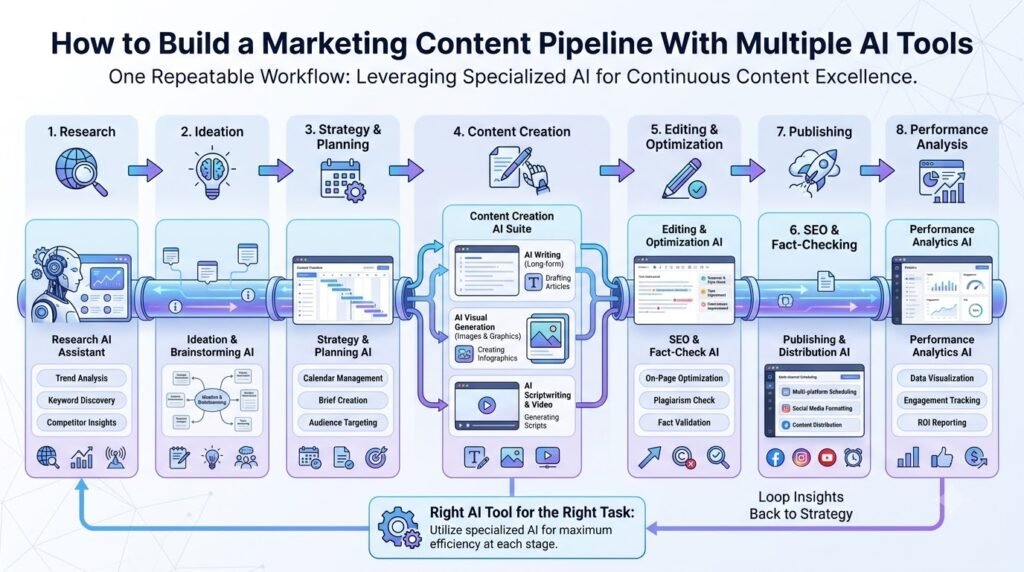
Using multiple AI tools can be useful, but only if each tool has a specific role.
The wrong approach looks like this:
ChatGPT → Claude → Gemini → Perplexity → ChatGPT → Claude
with the same prompt repeatedly pasted into each platform.
That creates more work. A better approach would be role-based.
Give Different AI Models Different Jobs
For example:
| Pipeline Stage | AI Role |
| Ideation | Generate and challenge angles |
| Research | Organize information and identify questions |
| Outline | Build logical structure |
| Drafting | Develop sections from approved research |
| Editing | Improve clarity and flow |
| Fact-checking | Identify claims requiring verification |
| Repurposing | Convert approved content into other formats |
| QA | Look for omissions and inconsistencies |
The specific model matters less than having a clear reason for using it.
Run the Same Important Prompt Through Multiple Models
For high-value decisions, multiple outputs can expose blind spots.
Let, you are creating a guide about AI content workflows.
Ask several models the same question:
“What are the three primary operational risks when using AI to generate marketing content at scale?”
If one is concerned with accuracy, another with brand, and another with fragmentation, you’ve found different angles for your article.
The models become different viewpoints, not multiple writers.
Use One Model’s Output as Structured Input for Another
This creates a more efficient chain.
For example:
Model 1: Generate 15 content angles.
↓
Human: Select three.
↓
Model 2: Develop the strongest angle into a content brief.
↓
Model 3: Challenge the brief for missing audience questions.
↓
Human: Approve the brief.
↓
Model 2: Create the first draft.
↓
Model 4: Identify claims requiring verification.
↓
Human: Verify and edit.
The human remains the decision-maker at the important transitions.
Keep Human Approval Between High-Risk Stages
Not every step needs approval.
You probably don’t need to manually approve every AI-generated list of headline variations.
But you should consider human review before:
- Publishing
- Making factual claims
- Publishing statistics
- Making product claims
- Giving financial/medical/legal advice
- Representing company positions
- Making significant brand claims
This keeps automation fast without allowing small errors to become published problems.
A Practical AI Marketing Content Pipeline Example
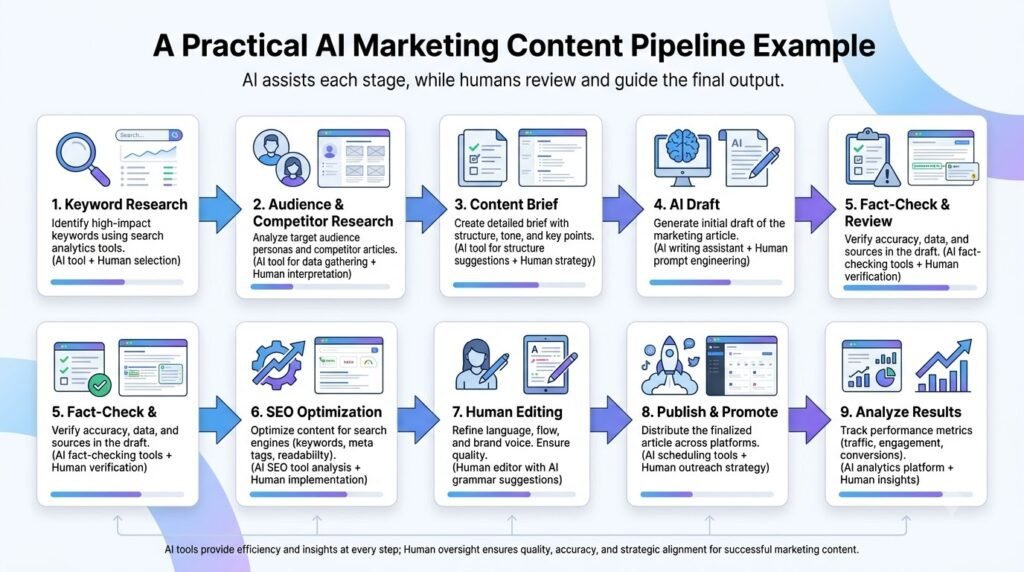
Imagine a SaaS company wants to publish a guide targeting:
“how to automate customer onboarding”
The workflow could look like this.
Stage 1: Research
Collect:
- Customer questions
- Search results
- Competitor articles
- Product documentation
- Customer interviews
AI summarizes the research and identifies recurring problems.
Stage 2: Ideation
Three AI models generate different perspectives.
One focuses on SEO opportunities. Another focuses on customer pain points. Another challenges the proposed angles.
The content strategist chooses the final direction.
Stage 3: Brief
The strategist creates:
- Audience
- Search intent
- Primary keyword
- Supporting topics
- H1
- H2s
- Examples
- Sources
- CTA
Stage 4: Draft
An AI model creates the first version using the approved brief and source material.
Stage 5: Review
Another model checks:
- Missing questions
- Repeated points
- Unsupported claims
- Weak explanations
- Logical gaps
Stage 6: Human Edit
The writer adds:
- First-hand insights
- Product knowledge
- Original examples
- Customer context
- Brand voice
Stage 7: Repurpose
The approved article becomes:
- Email newsletter
- LinkedIn post
- Short video script
- Sales enablement summary
- Social snippets
Stage 8: Measure
After publishing the article, it is necessary to analyze the traffic, interaction, and conversions.
If the article gets impressions but few clicks, it indicates a problem with the headline or description.
If people get to the article but do not complete any actions, the call-to-action or the connection between the content and the product needs optimization.
That is a pipeline, rather than simply “using AI to write a blog post.”
Where AiZolo Fits Into a Multi-Model Content Pipeline

If your workflow requires comparing AI outputs, AiZolo can be useful at the model-selection and review stages rather than replacing the whole marketing operation.
Its current website describes simultaneous access to multiple AI models, side-by-side comparison, dynamic layouts, project management, Prompt Manager, AI Memory, and encrypted custom API-key support.
For example, a marketer could use different models to generate content angles, compare outline approaches, review a draft, or test alternative explanations without constantly moving the same prompt between separate interfaces.
AiZolo’s Prompt Manager can also store reusable prompts for recurring research, editing, or QA tasks.
The important part is still the workflow itself: define the stage, give the model a specific job, compare outputs when useful, and keep human review where the decision matters.
Common Mistakes That Break a Marketing Content Pipeline
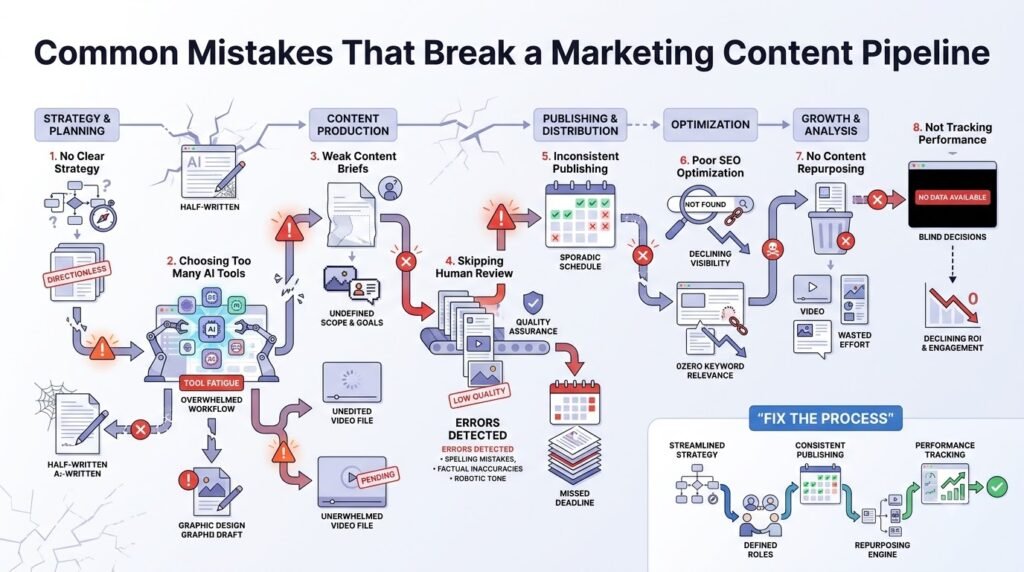
Starting With Tools Instead of Workflow
If you buy five AI tools before defining your process, you may end up designing the process around the tools.
Start with the work. Then select technology.
Letting AI Create Without Review
AI can accelerate production, but generated text can still contain inaccurate claims, weak reasoning, missing context, or generic explanations.
A faster draft is not automatically a better finished asset.
Creating Too Much Content
A pipeline makes production easier, which creates a temptation to increase volume indefinitely.
Don’t.
Google explicitly warns against producing large amounts of content primarily to attract search traffic and emphasizes original, helpful, people-first content instead.
A smaller pipeline producing genuinely useful content can be more valuable than a huge pipeline producing interchangeable pages.
Losing Context Between Tools
Copying the same brief between six platforms creates version-control problems.
Keep a source of truth for:
- Brief
- Research
- Approved claims
- Brand guidelines
- Final draft
- Feedback
- Publication URL
The fewer times important context has to be manually reconstructed, the less room there is for drift.
Measuring Output Instead of Outcomes
Publishing 30 articles isn’t necessarily better than publishing 10. Measure what the content is supposed to accomplish.
A content pipeline should ultimately answer:
Did this content help the business and the audience?
How to Measure and Improve Your Content Pipeline
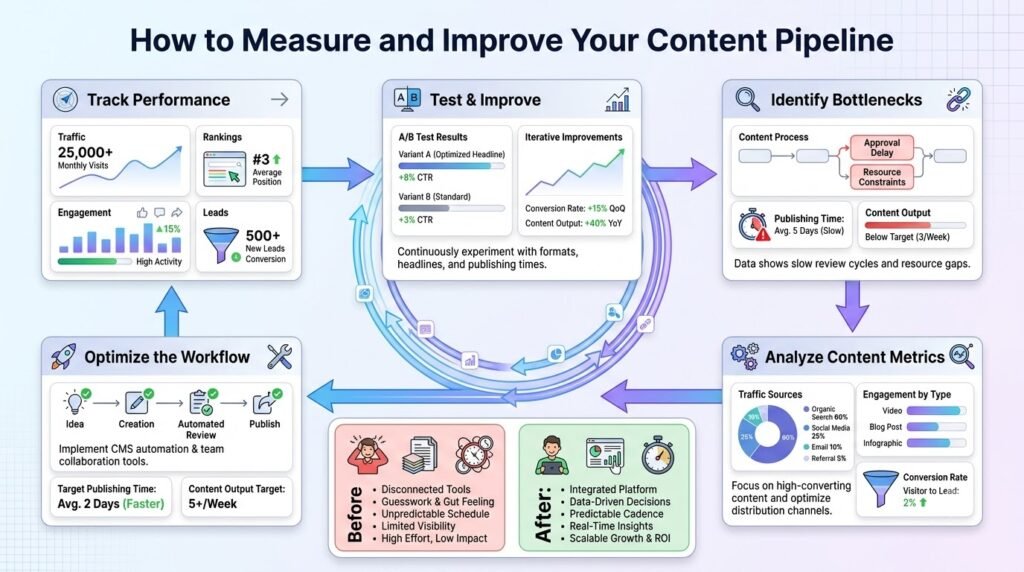
Start with a small set of operational metrics.
Production Metrics
Track:
- Time from idea to publication
- Number of pieces completed
- Average review cycles
- Time spent on research
- Time spent editing
- Percentage of pieces delayed
Quality Metrics
Track:
- Factual corrections
- Editorial revisions
- Content rejection rate
- SME feedback
- Search-intent coverage
- Content refresh frequency
Performance Metrics
Track:
- Impressions
- Clicks
- Rankings
- Organic traffic
- Engagement
- Leads
- Conversions
- Revenue influenced by content
Then look for bottlenecks.
If your research taking too long, improve the your research . If your drafts require too much rewriting, improve the your brief.
If your content getting stuck in review, define your clearer approval criteria. If your published content performing poorly, improve your topic selection and audience research.
The goal is not to make every stage faster.
The goal is to make the whole system more predictable and useful.
FAQs About Building a Marketing Content Pipeline
What is a marketing content pipeline?
A marketing content pipeline refers to a business’s repeatable, documented process of taking research and ideation through briefing, creation, review, publishing, distribution, and measurement.
It is aimed at specifying stages, responsibilities, outputs, and approval points required to consistently produce useful content.
How do you create a content pipeline?
Begin with specifying content goals and objectives. Then define major stages of a content creation process, ranging from research to measurement. Furthermore, it is essential to specify who is responsible for particular stages, define their output, and specify approval points.
After a manual process is defined, it is possible to optimize the workflow by automating repetitive tasks with the help of AI and other tools.
Can AI automate a marketing content pipeline?
AI can automate or accelerate many stages in a content pipeline, from research organization to brainstorming to outlining to drafting to editing to repurposing to QA — but judgment calls on things like strategy, fact checking, brand claims, and final approval should still be left to people.
Should you use multiple AI models for content marketing?
Using multiple models can be valuable when they have different areas of responsibility or when you want to compare and contrast their results, but just running the same prompt through different LLMs without a good reason is a waste of time.Use model comparison judiciously for especially important creative, research, or QA tasks.
What is the difference between a content calendar and a content pipeline?
A content calendar is a schedule of what should be published and when. A content pipeline is a description of how each content asset moves through research, briefing, creation, review, approval, publishing, and measurement. The former controls timing; the latter production.
How do you maintain quality when using AI for content?
Research, structured briefing, model-specific tasks, factual verification, editorial review, and human approval will fuel the content production process. AI should speed up the process but not be the sole authority on matters of fact or strategic decisions.
How many AI tools should a marketing team use?
There is not a universal number. It will depend on your team’s content formats, the complexity of the workflows, budget, and existing systems. You should begin by defining the gaps in your current workflows instead of purchasing tools by categories.
Moreover, consolidating various overlapping AI functions may reduce context switching and duplication of effort.
How can you make a content pipeline scalable?
The next step is standardizing the recurring inputs and outputs. Wherever possible, use templates for the briefs, research, reviews, and publishing of the content. Store repositories of prompts and brand guidelines for the consistent use of AI across your team.
Final Takeaway
A strong marketing content pipeline is not a collection of AI tools.
It is a repeatable system that connects strategy, research, creation, review, distribution, and measurement.
A lot of people say that using AI makes sense when different stages need to be performed, but what matters most is deciding on each step’s goal before starting the automation process.
When more than one AI is used by a team, the best strategy is to let both handle different tasks and only compare their results at the end if the situation requires it, while humans take charge at the most critical stages.
That turns AI from a collection of disconnected writing assistants into a structured part of the content operation.
The result isn’t simply more content.
It’s a pipeline that makes it easier to produce useful, accurate, consistent, and measurable content repeatedly.
Author
Anshika Verma is a content researcher and writer at Aizolo, focused on researching AI tools, models, and creator technologies. Her work emphasizes source verification, practical AI workflows, and clear explanations that help readers understand how emerging technologies can be used effectively.