If you ask 1 AI model for 10 ideas, you might get 10 variations of the same idea. A better approach is to use multiple AI models as independent brainstorming partners.
This best AI brainstorming technique using multiple models lets you frame the same problem for each model, ask for different perspectives, compare and deduplicate ideas, challenge the strongest assumptions, and finally choose the most promising idea to develop.
This leads to a simple process: Frame -> Generate -> Diversify -> Compare -> Cluster -> Challenge -> Choose -> Execute
The key part of this process isn’t just using multiple AI models, but making sure that their perspectives stay independent until you converge on an idea.
Comparing multiple AI models can reveal different ideas, assumptions, and approaches to the same problem. AiZolo makes this easier by bringing multiple AI models into one workspace, so you can test the same brainstorming prompt and compare responses without switching between different platforms.
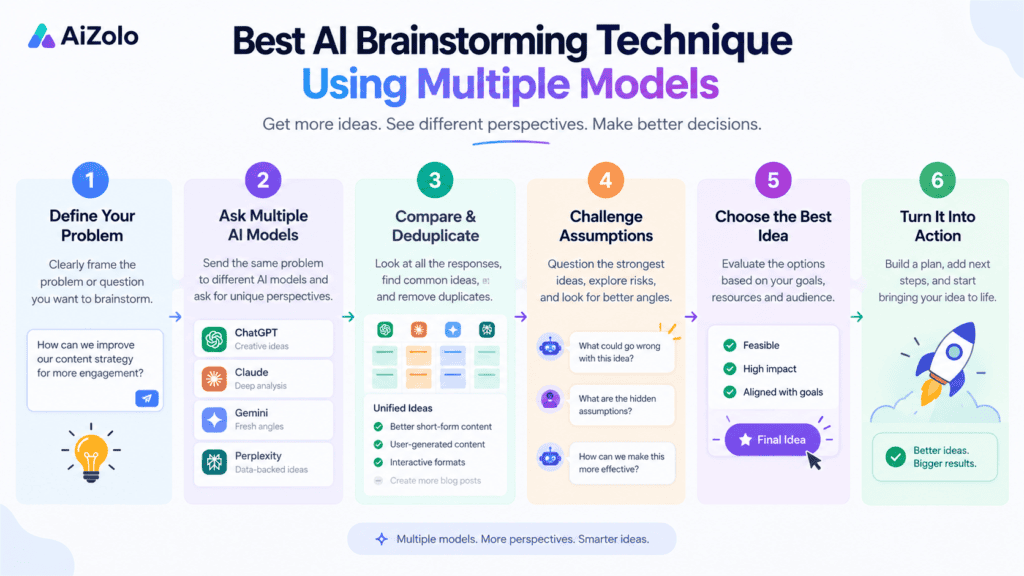
Table of Contents
Quick Answer: Use AI Models as Independent Idea Generators
The most useful multi-model brainstorming technique is a two-phase process that combines divergent thinking and convergent thinking.
First, send the same problem to two or more AI models independently. Ask each model to come up with several genuinely different ideas, instead of asking for a single solution.
Second, compile the responses, avoiding having one model influence the next, then compare and contrast the options, looking for similarities and differences, and ask an AI model to question the assumptions underlying the most compelling options.
Finally, consider the alternatives and pick which direction to pursue, and use an appropriate model to develop it.
This matters because AI can be productive for ideation while still producing relatively homogeneous ideas.
Research published in 2026 found that pooling ideas across different AI model vendors can help increase diversity, while other research has identified fixation and reduced idea diversity as important limitations of LLM-supported brainstorming.
The goal, therefore, is not:
“Ask more AIs and pick the answer they agree on.”
It is:
“Use different AIs to expand the possibility space, then use structured evaluation and human judgment to narrow it.”
Why One AI Model Is Not Enough for Serious Brainstorming
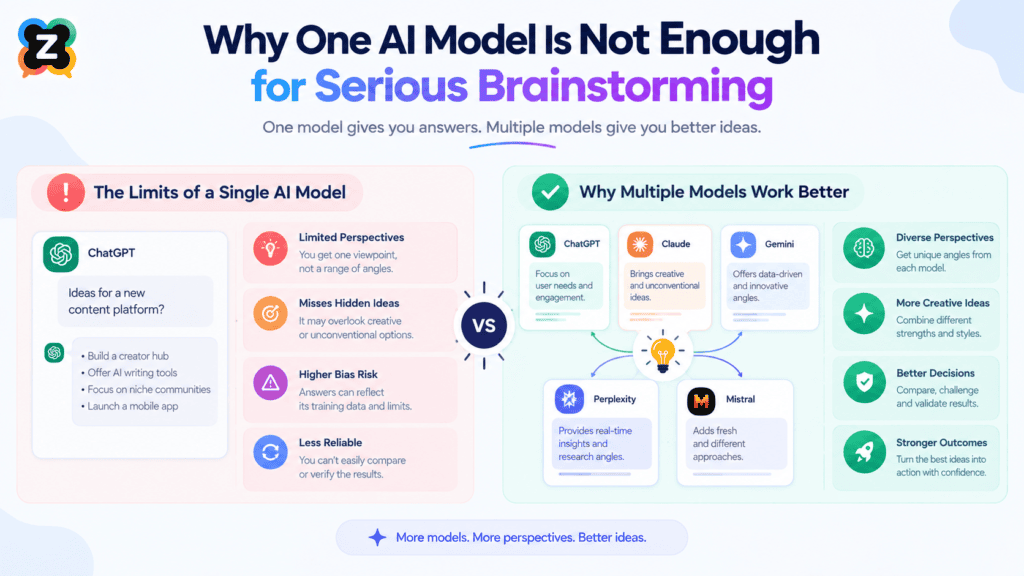
A single AI model can be an excellent brainstorming partner. It can rapidly produce alternatives, identify connections, and explore directions you might not have considered.
The challenge comes when you think of one model’s first ideas as the whole story.
Imagine asking:
“Give me ideas for a YouTube channel about AI.”
You may receive familiar suggestions: AI tutorials, AI news, AI tools, AI productivity, AI comparisons, and AI prompts.
The problem isn’t that those ideas are bad. They are simply predictable.
Now send the same underlying problem to several models independently. You might find that one lays out education content, one thinks about entertainment, one focuses on a certain audience, and one finds a business or community angle.
That variation is actually beneficial because brainstorming isn’t just about generating alternatives
Recent research on LLM-generated product ideas has found that AI-generated ideas can score well individually while being less novel and less diverse as a collection. The same research found that pooling ideas from different model vendors can help restore diversity.
This gives multi-model brainstorming a practical purpose: perspective diversification.
You are unlikely to need one model that’s consistently “better” than another. You are looking for different ways to approach the same problem.
The Best Multi-Model AI Brainstorming Technique
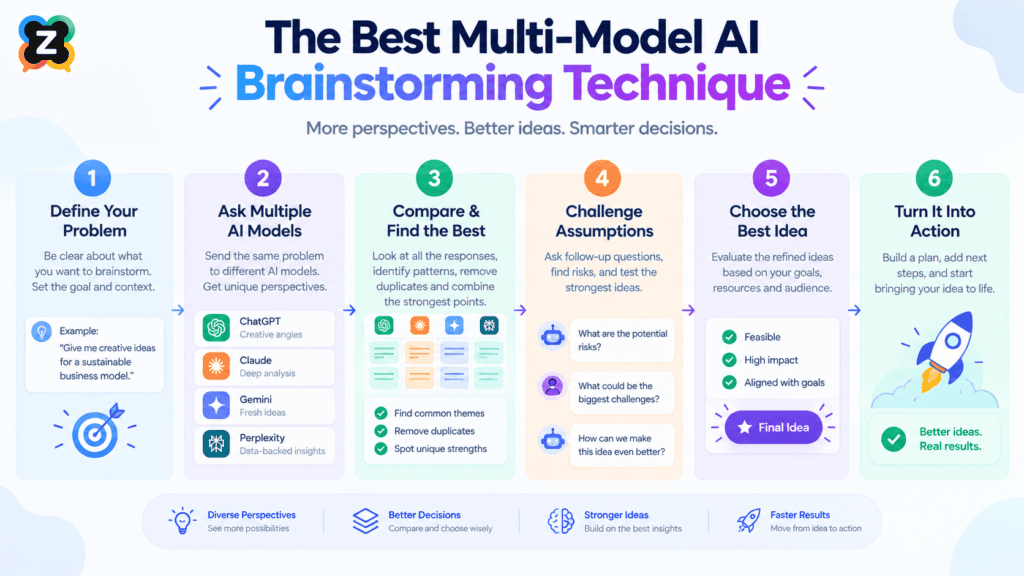
Step 1: Define the Problem Before Opening an AI Tool
Start with a specific question.
Bad:
“Give me business ideas.”
Better:
“I want to create a small digital product for freelance writers who use AI. Generate potential problems worth solving.”
Even better:
“I want to create a digital product for freelance writers who use multiple AI tools. Focus on recurring workflow problems that waste time, create inconsistency, or make quality control tough. Do not suggest products yet. Identify problem spaces first.”
The third version gives the AI something more useful to explore.
Define four things:
- Goal: What are you trying to discover?
- Audience: Who is affected?
- Constraints: What limitations matter?
- Success criteria: What would make an idea useful?
Do not over-specify the solution.
If you already tell the model exactly what the answer should look like, you reduce the room for exploration.
Step 2: Send the Same Core Problem to Multiple Models
Use the same base problem across your models.
For example:
“Find new content formats for an AI education YouTube channel targeting beginners.”
Run that prompt separately through two, three, or four models.
The objective is not to see which model produces the longest list.
Instead, look for:
- Ideas appearing in only one model
- Different interpretations of the audience
- Unexpected categories
- Contradictory assumptions
- Ideas that several models independently discovered
- Gaps that none of the models identified
Keeping the first round independent is important.
If Model B receives Model A’s suggestions and is asked to improve them, it is no longer an independent source of ideas. It is becoming a critic or optimizer of Model A.
That can be useful later, but not during the first divergent phase.
If you want to compare several AI responses without jumping between separate tools, AiZolo lets you work with multiple models in one workspace. This can make the independent-generation and side-by-side comparison stages of a brainstorming workflow easier to manage.
Step 3: Force Different Perspectives
Simply using different models is not always enough.
If every model receives:
“Give me 10 creative ideas.”
you may still get similar answers.
Instead, introduce perspective change.
For example:
Model A — Customer perspective
“Generate ideas based on the biggest frustrations this audience might experience.”
Model B — Contrarian perspective
“Challenge the conventional assumptions about this market and generate ideas that deliberately approach the problem differently.”
Model C — Practical perspective
“Generate ideas that could realistically be built by a small team with limited resources.”
Model D — Future-facing perspective
“Explore ideas that could become more valuable as AI adoption increases over the next three years.”
Now you are changing the search strategy, not merely changing the chatbot.
This is aligned with recent findings indicating that prompting interventions, e.g., heterogeneous personas or constraints, can enhance the diversity of LLM-generated ideas.
Step 4: Keep the First-Round Outputs Independent
Do not immediately feed Model A’s answer into Model B.
That creates an anchoring problem.
Suppose Model A proposes:
“Build an AI content calendar.”
If you then tell Model B:
“Here is one idea. Give me five better versions.”
Model B is now operating inside Model A’s conceptual frame.
Instead, collect all first-round responses first.
You might end up with:
| Model | Direction |
| Model A | AI content calendar |
| Model B | AI audience research assistant |
| Model C | Content repurposing workflow |
| Model D | AI content quality-control system |
Now the interesting work begins.
You can compare the categories rather than comparing four variations of the same idea.
Step 5: Pool and Cluster the Ideas
After independent generation, combine the outputs into one list.
Do not immediately ask:
“Which idea is best?”
First ask:
“What ideas are actually different?”
This is the clustering stage.
For example:
Ideas 1, 4 and 9: all solve content planning.
Ideas 2 and 7: both solve audience research.
Ideas 3, 6 and 11: all focus on repurposing.
Idea 12: deals with quality control and fact-checking.
You may find that 20 apparent ideas are actually five underlying concepts.
That is useful information.
Clustering also exposes white space.
If almost every model produces ideas around content generation but nobody suggests workflow auditing, this absence is worth investigating.
Step 6: Remove Duplicates and Identify Gaps
Now ask an AI model to act as an analyst rather than an idea generator.
Use a prompt such as:
“Group these ideas by underlying problem. Merge obvious duplicates, but preserve genuinely different approaches. Then identify which important problem areas are missing from the list.”
This creates three buckets:
Repeated
Ideas multiple models independently discovered.
Distinct
Ideas that appear substantially different from the others.
Missing
Important areas that the brainstorm did not explore.
This step is one of the biggest differences between multi-model brainstorming and simply asking several chatbots for ideas.
The value is created by the comparison.
Step 7: Run a Challenge or Red-Team Round
Once you have a smaller set of ideas, switch from divergence to criticism.
Ask another model—or the same models—to challenge them.
For example:
“For each idea, identify the strongest assumption it depends on, the biggest reason it might fail, who would not want it, and what evidence would make the idea worth pursuing.”
You can also assign different challenge roles:
- Customer critic
- Technical critic
- Financial critic
- Competitor
- Skeptical user
- Implementation specialist
This is important because brainstorming should not end with a pile of attractive ideas.
An idea can be original but not realistic.
The process of elimination helps separate interesting from worthy of investigation.
Step 8: Choose and Execute
Only after the exploration and challenge phases should you select a direction.
Your final decision can consider:
| Criterion | Question |
| Relevance | Does it solve a real problem? |
| Differentiation | Is the approach meaningfully different? |
| Feasibility | Can it realistically be executed? |
| Audience fit | Does the intended audience care? |
| Evidence | Is there evidence supporting the problem? |
| Potential | Is the idea worth further exploration? |
| Risk | What could make it fail? |
You should be able to ask the AI to organize the evidence, but the final decision should be yours.
Once you choose the direction, move into execution.
For example:
“Use the selected idea about AI content quality control. Develop it into a product concept with the target audience, core problem, proposed workflow, key features, limitations, and validation plan.”
The brainstorming phase is finished.
Now the model has a much clearer target.
The Multi-Model Brainstorming Prompt
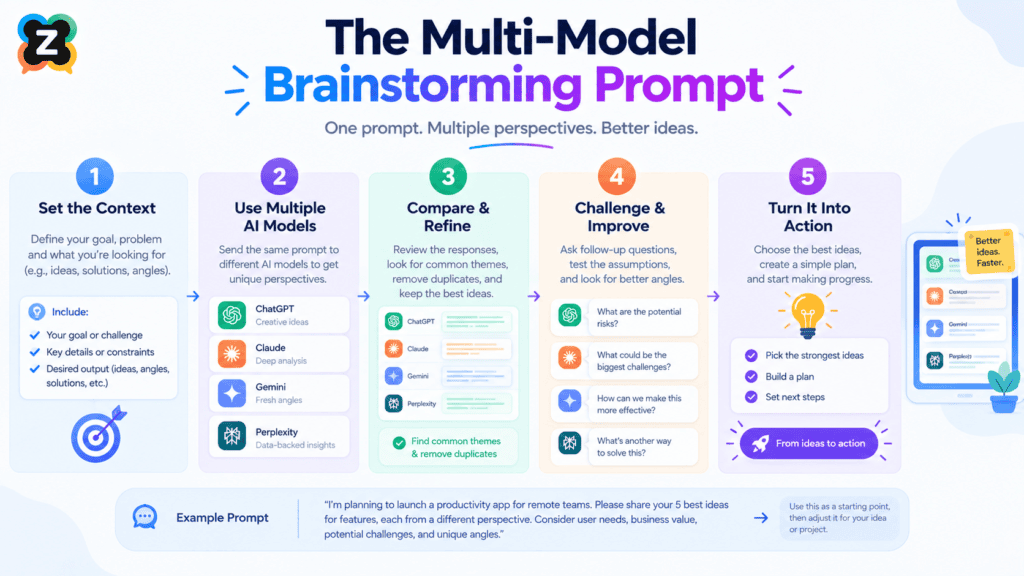
You can reuse the following framework for content, products, marketing campaigns, research questions, business ideas, or creative projects.
Core brainstorming prompt:
I want to explore this problem:
[DESCRIBE THE PROBLEM]
Audience:
[DESCRIBE THE AUDIENCE]
Goal:
[DESCRIBE WHAT YOU WANT TO DISCOVER]
Constraints:
[LIST IMPORTANT CONSTRAINTS]
Generate 7 genuinely different directions.
Do not produce the final solution.
For each direction, given:
- The core idea
- The problem it addresses
- Why is it different from the obvious direction
- The key assumption that makes it word
- One possible weakness
Do not produce multiple variations of the same idea.
Think creatively about practical, conventional, contrarian, niche, and unconventional directions.
For multi-model brainstorming, add a different instruction to each model.
For example:
Model role: Contrarian explorer
Challenge common assumptions and look for overlooked opportunities.
or:
Model role: Practical strategist
Focus on ideas that could realistically be implemented with limited resources.
or:
Model role: Customer advocate
Focus on unmet user needs, frustrations, and behavioral patterns.
The important thing is to create controlled variation.
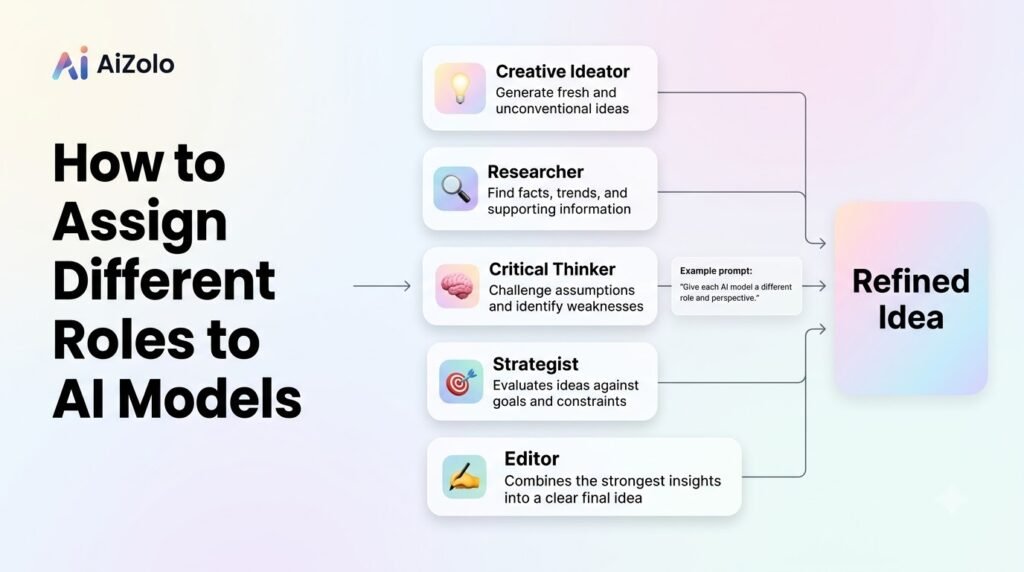
How to Assign Different Roles to AI Models
You do not need five models just because five models are available.
Two or three genuinely different perspectives can be more useful than ten nearly identical generations.
A practical setup might look like this:
| Role | Primary purpose |
| Explorer | Generate broad possibilities |
| Specialist | Explore the problem from a domain-specific perspective |
| Contrarian | Challenge conventional assumptions |
| Researcher | Identify evidence, trends, and unanswered questions |
| Critic | Find weaknesses and hidden assumptions |
| Synthesizer | Cluster and combine the strongest ideas |
The roles can be assigned to different models or reused sequentially.
For example, you might have three models independently generate ideas, then use one of those models as a synthesis layer.
This creates a workflow with different cognitive jobs:
Models generate → AI clusters → AI challenges → Human decides → AI executes
That is much more deliberate than simply asking several models to vote on an answer.
Example: Brainstorming a YouTube Content Strategy
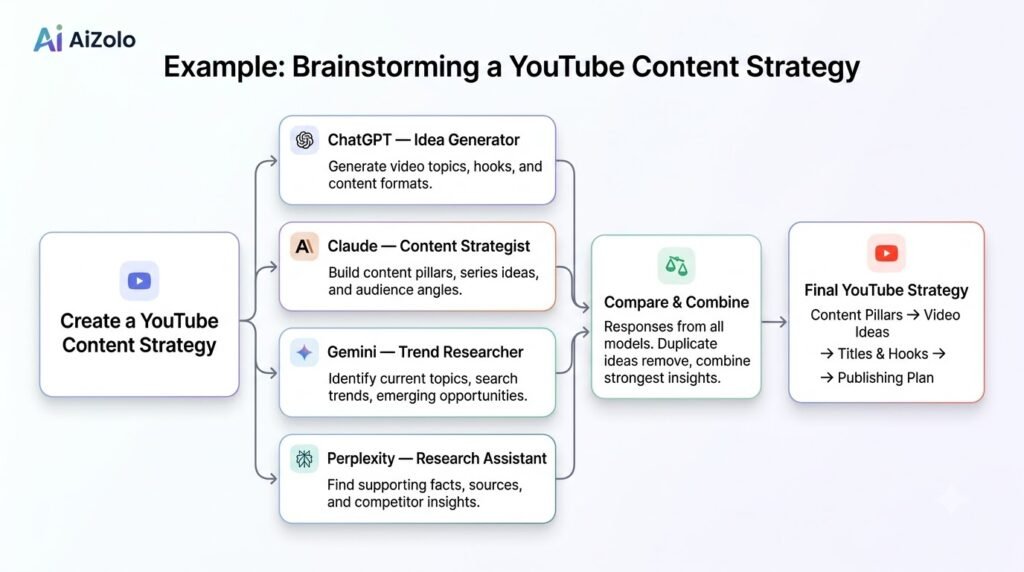
Suppose you want to start a YouTube channel about AI for non-technical professionals.
A basic prompt might generate:
- AI tutorials
- AI tool reviews
- AI news
- AI productivity tips
- AI prompts
Those are reasonable, but they are also predictable.
Instead, run four independent brainstorming rounds.
Model 1: Audience problems
It might identify:
- People don’t know which AI tool to use
- Users struggle to verify AI answers
- Beginners don’t know how to compare models
- Teams waste time switching between AI tools
Model 2: Contrarian exploration
It might suggest:
- Videos testing AI claims rather than explaining them
- “AI failed this task” experiments
- Comparing human workflows against AI workflows
- Deliberately stress-testing popular AI tools
Model 3: Creator perspective
It might suggest:
- Real workflow experiments
- One task across five models
- Weekly AI decision challenges
- Before-and-after productivity experiments
Model 4: Research perspective
It might identify:
- AI reliability
- AI hallucination testing
- Model diversity
- Prompt evaluation
- AI-assisted decision making
Now combine the results.
Instead of 40 disconnected suggestions, you may identify several content territories:
- AI comparison experiments
- AI reliability testing
- Real-world workflow experiments
- Model selection and evaluation
- AI productivity education
The next prompt can ask:
“Which content territories are already saturated, which have a clear audience problem, and which offer room for differentiated recurring content? Explain the reasoning without selecting a winner automatically.”
Then, you can compare the results with your own goals.
This is where human judgment matters.
The AI expands the possibilities. It does not decide what your channel should become.
Common Mistakes When Using Multiple AI Models
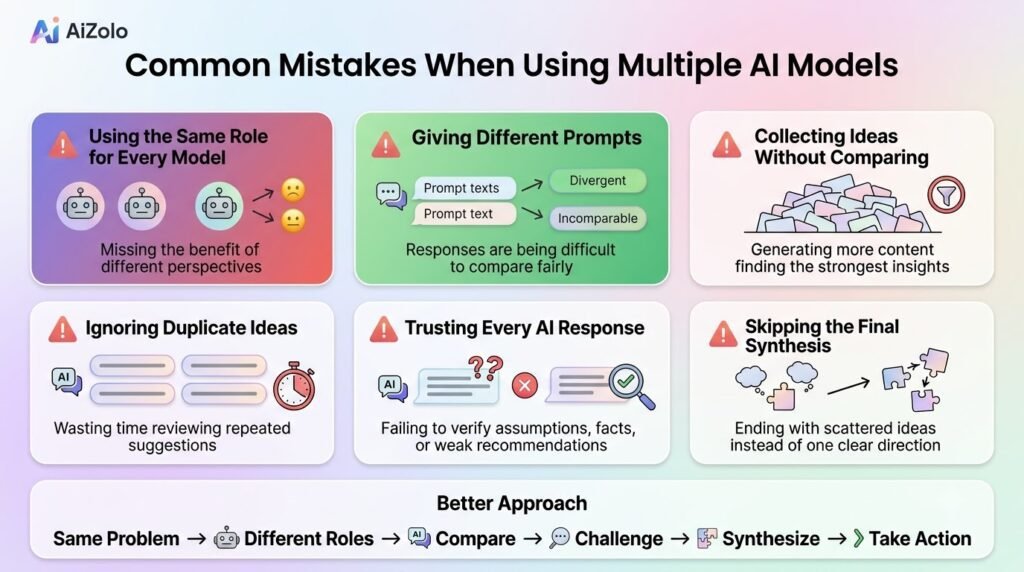
Asking every model the exact same generic prompt
While using identical prompts can sometimes be useful for controlled comparison, it often leads to the same ideas.
Use the same core prompt but ask for varying perspectives if you want to see a diverse set of thoughts.
Sharing one model’s ideas with the other models too early.
This introduces anchoring. Keep each model’s first thoughts to themselves, and let them see the other ideas during the synthesis portion of the prompt.
Assuming disagreement means one model is wrong
Disagreeing ideas are often founded on different assumptions.
Instead of challenging one model’s ideas, ask what assumptions would cause two of your models to disagree so thoroughly. The answer to that question might surprise you.
Using too many models
More models means more work, both in terms of generating ideas, and comparing them afterward.
Limit yourself to two or three for most standard brainstorming tasks.
Save the larger sets for more strategically important problems, or problems where you actually need the help of many different perspectives
Asking AI to choose the winner immediately
This turns a brainstorming session into a ranking exercise too soon.
First you should generate, then compare, then challenge, and finally rank your ideas. The whole point of a brainstorming session is to think about as many ideas as possible before doing any of them.
Treating consensus as proof
If four of your AI models have the same idea, it doesn’t automatically make that idea right or better than the others. They could have all been trained on the same assumptions or patterns, leading them to favor the same kinds of ideas.
Consensus among multiple models can often be a sign of interesting patterns, but it should not be treated as proof of quality or correctness.
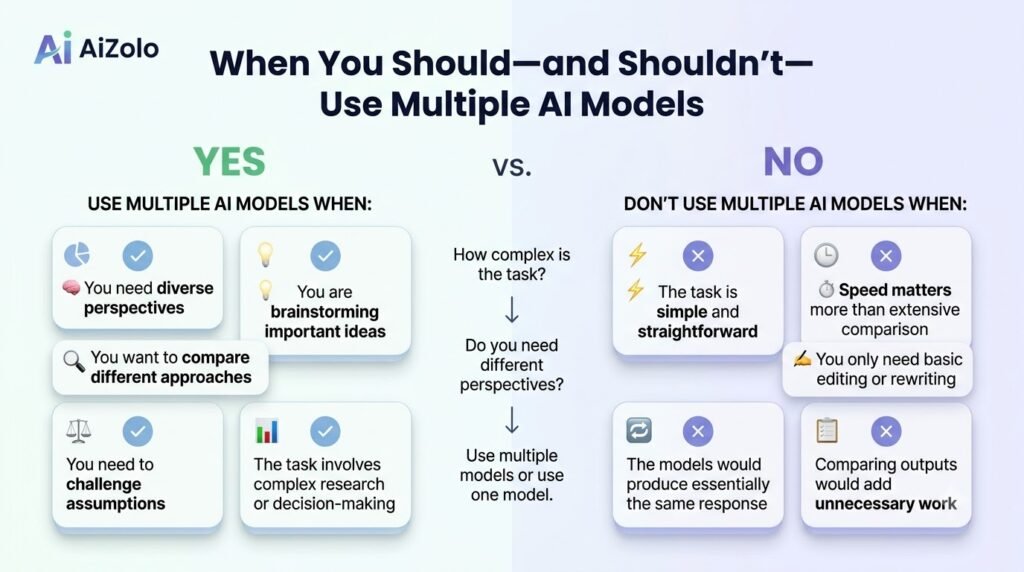
When You Should—and Shouldn’t—Use Multiple AI Models
When To, And When Not To, Use Multiple AI Models
Multi-model brainstorming works best when the question has multiple likely directions.
Use it for:
- Product ideas
- Marketing concepts
- Content strategies
- Business opportunities
- Naming
- Campaign concepts
- Research questions
- Strategic decisions
- Creative projects
- Feature planning
- Complex problem-solving
You probably do not need it for:
- Simple factual questions
- Basic calculations
- Straightforward formatting
- Routine rewriting
- Tasks where you know one reliable workflow already
- Situations where speed is more important than exploring
The goal isn’t to make every interaction with an AI a four-model process.
Use multiple models when you need diverse perspectives.
FAQs: Best AI Brainstorming technique using multiple models
Can you use multiple AI models for brainstorming?
Yes. You can ask the same question to different AI models. The most interesting way is to keep track of independent solutions in the first pass, then group, assess and confront them to choose a direction. That way you avoid the risk of building your thinking around one model’s assumptions.
Does using multiple AI models produce better ideas?
It can broaden the range of ideas you’re considering, especially if different models or prompts are tackling different aspects of the problem. Some research has shown that pooling ideas across model vendors can increase the diversity of ideas, but more isn’t always better so evaluation and human judgment are still needed.
How many AI models should I use for brainstorming?
Two or three models are often a good choice for everyday use in a brainstorming session. It is meant to spark a variety of answers, rather than maximizing the number of responses. The addition of other models might be desired for more strategically vital issues, but extra work would also need to be put into comparing and contrasting them.
Should I give every AI model the same prompt?
Make sure all of your models are given the same broad prompt if you want to compare them directly. You could also try asking each model to fulfill a different role or perspective if you want a variety of opinions. Some models could take on the role of a customer looking to solve a certain issue, while others could be more contrarian or optimistic about the same topic.
How do I prevent AI brainstorming from becoming repetitive?
Ask for genuinely different assumptions, categories, constraints, or perspectives, rather than just more ideas. Keep first round model responses independently, and then cluster the duplicates after generation. You can also ask a model specifically to identify repeated concepts and unexplored areas before entering into evaluation.
Should AI choose the final brainstorming idea?
The AI can help compare ideas against explicit criteria, but it shouldn’t make the final decision outright. Most useful, is to have the AI expose trade-offs, assumptions, risks, and evidence while the human decides on the fit to the actual audience, resources, goals, and context.
Is it better to compare AI models side by side?
Side-by-side comparison helps to spot differences because the same prompt and context can be reviewed together. It is great for brainstorming because you can see which ideas are common, which perspectives are unique to a model, and which contradict each other.
Can this technique be used for content creation?
Yes, content teams can ask for multiple models to generate article angles, video concepts, campaign ideas, headlines, audience problems, or content formats. First, you generate independently, then you cluster similar ideas, find gaps, challenge the most promising concepts, and pick one to ask the AI to flesh out into an article.
Final Takeaway
The best AI brainstorming technique using multiple models is not simply asking more chatbots for more ideas.
It is a disciplined approach that uses models for different stages of the thinking process:
Framing the problem, generating independently, introducing perspective diversity, pooling responses, clustering, identifying gaps, challenging assumptions, selecting, and executing.
The biggest advantage of multiple models is not that one will always produce a better answer than another. It is that comparing responses generated independently can make manifest possibilities, assumptions, and oversights not available to the individuals using only one response.
And that is the real purpose of AI-assisted brainstorming: expand the possibilities before you narrow them down.
Author
Anshika Verma is a content researcher and writer focused on researching AI tools, models, and creator technologies. Her work emphasizes source verification, practical AI workflows, and clear explanations that distinguish documented capabilities from real-world analysis.