
Introduction
Market research used to mean waiting six weeks and paying five figures for answers you needed yesterday.
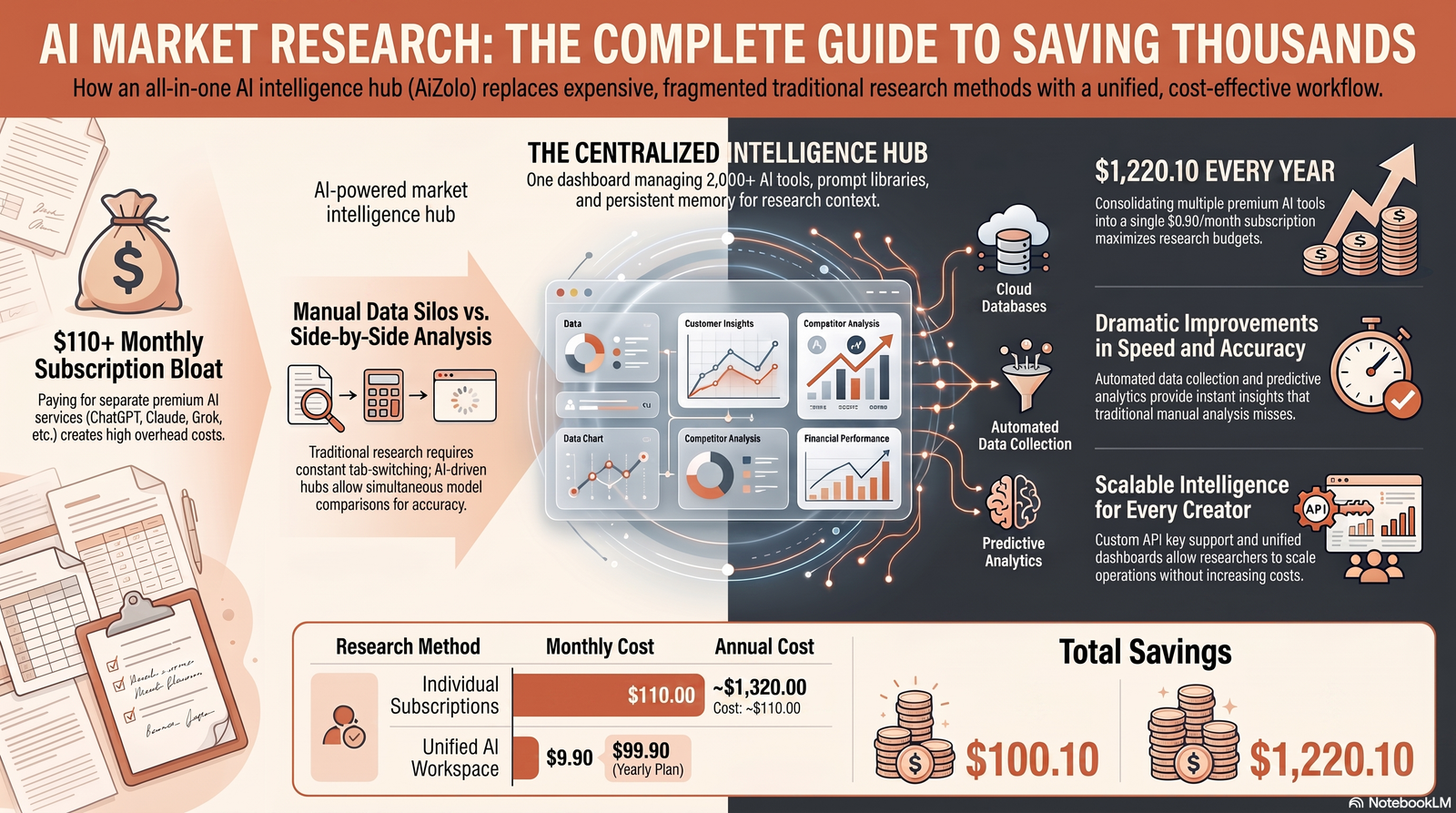
That math has changed. With Aizolo, AI-moderated interviews now run as low as $8–$25 per completed conversation, compared to $150–$300 for a human-moderated equivalent.
That’s not a small efficiency gain. It’s a structural shift in what research costs and how fast it moves.
Industry data backs this up. Greenbook’s 2025 GRIT report found that 72% of insights buyers now use generative AI somewhere in a research project, up from just 23% in 2023.
Qualtrics’ 2026 Market Research Trends report, drawn from over 3,000 researchers across 17 countries, puts AI usage even higher: 95% of researchers now use AI tools regularly or are actively experimenting with them.
This guide explains how AI for market research is changing the game and saving you thousands — not in theory, but in dollars, timelines, and decisions.
You’ll learn what AI market research actually is, why the old model got so expensive, which tools to use and when, real prompts you can copy today, and the mistakes that quietly waste budget.
Whether you’re a startup founder validating a product idea or an enterprise insights team scaling qualitative research, this is a practical, current playbook — not a sales pitch for any single tool.
Here’s the broader context. The global AI software market has grown sharply over the past two years, and market research is one of the functions absorbing that growth fastest.
McKinsey’s State of AI research found that most organizations now use AI in at least one business function, and a growing share use it across three or more.
Marketing and research teams specifically have been early adopters, because the work involves exactly what large language models are good at: reading huge volumes of text and finding patterns.
That’s why audience research and consumer insight generation now rank among the fastest-growing generative AI use cases inside marketing organizations.
None of this means the fundamentals of good research have changed. Sound questions, representative samples, and careful interpretation still matter as much as they ever did.
What’s changed is the cost of getting there — and that shift is what the rest of this guide unpacks in detail.
Table of Contents
What Is AI Market Research?
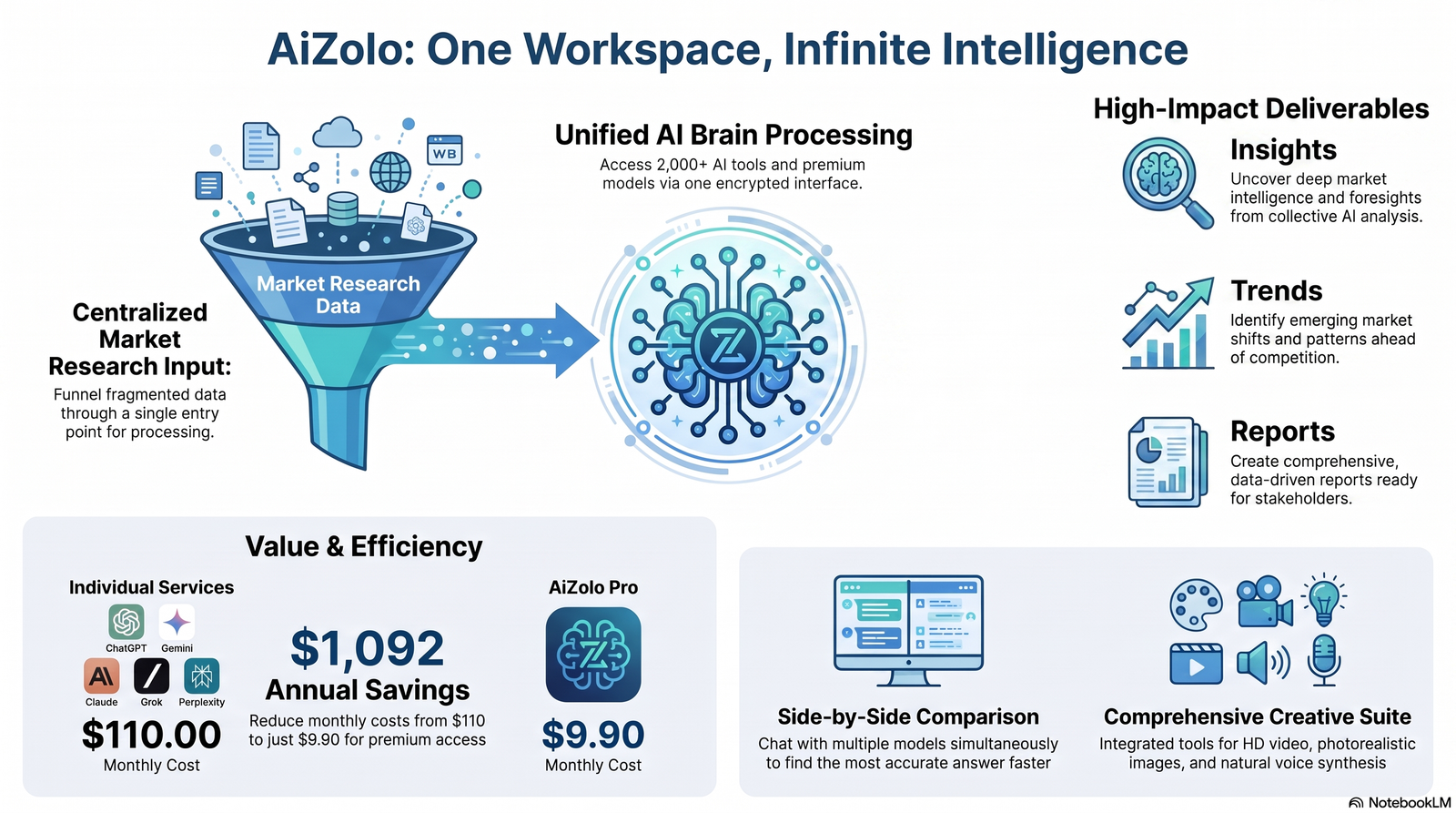
Featured Snippet Answer: AI market research is the use of artificial intelligence — including large language models, natural language processing, and predictive analytics — to collect, analyze, and interpret consumer and market data faster and at lower cost than traditional manual methods.
It covers a wide range of tasks. Survey design and programming. Open-ended response coding. Sentiment analysis. Competitive intelligence. Synthetic respondent simulation. Report generation.
AI doesn’t replace the researcher’s judgment. It replaces the slowest, most repetitive parts of the workflow.
Think of it as an analyst that never sleeps, reads every transcript instantly, and never gets tired of tagging the same theme for the two-hundredth time.
The category spans general-purpose AI assistants like ChatGPT, Claude, Gemini, and Perplexity, and purpose-built research platforms like Qualtrics AI, GWI Spark, Appinio, Crayon, Brandwatch, and Similarweb.
Each plays a different role. Purpose-built tools bring proprietary panels and structured data; general-purpose AI models bring flexible reasoning and synthesis across whatever you feed them.
Why Traditional Market Research Is So Expensive
Traditional research costs scale with human labor, and human labor doesn’t get cheaper as you scale.
Every in-depth interview needs a moderator to prep, conduct, and transcribe it. Every focus group needs a facility, a recruiter, incentives, and a trained note-taker.
Here’s what that actually looks like in dollars, based on current market research pricing data:
| Method | Typical Cost | Typical Timeline |
|---|---|---|
| In-depth interviews (IDIs) | $500–$1,500 per interview | 4–8 weeks |
| Focus groups | $6,000–$20,000 per session | 3–6 weeks |
| 1,000-response online survey | $5,000–$25,000 | 2–4 weeks |
| Brand tracking program | Low five figures to six figures per market | Ongoing |
| Marketing mix modeling | Up to $1M+ at global scale | Months |
Hidden costs make the real total even higher. Recruitment and screening alone can eat 15–25% of a project budget, and manual transcript coding can consume two to three weeks of an analyst’s time.
For a startup founder with a $10,000 research budget, that math rules out most traditional methods before the project even starts.
This is the exact pain point AI market research was built to solve — not by cutting corners, but by cutting the labor cost out of repetitive tasks.
There’s also a structural timing problem with traditional research that cost figures alone don’t capture.
By the time a six-week study wraps, the market question that prompted it has often already shifted. A competitor launched. A pricing test changed the picture. Leadership moved on.
Agencies aren’t overcharging out of greed — the pricing reflects real fixed costs. Facility rental, recruiter fees, moderator salaries, and manual coding all scale with headcount and hours, not with software.
That’s precisely why AI has found such fast adoption in this specific function. Research is unusually labor-intensive relative to the value of the underlying task — reading, summarizing, and pattern-matching text — which is exactly what modern AI models are built to do well.
For agencies and enterprise teams, this doesn’t eliminate the need for premium, high-touch research. It does mean the default cost of getting a first read on a question has dropped by an order of magnitude.
How AI for Market Research Is Changing the Game and Saving You Thousands
The shift isn’t just about cheaper tools. It’s about removing the constraints that defined research for decades: sample size, recruitment cost, time-to-insight, language coverage, and analyst capacity.
AI-moderated qualitative interviews now run roughly $8–$25 per completed interview with 24–72 hour turnaround, versus $150–$300 and multi-week timelines for human-moderated equivalents.
That means a 200-interview qualitative study that used to cost $30,000–$60,000 and take two months can now run for a few thousand dollars in a matter of days.
The savings aren’t limited to interviews. AI tools compress survey analysis, competitor tracking, and thematic coding — tasks that used to take analysts weeks — into hours.
Concretely, here’s where the “thousands saved” actually comes from:
- Labor replacement: AI handles transcription, coding, and first-pass synthesis instead of a paid analyst doing it manually
- Speed compounding: Faster insight cycles mean fewer delayed launches and less opportunity cost
- Smaller-team scaling: A two-person research function can now run what used to require five
- Reduced vendor markup: Some tasks move in-house instead of going to an agency
- Fewer bad decisions: Faster, cheaper research means teams validate more ideas before spending on execution
None of this means traditional research is obsolete. It means the decision of when to use it has become far more deliberate — and far less budget-constrained.
Cost Comparison: A 200-Interview Study
| Scenario | Traditional (Human-Moderated) | AI-Moderated |
|---|---|---|
| Cost per interview | $150–$300 | $8–$25 |
| Total project cost | $30,000–$60,000 | $1,600–$5,000 |
| Turnaround | 4–8 weeks | 24–72 hours |
| Analyst hours for coding | 2–3 weeks | Minutes to hours (AI first pass) |
ROI Comparison: Where the Savings Compound
| ROI Driver | Traditional Approach | AI-Powered Approach |
|---|---|---|
| Time-to-decision | Weeks | Days |
| Cost per research cycle | High, discourages frequent testing | Low enough to test iteratively |
| Number of ideas validated per quarter | 1–2 major studies | 5–10+ smaller studies |
| Opportunity cost of delay | High (slow decisions = slower launches) | Low |
The real ROI story isn’t just the line-item savings on any single project. It’s that lower costs let teams run research more often, which compounds into better decisions across a whole product or marketing cycle.
A team that can afford to test five pricing concepts instead of one is going to land closer to the right price, simply because it’s iterating instead of guessing once and hoping.
Traditional vs. AI Market Research: A Side-by-Side Comparison
| Factor | Traditional Research | AI-Powered Research |
|---|---|---|
| Cost per qualitative interview | $150–$300+ | $8–$25 |
| Typical project timeline | 4–8 weeks | 24 hours–2 weeks |
| Sample scalability | Limited by moderator time | Scales to hundreds/thousands |
| Language/geography reach | Constrained by local vendors | Near-instant multi-language coverage |
| Depth of open-ended analysis | Manual coding, analyst-dependent | Automated theming + human review |
| Human judgment & nuance | Strong | Requires human oversight to avoid bias |
| Best for | High-stakes, complex, sensitive topics | Iterative, ongoing, high-volume research |
| Upfront cost | High | Low to moderate |
The honest takeaway: AI wins decisively on cost, speed, and scale. Traditional methods still win when nuance, trust-building, and complex human judgment matter most — think sensitive healthcare topics or high-stakes B2B enterprise sales research.
Most mature research teams in 2026 aren’t choosing one over the other. They’re using AI for the 80% of work that’s repetitive and traditional methods for the 20% that genuinely needs a skilled human moderator in the room.
Benefits of AI Market Research
Featured Snippet Answer: The core benefits of AI market research are lower cost per insight, faster turnaround (hours or days instead of weeks), larger and more diverse samples, automated analysis of open-ended data, and the ability to run continuous research instead of one-off studies.
- Cost efficiency: Dramatically lower cost per interview, survey response, or analysis cycle
- Speed: Insights in hours or days rather than weeks
- Scale: Run hundreds of AI-moderated interviews in the time it takes to schedule five human ones
- Consistency: AI applies the same coding framework to every response, reducing analyst-to-analyst variance
- Always-on monitoring: Tools like Brandwatch and Similarweb track sentiment and competitor moves continuously, not just during a project window
- Lower barrier to entry: Startups and small teams can now run research that used to require an agency retainer
The tradeoff to be honest about: AI is only as good as the data it’s trained on and the prompts or frameworks it’s given. Unsupervised AI research can produce confident-sounding but shallow or biased conclusions.
The winning approach pairs AI’s speed with human researchers’ judgment on study design, interpretation, and strategic recommendations.
Pros and Cons at a Glance
Pros
- Dramatically lower cost per insight
- Much faster turnaround
- Easier to scale sample size and language coverage
- Consistent, repeatable analysis frameworks
- Enables continuous, always-on monitoring instead of one-off snapshots
Cons
- Can miss cultural nuance, sarcasm, or emotional subtext
- Quality depends heavily on prompt and study design
- Risk of over-trusting confident-sounding but shallow output
- Some purpose-built platforms carry real subscription costs
- Requires new skills — prompting and AI-output review — that not all teams have yet
Weighed honestly, the pros outweigh the cons for the majority of research use cases teams run today — especially iterative, exploratory, and continuous research.
The cons matter most for high-stakes, one-shot decisions where getting it wrong is expensive: major market entry decisions, sensitive healthcare or financial topics, or research feeding a board-level strategy call.
Real Business Use Cases
Startup product validation. A pre-seed founder uses an AI-moderated interview platform to talk to 100 potential users in 48 hours instead of spending three weeks and $15,000 on a traditional study.
SaaS churn analysis. A product team feeds support tickets and NPS open-ends into an AI tool to surface churn themes automatically, instead of manually tagging thousands of comments.
Competitive intelligence. A marketing team uses Crayon or Similarweb to track competitor pricing, messaging, and traffic changes continuously, replacing quarterly manual competitor audits.
Agency-scale brand tracking. A market research agency uses GWI Spark or Appinio to answer client questions about audience segments in minutes instead of commissioning a new custom survey each time.
Enterprise concept testing. A CPG brand tests 5 packaging concepts with a synthetic and real respondent blend, cutting a 3-week concept test down to under a week.
AI Tools Used in Market Research
General-Purpose AI Assistants
| Tool | Strengths | Limitations | Ideal Use Case |
|---|---|---|---|
| ChatGPT (OpenAI) | Broad reasoning, huge plugin/API ecosystem, fast drafting | No built-in respondent panel; can hallucinate stats | Brainstorming, survey drafting, summarizing desk research |
| Claude (Anthropic) | Strong long-document analysis, nuanced writing, careful reasoning | No native panel or survey tool | Synthesizing long transcripts, writing research reports |
| Gemini (Google) | Deep integration with Google Search and Workspace | Research-specific features still maturing | Combining live search data with analysis |
| Perplexity | Cites sources directly, good for live market scans | Less suited to deep qualitative synthesis | Quick competitive and trend scans with citations |
Purpose-Built Market Research Platforms
| Tool | Strengths | Limitations | Ideal Use Case |
|---|---|---|---|
| GWI Spark | Large proprietary consumer dataset, fast AI querying | Subscription cost, less useful for niche B2B audiences | Consumer segmentation and audience profiling |
| Appinio | Fast survey fielding, real-time results, intuitive UI | Panel size smaller than legacy giants | Quick concept and ad testing |
| Qualtrics AI | Enterprise-grade, strong governance, robust analytics | Higher price point, steeper learning curve | Large enterprise research programs |
| Crayon | Automated competitive intelligence tracking | Focused on competitors, not consumers | Ongoing competitor monitoring |
| Similarweb | Digital traffic and market share data | Web/app-focused, not survey-based | Market sizing and traffic benchmarking |
| Brandwatch | Deep social listening and sentiment analysis | Can be complex to configure well | Brand sentiment and social trend tracking |
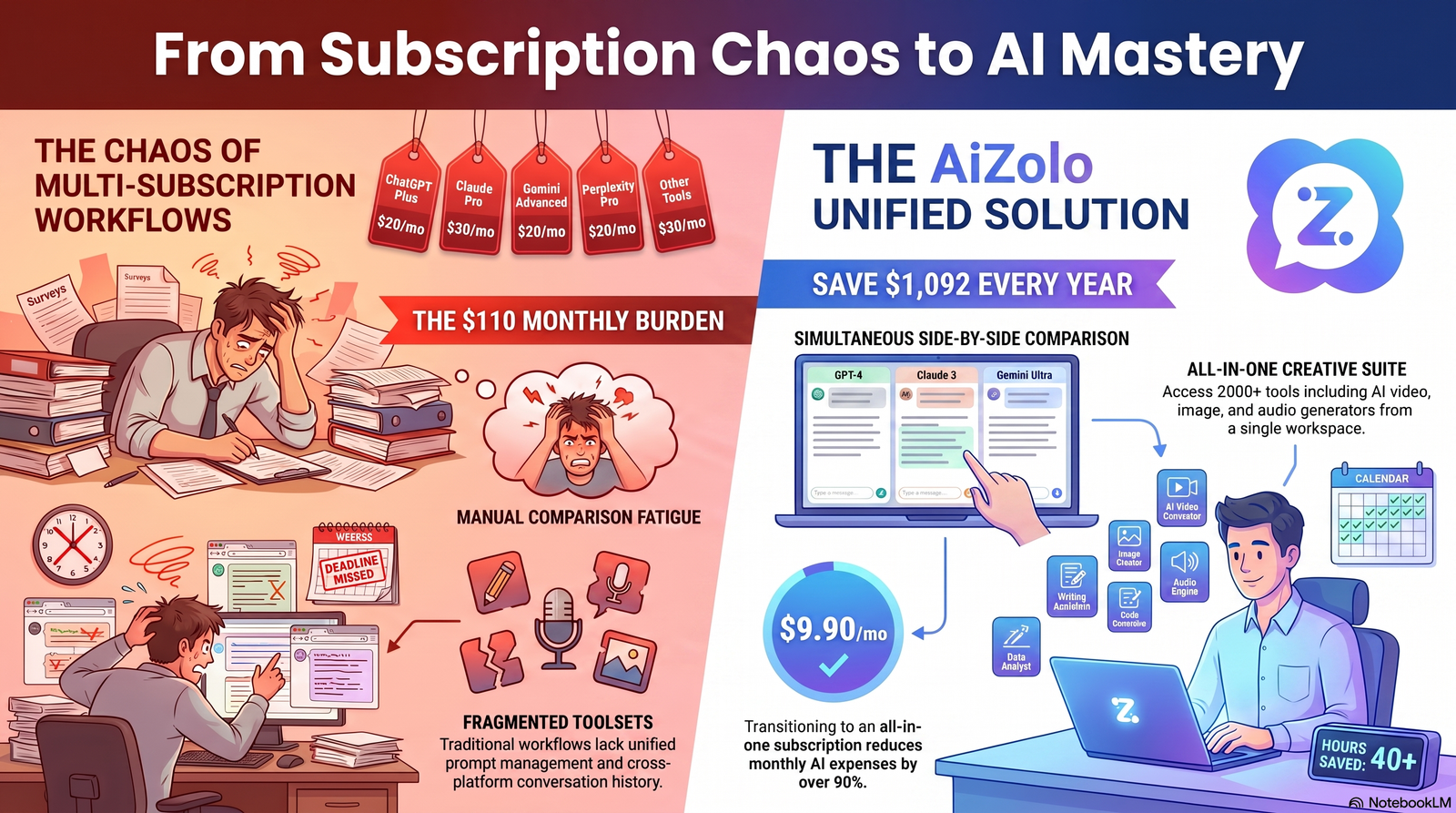
No single tool does everything well. Most serious research functions in 2026 use a stack — a general-purpose AI model for synthesis and writing, plus one or two purpose-built platforms for data collection.
A simple way to choose: start with the question “where does my current process lose the most time?”
If it’s writing survey drafts and summarizing desk research, a general-purpose model like ChatGPT or Claude will save the most time for the least cost.
If it’s finding respondents or fielding surveys at scale, a purpose-built panel platform like GWI Spark or Appinio solves a problem no general-purpose AI model can solve on its own — none of them ship with a verified respondent panel.
If it’s tracking what competitors are doing without a dedicated analyst, Crayon or Similarweb automate a task that used to require a recurring manual audit.
Budget-conscious teams often start with a general-purpose AI model, since the marginal cost of using one is close to zero, and add a purpose-built platform once research volume justifies the subscription cost.
Step-by-Step: How to Implement AI Market Research
- Define the decision, not just the question. Start with what business decision the research needs to inform — pricing, positioning, feature priority — not a vague topic.
- Choose the right mix of tools. Pick one general-purpose AI model for synthesis and one purpose-built platform matched to your method (survey, interview, or social listening).
- Design before you automate. Write your discussion guide or survey questions with the same rigor you’d use for a human-led study. AI amplifies good design and bad design equally.
- Run a small pilot first. Test your AI-moderated study or prompt chain on 5–10 respondents before scaling to hundreds.
- Let AI handle the first-pass synthesis. Use AI to code themes, summarize sentiment, and flag outliers across the full dataset.
- Have a human review and challenge the output. Treat AI synthesis as a first draft, not a final answer — check it against raw transcripts for nuance it may have missed.
- Turn insights into a decision brief. Translate findings into a short, action-oriented summary for stakeholders, not a raw data dump.
- Set up continuous monitoring. Where relevant, keep tools like Brandwatch or Crayon running so insight isn’t a one-time snapshot.
AI Prompts for Better Market Research
Copy, paste, and adapt these for your own AI assistant of choice.
1. Survey design
“Draft a 10-question consumer survey to test purchase intent for [product/service] among [target audience]. Include a mix of scaled and open-ended questions, avoid leading language, and flag any questions that might introduce bias.”
2. Open-ended response synthesis
“Here are 50 open-ended survey responses about [topic]. Identify the top 5 recurring themes, estimate the approximate share of respondents mentioning each, and quote 1–2 representative (anonymized) examples per theme.”
3. Competitive positioning analysis
“Compare [Company A] and [Company B] based on the following public information: [paste data]. Summarize differences in pricing, messaging, and target audience, and identify one clear positioning gap.”
4. Interview guide creation
“Create a 30-minute in-depth interview guide for understanding why users churn from [product category]. Structure it in warm-up, core, and closing sections with follow-up probes for each core question.”
5. Insight-to-strategy translation
“Based on this research summary [paste summary], suggest 3 concrete product or marketing actions a startup could take in the next 90 days, ranked by expected impact and ease of implementation.”
Common Mistakes to Avoid
- Treating AI output as final truth. Always sanity-check synthesized themes against a sample of raw responses — AI can summarize confidently even when it’s missed something important.
- Skipping study design. Automating a poorly designed survey just produces bad data faster; garbage in, garbage out still applies at AI speed.
- Ignoring sample representativeness. A fast AI-moderated study is still only as good as who’s actually being sampled — speed doesn’t fix a skewed panel.
- Over-relying on a single tool. No one platform covers desk research, panels, and analysis equally well, so a single-tool workflow usually leaves gaps.
- Forgetting human context. AI can miss sarcasm, cultural nuance, and emotional subtext that a trained researcher would catch in a live conversation.
- Not disclosing AI use to respondents where relevant. Transparency matters for trust and, increasingly, for compliance in regulated markets.
- Chasing statistical significance on tiny AI-run samples. Cheap interviews tempt teams to skip proper sample-size planning; cost savings shouldn’t come at the expense of valid conclusions.
Privacy, Ethics & Bias in AI Research
AI market research runs on data — often personal, sometimes sensitive. That makes privacy and consent non-negotiable, not optional.
Respondents should know when they’re interacting with an AI-moderated interview rather than a human, and how their responses will be stored and used.
Bias is a real risk. If a model is trained predominantly on certain demographics or languages, its synthesis can quietly underrepresent others.
Practical safeguards include auditing AI-generated themes against raw data samples, testing prompts across diverse respondent groups, and being explicit in reports about where AI was used versus human analysis.
Regulatory frameworks are tightening globally, including the EU AI Act’s risk-based requirements for high-risk AI systems, which can apply to certain research and profiling activities.
The responsible standard: use AI to move faster, but keep a human accountable for how the data was collected, interpreted, and applied.
Future Trends in AI Market Research
- From descriptive to predictive. Tools are shifting from summarizing what happened to forecasting which concept, message, or price point will win.
- Synthetic respondents as a supplement. AI-simulated audience responses are increasingly used to pre-test ideas before fielding real studies, though they still require validation against real humans.
- Continuous research over one-off studies. Always-on AI monitoring is replacing the quarterly or annual research cycle for many brand and competitive questions.
- Multimodal analysis. AI is expanding beyond text to analyze video interviews, voice tone, and even facial sentiment at scale.
- Tighter integration with business systems. Research insights are increasingly flowing directly into product, CRM, and marketing platforms instead of sitting in static reports.
Frequently Asked Questions
1. What is AI market research? AI market research uses artificial intelligence to collect, analyze, and interpret consumer data faster and more affordably than traditional manual research methods.
2. Can AI replace human market researchers? No. AI accelerates data collection and analysis, but interpreting findings and making strategic decisions still requires human judgment.
3. How much can AI market research actually save? AI-moderated interviews can cost roughly $8–$25 each versus $150–$300 for human-moderated equivalents, often cutting total project costs by 70% or more.
4. Is AI market research accurate? It can be highly accurate for pattern detection and theming, but accuracy depends on data quality, sample representativeness, and human review of outputs.
5. What’s the best AI tool for market research? There’s no single best tool — general-purpose AI models like ChatGPT and Claude suit synthesis and writing, while platforms like GWI Spark or Qualtrics AI suit structured data collection.
6. Is AI market research suitable for small businesses? Yes. Lower per-project costs make AI research one of the few ways small businesses can now run studies that used to require agency-level budgets.
7. How do I avoid bias in AI market research? Test prompts across diverse groups, audit AI-generated themes against raw responses, and always have a human review conclusions before acting on them.
8. What’s the difference between AI market research and traditional market research? Traditional research relies on human moderators and manual analysis; AI market research automates data collection and synthesis, cutting cost and turnaround time significantly.
9. Do respondents need to know they’re talking to an AI? Yes — transparency about AI involvement is considered an ethical best practice and, in some jurisdictions, a compliance requirement.
10. How long does AI market research take compared to traditional methods? AI-powered studies often deliver results in 24 hours to two weeks, compared to four to eight weeks for traditional qualitative or quantitative projects.
11. Can AI market research handle qualitative interviews? Yes — AI-moderated interview platforms can conduct hundreds of conversational interviews and synthesize themes automatically, though complex or sensitive topics may still need human moderators.
Conclusion
The evidence is consistent across every major industry report: AI has moved from experimental to foundational in market research, and the cost and speed advantages are real, not hype.
The right approach isn’t “AI instead of humans” — it’s AI for the repetitive, expensive parts of research, with human researchers focused on design, interpretation, and strategy.
Evaluate any AI market research tool against three things: your budget, your team’s workflow, and how much human oversight the topic genuinely requires.
Start small. Pilot one AI-moderated study or one synthesis workflow, compare it honestly against your traditional benchmark, and scale from there.
Ready to see where AI fits your research process? Start with a single pilot project this quarter and measure the time and cost saved against your last traditional study.
Author Bio
Jeevesh Tripathi Email: jeevesh@aizolo.com
Jeevesh Tripathi is an SEO strategist and content marketer specializing in AI, SaaS, and emerging technology. With a background spanning technical SEO, growth marketing, and applied AI tooling, Jeevesh writes data-driven guides that help startups, marketers, and enterprise teams make informed decisions about adopting AI in their workflows. His work focuses on translating fast-moving AI research and vendor claims into practical, verifiable guidance grounded in real cost and performance data.
Pingback: Compare AI Models Easily | AiZolo AI Comparison Platform
Pingback: All-in-One AI Platform: Stop Juggling AI Subscriptions
Pingback: Group Chat with Multiple AI Models | AiZolo Platform
Pingback: Best AI Model Comparison Tool for 2025
Pingback: Bypass Claude 4.5 Sonnet Message Limit in 3 Smart Ways 2026
Pingback: Compare AI Models Side by Side in 2026: 5 Smart Picks
Pingback: Free AI Wrapper for OpenAI Key: 5 Ways to Save More (2026)
Pingback: AI Tools Bundle: 6-in-1 Platform That Saves $1,000+ in 2026
Pingback: TypingMind vs AiZolo: 8 Key Differences That Matter 2026
Pingback: Analyze Website SEO with AI: 9-Step Audit That Ranks 2026 Fast
Pingback: 7 Best AI Writing Tools in 2026 for 3x Faster Content
Pingback: OmniGPT vs AiZolo vs Magai: 7 Reasons Teams Switch
Pingback: 7 best ai tools for generating engaging email subject lines (+45% Opens) 2026
Pingback: 7 AI Tools Bundle for Agencies Love Under $30 (2026)
Pingback: 7 Automated Competitor Battle Cards to Win 3x More Deals
Pingback: 7 Tools to Improve AI Prompts for 3x Better Results 2026
Pingback: 9 AI Website Analyzer Tools to Fix SEO Faster (2026)
Pingback: 7 Testing Frameworks for AI Tools to Ensure 10x Accuracy (2026)
Pingback: Magai vs. AiZolo: Which All-in-One AI Platform Actually Delivers on Its Promise? - AiZolo