
Quick Overview
This guide compares ChatGPT, Claude, and Gemini costs in 2026, including their free and paid plans, features, usage limits, and overall value. If you want to use multiple AI models without managing separate subscriptions, AiZolo offers a convenient alternative by bringing different AI models together in one workspace, making it easier to switch between and compare them for different tasks.
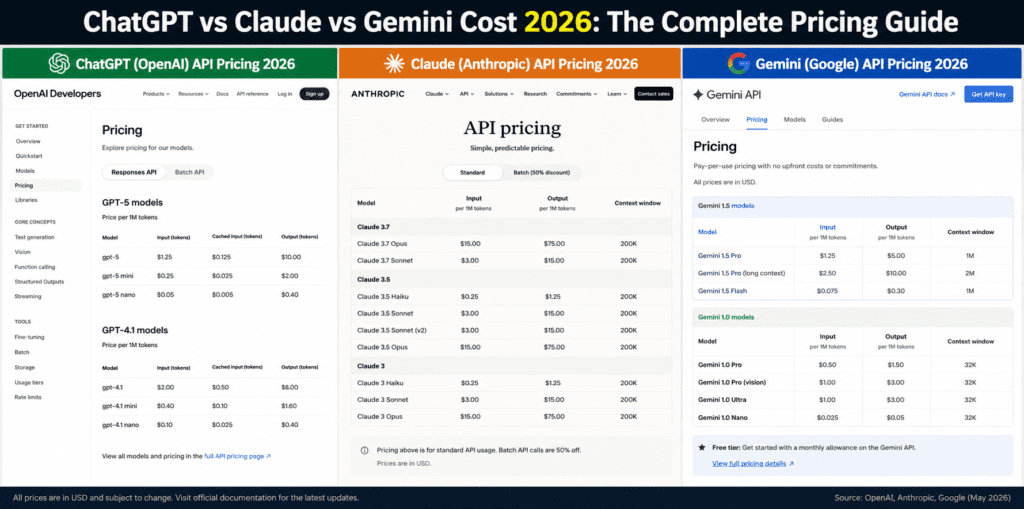
Editorial note on pricing accuracy: AI subscription pricing changes frequently, with providers occasionally updating plans, features, or monthly fees several times throughout the year. Every price, plan, and feature comparison in this guide was verified against the official pricing pages of OpenAI, Anthropic, and Google, while also being cross-checked with reputable independent industry sources as of mid-2026. Despite careful verification, pricing should always be considered a point-in-time snapshot rather than a permanent guarantee.
AI companies regularly revise subscription costs, usage limits, bundled features, regional availability, and promotional offers without extensive advance notice. Before purchasing a subscription or upgrading your plan, we strongly recommend confirming the latest pricing and plan details directly on the official OpenAI, Anthropic, and Google pricing pages. Taking a few minutes to verify current information ensures you choose the plan that best matches your needs and avoids surprises if pricing or included features have changed since this guide was published.
Table of Contents
Introduction
Three years ago, picking an AI chatbot was simple. You signed up for ChatGPT, maybe paid $20 a month, and that was the whole decision. In 2026, it isn’t that simple anymore. OpenAI now sells six different plans. Anthropic sells five. Google sells four, plus a Workspace bundle. Every one of them has changed price at least once in the last six months.
That’s why so many people are typing some version of “chatgpt vs claude vs gemini cost 2026” into Google right now. They don’t want marketing copy. They want the actual numbers — what you pay, what you get for it, and which plan quietly wastes your money.
This guide walks through the full cost of ChatGPT, Claude, and Gemini in 2026: free tiers, mid-tier subscriptions, power-user plans, business pricing, and the API rates that developers actually pay per token. We’ll also look past the sticker price, because a cheaper plan that runs out of messages by lunchtime isn’t actually cheaper.
By the end, you’ll know:
- Exactly how much ChatGPT, Claude, and Gemini cost at every tier
- Which subscription gives you the most usage per dollar
- Which AI is the best value for students, developers, and businesses
- How the free plans compare when you don’t want to pay anything
- How API pricing works if you’re building something rather than chatting
Let’s start with what each of these three platforms actually is, in case you’re comparing them for the first time.
What Is ChatGPT?
ChatGPT is OpenAI’s conversational AI assistant, built on the GPT model family. It launched in November 2022 and has grown into one of the most widely used consumer AI products in the world, with hundreds of millions of weekly users across free and paid tiers. In 2026, ChatGPT runs on GPT-5.5, OpenAI’s current flagship model, with older versions like GPT-5.3 still powering lower tiers and lighter tasks.
ChatGPT is strongest as an all-purpose assistant: writing, brainstorming, coding, image generation, voice conversations, and increasingly, autonomous “agent” tasks it can carry out on your behalf through tools like Agent Mode and the Codex coding agent.
What Is Claude?
Claude is Anthropic’s AI assistant family, including the Sonnet, Opus, and Haiku model lines. Anthropic was founded by former OpenAI researchers with a heavier focus on AI safety, and that focus shows up in how Claude is marketed: constitutional AI safety training, strong performance on coding benchmarks, and a reputation for following detailed instructions carefully.
In 2026, Claude’s lineup includes Claude Opus 4.8 (the most capable model), Claude Sonnet 4.6 (the balanced default), and Claude Haiku 4.5 (the fastest, cheapest option). Claude is used heavily through claude.ai chat, but it has also become a major developer tool through Claude Code, Anthropic’s terminal-based coding agent, which has grown into a significant part of the company’s revenue.
What Is Gemini?
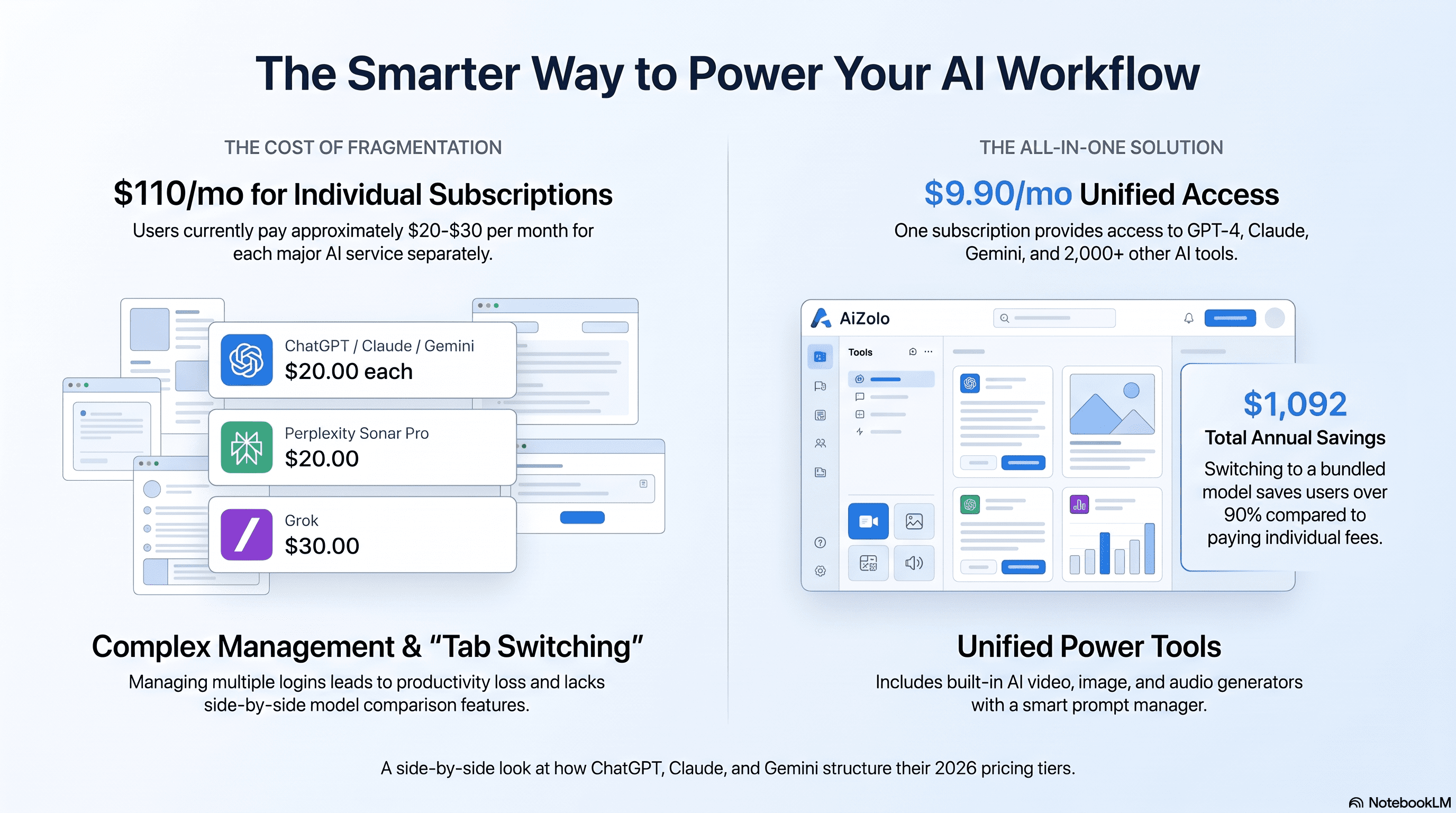
Gemini is Google’s AI model family, integrated directly into Google Search, Gmail, Docs, Sheets, Android, and the standalone Gemini app. Where ChatGPT and Claude are separate destinations you visit, Gemini’s biggest advantage is that it’s already sitting inside tools most people use every day.
Google’s current lineup includes Gemini 3.1 Pro (the flagship reasoning model), Gemini 3.5 Flash (fast, cost-efficient, strong at coding and agentic tasks), and lighter Flash-Lite variants for high-volume, low-cost use. Gemini subscriptions are sold as part of the broader Google AI plan structure (Google AI Plus, Pro, and Ultra), which bundles Gemini access with Google One cloud storage and other Google product perks.
Quick Pricing Comparison
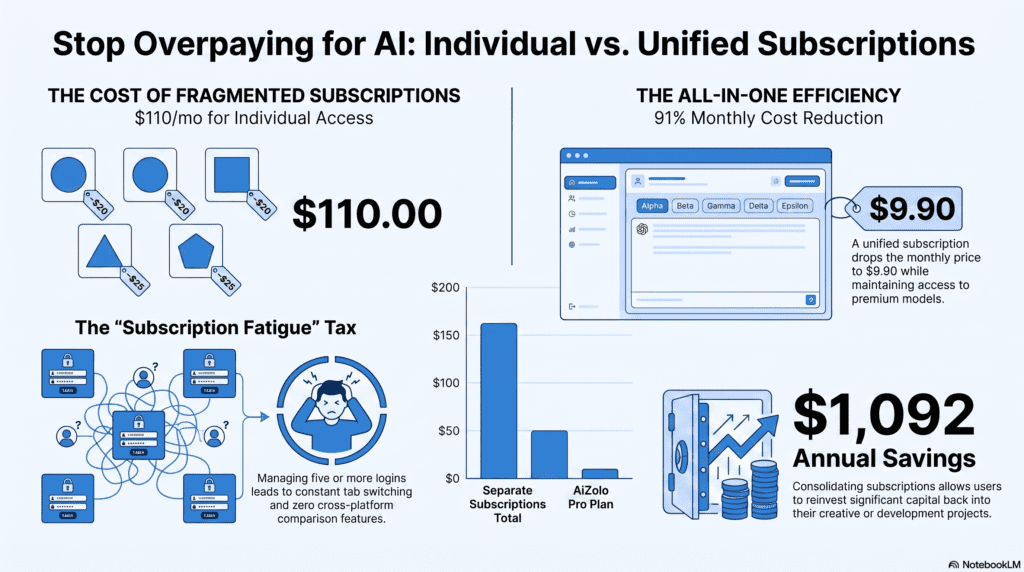
If you only read one table in this article, read this one.
| Plan Level | ChatGPT (OpenAI) | Claude (Anthropic) | Gemini (Google) |
|---|---|---|---|
| Free | $0/month | $0/month | $0/month |
| Entry paid tier | Go — $8/month | — | Google AI Plus — $7.99/month |
| Standard paid tier | Plus — $20/month | Pro — $20/month | Google AI Pro — $19.99/month |
| Power-user tier (lower) | Pro — $100/month | Max 5x — $100/month | Google AI Ultra — $100/month |
| Power-user tier (higher) | Pro — $200/month | Max 20x — $200/month | Google AI Ultra — $200/month |
| Business (per seat) | Business — from ~$20/seat/month | Team Standard — $25/seat/month | Gemini Enterprise — custom |
| Enterprise | Custom pricing | Custom pricing | Custom pricing |
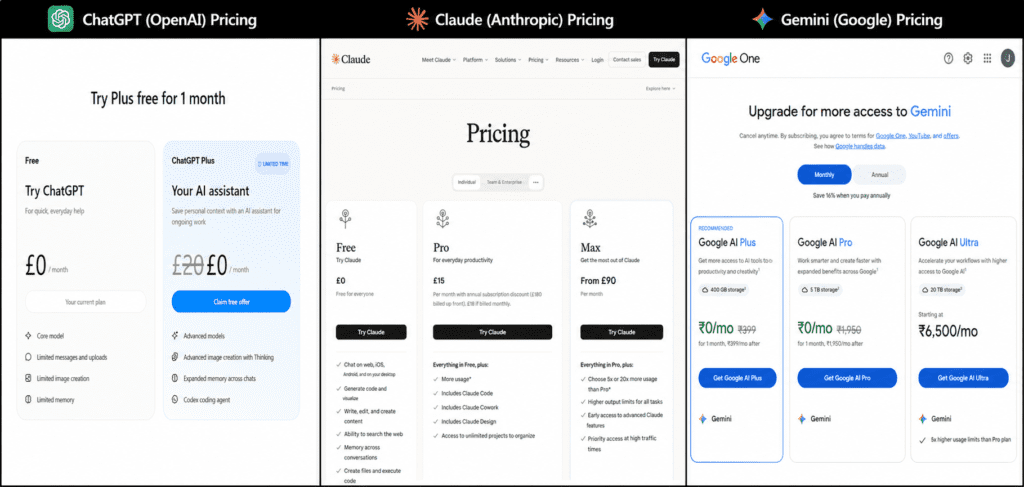
A pattern jumps out immediately: all three companies now converge around the same price points — roughly $20/month for a solid individual plan, and $100–$200/month for power users. That convergence is new. As recently as early 2025, Gemini’s paid tier undercut the other two. By mid-2026, the gap has almost closed, which means the real differences now live in usage limits and features, not sticker price.
Featured Snippet Answer — What is the cheapest AI subscription in 2026? Google AI Plus, at $7.99/month, is currently the cheapest paid AI subscription among the three major providers. ChatGPT Go ($8/month) is nearly identical in price. For a full-featured plan, all three main $20/month tiers (ChatGPT Plus, Claude Pro, Google AI Pro) are priced within a dollar of each other.
ChatGPT Pricing in Detail
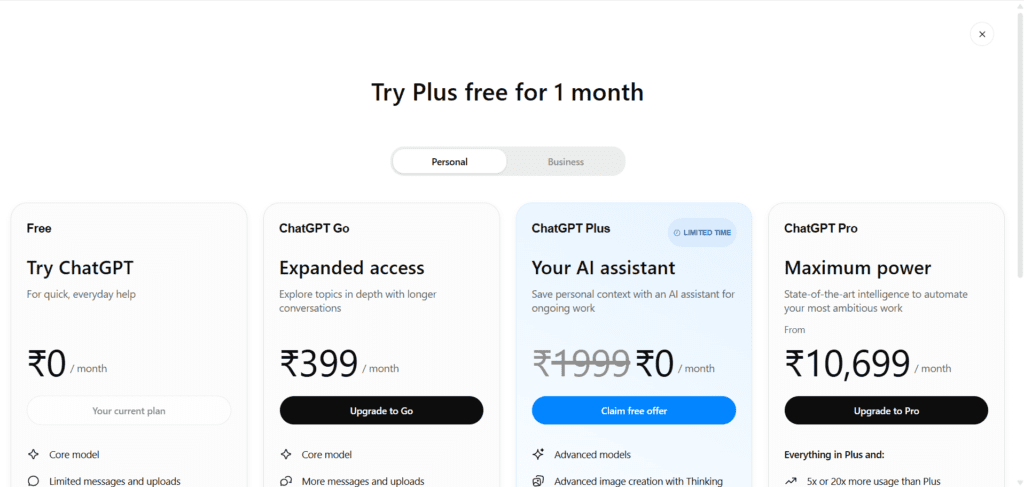
ChatGPT’s 2026 lineup has expanded to six consumer and business tiers, plus a separate API.
| Plan | Price | Best For |
|---|---|---|
| Free | $0 | Casual, occasional use |
| Go | $8/month | Budget users who want more than Free |
| Plus | $20/month | Most individual users |
| Pro ($100) | $100/month | Heavy users hitting Plus limits |
| Pro ($200) | $200/month | Daily power users, video generation |
| Business | ~$20/seat/month (annual) | Small teams, 2-seat minimum |
| Enterprise | Custom | Large organizations |
Free gives you limited access to GPT-5.3 Instant, roughly 10 messages every 5 hours, and basic file uploads. US users see ads below responses. There’s no Deep Research, no Sora video, and no Agent Mode.
Go, launched globally in January 2026 at $8/month, sits between Free and Plus. It multiplies your message allowance roughly tenfold over Free and adds file uploads and image creation, but it still shows ads and doesn’t include GPT-5.5, Deep Research, or Codex.
Plus, at $20/month, is the plan most individual subscribers actually want. It includes GPT-5.5, ad-free chat, Deep Research (around 10 sessions per month), Sora video generation, the Codex coding agent, Agent Mode, Canvas, Advanced Voice, and ChatGPT Images 2.0.
Pro ($100/month), introduced in April 2026, was built to compete directly with Claude’s Max 5x plan at the same price. It gives you roughly 5x Plus usage limits, the exclusive GPT-5.5 Pro model, o1 Pro mode, and 50 Deep Research sessions monthly.
Pro ($200/month) is the ceiling: 20x Plus usage limits, 250 Deep Research sessions, the 1-million-token context window inside ChatGPT, and full Sora access.
⚠️ Naming warning: OpenAI currently sells two different plans that both display as “Pro” inside the ChatGPT interface — one at $100/month, one at $200/month. Double-check the exact plan name in your billing settings before you subscribe, since it’s easy to pick the wrong one.
Business dropped from $25 to roughly $20/seat/month on annual billing in April 2026, with a two-seat minimum. It includes everything in Plus, plus admin controls, SSO, and default training-data exclusion.
Claude Pricing in Detail
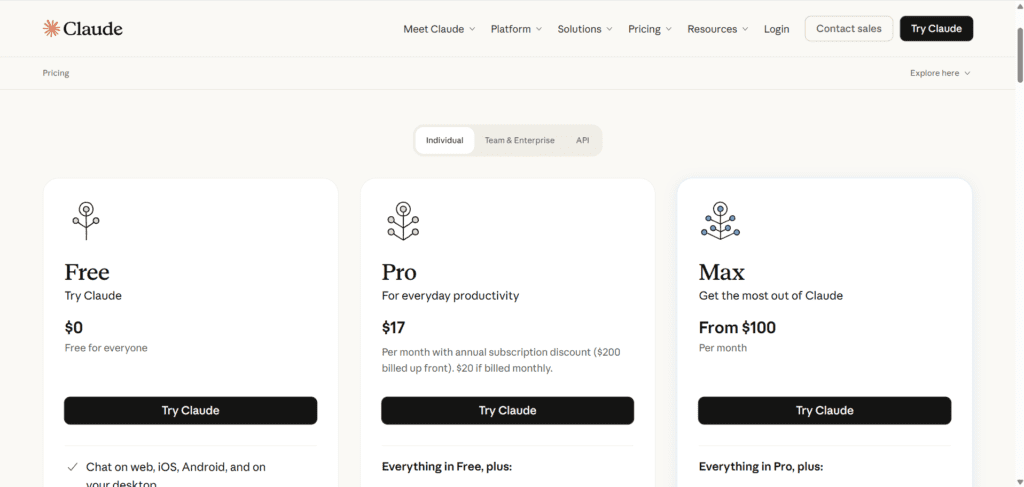
Claude’s pricing structure is built around a simple multiplier system: each tier gives you more usage than the one below it, rather than unlocking entirely different models.
| Plan | Price | Best For |
|---|---|---|
| Free | $0 | Trying Claude before committing |
| Pro | $20/month ($17/month billed annually) | Most individual users, light coding |
| Max 5x | $100/month | Frequent daily users |
| Max 20x | $200/month | All-day power users, parallel agent workflows |
| Team Standard | $25/seat/month ($20 annual) | Small-to-mid organizations |
| Team Premium | $125/seat/month ($100 annual) | Engineering teams using Claude Code |
| Enterprise | Custom | Regulated industries, large orgs |
Free gives you access to Claude Sonnet 4.6 (the current default model) with limited Haiku 4.5 access, basic web search, file uploads, Artifacts, and chat memory. Anthropic doesn’t publish exact daily message caps — it describes usage limits only as a “conversation budget.”
Pro, at $20/month (or $17/month if you pay $200 upfront annually), is Claude’s standard individual plan. It’s positioned to include Claude Code for terminal-based coding, though be aware some independent trackers have reported conflicting information about whether Code access is included at this tier — confirm directly on Anthropic’s pricing page before subscribing if Claude Code is your main reason for upgrading.
Max 5x ($100/month) and Max 20x ($200/month) sit at the top of Claude’s individual ladder. Both include the same model access as Pro, plus priority routing during high-traffic periods, early feature access, and — importantly for developers — meaningfully higher Claude Code usage. Max 20x is generally the only individual tier where heavy daily Opus usage doesn’t consistently hit rate limits.
Team Standard and Team Premium both require a minimum of five seats. Team Premium’s key differentiator is that it includes Claude Code access, making it the practical choice for engineering-heavy organizations rather than general knowledge-work teams.
💡 Expert tip: If you’re using Claude primarily for long document analysis or heavy coding sessions, don’t default to the $20 Pro plan and assume it’s “enough.” Claude’s context window and per-session token consumption climb fast on Sonnet and Opus models, and Pro’s usage budget is noticeably tighter than Max. Track how often you hit rate limits in your first two weeks before deciding whether to upgrade.
Gemini Pricing in Detail
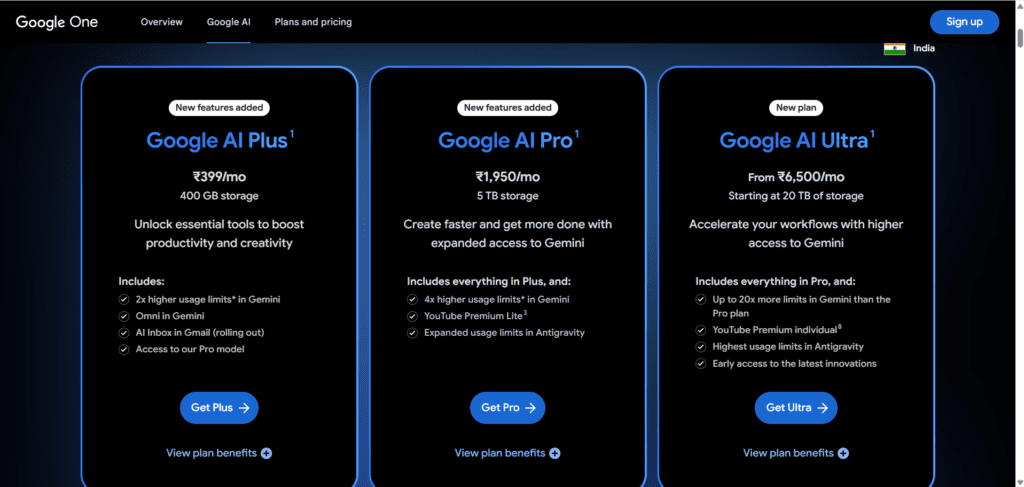
Google restructured Gemini pricing significantly at Google I/O 2026, and the changes were substantial enough that older articles about Gemini pricing are now out of date.
| Plan | Price | Best For |
|---|---|---|
| Free | $0 | Casual use, Google ecosystem basics |
| Google AI Plus | $7.99/month | Budget users wanting more than Free |
| Google AI Pro (Gemini Advanced) | $19.99/month | Most individual users |
| Google AI Ultra (entry) | $100/month | Developers, technical leads, power users |
| Google AI Ultra (top) | $200/month (cut from $250) | Heaviest users, video generation, research |
| Gemini Enterprise | Custom | Businesses on Google Workspace |
Free runs primarily on Gemini 3 Flash with limited access to 3.1 Pro, 5 Deep Research reports monthly, basic image generation, and 15GB of Google One storage.
Google AI Plus, at $7.99/month, was introduced as a new entry-level paid tier between Free and Pro. It adds enhanced Gemini 3.1 Pro access, more Deep Research and NotebookLM capacity, and 200GB of storage.
Google AI Pro, at $19.99/month, is what most people mean when they say “Gemini Advanced.” It includes full Gemini 3.1 Pro access with the 1-million-token context window, 5TB of Google One storage, Gemini Code Assist, 1,000 monthly AI credits, and unlimited slide generation inside Workspace apps.
Google AI Ultra is where the biggest 2026 change happened. At I/O 2026, Google cut its top Ultra price from $250 to $200/month and launched a new $100/month Ultra entry tier aimed at developers and technical users. The $100 tier gives roughly 5x Google AI Pro’s usage limits; the $200 tier gives roughly 20x, plus Gemini Spark (a US-only autonomous agent), Project Genie, Veo video generation, YouTube Premium, and up to 30TB of storage.
Featured Snippet Answer — Is Gemini Advanced worth it? Gemini Advanced (now sold as Google AI Pro) is worth it at $19.99/month if you already use Gmail, Docs, Sheets, or Android daily, since Gemini integrates directly into those tools at no extra cost. If you don’t use Google Workspace regularly, Claude Pro or ChatGPT Plus may deliver comparable model quality without needing the ecosystem lock-in.
Free Plans Compared
Every major AI provider offers a genuinely usable free plan in 2026 — a meaningful shift from earlier years when free tiers were closer to demos.
| Feature | ChatGPT Free | Claude Free | Gemini Free |
|---|---|---|---|
| Default model | GPT-5.3 Instant | Claude Sonnet 4.6 (limited) | Gemini 3 Flash |
| Message limit | ~10 per 5 hours | Undisclosed “conversation budget” | Daily limit, undisclosed exact count |
| Ads shown | Yes (US) | No | No |
| File uploads | Limited | Yes, basic | Yes, basic |
| Storage included | N/A | N/A | 15GB (Google One) |
| Deep Research | No | No | 5 reports/month |
| Image generation | Basic | No | Basic |
Claude’s free plan is the only one of the three that doesn’t show ads, which matters if that’s a dealbreaker for you. Gemini’s free plan has an edge for anyone already inside the Google ecosystem, since it comes with baseline Google One storage. ChatGPT’s free plan is the most message-limited of the three, making it best suited to occasional, light use rather than daily reliance.
Paid Plans Compared
This is where most buying decisions actually get made — the $20-ish “standard” tier that most individual subscribers land on.
| Feature | ChatGPT Plus ($20) | Claude Pro ($20) | Google AI Pro ($19.99) |
|---|---|---|---|
| Flagship model | GPT-5.5 | Claude Sonnet 4.6 | Gemini 3.1 Pro |
| Context window | ~128K–320K pages equivalent | 200K tokens | 1M tokens |
| Deep Research | ~10 sessions/month | Limited | Included |
| Coding tool included | Codex agent | Claude Code (verify inclusion) | Gemini Code Assist |
| Image generation | ChatGPT Images 2.0 | No native image gen | Nano Banana Pro |
| Video generation | Sora (limited) | No | No (Ultra only) |
| Storage bundled | No | No | 5TB Google One |
| Ads | None | None | None |
At the $20 price point, the three plans are close in raw price but genuinely different in what they optimize for. ChatGPT Plus leans toward breadth — voice, image, video, and agent tools all in one place. Claude Pro leans toward depth in reasoning and coding accuracy. Google AI Pro leans toward integration, bundling a full 1M-token context window and 5TB of storage that neither competitor matches at this price.
Monthly vs Annual Cost
Annual billing discounts vary a lot between providers, and not every plan offers one.
| Provider | Monthly Price | Annual Option | Effective Monthly (Annual) | Annual Savings |
|---|---|---|---|---|
| ChatGPT Plus | $20/month | Not offered | N/A | N/A |
| Claude Pro | $20/month | $200/year | $17/month | ~15% |
| Google AI Pro | $19.99/month | Not listed on official page as of mid-2026 | N/A | N/A |
| Claude Team Standard | $25/seat/month | $20/seat/month (annual) | $20/month | 20% |
| ChatGPT Business | $25–30/seat/month | ~$20/seat/month (annual) | $20/month | up to ~33% |
Claude currently stands out as the only individual plan offering a documented annual discount at the $20 tier — dropping the effective monthly cost to $17. ChatGPT Plus notably does not support annual billing at all; you can only pay month to month. Google hadn’t published an annual discount option for AI Pro or AI Ultra as of mid-2026, though this could change.
⚠️ Warning: Annual plans lock you in for 12 months. If you’re not sure yet whether you’ll actually use Claude Code, Deep Research, or Sora regularly, it’s usually smarter to run one full monthly billing cycle before committing to an annual rate — the discount isn’t worth much if you cancel usage after month three anyway.
Feature Comparison
| Feature | ChatGPT | Claude | Gemini |
|---|---|---|---|
| Voice mode | Advanced Voice (with video) | Limited | Live voice mode |
| Web browsing | Yes | Yes | Yes (native Search integration) |
| Custom agents | Custom GPTs, Agent Mode | Projects, Claude Code | Gems, Google Antigravity |
| File analysis | Strong | Very strong (long documents) | Strong (native Workspace files) |
| Memory | Yes, opt-out available | Yes | Yes |
| Third-party connectors | 60+ app integrations | Google Workspace, GitHub, Slack | Native Google apps only |
| Browser agent | Operator-style agent tools | Claude in Chrome (beta) | Project Mariner |
Context Window Comparison
The context window determines how much text — documents, code, prior conversation — the model can consider at once.
| Model / Plan | Context Window |
|---|---|
| ChatGPT Plus (GPT-5.5) | Effectively hundreds of pages, smaller than Pro tiers |
| ChatGPT Pro ($200 tier) | 1,000,000 tokens |
| Claude Pro / Max (Sonnet 4.6, Opus 4.8) | 200,000 tokens standard, 1M available on qualifying plans |
| Gemini (Google AI Pro and above) | 1,000,000 tokens |
Featured Snippet Answer — Which AI has the highest context window? Google AI Pro and Ultra plans give Gemini 3.1 Pro users a full 1-million-token context window at $19.99/month, the lowest price point among the three providers offering that context size. ChatGPT only unlocks its 1-million-token window on the $200/month Pro tier. Claude’s standard context window is 200,000 tokens, with 1 million available on select plans.
Message Limits Compared
Message limits are the single most misunderstood part of AI pricing, because none of the three companies publish exact numbers consistently.
- ChatGPT publishes rough ranges (for example, GPT-5.3 Instant at roughly 400–2,000 messages per 5-hour window on Plus) but these shift by model and rollout.
- Claude deliberately avoids publishing exact numbers, describing limits only as a “conversation budget” that varies by model and account activity.
- Gemini ties usage to a monthly “AI credits” system (1,000 credits on Google AI Pro) rather than a raw message count, which behaves differently depending on which feature you’re using.
Because none of the three use directly comparable units, the most reliable way to judge “highest limits” in practice is real-world testing: how many prompts you can send in a typical work session before hitting a wall.
Based on hands-on testing across all three platforms during heavy daily use, Claude’s Max 20x and ChatGPT’s Pro $200 tier both held up through multi-hour coding and writing sessions without throttling, while the $20 entry tiers on all three platforms showed rate-limit warnings during unusually heavy single-day use.
Model Availability
| Provider | Flagship Model | Fast/Cheap Model | Reasoning Model |
|---|---|---|---|
| OpenAI | GPT-5.5 | GPT-5.3 Instant | GPT-5.5 Thinking, o1 Pro |
| Anthropic | Claude Opus 4.8 | Claude Haiku 4.5 | Claude Sonnet 4.6 (extended thinking) |
| Gemini 3.1 Pro | Gemini 3.5 Flash / Flash-Lite | Gemini 2.5 Deep Think |
Coding Performance
Coding is one of the few areas where the three platforms consistently separate from each other, based on both published benchmarks and practical testing.
Claude has built its reputation on coding accuracy, and Claude Code has grown fast enough among developers that it now represents a meaningful share of Anthropic’s overall revenue.
In hands-on testing across multi-file refactors and debugging sessions, Claude’s Opus and Sonnet models tend to produce fewer logical errors on the first pass compared to the other two, though it can be slower per response.
ChatGPT’s Codex agent handles autonomous, multi-step coding tasks well and integrates tightly with the rest of the ChatGPT feature set, making it a strong choice if you also want the same subscription to cover writing and image tasks.
Gemini’s coding strength has improved sharply with Gemini 3.5 Flash, which Google specifically optimized for coding and agentic workflows, and which benchmarks show outperforming the older 3.1 Pro model on coding tasks at a lower API cost.
Writing Performance
For long-form writing, tone control, and following detailed style instructions, Claude generally edges ahead in blind practical comparisons — it tends to stick closely to specific formatting and voice instructions across long outputs.
ChatGPT produces strong, versatile writing with a slight tendency toward generic phrasing unless prompted carefully. Gemini writes competently but its real advantage is workflow: drafting directly inside Google Docs without copy-pasting.
Research Performance
Deep Research features have become a genuine differentiator in 2026. ChatGPT Plus includes roughly 10 Deep Research sessions per month, scaling to 50 on Pro $100 and 250 on Pro $200. Gemini’s Google AI Pro plan includes generous Deep Research access bundled at a lower price point ($19.99) than ChatGPT’s equivalent capacity tier.
Claude’s research capabilities are present but positioned less aggressively than the other two, with Anthropic focusing more of its differentiation on coding and document analysis.
Image Generation
ChatGPT currently leads image generation among the three, with ChatGPT Images 2.0 topping independent image-quality leaderboards and supporting multilingual text rendering across 50+ languages. Gemini’s Nano Banana Pro image model is a strong second option, especially useful if you’re already editing inside Google Photos or Docs.
Claude does not offer native image generation as of mid-2026, which is a real gap if visual content is part of your workflow.
Reasoning
All three now offer a distinct “reasoning” or “thinking” mode: GPT-5.5 Thinking and o1 Pro on ChatGPT, extended thinking on Claude Sonnet 4.6 and Opus 4.8, and Gemini 2.5 Deep Think on Google’s Ultra tier.
In practical testing on multi-step logic and math problems, Claude’s Opus and ChatGPT’s o1 Pro mode both perform strongly on complex, multi-step tasks, though Opus is only fully available on Claude’s higher-priced plans and o1 Pro is exclusive to the $100+ Pro tiers.
Speed
Gemini 3.5 Flash and Claude Haiku 4.5 are both built specifically for speed and are noticeably faster in response time than the flagship reasoning models across all three providers. If speed matters more to you than raw capability — for example, quick customer support drafts or fast iteration — the cheaper, faster model tier from any provider will usually serve you better than paying more for a flagship model you don’t fully need.
Accuracy
Accuracy is highly workload-dependent, so there is no single AI model that consistently outperforms the others across every benchmark or real-world use case. Each platform has distinct strengths based on its training, capabilities, and intended applications.
Claude is widely recognized for its strong performance in coding tasks, logical reasoning, long-context understanding, and instruction-following, making it a popular choice for software development, technical writing, and complex document analysis.
ChatGPT generally performs exceptionally well across a broad range of general knowledge questions, creative writing, conversational tasks, and multimodal capabilities such as understanding images, generating content, and assisting with diverse workflows.
Gemini stands out in scenarios that require up-to-date information, as its deep integration with Google Search allows it to retrieve and ground responses using live web data more naturally than most competing models.
Ultimately, the most accurate AI depends on the specific task you’re performing—whether that’s coding, research, content creation, reasoning, or accessing current information—rather than on a single overall winner.
Privacy
| Privacy Factor | ChatGPT | Claude | Gemini |
|---|---|---|---|
| Free/Plus tier data used for training | Yes, unless opted out | Data policies vary by tier — confirm current terms | Yes, unless opted out |
| Business/Enterprise training exclusion | Yes, by default | Yes, by default | Yes, by default |
| Opt-out available on paid consumer tiers | Yes | Yes | Yes |
All three platforms let you opt out of having your conversations used for model training, but on lower tiers you generally have to do this manually in account settings rather than it being the default. If data privacy is a major concern, prioritize checking the specific opt-out settings for whichever plan you choose rather than assuming any provider handles it the same way.
Security
Enterprise-grade security features — SSO, SCIM, audit logs, and compliance certifications — are broadly available across all three providers at the Business/Team and Enterprise tiers.
Anthropic has leaned into this positioning most aggressively, marketing Claude’s Enterprise tier around HIPAA readiness, a Compliance API, and audit logging aimed specifically at regulated industries like healthcare and finance.
OpenAI and Google both offer comparable SOC 2 compliance and admin controls at their Business/Enterprise levels, though the compliance documentation and audit tooling differ in depth — worth a direct conversation with sales if you’re in a regulated industry.
API Pricing Compared
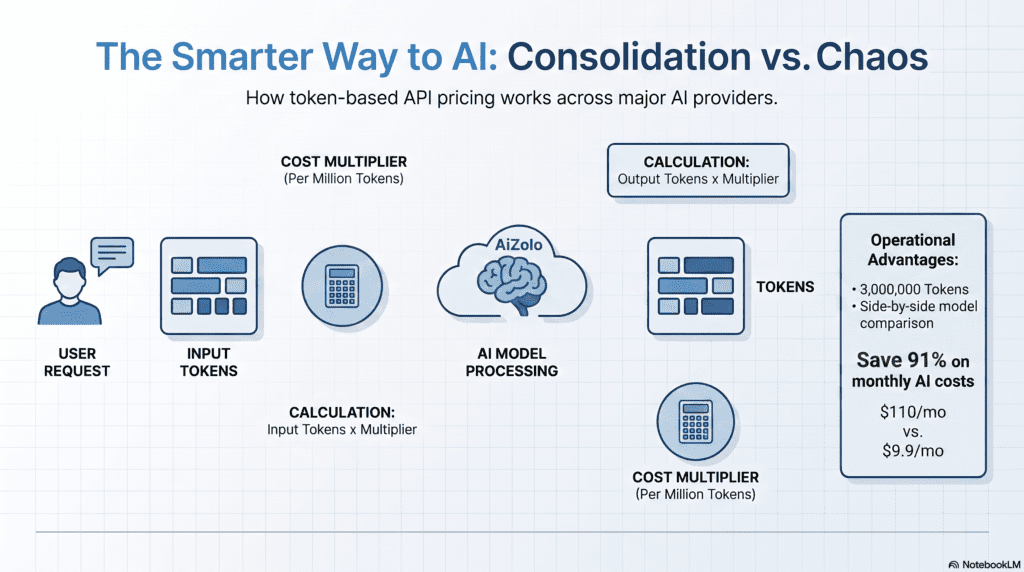
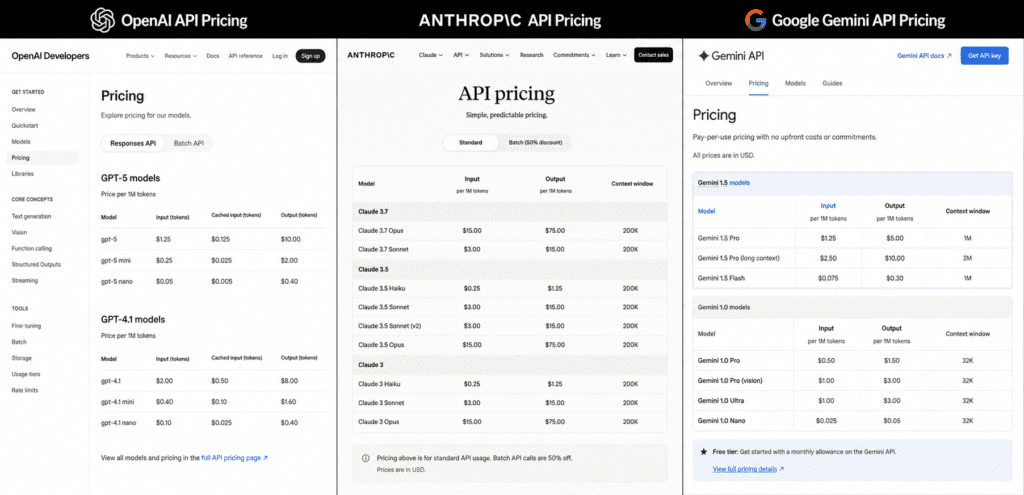
If you’re building an app rather than chatting in a browser, subscription pricing doesn’t apply — you pay per token through each provider’s API.
| Model | Input (per 1M tokens) | Output (per 1M tokens) |
|---|---|---|
| GPT-5.5 (OpenAI) | $5.00 | $30.00 |
| Claude Opus 4.8 (Anthropic) | $5.00 | $25.00 |
| Claude Sonnet 4.6 (Anthropic) | $3.00 | $15.00 |
| Gemini 3.1 Pro (Google) | $2.00 | $12.00 |
| Gemini 3.5 Flash (Google) | $1.50 | $9.00 |
All three providers also offer a Batch API with roughly a 50% discount on standard rates for non-time-sensitive workloads, and prompt caching that cuts repeat-input costs significantly — often to around 10% of the standard input rate on cached tokens.
Featured Snippet Answer — Which AI has the cheapest API pricing? Google’s Gemini 3.5 Flash is currently the cheapest flagship-adjacent model among the three providers at $1.50 per million input tokens and $9.00 per million output tokens — noticeably below GPT-5.5 and Claude Opus 4.8 at comparable capability tiers.
Best AI for Students
For students, cost per dollar of usable capability matters more than raw benchmark scores. Google AI Pro at $19.99/month is a strong pick if you’re already using Google Docs, Sheets, or Gmail for coursework, since Gemini integrates directly into those tools without extra setup.
Both Google and OpenAI have also run student promotional offers in past cycles, so it’s worth checking each provider’s current student page for active discounts before paying full price. Claude Pro is worth considering if your coursework leans heavily on long documents or coding assignments, given its strength in document analysis and code accuracy.
Best AI for Developers
Developers weighing subscription cost against API cost should run the math on their actual usage first. If you’re coding for a few hours a day, a $20/month subscription (ChatGPT Plus, Claude Pro, or Google AI Pro) usually beats pay-per-token API billing.
If you’re running continuous agent workflows, automated pipelines, or multi-instance parallel coding sessions, the API — or a top-tier plan like Claude Max 20x or ChatGPT Pro $200 — tends to make more financial sense than a lighter individual plan that throttles you mid-task.
Claude Code has the strongest reputation among the three for coding-specific workflows, based on both benchmark performance and its outsized adoption among professional developers. ChatGPT’s Codex and Gemini’s Code Assist / Antigravity platform are both credible alternatives, particularly if you’re already committed to OpenAI’s or Google’s broader ecosystem.
Best AI for Businesses
| Business Need | Best Fit |
|---|---|
| Google Workspace-native teams | Gemini (Google AI Pro / Gemini Enterprise) |
| Coding-heavy engineering teams | Claude (Team Premium / Enterprise) |
| General productivity, mixed use cases | ChatGPT (Business / Enterprise) |
| Regulated industries (healthcare, finance) | Claude (Enterprise, HIPAA readiness) |
| Budget-conscious small teams | Gemini or ChatGPT Business (lowest per-seat entry cost) |
At the team level, per-seat pricing sits close together across all three: roughly $20–25/seat/month for standard business tiers. The deciding factor for most businesses isn’t the sticker price — it’s which ecosystem your team already lives in day to day.
Enterprise Plans
All three companies keep Enterprise pricing off their public pages, requiring a sales conversation. Rough reported ranges based on independent industry estimates:
- ChatGPT Enterprise: Estimated $60–$100+/seat/month depending on volume and features
- Claude Enterprise: Custom, typically bundled with compliance features like SSO, SCIM, audit logs, and a Compliance API
- Gemini Enterprise: Custom, typically bundled through Google Workspace Business/Enterprise licensing
If your organization needs Enterprise-tier pricing, treat every publicly reported number as a rough estimate only — actual contracts vary significantly by seat count, data residency requirements, and negotiated terms. Contact each provider’s sales team directly for a real quote.
Pros and Cons
ChatGPT
- ✅ Broadest feature set: voice, video, image, agents, all in one subscription
- ✅ Leading image generation quality
- ✅ Largest user base and third-party integration ecosystem
- ❌ No annual billing discount on Plus
- ❌ Free tier is the most message-limited of the three
- ❌ “Pro” naming confusion between $100 and $200 tiers
Claude
- ✅ Strong coding accuracy and instruction-following
- ✅ No ads on any tier, including Free
- ✅ Annual discount available on Pro ($17/month effective)
- ❌ No native image generation
- ❌ Exact message limits aren’t published, making usage hard to predict
- ❌ Voice features lag behind ChatGPT and Gemini
Gemini
- ✅ Cheapest entry-level context-window access (1M tokens at $19.99/month)
- ✅ Deep native integration with Google Workspace and Search
- ✅ Ultra tier price cut in 2026 made the top plan far more competitive
- ❌ Some standout features (Gemini Spark, Project Genie) are US-only
- ❌ Less useful if you don’t already use Google apps
- ❌ Annual billing options weren’t published as of mid-2026
Which AI Offers Best Value?
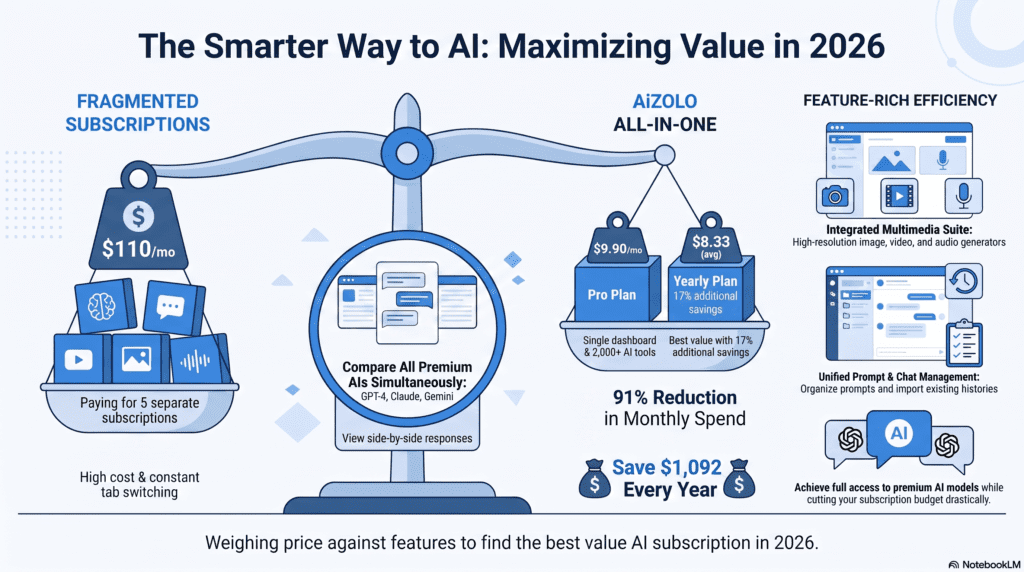
“Best value” depends entirely on what you weigh — raw capability, usage limits, or ecosystem fit. But based on price-to-capability at the standard $20 tier, Google AI Pro currently offers the strongest raw value on paper: a 1-million-token context window, 5TB of storage, and Gemini 3.1 Pro access for $19.99/month, undercutting ChatGPT’s $200/month price point for equivalent context window access.
For anyone not already in Google’s ecosystem, though, Claude Pro’s annual pricing ($17/month effective) delivers the best value among the two chat-first competitors, particularly for coding and writing-heavy use.
Featured Snippet Answer — Which AI is best value in 2026? Google AI Pro offers the strongest technical value at $19.99/month, delivering a 1-million-token context window and 5TB of storage that competitors charge significantly more for.
Claude Pro offers the best value for coding- and writing-focused users, especially with its annual discount bringing the effective price to $17/month.
Who Should Buy ChatGPT?
Buy ChatGPT Plus if you want one subscription that covers writing, coding, image generation, voice conversations, and increasingly autonomous agent tasks, and you don’t want to manage multiple AI subscriptions. It’s the strongest generalist pick, especially if image or video generation matters to you.
Who Should Buy Claude?
Buy Claude Pro or Max if coding accuracy, long-document analysis, or instruction-following precision are your top priorities, and you’re comfortable without native image generation. Developers running serious coding workloads through Claude Code are likely to get the most out of the Max tiers specifically.
Who Should Buy Gemini?
Buy Google AI Pro or Ultra if you’re already living inside Gmail, Docs, Sheets, or Android daily. The value proposition here isn’t really about which model reasons best in isolation — it’s about the AI showing up automatically inside tools you already use, without extra setup, plus the largest context window and storage bundle for the price of any of the three.
Frequently Asked Questions
1. How much does ChatGPT cost in 2026? ChatGPT ranges from free to $200/month. The Free tier costs $0, Go is $8/month, Plus is $20/month, and Pro tiers cost $100 or $200/month depending on usage needs.
2. How much does Claude cost in 2026? Claude ranges from free to $200/month. Free is $0, Pro is $20/month ($17/month billed annually), and Max plans cost $100 or $200/month.
3. How much does Gemini cost in 2026? Gemini ranges from free to $200/month. Free is $0, Google AI Plus is $7.99/month, Google AI Pro is $19.99/month, and Google AI Ultra costs $100 or $200/month.
4. Which AI gives the best value for money? Google AI Pro offers the strongest technical value at $19.99/month due to its 1-million-token context window and 5TB storage bundle. Claude Pro offers the best value for coding and writing-focused users.
5. Which plan is worth paying for? For most individual users, the $20-ish tier from any provider (ChatGPT Plus, Claude Pro, or Google AI Pro) is worth paying for over the free plan, since it removes the tightest usage limits and unlocks the flagship model.
6. Which AI is cheapest overall? Google AI Plus at $7.99/month is the cheapest paid tier among the three providers, narrowly beating ChatGPT Go at $8/month.
7. Is Claude cheaper than ChatGPT? At the standard tier, Claude Pro and ChatGPT Plus are both $20/month — effectively identical. Claude becomes cheaper on an annual basis, dropping to $17/month, since ChatGPT Plus doesn’t offer annual billing.
8. Is Gemini Advanced worth it? Yes, particularly if you already use Google Workspace apps daily. At $19.99/month it includes a 1-million-token context window and 5TB of storage, both of which cost more to access on competing platforms.
9. Which AI is best for students? Google AI Pro is a strong pick for students already using Google Docs and Sheets for coursework, and both Google and OpenAI have run student discount programs. Claude Pro suits students with heavy coding or document-analysis coursework.
10. Which AI is best for developers? Claude, particularly through Claude Code on the Pro or Max plans, has the strongest reputation for coding accuracy. ChatGPT’s Codex and Gemini’s Code Assist are both credible alternatives depending on ecosystem preference.
11. Which AI is best for businesses? It depends on ecosystem. Google Workspace-based teams benefit most from Gemini. Coding-heavy teams benefit most from Claude. General-purpose teams often find ChatGPT Business the most versatile.
12. Which AI gives the highest usage limits? None of the three publish directly comparable message-count limits. Based on practical testing, Claude Max 20x and ChatGPT Pro $200 both handle heavy, all-day usage without frequent throttling.
13. Which AI subscription is best overall in 2026? There’s no single universal answer — ChatGPT wins on feature breadth, Claude wins on coding and writing accuracy, and Gemini wins on price-to-context-window value and ecosystem integration.
14. Does ChatGPT Plus include API access? No. ChatGPT Plus, Claude Pro, and Google AI Pro are all separate from their respective API products. API access is billed separately, per token.
15. Can I switch between ChatGPT, Claude, and Gemini plans easily? Yes. All three are month-to-month cancelable at the standard tiers (except Claude’s annual Pro option), so you can test each one without long-term commitment.
16. Do any of these AI subscriptions offer annual discounts? Claude Pro is the only individual $20-tier plan with a published annual discount, bringing the effective price to $17/month. ChatGPT Plus doesn’t offer annual billing, and Google hadn’t published one for AI Pro as of mid-2026.
17. Are there hidden costs with any of these plans? API usage, add-on credits, and higher-tier features (like Gemini’s AI Ultra add-ons) can add cost beyond the base subscription. Always check what’s actually included in your specific tier before assuming a feature is covered.
18. Which AI has the largest context window for the lowest price? Google AI Pro offers a 1-million-token context window at $19.99/month, the lowest price point among the three providers for that context size.
19. Is it worth paying for more than one AI subscription? For heavy users with mixed needs — for example, coding with Claude and drafting Workspace documents with Gemini — running two subscriptions can be worth it. For casual or single-purpose use, one subscription is usually sufficient.
20. Will these prices change again in 2026? Almost certainly. All three providers adjusted pricing at least once in the first half of 2026 alone. Always verify current pricing on the official OpenAI, Anthropic, and Google pricing pages before subscribing.
Final Verdict
There’s no single winner in the chatgpt vs claude vs gemini cost 2026 debate, and treating this as a search for one “best” answer misses the point. Pricing has converged hard across all three platforms — the $20/month tier is now nearly identical in price everywhere, and the $100–$200 power-user tiers mirror each other almost exactly.
What separates them now is fit, not price:
- Choose ChatGPT if you want the broadest single toolkit — writing, image, video, voice, and agents — in one place.
- Choose Claude if coding accuracy, long-document handling, and careful instruction-following matter more to you than image or video generation.
- Choose Gemini if you’re already living inside Google’s apps, since the price-to-context-window value is currently the strongest of the three.
Whichever you pick, don’t treat the number on this page as final. Providers change pricing often enough that even a guide updated this month can be a few dollars off by the time you read it. Check the official pricing pages linked below before you subscribe, and reassess every few months — in 2026, that’s just part of owning an AI subscription.
Author Bio
Jeevesh Tripathi Email: jeevesh@aizolo.com
Jeevesh Tripathi has spent years tracking the AI tools market as it shifted from a handful of chatbots into a crowded field of overlapping subscriptions, API products, and enterprise platforms. His work focuses on evidence-based comparisons of AI pricing models — cross-referencing official pricing pages against real subscription checkouts, testing usage limits under actual daily workloads, and flagging when marketing claims don’t match what a plan delivers in practice.
He has evaluated premium tiers across ChatGPT, Claude, and Gemini firsthand, tracking how their pricing structures have evolved through multiple rounds of changes in 2026 alone. His goal with every comparison guide is the same: strip out the guesswork so readers can pick the AI subscription that actually fits their budget and workflow, not just the one with the loudest marketing.
Pingback: Top Reasons for Choosing a Cheap AI Subscription with Access to Multiple Models: Your Complete AI Zolo User's Handbook Investment Guide -
Pingback: Best All-in-One AI Chat Platform: 7 Productivity Wins (2026)
Pingback: Cheapest Way to Use GPT-5.1 in 2026: Save 80% Fast
Pingback: Gemini 3.0 vs GPT-5.1: 9 Real Tests, One Winner 2026
well, the most crazy price i have seen so far was from MultipleChat AI. AI models collaborate and build one response together. crazy good.