Claude Fable 5.1 vs GPT-6 Astra is a close 2026 AI model comparison. GPT-6 Astra leads in automation, computer use, mathematics, and AI agents, while Claude Fable 5.1 excels at writing, research, deep reasoning, and long documents.
There’s no universal winner—the best model depends on your workflow. With AiZolo, you can compare both models side by side using the same prompts and choose the one that delivers the best results for your task.
Table of Contents
Introduction
The AI landscape shifted again in September 2026 with OpenAI’s release of GPT-6 Astra, a frontier model built around computer use, agentic browsing, and software engineering, going head-to-head with Anthropic’s Claude Fable 5.1.
Both companies are racing toward the same goal: models that don’t just answer questions but complete complex, multi-step work autonomously across code, browsers, and professional tools.
GPT-6 Astra arrives with bold claims — near-saturated scores on FrontierMath and ARC-AGI-3, and the distinction of being the first OpenAI model to cross the “Critical” cybersecurity threshold under its Preparedness Framework.
Claude Fable 5.1, part of Anthropic’s Mythos-tier lineup, takes a different posture, layering in additional safety measures around biology, cybersecurity, and LLM research.
This comparison breaks down how the two models stack up on reasoning, coding, safety design, pricing, and real-world usability — so you can decide which one actually fits your workflow in 2026.
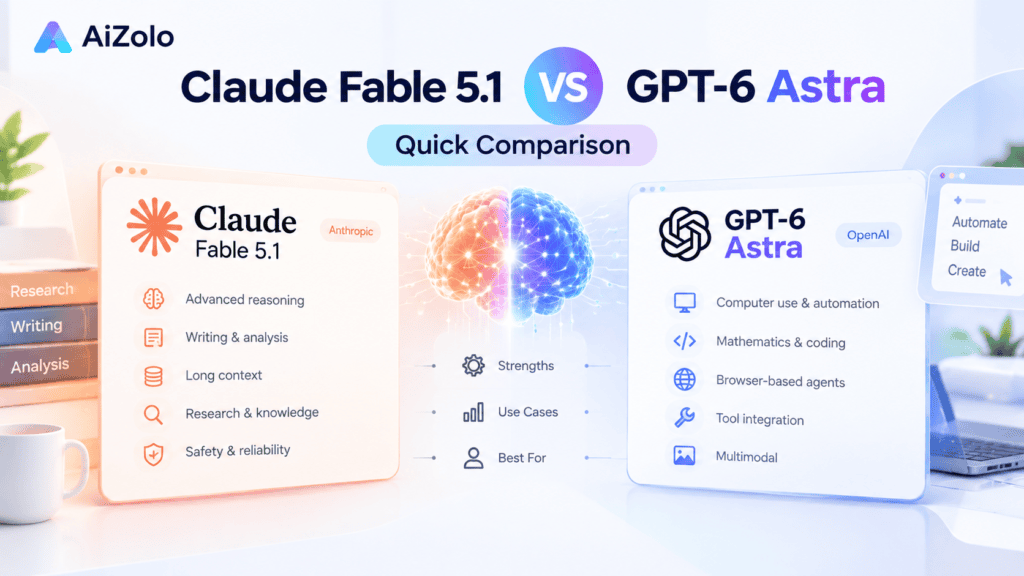
Claude Fable 5.1 vs GPT-6 Astra: Quick Comparison
| Feature / Metric | Anthropic Claude Fable 5.1 | OpenAI GPT-6 Astra |
| Developer | Anthropic | OpenAI |
| Release date | September 1, 2026 | September 3, 2026 |
| Context window | ~1 Million tokens | ~1.05 Million tokens |
| Maximum output | 128,000 tokens | 128,000 tokens |
| Knowledge cutoff | Mid-2026 | Mid-2026 |
| API pricing | $10.00 / 1M input · $50.00 / 1M output | $10.00 / 1M input · $50.00 / 1M output |
| Cached input | $0.25 / 1M tokens (75% savings) | $1.00 / 1M tokens |
| Reasoning | Built for long-horizon planning and agentic persistence | Recurrent depth (“looped transformers”); math frontier SOTA (97.6%) |
| Computer use | Solid (55.8% Terminal-Bench 4.0) | State-of-the-art (72.6% OSWorld 2.0, 92.7% ScreenSpot-Pro) |
| Coding | Leads repository-level patching, mergeable code, and Cursor/IDE integration | Superior for end-to-end execution, terminal scripting, and automated QA |
| Best use cases | Multi-file codebases, long document analysis, design/UI, agentic context caching | OS/browser automation, complex math/physics, zero-day research, prompt-to-artifact 3D/games |
Key Takeaways
Architectural Focus: GPT-6 Astra excels as an autonomous computer operator—navigating GUI applications, running terminal workflows, and solving theoretical mathematics. Claude Fable 5.1 targets software architecture, producing cleaner merge-ready code and long-horizon context management.
Cost Factor: While both models share identical base input and output rates, Anthropic offers notable lower cache read pricing ($0.25/M vs $1.00/M), making Fable 5.1 more economical for continuous, context-heavy agentic loops.
Want to compare both models yourself? Instead of switching between multiple AI platforms, you can access GPT-6 Astra and Claude Fable 5.1 through AiZolo and compare their responses on the same prompt. This makes it easier to see which model fits your workflow before committing to one.
What Are GPT-6 Astra and Claude Fable 5.1?
GPT-6 Astra and Claude Fable 5.1 are competing flagship AI models released in September 2026. GPT-6 Astra, developed by OpenAI, was released on September 4, 2026, and represents the company’s most advanced general-purpose model, reportedly trained using approximately 100,000 GPUs at a cost of $500 million to $1 billion.
Nvidia CEO Jensen Huang described it as symbolizing the arrival of the AGI era. Claude Fable 5.1, developed by Anthropic, is the successor to Fable 5 and is positioned below Anthropic’s restricted Mythos 5 model.
In terms of performance, the two models are closely matched. GPT-6 Astra leads on the LLM Stats composite score (60.7 vs. 56.8) and wins three of four shared benchmarks, while Claude Fable 5.1 outperforms on independent evaluations such as SWE-bench Pro, the Artificial Analysis Intelligence Index, and ProofBench v1.1.
Both models share identical API pricing at $10 per million input tokens and $50 per million output tokens, though actual task costs differ—Astra averages approximately $2.57 per task versus Fable 5.1’s $6.12. GPT-6 Astra offers a slightly larger context window of 1,050,000 tokens compared to Fable 5.1’s 1,000,000 tokens.
The competition between these models has expanded beyond raw capability to include training scale, inference efficiency, and real-world cost effectiveness.
What Is Claude Fable 5.1?
Claude Fable 5.1 is part of Anthropic’s Mythos tier, the company’s most advanced model class, sitting above Opus in Anthropic’s lineup. Fable 5.1 shares its underlying architecture with Claude Mythos 5.1, but ships with extra safety layers specifically around biology, cybersecurity, and LLM research and development — making it the version Anthropic positions for broader availability.
The Fable and Mythos 5 models actually had a bumpy rollout: both launched on June 9, 2026, only to have access suspended three days later when they became subject to U.S. Department of Commerce export controls. Anthropic restored full access on July 1, 2026, after the Commerce Department lifted those restrictions.
Fable 5.1 is built for demanding reasoning, coding, and agentic tasks, while keeping tighter guardrails on dual-use capabilities than its Mythos sibling — a deliberate trade-off between raw capability and controlled deployment.
What Is GPT-6 Astra?
GPT-6 Astra is OpenAI’s newest frontier model, unveiled September 3, 2026, and released publicly the next day. OpenAI calls it its “most intelligent and aligned” model yet, built to act as a computer operator — working directly inside browsers, terminals, and professional software rather than just explaining tasks.
Astra has a 1.05-million-token context window, 128K max output, and an April 30, 2026 training cutoff. Pricing runs $10/$50 per million input/output tokens — about 2.5x its predecessor, GPT-5.6 Sol. OpenAI reports near-saturated scores on FrontierMath Tier 4 (~98%) and ARC-AGI-3 (99.9%), plus ~1.9x faster agentic task completion than Sol.
Notably, Astra is the first OpenAI model to cross the “Critical” cybersecurity threshold under its Preparedness Framework, so its most advanced exploit-related capabilities are gated behind a vetted-access program.
Claude Fable 5.1 vs GPT-6 Astra: Key Differences
Both GPT-6 Astra and Claude Fable 5.1 are top-of-the-range AI products, but they highlight different features. While Astra excels in agent-based tasks, human-computer interaction and application work, Fable 5.1 is particularly valuable for complex reasoning, writing, and intellectual activity requiring thorough knowledge work.
Length of Context and Tasks Involving Long Context
The length of the context is important for the AI to deal with large texts, programs, articles and other lengthy texts of some kind (such as long-term project histories).
For users working with large projects, the better model is not necessarily the one with the biggest advertised context window. Accuracy, information retrieval, and consistency throughout a long conversation matter just as much.
Reasoning and Problem Solving
Reasoning is one of the biggest areas to compare. GPT-6 Astra is designed to handle complex multi-step problems while connecting reasoning with actions and tools. This makes it useful when a task requires planning, analysis, and execution.
Claude Fable 5.1 takes a particularly strong approach to structured reasoning and detailed explanations. It can be valuable for breaking down complicated subjects, evaluating alternatives, and producing thoughtful conclusions.
Quick takeaway: Choose Astra when reasoning needs to lead into action; choose Fable 5.1 when deep analysis and explanation are the priority.
Coding and Software Engineering
For developers, both models can assist with debugging, code generation, refactoring, documentation, and understanding existing repositories.
Astra has an advantage when coding is part of a broader agentic workflow. It can combine software development with tool use and computer interaction, making it useful for tasks that go beyond simply generating code.
Fable 5.1 is especially attractive for developers who want careful code analysis, clear explanations, and help navigating complex programming problems.
Computer Use and AI Agents
This is where Astra can have a meaningful advantage. Instead of only responding with text or code, computer-oriented AI can interact with applications, websites, files, and development environments.
That makes GPT-6 Astra particularly interesting for AI agents that need to perform multi-step workflows rather than simply answer questions.
Claude Fable 5.1 remains useful for agentic tasks, but its strengths are more apparent when reasoning, planning, and language understanding are central to the workflow.
Composition and Content Generation
When it comes to writing, however, the distinction depends more on a subjective criterion. Claude models have long been exceptional at producing writing that is natural, sophisticated, and relevant, thus making Fable 5.1 a great tool for article writing, editing, storytelling, and business communications.
Astra is better used in cases where the work relates to research, automation, data analysis, and the like.
In terms of pure writing quality, Fable 5.1 remains the better option for those who value tonal quality, nuances, and beautiful long-form writing.
Research and Knowledge Work
Both models can support research, summarization, analysis, brainstorming, and synthesis. Astra’s strength becomes more apparent when research is combined with tools and multi-step workflows.
Fable 5.1 is well suited to reading complex material, comparing information, organizing arguments, and turning research into coherent written output.
For researchers and content teams, the choice may therefore depend less on raw intelligence and more on workflow: Fable 5.1 for deep knowledge work, Astra for research combined with execution and automation.
Website Design and Frontend Development
Website creation provides another interesting distinction. Both models can generate HTML, CSS, JavaScript, React components, and complete frontend concepts, but their usefulness extends beyond writing the initial code.
Research from MindStudio highlights how newer AI models are increasingly capable of handling practical website-building workflows, from interpreting design requirements to generating functional frontend experiences.
GPT-6 Astra’s combination of coding, reasoning, and computer-use capabilities makes it particularly interesting for end-to-end website development. It can potentially move from understanding a brief to creating, testing, and refining a website rather than stopping at code generation.
Claude Fable 5.1 remains an excellent option for producing clean frontend code and refining design details, especially when human developers want greater control over the implementation.
Overall, Astra is the stronger choice for agentic, computer-based development workflows, while Fable 5.1 is especially for reasoning, writing, and knowledge-intensive work.
Claude Fable 5.1 vs GPT-6 Astra Benchmarks: Which Model Leads?
Mathematics and Science
GPT-6 Astra dominates theoretical domains, saturating Tier 4 of FrontierMath at 97.6% compared to Claude Fable 5.1’s 87.8%. It also holds a narrow edge on GPQA Diamond (96.0% vs 93.4%).
However, Fable 5.1 leads in expert-level scientific reasoning and research tasks, scoring 65% on Humanity’s Last Exam (HLE) with tools against Astra’s 57.2%, as well as outperforming Astra on the SciCode benchmark.
Coding and Terminal Tasks
Fable 5.1 takes the lead on the Coding Agent Index (70 vs 67) due to superior repository patching, multi-file software architecture, and cleaner merge-ready outputs. Conversely, Astra pulls ahead on multi-step CLI operations, leading Terminal-Bench 4.0 (57.9% vs 55.8%).
Astra also generates far fewer output tokens per task, though developers often report higher functional confidence in Fable’s IDE code suggestions.
Computer Use
GPT-6 Astra establishes a definitive lead in OS level automation and GUI control. It scores 72.6% on OSWorld 2.0 compared to Fable 5.1’s 41.7%, jumps to 92.7% on ScreenSpot Pro, and beats Fable on AutomationBench (41.4% vs 31.4%).
Astra operates browsers and desktop interfaces faster and handles long-step app interactions with significantly higher accuracy than Anthropic’s flagship.
General Intelligence
On overall intelligence aggregators, the models are tightly matched. Fable 5.1 slightly edges out Astra on initial launch evaluations for long-horizon knowledge work like GDPval, while third-party indices like Artificial Analysis place both models in an effective tie.
Astra shines in dynamic long-context retrieval (96% needle-in-a-haystack accuracy across 1M tokens), whereas Fable excels in analytical writing and long document synthesis.
Why Benchmark Results Disagree
Discrepancies stem from harness configuration and test conditions. Vendor runs often preserve internal reasoning tokens and use customized agent loops that boost scores. Independent testers like Artificial Analysis evaluate models under strict, standardized API conditions.
Furthermore, Astra achieves its scores with extreme token brevity, whereas Fable 5.1 uses significantly more output tokens, trading higher verbosity for improved qualitative depth.
We gave both models the same four tasks. What happened?

To make the Claude Fable 5.1 vs GPT-6 Astra comparison more practical, Improvado tested both models on four everyday tasks: writing, spreadsheet analysis, research, and data cleaning.
The company used identical prompts through OpenRouter, with medium reasoning and one run per prompt for each model. Because this was only a single run for each task, the results are best viewed as an example of model behavior—not a definitive benchmark.
Task 1 — Writing
The first test asked both models to create a headline and a 120-word introduction around the idea of being genuinely data-driven, while avoiding emojis and identifying any statistics used.
According to Improvado, both models avoided inventing statistics. However, Claude Fable 5.1 produced the stronger editorial-style opening in this particular test and required fewer edits. GPT-6 Astra’s response was also competent and followed the instructions safely. Fable generated fewer output tokens in this task and was slightly cheaper in the test.
Takeaway: Fable 5.1 had the edge for polished writing in this particular run.
Task 2 — Spreadsheet Analysis
The second task involved calculating customer acquisition cost from a spreadsheet containing three deliberately problematic elements: a duplicated row, a channel reporting zero customers, and a free channel appearing inside a paid advertising export.
Both models identified all three issues. Astra presented a concise answer and highlighted the questionable duplicate without automatically deleting it. Fable 5.1 went further, providing multiple corrected versions and additional validation questions.
The trade-off was efficiency. Improvado’s Fable response used substantially more tokens and cost about 2.2 times as much for this task.
Takeaway: Both were accurate, but Astra was more concise while Fable provided a more detailed report
Task 3 — Research and Citations
The third test asked the models to identify three recent studies measuring the revenue impact of marketing mix modeling and provide links.
This was an important hallucination test. Neither model fabricated citations. Astra declined to invent study links and instead provided publisher homepages marked as not being direct study URLs. Fable 5.1 also acknowledged uncertainty, naming plausible research series without inventing figures or links and suggesting a research approach.
Takeaway: Both prioritized accuracy over pretending to know something they could not verify.
Task 4 — Data Cleaning
Finally, both models had to turn five messy campaign names into a structured table and flag anything that could not be reliably parsed.
Both produced valid tables and identified the problematic campaign name. However, Improvado found that Astra interpreted the year “2026” in one campaign name as an ID, while Fable 5.1 correctly left the ID blank. Fable also preserved the original campaign names alongside the cleaned versions.
Takeaway: Fable avoided the specific parsing mistake Astra made in this test.
What we learned
| Task | GPT-6 Astra | Claude Fable 5.1 | Result |
| Writing | Competent, concise | More polished | Fable 5.1 |
| Spreadsheet analysis | Accurate and concise | More detailed | Tie on accuracy |
| Research & citations | Avoided fabrication | Avoided fabrication, more useful | Fable 5.1 |
| Data cleaning | Correct overall, one parsing mistake | Avoided the parsing trap | Fable 5.1 |
The broader lesson is that there is no universal winner. In Improvado’s limited four-task snapshot, Fable 5.1 showed an advantage in writing, research, and careful data handling, while Astra often delivered more concise responses. Importantly, these findings came from one run per prompt, so they should not be treated as proof that one model will always outperform the other
Claude Fable 5.1 vs GPT-6 Astra for Website Design

Can GPT-6 Astra Build Better Websites?
GPT-6 Astra introduces impressive zero-shot web design capabilities. By pairing Astra with integrated image models like ChatGPT Images 2.0 directly inside Codex, it generates cohesive, media-rich layouts and interactive web artifacts from simple text prompts in a single pass.
One-Shot Website Generation
Astra excels at single-prompt initial builds. In creator testing, Astra’s immediate one-shot site attempt matched the vibe, color accuracy, and brand alignment of websites that previously required over a dozen manual iteration rounds in Claude Fable 5.1.
Visual Design, Animation and Layering
Astra demonstrates superior spatial depth and automated scroll behaviors. It naturally breaks visual layouts into multi-plane depth layers—separating foreground typography, midground assets, and background visuals—and automatically writes smooth CSS/JS scroll interactions without explicit step-by-step guidance.
Astra vs Fable 5.1 for Web Development
While Astra wins for speed, integrated image handling, and one-shot polish, Claude Fable 5.1 remains the preferred model for final production web engineering. Fable 5.1 delivers cleaner codebase structure, better component modularity, and superior multi-file refactoring across large repos.
Why Design References Matter
Neither model generates pixel-perfect web experiences consistently without structure. By establishing layout grid regulations, micro-interactions, and typography scales, design templates (such as “Scroll Craft” prompts or Figma UI references) significantly improve Astra’s quality.
The costs of GPT-6 Astra and Claude Fable 5.1 are exactly the same when they are initially launched based on their API rates, however the actual prices in the real world can be different when issues like caching, context length, and token efficiency are taken into account.
GPT-6 Astra API Pricing
GPT-6 Astra’s standard tier costs $10.00 per million input tokens and $50.00 per million output tokens. Cached input reads are discounted to $1.00 per million, though cache writes bill at $12.50 per million—a 25% premium over standard input.
A critical cost cliff hits at 272K input tokens: beyond that threshold, the entire request reprices at $20.00 input and $75.00 output, effectively doubling input costs and raising output by 50%. Batch and Flex tiers halve rates to $5/$25, while Fast mode doubles them to $20/$100.
Claude Fable 5.1 API Pricing
Claude Fable 5.1 matches Astra’s headline rates at $10.00 input and $50.00 output per million tokens. Its distinguishing feature is aggressive caching: cache reads cost just $0.25 per million—a 75% reduction from the previous Fable 5—while cache writes run $12.50 for 5-minute retention or $20.00 for 1-hour.
Unlike Astra, Fable 5.1 applies these standard rates across its entire 1M-token context window without a long-context surcharge.
Which Model Is Cheaper?
At list price, they are identical. In practice, Astra is cheaper for most workloads. Independent task testing showed Astra averaged $0.148 across four tasks versus Fable 5.1’s $0.200—a 35% higher bill for Fable, driven by Fable writing more output tokens and doing more work on complex tasks.
Astra’s token efficiency advantage is especially pronounced in agentic and coding workloads.
Long-Context and Cached-Token Costs
The pricing dynamics flip for long-context, cache-heavy work. If your workload reads roughly 20 cached tokens for every output token, Fable 5.1 becomes cheaper. Astra’s 272K threshold creates a punishing cost step for large prompts, while Fable 5.1’s cache reads at $0.25/M make repeated long-context queries dramatically more affordable.
For short-context tasks with minimal caching, Astra’s efficiency wins; for retrieval-heavy or document-analysis pipelines where prompts are reused, Fable 5.1’s cache economics dominate.
When to Choose Claude Fable 5.1 vs GPT-6 Astra
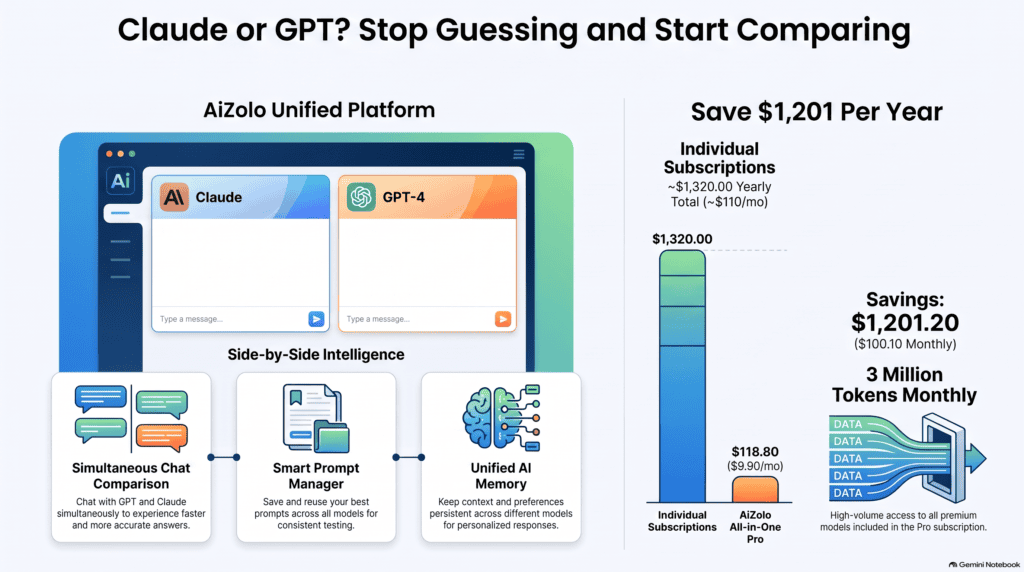
The right pick depends less on which model is “smarter” overall and more on what you’re actually trying to get done.
| If you need… | Choose |
| Computer automation | GPT-6 Astra |
| Math-heavy reasoning | GPT-6 Astra |
| Browser-based agents | GPT-6 Astra |
| Cybersecurity workflows | GPT-6 Astra |
| Professional documents | GPT-6 Astra |
| Deep writing | Claude Fable 5.1 |
| Long documents | Claude Fable 5.1 |
| Research | Claude Fable 5.1 |
| Long-running reasoning | Claude Fable 5.1 |
| Cached long-context workflows | Claude Fable 5.1 |
| Coding | Depends on workflow |
GPT-6 Astra is the stronger pick when the job involves doing something inside a live environment — clicking through a browser, operating a spreadsheet, running a terminal, or chaining together multi-step actions across apps. Its benchmark strength on FrontierMath and agentic computer-use tasks also makes it a natural fit for heavy quantitative reasoning and gated cybersecurity work.
Claude Fable 5.1 tends to be the better fit when the output itself is the deliverable — long-form writing, detailed research synthesis, or documents that need to hold structure and nuance over extended context. Its Mythos-tier lineage and added safety layering also make it a steadier choice for sensitive, higher-stakes reasoning work.
For coding, it really comes down to workflow: agentic, tool-heavy engineering tasks lean toward Astra, while iterative, explanation-heavy coding sessions often favor Fable 5.1.
Claude Fable 5.1 vs GPT-6 Astra: Which Is Better for You?

There is no single winner between GPT-6 Astra and Claude Fable 5.1. The better choice depends on whether you prioritize agentic workflows, coding, writing, research, or collaboration. Here is a practical breakdown.
For Students
Claude Fable 5.1 is a strong choice for students who need help understanding difficult concepts, summarizing long readings, improving essays, and developing well-structured answers. It’s writing and explanation strengths make it useful for coursework and study. GPT-6 Astra becomes more attractive when assignments involve data analysis, coding, or tool-based workflows.
For Developers
GPT-6 Astra is the better fit for developers who want more than code generation. It’s combination of coding, reasoning, and computer-use capabilities makes it useful for debugging, testing, navigating development environments, and completing multi-step software tasks. Fable 5.1 remains an excellent option for code review, explanations, refactoring, and working through complex programming problems.
For Content Creators
For writers, bloggers, and creators focused on polished long-form content, Claude Fable 5.1 gets the edge. It is particularly useful for maintaining tone, developing ideas, editing drafts, and producing natural-sounding copy. Astra may be preferable when content creation is connected to research, automation, data, or other tools.
For Researchers
Claude Fable 5.1 is a compelling choice for researchers who spend significant time reading, comparing, synthesizing, and explaining information. Its strength in structured knowledge work makes it useful for literature reviews and complex analysis. Astra is worth considering when research needs to connect directly to tools, browsing, data processing, or multi-step execution.
For Marketers
For marketers, the answer depends on the workflow. Fable 5.1 is well suited to content strategy, campaign messaging, audience analysis, and creating polished marketing copy. GPT-6 Astra can have an advantage for workflows that combine analysis, automation, spreadsheets, research, and execution.
For Businesses and Teams
GPT-6 Astra may be the stronger choice for teams looking to automate multi-step workflows. Its computer-use and agentic capabilities make it particularly interesting for operational tasks that require an AI system to interact with software rather than simply generate text.
Fable 5.1 can be a better fit for teams centered on writing, analysis, documentation, and knowledge work.
For AI Agents
If your primary goal is building or using AI agents, GPT-6 Astra is the more natural choice. Agentic systems need to reason, use tools, interact with computers, and complete tasks across multiple steps. Astra’s combination of these capabilities makes it especially suited to this use case.
Bottom line: Choose Claude Fable 5.1 for writing, careful analysis, and knowledge-intensive work. Choose GPT-6 Astra when coding, computer use, automation, and AI agents are central to what you want to accomplish.
What happens next: six predictions with dates

Analysis & Predictions
- September–October 2026: Independent benchmark results become more reliable.
Initial vendor-reported scores reflect tailored harnesses and ideal prompt conditions. Over the next two months, neutral evaluation bodies (e.g., Artificial Analysis, Epoch AI) will publish standardized, third-party benchmarks, clarifying true real-world gaps in coding, computer use, and context retention.
- Q4 2026: AI coding and browser-agent platforms aggressively adopt Astra and Fable 5.1.
Developer tools, IDE extensions (like Cursor and VS Code derivatives), and browser-automation platforms will rapidly migrate their backends to Fable 5.1 for codebase-wide refactoring and Astra for dynamic, multi-step browser tasks.
- Q4 2026: API pricing competition intensifies.
While both models share a $10/$50 per million token baseline, Anthropic’s $0.25 cached input rate puts severe pressure on OpenAI’s $1.00 tier. Expect OpenAI to launch tiered pricing or cheaper context-caching options before year-end to remain competitive for agentic loops.
- Late 2026: Website-building workflows become natively multimodal.
Single-prompt site generation will move away from generating static HTML/CSS toward integrated pipelines. Systems will combine text-to-code models with real-time image, audio, and motion generation to output complete, interactive, depth-layered web experiences in a single turn.
- 2026–2027: Agent reliability eclipses raw benchmark scores.
As static benchmarks saturate, enterprise adoption will be driven by operational metrics: execution consistency, error recovery, state management, and long-horizon task completion over raw speed or isolated test scores.
- 2027: The distinction between “chatbot” and “AI agent” fades entirely.
Conversational interfaces will standardly include persistent memory, background browser/OS access, and continuous execution, making autonomous agentic capabilities the universal default across consumer and enterprise AI applications.
FAQs: Claude Fable 5.1 vs GPT-6 Astra
1. Is GPT-6 Astra better than Claude Fable 5.1 for coding?
GPT-6 Astra is particularly strong for software engineering, terminal tasks, computer use, and autonomous coding workflows.
Claude Fable 5.1 is also highly capable for coding, especially when a task requires long-context reasoning and maintaining context across complex projects. The better choice depends on the type of coding workflow.
2. Which is better for long documents, Claude Fable 5.1 or GPT-6 Astra?
Both support extremely large context windows, with Fable 5.1 supporting up to 1 million tokens and Astra supporting around 1.05 million. Fable 5.1 can be especially appealing for analyzing lengthy documents, research materials, and other context-heavy workflows.
3. Can GPT-6 Astra and Claude Fable 5.1 create websites?
Yes. Both models can generate website code, interfaces, and frontend components. GPT-6 Astra is particularly interesting for visual website generation and computer-use workflows, while Fable 5.1 can be useful for planning, coding, refining, and reasoning through complex web projects.
4. Which AI model is more cost-effective: GPT-6 Astra or Claude Fable 5.1?
Both have an API charge of $10 for every million tokens used in input and $50 charged for every million tokens used in output, but the final cost may still differ based on the token consumption, caching, length of context, and difficulty of task.
In case of certain simple workflows, Astra engine may be less demanding in expenses; at the same time, Fable 5.1 may operate cheaper when completing different long-context tasks due to a lower caching cost.
5. Should I use GPT-6 Astra and Claude Fable 5.1 together?
Yes. Using both can be more effective than choosing a single model for every task. You can give the same prompt to both, compare their reasoning and outputs, and use the model that performs better for that particular workflow. A multi-model workspace such as AiZolo can make this side-by-side testing easier.
If you’re still deciding between GPT-6 Astra and Claude Fable 5.1, testing both on your own real prompts is often more useful than relying on benchmark scores alone. AiZolo lets you compare different AI models from one workspace, making side-by-side testing much easier.
Final Verdict — Claude Fable 5.1 vs GPT-6 Astra
After comparing capabilities, pricing, and design philosophy, one thing is clear: there’s no universal winner here. Each model was built with a different job in mind, and that shows in where it excels.
GPT-6 Astra wins for:
- Computer use
- Automation
- Mathematics
- Browser agents
- Cybersecurity
- Efficient high-volume workflows
Astra’s architecture is built around acting — operating software, chaining multi-step tasks, and executing agentic work with speed. Its near-saturated math benchmarks and Critical-tier cybersecurity capabilities make it the natural choice when the task is doing rather than explaining.
Claude Fable 5.1 wins for:
- Writing
- Deep reasoning
- Long documents
- Research
- Long-running agentic work
- Cached-context-heavy workflows
Fable 5.1 is built for depth over speed — sustained reasoning, nuanced writing, and holding structure across long or research-heavy sessions. Its Mythos-tier lineage and added safety layering also make it a steadier fit for sensitive, high-stakes work.
Overall: Trying to crown one model “better” misses the point. Astra is the stronger engine for automation, computation, and browser-driven action. Fable 5.1 is the stronger partner for writing, research, and extended reasoning.
The smarter question isn’t “which model wins” — it’s “which model wins for this task.” Teams that need both will likely end up using each where it’s strongest, rather than picking a single default.
Author Bio
Anshika Verma is a content writer and researcher at AiZolo. She specializes in AI tools, emerging technologies, and practical AI use cases, creating clear, research-backed content that helps readers understand and choose the right AI solutions.