

Introduction
Two frontier level open-weight language models from two different approaches battle it out in 2026: Moonshot AI’s Kimi K3 (2.8T parameters) and Claude Opus 5.5 from Anthropic.
AiZolo makes the comparison easy to read for those that want to check out both models’ strengths, price and performance in one place.
The comparison focuses on Kimi K3 vs Claude Opus 5.5, pulling together available information about benchmarks, pricing and architectures as opposed to whichever vendor’s marketing may be more compelling.
For those looking for coding, writing, reasoning and agentic capabilities, this article explores what model could be best for you, and what areas each model tends to excel in.
AI Overview Answer Box: Kimi K3 and Claude Opus 5.5 each have a different approach to AI performance. Kimi K3 boasts open weights and versatility, but Opus 5.5 has been engineered to be effective at reasoning, coding and agentic tasks.
The real-world performance, pricing and benchmarking analysis helps indicate which model would be the best for your needs.
Table of Contents
Quick Verdict
| Category | Winner | Why |
|---|---|---|
| Coding (real-world, SWE-bench Pro) | Claude Opus 5.5 | Leads on complex software engineering and agentic coding |
| Frontend coding | Kimi K3 | #1 on Frontend Code Arena, ahead of Claude models |
| Reasoning (HLE, Intelligence Index) | Claude Opus 5.5 | Stronger overall reasoning and intelligence scores |
| Science knowledge (GPQA Diamond) | Kimi K3 | 93.5% vs 93.2%, a narrow edge |
| Agentic browsing (BrowseComp) | Kimi K3 | Stronger performance on autonomous web research |
| Price | Kimi K3 | About 40% cheaper on input and output tokens |
| Speed | Claude Opus 5.5 | Higher throughput and faster time-to-first-token |
| Context window | Kimi K3 (marginally) | 1,048,576 tokens vs Opus 5.5’s 1,000,000 |
| Open weights / self-hosting | Kimi K3 | Modified MIT license; Opus 5.5 is API-only |
| Enterprise / compliance | Claude Opus 5.5 | Mature enterprise tooling and stronger business adoption |
| Best overall (general use) | Claude Opus 5.5 | Stronger aggregate performance, reasoning, coding, and ecosystem |
What Is Kimi K3?
Kimi K3 is a large language model released by Moonshot AI, a Beijing-based startup backed by Alibaba, on July 16, 2026, with full model weights following on July 27.
It’s a mixture-of-experts (MoE) model with roughly 2.8 trillion total parameters, of which only about 32 billion are active per token (16 of 896 experts) — which is what makes its aggressive pricing possible.
History: Kimi K3 follows Kimi K2, K2.5, and K2.6, Moonshot’s earlier open-weight releases that had already built a following among developers for coding and agentic tasks. K3 represents a major jump in scale and is, by parameter count, likely the largest open-weight model publicly released to date.
Developer: Moonshot AI (Beijing), founded by Yang Zhilin.
Strengths: Native vision understanding built into the base model, a 1,048,576-token context window, the Kimi Delta Attention mechanism (a hybrid linear-attention design Moonshot says speeds up long-context decoding significantly), and the #1 ranking on the Frontend Code Arena leaderboard as of its launch.
Weaknesses: Slower output and much higher time-to-first-token latency than Opus 5, a fixed high-effort reasoning mode with no lower-cost tier, and a less mature agentic ecosystem outside of Moonshot’s own tooling.
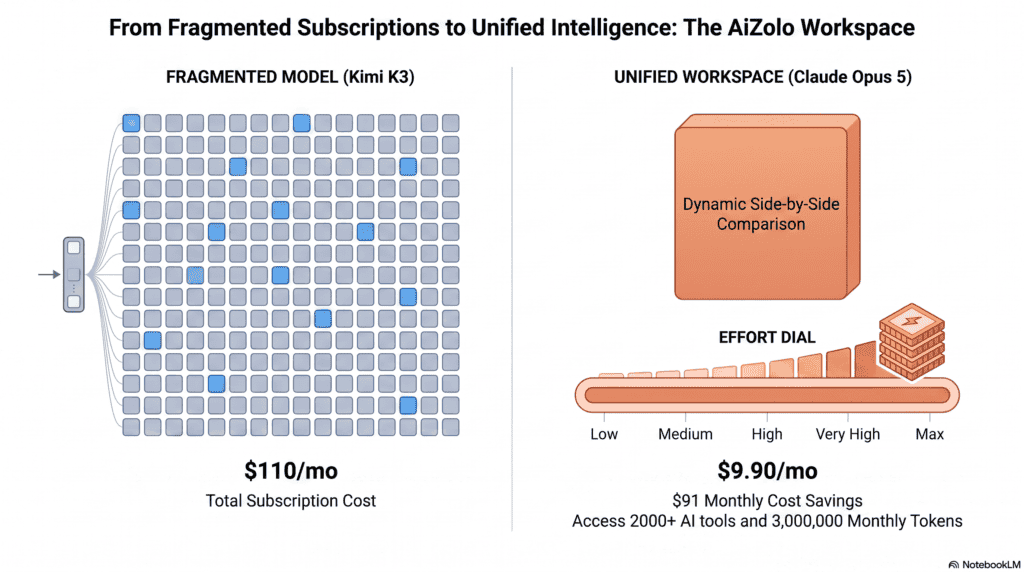
Pricing: $3.00 per million input tokens, $15.00 per million output tokens, $0.30 for cached input.
API: OpenAI SDK-compatible, which lowers the integration barrier for teams already building on OpenAI or Anthropic toolchains. Available via Kimi’s own API, Kimi Code, Kimi Work, and third-party routers.
Target users: Teams that want self-hosting or air-gapped deployment, cost-sensitive high-volume workloads, and developers already comfortable with open-weight infrastructure.
What Is Claude Opus 5.5?
Claude Opus 5.5 is Anthropic’s newest flagship, featuring improved reasoning, coding, research, and agentic capabilities. This model is the successor of Claude Opus 5 and is available in Claude.ai, Claude Code, Claude Cowork, and Claude API.
Overview
Developer: Anthropic
Claude Opus 5.5 is the latest iteration in the Opus series of large language models from the company. Anthropic has once again increased the level of reasoning, coding, research, and agentic abilities.
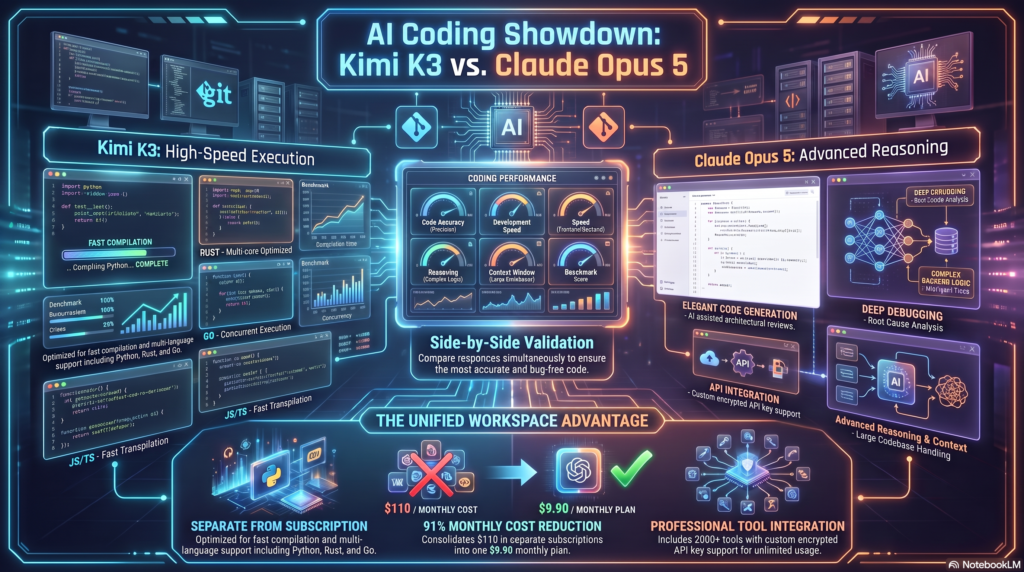
Capabilities: Claude Opus 5.5 offers advanced reasoning, agentic skills, coding, long-context processing, self-verification, and adjustable effort to balance response, latency, and cost. Overall, Claude Opus 5.5 is particularly strong at reasoning and coding, including software engineering, agentic workflows, and complex multi-step tasks.
Limitations: Claude Opus 5.5 is not open-sourced and only available via API; moreover, it is not self-hosted and weights are not available. Its API has a high price point for commercial use compared to Kimi K3’s open-weight counterpart.
Pricing: Premium API pricing, depending on input, output, caching, and mode.
APIs: Claude API access with tool use and agentic workflows.
Audience: Developers, research teams, enterprises, and professionals looking to implement heavy coding, reasoning, research, long-context processing, self-verification, agentic workflows, and other advanced capabilities.
Kimi K3 vs Claude Opus 5.5: Head-to-Head Specs
| Spec | Claude Opus 5.5 | Kimi K3 |
|---|---|---|
| Developer | Anthropic | Moonshot AI |
| Released | 2026 | July 16, 2026 |
| API model ID | claude-opus-5-5 | kimi-k3 |
| Architecture | Proprietary, undisclosed parameter count | MoE — 2.8T total, ~32B active |
| License | Closed, API only | Open weights, Modified MIT |
| Input price (per 1M tokens) | Check current pricing | $3.00 |
| Output price (per 1M tokens) | Check current pricing | $15.00 |
| Cached input price | Check current pricing | $0.30 |
| Context window | 1,000,000 tokens | 1,048,576 tokens |
| Max output | Check current specification | Not independently confirmed |
| Reasoning mode | Adjustable effort levels | High-effort thinking mode |
| Vision | Text + image input | Native vision |
| Output speed | Faster than Kimi K3 | ~32 tokens/sec |
| Time to first token | Faster than Kimi K3 | ~164.6 seconds |
| Deployment | API only | API or self-hosted |
Reading this table correctly: raw parameter count and architecture details aren’t independently verifiable for either model — Anthropic doesn’t disclose Opus 5.5’s parameter count, and Moonshot’s 2.8T figure comes from its own technical report. Treat structural specs as vendor-reported and benchmark scores as the more reliable signal.
Coding Comparison
Coding is where this comparison gets genuinely interesting, because the two models don’t just differ in score — they differ in what they’re good at.
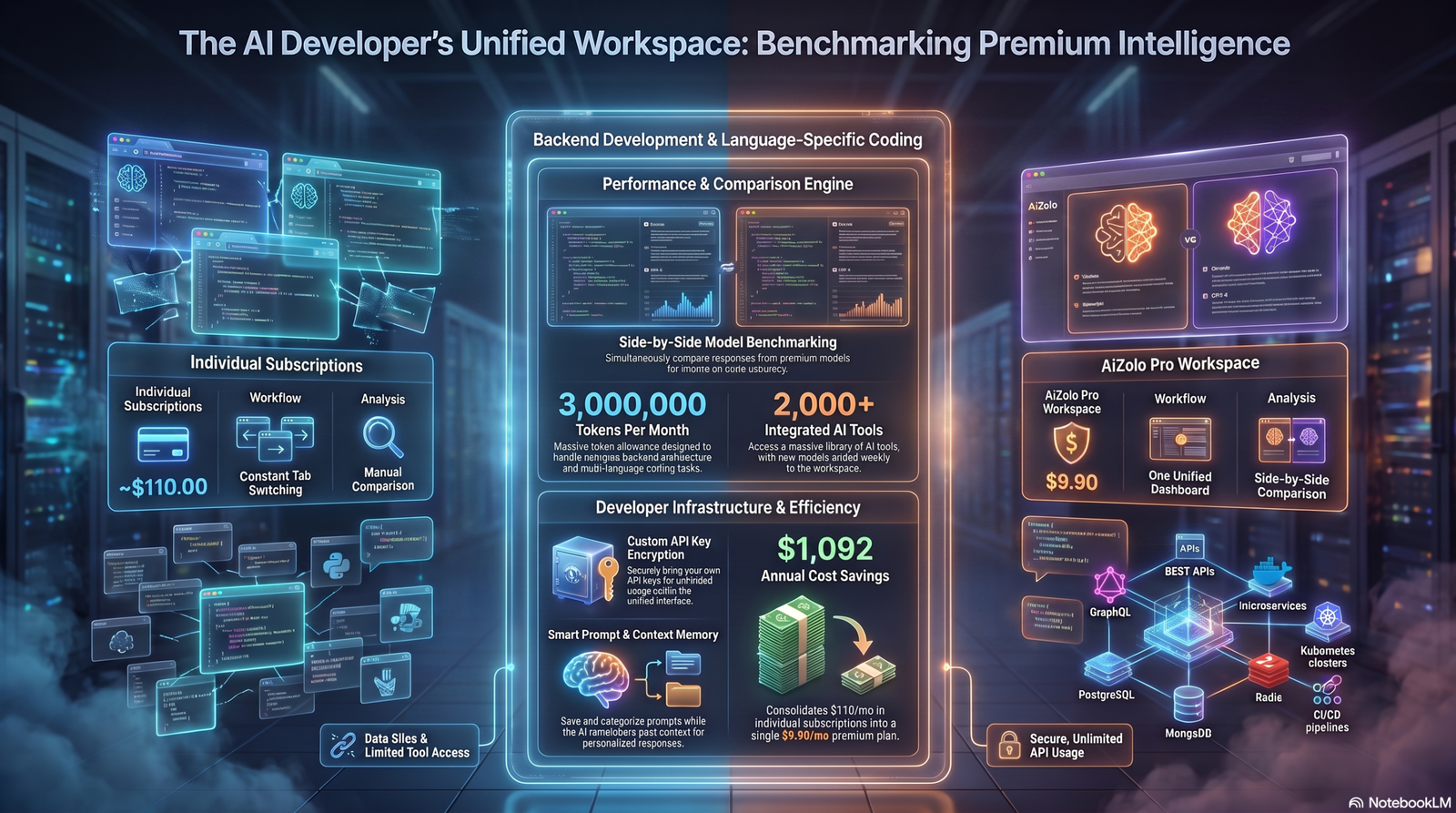
Backend and long-horizon engineering: On SWE-bench Pro, a set of real GitHub issues from actively maintained repositories, Claude Opus 5.5 scores 79.2%. Moonshot has not published a directly comparable SWE-bench Pro number for K3, reporting instead on its own suite (ProgramBench, FrontierSWE).
On DeepSWE v1.1, a long-horizon engineering benchmark both companies report, Opus 5.5 edges ahead 68.8% to 67.5% — a narrow margin, but a consistent one.
Frontend and UI generation: This is Kimi K3’s clearest win. It took the #1 spot on LMArena’s Frontend Code Arena, a 17-place jump from its predecessor Kimi K2.6, and placed first in six of seven frontend sub-domains — the first time an open-weight model has led that leaderboard.
Its native vision capability appears to help here: understanding what a UI should look like, not just what the code should say, seems to matter for this category.
CLI and agentic terminal tasks: On Terminal-Bench 2.1, the two are close: Opus 5.5 at 89.1% versus K3 at 88.3%, essentially a statistical tie once you account for run-to-run variance.
Large repositories and refactoring: Neither company publishes a benchmark isolating large-repo refactoring specifically, but Opus 5.5’s much lower time-to-first-token and its mid-conversation tool-switching feature make it the more practical choice for long, interactive refactoring sessions where you’re iterating in real time.
K3’s strength shows up more in single-shot or batch generation tasks where latency matters less.
Practical read: if your workflow is backend-heavy, agentic, and interactive — fixing real bugs, running CLI agents, iterating live — Opus 5.5’s combination of accuracy and speed wins.
If you’re generating frontend components or UI code in batches where latency is less critical, K3’s Frontend Code Arena lead is hard to ignore, especially at 40% lower cost.
Featured Snippet Answer (48 words): Claude Opus 5.5 leads real-world backend coding benchmarks like SWE-bench Pro (79.2%) and DeepSWE (68.8%). Kimi K3 leads frontend code generation, ranking #1 on the Frontend Code Arena leaderboard.
For interactive, agentic coding sessions, Opus 5.5’s speed advantage matters; for batch UI generation, K3 is competitive at lower cost.

Writing, Reasoning & Knowledge Comparison
Writing (blogs, emails, marketing, documentation): Neither company publishes a standardized writing-quality benchmark — this category is inherently more subjective than coding.
What’s measurable: Opus 5.5’s effort dial lets you scale up reasoning for long-form technical writing or scale down for short copy, which is useful for cost control across a content pipeline.
K3’s larger context window is a practical advantage for tasks like summarizing or editing very long documents in a single pass.
Reasoning and knowledge: On Humanity’s Last Exam (HLE), a benchmark designed to test advanced reasoning beyond simple lookup, Claude Opus 5.5 demonstrates stronger overall reasoning performance than Kimi K3, giving Anthropic the edge on difficult knowledge-intensive tasks.
On the Artificial Analysis Intelligence Index, a composite reasoning-and-knowledge score, Opus 5.5 (max effort) leads at 61 versus K3’s 57.
Science and graduate-level knowledge: K3 pulls ahead here. On GPQA Diamond, a graduate-level physics, chemistry, and biology benchmark designed to resist pattern-matching, K3 scores 93.5% against Opus 5.5’s 93.2% — a narrow but real edge, and one of the strongest open-weight GPQA results published to date.
Math: Neither vendor’s launch materials isolate a head-to-head math benchmark for these two specific models.
Both are evaluated on general reasoning suites that include quantitative components (HLE, GPQA), where Opus 5.5’s overall lead suggests a modest edge, but a dedicated math-only comparison isn’t currently available from independent trackers.
AI Overview Answer Box: On composite reasoning benchmarks (HLE, Intelligence Index), Claude Opus 5.5 leads Kimi K3 by 4–9 points depending on the test.
Kimi K3 narrowly leads on GPQA Diamond, a graduate-level science benchmark, by 0.3 points — close enough to be within normal run-to-run variance.
Agentic and Real-World Task Comparison
Beyond synthetic benchmarks, both companies and independent trackers have tested these models on task types closer to daily use:
| Task type | Better performer | Basis |
|---|---|---|
| Web browsing / multi-step research | Kimi K3 | Strong BrowseComp performance and autonomous research capabilities |
| Business process automation | Kimi K3 | Stronger performance on available automation evaluations |
| Professional computer-use tasks | Claude Opus 5.5 | Stronger performance on complex computer-use workflows |
| CLI/terminal agent tasks | Claude Opus 5.5 | Strong performance on real-world terminal and coding agents |
| Long-horizon engineering sessions | Claude Opus 5.5 | Better suited to sustained software engineering and agentic workflows |
One important caveat worth being upfront about: Kimi K3 has not been submitted to the Frontier-Bench v0.1 leaderboard at all as of this writing. That’s not a low score being hidden — it’s an absent entry.
Opus 5.5’s position at the top of that board currently has no direct open-weight competitor to compare against.
Featured Snippet Answer (52 words): Kimi K3 performs better on agentic web-browsing tasks (BrowseComp) and business process automation, while Claude Opus 5.5 leads on long-horizon software engineering and professional computer-use benchmarks.
Kimi K3 has not yet been evaluated on Frontier-Bench, the benchmark where Opus 5.5 currently ranks first among all tested models.
Speed Comparison
This is one of the least ambiguous categories. Independent testing from Artificial Analysis puts Claude Opus 5.5’s output speed at roughly 57–60 tokens per second, against Kimi K3’s roughly 32 tokens per second — close to double.
The bigger gap is time-to-first-token: Opus 5.5 starts responding in about 21.7 seconds at high effort, while K3 takes roughly 164.6 seconds under comparable methodology — a 7.6x difference.
For interactive use cases — live pair-programming, chat-based debugging, anything where a person is waiting on the response — that latency gap is the difference between a usable tool and a frustrating one.
For batch or asynchronous workloads, where nobody is watching a spinner, this gap matters far less.
Featured Snippet Answer (44 words): Claude Opus 5.5 is roughly twice as fast as Kimi K3 in output speed (57–60 vs 32 tokens/second) and about 7.6 times faster to first token (21.7 seconds vs 164.6 seconds). Opus 5.5 is the clear choice for interactive, latency-sensitive workflows.
Cost Comparison
| Pricing tier | Claude Opus 5.5 | Kimi K3 |
|---|---|---|
| Input (per 1M tokens) | $5.00 | $3.00 |
| Output (per 1M tokens) | $25.00 | $15.00 |
| Cached input (per 1M tokens) | $0.50 | $0.30 |
| Blended cost (7:2:1 cache/input/output ratio) | $3.85 | $2.31 |
| Fast/priority mode | $10 / $50 (2.5x speed) | Not offered |
| Self-hosting | Not available | Available (open weights) |
On raw list price, Kimi K3 is about 40% cheaper on both input and output tokens. That gap holds on Artificial Analysis’s blended cost metric, which weights a realistic mix of cached, input, and output tokens: $2.31 per million for K3 versus $3.85 for Opus 5.5.
One nuance worth flagging: some independent testing notes that K3 tends toward verbose responses, which can offset part of its per-token discount if a task requires it to generate more tokens to reach the same answer.
Cost-per-completed-task, not just cost-per-token, is the more honest comparison — and on that metric, results are more mixed depending on task type.
For teams with existing GPU infrastructure, K3’s open-weight license adds a further lever: self-hosting can push marginal costs below even the discounted API price, at the cost of managing your own deployment and inference stack.
Featured Snippet Answer (46 words): Kimi K3 costs $3/$15 per million input/output tokens versus Claude Opus 5.5’s $5/$25 — roughly 40% cheaper. Opus 5.5 offers no self-hosting option; K3’s open-weight license lets enterprises self-host to reduce costs further, though this adds infrastructure management overhead.

Context Window
Both models sit in the same practical tier: Claude Opus 5.5 offers 1,000,000 tokens, Kimi K3 offers 1,048,576 tokens — a difference small enough to be irrelevant in practice.
What matters more than the raw number is whether that context is usable — whether accuracy holds up as you fill the window, rather than degrading past a certain point.
Independent testing of K3 at full 1-million-token context (without context-management tricks) reported a score around 90.4 on long-context retrieval tasks, suggesting the window is largely usable rather than a spec-sheet figure that degrades in practice.
Comparable independent long-context degradation data for Opus 5.5 specifically wasn’t available from the sources checked for this article — a gap worth noting rather than papering over.
Why context window matters: a larger, more reliable context window lets you feed an entire codebase, a long research paper, or a full document set into a single request instead of chunking it — which matters directly for accuracy on tasks like large-scale code review or multi-document summarization.
Strengths
Kimi K3:
- Open weights under a Modified MIT license — self-hosting, fine-tuning, and air-gapped deployment are all possible
- Roughly 40% lower token pricing, both list and blended
- #1 on the Frontend Code Arena leaderboard
- Narrow but real leads on GPQA Diamond and BrowseComp
- Native vision built into the base model
- Slightly larger context window
Claude Opus 5.5:
- Higher independent aggregate benchmark score (BenchLM: 85.88 vs 79.98)
- Leads real-world backend coding (SWE-bench Pro, DeepSWE)
- Roughly 2x faster output, 7.6x faster time-to-first-token
- Adjustable effort dial for cost/quality tradeoffs per request
- No mandatory data retention — relevant for regulated industries
- Mature ecosystem: Claude Code, Claude Cowork, mid-conversation tool switching
Weaknesses
Kimi K3:
- Much higher latency — impractical for live, interactive sessions
- Fixed reasoning mode, no lower-cost effort tier
- Less mature agentic tooling outside Moonshot’s own products
- Verbosity can offset per-token savings on some tasks
- No comparable published SWE-bench Pro score
Claude Opus 5.5:
- No self-hosting or weight access — full dependence on Anthropic’s API
- Meaningfully higher price per token than K3, even after Opus 5 undercut Fable 5.1
- Still trails Anthropic’s own Fable 5.1 and Mythos 5 on the hardest tasks and highest-security cybersecurity work
- Closed model — no ability to audit weights directly
Which Should You Choose?
Students: Kimi K3’s lower cost matters if you’re paying out of pocket, and its GPQA Diamond performance makes it a solid study aid for STEM subjects. Opus 5.5 is worth it if you value faster, more reliable back-and-forth over raw cost.
Developers: Opus 5.5 for backend work, agentic debugging, and anything interactive. K3 is genuinely competitive for frontend/UI generation, especially in batch workflows where its latency doesn’t bite.
Researchers: K3’s open weights allow direct inspection and fine-tuning, which matters for reproducibility and academic work. Opus 5.5’s stronger reasoning benchmarks make it the better default for general research assistance.
Businesses choosing a default assistant: Opus 5.5, for speed, ecosystem maturity, and the effort dial’s cost control — unless data sovereignty specifically requires self-hosting.
Startups: K3’s pricing and self-hosting option can matter a lot at high volume with a lean budget. Opus 5.5 is the safer default if engineering time is more scarce than compute budget.
Agencies: Mixed-model workflows are increasingly common — some teams reportedly use K3 for visual/frontend implementation and a Claude model for review and refinement, splitting tasks by each model’s demonstrated strength.
Content writers: Neither model has a published, standardized writing-quality benchmark, so this comes down to hands-on testing with your own prompts and voice guidelines rather than a benchmark score.
Enterprise: Opus 5.5, primarily for its no-mandatory-retention policy, established compliance posture, and integration with Claude Code and Claude Cowork — factors that matter more than a few benchmark points for most enterprise buyers.
Final Verdict
Neither model is an outright winner with respect to anything; any purported comparison is missing key qualifications. Claude Opus 5.5 clearly wins on the metrics that matter most to production coders, reasoners, and agents. Kimi K3 has clear advantages in openness, price, and flexibility where these matter.
Kimi delivers on open weights (which Opus 5.5 never will) plus a significant cost advantage with demonstrated strength in frontend coding, science knowledge, and agentic browsing.
If you need the most featureful assistant for production engineering, reasoning, and agentic applications and can pay the price, Opus 5.5 is the safer choice.
If your priorities are cost, self-hosting, data sovereignty, or frontend coding, Kimi K3 should be viewed as a viable alternative to Opus 5.5 and not just dismissed as a cheap alternative.
The reality is you should benchmark both models on your own code and documents before committing to either as a production tool. The differences between the two large language models are informative, but no single model clearly outperforms the other for every possible application.
FAQs
1. Is Kimi K3 better than Claude Opus 5.5?
Neither is better across the board. Opus 5.5 leads in advanced reasoning, coding, and agentic workflows, while Kimi K3 stands out for frontend coding, lower pricing, and open-weight flexibility.
2. Is Kimi K3 free to use?
Kimi K3 is available through Moonshot’s consumer products with usage limits. API access is paid, while its open weights can be downloaded and self-hosted.
3. Which is cheaper, Kimi K3 or Claude Opus 5.5?
Kimi K3 is cheaper, offering a significant cost advantage over Claude Opus 5.5 for teams managing high-volume API usage.
4. Can Kimi K3 be self-hosted?
Yes. Kimi K3’s open-weight release allows organizations to deploy the model on their own infrastructure, subject to its license terms.
5. Can Claude Opus 5.5 be self-hosted?
No. Claude Opus 5.5 is a proprietary model available through Anthropic’s products and API, with no publicly available model weights.
6. Is Claude Opus 5.5 better than Claude Fable 5.1?
They target different priorities. Opus 5.5 focuses on advanced reasoning, coding, and agentic workflows, while Fable 5.1 remains positioned for highly capable long-running and complex tasks.
7. What is the context window of Kimi K3?
Kimi K3 supports a context window of approximately 1 million tokens, making it suitable for large documents and long-running workflows.
8. What is the context window of Claude Opus 5.5?
Claude Opus 5.5 supports a 1-million-token context window, allowing it to process large amounts of information within a single interaction.
9. Which model is faster, Kimi K3 or Claude Opus 5.5?
Claude Opus 5.5 is generally faster in interactive use, particularly for complex agentic and coding workflows where response latency matters.
10. Does Kimi K3 support vision/image input?
Yes. Kimi K3 supports multimodal capabilities, including image understanding, alongside its text-based reasoning.
11. Does Claude Opus 5.5 support vision/image input?
Yes. Claude Opus 5.5 supports image input alongside text, making it suitable for multimodal analysis and computer-use workflows.
12. Which model is better for frontend coding?
Kimi K3 is particularly strong for frontend generation and holds an advantage on available frontend coding evaluations.
13. Which model is better for backend/production coding?
Claude Opus 5.5 is the stronger choice for complex backend engineering, debugging, large codebases, and long-running software development workflows.
14. Is Kimi K3’s benchmark performance verified independently?
Partially. Several independent trackers and evaluations provide Kimi K3 results, but coverage varies by benchmark, so direct comparisons with Opus 5.5 are not available everywhere.
15. Which model should a startup on a budget choose?
Kimi K3 is worth evaluating for budget-conscious teams, particularly those that can benefit from open weights and self-hosting. Teams prioritizing coding performance and productivity may prefer Opus 5.5.
16. Do both models support function calling and tool use?
Yes. Both support tool use and function calling for agentic workflows. Claude Opus 5.5 is particularly suited to complex, multi-step workflows requiring sustained tool interaction.
Author Bio
Author: Jeevesh Tripathi Email: jeevesh@aizolo.com
Bio: Jeevesh Tripathi writes about AI models, developer tools, and the LLM ecosystem, with a focus on comparing coding and reasoning performance across frontier models.

We absolutely love your blog and find almost all of your post’s to
be exactly what I’m looking for. can you offer guest writers to write content for you personally?
I wouldn’t mind producing a post or elaborating on most of
the subjects you write with regards to here. Again, awesome weblog!
1
Choose secure sites for a safe and enjoyable experience.