
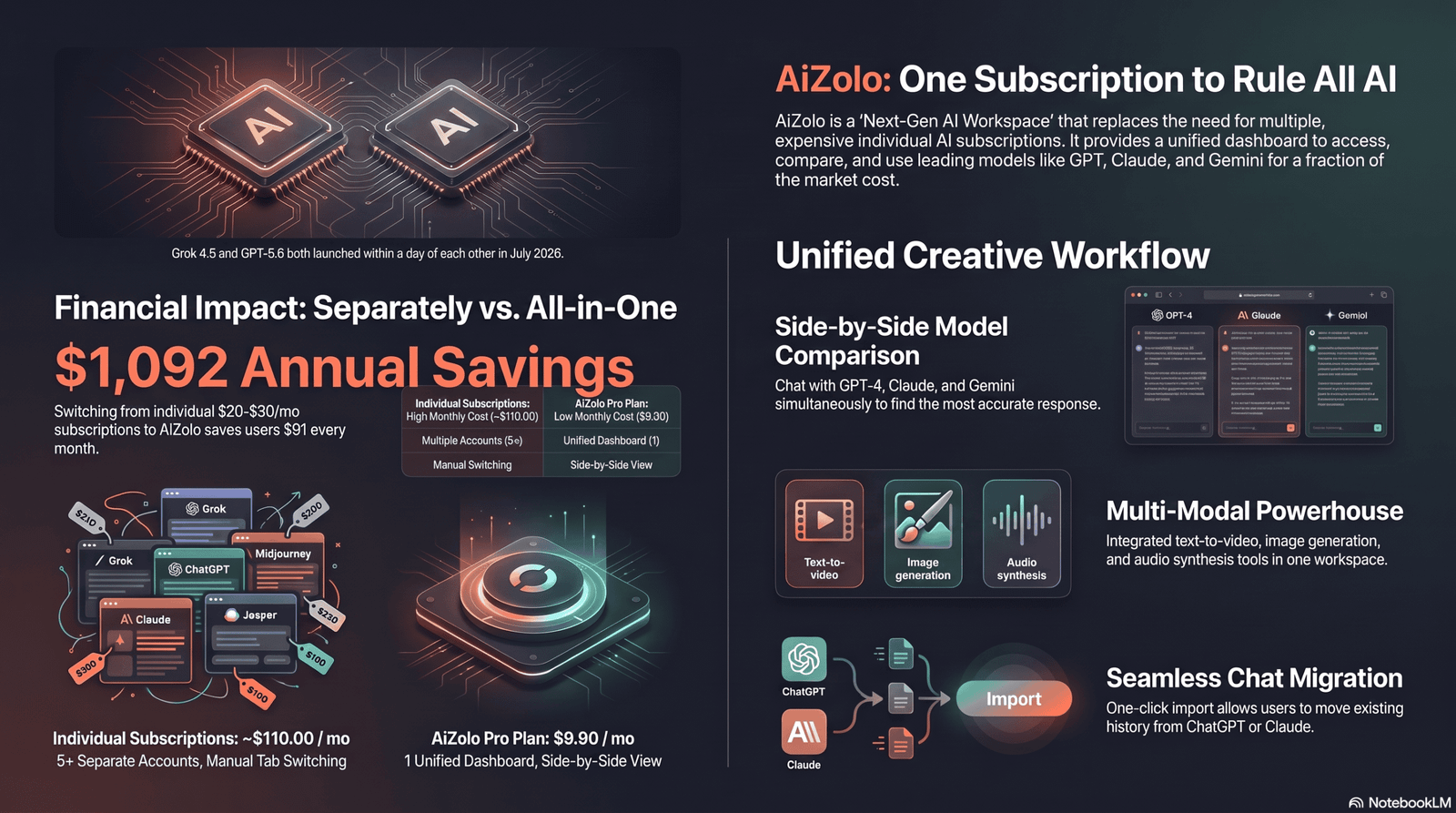
A note on the keyword this article was originally scoped for: the original brief asked for a comparison against “Grok 4.6.” Since then, Grok 4.7 and GPT-6.1 Sol have shipped with real benchmark data, making the original comparison outdated. Aizolo now compares the latest models: Grok 4.7 (xAI, released September 21, 2026) and GPT-6.1 Sol (OpenAI). We’ll update this article as new benchmark results become available.
Table of Contents
Grok 4.7 vs GPT-6.1 Sol: Full Benchmark Comparison
Two up-and-coming frontier models are now competing across coding, reasoning, and agentic workloads.
Grok 4.7 is xAI’s new flagship model while GPT-6.1 Sol is OpenAI’s latest frontier model for their most demanding workloads.
The comparison is important because each model targets different workloads but has diverging approaches to reasoning, coding, long-context work, and agentic performance.
This article will analyze what has actually been published in which form, from which source, and how these findings could support or discourage you during your decision-making process for the best large language model, depending on your use case of coding, reasoning, or agentics.
Both models are compared based on the newest releases of models, and not on outdated scores of Grok 4.6 or GPT-5.6 benchmark data. Aizolo is dedicated to published results and will not try to make believe you scores that were not released yet.
All the following information is either published by xAI or OpenAI or reviewed by an independent benchmark provider. If a benchmark scores one model higher than the other, it will be stated clearly. If a benchmark does not cover one model, it will also be stated.
Model Overview: Grok 4.7 and GPT-6.1 Sol
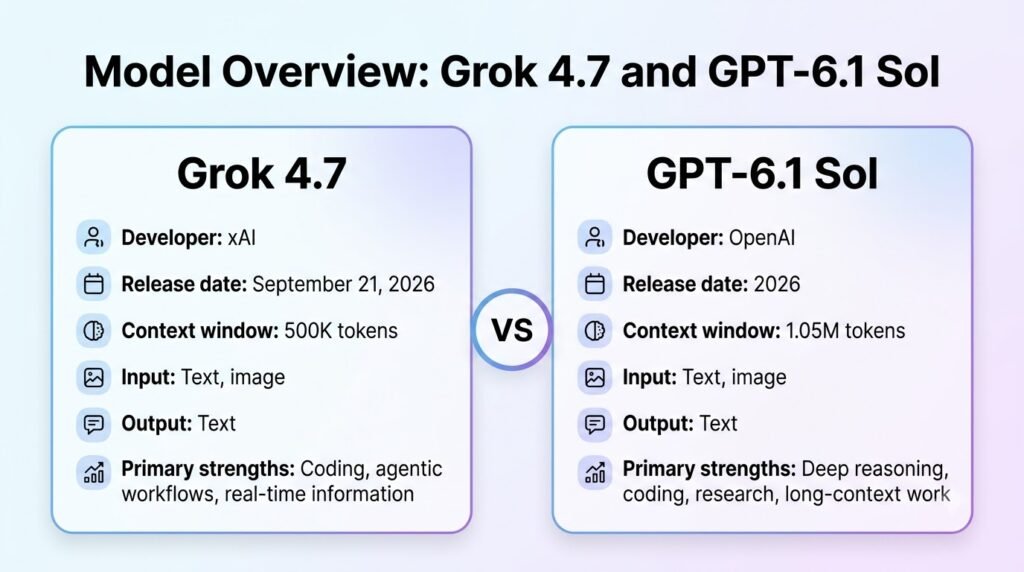
Grok 4.7 is xAI’s latest flagship model, which is designed to tackle demanding coding, reasoning, knowledge-work, and agentic tasks.
xAI positions Grok 4.7 as a major improvement in terms of long-running agentic workflows, with enhanced coding, tool use, reasoning, and complex interactive tasks. The model builds on the capabilities which were introduced with Grok 4.6, but targets better performance across a variety of real-world workloads.
Grok 4.7 also preserves access to xAI’s broader ecosystem including the web search and real-time information capabilities. These features are especially relevant for tasks which entail current information as well as reasoning and execution.
These are the vendor positioning claims, and not the neutral benchmark conclusions. The published scores, which are covered below, represent a far more useful reference regarding what Grok 4.7 can genuinely deliver.
GPT-6.1 Sol is OpenAI’s latest flagship reasoning model, which is built for complex coding, research, analysis, and agentic workloads.
Unlike the previous GPT-5.6 generation, GPT-6.1 Sol is positioned as a stronger frontier model for challenging professional and technical tasks. OpenAI focuses on improved reasoning, coding, tool use, and long-context performance while retaining compatibility with the broader model ecosystem.
GPT-6.1 Sol also supports a large context window, which makes it suitable for analyzing extensive codebases, documents, and multi-step projects without repeatedly splitting the input into smaller segments.
As with Grok 4.7, OpenAI’s capability claims should be separated from the independent benchmark results. The sections below seek to compare the published evaluations in order to identify what each model genuinely leads in.
As a result of the timing difference, the comparison uses different sets of benchmarks.
- September 21, 2026 — xAI launches Grok 4.7, their latest flagship model, featuring improvements in coding, reasoning, knowledge work, and agentic capabilities.
- September 2026 — OpenAI launches GPT-6.1 Sol, their latest frontier model for complex reasoning, coding, research, and agentic workloads.
- October 2026 — Both models are now available for direct comparison using the latest published benchmark results and independent evaluations.
The difference from the previous comparison is that Grok 4.7 and GPT-6.1 Sol are both current shipping models. As a result, the latest benchmark results for these models have more relevance than the Grok 4.5 vs GPT-5.6 comparison which is still circulating online.
We make a distinction between the vendor-reported scores and the independent evaluations throughout this article, as the methodology can greatly impact the results.
Architecture and Training Philosophy
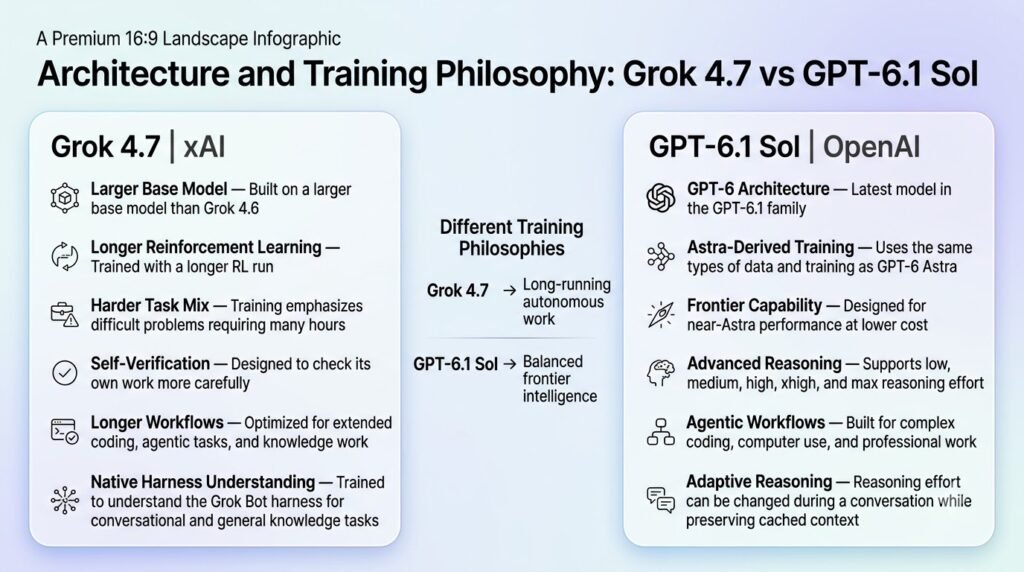
Grok 4.7 is an evolution of xAI’s prior Grok 4 generation with an increased focus on long-running reasoning, coding, tool use, and agentic workflows. xAI has framed Grok as a significant improvement for tasks that require sustained interaction rather than short, isolated responses.
One of Grok 4.7’s key strengths is its focus on autonomous software engineering and complex knowledge work. The model is designed to handle multiple steps, use tools, deal with larger problems, and maintain coherence in the longer term.
The GPT-6.1 Sol architecture story is about its role as a flagship frontier model for OpenAI. Rather than being a lightweight everyday model, Sol is designed for maximum capacity across challenging reasoning, coding, research, and agentic workloads.
GPT-6.1 Sol also has the capability for advanced reasoning and long-context workflows, allowing it to process large codebases, documents, and complex project context in a single session.
Both models therefore target similar high-end use cases, but their strengths can be significantly different based on whether the workload is focused on autonomous agents, coding, reasoning depth, or long-context analysis.
Coding Benchmarks
Coding is a domain where both companies make some of their strongest performance claims, and one where results can vary considerably between different benchmarks, prompt setups, reasoning configurations, and evaluation methodologies.
Terminal-Bench 2.1 (command line, multi-step agentic tasks):
xAI’s latest published results position Grok 4.7 as extremely capable for autonomous software engineering and terminal based tasks, showing marked improvement over the previous Grok version.
OpenAI’s GPT-6.1 Sol targets advanced coding and agentic workloads, with strong performance on software engineering benchmarks and multi-step development tasks.
The critical qualification is that results from different labs are not always directly comparable, due to differences in prompting, tool configuration, reasoning effort, versions tested, and evaluation dates.
Where a shared, independently reproduced benchmark exists, we prioritize that. Where only vendor reported figures are available, we clearly label them as such rather than presenting the two as a direct head-to-head.
SWE-bench Pro:
Grok 4.7 emphasizes continued development of xAI’s focus on software engineering and autonomous coding capabilities, with particular strengths in long-horizon, multi-step development tasks. GPT-6.1 Sol is similarly strong in advanced software engineering tasks, including complex code generation and agentic development.
Due to variations in what and how was benchmarked, prompting, available tools, and reasoning settings, we believe that individual vendor-provided comparisons are not particularly useful, and that independently reproduced comparisons are more informative.
We would prefer to see independent third-party comparisons rather than aggregated vendor launch comparisons for this benchmark.
DeepSWE 1.1:
We find DeepSWE particularly interesting due to its focus on complex software engineering tasks beyond basic code generation, and believe that results can vary significantly based on specific evaluation setups and model specifics.
For Grok 4.7 and GPT-6.1 Sol, we prefer to use the latest independently verified figures, rather than the Grok 4.5 and GPT 5.6 numbers from previous releases. We believe it is more useful to evaluate the latest models on their own terms, rather than comparing them to earlier iterations of the same models.
Token efficiency:
While raw coding accuracy is useful, for many real-world applications of an agentic coding assistant, the value of reduced tokens, latency, and costs for each successfully executed task can be significant. Grok 4.7’s emphasis is on long-horizon, agentic development, and GPT-6.1 Sol’s emphasis is on extended capabilities and highest performance in demanding coding and reasoning tasks.
For this reason, we think that value for money should be assessed in terms of tasks, not tokens, and prefer comparisons in terms of successful tasks executed.
A model that scores slightly lower in some aggregate metric but has significantly lower token costs for similar performance may be significantly more valuable in a real-world coding-assistant application.
Reasoning and Knowledge Benchmarks
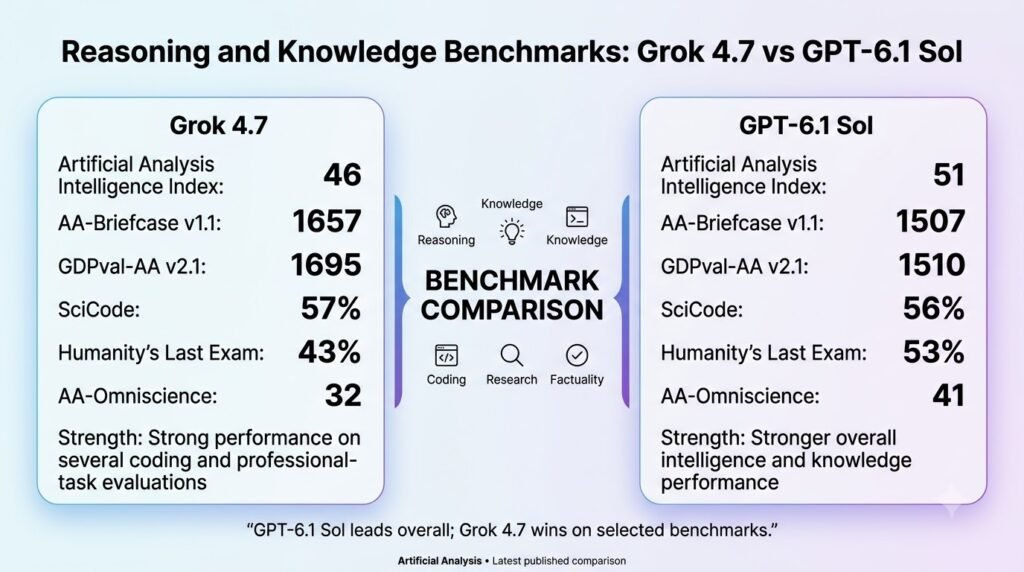
Artificial Analysis Intelligence Index, an independent composite score that is independent of both vendors, is one of the most valuable sources for cross-model comparisons since it evaluates models using a standard methodology.
For Grok 4.7 and GPT-6.1 Sol, the latest Artificial Analysis results should be prioritized over older Grok 4.5 and GPT-5.6 results. This index provides a more comprehensive assessment of model intelligence across reasoning, knowledge, coding, and other domains than individual task performance.
The important lesson is that independent rankings can lead to an entirely different order of performance than what vendors report. That is why we make a distinction between official laboratory results and independent evaluations throughout this comparison.
GDPVal+ (Snorkel AI) evaluates real-world professional tasks across various fields, while also testing expert-level competencies. It is most valuable in providing an independent perspective on how these language models perform beyond traditional academic and coding benchmarks.
For Grok 4.7 and GPT-6.1 Sol, the latest independently reported GDPVal+ results should be prioritized where available. Older Grok 4.5 versus GPT-5.5 figures provide interesting historical context, but should not be presented as a direct comparison of the current models.
Hallucination rate (AA-Omniscience Index):
Hallucination performance is another domain where the differences in benchmarking methodology are relevant. One should consider a model’s factual reliability, even when it has excellent reasoning or knowledge scores.
The latest independently published Omniscience results for Grok 4.7 and GPT-6.1 Sol provide a more accurate comparison of factual fluency and reliability. Where a directly comparable score is not available for either model, we do not attempt to approximate one using results from a different generation or benchmark.
For production use cases, benchmark intelligence scores should therefore be considered alongside factual accuracy, consistency, tool use, and the model’s ability to acknowledge limitations of its knowledge.
Agentic Workflows and Tool Use
Agents’ Last Exam (ALE) is designed to assess multi-layer professional use cases across dozens of domains and is valuable for benchmarking LLMs’ ability to perform complex knowledge work, not isolated queries.
For Grok 4.7 and GPT-6.1 Sol, the most recent independent ALE evaluations should be used for comparison if available, while vendor-reported scores can serve as a supplementary reference, but must be used with caution as direct comparisons may reflect different assessment scenarios.
BrowseComp is the other relevant benchmark focused on autonomous research and information retrieval.
Grok 4.7’s capabilities in web search and up-to-date information make it a strong contender for this type of challenge, while GPT-6.1 Sol is similarly oriented towards research-intensive and tool-assisted workflows.
Therefore, if available, independent BrowseComp evaluations with the same set of instructions for both models are preferable to identify relative strengths.
Context handling in agent loops:
Context capacity plays a critical role in agent performance, particularly in large-scale professional use cases that require retaining extensive information over extended dialogues. Grok 4.7 implements a substantial context window, optimized for long-horizon conversations, while GPT-6.1 Sol is similarly designed to process long context with extended reasoning and coding.
However, actual performance should be evaluated based on a model’s ability to retain and utilize information within extended agent loops, not merely based on theoretical context window sizes.
Cybersecurity and Safety Evaluations
This is an area where OpenAI published unusually detailed third-party evaluation data for GPT-6.1 Sol.
On ExploitBench, OpenAI reports Sol performs competitively with the Mythos Preview model while using roughly a third of the output tokens.
On ExploitGym, a benchmark built by UC Berkeley researchers in collaboration with OpenAI and other labs, OpenAI reports that Sol, Terra, and Luna all show meaningful cyber-capability improvements as reasoning effort increases.
OpenAI’s GPT-6.1 Sol safety documentation should be used for the model’s current cybersecurity and biological/chemical risk profile, rather than carrying forward the “High” capability classification from the GPT-5.6 generation.
In cybersecurity testing, the distinction between identifying vulnerabilities, generating exploitation steps, and autonomously completing a full exploit chain remains important. Results from earlier GPT generations should not automatically be attributed to GPT-6.1 Sol.
Grok 4.7 should likewise be assessed using its latest published safety evaluations. Because both models are newer generations, this article avoids treating historical safety findings as current benchmark results unless they have been independently confirmed for the models being compared.
Context Window, Speed, and Multimodal Capability
| Capability | Grok 4.7 | GPT-6.1 Sol |
|---|---|---|
| Context window | 500,000 tokens | 1,000,000+ tokens |
| Serving speed | Not consistently published | Not consistently published |
| Input modalities | Text, image | Text, image |
| Output modality | Text | Text |
| Reasoning modes | Configurable reasoning | Configurable reasoning |
| Primary strengths | Coding, agents, real-time information | Reasoning, coding, research, agentic work |
Grok 4.7 accepts text and image input and produces text-only output, running a configurable reasoning process where “high” effort is the default and cannot be turned off.
GPT-6.1 Sol’s headline differentiator on this front is the larger 1-million-token context window, plus the addition of max and ultra reasoning tiers layered on top of the three-model system.
Pricing and Cost-per-Task
This is the least ambiguous part of the comparison, since both companies publish list pricing directly.
| Model | Input (per 1M tokens) | Output (per 1M tokens) | Notes |
|---|---|---|---|
| Grok 4.7 | $2.00 | $6.00 | $0.50 for cached input |
| GPT-6.1 Sol | $5.00 | $30.00 | First OpenAI cache-write pricing |
| GPT-5.6 Terra | $2.50 | $15.00 | ~50% lower cost-per-task than Sol per Artificial Analysis |
| GPT-6 Luna | $1.00 | $6.00 | ~80% lower cost-per-task than Sol per Artificial Analysis |
By list price, Grok 4.7 is roughly 4–5 times cheaper than GPT-6.1 Sol on a per-token basis, according to comparison data compiled by DocsBot. GPT-5.6 Terra and Luna narrow that gap considerably, with Luna landing close to Grok 4.7’s price point while trading away some of Sol’s peak capability.
If cost-per-completed-task rather than cost-per-token is what matters for your use case, the Snorkel and independent-reporting figures above (Grok 4.7 at roughly $2.49 per typical coding task, versus $5.07 for GPT-6.1) are the most concrete data currently public — though a directly equivalent GPT-6 figure hasn’t been independently published yet.
What the Benchmarks Don’t Show
Benchmarks tell you whether a model is capable under controlled, repeatable conditions. They don’t tell you how it behaves in your actual workflow.
Reproducibility. Several of the coding numbers cited across this comparison — on both sides — are vendor-reported, not independently reproduced at time of writing. Treat any single-source chart as a starting hypothesis, not a settled conclusion.
Reliability drift over long sessions. None of the published benchmarks fully capture how a model behaves across a multi-hour agent loop touching a messy real-world repository, inconsistent tool outputs, and ambiguous instructions.
Grok 4.7’s rising hallucination rate on the AA-Omniscience Index is a hint that raw knowledge gains and reliability don’t always move together — worth testing directly rather than assuming from a leaderboard.
Latency under load. Published tokens-per-second figures are typically measured under favorable conditions. Production latency, especially for GPT-6.1 Sol’s “max” and “ultra” reasoning modes, which plan more before acting, will vary by workload.
Prompt robustness. How a model handles ambiguous, poorly specified, or adversarial prompts in your specific domain isn’t something any of these benchmarks directly measure.
The practical takeaway from every source we reviewed, including outlets favorable to each vendor, is the same: validate both models against your own repositories, tool schemas, and latency targets before committing to production routing.
Strengths, Weaknesses, and Best Use Cases
Grok 4.7 — strengths: Superior coding and agentic capabilities, efficient long-running workflows, access to real-time information, and a focus on autonomous software engineering and complex knowledge work.
Grok 4.7 — weaknesses: Benchmark results can vary significantly by evaluation setup, and some of its strongest performance claims come from vendor-reported testing rather than independently reproduced comparisons.
GPT-6.1 Sol — strengths: Strong reasoning, coding, research, and agentic capabilities, a larger context window, and strong performance across demanding professional and technical workloads.
GPT-6.1 Sol — weaknesses: Higher-end reasoning workloads can be more computationally expensive, and several headline benchmark results may depend on configuration, reasoning effort, and evaluation methodology.
Best use case for Grok 4.7: Long-running agentic coding workflows, autonomous software engineering, research requiring current information, and tasks where tool use and real-time data access matter.
Best use case for GPT-6.1 Sol: Complex reasoning, large-scale code analysis, research-heavy workflows, and professional tasks where maximum reasoning capability and long-context processing are priorities.
Who should choose which: Choose Grok 4.7 if your workflow prioritizes autonomous coding, real-time information, and agentic execution. Choose GPT-6.1 Sol if you prioritize deep reasoning, long-context analysis, and demanding research or technical workloads.
Comparison Tables
Feature Comparison
| Feature | Grok 4.7 | GPT-6.1 Sol |
|---|---|---|
| Developer | xAI | OpenAI |
| Release date | September 21, 2026 | 2026 |
| Context window | 500K tokens | 1M+ tokens |
| Input | Text, image | Text, image |
| Output | Text | Text |
| Pricing (in/out per 1M) | Verify latest pricing | Verify latest pricing |
| Speed | Not consistently published | Not consistently published |
FAQ: Compare Grok 4.7 EQ Bench and GPT 6.1 Sol Benchmarks
Is Grok 4.6 available yet? This version is no longer the current model in this comparison. xAI has launched Grok 4.7, and this article now focuses on comparing Grok 4.7 to GPT-6.1 Sol, rather than Grok 4.6.
Which model is cheaper, Grok 4.7 or GPT-6.1 Sol? On the API list-price, Grok 4.7 is cheaper on output tokens, at $2 per million input tokens and $6 per million output tokens (Artificial Analysis), versus $2 input and $10 output for GPT-6.1 Sol.
Which model has a bigger context window? GPT-6.1 Sol has the bigger context window in this comparison. OpenAI lists a 1,050,000 token context window, versus 500,000 tokens for Grok 4.7 (Artificial Analysis).
Does Grok 4.7 beat GPT-6.1 Sol on coding benchmarks? Not overall. Artificial Analysis currently shows a lead for GPT-6.1 Sol on Terminal-Bench 4.0, while Grok 4.7 has an edge on SciCode. The result varies by benchmark and reasoning configuration, and neither model dominates on coding tasks.
What is the Artificial Analysis Intelligence Index? It is an independent, composite evaluation used to compare the performance of different AI models on a range of criteria. On this metric, GPT-6.1 Sol shows a higher score than Grok 4.7 at the Xhigh reasoning setting: 51 versus 46.
Is Grok 4.7 more likely to hallucinate than GPT-6.1 Sol? In the latest Artificial Analysis comparison, GPT-6.1 Sol achieves a higher score on the AA-Omniscience metric (41 versus 32 for Grok 4.7 at the Xhigh setting). This should not be taken as a definitive statement about the likelihood of either model to generate false information, however.
Which model is better for cybersecurity research? GPT-6.1 Sol has a stronger foundation in documented reasoning and professional technical work, but this is not a sufficient basis for making a choice about cybersecurity-specific performance.
Both models should be benchmarked on relevant tasks for this application, rather than assuming that either would dominate the other. GPT-6.1 Sol is explicitly designed for complex coding and professional work.
What is GPT-6.1 Sol? GPT-6.1 Sol is the reasoning model from OpenAI, optimized for complex coding, computer use and professional work. It offers configurable reasoning effort (low through max, with medium as the default) and a 1,050,000 token context window.
Does Grok 4.7 support image input? Yes, Grok 4.7 can accept text and image input, and produce text output, according to Artificial Analysis. GPT-6.1 Sol also supports text and image input with text output.
How does GPT-6.1 Sol compare with Grok 4.7 on overall intelligence? It depends on the reasoning setting. At the Xhigh setting, Artificial Analysis currently shows GPT-6.1 Sol with an Intelligence Index score of 51, versus 46 for Grok 4.7. At lower GPT reasoning settings, the result is different, which is why the configuration always matters in a comparison like this.
Which model is faster, Grok 4.7 or GPT-6.1 Sol? Grok 4.7 has a higher output speed in the Artificial Analysis Xhigh comparison (about 73 tokens per second versus 63 for GPT-6.1 Sol).
The speed also depends on the reasoning effort and the nature of the workload, however, so these results should not be taken as a universal statement about either model’s performance.
Is there a third-party benchmark that includes both models? Yes, Artificial Analysis directly compares Grok 4.7 and GPT-6.1 Sol on its Intelligence Index and multiple other evaluations, including Terminal-Bench, SciCode, Humanity’s Last Exam, GDPval and AA-Omniscience.
Should I choose Grok 4.7 or GPT-6.1 Sol? If you want a model that offers speed and lower cost per output token, plus real-time information and agentic coding, choose Grok 4.7.
If you need stronger reasoning on a larger context window and want to take advantage of a model with demonstrably stronger performance on complex, professional or technical workloads, choose GPT-6.1 Sol. Both models have advantages, but neither is dominant in all areas of performance.
Conclusion
There’s no clean, universal winner here, and the evidence doesn’t support pretending otherwise.
Grok 4.7. is your best choice if you want to minimize output-token costs, maximize responsiveness, enable real-time information workflows and agentic coding. While it has a smaller 500K token context window than GPT-6.1 Sol, this is still sufficient for the majority of development and research tasks.
GPT-6.1 Sol is the better choice if you need the extra 1.05M token context window, want the best overall performance across multiple independent evaluations, or need the most sophisticated reasoning for complex coding, research or professional workloads.
Avoid choosing between the two based on these rankings alone. Both Grok 4.7 and GPT-6.1 Sol outperform the other on certain evaluations, and performance can vary greatly depending on reasoning settings, tools, prompts and the specific benchmark.
The most pragmatic approach is to test both models against your own repositories, tools, prompts and latency constraints before routing production traffic to one or the other. These benchmarks should be seen as a starting point, not an endpoint
Author bio
Jeevesh Tripathi AI Researcher, Aizolo Email: jeevesh@aizolo.com
Jeevesh Tripathi is an AI researcher at Aizolo focused on independent evaluation of frontier language models, benchmark methodology, and enterprise AI adoption. His work centers on separating vendor marketing claims from reproducible, third-party evaluation data, helping engineering and product teams make model-selection decisions grounded in evidence rather than launch-day hype.
He writes regularly on model benchmarking, agentic coding workflows, and the practical gap between published scores and production performance.

Pingback: What Is an All-in-One AI Subscription Service? 7 Powerful Benefits
Pingback: Top AI Trends in 2026 — 7 Shifts Smart Teams Can’t Ignore
Pingback: Best AI Models for Coding May 2026 | Full Guide