Manufacturing processes need to run smoothly to ensure high-quality products, safe machine use and production. However, creating documentation for the whole process can be a lengthy task.
AI manufacturing SOP generators can create SOP documents that will clearly lay out processes. Manufacturing teams can use AI to create SOPs, for example, relating to machine use, production, quality checks, maintenance and more.
Once you have created your SOP, it’s important that it has been validated.
You will need to make sure your SOP has correct equipment specific instructions, safety requirements, processes and quality standards. This should be done by qualified manufacturing professionals.
Manufacturing is one of several areas where AI-assisted documentation can be useful.
If you want to understand the broader process before exploring factory-specific applications, this guide to using AI to create standard operating procedures explains the general methodology, from preparing instructions to reviewing and maintaining completed procedures.
In this guide we explain how you can use AI for manufacturing SOP creation. We also explain what information you will need to provide, real world examples, re-usable prompts and what needs to be validated.
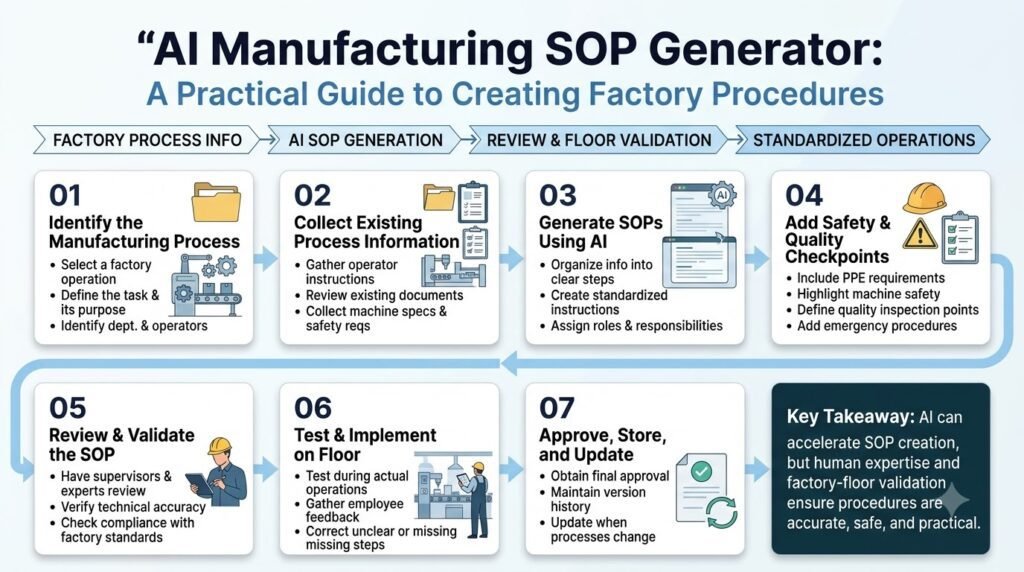
Table of Contents
What Is an AI Manufacturing SOP Generator?
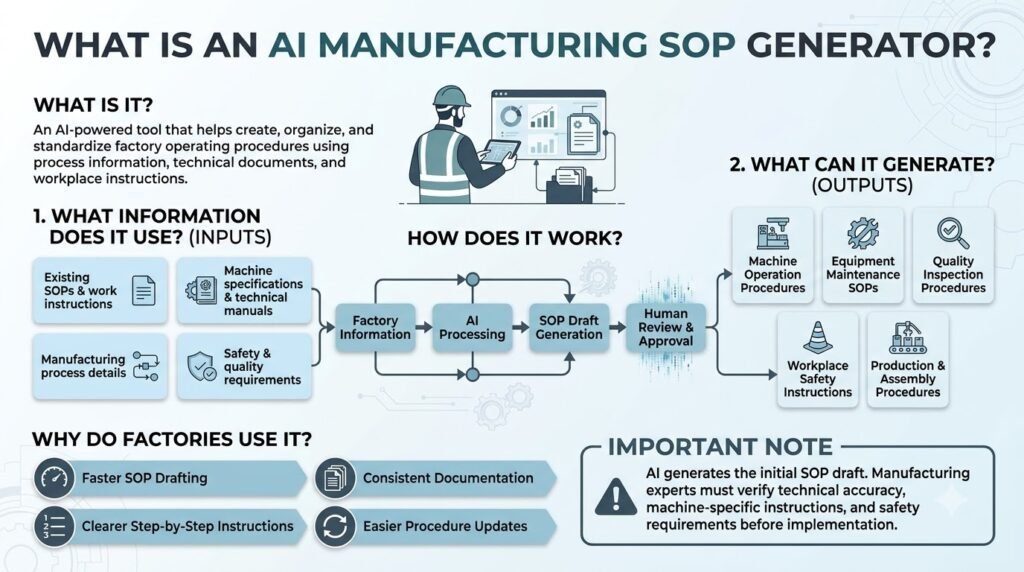
An AI manufacturing SOP generator is an AI-powered tool or workflow that helps convert manufacturing process information into structured standard operating procedures.
All you need to do is give the manufacturing manager details of your current processes, equipment, quality checks and employee roles and the AI will sort it all out into a clear process.
For example, a factory supervisor may provide details on an injection moulding process. This will include how to set up the machine, what materials are approved, quality check points and shutdown requirements.
AI can organize the supplied information into sections such as:
- Purpose and scope
- Equipment and materials required
- Employee responsibilities
- Pre-operation checks
- Step-by-step instructions
- Quality inspection requirements
- Safety precautions
- Abnormal conditions and escalation
- Required records and approvals
The important distinction is that AI organizes and drafts information. It will not necessarily have knowledge of the right operational parameters or safety requirements for a particular factory.
The accuracy of the SOP produced will depend on the quality of the information provided and the review by qualified individuals.
Which Manufacturing Processes Can AI Help Document?
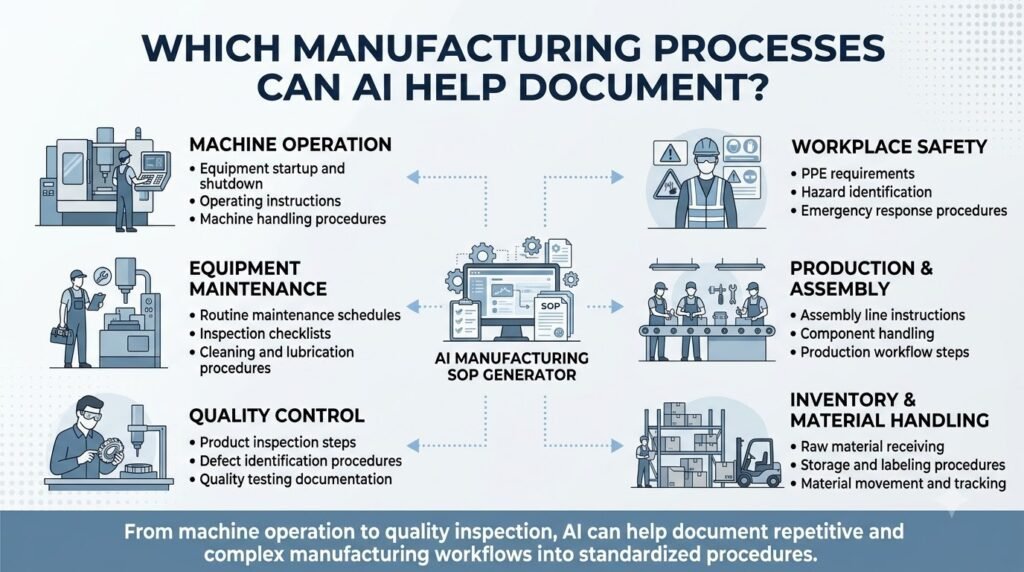
Many repetitive tasks are required within manufacturing businesses and can be documented to help maintain consistency. AI can be used to produce processes for individual tasks.
Here are five important applications.
1. Production Line Setup and Operation
Production line procedures explain how employees prepare equipment, organize materials and begin manufacturing activities.
An AI manufacturing SOP generator can help structure documentation covering:
- Production order verification
- Raw material availability
- Equipment readiness checks
- Workstation preparation
- Production sequence
- In-process monitoring
- Production record completion
- End-of-run procedures
For instance, if your business is a packaging company you may want to have an SOP in place to outline how operators will set up their packaging line.
The AI can take the setup instructions provided and create a checklist that covers verifying the materials, checking the equipment, ensuring setup is to approved production parameters and checking the initial product.
The Production Supervisor must ensure that the process followed is to the approved production process.
2. Machine Operation and Changeover
Machine operation procedures are particularly important because different machines require different operating instructions.
A manufacturing SOP generator can help document:
- Equipment identification
- Pre-operation inspections
- Approved machine settings
- Tool and material requirements
- Operating sequences
- Changeover instructions
- Shutdown procedures
- Fault reporting
Imagine you have several CNC milling machines in your factory.
The supervisor may require specific instructions on how to run each machine. For example, there may be different instructions for turning the machine on, changing a tool, putting the work piece on and turning off at the end of shift.
Whilst AI can help provide structure to the instructions, it should not make up any technical details like spindle speed, depth of cut, pressure limits etc.
These should always be taken from approved engineering drawings, equipment manuals and approved production requirements.
3. Quality Control and Inspection
Quality control procedures describe how you ensure your products meet defined specifications.
AI can help organize inspection instructions covering:
- Incoming material inspections
- First-piece inspections
- In-process quality checks
- Final product inspections
- Defect identification
- Measurement recording
- Nonconformance reporting
- Product release approvals
For example, an electronics manufacturer may require a procedure or SOP to visually check their circuit board assemblies.
This can describe when items will be visually checked, what measuring devices are required, where results will be documented and who will check rejected items.
AI can be used to create a workflow for the checking process using information provided by your quality team.
However, pass/fail criteria, measuring tolerances and sample rates must be taken from approved quality documentation.
4. Preventive Maintenance and Equipment Cleaning
Manufacturing facilities will require standardised maintenance processes. This could include regular checks on a production facility’s conveyors.
AI can help draft documentation for:
- Routine equipment inspections
- Lubrication activities
- Cleaning procedures
- Filter replacement
- Calibration checks
- Maintenance record completion
- Equipment fault reporting
For example, a facility may have regular maintenance checks on conveyors.
This can be converted to a structured checklist using AI, showing who is responsible, what tools are needed, what checks to perform and what needs to be recorded.
Where maintenance includes working with hazardous energies, specific lockout/tagout requirements for each piece of equipment should be created and checked against the approved energy control program.
5. Workplace Safety and Shift Handover
Manufacturing SOPs should also explain how employees manage operational hazards and communicate important information between shifts.
Relevant documentation may include:
- Required personal protective equipment (PPE)
- Machine guarding requirements
- Hazard identification
- Chemical handling instructions
- Emergency reporting procedures
- Equipment status reporting
- Outstanding maintenance issues
- Production quality holds
- Shift handover records
For US workplaces, OSHA’s machine guarding requirements under 29 CFR 1910.212 provide relevant requirements for protecting employees from machinery hazards.
These requirements should not be treated as generic text for AI to invent. Qualified safety personnel must determine which requirements apply to the actual equipment and workplace.
What Information Should You Give an AI Manufacturing SOP Generator?
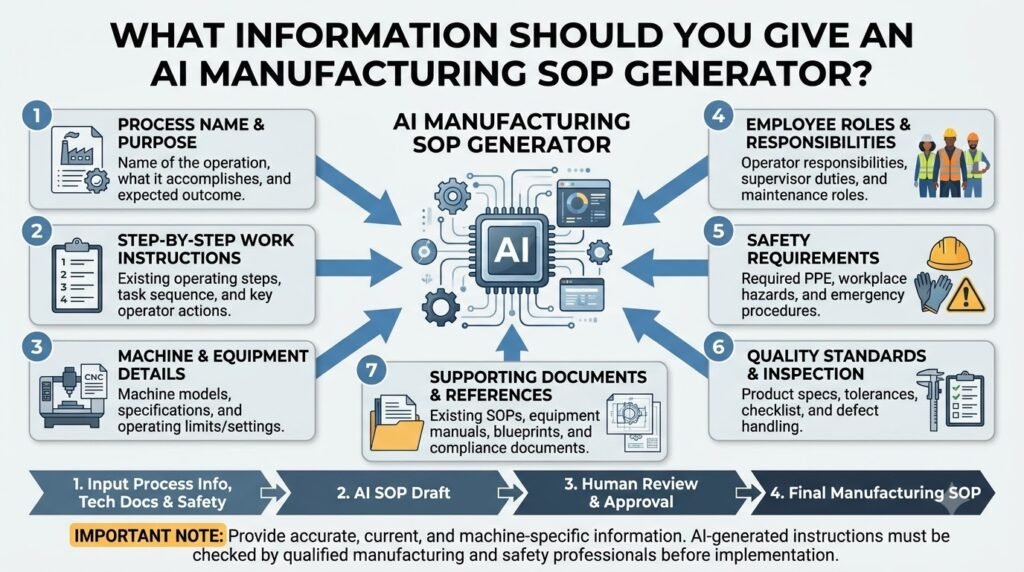
The quality of an AI-generated manufacturing procedure depends heavily on the information provided.
A short instruction such as “Create an SOP for operating a machine” does not give AI enough information to produce a reliable, facility-specific document.
Before generating an SOP, collect the following information.
| Information | What to provide | Example |
| Process details | Exact activity being documented | CNC machine setup |
| Equipment information | Machine name, model and configuration | Equipment identification and approved manual |
| Materials | Required raw materials and consumables | Approved material specification |
| Operating requirements | Verified settings and parameters | Approved production control sheet |
| Employee roles | Who performs and approves the activity | Machine operator and supervisor |
| Quality requirements | Inspection criteria and records | Approved inspection checklist |
| Safety information | Applicable hazards and controls | Machine guarding and energy control procedures |
| Exceptions | What happens when something goes wrong | Equipment fault or failed inspection |
| Documentation | Records that must be maintained | Production and maintenance logs |
You should also collect existing machine manuals, work instructions, quality documents and maintenance records.
These sources provide information that a general-purpose AI model cannot reliably infer from a process name alone.
Collecting accurate source information is an important part of producing useful AI-generated procedures.
If you need a broader explanation of how to organize source material, prepare prompts and structure SOP drafts, explore the general process of creating SOPs with AI.
The manufacturing-specific requirements discussed here can then be applied to individual factory processes.
How to Generate a Manufacturing SOP Using AI
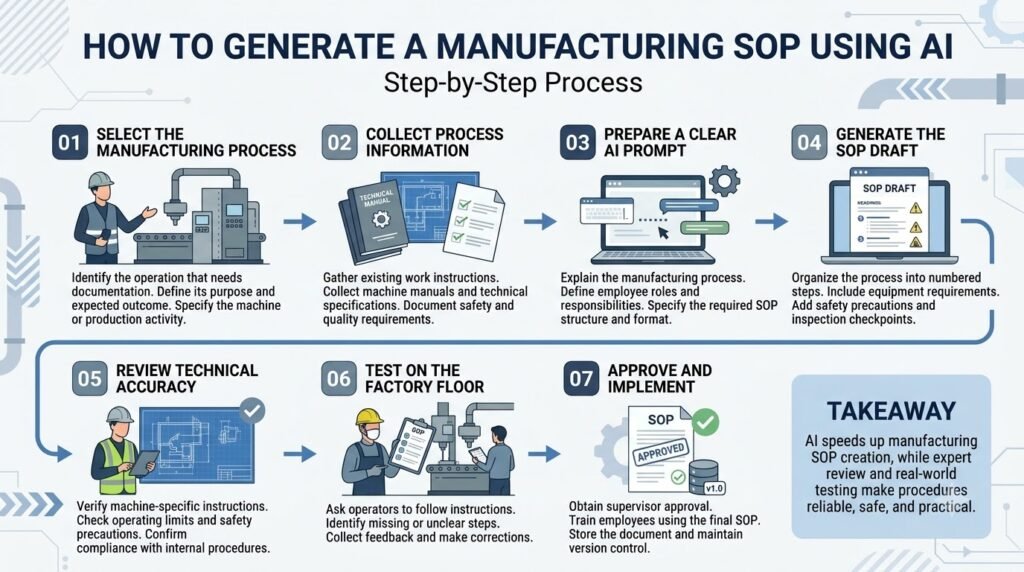
Practical SOPs will have data gathering, writing, technical checks and approvals as part of their workflow.
Step 1: Select One Manufacturing Process
Start with one clearly defined activity.
Do not ask the AI to create SOPs for your entire production department in one go.
Instead, select a specific process, such as CNC machine startup, incoming material inspection, assembly line changeover, equipment cleaning or final product inspection.
Step 2: Collect Approved Manufacturing Information
Collect information required to describe the real process.
Talk to machine operators, production supervisors, maintenance technicians and quality inspectors.
They can give you practical information that may not be included in existing documentation.
Use approved documents as the source of technical information.
Step 3: Prepare a Manufacturing-Specific AI Prompt
Describe the process, equipment, roles, documentation and safety issues involved.
Do not ask AI to make up any missing information about how the process should be run or what regulations need to be met.
Step 4: Generate the Initial SOP Draft
Have the AI arrange the information into a process.
Check the document has been created in the right order and the roles are clear.
Step 5: Check Technical and Operational Accuracy
Ensure the process can be compared to the original machine manuals, engineering drawings, quality documents and approved safety procedures.
Pay particular attention to operating parameters, inspection tolerances, machine settings and abnormal operating conditions.
Step 6: Obtain Departmental Review and Approval
Involve the appropriate process owner, production supervisor, maintenance engineer, quality manager and safety professional.
Assign reviewers as required by the process and company document control criteria.
Step 7: Test, Release and Maintain the Procedure
Where appropriate, conduct a controlled practical review to confirm that trained employees can follow the instructions.
Record the approved version, effective date, document owner and review history.
Update the SOP when equipment, materials, operating conditions or approved processes change.
Once individual manufacturing procedures have been created, businesses also need a consistent way to organize related processes, responsibilities and documentation.
An AI-powered business process documentation system can help establish this wider structure, connecting individual factory SOPs with the organization’s broader operational workflows.
Example: Creating a Production Line Inspection SOP
A manufacturer wishes to create a set of hourly checks on a packaging production line.
The quality manager provides the existing inspection checklist, approved product specifications, equipment identification and recordkeeping requirements.
AI can organize the information into a procedure such as:
| SOP section | Example information |
| Purpose | Standardize scheduled packaging line inspections |
| Scope | Defined production line and applicable products |
| Responsibility | Assigned production operator and quality inspector |
| Preparation | Approved inspection checklist and measuring equipment |
| Inspection steps | Verify the specified product characteristics |
| Recording | Enter actual results into the designated inspection record |
| Failed inspection | Follow the approved product hold and escalation process |
| Approval | Authorized quality representative |
These are not made up values for how often to inspect, what tolerances to apply and what product acceptance criteria. These will be taken from the manufacturers approved quality specifications.
Sample AI Prompt for Manufacturing SOP Creation
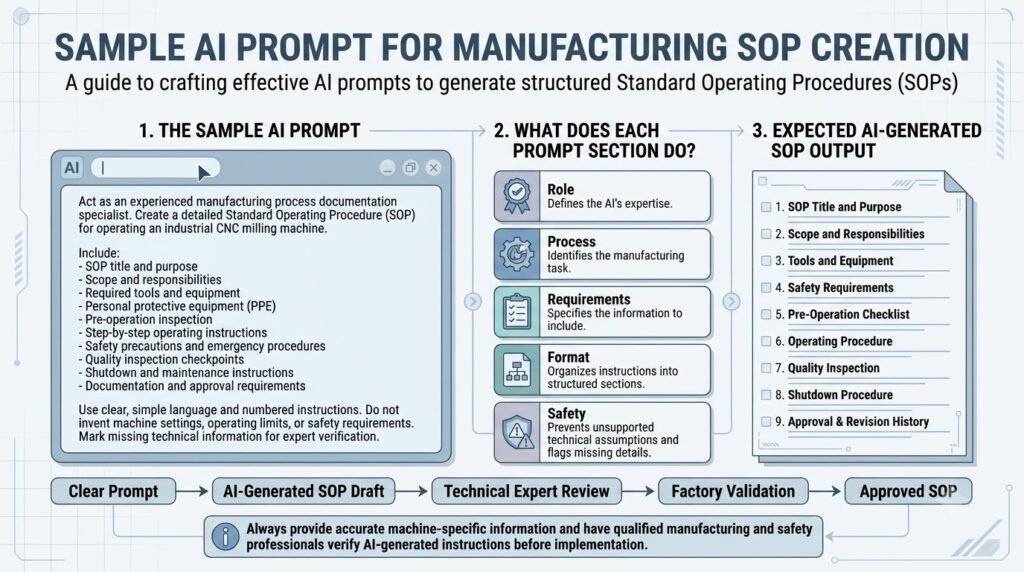
This provides a framework for the AI to understand the manufacturing environment it will be working in and what data should be stored.
The following prompt can be adapted to suit various manufacturing processes.
Copy and customize this prompt:
Act as a manufacturing process documentation specialist.
Create a structured Standard Operating Procedure (SOP) using only the manufacturing information supplied below.
Process name: [Enter process name]
Manufacturing industry: [Enter industry]
Facility or department: [Enter facility or department]
Equipment: [Enter equipment name and model]
Materials required: [Enter materials]
Approved operating parameters: [Insert verified values or reference documents]
Responsible employees: [Enter roles]
Quality requirements: [Enter approved inspection criteria]
Safety requirements: [Insert approved safety procedures]
Existing process instructions: [Paste approved instructions]
Include:
- Purpose and scope.
- Roles and responsibilities.
- Equipment and materials.
- Prerequisites and preparation.
- Step-by-step operating instructions.
- Quality inspection checkpoints.
- Safety considerations and references to approved safety procedures.
- Abnormal conditions and escalation procedures.
- Required records and documentation.
- Revision and approval information.
Important instructions:
- Do not invent machine settings, pressure values, temperatures, inspection tolerances or safety requirements.
- Clearly identify missing information using placeholders.
- Do not claim regulatory compliance without verified supporting documentation.
- Preserve all supplied technical values accurately.
- Separate mandatory instructions from recommendations.
- Use simple language that trained manufacturing employees can understand.
- Present the final document in a structured, numbered format.
This prompt creates a starting structure while making missing technical information visible to the reviewer.
How to Review and Validate AI-Generated Manufacturing SOPs
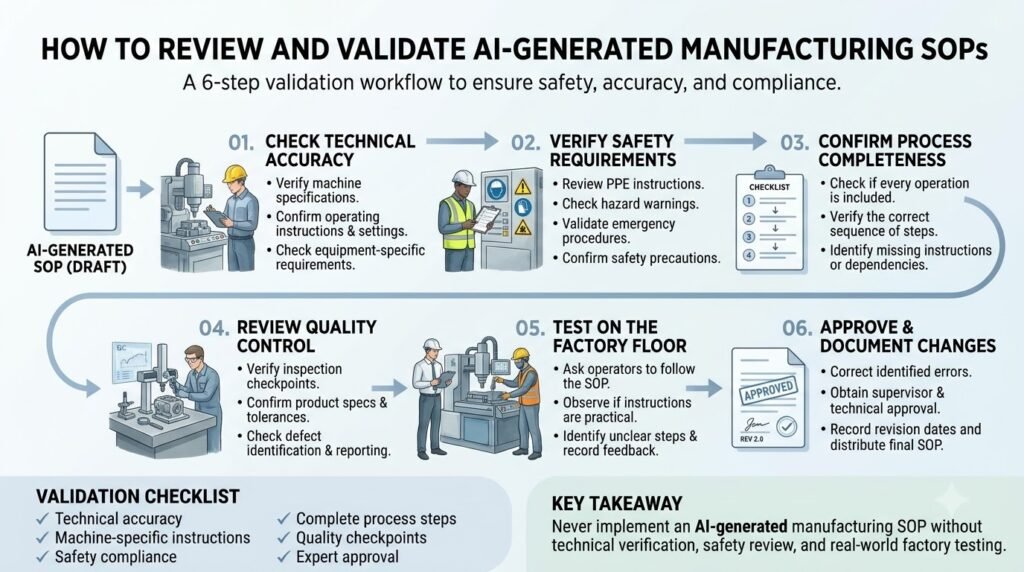
This can impact product quality, staff safety and consistency of production. Therefore, these AI generated documents should never be assumed to be an approved operating instruction due to them looking professional.
Use a review process that checks the following areas.
1. Equipment accuracy: Ensure procedures are correct for the machine, set up, tools and approved information.
2. Operating parameters: Check temperatures, pressures, velocities, tolerances and other values are correct according to approved engineering/production criteria.
3. Safety requirements: Have qualified safety personnel verify applicable guarding, hazardous energy control, PPE and other workplace safety requirements.
4. Quality requirements: Confirm that inspection methods, acceptance criteria, sampling requirements and escalation instructions match the approved quality system.
5. Employee responsibilities: Ensure that every critical activity has an appropriate responsible role.
6. Practical usability: Have trained staff look through the process to identify any instructions that are unclear and any gaps in the process.
7. Document control: Confirm the document owner, approval status, revision number, effective date and distribution arrangements.
For example, OSHA’s hazard communication standard, 29 CFR 1910.1200, addresses written hazard communication programs, chemical labels, safety data sheets and employee training in applicable US workplaces.
This will vary depending on the location, activity and jurisdiction.
Reviewing generated instructions is part of a wider AI-assisted SOP development process.
The guide to using AI for standard operating procedures provides additional guidance on checking drafts, correcting missing information and maintaining procedures over time.
For manufacturing, these reviews should also involve personnel who understand the actual equipment and production environment.
How Manufacturing SOP Documentation Connects With Other Business Processes
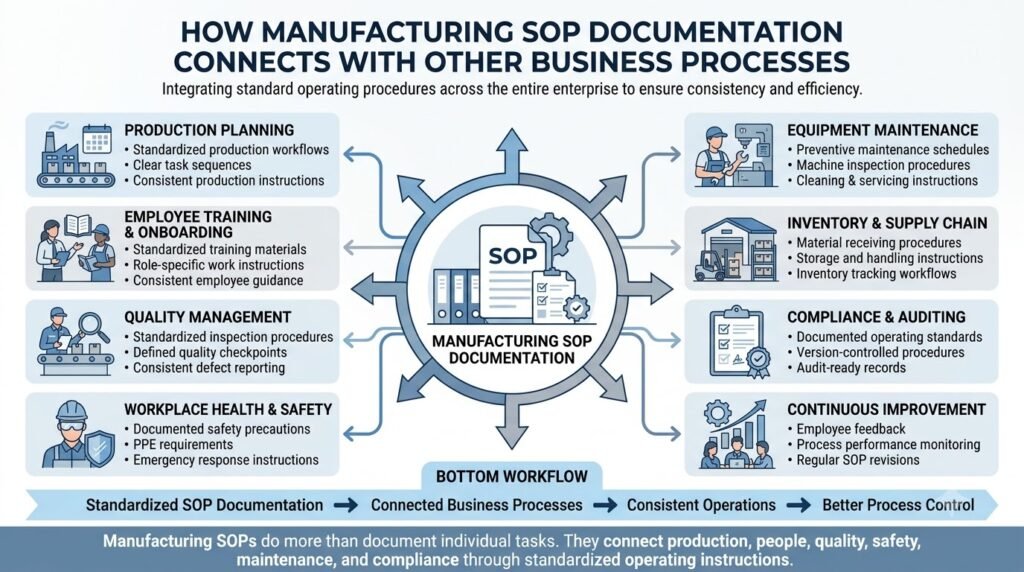
Manufacturing procedures do not operate independently. They connect with employee training, quality management, maintenance documentation and wider business processes.
For example, a factory may have separate SOPs for production line operation, equipment maintenance, material inspection and employee training.
Managing this can lead to inconsistencies in the documentation and can be difficult to keep up to date.
A better way to manage this is to link individual processes together using an AI powered business process documentation system. This enables businesses to think about how processes, roles and documentation all fit together.
Manufacturing businesses can also learn from industry-specific documentation approaches. For example, the AI medical office SOP generator guide explores how AI-assisted procedures can be adapted to the requirements of a different operational environment.
Although healthcare and manufacturing have different compliance and workflow requirements, both demonstrate why SOPs need to reflect the actual activities of the organization.
Employee training is another important connection. When a new machine operator joins a factory, the organization needs a structured way to introduce responsibilities, operating procedures and workplace expectations.
A structured employee onboarding SOP can help businesses organize this part of the process and connect employee induction with the relevant manufacturing documentation.
For a broader explanation of how individual procedures can be developed and maintained, explore the broader process of using AI to create SOPs. It provides the general methodology, while this article focuses on applying it to manufacturing operations.
Common Mistakes to Avoid When Using AI for Manufacturing SOPs
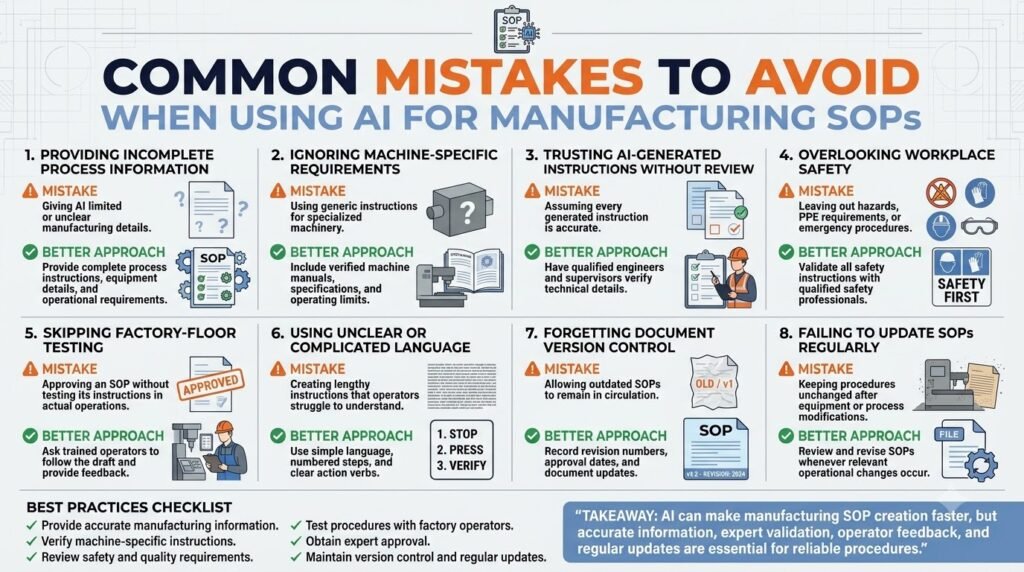
Even a well-written AI-generated procedure can be unsuitable for actual production use.
Using generic instructions for specific machines: Different models of equipment may have different procedures, controls and safety requirements. Provide equipment specific sources.
Allowing AI to invent technical values: Never assume values for machine settings, pressures or quality tolerances.
Ignoring employee experience: Make sure to take account of the knowledge operators / technicians have of practical workarounds.
Combining unrelated processes: Don’t create one large document. Create controlled procedures for each of operation, maintenance, quality / inspection and emergency actions.
Overlooking revision history: A procedure may become outdated due to changes to equipment or materials and/or process.
Skipping practical validation: A document may be grammatically correct but hard or dangerous to follow in practice.
Treating AI output as regulatory approval: AI generated content will not ensure the procedure complies with safety regulations in the workplace or industry standards.
Choosing an AI Manufacturing SOP Generator
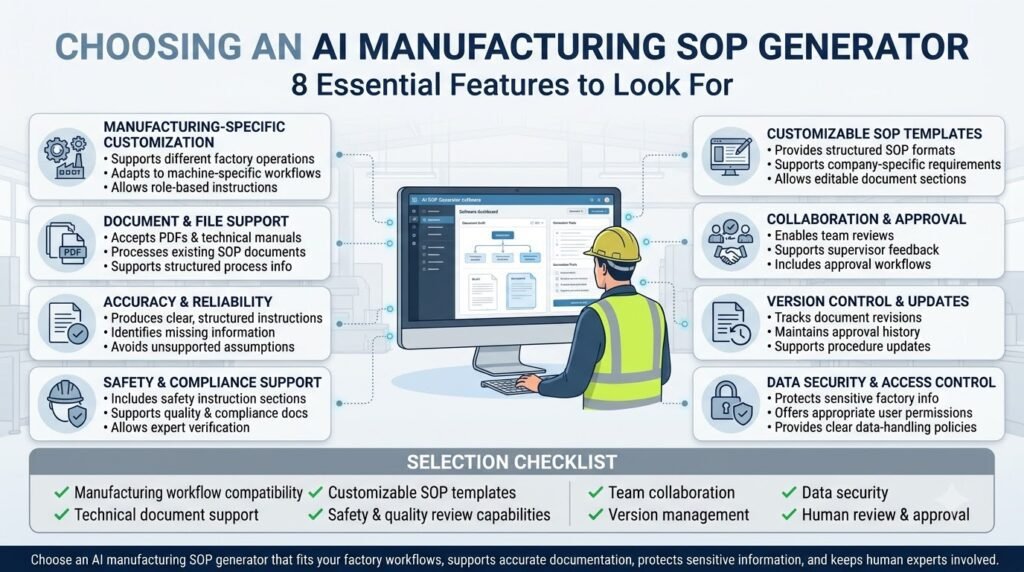
Not every AI tool is designed for manufacturing documentation.
Before choosing a solution, evaluate whether it supports the workflow your team actually needs.
| Evaluation criterion | What to check |
| Process customization | Can you provide facility-specific process information? |
| Equipment context | Can the workflow preserve machine-specific details? |
| Output structure | Does it create clearly numbered instructions and checklists? |
| Source handling | Can you work with relevant approved documents? |
| Revision management | Can you maintain document versions and review changes? |
| Collaboration | Can relevant employees review and approve documents? |
| Security | Does the provider’s data handling meet your organization’s requirements? |
| Export options | Can the final document be stored in your existing documentation system? |
For teams experimenting with AI-generated procedure drafts, comparing different AI responses can also help identify missing questions or unclear instructions.
For example, AiZolo provides a multi-model AI workspace where users can compare responses side by side and reuse saved prompts through its Smart Prompt Manager.
A manufacturing team could use this workflow to compare alternative draft structures or refine a documentation prompt.
The resulting technical content must still be checked against approved factory documentation and reviewed by responsible personnel.
Frequently Asked Questions
1. What is an AI manufacturing SOP generator?
An AI manufacturing SOP generator helps turn manufacturing process descriptions, equipment information and existing work instructions into structured standard operating procedures.
It can help draft production, maintenance, quality inspection and machine operation documentation. Qualified personnel must review the generated procedures before they are approved for workplace use.
2. Can AI generate SOPs for specific manufacturing machines?
Yes, you can use AI to create machine specific SOPs, providing you have accurate information on the equipment, approved manuals and instructions.
Within your prompt you would want to state what model of machine you are looking to create an SOP for, what processes are involved, what tools are needed and what the correct settings are.
The AI should not make up any technical details or safety measures that have not been verified.
3. What should a manufacturing SOP include?
In general, a manufacturing SOP will state the objective, scope, personnel involved, equipment needed, preparation steps, operation instructions, quality control points, safety information, unusual circumstances and record keeping requirements.
The complexity and risk level of the manufacturing process will affect the layout of the SOP.
4. Can AI create manufacturing quality control procedures?
AI can organize existing quality requirements into inspection procedures, checklists and reporting instructions.
However, acceptance criteria, measurement tolerances, sampling frequencies and product release requirements must come from the manufacturer’s approved quality documentation.
5. Are AI-generated manufacturing SOPs reliable?
They can be a helpful starting point, but the accuracy will depend on the source data and reviewing. The manufacturing professionals must ensure that the data provided is correct for the equipment, working parameters, quality and safety requirements.
AI generated procedures must never replace technical reviews or staff training.
6. Can small manufacturing businesses use AI for SOP creation?
Yes. Small manufacturers can use generic AI tools to collate their existing processes and document their repeatable processes. To begin with they will want to focus on documenting one process such as cleaning equipment or checking incoming materials.
7. How often should manufacturing SOPs be updated?
Manufacturing SOPs should be reviewed in accordance with document control requirements. They should also be reviewed when there are changes to relevant equipment, materials, processes, safety requirements or quality requirements. Any incidents, process deviations or audit observations should be reviewed.
Conclusion
An AI SOP generator can help manufacturers put their manufacturing knowledge into well-structured documents.
This will provide accurate information about their manufacturing process, creating targeted procedures and engaging staff.
However, AI can’t automatically verify machine settings, recognise all hazards in the workplace and verify compliance with regulations.
Start with one manufacturing process. Ensure you have a well-informed prompt. Review the instructions produced and get the relevant approvals. Then you can introduce the process to your staff.
Using AI as part of a controlled documentation process can make it a useful tool to help keep manufacturing processes clear and consistent.
About the Author
Anshika Verma is a content researcher and writer at AiZolo, focused on researching AI tools, models and creator technologies. She explores practical applications of AI to help readers understand emerging technologies and use them more effectively in their everyday workflows.