A rap lyrics generator AI is not going to hand you a finished, radio-ready verse in one click. Aizolo helps you generate creative rap lyrics faster, but anyone who tells you it’s enough to ship a real song without editing hasn’t actually done it.
What it can do — reliably, in 2026 — is break writer’s block, generate rhyme options faster than any thesaurus, and give you a rough draft to rewrite in your own voice.
This guide covers what a rap lyrics generator AI actually is, how the technology behind it works, which tools are worth your time, and where the legal lines sit right now. I’ve tested prompts across several major platforms while researching this piece, and I’ll flag the parts that are genuinely useful versus the parts that are marketing.
By the end, you’ll know how to use an AI rap generator without sounding like every other AI-written verse on TikTok.
Table of Contents
What Is a Rap Lyrics Generator AI?
A rap lyrics generator AI is software built on a large language model (LLM) that produces rhyming, rhythmic text based on a topic, mood, or style you give it.
Think of it as a collaborator that has read an enormous amount of hip-hop history — flows, slang, rhyme patterns, cadence — and can remix that knowledge into new lines on demand.
It’s different from a general AI creative writing tool because it’s tuned (or prompted) specifically for rhyme density, syllable rhythm, and rap-specific structure: verses, hooks, bridges, and ad-libs.
Some platforms are dedicated AI lyric software, built only for lyric generation. Others, like Aizolo, combine lyric writing with beat and vocal generation in one workflow, closer to a full rap song maker.
Then there are general-purpose models — ChatGPT, Claude, Gemini — which weren’t built specifically for music but can still write competent rap verses when prompted well, because rhyme and rhythm are just patterns in language, and that’s exactly what LLMs are trained to model.
Where This Technology Came From
Rhyme-generation software has existed since the early 2000s (basic rhyming dictionaries and Markov-chain lyric bots). What changed is the underlying model.
Modern generative AI systems — the same transformer architecture behind ChatGPT and Claude — understand context, theme, and internal rhyme in a way that older rule-based generators never could. That’s the real leap: not “finds rhyming words,” but “understands what a rap verse is trying to say and rhymes while saying it.”
How Does an AI Rap Lyrics Generator Actually Work?
Here’s the honest, non-hype version.
Step 1: Training on text patterns. The underlying LLM was trained on huge volumes of publicly available text, including song structures, poetic devices, and rhythmic language patterns — not by “memorizing” specific songs, but by learning statistical patterns in how words and syllables relate.
Step 2: You provide a prompt. Topic, mood, flow style, reference artist’s general vibe (not their exact lyrics), rhyme scheme, and length.
Step 3: The model predicts likely next words. It generates text one token at a time, weighing which word is both semantically relevant and phonetically likely to rhyme or scan well, based on patterns it has learned.
Step 4: Post-processing (in dedicated tools). Purpose-built platforms like Aizolo or Suno often layer extra logic on top of the raw LLM output — syllable counters, rhyme-density scoring, or beat-matching — to make sure the text actually sits on a beat instead of just rhyming on paper.
Callout box — Important distinction: A general chatbot writes rhyming text. A dedicated rap generator tries to write text that fits a flow — meaning syllable count and stress patterns that match a beat’s tempo. This is the single biggest quality difference between tools.
Best AI Rap Lyrics Generators in 2026 (Compared)
I focused this comparison on tools people actually use for rap and hip-hop specifically, not generic AI chatbots repurposed for lyrics.
| Tool | Best For | Free Tier | Commercial Use | Lyrics + Music? | Multilingual |
|---|---|---|---|---|---|
| Aizolo | Rap-focused lyric + song workflow | Yes, limited generations | Paid plans only | Yes (lyrics, beats, structure) | Yes |
| Suno | Full song generation (vocals + instrumental) | Yes, 10 gens/day, no commercial rights | Paid plans only | Yes, full song | Yes, multiple languages |
| Udio | Natural-sounding vocal rendering, style variation | Limited free credits | Paid plans only | Yes, full song | Limited |
| ChatGPT | Fast draft verses, brainstorming, editing | Yes (rate-limited) | Depends on your OpenAI plan/usage terms | No (text only) | Yes, strong |
| Claude | Longer-form lyric drafts, nuanced wordplay, editing | Yes (rate-limited) | Depends on your Anthropic plan/usage terms | No (text only) | Yes, strong |
| Gemini | Quick rhyme brainstorming, Google ecosystem integration | Yes (rate-limited) | Depends on your Google plan/usage terms | No (text only) | Yes, strong |
A note on accuracy: pricing and free-tier limits on all of these platforms change often — sometimes month to month. Suno, for example, has shifted its free daily credit allowance and commercial-rights structure multiple times through 2026. Always check the tool’s own pricing page before you commit a budget.
Aizolo
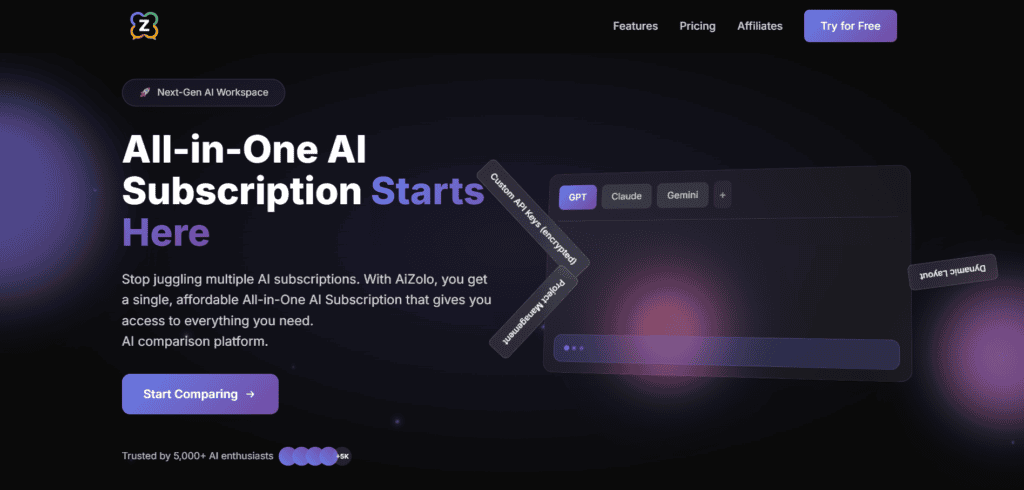
Positioned as a rap-specific writing and production assistant rather than a general music generator. Its lyric engine is built around flow structure — verse/hook/bridge templates, syllable-aware rhyme suggestions, and genre-specific slang libraries — which makes it a stronger starting point for rap specifically than a general chatbot.
Strengths: purpose-built for hip-hop; structured verse/hook workflow; rhyme-density controls. Weaknesses: smaller ecosystem and community than Suno/Udio; best results still require human rewriting.
Suno
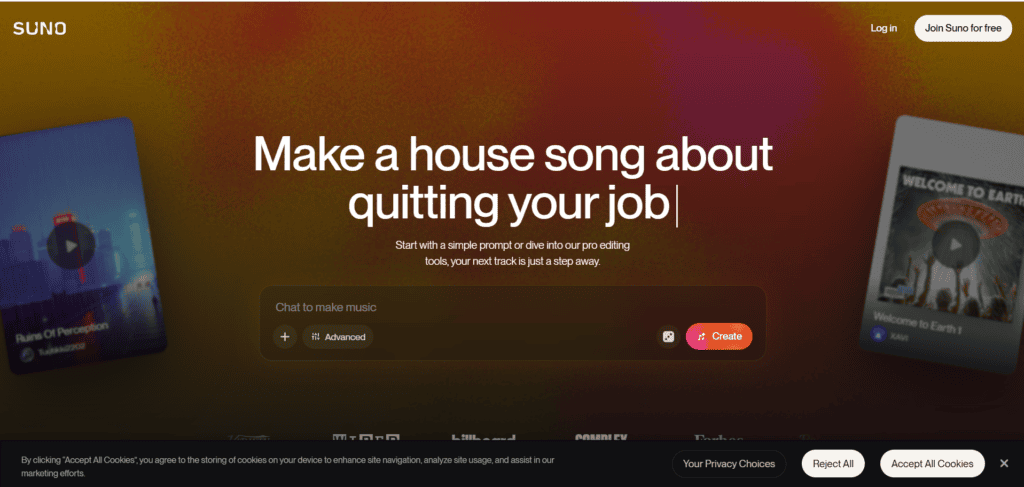
Suno has become the AI music generator most people mean by default when they say “AI music,” reporting more than 100 million users and a major-label licensing partnership with Warner Music Group announced in November 2025. It generates full songs — lyrics, vocals, and instrumentation together — rather than lyrics alone.
Its free tier includes daily credits, but commercial use is restricted to paid plans, and generations on the free tier remain public with no licensing for monetization.
Strengths: full song output, not just text; strong vocal realism in recent model versions; large community and preset library. Weaknesses: you’re generating a whole song, not just editable lyric text, which gives you less granular control over the words alone; some users report needing many generation attempts to land a usable result, which burns through credits quickly.
Udio
Known for natural-sounding vocal delivery and strong stylistic range across genres, including hip-hop. Like Suno, it’s a full song generator rather than a lyrics-only tool, so it’s best for creators who want a finished demo, not just a written verse.
Strengths: vocal realism, style flexibility. Weaknesses: less rap-specific tooling (rhyme scheme control, flow templates) than dedicated hip-hop platforms.
ChatGPT, Claude, and Gemini
These are general-purpose AI songwriting assistant options. None of them were purpose-built for rap, but all three can produce competent draft verses, punch-up existing lines, brainstorm concepts, or explain rhyme schemes when you ask directly.
Where they tend to outperform dedicated rap tools: longer creative reasoning (explaining why a line works, iterating on theme, multilingual rap lyrics with nuance) and general editing quality.
Where they tend to underperform: they won’t natively track syllable-to-beat matching or produce audio, so you’re doing more manual flow-checking yourself.
Free vs Paid: What You Actually Get
| Free Plans | Paid Plans | |
|---|---|---|
| Generation limits | Small daily/monthly caps | Higher or unlimited caps |
| Commercial rights | Almost never included | Usually included, confirm per platform |
| Output quality/priority | Standard queue, sometimes watermarked audio | Priority processing, higher fidelity |
| Customization depth | Basic prompt only | Advanced controls: flow, rhyme density, structure, style reference |
| Export options | Limited or text-only | Full export: stems, audio files, lyric sheets |
The pattern across nearly every platform in this space, including Suno, Udio, and Aizolo, is the same: free tiers are for testing quality, paid tiers are for anything you plan to publish or monetize. Free tier users generally get zero commercial rights — if you plan to monetize content using AI-generated music or lyrics, you need a paid plan.
Key Features That Separate Good Tools From Gimmicks
Not all “AI rhyme generators” are built the same. Here’s what actually matters when you’re evaluating one.
- Rhyme scheme control — can you specify AABB, ABAB, internal rhyme density, or is it random?
- Syllable/flow awareness — does it try to match a beat’s tempo, or just rhyme on paper?
- Editable output — can you regenerate a single line instead of the whole verse?
- Style and tone controls — aggressive, storytelling, party, conscious rap, drill, boom-bap, etc.
- Multilingual rap lyrics support — genuinely useful if you write in Spanish, Hindi, French, or code-switch between languages.
- Export formats — plain text, formatted lyric sheet, or (for full-song tools) audio stems.
- Content filters — how the tool handles explicit language, since rap often depends on it stylistically.
If a tool can’t do at least the first three, it’s a novelty generator, not a working songwriting tool.
Step-by-Step: How to Generate Rap Lyrics With AI
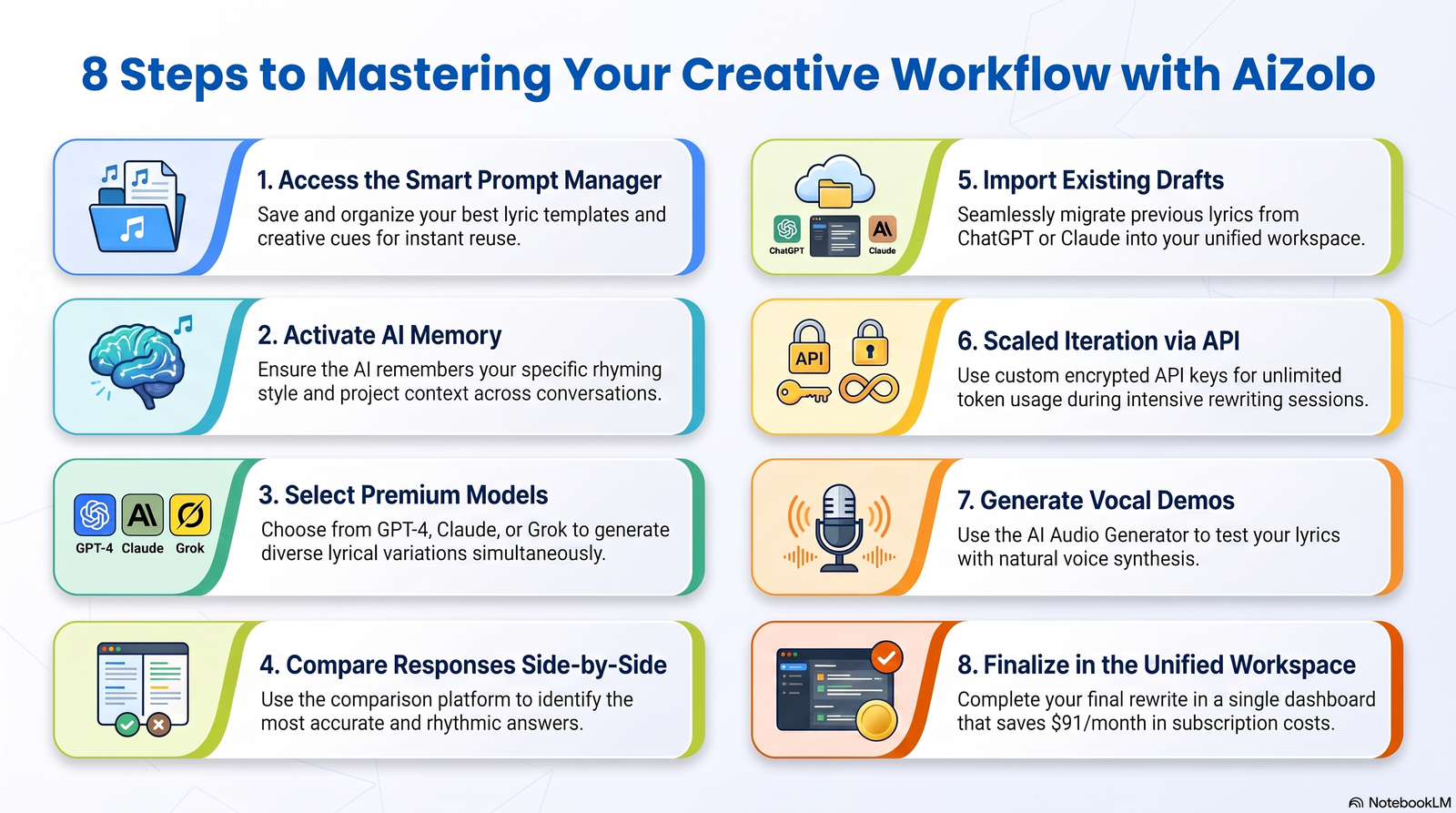
- Pick your foundation. Decide if you want a lyrics-only draft (ChatGPT, Claude, Gemini, Aizolo’s text mode) or a full song with vocals and beat (Suno, Udio, Aizolo’s full workflow).
- Set the concept, not just the topic. “A verse about grinding through a slow year, using boxing as a metaphor” beats “write a rap about hustling.”
- Specify structure. Ask for a 16-bar verse, an 8-bar hook, or a full verse-hook-verse-hook-bridge arrangement.
- Set the flow reference. Describe cadence in your own words — “laid-back, conversational, mostly single-syllable rhymes” versus “fast, multisyllabic, internal rhyme heavy.”
- Generate multiple drafts. Treat the first output as a sketch, not a final. Generate 3–5 variations of the same prompt.
- Rewrite in your voice. Swap generic lines for personal detail. This step is what separates a usable song from something that sounds AI-written.
- Check it against a beat. Read it out loud or record a scratch take over an actual instrumental to confirm the flow lands.
- Verify originality. Run key lines through a search or lyric database check to confirm you haven’t landed on something too close to an existing song (more on why in the copyright section).
How to Write Better Prompts for Rap Lyrics
Vague prompts produce generic output. This is true of every LLM, not just music tools.
Weak prompt: “Write a rap about success.”
Strong prompt: “Write a 16-bar rap verse about earning success after years of being overlooked. Use a boom-bap cadence, moderate rhyme density (not overly technical), first-person perspective, and one extended metaphor about planting and harvest. Avoid clichés like ‘grind’ and ‘hustle.'”
The difference: specificity about structure, cadence, perspective, and what to avoid. AI models respond well to negative constraints (“avoid clichés like X”) because it narrows the output space.
A Reusable Prompt Template
Write a [length] rap [verse/hook] about [specific concept/story, not just a topic].
Tone: [aggressive / reflective / playful / conscious / etc.]
Flow: [describe cadence — fast/slow, syllable-heavy or sparse]
Rhyme style: [end rhyme only / internal rhyme / multisyllabic]
Perspective: [first person / storytelling / third person]
Avoid: [list clichés or words you don't want]
This template works across ChatGPT, Claude, Gemini, and most AI songwriting prompts interfaces because it gives the model concrete constraints instead of an open-ended request.
How Accurate and “On-Beat” Are AI Rap Lyrics?
This is where most reviews oversell the technology, so let’s be direct.
What AI rap generators are good at: rhyme generation, thematic consistency, producing volume quickly, and matching a general tone you describe.
What they’re inconsistent at: natural syllable stress (where the emphasis falls when spoken), matching a specific BPM or beat pocket, and avoiding rhythmic patterns that feel mechanical when you actually try to rap them.
In practice, dedicated tools with syllable-counting logic (like Aizolo’s flow templates, or Suno/Udio’s full audio generation, which forces syllables to fit a rendered beat) perform noticeably better on flow than a general chatbot asked to “write a rap,” because the chatbot has no concept of tempo — only of text.
If flow accuracy matters to you, prioritize a tool that either generates audio directly or has explicit syllable/rhythm controls, not just rhyme suggestions.
Customization: Style, Flow, Tone, and Multilingual Rap
Good AI lyric creator tools let you steer more than just topic. Look for control over:
- Sub-genre style — drill, trap, boom-bap, conscious rap, mumble-adjacent cadence, old-school.
- Emotional register — braggadocio, vulnerability, storytelling, humor, protest.
- Explicit content toggle — since profanity and explicit themes are stylistically core to much of the genre, not incidental.
- Multilingual rap lyrics — Spanish-language trap, Punjabi hip-hop, French drill, and code-switching bars are all growing categories, and general LLMs like ChatGPT, Claude, and Gemini are often stronger here than genre-specific tools because of broader language training.
- Reference-artist style, not reference-artist lyrics — you can legitimately ask a tool to write “in the stylistic tradition of boom-bap storytelling rap,” but asking it to imitate one specific living artist’s exact voice and persona raises separate ethical and legal questions, especially for commercial release.
Copyright and Legal Considerations
This is the section most rap lyrics generator AI content skips, and it’s the one that actually affects whether you can release and monetize what you make.
The US Copyright Office’s position, active through 2026, is that purely AI-generated works without meaningful human creative input are not copyrightable, while works with meaningful human creative contribution can be registered, with a disclaimer covering the AI-generated portions.
In plain terms: if you type a prompt and post the raw output, you likely don’t own an enforceable copyright on it. If you write or substantially rework the lyrics yourself — even using AI as a drafting tool — the human-authored portions are protectable.
The Copyright Office’s January 2025 Part 2 report stated directly that prompts alone do not provide sufficient human control to make the user the legal author of AI output.
In April 2026, a federal court went further, ruling that tracks generated primarily by AI cannot claim copyright protection even when a human heavily prompted and curated the output — the court required “substantial human authorship,” not just curation.
What This Means Practically
- Lyrics you write or heavily rewrite yourself are generally copyrightable, even if you used AI to brainstorm or draft them first.
- Lyrics can be copyrighted even when the underlying AI-generated music cannot be.
- Avoid prompts that reference a specific living artist’s style by name for anything you plan to release commercially — this sits in legally uncertain territory around style-mimicry and publicity rights, separate from copyright itself.
- The Copyright Office looks for original human expression that survives into the final work — lyrics, vocal melody, arrangement choices, or substantial editing decisions that change the expressive result, not just polish it.
- Document your process. Vague claims like “I used AI in the process” are weak; specific documentation of exactly what you wrote, selected, and rebuilt is what actually supports a registration.
Disclaimer: This section explains the general legal landscape as of mid-2026 and is not legal advice. Copyright law around generative AI is actively evolving, with ongoing litigation between major labels and AI platforms. If you plan to commercially release or license AI-assisted music, consult an entertainment attorney before you publish.
Can You Use AI Rap Lyrics Commercially?
It depends entirely on the platform’s terms of service and how much human authorship you’ve added — these are two separate questions.
- Platform terms: Most platforms (Suno, Udio, Aizolo, and general LLM providers) only grant commercial usage rights on paid tiers. Free-tier output is typically for personal or non-commercial use only.
- Copyright ownership: Even with commercial usage rights from a platform, you may not hold an enforceable copyright on purely AI-generated text unless you’ve added substantial human creative work, per current Copyright Office guidance covered above.
- Distribution platform policies: Streaming services increasingly require AI-disclosure. Failing to disclose material AI involvement in a commercial release risks takedown under platform policy, independent of copyright law.
Practical rule of thumb: write your own lyrics (or substantially rewrite AI drafts), use a paid plan for any commercial project, and disclose AI involvement where a platform asks for it.
Can AI Replace Rappers and Songwriters?
Short answer: not the parts that make rap actually connect with people — not yet, and arguably not by design.
Rap as a genre is built on specificity: real names, real streets, real timelines, cultural references that only land because they’re true or feel true. An AI model has no lived experience to draw from — it can approximate the pattern of a personal story, but it can’t have had one.
Where AI is genuinely replacing manual labor: rhyme-hunting, first-draft generation, brainstorming when you’re stuck, and producing scratch demos quickly. Where it isn’t: original perspective, cultural authenticity, and the specific lived detail that makes a verse memorable rather than generic.
The realistic frame for 2026: AI rap tools are a drafting and brainstorming layer, not a replacement for the writer. Most professional users treat generated output the way they’d treat a rhyming dictionary or a co-writer suggesting lines — a starting point to argue with, not a finished product to publish as-is.
Pros and Cons of Using an AI Lyrics Writer
| Pros | Cons |
|---|---|
| Breaks writer’s block fast | Generic output if prompts are vague |
| Generates rhyme options instantly | Weak on natural flow/syllable stress without dedicated tools |
| Useful for brainstorming concepts and structure | Raises copyright ownership questions on raw output |
| Multilingual support in general LLMs | Can drift toward cliché phrasing without editing |
| Low cost of experimentation | Risk of sounding derivative if not personalized |
| Good for demos, jingles, practice writing | Commercial use often requires a paid plan |
Best Use Cases for a Rap Song Maker
- Beginners learning song structure — seeing a full verse-hook-verse arrangement modeled is genuinely useful for understanding form.
- Content creators and YouTubers needing quick original background rap for videos, where perfection matters less than speed.
- TikTok creators experimenting with short-form hooks and trending flow styles.
- Marketers writing jingles who need rhythmic, memorable copy fast and don’t need “artistic” depth.
- Songwriters battling writer’s block who want a rough draft to argue with and rewrite.
- Students studying rhyme scheme, meter, and lyrical devices through generated examples.
- Producers who want scratch lyrics to test a beat’s pocket before bringing in a vocalist.
Limitations You Should Know Before You Start
- Flow accuracy varies wildly between tools; text-only models don’t inherently understand tempo.
- Output can feel derivative if you don’t personalize it — AI models pull from patterns, so unedited output often reads as generic.
- Copyright protection is not automatic, as covered above — raw AI output has weak or no legal protection.
- Explicit content filters on some platforms can water down authentic rap language and slang.
- Free tiers rarely support commercial release, and limits change frequently across platforms.
- Cultural nuance and slang can misfire, especially with regional or era-specific hip-hop vocabulary, if the model wasn’t trained on enough current examples.
Common Mistakes Creators Make
- Publishing the raw first output. This is the single biggest tell of AI-written rap — generic phrasing, safe rhymes, no personal detail.
- Vague prompts. “Write a rap about money” produces the most generic possible output. Specificity fixes this.
- Ignoring flow when reading, only checking rhyme on paper. Always read bars out loud or over a beat before finalizing.
- Assuming commercial rights are automatic. Check the specific platform’s terms every time, especially on free tiers.
- Prompting with a specific living artist’s name for content meant for commercial release, which invites both legal and ethical complications.
- Skipping the rewrite pass entirely. Treating AI output as a finished product instead of a first draft.
Expert Tips From Working With These Tools
- Generate in batches, then splice. Instead of accepting one full verse, generate 4–5 versions and combine the strongest individual lines into a single verse.
- Ask the AI to explain its rhyme choices. With text-based tools like ChatGPT or Claude, asking “why did you choose that word” often surfaces alternate options you can swap in.
- Use AI for hooks, write verses yourself (or vice versa). Hooks benefit from repeatable, catchy simplicity — something AI does reasonably well. Verses benefit from personal specificity — something you do better.
- Feed it constraints, not just topics. Syllable counts, specific rhyme schemes, and “avoid” lists consistently produce sharper output than open-ended prompts.
- Always do a spoken read-through against an actual beat, not just a silent read, before you consider a verse finished.
The Future of AI Songwriting
The near-term trajectory is toward tighter integration between lyrics and audio: tools that generate lyrics already matched to a chosen BPM and beat pocket, rather than text you have to manually fit afterward.
Expect more platforms to add explicit AI-disclosure metadata as a standard export feature, driven by streaming platform policy rather than by choice — Spotify, Apple Music, and YouTube are already moving in this direction.
Expect copyright practice to keep tightening around “substantial human authorship” as the deciding factor, rather than loosening — the April 2026 federal court ruling requiring substantial human authorship, even over heavily prompted and curated AI output, is a strong signal of where courts are heading, not an outlier.
And expect the gap between “novelty rhyme generator” and “genuine songwriting assistant” to widen — tools with real flow/rhythm modeling will keep separating from ones that just autocomplete rhyming text.
FAQs
What is the best free AI rap lyrics generator? There’s no single universal “best” — it depends on whether you want text-only drafts (ChatGPT, Claude, Gemini all have usable free tiers) or a full audio demo (Suno and Udio offer limited free daily generations, without commercial rights).
Can I sell songs made with an AI rap lyrics generator? Only if you’re on a paid plan with commercial usage rights from the platform, and ideally only if you’ve added substantial human authorship to the lyrics — see the copyright section above for specifics.
Do AI rap generators understand flow and beat timing? Text-only chatbots generally don’t, since they have no concept of tempo. Dedicated audio tools like Suno, Udio, and workflow-based platforms like Aizolo handle flow more reliably because the output is checked against an actual rendered beat.
Is it legal to ask an AI to write “in the style of” a specific rapper? Style imitation sits in a legally and ethically gray area, especially for commercial release — it’s different from copying specific lyrics, but it can still raise publicity-rights and platform-policy issues. For anything you plan to monetize, avoid naming a specific living artist in your prompts.
Will AI-generated rap lyrics sound generic? Often, yes, if you use vague prompts and publish the raw output. Specific prompts, multiple draft generations, and a personal rewrite pass are what separate usable songs from obviously AI-written ones.
Can beginners use these tools to learn songwriting? Yes — seeing modeled verse/hook structures and rhyme patterns is a legitimate way to study song form, especially for students and new writers.
Do I need to disclose AI use when releasing music? Increasingly, yes. Major streaming distributors have begun requiring AI-disclosure when AI tools materially contributed to a track, and non-disclosure risks takedown independent of copyright status.
Key Takeaways
- A rap lyrics generator AI is an LLM-based tool tuned for rhyme, rhythm, and hip-hop structure — not a finished-song machine.
- Dedicated audio-generating tools (Suno, Udio, Aizolo) handle flow better than text-only chatbots because they check output against a rendered beat.
- General LLMs (ChatGPT, Claude, Gemini) are strong for brainstorming, editing, and multilingual rap lyrics, but don’t natively understand tempo.
- Raw AI output usually isn’t copyrightable — substantial human authorship is what makes lyrics legally protectable.
- Commercial use nearly always requires a paid plan and, ideally, disclosed and documented human creative contribution.
- The best results come from specific prompts, multiple draft generations, and a genuine personal rewrite pass — not from publishing the first output.
Conclusion
A rap lyrics generator AI is a genuinely useful tool for the right job: breaking writer’s block, drafting quickly, learning song structure, and generating rhyme options at a speed no human can match manually.
It is not, in 2026, a replacement for the lived specificity and authentic voice that make rap connect — and legally, raw AI output carries real copyright limitations you need to understand before you monetize anything.
Use it as a co-writer you argue with, not an author you trust blindly, and you’ll get results that actually sound like you.
Author Bio
Author: Jeevesh Tripathi Email: jeevesh@aizolo.com
Jeevesh Tripathi is an AI researcher and technical content specialist at Aizolo, focusing on artificial intelligence, prompt engineering, generative AI tools, productivity software, and emerging technologies. His research-driven content emphasizes accuracy, practical insights, and Google’s EEAT principles to help readers make informed decisions.