
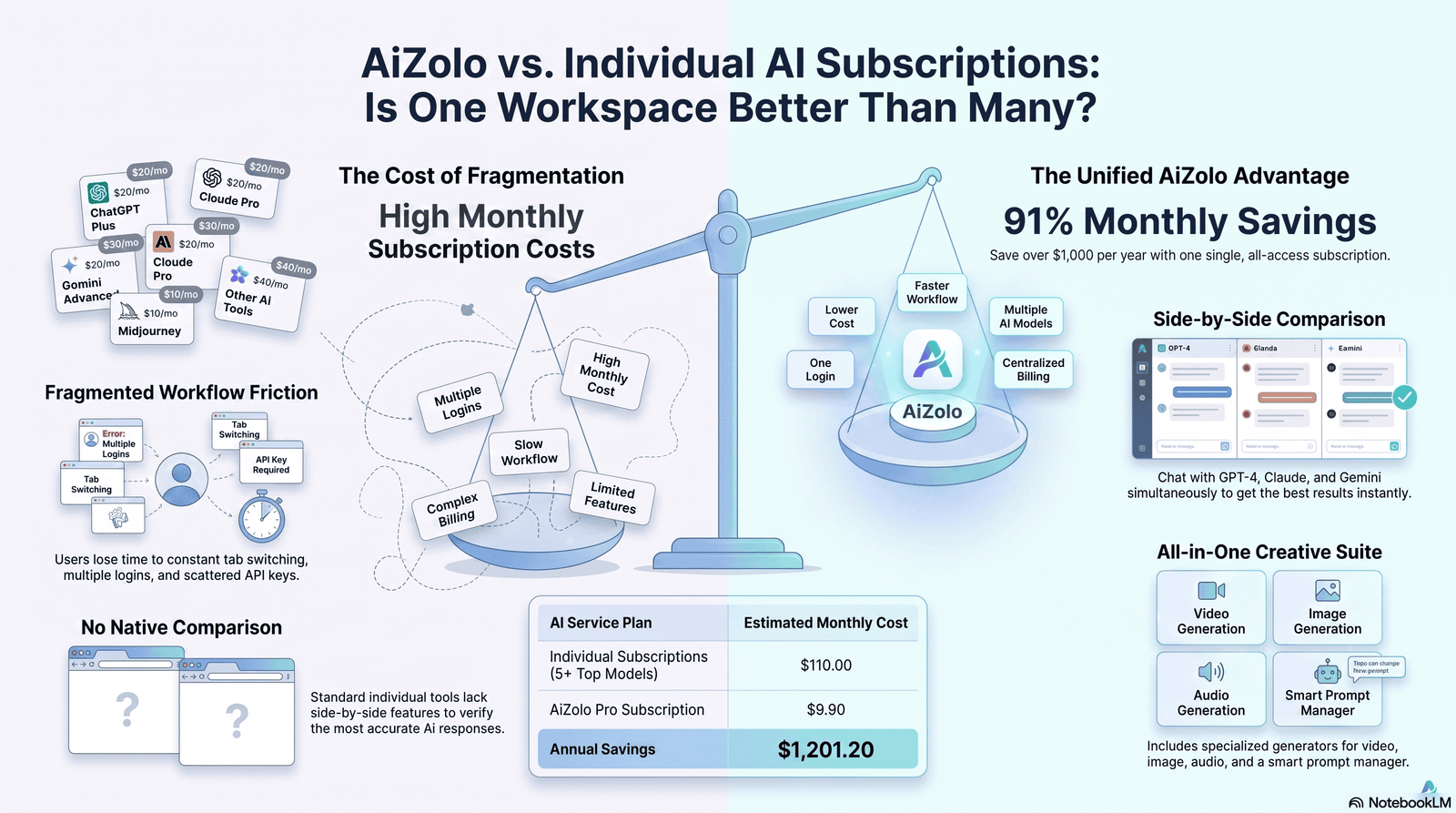
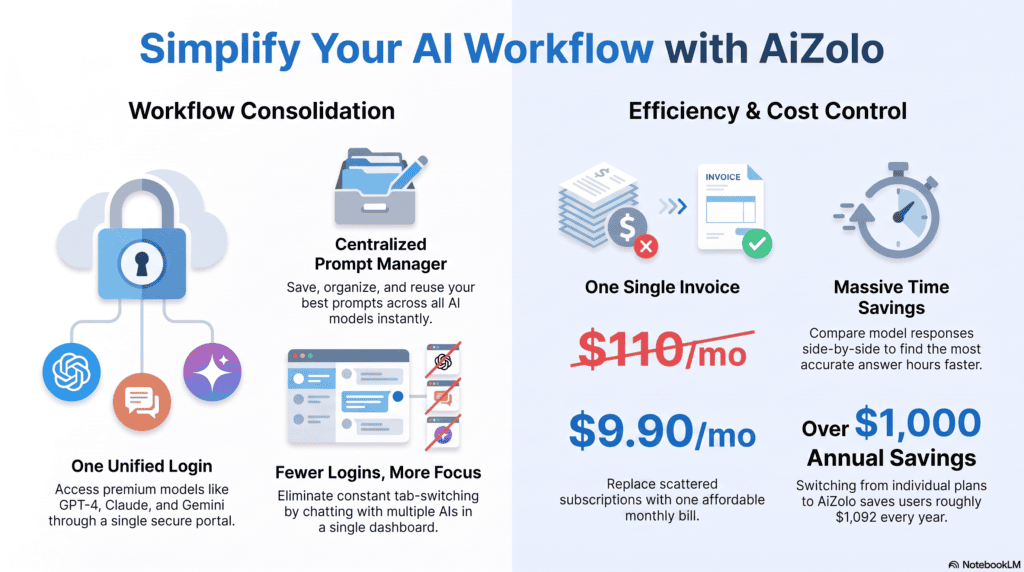
If you use more than one AI model regularly, you’ve probably done the math already. ChatGPT Plus is $20 a month. Claude Pro is another $20. Add Google AI Pro, Perplexity Pro, or SuperGrok, and you’re suddenly running a small software budget just to ask questions and generate content. Aizolo helps reduce that complexity by giving you access to multiple leading AI models in one place, so you don’t have to manage separate subscriptions for every tool.
This is the exact problem Aizolo was built to solve — a single subscription that gives you access to multiple AI models instead of five separate logins, five separate bills, and five separate interfaces.
But “cheaper” and “better” aren’t automatically the same thing. This article breaks down the real costs, the real trade-offs, and who actually benefits from a unified AI workspace versus who is better off subscribing to each tool directly.
Note on pricing: AI subscription pricing changes frequently. The figures in this article reflect publicly listed pricing as of mid-2026 and were checked against official pricing pages. Always confirm current pricing directly with each provider before making a purchasing decision.
Table of Contents
Quick Answer (Featured Snippet)
Is Aizolo better than buying individual AI tools?
For most people who regularly use two or more AI models, Aizolo is the more cost-efficient option because it bundles access to multiple models under one lower monthly price instead of several $20+ subscriptions. Buying individual tools is still the better choice if you need the absolute highest usage limits, the newest features the moment they launch, or deep native integrations (like Claude Code or Gemini inside Google Workspace) that a third-party workspace can’t fully replicate.
Quick Comparison Table
| Factor | Aizolo (Unified Workspace) | Buying Individual AI Tools |
|---|---|---|
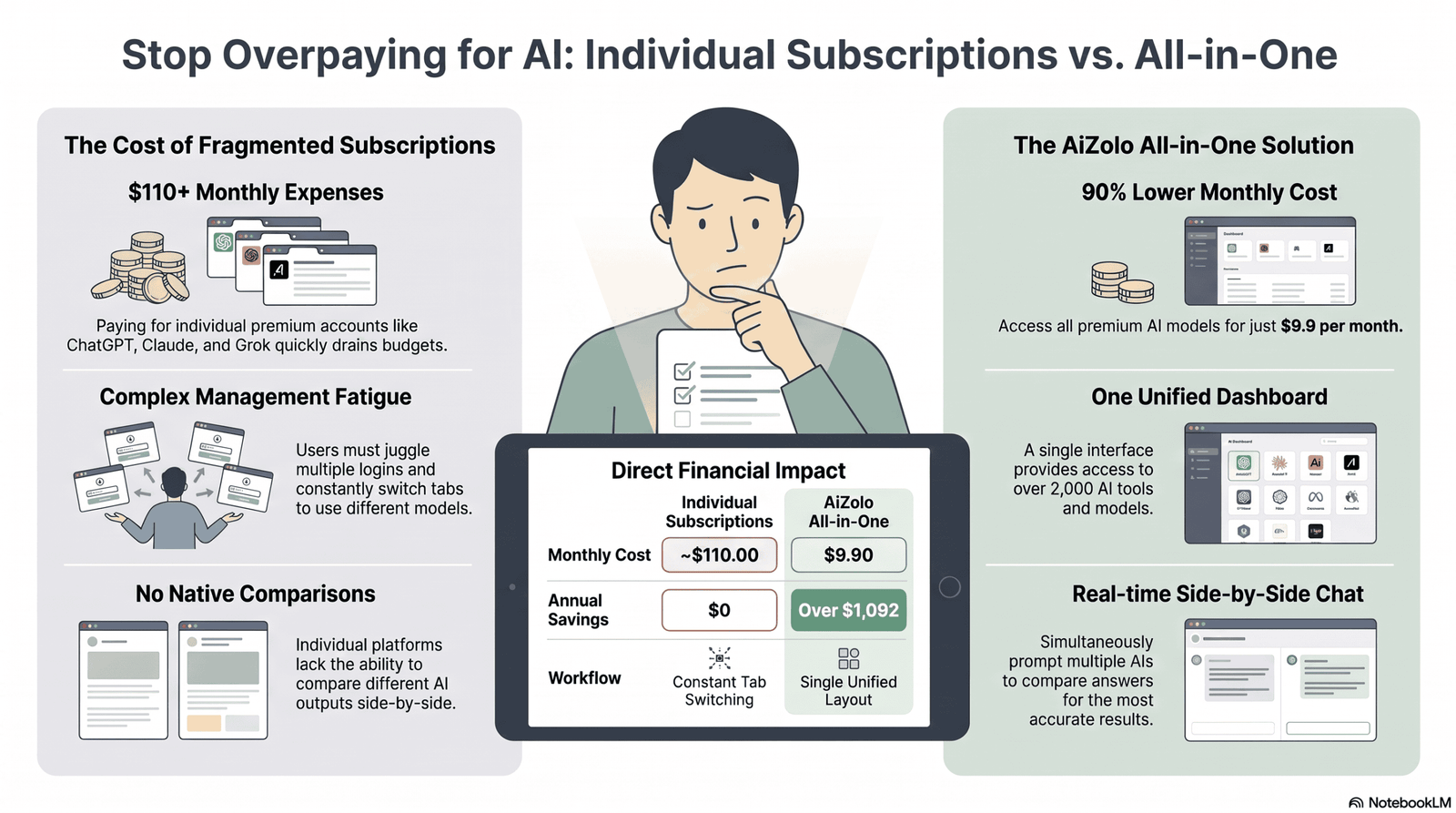
| Monthly cost | ~$9.90/mo (Pro), ~$8.33/mo billed annually | ~$20 each; $90–$110+/mo for four to five tools |
| Models in one place | Yes — ChatGPT, Claude, Gemini, Grok, Perplexity Sonar Pro, and more | No — one login and interface per model |
| Side-by-side comparison | Yes, built-in | Not natively; requires manual tab-switching |
| Newest flagship features | Slight delay possible as models are added | Immediate, direct from provider |
| Highest usage tiers | Limited by monthly token allowance | Available (e.g., ChatGPT Pro, Claude Max) |
| Image/video/audio generation | Included in one plan | Usually separate subscriptions |
| Native ecosystem integration | Limited | Deep (e.g., Gemini in Docs, Claude Code in your IDE) |
| Best for | Multi-model users, budget-conscious professionals, creators | Power users needing one model at maximum capacity |
Pricing is approximate and subject to change. Verify current rates on each provider’s official pricing page before subscribing.
What Aizolo Is
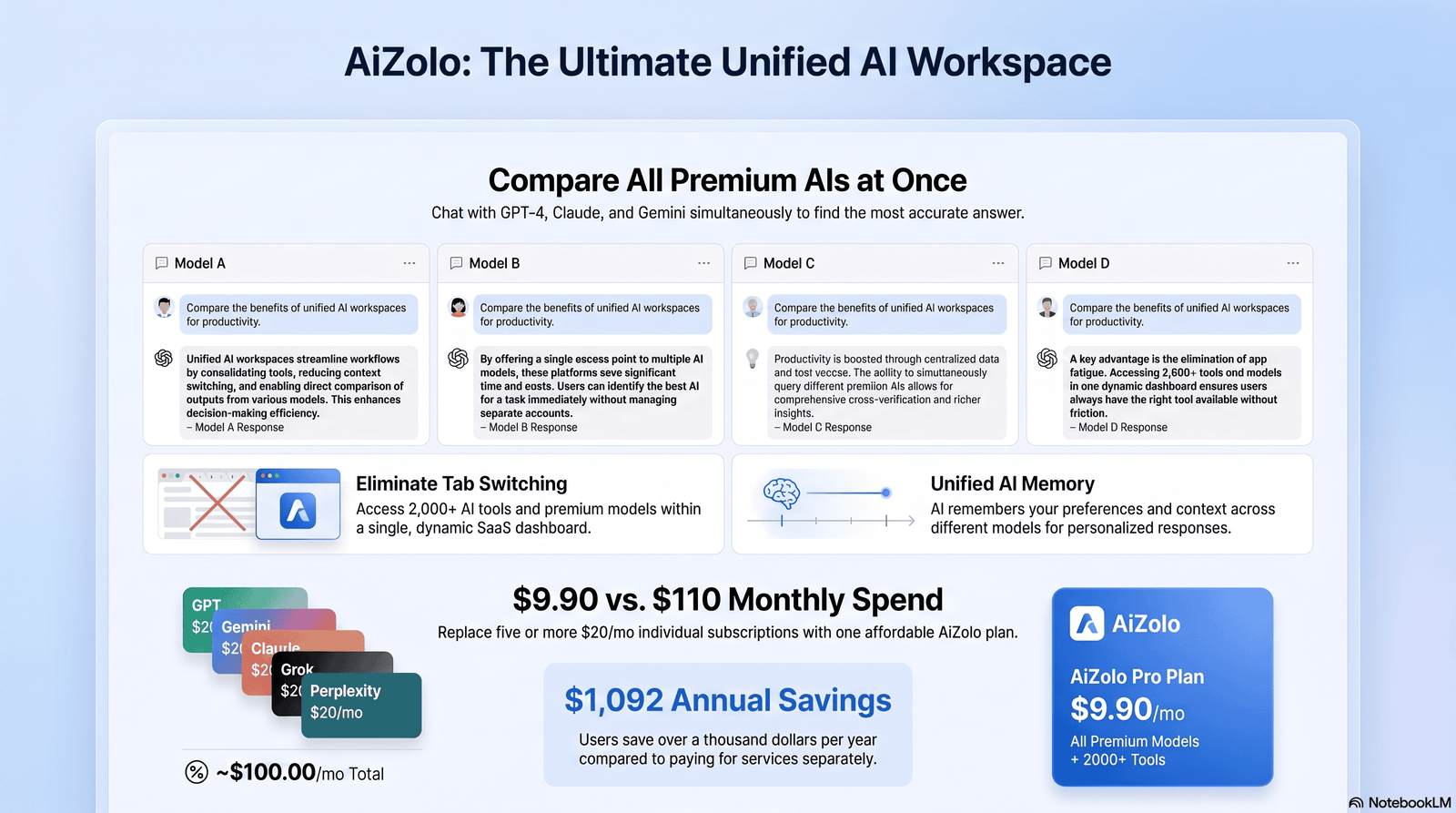
Aizolo is an all-in-one AI workspace that gives users access to several major AI models — including ChatGPT, Claude, Gemini, Grok, and Perplexity Sonar Pro — from a single dashboard and subscription.
Instead of logging into five different apps, you run your prompt once and can send it to multiple models at the same time. The platform displays the responses side by side so you can compare quality, tone, and accuracy before choosing which output to use.
Beyond chat, Aizolo also includes image, video, and audio generation tools in the same interface, along with a prompt manager for saving reusable prompts and a memory feature that carries context and preferences between sessions.
Users can also import existing conversation history from ChatGPT or Claude, and connect their own API keys for any model they already pay for directly.
What Buying Individual AI Tools Means
Buying individual AI tools means subscribing directly to each provider: OpenAI for ChatGPT, Anthropic for Claude, Google for Gemini, xAI for Grok, and Perplexity for Perplexity Pro.
Each subscription gives you full, first-party access to that model, including the newest features the moment they ship, the provider’s own usage limits, and any native integrations that model offers.
The trade-off is that each tool lives in its own app, with its own login, its own billing cycle, and its own interface conventions. If you use three models regularly, that’s three separate places to manage your work.
For many professionals, this is the default setup simply because it’s what they started with — not necessarily because it was a deliberate decision.
How Professionals Actually Use Multiple AI Models
Very few people who use AI heavily rely on just one model for everything. In practice, different models tend to specialize:
- Claude is frequently used for long-form writing, coding tasks, and document-heavy work.
- ChatGPT is often used for quick ideation, multimodal tasks, and general-purpose assistance.
- Gemini tends to be preferred by people already inside Google Workspace, for its integration with Docs, Sheets, and Gmail.
- Perplexity is commonly chosen specifically for research tasks that require cited sources.
- Grok is used by people who want real-time access to X/Twitter data or DeepSearch-style research.
This pattern — using the “right model for the right task” — is exactly why multi-model workspaces like Aizolo exist.
If everyone only ever used one model, the cost-comparison in this article wouldn’t matter much. But most professionals, founders, and agencies genuinely do move between models depending on the task.
Subscription Cost Comparison
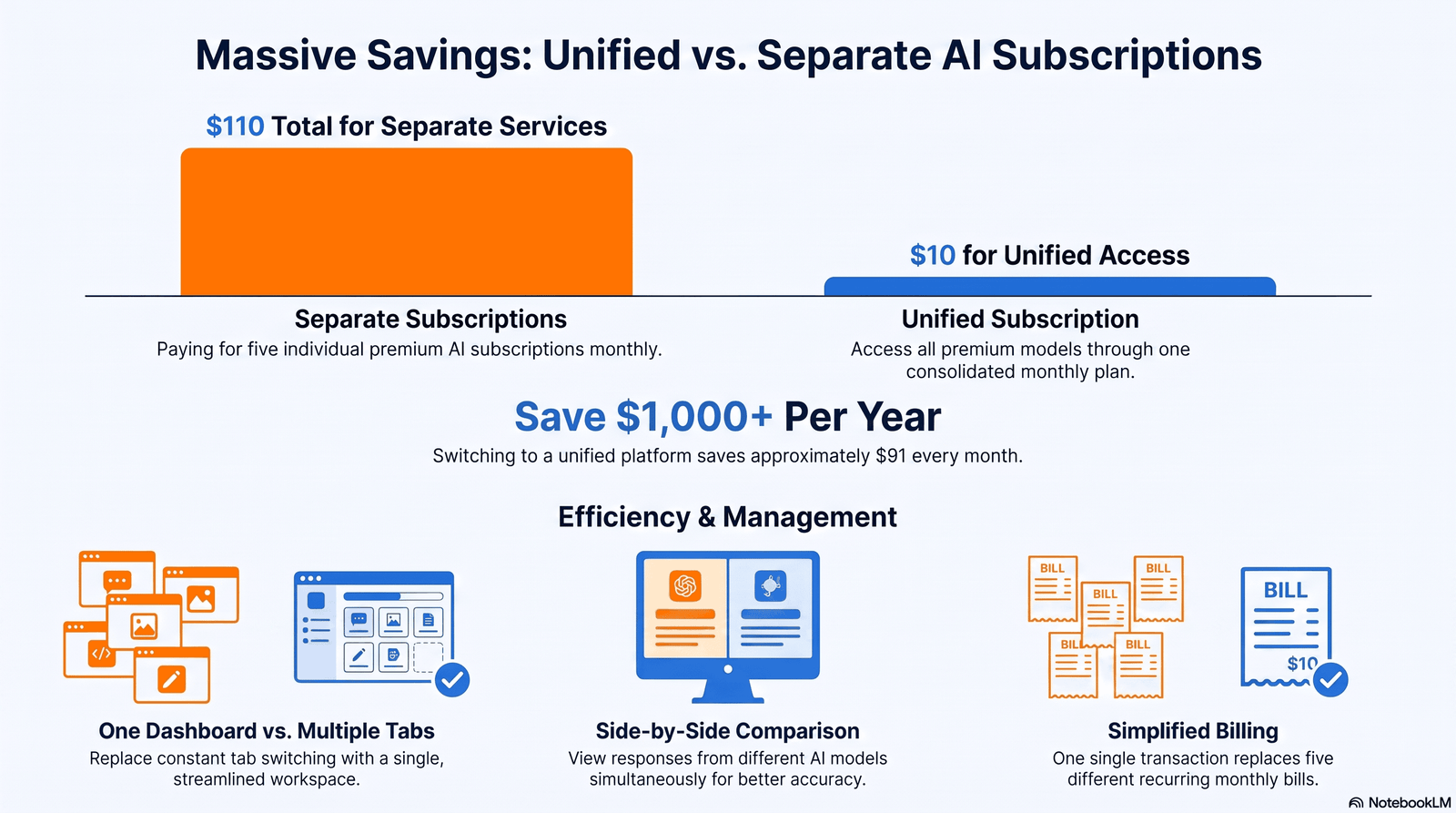
Here is what the standard paid tiers of major AI tools cost as of mid-2026, compared to Aizolo’s Pro plan.
| Tool | Standard Paid Tier | Monthly Price* |
|---|---|---|
| ChatGPT Plus | Standard consumer tier | $20/mo |
| Claude Pro | Standard consumer tier | $20/mo |
| Google AI Pro (Gemini) | Standard consumer tier | $19.99/mo |
| Perplexity Pro | Standard consumer tier | $20/mo |
| SuperGrok | Standard standalone tier | $30/mo |
| Combined total (all five) | — | ~$110/mo |
| Aizolo Pro | Access to all major models in one plan | ~$9.90/mo (~$8.33/mo billed annually) |
Prices are publicly listed rates as of mid-2026 and change periodically. Always confirm current pricing directly with each provider and with Aizolo before subscribing.
If your workflow genuinely requires two or more of these tools every week, the arithmetic favors a bundled workspace. If you only ever use one model, this comparison is largely irrelevant — you’d just pay that one provider directly.
It’s also worth being precise about what you’re comparing. Aizolo’s token allowance is not unlimited, and it isn’t identical to the rate limits each provider sets on its own paid tier. A fair comparison looks at whether your actual usage fits inside Aizolo’s monthly token allocation, not just the sticker price.
Hidden Costs Most People Ignore
The monthly subscription fee is rarely the full cost of running multiple AI tools. A few costs are easy to overlook:
Underused seats. Many professionals pay for a tool’s full price but only use a fraction of its capability, because switching tools mid-task feels like friction.
Duplicate creative tools. Image, video, and audio generation are often billed as separate add-ons or entirely separate products, stacking on top of your core chat subscriptions.
Time spent re-explaining context. Every time you move a task from one AI tool to another, you lose the conversation history and have to re-establish context manually.
Annual auto-renewal creep. Subscriptions renew automatically at “then-current” pricing, which can quietly increase year over year if you’re not checking.
None of these costs show up on a single invoice, which is exactly why they’re easy to underestimate when comparing “$20/month” against a bundled alternative.
The Context-Switching Problem
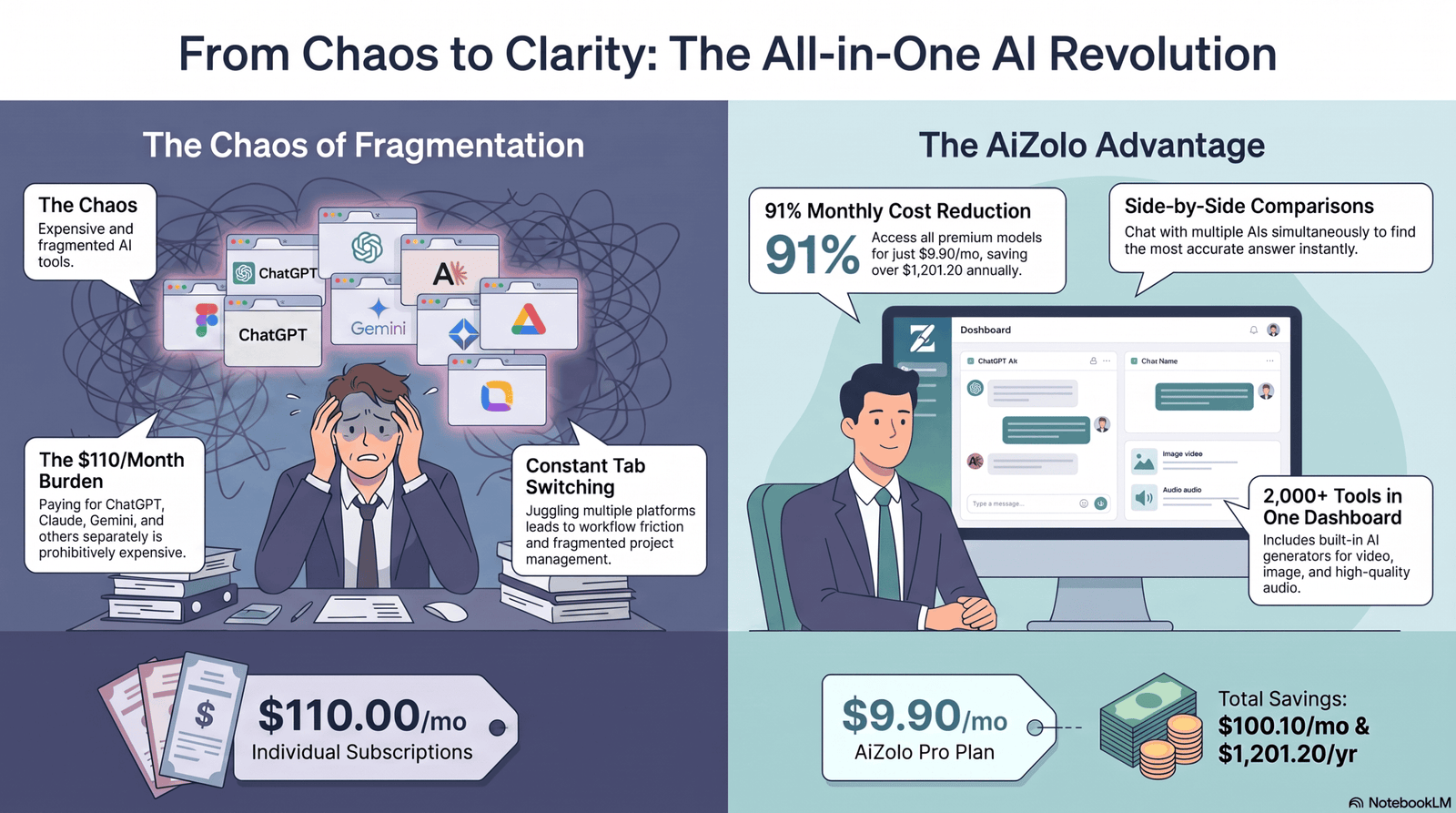
Context switching is the productivity cost of moving between tools, tabs, and mental models. It’s well documented in general knowledge-work research, and it applies directly to AI usage.
Every time you leave ChatGPT to open Claude, you’re not just opening a new tab. You’re re-loading the context of what you were doing, re-typing or re-pasting your source material, and re-establishing the thread of your thinking.
This is one of the more overlooked arguments for a unified workspace: it’s not just about saving money, it’s about reducing the number of times per day your attention gets interrupted by switching environments.
That said, this benefit is genuinely proportional to how often you switch models. If you use one tool for 95% of your work, context switching isn’t costing you much, and a unified workspace won’t meaningfully change your day.
Workflow Comparison
| Workflow Step | Aizolo | Individual Tools |
|---|---|---|
| Logging in | One login for all models | Separate login per tool |
| Running the same prompt on multiple models | Native, simultaneous | Manual copy-paste across tabs |
| Reusing prompts | Built-in prompt manager | Manual notes or separate prompt tools |
| Carrying context between sessions | AI memory feature | Per-tool memory only, not shared |
| Switching to a new/better model | Toggle within the same dashboard | New signup, new billing, new interface |
| Bringing your own API key | Supported for most models | Not applicable — you’re the direct customer |
Model Access Comparison
| Model | Available via Aizolo | Available via Direct Subscription | Notes |
|---|---|---|---|
| ChatGPT (GPT-4o and newer) | Yes | Yes | Direct subscription unlocks OpenAI’s newest features first |
| Claude (Sonnet/Opus) | Yes | Yes | Claude Pro includes Claude Code, not available through most aggregators |
| Gemini | Yes | Yes | Google AI Pro integrates natively with Workspace apps |
| Grok | Yes | Yes | SuperGrok includes deeper X/Twitter data access |
| Perplexity Sonar Pro | Yes | Yes | Perplexity Pro includes a capped number of Deep Research runs |
Direct subscriptions will generally always have an edge in one respect: they are first in line for new features, deeper native integrations, and provider-specific tools (like Claude Code for developers or Gemini inside Google Docs). A workspace like Aizolo adds new models as they become available, which can mean a short lag between a model’s public launch and its availability inside the platform.
Productivity Comparison
| Metric | Aizolo | Individual Tools |
|---|---|---|
| Time to compare 3 model outputs on one prompt | Seconds (simultaneous) | Several minutes (manual switching) |
| Number of logins per day for multi-model users | 1 | 3–5 |
| Prompt reuse across models | Centralized | Manual, tool-specific |
| Learning curve | One interface to learn | One interface per tool |
| Billing overhead | One invoice | Multiple invoices, multiple renewal dates |
Productivity gains here are real but concentrated in one specific behavior: comparing or switching between models. If your work genuinely only needs one model, these numbers don’t move the needle much for you.
Who Should Buy Individual AI Tools
A unified workspace isn’t the right fit for everyone. Buying individual tools directly still makes sense if you:
- Need the highest usage tier a provider offers, such as ChatGPT Pro or Claude Max, for near-unlimited usage of one specific model.
- Rely on deep native integrations, like Claude Code inside your IDE, or Gemini embedded across Gmail, Docs, and Sheets.
- Only use one model consistently and have no real need to compare outputs across providers.
- Need access to a provider’s newest features on day one, without waiting for a third-party platform to integrate them.
- Are working under enterprise compliance requirements that mandate a direct vendor relationship.
If any of these describe your situation, the monthly savings of a bundled subscription may not outweigh what you’d give up.
Who Should Choose Aizolo

A unified workspace tends to make the most sense if you:
- Regularly use two or more AI models for different parts of your work.
- Want to compare outputs before committing to one model’s answer, especially for important or client-facing work.
- Are a student, freelancer, or early-stage founder on a tight software budget.
- Create a mix of text, images, video, or audio and don’t want separate subscriptions for each format.
- Value having one login, one invoice, and one interface over having the single most powerful version of any one tool.
Pros and Cons
| Pros | Cons | |
|---|---|---|
| Aizolo | Lower combined cost; one dashboard; built-in comparison; includes image/video/audio tools | Token allowance is capped; slight lag on brand-new model releases; fewer native ecosystem integrations |
| Individual Tools | First access to new features; highest usage ceilings; deep native integrations | Higher combined cost; separate logins and billing; no built-in cross-model comparison |
Real Use Cases
A solo content creator scripting videos, generating thumbnails, and writing captions may find a bundled workspace covers text, image, and basic video generation without stacking three separate creative subscriptions.
A software developer who relies heavily on Claude Code’s IDE integration is likely better served subscribing to Claude Pro directly, since that specific integration isn’t replicated by third-party aggregators.
A small marketing agency juggling client work across ChatGPT, Claude, and Gemini may benefit from centralizing all three under one login with shared prompt templates for consistency across the team.
A university student on a tight budget who occasionally needs to double-check an answer across models may find a low-cost bundled plan is enough, without justifying $60+/month across three separate subscriptions.
Pricing Analysis
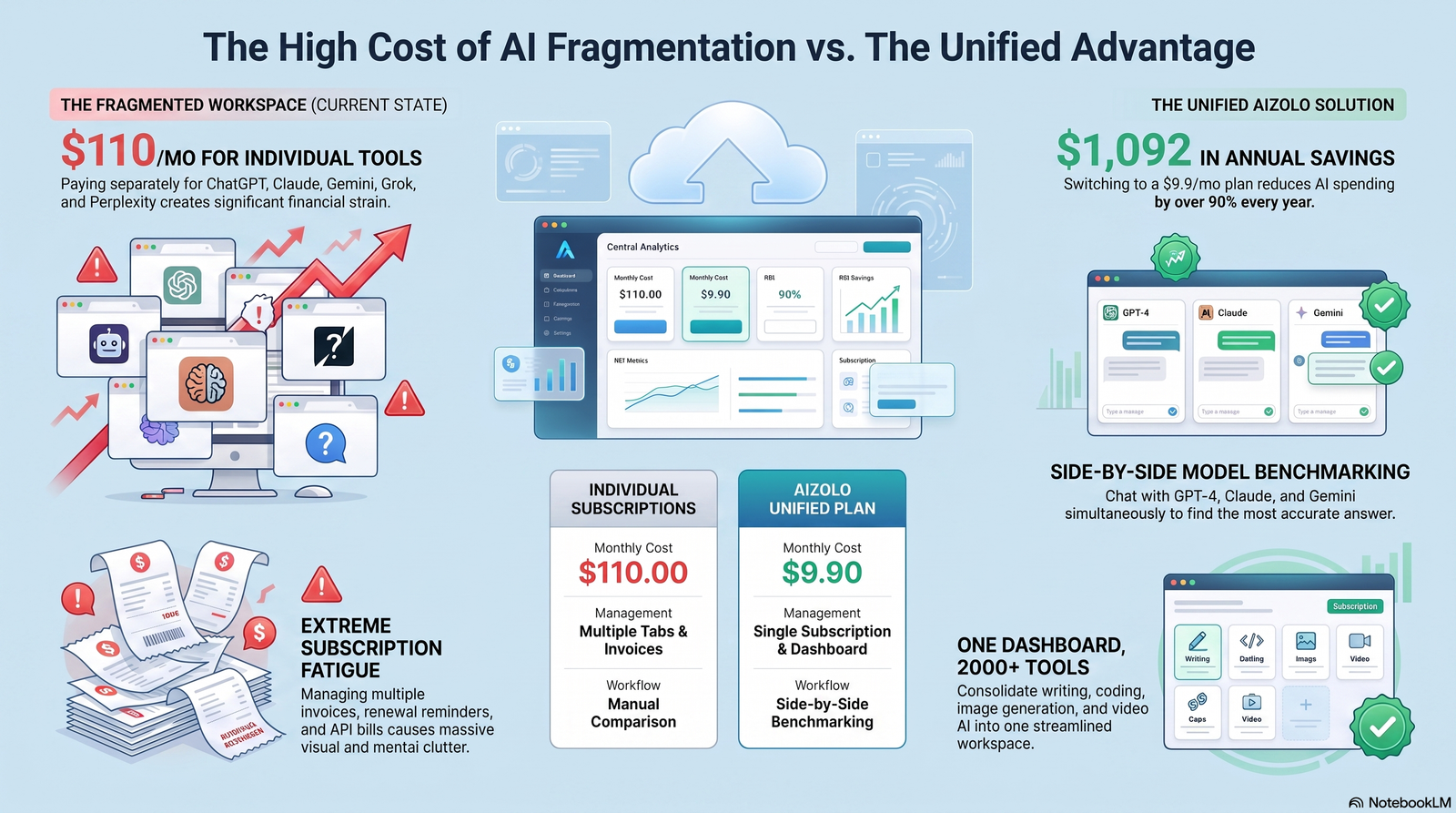
Looking purely at list prices, subscribing to ChatGPT Plus, Claude Pro, Google AI Pro, and Perplexity Pro individually runs about $80/month combined, and closer to $110/month if SuperGrok is included. Aizolo’s Pro plan is publicly listed at roughly $9.90/month, or about $8.33/month if billed annually at $99.90/year.
That gap is significant on paper. But a fair pricing analysis has to account for what you’re actually getting at each price point:
- Direct subscriptions typically include higher rate limits on their respective model.
- Aizolo’s plan includes a fixed monthly token allowance (publicly listed as 3,000,000 tokens on the Pro plan) rather than unlimited usage.
- Aizolo supports bringing your own API keys, which can extend usage beyond the platform’s own allowance if you already pay providers directly for API access.
In practice, the better question isn’t “which is cheaper on paper” — it’s “does my actual usage fit comfortably inside the cheaper option’s limits.” Light-to-moderate multi-model users usually come out ahead with a bundle. Heavy single-model power users often don’t.
ROI Examples
A useful way to think about return on investment here is annualized savings versus annualized limitations.
Example 1 — Multi-model professional: Someone paying for ChatGPT Plus, Claude Pro, and Google AI Pro individually spends roughly $720/year. Switching to a bundled Pro plan at roughly $119/year (monthly billing) represents a potential saving of around $600/year, assuming their usage stays within the bundle’s token allowance.
Example 2 — Single-model developer: A developer who relies exclusively on Claude Pro for Claude Code sees little ROI from switching, since the value they get is tied to a native integration a bundled workspace doesn’t fully replicate.
Example 3 — Creative freelancer: Someone currently paying separately for a chat AI subscription and an image-generation tool may find that consolidating both into one plan reduces their total AI spend by half or more, depending on their current stack.
These are illustrative scenarios, not guaranteed outcomes — your actual ROI depends entirely on your specific usage pattern and which features you rely on most.
Common Mistakes
Comparing sticker price only. $9.90 vs. $20 looks like an easy win, but usage limits, not just price, determine real-world value.
Ignoring native integrations you already depend on. If your workflow is built around one provider’s ecosystem, switching platforms can cost more in disruption than it saves in dollars.
Assuming “unlimited” claims are truly unlimited. Most plans, on both sides of this comparison, have some form of rate limit, token cap, or fair-use policy. Read the specifics before committing.
Not testing on a free tier first. Both individual providers and bundled platforms typically offer free tiers. Running your actual, real-world prompts through a free tier before paying is the most reliable way to judge fit.
Frequently Asked Questions
Is Aizolo cheaper than subscribing to ChatGPT, Claude, and Gemini separately? Yes, in most cases. Publicly listed pricing puts Aizolo’s Pro plan at roughly $9.90/month, compared to about $60/month for those three tools combined. Actual savings depend on your usage staying within Aizolo’s token allowance.
Does Aizolo give you the exact same AI models as the originals? Aizolo provides access to the same underlying models (like GPT-4o, Claude, and Gemini) through its interface, either via its own token allowance or your own connected API key. Response quality is generally consistent with the original provider.
Can I use my existing ChatGPT or Claude subscription with Aizolo? Aizolo supports connecting your own API keys and importing existing conversation history from ChatGPT and Claude, which lets you keep prior context while using the unified dashboard.
Is buying individual AI subscriptions ever the better choice? Yes. If you rely on one model’s highest usage tier, or on integrations that only exist within that provider’s own ecosystem (like Claude Code or Gemini in Google Workspace), a direct subscription usually delivers more value.
Does Aizolo have a free plan? Aizolo offers a free tier with limited model access and a capped monthly token allowance, according to its official pricing page, allowing you to test the platform before upgrading.
What happens if I exceed Aizolo’s monthly token limit? You can either upgrade to a higher plan or connect your own API keys for the models you use most, which lets usage continue beyond the platform’s included allowance.
Is Aizolo good for developers? It can be useful for developers who want to compare code suggestions across multiple models, but it doesn’t fully replace IDE-native tools like Claude Code for developers whose workflow depends on that specific integration.
How does Aizolo handle image and video generation? Aizolo includes image, video, and audio generation tools within the same subscription, which can reduce the need for separate creative-AI subscriptions for users who need those formats occasionally.
Is a multi-model AI workspace worth it if I only use one AI tool? Generally, no. The cost and workflow benefits of a bundled platform are tied to using multiple models. If you consistently use only one model, subscribing directly to that provider is usually simpler and may offer higher usage limits.
Does Aizolo support annual billing? Yes, Aizolo lists an annual plan at a lower effective monthly rate than its monthly plan, according to its official pricing page.
Are there hidden fees with either option? Direct subscriptions can auto-renew at increased “then-current” pricing over time. Aizolo’s official pricing page states no hidden fees, with cancellation available anytime and a limited refund window if no premium tokens have been used. Always review the current terms directly.
What’s the biggest downside of switching from individual subscriptions to a unified workspace? The most common trade-off is losing first-day access to brand-new provider features and giving up deep native integrations that only work inside a provider’s own app or ecosystem.
Final Verdict
There isn’t a single universal answer to whether Aizolo is better than buying individual AI tools — it depends on how you actually use AI day to day.
If you regularly move between two or more models, want to compare their outputs, and are trying to control software costs, a unified workspace like Aizolo is very likely the more efficient option, both financially and in terms of daily workflow friction.
If your work depends on one model’s highest usage tier or a deep, provider-specific integration, buying that tool directly is still the smarter move — no bundled platform fully replicates a native ecosystem.
The most reliable way to decide is to test your own real prompts on a free tier of both approaches before committing a full year of budget to either one.
Author Bio
Jeevesh Tripathi Email: jeevesh@aizolo.com
Jeevesh Tripathi writes about AI platforms, productivity workflows, and SaaS tool comparisons, with hands-on experience managing and evaluating multiple AI subscriptions across content, development, and research workflows. His work focuses on practical, evidence-based comparisons rather than promotional claims, with an emphasis on helping readers match tools to their actual usage patterns rather than following trends.