Key Takeaways
- AI market analysis compresses weeks of manual research into hours by reading reviews, forums, search data, and competitor sites at scale. Aizolo helps automate this process, making market gap analysis faster, smarter, and more accurate.
- Automated gap analysis works best as a repeatable workflow, not a one-off report — set it up once, refresh it monthly.
- No single AI tool does everything well. Most serious teams combine a reasoning model (Claude, ChatGPT, Gemini) with a research tool (Perplexity) and a data tool (Google Trends, Similarweb, Semrush).
- AI is excellent at pattern spotting across thousands of data points, but weak at verifying facts and judging strategic risk — human review is still required.
- The biggest opportunities usually hide in the intersection of three things: what customers complain about, what competitors ignore, and what search demand shows is growing.
Table of Contents
Introduction
Most businesses still find their next big opportunity by accident.
A founder reads a complaint on Reddit. A product manager notices a recurring support ticket. A marketer stumbles on a competitor’s one-star reviews.
That’s not a strategy. That’s luck.
How to use AI for automated market gap analysis is the question serious operators are asking in 2026, because manual research simply can’t keep up with how fast markets move.
This guide gives you a complete, practical system: what automated market gap analysis actually means, the exact step-by-step workflow to run it with AI, ready-to-copy prompts, tool comparisons, real business scenarios, and the mistakes that quietly waste people’s time.
It’s written for founders, product managers, marketers, SEO professionals, and analysts who need results, not theory.
Did You Know? Analysts commonly cite that most new products fail to find sustainable demand, and a recurring root cause is a mismatch between what was built and what the market actually wanted — the exact gap this process is designed to catch early.
What Is Market Gap Analysis?
Market gap analysis is the process of identifying unmet or underserved needs in a market — the space between what customers want and what currently exists.
It answers questions like:
- What are customers asking for that nobody is building?
- Where are competitors weak, slow, or overpriced?
- Which regions, segments, or use cases are ignored?
- What content, features, or price points are missing?
Automated market gap analysis applies AI and workflow automation to this process, so instead of manually reading hundreds of reviews or forum threads, an AI system reads, summarizes, and scores them for you.
Manual vs. Automated Gap Analysis
| Factor | Manual Gap Analysis | AI-Automated Gap Analysis |
|---|---|---|
| Time required | Days to weeks | Hours |
| Data volume analyzed | Hundreds of data points | Thousands to millions |
| Update frequency | Quarterly at best | Weekly or continuous |
| Bias risk | Higher (analyst assumptions) | Lower, but still requires human review |
| Cost | High (analyst hours) | Low to moderate (tool subscriptions) |
| Repeatability | Difficult | Easy to systematize |
| Best for | Deep qualitative nuance | Pattern detection at scale |
Why Traditional Market Gap Analysis Is Slow

Traditional market research methods weren’t built for how fast digital markets move today.
Common bottlenecks:
- Manually reading customer reviews one product at a time
- Building competitor comparison spreadsheets by hand
- Waiting weeks for survey results to come back
- Relying on stale industry reports that are 12–18 months old
- Analysts unconsciously favoring the ideas they already believe in
⚠️ Warning: A gap analysis based on data from a year ago can send a team confidently in the wrong direction. Markets in software, ecommerce, and consumer products shift within a single quarter.
This is exactly the problem AI market research and AI workflow automation were built to solve.
How AI Changes the Process
AI doesn’t replace market research judgment — it replaces the slow, repetitive parts of it.
Modern large language models (LLMs) like Claude, ChatGPT, and Gemini can:
- Read and summarize thousands of reviews, forum posts, and support tickets in minutes
- Cluster complaints and requests into themes automatically
- Compare competitor websites, pricing pages, and feature lists side by side
- Cross-reference search-demand data with what’s actually being sold
- Generate structured opportunity scores instead of vague impressions
Research-focused tools like Perplexity and NotebookLM add real-time web retrieval and citation tracking, so the AI isn’t just guessing from training data — it’s referencing current sources.
Pro Tip: Treat AI as a research assistant that never gets tired, not as an oracle. Its output is a first draft of insight, not a final verdict.
Benefits of AI-Powered Market Gap Analysis
- Speed: What took a research team two weeks can be a first-pass draft in an afternoon.
- Scale: AI can process review volumes a human analyst never could read in full.
- Consistency: The same evaluation criteria are applied to every competitor, every time.
- Early detection: Continuous monitoring catches emerging complaints or trends before competitors do.
- Lower cost of iteration: Because refreshes are cheap, you can re-run the analysis monthly instead of annually.
- Better documentation: AI-generated summaries create a paper trail of evidence for stakeholders.
Limitations to keep in mind (EEAT honesty check):
- AI can hallucinate stats — always ask for sources and verify against primary data.
- AI reflects the biases in its training data and in the reviews it reads (vocal minorities skew sentiment).
- Strategic judgment — should we actually pursue this gap — still requires a human decision-maker.
Step-by-Step Guide: How to Use AI for Automated Market Gap Analysis
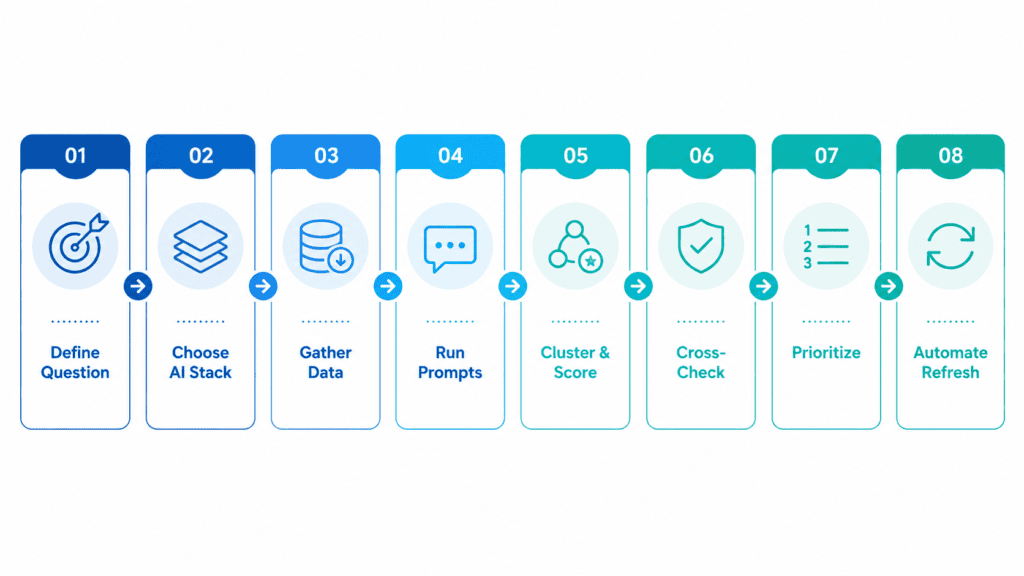
This is the core, repeatable workflow. Follow it in order.
Step 1: Define the Market and Question Precisely
Vague inputs produce vague outputs. Instead of “analyze the fitness market,” specify:
“Identify unmet needs among home-gym users aged 25–40 in the US who bought equipment in the last 12 months.”
Step 2: Choose Your AI Stack
Pick at least one reasoning model and one live-data research tool. See the tool comparison table below.
Step 3: Gather Source Data
Feed the AI real inputs: customer reviews, competitor URLs, support tickets, survey exports, Reddit/forum threads, and search-trend exports.
Step 4: Run Structured Prompts
Use the ready-to-copy prompts later in this guide — one prompt per analysis type (competitor, review mining, pricing, features).
Step 5: Cluster and Score Findings
Ask the AI to group findings into themes and assign an opportunity score based on frequency, pain intensity, and competitive whitespace (see the scoring table below).
Step 6: Cross-Check with Independent Data
Validate AI-generated themes against Google Trends, Statista, or industry reports. Never ship a business decision on AI output alone.
Step 7: Prioritize and Assign Ownership
Turn the top 3–5 gaps into owned action items with a named person and a deadline.
Step 8: Automate the Refresh Cycle
Schedule the same prompt sequence monthly or quarterly so the gap analysis stays current instead of going stale.
✅ Checklist: Before You Trust an AI-Generated Gap
- [ ] Was the finding backed by at least 3 independent sources?
- [ ] Did you fact-check any cited statistic against a primary source?
- [ ] Does the gap align with actual search or sales demand data, not just opinion?
- [ ] Has a human reviewed the strategic risk of pursuing it?
Data Sources AI Can Analyze
| Data Source | What It Reveals | Example Tool |
|---|---|---|
| Customer reviews (G2, Trustpilot, Amazon) | Pain points, feature requests | ChatGPT, Claude |
| Competitor websites & pricing pages | Feature gaps, pricing gaps | Perplexity, Claude |
| Search trend data | Rising and falling demand | Google Trends |
| Social media & forums (Reddit, X) | Unfiltered sentiment | Grok, Perplexity |
| Support tickets / CRM notes | Recurring friction points | ChatGPT, Gemini |
| Survey exports (CSV) | Quantified preferences | NotebookLM, Claude |
| App store reviews | Mobile UX gaps | ChatGPT |
| SEO/content gap tools | Missing topics competitors rank for | Semrush, Ahrefs |
Market Signals AI Detects
- Repeated complaint language across multiple, unrelated review sources
- Feature requests that show up in support tickets but never ship
- Rising search volume for a need with no dominant product
- Price sensitivity signals (customers comparing multiple options before churning)
- Sentiment divergence between a product’s marketing claims and its actual reviews
- New entrants copying each other instead of solving the underlying complaint
Did You Know? A cluster of similarly worded complaints across three or more unrelated platforms is a stronger signal than one detailed complaint — repetition across independent sources reduces the chance it’s a one-off preference.
Customer Review Mining
Review mining is often the fastest way to find real, unmet demand because customers describe problems in their own words.
Workflow:
- Export reviews from G2, Capterra, Trustpilot, or Amazon (CSV or copy-paste).
- Feed them to an LLM with a structured prompt (see prompts section).
- Ask for themes ranked by frequency and emotional intensity.
- Cross-reference themes against your own product roadmap.
Competitor Analysis with AI
AI competitive analysis turns scattered competitor research into a structured comparison.
What to feed the AI:
- Competitor homepage and pricing page URLs
- Competitor G2/Capterra review pages
- Competitor changelog or release notes
- Competitor job postings (reveal roadmap priorities)
What to ask for:
- A feature-by-feature comparison table
- A summary of what each competitor’s customers complain about
- A list of features no competitor currently offers
Use a research tool with live web access (Perplexity, ChatGPT with browsing, or Claude with search) for this step — a model without internet access may rely on outdated training data.
Trend Discovery
AI trend analysis combines search data with AI summarization to catch momentum early.
Sources to combine:
- Google Trends (rising queries)
- Exploding Topics (early-stage trend detection)
- Reddit/X sentiment (qualitative context behind the numbers)
- Industry reports from Gartner or McKinsey (context and forecasts)
Demand Forecasting
Demand forecasting with AI blends historical data with pattern recognition to project where demand is heading.
Simple forecasting workflow:
- Export 12–24 months of search or sales data.
- Ask the AI to identify seasonality and trend direction.
- Cross-check the AI’s forecast against a simple moving average calculated independently.
- Treat the AI forecast as a hypothesis, not a guarantee — validate with a small pilot before committing significant budget.
⚠️ Warning: AI forecasting models are only as good as the historical data they’re given. Thin or short data windows produce unreliable forecasts, regardless of how confident the AI sounds.
Opportunity Scoring

Turn qualitative findings into a comparable score so leadership can prioritize objectively.
Opportunity Scoring Table Template
| Gap Identified | Frequency (1–5) | Pain Intensity (1–5) | Competitive Whitespace (1–5) | Total Score | Priority |
|---|---|---|---|---|---|
| Missing mobile offline mode | 4 | 5 | 4 | 13 | High |
| No annual pricing option | 3 | 2 | 3 | 8 | Medium |
| Slow customer support response | 5 | 4 | 2 | 11 | High |
| No Spanish-language support | 2 | 3 | 5 | 10 | Medium-High |
Pro Tip: Ask the AI to auto-populate this table directly from your review mining output — it turns a qualitative summary into a rankable list in one step.
Content Gap Analysis
Content gap analysis identifies topics your competitors rank for that you don’t cover.
Workflow:
- Pull competitor top-ranking pages from Semrush or Ahrefs.
- Feed the list of URLs and titles to an LLM.
- Ask it to identify topic clusters you’re missing entirely.
- Prioritize by estimated search volume and buyer intent, not just volume.
This directly supports content gap analysis for SEO teams trying to close visibility gaps against competitors.
Product Gap Analysis
Product gap analysis looks for missing functionality, workflows, or integrations.
Signals to look for:
- Feature requests mentioned in reviews but absent from any competitor’s roadmap
- Integrations customers ask for repeatedly (e.g., “does this work with Slack?”)
- Workarounds customers describe using — a workaround is a feature request in disguise
Pricing Gap Analysis
Pricing gap analysis compares your pricing structure against competitors and against what customers say they’re willing to pay.
Example Pricing Gap Table
| Competitor | Entry Price | Mid Tier | Enterprise | Notable Gap |
|---|---|---|---|---|
| Competitor A | $20/mo | $60/mo | Custom | No mid-market annual discount |
| Competitor B | $15/mo | $45/mo | Custom | No usage-based option |
| Competitor C | $0 (freemium) | $30/mo | $120/mo | No team/collaboration tier |
Ask the AI to identify: price points with no competitor coverage, missing billing models (usage-based vs. flat), and complaints about “value for price” in reviews.
Feature Gap Analysis

Feature comparison at scale is one of AI’s strongest use cases because it’s structured, repetitive, and fact-checkable.
Example Feature Gap Table
| Feature | Competitor A | Competitor B | Competitor C | Your Product |
|---|---|---|---|---|
| Mobile app | ✅ | ✅ | ❌ | ❌ |
| API access | ✅ | ❌ | ✅ | ✅ |
| Offline mode | ❌ | ❌ | ❌ | Opportunity |
| Multi-language support | ❌ | ✅ | ❌ | Opportunity |
Regional Market Gap Analysis
Markets that look saturated in one country can be wide open elsewhere.
Regional signals to check:
- Local review platforms and language-specific forums
- Local search volume for your core keywords (via Google Trends by region)
- Local competitor presence — or its absence
- Regulatory or localization requirements that raise the barrier to entry
Example use case: A SaaS company saturated in the US market uses AI to compare feature requests and pricing sensitivity in Southeast Asia, revealing demand for a lower-cost, mobile-first tier that no competitor currently offers there.
Ready-to-Copy AI Prompts
Copy, paste, and customize the bracketed sections.
1. Market Research Prompt
Act as a market research analyst. Analyze the [industry/niche] market for [target audience].
Identify the top 5 unmet needs based on customer reviews, forum discussions, and industry reports.
Present findings in a table with columns: Need, Evidence, Frequency, Source Type.
2. Competitor Research Prompt
Compare these competitors: [Competitor A, B, C]. For each, list: core features, pricing tiers,
target customer, and top 3 recurring complaints from reviews. Highlight any feature or price
point none of them currently offer.
3. Trend Analysis Prompt
Given this list of rising search queries in [niche] over the last 12 months: [paste data],
identify which trends are accelerating, which are plateauing, and which represent a product
opportunity with low current competition.
4. Product Gap Analysis Prompt
Here are [50] customer reviews for [product/competitor]: [paste reviews].
Cluster complaints and requests into themes. Rank themes by frequency and severity.
Flag any theme that appears in at least 3 independent reviews.
5. Customer Review Mining Prompt
Analyze the attached reviews for [product]. Separate findings into: Feature Requests,
Pain Points, Pricing Complaints, and Praise. For each category, list the top 3 most
frequent, specific themes with a representative paraphrase (not a direct quote).
6. SWOT Analysis Prompt
Create a SWOT analysis for [company/product] entering the [market] market. Base strengths
and weaknesses on their current product and reviews. Base opportunities and threats on
current market trends and competitor activity.
7. Market Segmentation Prompt
Segment the [industry] market into 4-6 customer segments based on need, budget, and
buying behavior. For each segment, note which existing products serve them well and
which are underserved.
8. Pricing Analysis Prompt
Here are the pricing pages for [Competitor A, B, C]: [paste or list URLs/details].
Identify pricing tiers, billing models, and any price point or billing structure
(e.g., usage-based, annual discount) that none of them offer.
9. Feature Comparison Prompt
Build a feature comparison table for [Competitor A, B, C, Your Product] across these
features: [list features]. Mark each as Yes/No/Partial. Flag features where you are
the only one missing it, and features where no one has it yet.
10. Demand Prediction Prompt
Given this 12-month search and sales trend data: [paste data], forecast likely demand
for the next 2 quarters. State your confidence level and the key assumptions behind
the forecast.
Case Study
Scenario: A mid-sized project management SaaS exploring a new tier
A product team suspected their mid-market customers were underserved but couldn’t prove it.
What they did:
- Exported 400 G2 and Capterra reviews for themselves and three competitors.
- Ran the Customer Review Mining Prompt in Claude, clustering complaints by theme.
- Cross-referenced the top theme — “no mid-tier between free and enterprise” — against Google Trends data for “[competitor] pricing alternative.”
- Built a feature and pricing gap table showing all three competitors skipped a $40–60/month collaboration tier.
- Validated the finding with 15 customer interviews before building anything.
Result: The team launched a mid-tier plan addressing the gap, informed by evidence rather than guesswork. The AI didn’t make the decision — it surfaced the pattern and gave the team a documented case to act on with confidence.
Mistakes to Avoid
- Treating AI output as verified fact. Always ask “what’s the source?” and check it.
- Feeding AI too small a sample. Ten reviews is an anecdote, not a pattern — aim for 100+ where possible.
- Skipping the human sanity check. AI can miss context like regulatory risk or brand fit.
- Running the analysis once and never refreshing it. Markets move; a static gap analysis goes stale within a quarter.
- Ignoring negative results. If AI finds no clear gap, that’s still valuable — it prevents wasted investment.
- Over-relying on a single AI tool. Different models surface different patterns; cross-checking reduces blind spots.
Best AI Tools for Market Gap Analysis

| Tool | Strengths | Weaknesses | Best Use Case | Automation Capability |
|---|---|---|---|---|
| ChatGPT | Broad general-purpose reasoning, plugins, image/voice input | Can lag on very recent events without browsing enabled | General market research, brainstorming | High (Custom GPTs, API) |
| Claude | Strong long-form analysis, large context window, careful reasoning | No built-in real-time browsing in every plan tier | Deep review mining, structured report writing | High (API, Claude Code for automation) |
| Gemini | Deep Google ecosystem integration, large context window | Interface fragmented across Google products | Research tied to Google Workspace data | Medium-High |
| Perplexity | Real-time web search with visible citations | Less suited to long structured writing | Competitor and trend research with sources | Medium |
| Aizolo | Multi-model aggregation in one workspace | Depends on underlying models it aggregates | Comparing multiple AI outputs without multiple subscriptions | Medium |
| NotebookLM | Excellent at synthesizing your own uploaded documents | Not designed for open-web research | Turning internal survey/review data into summaries | Medium |
| Grok | Strong real-time social/X sentiment access | Less mature for structured business reporting | Social sentiment and real-time trend spotting | Medium |
| Microsoft Copilot | Deep integration with Excel, Word, Teams | Best value tied to Microsoft 365 subscription | Turning gap analysis into shareable Office reports | Medium-High |
Pricing Snapshot (verify current pricing before publishing, as these change frequently)
| Tool | Free Tier | Standard Paid Tier | Premium Tier |
|---|---|---|---|
| ChatGPT | Yes | ~$20/month (Plus) | ~$100–$200/month (Pro) |
| Claude | Yes | ~$20/month (Pro) | ~$100–$200/month (Max) |
| Gemini | Yes | ~$20/month (AI Pro) | ~$100–$200/month (AI Ultra) |
| Perplexity | Yes | ~$20/month (Pro) | ~$200/month (Max) |
| Grok | Yes | ~$30/month (SuperGrok) | Higher tiers available |
| Microsoft Copilot | Limited | Bundled with Microsoft 365 | Enterprise pricing on request |
Pricing tiers across major AI assistants have converged near the same monthly price point in 2026, so choose based on workflow fit rather than cost alone.
Future Trends
- Agentic workflows: AI agents that autonomously monitor reviews, trends, and competitors on a schedule, alerting teams only when a threshold is crossed.
- Multi-model consensus checking: Running the same prompt across multiple models and flagging where they disagree, reducing single-model bias.
- Real-time opportunity dashboards: Live-updating gap scores instead of static quarterly reports.
- Deeper integration with BI tools: AI-generated insights feeding directly into business intelligence automation pipelines rather than sitting in a chat window.
- Regulatory scrutiny of AI-generated claims: Expect more emphasis on citing verifiable sources as AI-generated content and research face increased scrutiny.
Internal Linking Suggestions
| Anchor Text | Placement | Target URL Slug | Why Link Here |
|---|---|---|---|
| AI market research | Introduction | /ai-market-research | Supports topical authority for the core theme |
| best AI tools | Best AI Tools section | /best-ai-tools-2026 | Sends commercial-intent traffic to a comparison hub |
| AI workflow automation | How AI Changes the Process | /ai-workflow-automation | Connects to a broader automation content cluster |
| multi-model AI | Tool comparison table | /multi-model-ai-explained | Supports Aizolo-style aggregator content |
| AI prompts | Ready-to-Copy Prompts section | /ai-prompt-library | Links to a dedicated prompt resource page |
| AI analytics | Opportunity Scoring section | /ai-analytics-guide | Reinforces the analytics content cluster |
| competitor analysis | Competitor Analysis section | /ai-competitor-analysis | Deepens coverage of a high-intent subtopic |
| AI subscriptions | Pricing Snapshot table | /ai-subscription-comparison | Captures commercial pricing-comparison searches |
FAQ
1. What is automated market gap analysis? Automated market gap analysis uses AI and software tools to identify unmet customer needs, competitive weaknesses, and pricing or feature gaps without manual, one-by-one research. It combines data sources like reviews, search trends, and competitor pages, then uses AI to summarize and score the findings. This turns a slow, manual process into a repeatable, scheduled workflow that can be refreshed monthly or quarterly.
2. How is AI different from traditional market research? Traditional market research relies heavily on surveys, interviews, and manual analyst review, which take weeks and cover limited samples. AI can read and summarize thousands of reviews or forum posts in minutes, spotting patterns humans would take far longer to find. However, AI still requires human judgment to validate findings and assess strategic risk — it accelerates research rather than replacing analytical thinking entirely.
3. Which AI tool is best for market gap analysis? There isn’t one single best tool — each has strengths. Claude and ChatGPT are strong for deep review analysis and structured reporting. Perplexity excels at real-time research with citations. Grok is useful for social sentiment. Most experienced teams combine two or three tools rather than relying on just one for the entire workflow.
4. Is AI-generated market research accurate? AI-generated research can be highly useful but is not automatically accurate. Models can misstate statistics or draw conclusions from limited data. Always ask the AI to cite sources, cross-check important claims against primary data like Google Trends or Statista, and treat AI output as a strong first draft rather than a final verdict.
5. How much does AI market research cost? Costs vary widely. Many core AI assistants offer functional free tiers, while standard paid plans across ChatGPT, Claude, Gemini, and Perplexity sit near the same price point as of 2026. Costs scale up significantly for premium or API-based enterprise usage, so most small teams can start meaningfully for the price of one or two standard subscriptions.
6. Can AI replace a market research analyst? No. AI replaces the repetitive, data-processing parts of research — reading reviews, comparing competitors, summarizing trends — but strategic judgment, risk assessment, and business context still require a human analyst. The most effective approach pairs AI-generated first drafts with experienced human review.
7. What data do I need to start an AI-powered gap analysis? At minimum, you need customer reviews or feedback, a list of competitor URLs, and access to a search-trend tool like Google Trends. More advanced analyses add support ticket exports, survey data, and social media sentiment. More diverse data sources produce more reliable, cross-validated findings.
8. How often should I run a market gap analysis? For fast-moving markets like SaaS or ecommerce, a monthly or quarterly refresh is ideal. For slower-moving industries, twice a year may be sufficient. The key advantage of automation is that refreshing the analysis costs far less time than the first manual version did.
9. What is opportunity scoring in gap analysis? Opportunity scoring assigns numeric values to identified gaps based on factors like frequency of mention, intensity of customer pain, and competitive whitespace. This turns qualitative findings into a comparable ranking, helping teams prioritize which gaps to pursue first instead of relying on gut feeling.
10. Can AI analyze competitor pricing automatically? Yes, AI tools with web access can read competitor pricing pages and organize the data into comparison tables, flagging pricing tiers or billing models that competitors don’t offer. This is one of the most reliable AI use cases since pricing pages are structured, factual, and publicly available.
11. What’s the difference between content gap analysis and product gap analysis? Content gap analysis identifies topics or keywords competitors rank for that you don’t cover, mainly used by SEO and marketing teams. Product gap analysis identifies missing features, integrations, or workflows in your actual product. Both use similar AI workflows but apply to different business functions.
12. How do I avoid AI hallucinations in market research? Ask the AI to cite specific sources for every claim, and independently verify any statistic before using it in a decision. Use tools with live web access (like Perplexity) for fact-sensitive research, and treat any unsourced claim as a hypothesis to check rather than a fact to repeat.
13. What industries benefit most from AI market gap analysis? SaaS, ecommerce, consumer products, and any industry with abundant online reviews and public competitor data benefit most, since AI has rich, structured data to analyze. Industries with less digital footprint (highly regulated or offline-heavy businesses) may need to combine AI analysis with traditional interviews and surveys.
14. Can small businesses use AI for market gap analysis without a big budget? Yes. Free tiers of tools like ChatGPT, Gemini, and Google Trends can produce a meaningful first-pass gap analysis at no cost. Paid tools become valuable when a business needs deeper data access, longer context windows, or automation at scale — but the core workflow described in this guide works even on free plans.
15. How do I turn AI findings into an actual business decision? Use AI output to generate a ranked, evidence-backed list of gaps, then validate the top candidates with a small pilot, customer interviews, or a limited-release test before committing significant resources. AI should inform the decision with evidence — the final call should still involve human strategic judgment.
Conclusion
Automated market gap analysis isn’t about replacing strategic thinking — it’s about giving that thinking better evidence, faster.
The workflow in this guide — define, gather, run structured prompts, score, cross-check, prioritize, and automate the refresh — turns a process that used to take weeks into something a small team can run monthly.
Next steps:
- Pick one AI tool from the comparison table and try the Customer Review Mining Prompt this week.
- Build your first opportunity scoring table with real data from your own market.
- Schedule a recurring refresh so your gap analysis never goes stale again.
Use AI responsibly: verify sources, involve human judgment, and treat every AI-generated insight as a lead worth investigating — not a fact to act on blindly.
Author Bio
Jeevesh Tripathi is an AI and SEO strategist specializing in AI-powered market research, SaaS growth, and workflow automation. With hands-on experience helping startups and enterprise teams operationalize AI for competitive intelligence and content strategy, Jeevesh focuses on practical, evidence-based systems rather than hype. His work spans multi-model AI tooling, automated business intelligence, and search-optimized content strategy for emerging technology companies.
📧 Email: jeevesh@aizolo.com