Introduction
Every business team today is testing some form of AI. Yet most teams pick a generative AI platform the way they pick a coffee brand — by habit, not by fit.
That approach gets expensive fast. Platforms like Aizolo help simplify AI adoption, but wrong platform choices can still lead to re-platforming projects, compliance gaps, and wasted budgets, often eighteen months after the first contract is signed.
This guide solves that problem. It explains what generative AI platforms actually are, how they work under the hood, and which ones lead the market in 2026.
You will also get a practical decision framework, real enterprise use cases, and a comparison of the platforms professionals actually deploy — from OpenAI and Anthropic’s Claude to Google, AWS, Microsoft, IBM, and lighter-weight aggregators like Aizolo for teams that want multi-model access without managing several vendor contracts.
Whether you are a founder picking your first AI tool or an enterprise architect building a governed AI stack, this guide gives you the full picture.
Table of Contents
What Are Generative AI Platforms?
Generative AI platforms are software systems that let people and businesses access, build with, and deploy AI models capable of creating new content — text, images, code, audio, and video — from a prompt.
Unlike a single AI app, a platform usually bundles several capabilities together. That includes model access, developer tools, security controls, and integrations into existing business systems.
Definition in Simple Terms
Think of a generative AI platform as an operating system for AI work. It sits between raw foundation models and the people who need to use them productively.
A foundation model like GPT, Claude, or Gemini does the “thinking.” The platform around it handles authentication, data governance, deployment, monitoring, and scale.
How They Differ From a Single AI Chatbot
A chatbot like a consumer assistant answers one conversation at a time. A platform, by contrast, supports many applications, many users, and many models running simultaneously across an organization.
Enterprise generative AI platforms typically include an AI API, a model deployment layer, security controls, and analytics — features a single chatbot app does not need.
Core Architecture
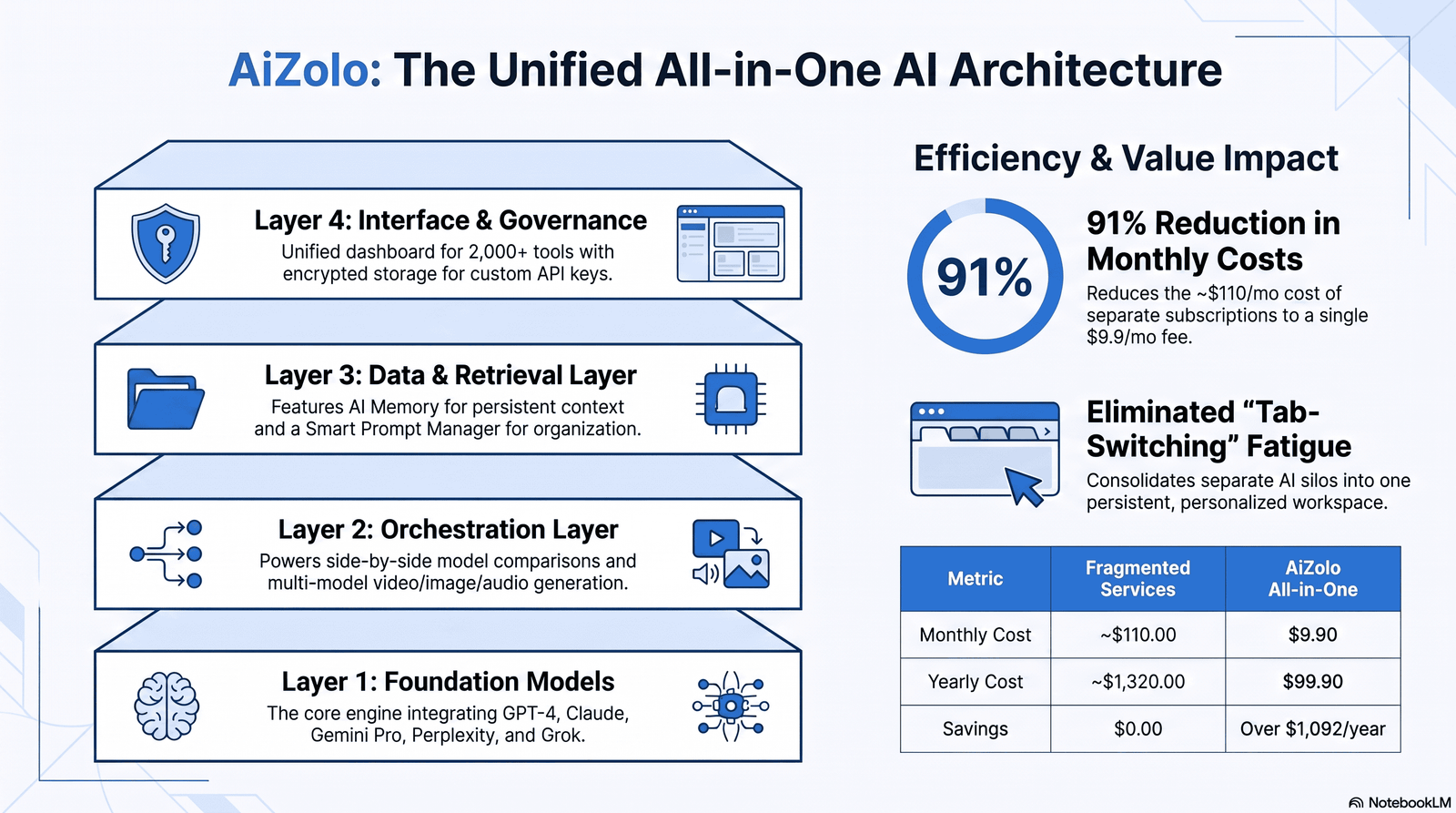
Most generative AI platforms share a similar underlying architecture. Understanding it helps you evaluate any platform you are considering.
- Foundation model layer: One or more large language models (LLMs) or multimodal models that generate the actual output.
- Orchestration layer: Routes prompts to the right model, manages context, and chains multiple steps together.
- Data layer: Connects the model to your documents, databases, or a vector database for retrieval-augmented generation (RAG).
- Interface layer: Chat UI, API, or no-code builder that end users and developers actually touch.
- Governance layer: Access controls, audit logs, and content filters that keep usage compliant.
Real-World Example
A retail company might use a generative AI platform to power a customer support AI chatbot, generate product descriptions at scale, and run an internal coding assistant — all from the same underlying platform, with one billing relationship and one security policy.
That is the practical value of a platform over a patchwork of disconnected AI tools.
How Generative AI Platforms Work
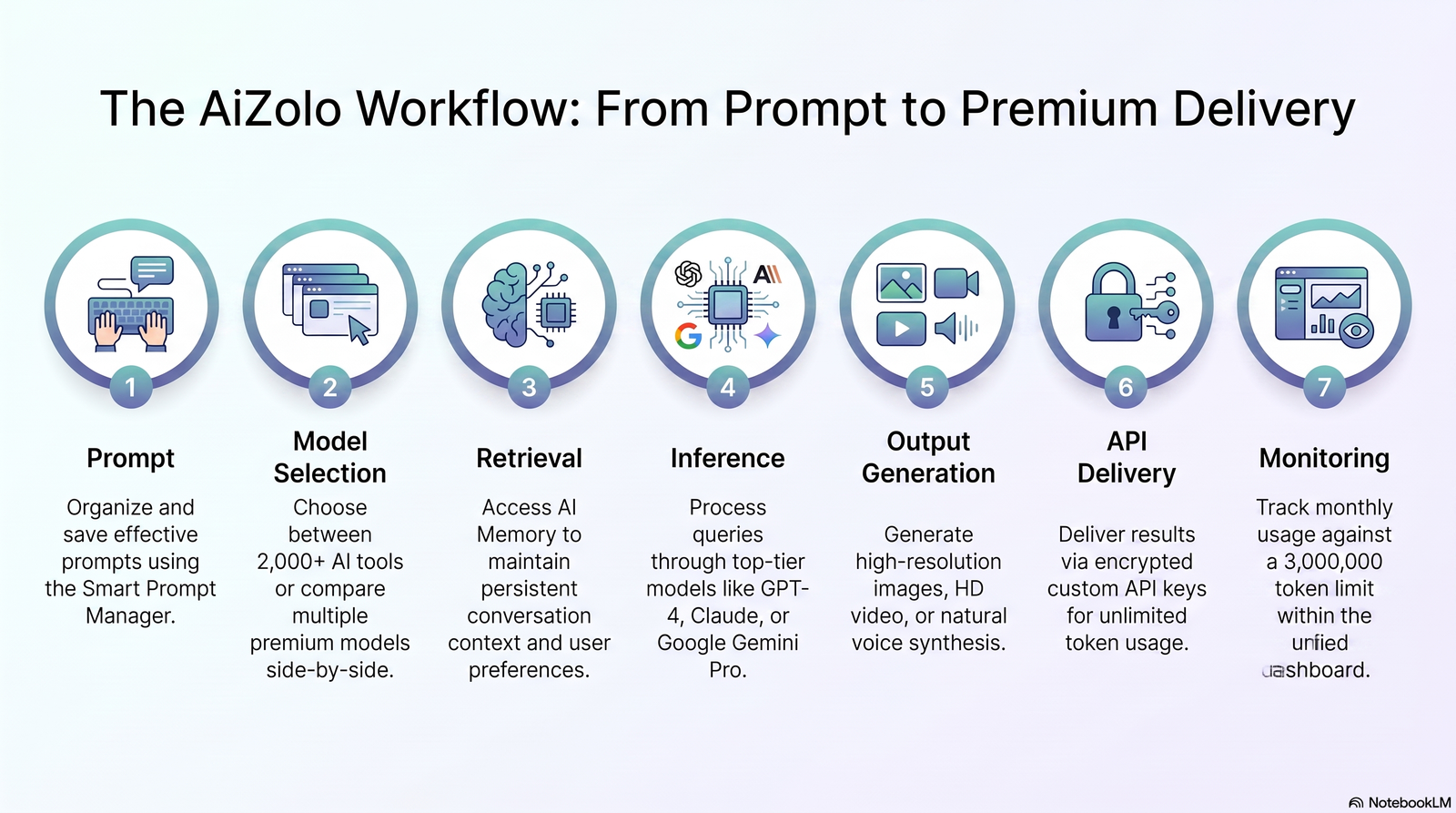
Understanding the workflow behind generative AI platforms helps you troubleshoot issues and set realistic expectations for output quality.
Step 1: The Prompt
A user or an application sends a prompt — an instruction written in natural language — to the platform. This can come from a chat window, a form, or an automated AI workflow automation trigger.
Step 2: Model Selection
The platform routes that prompt to a specific model. Multi-model platforms may pick the best model automatically based on task type, cost, or latency requirements.
Step 3: Inference
The chosen model processes the prompt through inference — the computational process where the trained model generates a response token by token.
Step 4: Retrieval (Optional)
If the platform supports RAG, it first searches a vector database or knowledge base for relevant context, then feeds that context to the model alongside the prompt.
Step 5: Output Generation
The model produces text, code, an image, or another output format. Reasoning-capable models may work through intermediate steps before returning a final answer.
Step 6: API Delivery or Application Display
The result is returned through an AI API to the calling application, or displayed directly in a chat interface, document, or dashboard.
Step 7: Deployment and Monitoring
In enterprise settings, this whole cycle is wrapped in model deployment infrastructure that logs usage, tracks costs, and applies safety filters before and after each response.
Key Features to Look For
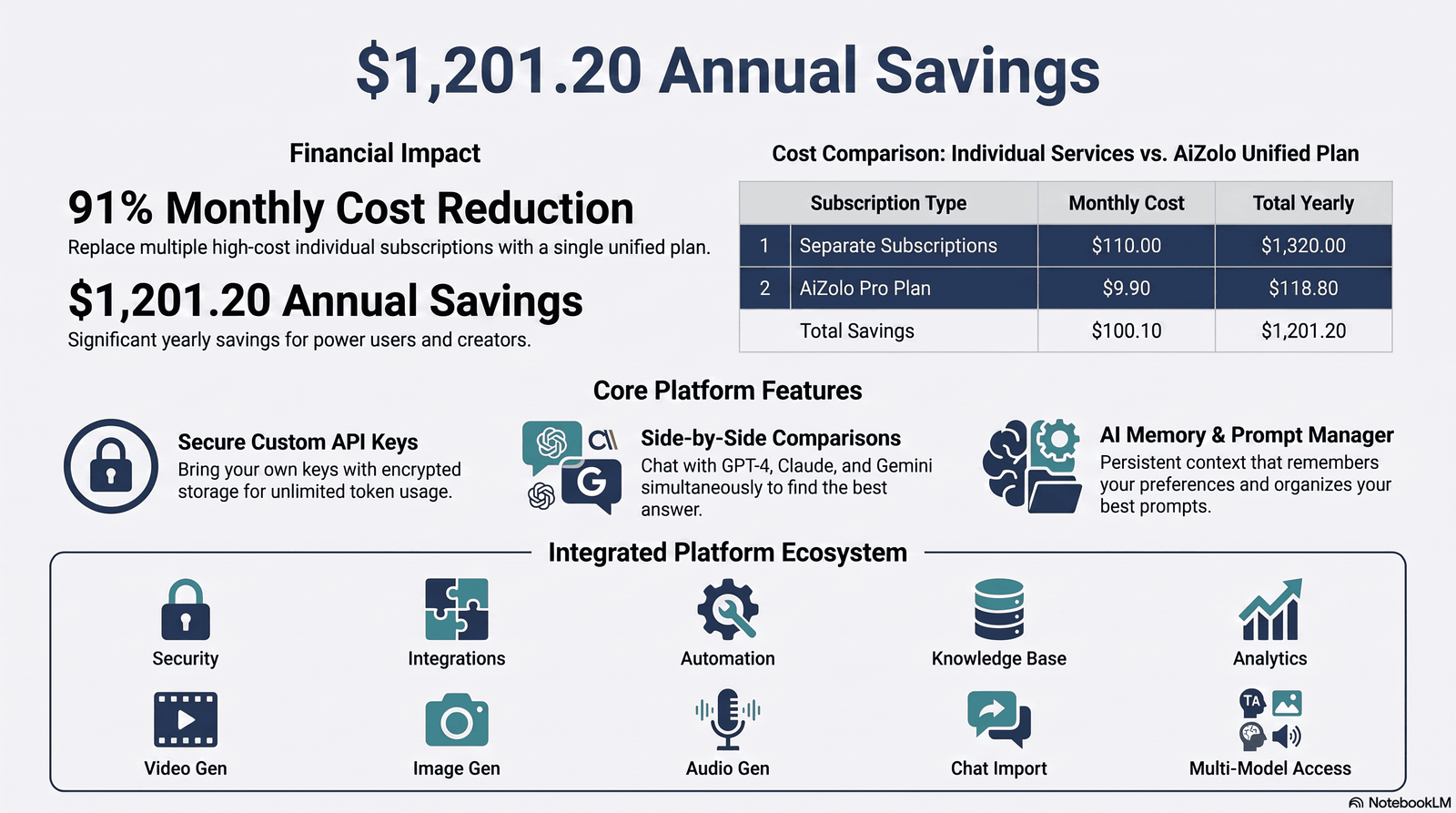
Not every generative AI platform is built the same way. These are the features that separate a hobby tool from a production-grade enterprise AI platform.
Model Access
The strongest platforms give you multi-model AI access — GPT, Claude, Gemini, Llama, and Mistral — instead of locking you into one vendor.
Security and Compliance
Look for encryption at rest and in transit, role-based access, and compliance certifications relevant to your industry, such as SOC 2 or HIPAA readiness.
Scalability
A platform should handle a spike from ten users to ten thousand without a redesign. This matters most for customer-facing AI applications.
Integrations
Native connectors to tools like Slack, Salesforce, or your CRM reduce the engineering work needed to put AI into daily workflows.
Automation and Orchestration
AI orchestration capabilities let you chain multiple model calls, tools, and data sources into a single automated workflow rather than one-off prompts.
Multi-Model Support
Being able to switch models per task — a cheaper model for simple work, a stronger one for complex reasoning — controls cost without sacrificing quality.
Fine-Tuning
Fine-tuning lets you adapt a general-purpose model to your company’s tone, terminology, or domain knowledge using your own data.
Knowledge Base and RAG
Built-in support for connecting proprietary documents through embeddings and a vector database makes answers more accurate and current.
Analytics
Usage dashboards, cost tracking, and quality monitoring help teams justify AI spend and catch problems early.
Pricing Transparency
Clear, predictable pricing — whether token-based, seat-based, or subscription-based — is essential for budgeting AI initiatives responsibly.
Types of Generative AI Platforms
Generative AI platforms fall into several categories. Knowing which category fits your need narrows your search considerably.
| Type | Best For | Example Approach |
|---|---|---|
| Consumer | Individuals, casual use | Simple chat interface, subscription pricing |
| Enterprise | Large organizations | Governance, SSO, audit logs, SLAs |
| Developer / API-first | Engineering teams building products | Direct API access, SDKs, fine-tuning |
| No-code | Non-technical business users | Drag-and-drop workflow builders |
| Low-code | Technical but time-constrained teams | Templates plus light scripting |
| Open-source | Teams needing full control or on-prem hosting | Self-hosted models like Llama or Mistral |
Consumer Platforms
These prioritize ease of use over configurability. They are ideal for individuals writing content, summarizing documents, or brainstorming.
Enterprise Platforms
Enterprise-grade platforms add governance, data residency controls, and dedicated support — the layer that regulated industries cannot skip.
Developer and API-First Platforms
These platforms expose raw model access through an AI API, giving engineering teams full control over prompts, context, and application logic.
No-Code and Low-Code Platforms
No-code tools let marketing or operations teams build simple AI agents and automations without writing code, using visual builders instead.
Open-Source Platforms
Open-source options built around models like Llama or Mistral give organizations full control over hosting, data residency, and customization, at the cost of more hands-on maintenance.
Matching Platform Type to Team Maturity
Early-stage teams with no dedicated AI engineer usually start with a consumer or no-code platform, since it delivers value with minimal setup time.
Teams with in-house engineering capacity often move to a developer-first or API-first platform once they need custom logic, structured outputs, or function calling inside their own applications.
Larger organizations with compliance obligations eventually need an enterprise platform, regardless of technical maturity, simply because governance and audit requirements cannot be met by a consumer tool.
Organizations with strong infrastructure teams and a desire to control hosting costs at scale are the best candidates for open-source deployment, since it demands ongoing operational investment that smaller teams rarely have the resources to sustain.
Best Generative AI Platforms in 2026
Below is a practical, non-exhaustive comparison of platforms professionals actively use in 2026. Pricing changes frequently across every vendor, so always confirm current rates on the provider’s official pricing page before budgeting.
| Platform | Company | Best For | Free Plan | Pricing Model | Supported Models | Overall Rating |
|---|---|---|---|---|---|---|
| OpenAI Platform | OpenAI | General-purpose AI, coding, multimodal apps | Limited free tier | Token-based API + subscription tiers | GPT family, reasoning models | 4.6/5 |
| Claude / Claude Platform | Anthropic | Long-context reasoning, coding, enterprise safety | Free and Pro plans | Token-based API + subscription tiers | Claude Sonnet, Opus, Haiku | 4.7/5 |
| Gemini Enterprise Agent Platform (formerly Vertex AI) | ML-heavy workloads, multimodal, agent building | Free credits for new customers | Token-based + agent runtime billing | Gemini family, Claude, Llama, Gemma | 4.5/5 | |
| Azure AI Foundry | Microsoft | Microsoft-native enterprises | Free credits | Token-based + Azure billing | OpenAI models, open-weight models | 4.5/5 |
| Amazon Bedrock | AWS | Model flexibility, AWS-native teams | Free tier limits | Token-based + provisioned throughput | Claude, Llama, Mistral, Titan, Cohere | 4.5/5 |
| IBM watsonx | IBM | Regulated industries, governance-heavy sectors | Trial access | Subscription + consumption pricing | IBM Granite, open-source, partner models | 4.3/5 |
| Hugging Face | Hugging Face | Open-source model hosting, research teams | Generous free tier | Free + paid Inference Endpoints | Thousands of open-weight models | 4.4/5 |
| Cohere | Cohere | Enterprise search, RAG-first applications | Limited trial | Token-based API | Command model family | 4.2/5 |
| Oracle AI | Oracle | Oracle Cloud-native enterprises | Trial credits | Consumption-based | Partner and open-weight models | 4.0/5 |
| Databricks Mosaic AI | Databricks | Data teams already on Databricks | Trial workspace | Consumption-based | Open-source and custom-trained models | 4.2/5 |
| Aizolo | Aizolo | Individuals and small teams wanting multi-model access in one subscription | Free tier with limited access | Flat monthly subscription | Aggregates access to multiple leading chat models | 4.0/5 |
OpenAI
OpenAI’s platform remains one of the most widely adopted generative AI software ecosystems, spanning consumer chat products, a developer API, and enterprise tooling.
Its model lineup is refreshed frequently, with different tiers optimized for cost, speed, or advanced reasoning. Always check OpenAI’s own pricing page for current per-model rates before estimating costs.
Anthropic Claude
Claude, built by Anthropic, is known for strong performance on long documents, coding tasks, and enterprise safety practices. The Claude Platform provides API access, and Claude is also available through Amazon Bedrock, Google Cloud, and Microsoft Foundry.
Anthropic’s models are available in multiple tiers designed to balance capability against cost, giving developers flexibility depending on task complexity.
Google Gemini / Gemini Enterprise Agent Platform
Google’s platform, formerly known as Vertex AI, was expanded into the Gemini Enterprise Agent Platform to support full agent-building workflows alongside traditional model access.
It offers a large model marketplace, including Google’s own Gemini models and select third-party models, plus deep integration with Google Cloud data tools.
Microsoft Azure AI Foundry
Azure AI Foundry is the natural choice for organizations already standardized on Microsoft 365 and Azure infrastructure. It combines a model marketplace with Copilot Studio for building custom assistants.
Amazon Bedrock
Amazon Bedrock is known for breadth: it offers access to Claude, Llama, Mistral, Amazon’s own Titan models, and more, all through one governed API, with strong AWS-native identity and monitoring tools.
IBM watsonx
IBM watsonx is purpose-built for regulated industries. Governance tooling, audit trails, and compliance features are the platform’s central selling point rather than an add-on.
Hugging Face
Hugging Face is the largest open-source model hub. Teams that want full control over model weights, hosting, and customization often start here.
Cohere
Cohere focuses on enterprise search and retrieval use cases, with models tuned for grounded, RAG-first applications.
Oracle AI and Databricks Mosaic AI
Oracle AI suits organizations already running Oracle Cloud Infrastructure, while Databricks Mosaic AI is the natural fit for data teams that already manage their pipelines on Databricks.
Aizolo
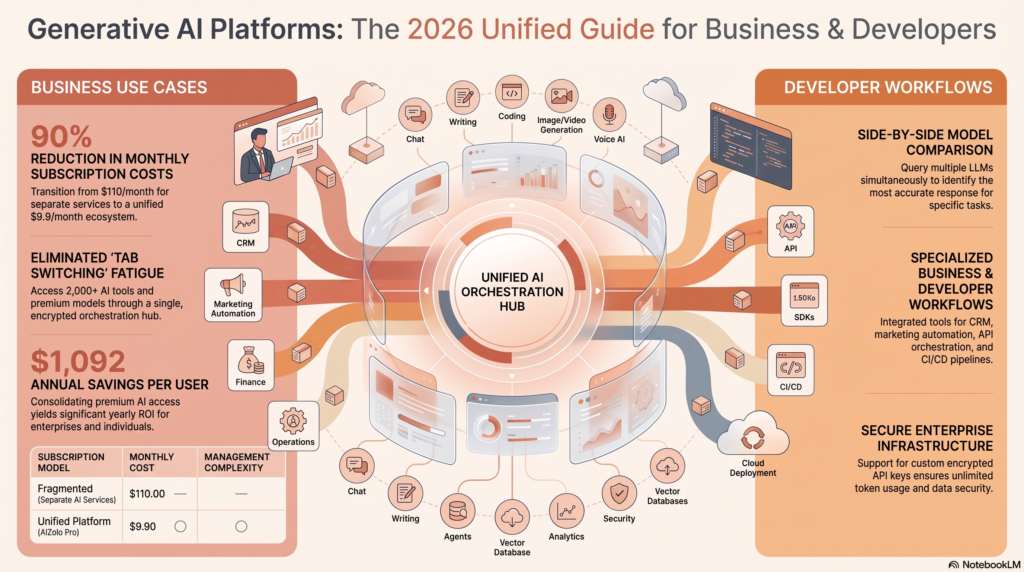
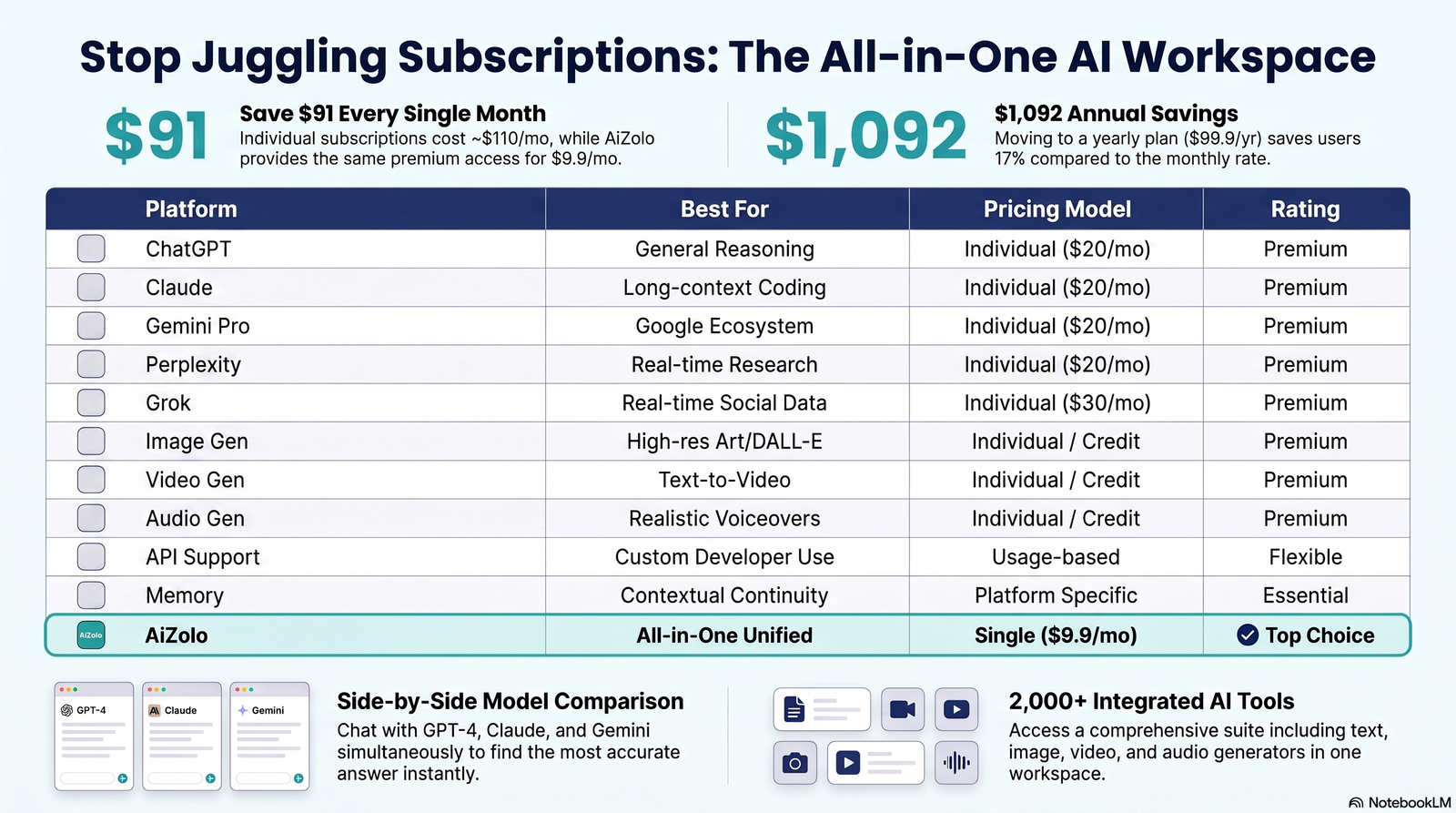
Aizolo takes a different approach. Instead of building its own foundation model, it functions as a multi-model workspace that lets individuals and small teams access several leading chat models from one subscription and one dashboard.
For a solo founder or a small marketing team, this consolidation can simplify billing and reduce the friction of managing multiple separate AI subscriptions. It is not designed to replace enterprise-grade platforms like Bedrock or watsonx for large, regulated deployments.
Pros and Cons: Quick Reference
OpenAI Platform
- Pros: Broad model lineup, fast iteration cycle, strong developer ecosystem and documentation.
- Cons: Pricing tiers change frequently, which makes long-term budgeting harder without active monitoring.
Claude (Anthropic)
- Pros: Strong long-document reasoning, large context windows, careful safety practices favored by regulated teams.
- Cons: Smaller third-party plugin ecosystem compared to some competitors.
Gemini Enterprise Agent Platform (Google)
- Pros: Deep integration with Google Cloud data tools, strong multimodal capabilities, large model marketplace.
- Cons: Recent rebranding from Vertex AI means some documentation and tooling is still catching up.
Amazon Bedrock (AWS)
- Pros: Widest model selection through one API, strong AWS-native governance and monitoring.
- Cons: Best suited to teams already invested in the AWS ecosystem; steeper learning curve otherwise.
IBM watsonx
- Pros: Purpose-built governance and audit tooling, strong fit for regulated industries.
- Cons: Smaller general-purpose model catalog compared to hyperscaler platforms.
Aizolo
- Pros: Simple flat pricing, access to multiple chat models from one dashboard, low setup effort for individuals and small teams.
- Cons: Not designed as a replacement for enterprise governance, fine-tuning, or large-scale deployment infrastructure.
How to Choose the Right Platform
Choosing a generative AI platform should follow a structured evaluation, not a quick demo call. Use this checklist.
Budget
Map expected usage volume against pricing models. Token-based pricing rewards efficient prompts; subscription pricing rewards predictable, steady usage.
Privacy
Confirm where your data is stored, whether it is used for model training, and what data residency options exist for your region.
Speed
Latency matters for customer-facing applications. Test response times under realistic load, not just a single demo prompt.
Context Window
A larger context window lets a model process longer documents or conversations in one request, which matters for legal, research, or long-form use cases.
Security
Verify encryption standards, access controls, and available compliance certifications relevant to your industry.
Integrations
Check whether the platform connects natively to your existing stack — CRM, helpdesk, code repositories, or data warehouse.
Customization
Assess whether fine-tuning, custom instructions, or retrieval pipelines are available if your use case needs domain-specific behavior.
Support
Enterprise deployments need dedicated support channels and clear SLAs, not just community forums.
Compliance
Regulated industries should confirm the platform supports relevant frameworks, such as HIPAA, GDPR, or the EU AI Act, before signing a contract.
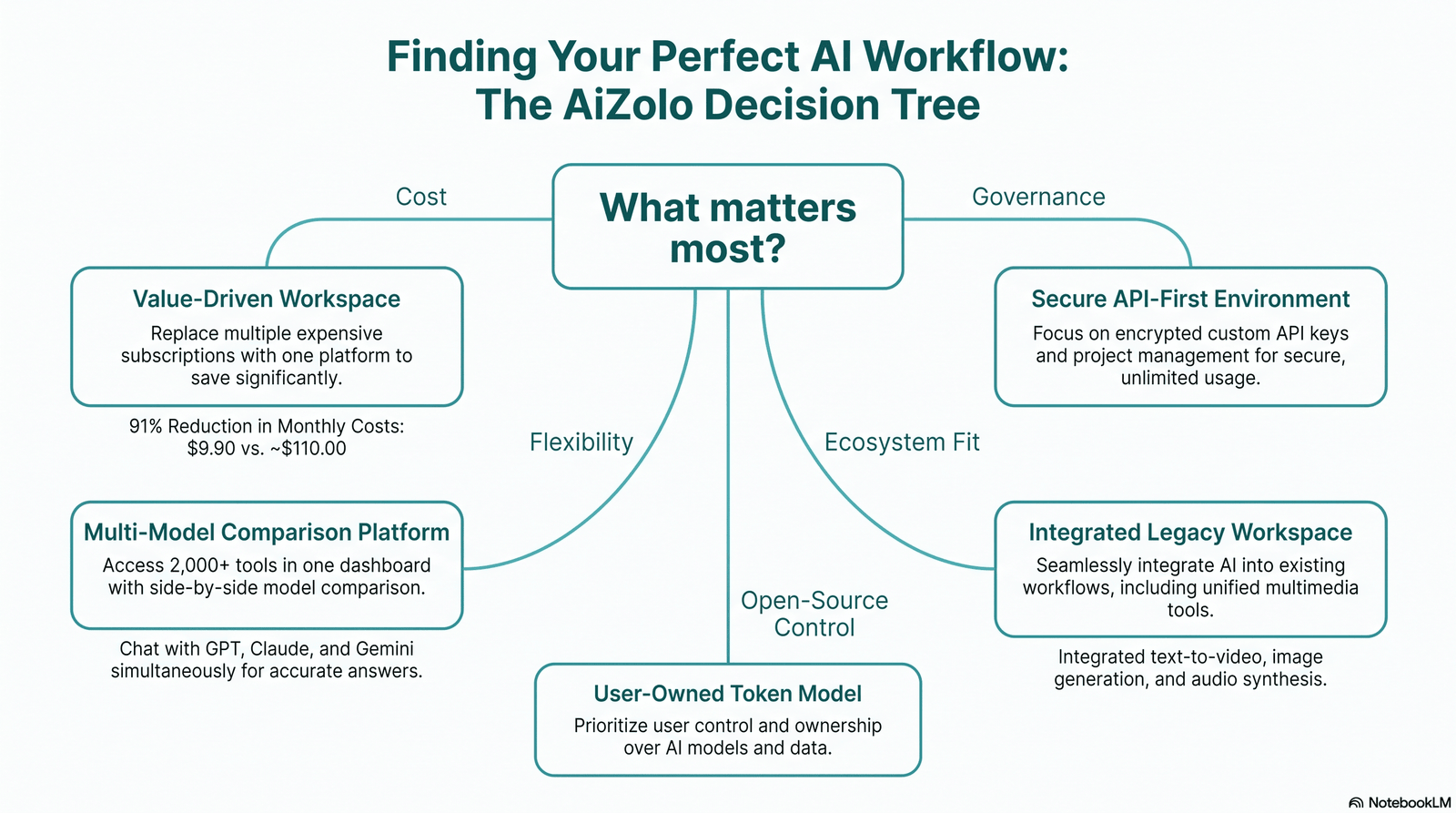
Decision Matrix
| Priority | Best-Fit Platform Type |
|---|---|
| Lowest cost for individuals | Consumer or aggregator platforms |
| Deepest model flexibility | AWS Bedrock |
| Microsoft ecosystem fit | Azure AI Foundry |
| Heaviest governance needs | IBM watsonx |
| Open-source control | Hugging Face |
| Google data ecosystem fit | Gemini Enterprise Agent Platform |
| Long-context reasoning and coding | Claude / Anthropic |
| Broad general-purpose use | OpenAI Platform |
Pre-Purchase Checklist
Use this checklist before signing any contract or committing engineering time to a platform.
- Confirm data residency and training-data usage policies in writing.
- Request a security and compliance whitepaper, not just a sales summary.
- Run a paid pilot with real workloads, not just a scripted demo.
- Calculate cost at three usage levels: low, expected, and peak.
- Confirm SLA terms for uptime and support response time.
- Check exit terms: can you export data and switch providers without penalty?
- Verify the platform supports the specific model types your use case needs.
- Involve legal and security teams before, not after, the pilot begins.
Best Practices for Platform Evaluation
Run a structured proof of concept before any enterprise-wide rollout. A two-to-four week pilot with a defined success metric reveals more than a sales demo ever will.
Involve end users early. The team that will actually use the platform daily should test it before procurement finalizes a contract.
Score platforms against your own weighted criteria, not a generic industry ranking. Cost matters more for a startup; governance matters more for a bank.
Revisit your choice annually. The generative AI platform market moves quickly, and the best fit today may not be the best fit in twelve months.
Enterprise Use Cases
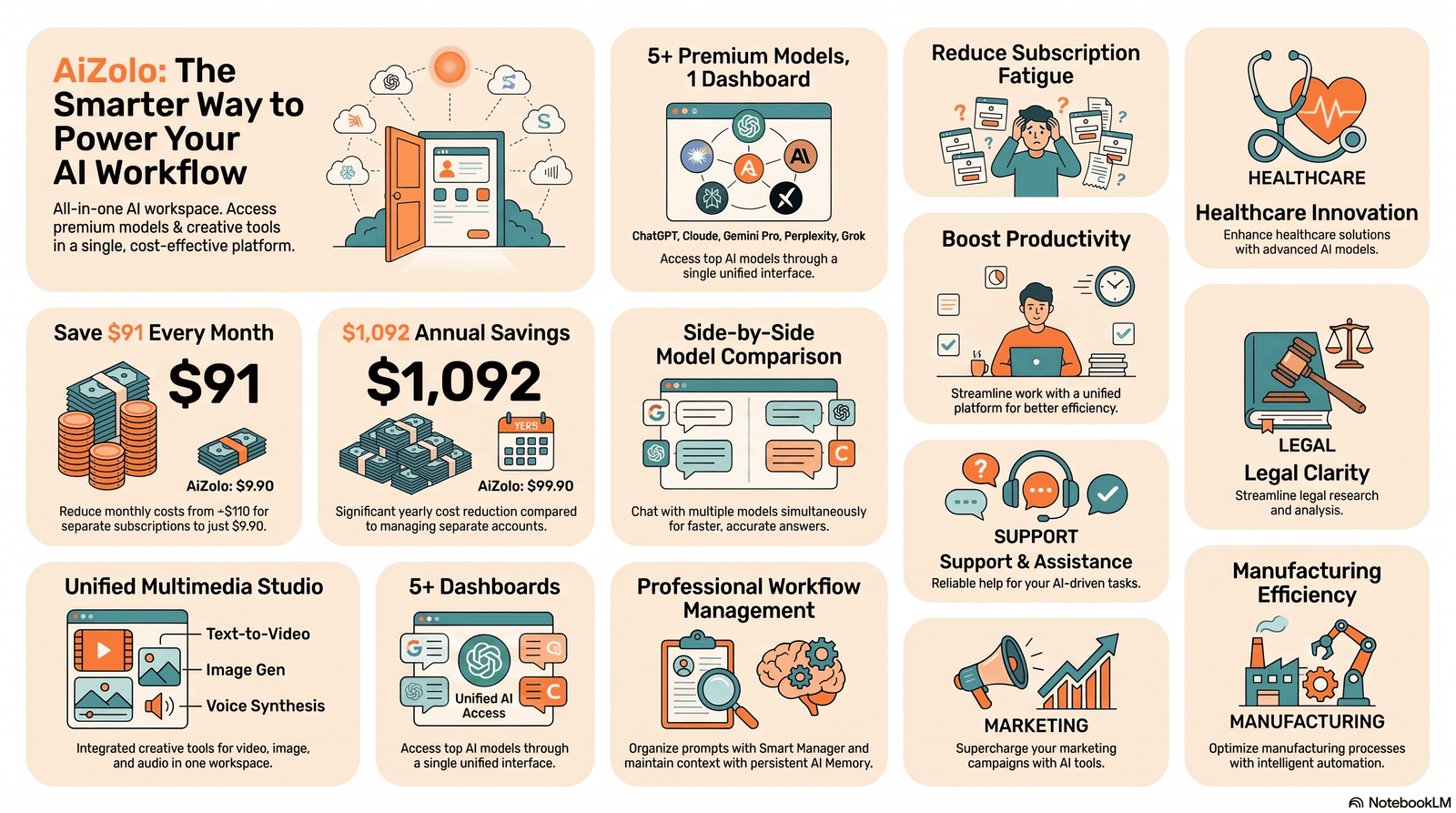
Generative AI platforms are already embedded across nearly every business function. These are the most common, verified patterns of adoption.
Customer Support: Companies deploy an AI chatbot platform to triage tickets, draft responses, and resolve common questions before a human agent gets involved. This reduces average response time and lets human agents focus on complex, high-stakes cases.
Most support deployments start narrow, covering only a handful of frequently asked questions, then expand as accuracy is validated against real customer conversations.
Marketing: Marketing teams use generative AI for campaign ideation, ad copy variations, and rapid AI content generation at scale. This lets small marketing teams test more creative directions without proportionally increasing headcount.
Brand guidelines and tone-of-voice documents are commonly fed into the platform through fine-tuning or prompt templates, so output stays consistent across channels.
Content Creation: Publishers and content teams use platforms to draft, edit, and repurpose long-form content across formats and channels. Editors typically review and fact-check AI drafts before publication, treating the model as a first-draft assistant rather than a final author.
Many generative AI platforms support more than general-purpose chat, including writing, editing, marketing, and other creative workflows. For a deeper look at these use cases, see our guide to generative AI for content creation.
Coding: Development teams use AI coding platform tools to generate boilerplate, review pull requests, and accelerate legacy code migration. Senior engineers still review generated code for security and architectural fit before merging.
Healthcare: Providers use generative AI to summarize clinical notes and support administrative documentation, always with human review for clinical decisions. Deployments in this sector require strict compliance controls and are usually limited to administrative, non-diagnostic workflows.
Finance: Financial teams use AI for report drafting, anomaly detection support, and internal knowledge search across compliance documents. Audit trails and explainability features matter more here than in almost any other sector.
Education: Institutions use AI platforms to build tutoring assistants, generate practice materials, and support curriculum drafting. Educators generally review AI-generated materials before they reach students, particularly at younger grade levels.
HR: HR teams automate job description drafting, interview question generation, and internal policy Q&A. This shortens time-to-hire while keeping human judgment central to final decisions.
Legal: Legal teams use AI for first-draft contract review and legal research support, with attorneys verifying every output. No output from a generative AI platform should be treated as final legal advice without professional review.
Sales: Sales teams use AI to draft outreach, summarize call notes, and prepare account research briefs. This frees sales representatives to spend more time in actual conversations with prospects.
Manufacturing: Manufacturers apply generative AI to technical documentation, maintenance troubleshooting guides, and quality report drafting. Some plants also pair generative AI with computer vision tools for defect detection support.
Retail: Retailers use AI for product description generation, personalized marketing copy, and customer service automation. Multilingual generation is a common driver of adoption for retailers selling across regions.
Benefits
Generative AI platforms deliver measurable value when deployed thoughtfully.
They reduce time spent on repetitive writing and research tasks, freeing employees for higher-value work.
They lower the barrier to building custom AI applications, since teams no longer need to train models from scratch.
They improve consistency in customer-facing communication by standardizing tone and accuracy across channels.
They give smaller organizations access to capabilities once limited to companies with large AI research teams.
They support faster experimentation, since teams can prototype new AI applications in days instead of months.
They help smaller teams compete with larger competitors on content volume and customer responsiveness, narrowing a gap that used to require significant headcount.
They create reusable institutional knowledge when connected to a company’s own documents through RAG, since the platform can surface accurate answers instead of employees searching manually across scattered files.
Challenges
Every benefit comes with a corresponding challenge that deserves honest attention.
Cost unpredictability is common with token-based pricing, especially as usage scales without monitoring.
Data privacy risk exists if teams paste sensitive information into consumer-grade tools without enterprise safeguards.
Model inconsistency can occur, since outputs are probabilistic and may vary between runs on the same prompt.
Integration complexity grows as organizations connect AI into legacy systems that were not designed for it.
Skill gaps slow adoption, since prompt engineering and AI governance are still maturing disciplines inside most companies.
Vendor lock-in is a real risk when a business builds deeply around one platform’s proprietary features.
Output verification burden shifts work rather than eliminating it — someone still has to check accuracy, especially in regulated or customer-facing contexts.
Change management resistance from employees who worry about job security can slow adoption even when the underlying tool works well.
Common Mistakes
Avoid these frequent missteps when adopting a generative AI platform.
Choosing a platform based on hype rather than a documented evaluation against actual business requirements.
Skipping a pilot phase and rolling AI out to an entire department before testing it on a smaller, controlled use case.
Ignoring data governance until after sensitive information has already been shared with an external model.
Treating AI output as final instead of building in human review for anything customer-facing or compliance-sensitive.
Underestimating change management — employees need training and clear guidelines, not just tool access.
Failing to track cost as usage scales, which can turn a promising pilot into an unmanageable bill.
Future Trends
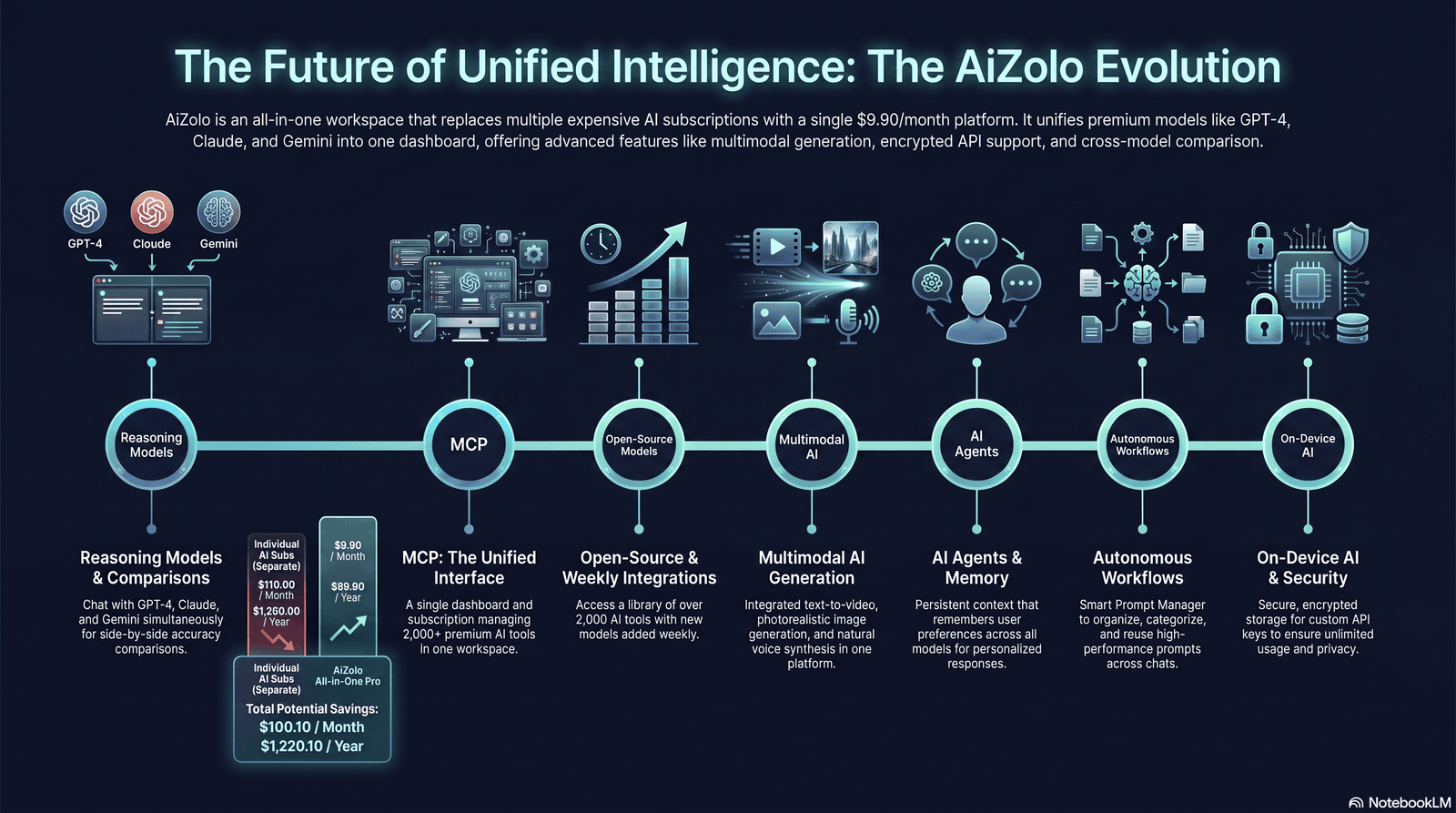
The next phase of generative AI platforms is already visible in 2026 product roadmaps.
AI Agents: Platforms are shifting from single-turn chat toward autonomous AI agents that complete multi-step tasks with minimal supervision.
Model Context Protocol (MCP): MCP is emerging as a standard way for AI models to connect to external tools and data sources consistently across vendors.
Multimodal AI: Models increasingly process text, images, audio, and video together in a single request, rather than requiring separate tools.
On-Device AI: Smaller, efficient models are moving processing onto local devices for privacy and latency-sensitive use cases.
Autonomous Workflows: Businesses are chaining multiple agents together into AI workflows that handle entire processes end to end.
Reasoning Models: Models built for step-by-step reasoning are improving performance on complex analytical and coding tasks.
Open-Source Models: Open-weight models continue to narrow the performance gap with proprietary systems, giving organizations more hosting flexibility.
Frequently Asked Questions
What are generative AI platforms? Generative AI platforms are software systems that give businesses and developers access to AI models capable of creating text, images, code, or audio from a prompt, along with tools for deployment, security, and integration.
What is the best generative AI platform in 2026? There is no single best platform. OpenAI and Claude lead for general reasoning and coding, Google’s Gemini Enterprise Agent Platform leads for agent building, and IBM watsonx leads for regulated industries.
How do generative AI platforms differ from AI chatbots? A chatbot handles one conversation. A platform supports many applications, users, and models across an organization, with added security, analytics, and deployment tools.
Are generative AI platforms safe for enterprise data? Enterprise-tier platforms offer encryption, access controls, and options to exclude your data from model training, but safety depends on how your team configures and uses the tool.
What is a foundation model? A foundation model is a large, pre-trained AI model — such as GPT, Claude, or Gemini — that generative AI platforms build applications on top of.
What is RAG in generative AI platforms? RAG, or retrieval-augmented generation, lets a model pull relevant information from your documents or a vector database before generating a response, improving accuracy.
Can small businesses afford generative AI platforms? Yes. Many platforms offer free tiers or low-cost subscriptions, and aggregator tools like Aizolo let small teams access multiple models under one flat monthly plan.
What is the Model Context Protocol (MCP)? MCP is an emerging open standard that lets AI models connect consistently to external tools, data sources, and applications across different platforms.
Do I need coding skills to use a generative AI platform? No. No-code and low-code platforms let non-technical users build AI-powered workflows through visual builders, while developer-first platforms serve engineering teams.
What is fine-tuning? Fine-tuning is the process of further training a foundation model on your own data so it better matches your company’s tone, terminology, or domain expertise.
How do I choose between OpenAI, Claude, and Gemini? Base the choice on your priority: OpenAI for broad general-purpose flexibility, Claude for long-context reasoning and coding reliability, and Gemini for deep integration with Google Cloud data tools.
What industries benefit most from generative AI platforms? Customer support, marketing, software development, finance, healthcare administration, legal research support, and retail see some of the fastest, most measurable gains.
Is open-source AI a good alternative to proprietary platforms? Open-source models through platforms like Hugging Face offer more control and lower long-term hosting costs, but require more in-house engineering effort to maintain.
What is an AI agent? An AI agent is a system that can plan and execute multi-step tasks autonomously, using tools and data sources, rather than just responding to a single prompt.
How much do generative AI platforms cost? Costs vary widely by vendor and usage volume, from free consumer tiers to enterprise contracts priced by token consumption or seat count. Always confirm current pricing directly on each provider’s official page.
Conclusion
Generative AI platforms have moved from experimental tools to core business infrastructure in a very short time.
The right choice depends less on which platform is “best” overall and more on your budget, compliance needs, and the specific workflows you want to transform.
Large enterprises with regulatory demands will lean toward IBM watsonx or Azure AI Foundry. Teams building custom products will often lean toward OpenAI, Claude, or Amazon Bedrock for their API flexibility.
Individuals and small teams that want simplicity, and access to several leading models without managing multiple subscriptions, may find a consolidated workspace like Aizolo a practical starting point before scaling into a dedicated enterprise platform.
Start with a small, well-defined pilot. Measure real outcomes. Then scale the platform that actually fits how your team works, not the one with the loudest marketing.
Ready to explore your options? Compare two or three platforms against the decision matrix above before committing to a contract.
Comparison Tables
Pricing Model Comparison
| Platform | Pricing Structure | Free Option |
|---|---|---|
| OpenAI Platform | Token-based API, tiered subscriptions | Limited free tier |
| Claude / Anthropic | Token-based API, tiered subscriptions | Free and Pro plans |
| Gemini Enterprise Agent Platform | Token-based + agent runtime billing | Free trial credits |
| Azure AI Foundry | Token-based + Azure consumption | Free trial credits |
| Amazon Bedrock | Token-based + provisioned throughput | Free tier limits |
| IBM watsonx | Subscription + consumption | Trial access |
| Hugging Face | Free + paid Inference Endpoints | Generous free tier |
| Aizolo | Flat monthly subscription | Free tier with limited access |
Feature Comparison
| Feature | OpenAI | Claude | Gemini Platform | Bedrock | watsonx |
|---|---|---|---|---|---|
| Multi-model access | Partial | Partial | Yes | Yes | Yes |
| Native agent building | Yes | Yes | Yes | Yes | Yes |
| Fine-tuning support | Yes | Limited | Yes | Yes | Yes |
| Governance tooling | Growing | Strong | Strong | Strong | Strongest |
| Open-weight model access | Limited | No | Yes | Yes | Yes |
Enterprise Platform Comparison
| Platform | Strongest Fit |
|---|---|
| Azure AI Foundry | Microsoft-native organizations |
| Amazon Bedrock | Multi-model flexibility, AWS-native teams |
| Gemini Enterprise Agent Platform | ML-intensive workloads, Google Cloud data |
| IBM watsonx | Regulated industries needing audit trails |
Open-Source Comparison
| Platform | Approach |
|---|---|
| Hugging Face | Model hub hosting thousands of open-weight models |
| Llama (via Meta and partners) | Open-weight models deployable across major clouds |
| Mistral AI | Efficient open-weight and commercial models |
Author Bio
Author: Jeevesh Tripathi Email: jeevesh@aizolo.com
Jeevesh Tripathi is an AI platforms researcher and technology writer who specializes in generative AI, enterprise AI infrastructure, and search-optimized content strategy. His work focuses on translating fast-moving developments in foundation models, AI agents, and platform architecture into practical, decision-ready guidance for both technical teams and business leaders. He follows official documentation from major AI labs and cloud providers closely, prioritizing verified, current information over speculation, in line with Google’s expertise, experience, authoritativeness, and trustworthiness principles.