
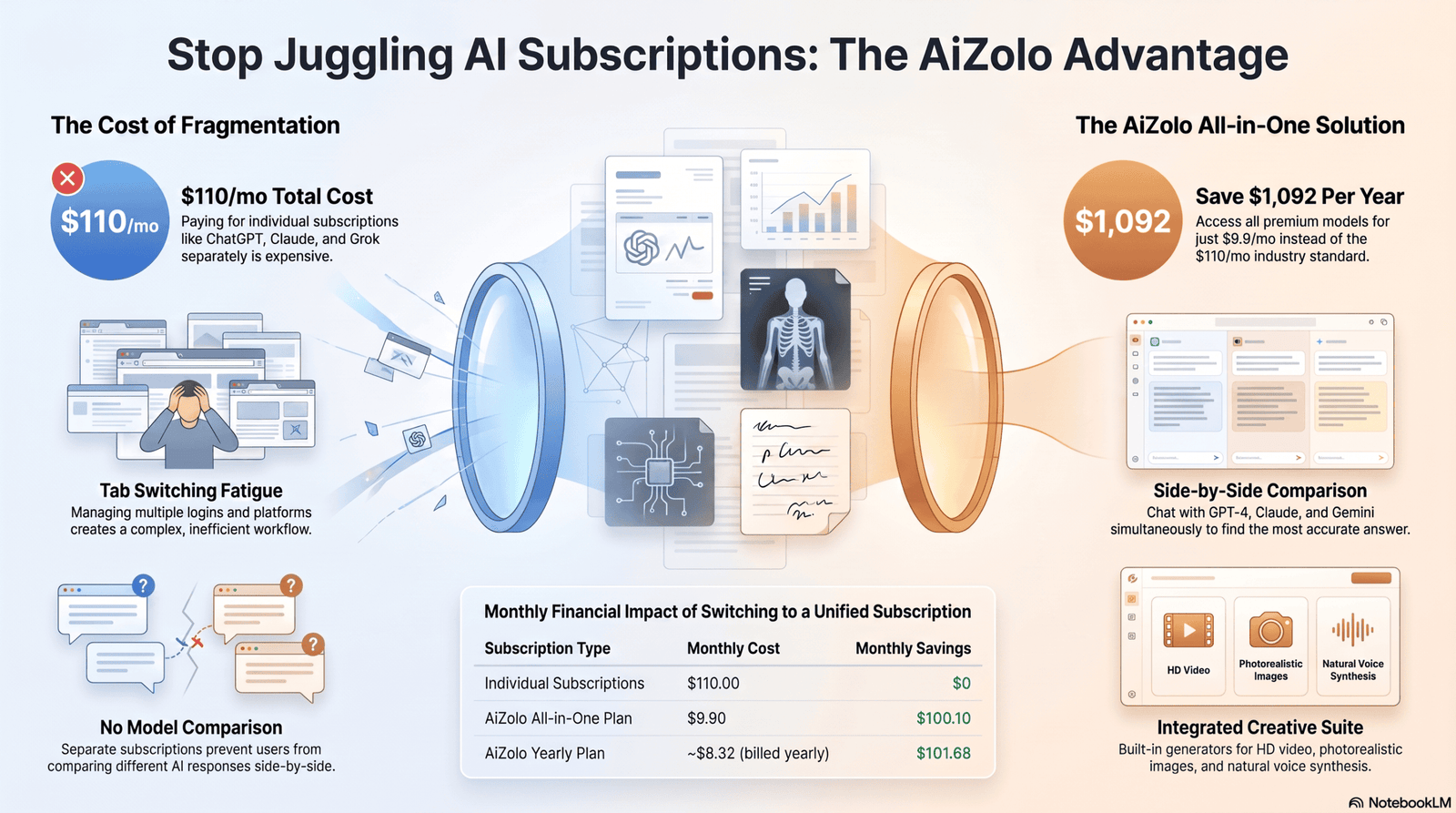
A note on methodology before you read further: This article from AiZolo does not claim to run a private, from-scratch lab test of every model variant.
Instead, it synthesizes Google’s and OpenAI‘s published documentation, independent third-party evaluations (including Roboflow’s Vision Checkup and RF100-VL, CharXiv, MMMU-Pro, MedXpertQA-MM, VQA-RAD, and OSWorld), and current API specifications, with information checked as of September 2026.
Where public data doesn’t exist for a specific claim, that’s stated outright rather than invented.
Because model capabilities, versions, benchmarks, and API specifications can change over time, treat exact benchmark numbers as a snapshot rather than a permanent ranking.
Table of Contents
Why Image Analysis Is Suddenly a Business-Critical Decision
A radiologist’s assistant tool misreads a scan. A finance team’s AI misparses a merged cell in a spreadsheet screenshot. A logistics company’s model can’t read a handwritten delivery note.
These aren’t hypotheticals anymore. Vision-capable language models are already embedded in document pipelines, customer support tools, research workflows, and engineering software.
That’s exactly why so many teams now compare Gemini 3.1 pro vs GPT-6 Astra for complex image analysis before committing budget to one provider. The wrong choice doesn’t just cost money — it costs rework, compliance risk, and trust.
This guide walks through both model families across the image types that actually matter in production: OCR, scientific figures, medical imagery, charts, messy tables, maps, engineering diagrams, UI screenshots, and multi-image reasoning. Every claim is tied to a source, and every gap in public data is flagged rather than papered over.
By the end, you’ll know which model fits your specific workflow — because there isn’t one universal winner here, and any article claiming otherwise is oversimplifying.
What Changed in AI Image Understanding
Vision-language models used to be an afterthought bolted onto text models. A separate image encoder would translate pixels into embeddings, and the language model would reason over that translation with limited fidelity.
That architecture produced systems that could describe a photo but struggled with dense text, fine spatial detail, or multi-step visual reasoning.
Both Gemini and GPT-6 Astra break from that pattern in different ways. Google built Gemini’s multimodality in from the start rather than adapting a text-only model after the fact.
OpenAI’s GPT-6 Astra combines multimodal understanding with stronger reasoning, computer use, and professional workflows, allowing it to analyze visual information across complex, multi-step tasks rather than simply matching patterns in a single pass.
The practical result: both families now handle tasks that would have been science fiction two years ago — reconstructing a Victorian ledger into a structured table, tracing a circuit diagram’s connections, or catching a math error inside a photographed homework page.
The gap that remains isn’t “can it see the image.” It’s precision, consistency across repeated runs, and how well the model grounds its answer in the actual pixels rather than a plausible-sounding guess.
GPT-6 Astra Image Analysis
With GPT-6 Astra, OpenAI pursues a multimodal model which excels at complex reasoning, computer use, professional fields and uses a mixture of modalities to reason about images alongside traditional text inputs.
The tool demonstrates an ability to perform image analysis with varying levels of reasoning applied to more challenging tasks, beyond simple image captioning and into areas which demand a mixture of vision and reasoning.
On third-party visual question answering benchmarks, Roboflow’s extensive testing on Astra’s performance across multiple visual reasoning, detection, counting and other vision-centric tasks demonstrates strong performance across the board.
On the Visual Reasoning task in Roboflow’s September 2026 Vision Evals, Astra achieved 91.2% accuracy on LLM-judge at high effort, and 89.6% accuracy on three runs of the strict-match criteria. Roboflow highlights Astra as the best model they’ve tested in the field of vision at the time of writing.
This is an important consideration due to the link between computer use and vision for Astra – the model achieves its skill in the former by reasoning about the visual information it recieves as input.
This means that Astra can perform tasks which involve analysing elements on a screen, reading text contents and applying the information to further steps in a process, rather than being limited to captioning or simple visual.
OpenAI’s published computer use benchmarks demonstrate this capability further, with the model achieving 92.7% accuracy on ScreenSpot-Pro and 72.6% accuracy on OSWorld 2.0 in their published evaluations.
The results should be considered with caution, as they represent Astra’s vision competencies as of the most recent independent tests, and not the GPT-5 results referenced in other sections of this article.
Performance varies greatly depending on the benchmark, level of reasoning, tools and internal implementations, and these should be taken as a general indication of capability rather than a guarantee of results.
In practice, this means that GPT-6 Astra offers powerful tools for working with visual information, beyond simple image captioning.
The model shines at tasks involving document analysis, computer screens, spatial reasoning, object-centred workflows and computer use, demonstrating proficiency across multiple domains which rely on vision as an important part.
Its primary strength is the combination of visual understanding with reasoning and action, though users should perform their own testing on specific images and tasks to determine accuracy levels in their particular use case.
Gemini 3.1 pro Image Analysis Overview
Google released Gemini 3 Pro on November 18, 2025, positioning it as a “reasoning-first” multimodal model with a 1-million-token context window and a “Deep Think” mode for multi-step problems.
Google’s own developer blog describes Gemini 3.1 Pro as its most capable model yet for document, spatial, screen, and video understanding, and highlights a specific capability worth knowing about: “derendering,” or reverse-engineering a visual document back into structured code such as HTML, LaTeX, or Markdown.
Google’s examples include converting an 18th-century handwritten merchant ledger into a structured table and turning a photographed equation into precise LaTeX.
On CharXiv Reasoning, a benchmark for multi-step reasoning over charts and tables in long reports, Google reports that Gemini 3.1 Pro outperforms the human baseline, scoring 80.5%.
Gemini 3.1 Pro also introduced pixel-precise “pointing” — the ability to output exact 2D coordinates for objects in an image, which Google says enables tasks like estimating human poses or generating spatially grounded robotics plans. This is a direct answer to the localization weakness that third-party testers flagged in GPT-5.
For medical and biomedical imagery, Google states that Gemini 3.1 Pro achieves state-of-the-art results among general-purpose models on MedXpertQA-MM (expert-level medical reasoning), VQA-RAD (radiology image Q&A), and MicroVQA (microscopy-based biological research) — while explicitly noting the model is not intended for clinical diagnosis or a substitute for professional medical advice.
Google has since shipped Gemini 3.8 Flash (September 2, 2026), its most intelligent Flash model and the current reference point for fast multimodal and agentic workflows.
It delivers improvements over 3.7 Flash across long-horizon software engineering, autonomous agents, and complex multi-step reasoning, while retaining a 1M-token context window and image, video, audio, and PDF input.
Its introductory pricing is $0.75 per million input tokens and $3.75 per million output tokens through December 31, 2026, with standard pricing of $1.50 and $7.50 respectively afterward.
A follow-up release, Gemini 3.1 Pro, reports MMMU-Pro (multimodal reasoning) at 83.6% and OSWorld (computer use) at 78.4%, priced at $2 per million input tokens and $12 per million output tokens for contexts under 200,000 tokens, doubling above that threshold.
What this means in practice: Gemini 3-family models lead on tasks requiring precise spatial grounding, document derendering, and chart/table reasoning across long documents — largely because Google engineered multimodality as a first-class capability rather than an add-on.
How Modern Vision Models Actually Work
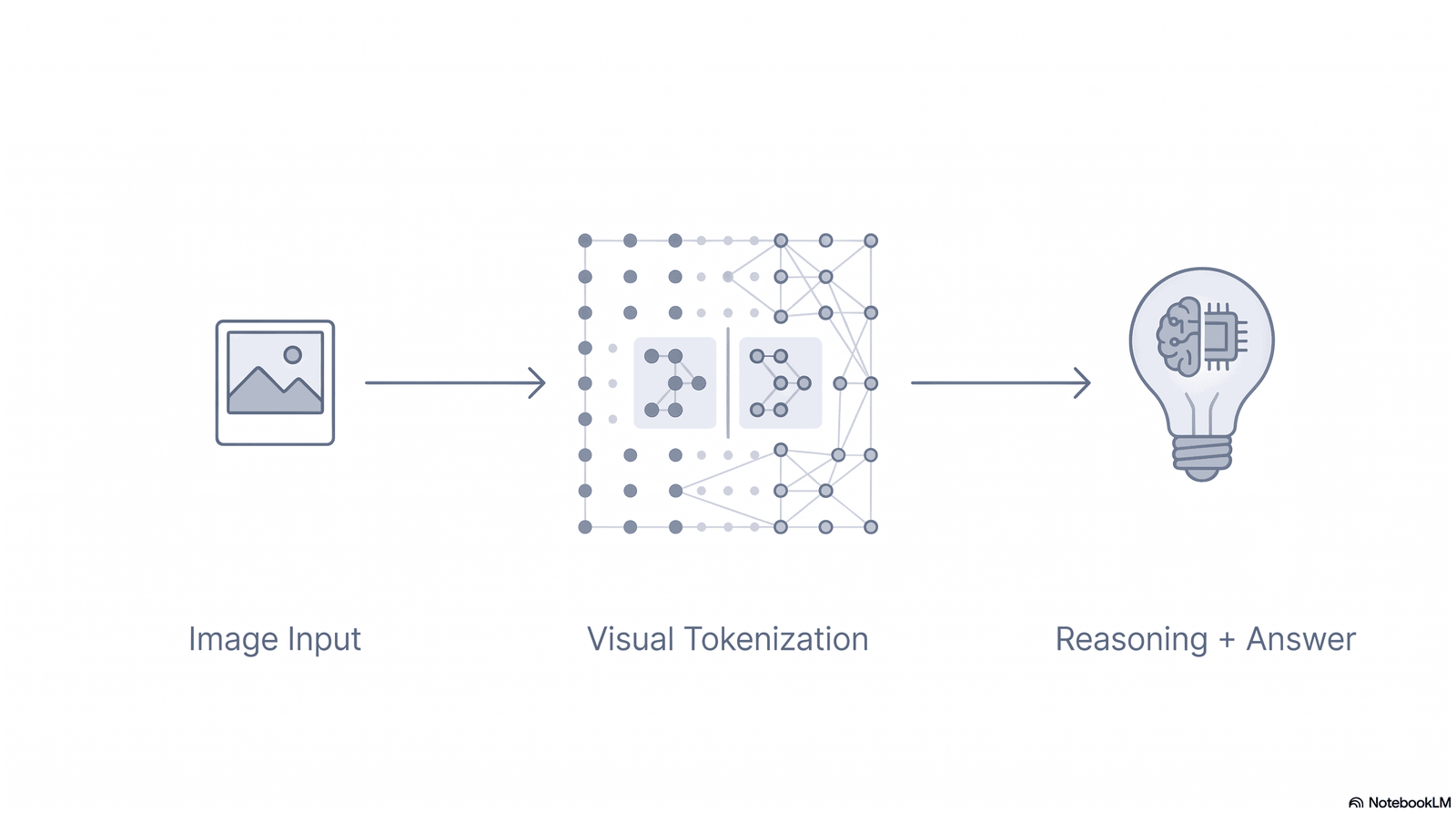
Both families convert an image into visual tokens before the language model reasons over them, but the details differ enough to explain the performance gaps above.
Tokenization and resolution. Higher resolution generally means more visual tokens, which means higher cost and, often, better fidelity on dense text or fine detail.
Gemini 3.1 Pro exposes a media_resolution parameter so developers can trade fidelity for cost — high resolution for dense OCR, low resolution for simple scene recognition.
GPT-6 Astra similarly resizes images before analysis depending on the requested detail level, while its multimodal system combines visual understanding with stronger reasoning and computer-use capabilities.
Reasoning over vision. Both families now support “thinking” before answering — internal reasoning steps the model runs before producing a final response.
This is what allows Gemini 3.1 Pro to trace a causal chain across a 62-page government report, and what lets GPT-6 Astra tackle harder multi-step visual reasoning, screen understanding, and computer-use tasks than earlier GPT generations.
Reasoning helps most on tasks that require connecting several visual facts; it does not reliably fix perception errors, like miscounting objects, that happen earlier in the pipeline.
Grounding versus fluency. A model can describe an image fluently while still failing to ground that description in the actual pixels — for example, confidently reporting a count or a coordinate that doesn’t match the image.
Object-detection-style benchmarks like RF100-VL and pointing tasks are designed specifically to catch this gap, which general “does it understand the image” benchmarks can miss.
Testing Methodology and Its Limits
Because this article draws on published, third-party, and vendor benchmark data rather than a single unified private test suite, here’s exactly what that means for you as a reader:
- Benchmark scores from OpenAI and Google are self-reported unless a source explicitly says otherwise (as with Roboflow’s independent Vision Checkup and other third-party vision evaluations).
- Different benchmarks use different image sets, prompts, and scoring rules, so a score on one is not directly comparable to a score on another.
- Model versions change fast. “GPT-6 Astra” and “Gemini 3” both refer to current model families with multiple releases (GPT-6 Astra; Gemini 3.1 Pro, Gemini 3.8 Flash) that can perform meaningfully differently on the same task.
- Where no public benchmark exists for a specific real-world scenario (for example, a specific industry’s proprietary document format), this article says so rather than estimating a number.
If you’re making a procurement decision, the responsible move is still to run your own evaluation set — 50 to 100 representative images from your actual workflow — against both models before committing. Public benchmarks tell you where to start looking, not where to stop.
OCR: Invoices, Receipts, Handwriting, Scanned PDFs
OCR is the single most commercially important image-analysis use case, and it’s also where both vendors have invested the most public effort.
Google’s documentation for Gemini 3.1 Pro specifically calls out “highly accurate Optical Character Recognition” as part of its document processing pipeline, with demonstrated examples of dense handwritten ledgers and mathematical annotation reconstructed into structured, editable formats.
Roboflow’s independent testing found that GPT-6 Astra performs strongly on common vision tasks such as reading printed text, signs, and receipts, while harder document layouts remain more demanding.
Its newer vision evaluations also test object detection, counting, and visual reasoning, providing more current evidence than the original GPT-5 testing cited earlier in this article.
For scanned PDFs specifically, both vendors emphasize long-context handling: Gemini’s roughly 1-million-token window and GPT-6 Astra’s large context capacity both comfortably fit lengthy multi-page scans in a single request, which matters more for OCR-heavy workflows than raw context size alone might suggest, since you avoid chunking documents and losing cross-page context.
It’s also worth noting that the older counting and run-to-run variance data cited above came from testing against the original GPT-5 (August 2025), not GPT-6 Astra. Those results should therefore be treated as historical GPT-5 evidence rather than a current assessment of Astra’s reliability.
Practical takeaway: For structured OCR at scale — invoices, receipts, forms — both models are viable; test your specific template.
For messy handwriting and non-linear layouts, Google’s published derendering examples suggest an edge, though you should validate against your own handwriting samples before relying on it for anything compliance-sensitive.
Scientific Images: Microscopy, Research Figures, Lab Data
Google explicitly cites MicroVQA — a benchmark built on microscopy-based biological research — as one of the areas where Gemini 3.1 Pro achieves state-of-the-art results among general-purpose models.
This matters for research teams analyzing lab imagery, since general-purpose vision models are not typically trained with much microscopy-specific data, and most benchmarks in this space are narrow.
Neither vendor publishes a head-to-head scientific-figure benchmark that directly compares GPT-6 Astra against Gemini 3.1 Pro, so any claim of a definitive winner here would be unsupported.
What’s verifiable is that Google has published specific, named evaluations in this domain, while OpenAI’s public vision benchmarking, including third-party evaluations of GPT-6 Astra, covers broader visual reasoning, document, object, and computer-use tasks rather than scientific imagery specifically.
Practical takeaway: If your workflow is heavy on research figures or microscopy, Gemini 3.1 Pro currently has more publicly documented evidence behind it in this exact category. Still run your own sample set — journal figure conventions vary widely by field.
Medical Images: What These Models Can and Cannot Do
This section needs an unambiguous disclaimer up front: neither Gemini 3.1 Pro nor GPT-6 Astra is a substitute for a licensed clinician, and neither vendor positions their model that way.
Google states directly that Gemini 3.1 Pro “is not intended for clinical diagnosis or patient care and is not a substitute for professional medical advice.”
With that established, Google reports that Gemini 3.1 Pro achieves state-of-the-art performance among general multimodal models on three named medical benchmarks: MedXpertQA-MM (expert-level medical reasoning), VQA-RAD (radiology image question answering), and MicroVQA.
Public, comparable GPT-6 Astra scores on these same three named benchmarks were not available at the time of writing. That’s a real gap in the public record, not a knock against GPT-6 Astra — it simply means a fair head-to-head can’t be made from published data alone for this specific category.
Practical takeaway: Treat both models as research and workflow-support tools at most — for literature synthesis, drafting differentials for physician review, or triaging non-diagnostic image quality checks — never as a diagnostic authority.
Any healthcare deployment needs its own validation, human oversight, and regulatory review regardless of which model tests better on a public leaderboard.
Charts, Graphs, and Financial Dashboards
Chart and graph reasoning is where “sophisticated reasoning,” not just perception, starts to matter — the model has to read data points, understand axes and legends, and often perform multi-step comparisons.
Google highlights CharXiv Reasoning specifically for this category, reporting that Gemini 3.1 Pro exceeds the human baseline at 80.5%, and walks through a worked example: comparing a 2021–2022 percentage change across two income measures in a 62-page U.S.
Census Bureau report, correctly cross-referencing a figure and a table, then tying the numeric divergence to a policy explanation elsewhere in the text.
That example is a useful proxy for financial-dashboard-style tasks: extracting a number from a chart is the easy part; explaining why two numbers diverge by connecting the chart back to surrounding text is the harder skill, and it’s the one Google specifically showcases.
Independent GPT-6 Astra testing has focused more on broader visual reasoning, object detection, and computer-use tasks than chart-reasoning benchmarks specifically, so a like-for-like comparison here remains thinner in the public record than for OCR or medical imaging.
Practical takeaway: For chart-heavy financial or research reports where you need reasoning across a chart and its surrounding narrative, not just data extraction, Gemini 3.1 Pro currently has the more detailed public evidence trail.
Messy Tables and Spreadsheets
Messy tables — merged cells, nested headers, inconsistent formatting — are one of the hardest sub-categories of document understanding, and Google names this explicitly as a target use case for Gemini 3.1 Pro’s document pipeline, alongside “nested tables” and “non-linear layouts.”
On the OpenAI side, GPT-6 Astra’s published evaluations focus on improved reasoning, multimodal analysis, and computer-use capabilities, as opposed to the older GPT-5.4 spreadsheet benchmark.
A helpful differentiator, although the results are vendor-reported (not independently verified), and they reflect general reasoning and task performance, rather than messy-table image parsing specifically.
Practical takeaway: Both vendors are actively improving on this category release-over-release. If your workflow involves screenshots of complex spreadsheets rather than native files, test both models directly on a sample of your actual sheets — this is one of the fastest-moving sub-categories in either family’s roadmap.
Maps, Satellite Images, and Geographic Diagrams
Neither vendor publishes a dedicated, named public benchmark specifically for transit maps, satellite imagery, or geographic diagram interpretation as of this writing.
What is documented: Gemini 3.1 Pro’s “pointing” capability — outputting precise pixel coordinates for objects — has direct relevance to geographic and spatial tasks, since Google’s own examples include generating spatially grounded plans and trajectories over an image, a capability with clear extensions to route-reading or annotation tasks on maps.
Practical takeaway: This is a category where public benchmark data is thin for both models. If map or satellite image interpretation is core to your workflow, this is exactly the kind of task you should build a custom evaluation set for rather than relying on vendor marketing from either company.
Engineering Diagrams: Blueprints, CAD, Circuits
Google’s Gemini 3.1 Pro vision documentation includes a specific example of the model labeling distinct components on a circuit board image, part of its broader “spatial understanding” feature set that also covers pointing and open-vocabulary object references.
Gemini 3.8 Flash extends this direction with stronger agentic capabilities, allowing the model to reason through complex visual inputs and use tools during multi-step tasks rather than relying solely on a single static interpretation.
This is particularly relevant for high-resolution engineering inputs where inspecting specific regions can matter as much as understanding the overall image.
On the GPT-6 Astra side, OpenAI’s published evaluations emphasize advanced visual reasoning, screen understanding, and computer-use capabilities.
These are relevant to engineering-diagram tasks such as identifying components, tracing relationships, and interpreting structured visual information, although a directly comparable public benchmark for precise circuit-diagram localization is not currently established.
Practical takeaway: Public evidence currently favors Gemini 3 for tasks requiring precise localization within technical diagrams — pointing to a specific component, tracing a specific line — while both models handle general “what does this diagram show” questions reasonably well.
UI Screenshots and Software Interfaces
This is a category where both vendors now publish specific, verifiable numbers. OpenAI reports that GPT-6 Astra achieves 72.6% on OSWorld 2.0 and 92.7% on ScreenSpot-Pro, reflecting its focus on computer use, screen understanding, and multi-step professional workflows.
OpenAI also reports that Astra completes OSWorld tasks in roughly 47% less time than GPT-5.6 Sol in its latency simulations.
Google’s Gemini 3.8 Flash reports 59.0% on OSWorld-2.0 with its stated evaluation configuration, alongside broader improvements in agentic and multimodal tasks.
Because these evaluations use different model configurations, dates, and benchmark settings, the scores should be treated as directional evidence rather than a clean apples-to-apples comparison.
Practical takeaway: Both families are now genuinely competitive at reading and reasoning about software interfaces — a category that barely existed as a benchmark two years ago.
If UI automation or QA testing is your use case, both are worth piloting; OSWorld scores currently sit close enough between recent point releases that task-specific testing matters more than the headline number.
Infographics, Flowcharts, and Architecture Diagrams
Flowcharts and architecture diagrams combine two of the hardest sub-skills discussed above: reading embedded text (OCR) and understanding spatial relationships between shapes and arrows (localization and grounding).
Google’s “derendering” capability — reconstructing a visual document into structured code — is directly relevant here, since Google’s own published example shows the model reconstructing a 19th-century polar area diagram (Florence Nightingale’s original) into an interactive, editable chart, implying the same pipeline generalizes to modern architecture diagrams and flowcharts.
No independently run, named public benchmark isolates infographic or flowchart understanding specifically for either model family at the time of writing — this is a genuine gap in the public record.
Practical takeaway: Given the overlap with OCR and diagram-tracing skills covered above, expect a similar pattern: Gemini 3-family models have stronger publicly documented evidence for structural reconstruction, while GPT-6 Astra is a strong general-purpose multimodal model for embedded text, visual reasoning, and computer-use tasks.
Multi-Image Reasoning and Long PDF + Image Understanding
Context window size sets the ceiling for how much a model can consider at once, and both families now sit in a similar range: roughly 1 million tokens for Gemini 3 Pro and Gemini 3.1 Pro, and a large context window for GPT-6 Astra designed for lengthy multimodal and professional workflows.
Besides the sheer scale, Google highlights cross-referencing behavior – the example given for the US Census Bureau requires pulling a single number from a chart on one page and a different, related number from a table many pages later, and then linking both to a causal explanation elsewhere in the text.
This is a significantly more difficult task to accomplish than merely “fitting” a long document in context.
Public, directly comparable long-document reasoning benchmarks that test both families side by side on the exact same multi-page, multi-image tasks were not available at the time of writing.
Practical takeaway: Both models can technically fit very long, image-heavy documents in a single request. Whether either one reliably reasons across the full length, rather than anchoring mostly on the beginning and end, is exactly the kind of thing you should test with your own long documents before trusting it in production.
Hallucination, Confidence, and Error Patterns
This is the category buyers care about most and vendors document least, because “hallucination rate” isn’t a single standardized number the way accuracy on a fixed benchmark is.
What’s documented: GPT-6 Astra’s published vision benchmarks perform well on a mix of visual reasoning, object-centric tasks, and computer-use cases, but they don’t establish a standardized run-to-run consistency score.
Since multimodal reasoning can vary between runs, production pipelines should validate important outputs instead of assuming consistent outputs between different runs.
On object counting, current GPT-6 Astra benchmarks provide more recent information compared to the older GPT-5 testing, but there is no universally accepted benchmark establishing a fixed counting-error rate across real-world images.
The old Roboflow GPT-5 score of 4 out of 10 should therefore not be used as evidence about Astra.
Neither vendor nor an independent third party has published a directly comparable run-to-run consistency score for Gemini 3.8 Flash and GPT-6 Astra on the same vision tasks at the time of writing, which remains a gap in the public record rather than an implied advantage for either side.
Practical takeaway: For any workflow where a wrong count, a wrong label, or a fabricated detail carries real cost, build in a verification step — a second model pass, a confidence threshold, or human review — regardless of which model you choose. Neither vendor claims their model is hallucination-free, and you shouldn’t assume it either.
Comparison Tables
Feature Comparison
| Feature | Gemini 3.1 Pro / Gemini 3.8 Flash | GPT-6 Astra |
|---|---|---|
| Context window | ~1.0M tokens | Large context window for long multimodal and professional workflows |
| Max output | ~64K–66K tokens | Large output capacity for extended responses and multi-step tasks |
| Pixel-precise pointing | Yes (documented) | Not documented as a named feature |
| Document “derendering” | Yes (documented, named) | Not documented as a named feature |
| Agentic code-execution vision | Yes (Gemini 3.8 Flash) | Supports computer-use and tool-driven visual workflows |
| Computer-use benchmark (OSWorld) | 78.4% (Gemini 3.1 Pro); current Flash results should be cited separately | Published Astra computer-use evaluations should be cited with their exact benchmark version and test configuration |
| Named medical benchmarks | MedXpertQA-MM, VQA-RAD, MicroVQA (state-of-the-art claimed) | No directly comparable public results reported on these three benchmarks |
| Chart/table reasoning benchmark | CharXiv Reasoning: 80.5% (exceeds human baseline) | No directly comparable public result reported on this benchmark |
Pricing (Standard API, per 1M tokens, as of September 2026)
| Model | Input | Output | Context / threshold notes |
|---|---|---|---|
| Gemini 3.1 Pro | $2.00 | $12.00 | Doubles to $4.00 / $18.00 above 200K tokens |
| Gemini 3.8 Flash | Lower cost tier | Lower cost tier | Positioned for speed and high-volume workloads |
| GPT-6 Astra | — | — | Use the current published Astra API rates and any applicable long-context pricing threshold |
Pros and Cons
| Gemini 3 Family | GPT-6 Astra | |
|---|---|---|
| Pros | Strong documented performance on OCR, document derendering, chart/table reasoning, spatial pointing, and named medical benchmarks; competitive pricing at the Pro tier | Very large output ceiling (128K tokens); strong general reasoning; fast-iterating release cadence; strong computer-use scores on recent point releases |
| Cons | Long-context requests get notably more expensive above 200K tokens; some categories (maps, infographics) lack dedicated public benchmarks | Documented weaknesses in object counting and precise localization in independent testing; run-to-run answer variance observed in reasoning mode |
Winner by Category (Based on Available Public Evidence)
| Category | Leaning | Confidence in public data |
|---|---|---|
| OCR (printed/structured) | Roughly even | Moderate |
| OCR (handwriting, messy layouts) | Gemini 3 | Moderate |
| Scientific/microscopy images | Gemini 3 | Moderate (named benchmark exists) |
| Medical images | Gemini 3 (data-supported), but not diagnostic-grade for either | Moderate |
| Charts and financial dashboards | Gemini 3 | Moderate (named benchmark exists) |
| Messy tables/spreadsheets | Roughly even | Low-moderate |
| Maps and satellite imagery | Insufficient public data | Low |
| Engineering diagrams | Gemini 3 | Low-moderate |
| UI/screenshot understanding | Roughly even, slight Gemini 3 edge on latest point release | Moderate |
| Object counting | Neither confirmed strong; GPT-6 Astra documented weakness | Moderate |
| Multi-image/long PDF reasoning | Roughly even on capacity; Gemini 3 has documented cross-reference example | Low-moderate |
Buyer Decision Guide by Role
- Researchers: Gemini 3.1 Pro’s named performance on MicroVQA and CharXiv Reasoning makes it a reasonable first choice for figure-heavy papers and lab imagery, but validate against your specific journal or instrument formats.
- Students: Google’s own homework-correction example (visually annotating where a math step went wrong) is a strong, documented fit for Gemini 3; either model works for general study-material Q&A.
- Doctors and clinical researchers: Neither model is a diagnostic tool. Gemini 3.1 Pro has more documented benchmark support for radiology and biomedical image reasoning tasks, but any clinical-adjacent use requires human oversight and institutional validation regardless of model choice.
- Developers: GPT-6 Astra’s large output capacity helps with tasks that generate long structured output from an image, such as producing full code from a screenshot. Gemini 3’s documented pointing and derendering capabilities help with tasks requiring precise coordinates or structured document reconstruction.
- Businesses processing invoices/receipts at scale: Both are viable; the deciding factor is usually pricing at your volume and how your documents perform in a pilot test, not a universal accuracy gap.
- Designers: Gemini 3’s spatial pointing and UI-screenshot handling are documented strengths for interface review and design QA workflows.
- Lawyers: Long-context document reasoning matters more than raw vision accuracy here; both context windows (~1M tokens) comfortably fit lengthy scanned contracts, but neither model should be treated as legal judgment — only as a drafting and review aid.
- Analysts and finance teams: Gemini 3’s documented chart-and-table cross-referencing (the Census Bureau example) is directly relevant to financial report analysis.
- Manufacturing/engineering teams: Gemini 3’s spatial pointing and the documented building-plan validation example are the stronger public data points for blueprint and CAD-adjacent work.
- Education institutions: Gemini 3’s documented education use cases (diagram-heavy math and science problems) give it a slight public-evidence edge; both models are broadly usable for general instructional content.
Final Verdict
There is no universal winner between Gemini 3.1 Pro and GPT-6 Astra for complex image analysis — this truth, in my view, should be evident from the article itself, as it fails to consider several key nuances.
Based on publicly available data, Gemini 3-family models have a demonstrable advantage over their competitor in the field of grounded spatial reasoning: the ability to indicate exact coordinates, reconstruct disordered documents, and perform reasoning on the content of charts and tables in long reports.
Furthermore, Google has published more named, category-specific benchmarks (CharXiv Reasoning, MedXpertQA-MM, VQA-RAD, MicroVQA) than its competitor for the equivalent categories.GPT-6 Astra is a strong general-purpose multimodal reasoner with visual understanding, computer-use capabilities, and support for complex multi-step professional workflows.
However, some precision-focused areas, including pixel-level localization, document derendering, and category-specific medical benchmarks, do not yet have directly comparable public Astra results.
If your workflow leans heavily on precise localization, document structure reconstruction, or chart/table reasoning across long documents, test Gemini 3 first against your own requirements.
If your workflow is broader general-purpose reasoning with images as one input among several, and you need strong multimodal reasoning and computer-use capabilities, GPT-6 Astra is also worth testing.
Either way: pilot both on your own data before committing. Public benchmarks are a starting point for due diligence, not a replacement for it.
FAQs
Is Gemini 3.1 Pro better than GPT-6 Astra for image analysis? For tasks requiring precise spatial grounding, document reconstruction, and chart/table reasoning, Gemini 3-family models have more specifically documented public evidence.
GPT-6 Astra is strong for general-purpose multimodal reasoning, visual understanding, and computer-use workflows. There’s no single universal winner.
Which model is more accurate for OCR? Both handle printed text and receipts well. For messy handwriting and non-linear document layouts, Google’s published “derendering” examples suggest Gemini 3 currently has stronger documented evidence.
Can either of the models be used for medical diagnosis? Neither the Gemini 3.1 Pro nor the GPT-6 Astras are intended for clinical diagnosis or as a substitute for professional medical advice. Both should be used as research or workflow-support tools, with appropriate clinician oversight.
Which model has a bigger context window? The Gemini 3 Pro and 3.1 Pro can handle around 1.0 million tokens, while the GPT-6 Astra has an exceptionally large context window that’s been designed to handle extensive multi-modal and professional workflows.
Instead of quoting the older 1.05M-token figure from GPT-5.6, feel free to cite the Astra specification if an exact context limit is needed.
Does GPT-6 Astra struggle with counting objects in images? There is no directly comparable public evidence establishing the same 4-out-of-10 object-counting result for GPT-6 Astra.
Older Roboflow findings were specific to GPT-5 and should not be presented as evidence about Astra. For precision-dependent counting tasks, test Astra on your own images and validate the results.
What is Gemini 3’s “pointing” capability? It’s the ability to output precise pixel coordinates for objects in an image, which Google says enables tasks like estimating human poses, generating robotics plans, or annotating where a specific component is located.
How much does each model cost for image analysis? As of September 2026, Gemini 3.1 Pro costs $2/$12 per million input/output tokens under 200K context (doubling above that). GPT-6 Astra pricing should be based on its current published rates.
Both offer lower-cost options (Gemini 3.8 Flash; Astra’s available lower-cost tiers, where applicable) for cost-sensitive workloads.
Which model is better for reading charts and financial dashboards? Google reports Gemini 3.1 Pro exceeds the human baseline (80.5%) on CharXiv Reasoning, a benchmark specifically for multi-step chart-and-table reasoning across long reports. No directly comparable published GPT-6 Astra score on this exact benchmark was found.
Can these models analyze scanned PDFs directly? Yes, both accept image and PDF-derived inputs and can handle multi-page scans within their roughly 1-million-token context windows.
Is either model hallucination-free? No. Neither vendor claims this. Independent testing has documented run-to-run answer variance and counting errors for GPT-5; comparable independently run consistency data for GPT-6 Astra and Gemini 3 was not available at the time of writing. Build verification steps into any production workflow regardless of model choice.
Which model is better for engineering diagrams and blueprints? Public evidence — including Gemini’s documented circuit-labeling example and a cited building-plan-validation accuracy improvement — currently favors Gemini 3 for tasks needing precise component localization within technical diagrams.
Do these models understand handwritten notes? Yes, both can process handwriting to varying degrees. Google specifically showcases an 18th-century handwritten ledger reconstruction as a Gemini 3.1 Pro example.
What’s the difference between GPT-5 and GPT-6 Astra? GPT-6 Astra is a newer generation than GPT-5, with stronger multimodal reasoning, visual understanding, computer-use capabilities, and support for complex multi-step professional workflows.
It should not be described as a point release of GPT-5, and GPT-5.6-specific pricing or release details should not be carried over to Astra.
Which model should a developer choose for a computer-use or UI-automation project? Both are viable. GPT-6 Astra has published computer-use evaluations, while Gemini 3.1 Pro has also reported strong OSWorld performance.
These results use different model versions and benchmark configurations, so direct testing on your specific UI matters more than comparing headline scores.
Should I trust benchmark numbers when choosing between these models? Use them to narrow your options, not to make the final call. Both model families update every few months, benchmarks use different methodologies, and your specific documents or images may behave differently than any public test set.
Author Bio
Jeevesh Tripathi Email: jeevesh@aizolo.com
Jeevesh Tripathi writes about AI tools and multimodal models for Aizolo, focusing on hands-on evaluation of how large language models handle real-world document and image workflows. His work centers on translating vendor documentation and independent benchmark research into practical, decision-ready comparisons for developers, analysts, and enterprise teams choosing between competing AI platforms.
Pingback: 7 AI Bio Generators to Craft Perfect Profiles Fast (2026)
Pingback: Why AI Gives Wrong Answers : A Deep, Complete Explanation in 2026