Writing a bio about yourself is harder than it looks. At Aizolo, you know your own work better than anyone, yet somehow the words never come out right.
That’s the gap an AI bio generator is built to close. It takes what you already know about yourself and turns it into a bio that actually sounds like you, in a fraction of the time.
This guide covers everything: what these tools do, how they work, where they fall short, and how to get a genuinely good result out of one. We’ll also walk through real prompt-to-bio examples so you can see the process, not just read about it.
Table of Contents
What Is an AI Bio Generator?
Featured Snippet Answer (44 words): An AI bio generator is a tool that uses natural language processing to turn basic details about a person or business — like role, achievements, and tone preferences — into a ready-to-use biography. It works for LinkedIn, Instagram, resumes, websites, and other platforms in seconds.
At its core, it’s a text tool. You give it inputs — your job title, a few accomplishments, the tone you want — and it outputs a structured paragraph or a set of short-form options.
The better tools don’t just string sentences together. They adjust structure and word choice based on the platform you’re writing for, since a LinkedIn summary and an Instagram caption serve completely different purposes.
Most AI bio generators today are built on large language models, the same underlying technology behind general-purpose AI writing assistants. What makes a bio generator different is the interface: structured fields, platform presets, and tone controls that make the output usable without heavy editing.
How an AI Bio Generator Works
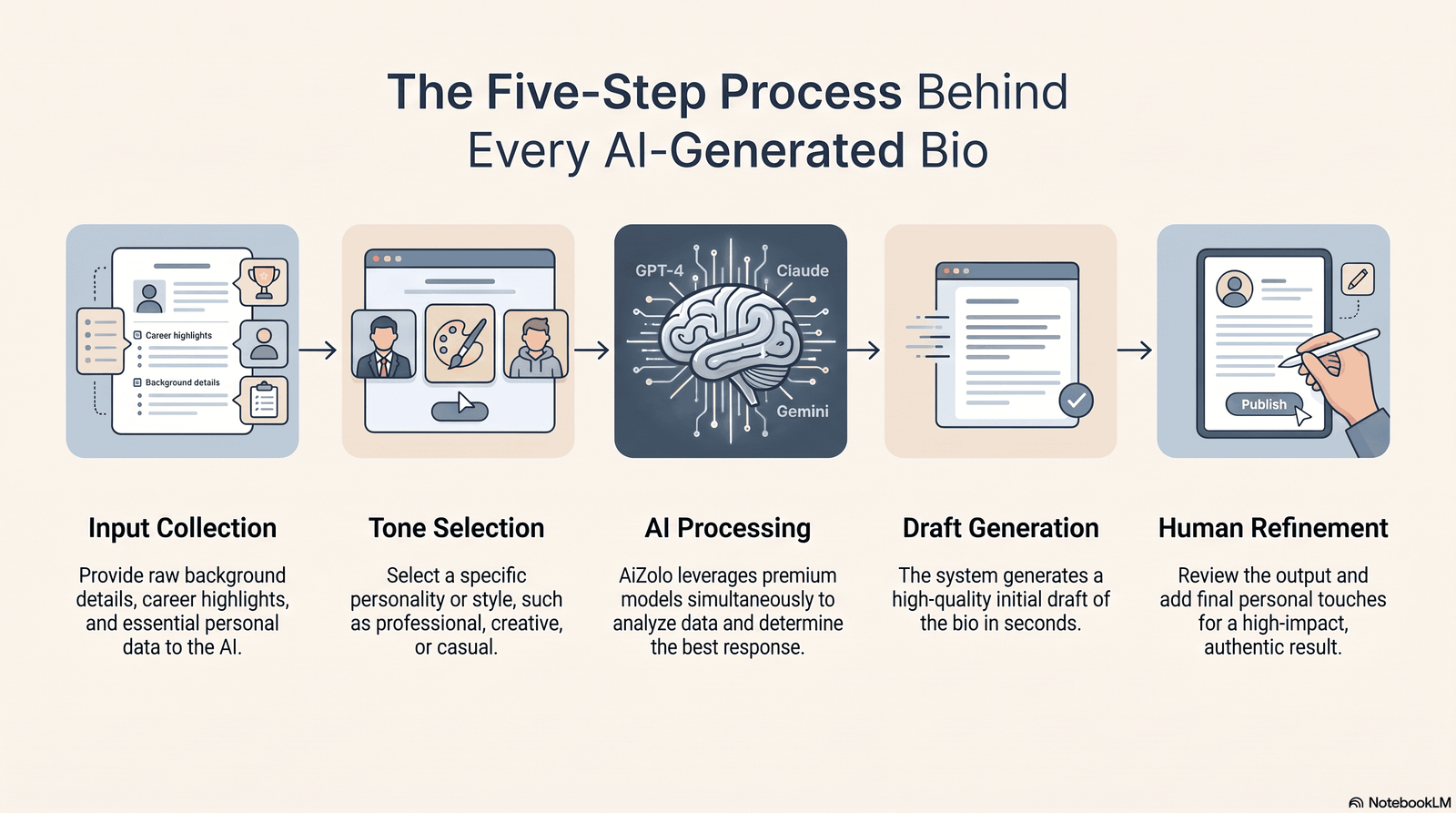
Understanding the mechanics helps you get better output, not just faster output. Here’s the typical flow:
- Input collection. You provide facts: name, role, industry, key achievements, personality traits, and the platform you’re writing for.
- Tone and format selection. You choose a voice — professional, witty, warm, bold — and a length limit, since Twitter/X, Instagram, and LinkedIn all have different character caps.
- Language model processing. The tool sends your inputs, wrapped in a prompt template, to a language model that has been trained on large volumes of text and understands sentence structure, tone, and narrative flow.
- Draft generation. The model returns one or more draft bios based on the template and constraints.
- Refinement. Most tools let you regenerate, shorten, lengthen, or shift tone until the draft feels right.
The output quality depends heavily on your inputs. A generator can only work with what you give it — vague inputs produce generic bios, and specific inputs produce sharper ones.
A practical observation from testing dozens of drafts: the single biggest quality lever isn’t the tool you choose — it’s whether you feed it a real number.
A prompt that includes “grew the team from 3 to 15” or “managed a $2M budget” consistently outperforms a prompt built only from adjectives like “experienced” or “dedicated.” The model has more concrete material to build sentences around, and the result reads as earned rather than asserted.
It’s also worth understanding what the model is not doing. It isn’t checking a database for your actual job history, and it isn’t verifying that your claimed achievement is true. It’s pattern-matching sentence structure to the inputs you gave it. That means the responsibility for accuracy sits entirely with you, the human reviewing the draft — not with the tool.
Featured Snippet Answer — How does AI Bio Generator work? (46 words): It works by collecting structured details about you (role, achievements, tone), feeding them into a language model through a prompt template, and generating a draft bio matched to your chosen platform and word limit. You then review, edit, and regenerate until it fits.
Benefits of Using an AI Bio Generator
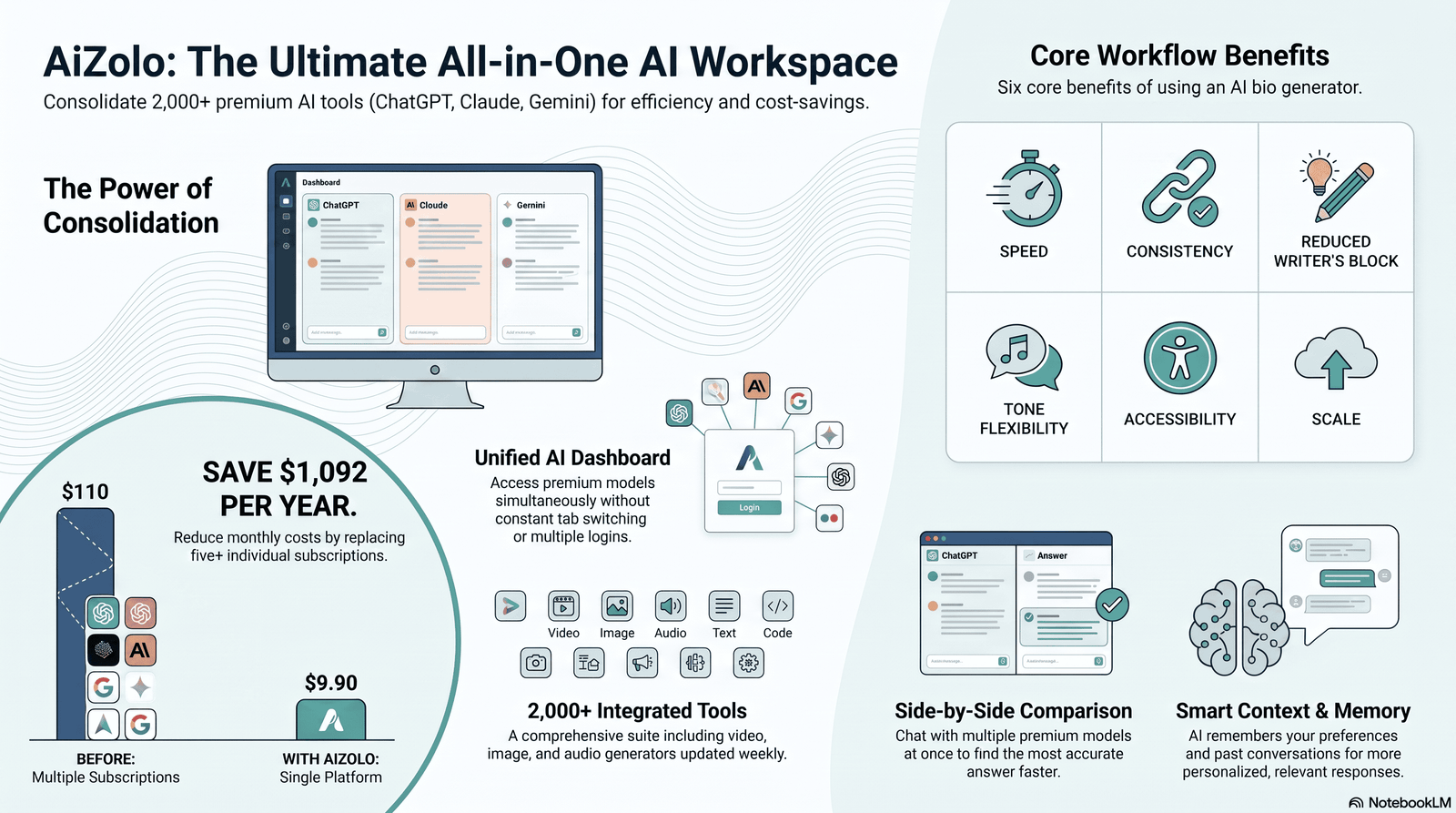
- Speed. A first draft in seconds instead of an hour of staring at a blank box.
- Consistency across platforms. One core story, adapted to LinkedIn, Instagram, and your website without starting from scratch each time.
- Reduced writer’s block. Even a rough AI draft gives you something to react to and edit, which is easier than starting from nothing.
- Tone flexibility. Quickly test a professional version against a casual version and compare.
- Accessibility. Useful for non-native English speakers or anyone who finds self-promotion uncomfortable to write.
- Scale for teams. Agencies and recruiters can produce dozens of consistent bios for clients or candidates without a dedicated copywriter for every one.
None of this replaces judgment. The tool gives you raw material; you still decide what’s true, what’s relevant, and what sounds like you.
Types of Bios You Can Create
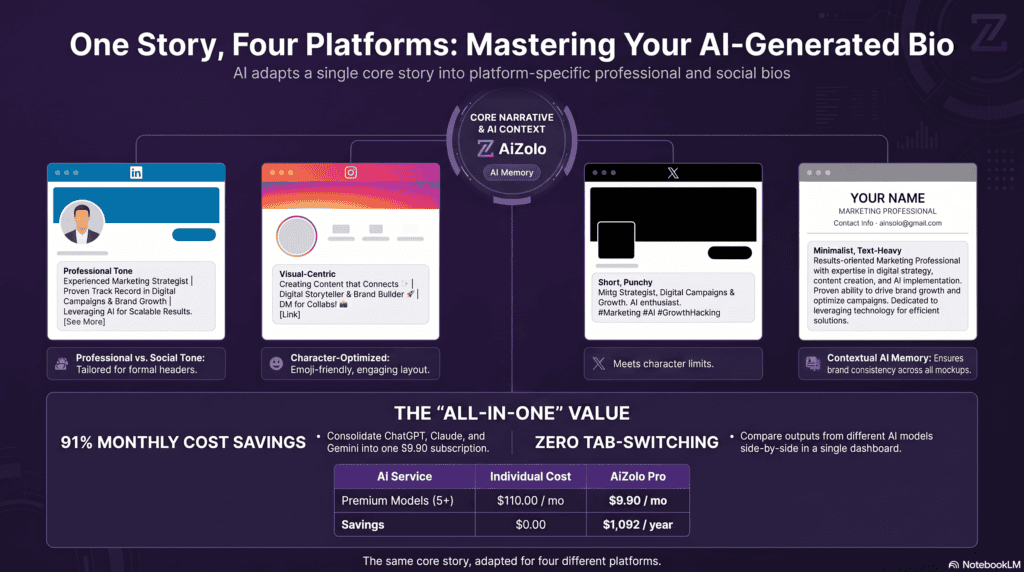
A good AI bio generator should flex across formats, not just produce one generic paragraph. Here’s how the requirements shift by platform.
The mistake most people make is writing one bio and pasting it everywhere. A LinkedIn summary optimized for recruiters reads as stiff and over-formal on Instagram.
An Instagram-style bio full of emoji and fragments looks unprofessional on a resume. Treat each platform as a separate writing task that happens to draw from the same underlying facts about you.
LinkedIn Bio
LinkedIn summaries run up to 2,600 characters, but the strongest ones lead with a hook in the first two lines, since that’s all that shows before “see more.” Focus on career narrative, measurable results, and what you’re looking for next.
Instagram Bio
Instagram gives you only 150 characters. Every word has to earn its place. Think identity + value + a call to action (link in bio, DM, etc.), not a full career summary.
Twitter/X Bio
Similar constraint to Instagram — 160 characters. Twitter/X bios lean toward personality and niche positioning: what you talk about, and why someone should follow you.
Facebook Bio
Facebook’s “Intro” section is more casual and personal than LinkedIn. It works best with a mix of professional identity and personal interests.
Website / About Page Bio
No hard limit, but readability drops fast after 150–200 words for a homepage. Longer, more detailed bios belong on a dedicated “About” page.
Portfolio Bio
Portfolio bios need to sell your craft, not just your résumé. Lead with your specialty and the kind of work you want more of.
Company Bio
Company bios need to balance mission, credibility, and differentiation. Avoid generic mission-speak — specificity about what the company actually does wins here.
Speaker Bio
Event organizers need a fast-scan version: credentials, notable talks or media, and why you’re relevant to their specific audience. Often written in third person.
Author Bio
Author bios usually run 50–150 words, written in third person, and combine writing credentials with a personal detail that makes the author memorable.
Resume Bio (Professional Summary)
A resume summary needs to be dense: 2–4 lines, quantified achievements, and keywords relevant to the role you’re applying for (important for applicant tracking systems).
Freelancer Bio
Freelancers need to answer three questions fast: what do you do, who do you do it for, and what makes you different from the next freelancer in the same niche.
Startup Founder Bio
Founder bios often need to build investor and customer trust simultaneously — relevant background, why this problem, and any traction or proof points.
Platform Character Limits at a Glance
| Platform | Typical Limit | Best Use |
|---|---|---|
| LinkedIn About | 2,600 characters | Full career narrative |
| LinkedIn Headline | 220 characters | Role + value proposition |
| Instagram Bio | 150 characters | Identity + niche + CTA |
| Twitter/X Bio | 160 characters | Personality + topic focus |
| Facebook Intro | ~101 characters shown, more in About | Personal + professional mix |
| TikTok Bio | 80 characters | Punchy identity line |
| Resume Summary | 2–4 lines (~40–60 words) | Quantified professional summary |
| Author Bio (book jacket) | 50–150 words | Credentials + personal detail |
Knowing the limit before you write saves an entire editing pass — it’s much easier to trim a generated draft down to fit than to guess and go over.
Best AI Bio Generator Features
When comparing tools, these are the features that actually change the quality of your output:
- Platform-specific templates with correct character limits built in
- Tone selector (professional, casual, witty, bold, warm)
- Multiple draft variations per generation, not just one
- Editable output rather than a locked final result
- Keyword/industry customization for resume and LinkedIn use cases
- Length control (short, medium, long) to match different placements
- Export options (copy, download, direct post where supported)
- Multi-language support for non-English bios
If a tool is missing tone control or platform presets, you’ll end up rewriting most of the output manually anyway — which defeats the purpose.
Manual Writing vs. AI Bio Generator
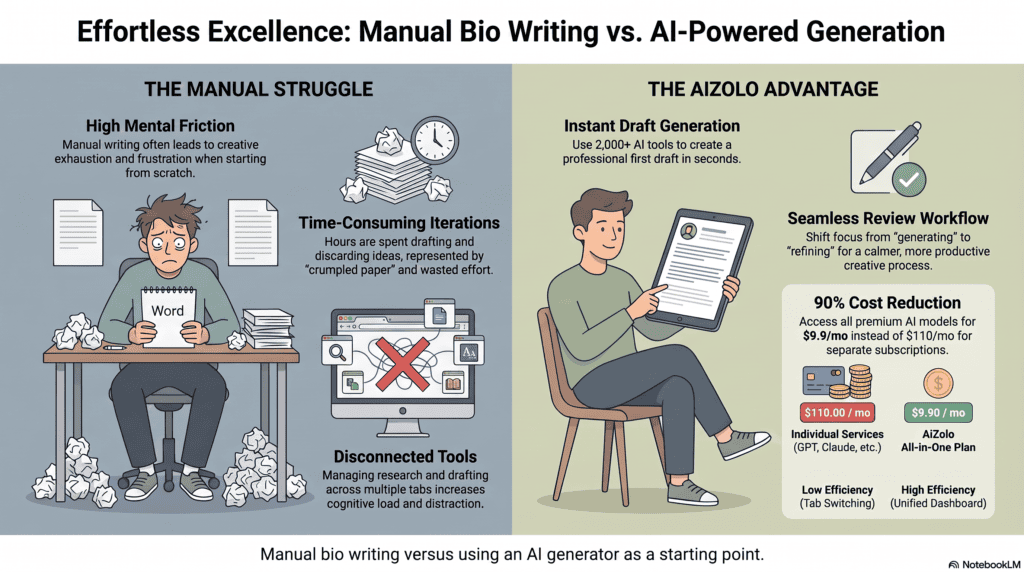
| Factor | Manual Writing | AI Bio Generator |
|---|---|---|
| Speed | Slow — often 30–60 minutes | Fast — draft in seconds |
| Consistency across platforms | Requires manual rewriting each time | Easy to adapt one draft to many formats |
| Personal authenticity | Naturally high, if the writer is skilled | Needs editing to sound fully authentic |
| Objectivity about yourself | Often too modest or too vague | More willing to state achievements plainly |
| Cost | Free (your time) or costly (hiring a copywriter) | Often free or low-cost |
| Best for | Deeply personal, nuanced narratives | First drafts, quick iteration, multiple platforms |
| Risk | Writer’s block, inconsistency | Generic phrasing if inputs are weak |
The most effective approach for most people is a hybrid: use the AI draft as a starting point, then edit in specific details, real numbers, and phrasing that sounds like you.
Short Bio vs. Long Bio
| Short Bio (under 50 words) | Long Bio (100–300 words) | |
|---|---|---|
| Best for | Instagram, Twitter/X, conference badges, team pages | LinkedIn About, website About page, press kits |
| Structure | One identity line + one value line | Opening hook, career narrative, achievements, closing detail |
| Editing priority | Every word must earn its place | Flow and narrative arc matter more than density |
| Common mistake | Trying to fit a full résumé in | Padding with filler sentences that say nothing specific |
Most people actually need both versions of themselves — a short one for social platforms and a long one for anything that asks “tell us about yourself” in more depth. Generate both from the same core facts so they stay consistent.
Best Practices for Using an AI Bio Generator
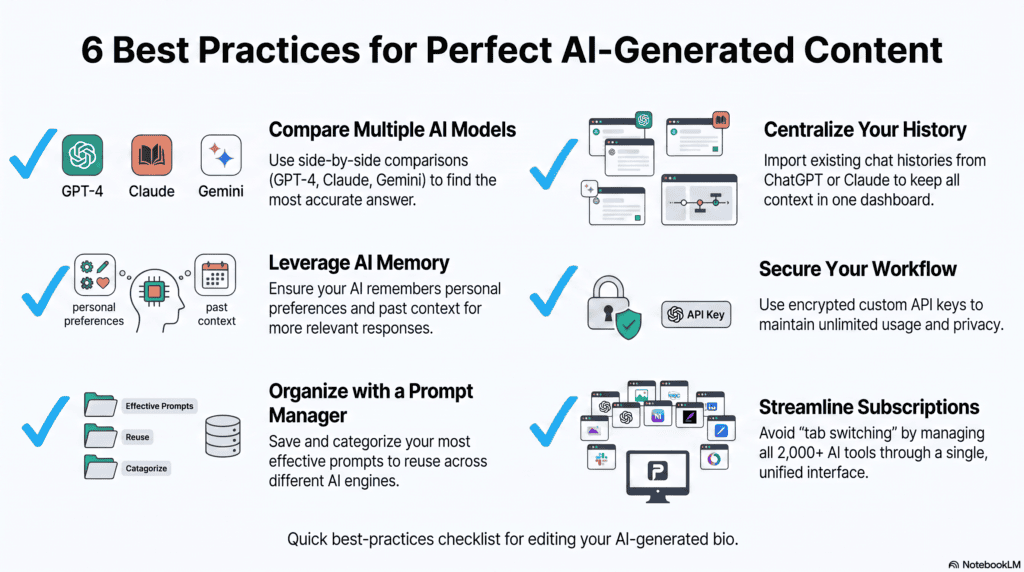
- Give it specifics, not adjectives. “Grew newsletter from 200 to 12,000 subscribers” beats “passionate about growth.”
- Write for one platform at a time. Generate a LinkedIn version, then a separate Instagram version — don’t force one draft to fit both.
- Always edit the opening line. The first sentence is what gets read; make sure it’s not a generic AI opener like “In today’s fast-paced world.”
- Keep your real voice. If you never use exclamation points in real life, remove the ones the AI added.
- Fact-check every claim. Never let the tool imply a credential, title, or number you can’t back up.
- Regenerate before you settle. The first draft is rarely the best one — try two or three variations and mix the best lines.
- Match length to platform limits. Don’t paste a 300-word LinkedIn summary into a 150-character Instagram bio field.
Mistakes to Avoid
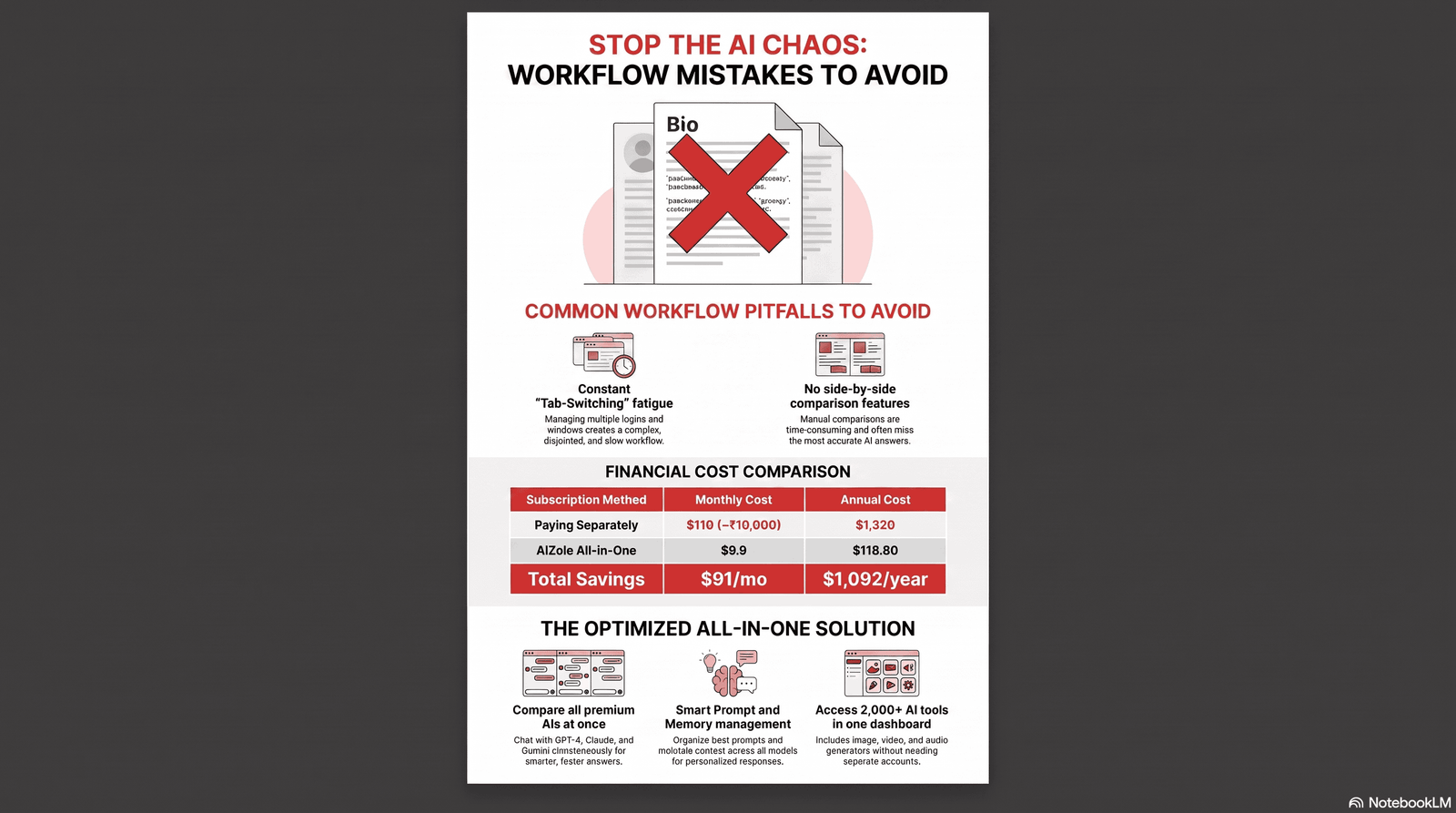
- Publishing the raw output. Unedited AI bios often sound the same as everyone else’s — generic and forgettable.
- Overusing buzzwords. Words like “passionate,” “synergy,” and “thought leader” show up constantly in AI drafts. Cut them.
- Ignoring platform norms. A stiff, formal bio on Instagram or a too-casual one on LinkedIn both undercut credibility.
- Fabricating achievements. Never let the AI’s confident tone talk you into overstating something untrue.
- Skipping proofreading. Even good tools produce awkward phrasing occasionally — always read the final version aloud.
- Using one bio everywhere. A single, unedited bio copy-pasted across five platforms usually fits none of them well.
15 AI Bio Generator Prompts
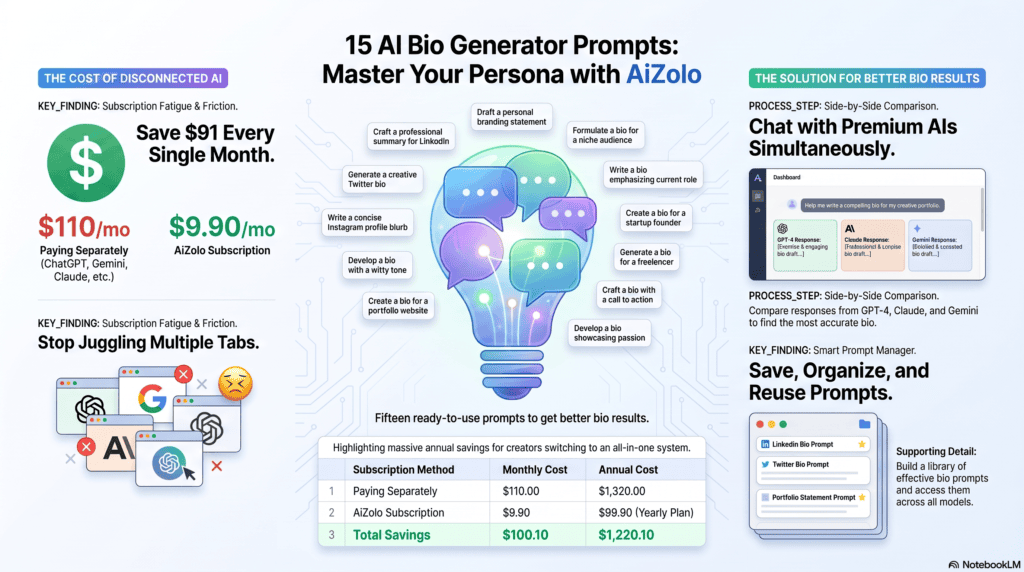
Use these as starting templates. Fill in the bracketed details with your own information.
- “Write a 100-word LinkedIn summary for a [job title] with [X years] of experience in [industry], highlighting [achievement].”
- “Create a 150-character Instagram bio for a [niche] creator who focuses on [topic] with a [tone: witty/warm/bold] voice.”
- “Write a Twitter/X bio under 160 characters for someone who writes about [topic] and works as a [role].”
- “Generate a third-person author bio for a [genre] writer with [X published books/articles], mentioning [notable achievement].”
- “Write a 2-line professional resume summary for a [job title] applying for roles in [industry], emphasizing [skill/achievement].”
- “Create a speaker bio for a [X]-minute conference talk on [topic], written in third person, including [credentials].”
- “Write a company bio for a [industry] startup that helps [target customer] do [core outcome], in a confident but not overly formal tone.”
- “Generate a freelancer bio for a [job title, e.g., graphic designer] who works with [client type], highlighting [specialty].”
- “Write a founder bio for the CEO of a [industry] startup, focused on [background] and why they started the company.”
- “Create a portfolio ‘About’ bio for a [profession] specializing in [style/niche], written in first person.”
- “Write a warm, casual Facebook ‘Intro’ bio for someone who works as a [role] and enjoys [hobby/interest].”
- “Generate three tone variations (professional, witty, warm) of a bio for a [job title] in [industry].”
- “Write a short bio (under 50 words) for a [role] to use on a conference name badge or attendee list.”
- “Create a LinkedIn ‘About’ section opening line for a [job title] that avoids clichés like ‘passionate’ or ‘results-driven.'”
- “Write a bio for a non-native English speaker working as a [role], using simple, clear sentence structure.”
Quick-Reference Bio Templates
| Bio Type | Structure |
|---|---|
| Professional (LinkedIn) | Role + years of experience → key achievement (quantified) → specialization → what you’re working on now |
| Casual (Instagram) | Identity/niche → personality detail → call to action |
| Author | Third-person name → genre/credentials → notable achievement → personal closing detail |
| Company | What you do → who you do it for → why it matters → proof point |
| Founder | Background → the problem you saw → why you started the company |
| Speaker | Credentials → notable talks/media → relevance to this specific audience |
These templates aren’t rigid rules, but they’re a reliable starting structure when you’re not sure how to organize your inputs into a generator prompt.
Real Examples: Before, Prompt, Generated, Improved
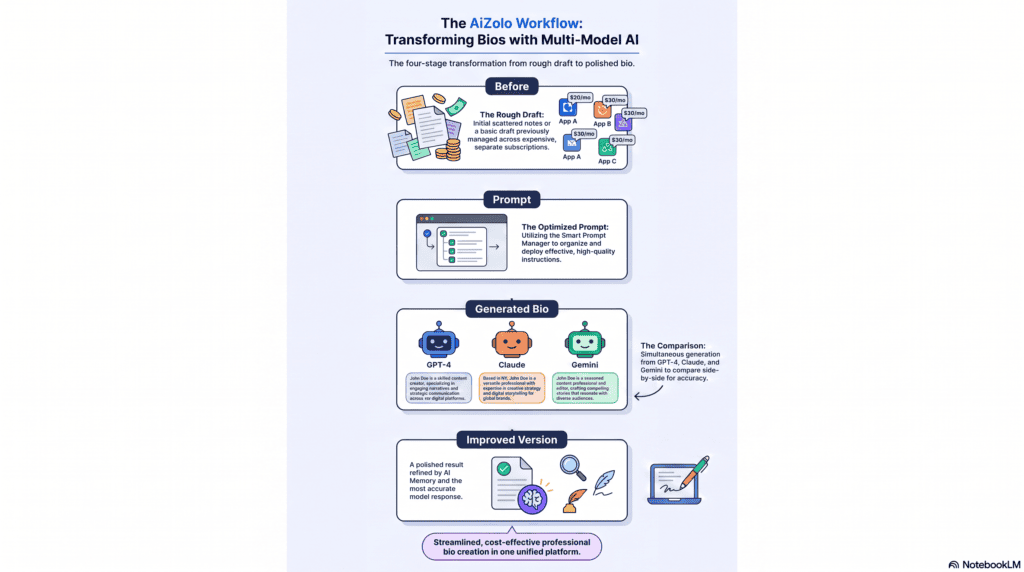
Example 1 — LinkedIn (Marketing Manager)
Before: “I am a marketing manager who likes working with teams and helping companies grow. I have a few years of experience.”
Prompt: “Write a 100-word LinkedIn summary for a marketing manager with 6 years of experience in SaaS, highlighting a 3x increase in lead generation.”
Generated Bio: “Marketing manager with 6 years of experience driving growth for SaaS companies. Over the past two years, I led a lead generation strategy that tripled qualified leads while cutting cost-per-acquisition by 20%.
I specialize in demand generation, lifecycle marketing, and cross-functional collaboration between marketing and sales. Currently focused on building scalable campaigns that turn awareness into pipeline.”
Improved Version (human-edited): “I help B2B SaaS companies turn marketing spend into predictable pipeline. Over the last two years, I tripled qualified leads for my current company while cutting acquisition costs 20%.
Before that, I built the demand-gen function at a 40-person startup from scratch. I’m most useful in rooms where marketing and sales need to actually agree on what a ‘good lead’ looks like.”
Example 2 — Instagram (Fitness Coach)
Before: “Fitness coach. I love helping people get fit and feel good.”
Prompt: “Create a 150-character Instagram bio for a fitness coach who focuses on strength training for beginners, with a warm, encouraging tone.”
Generated Bio: “🏋️ Strength training for beginners | No judgment, just progress | 1:1 coaching + free guides below 👇”
Improved Version (human-edited): “Strength coaching for people who’ve never lifted before. No judgment, just progress 💪 Free beginner guide ⬇️”
Example 3 — Author Bio
Before: “I write books. I’ve published two novels and I like writing about family and identity.”
Prompt: “Generate a third-person author bio for a literary fiction writer with 2 published novels, mentioning a regional book award.”
Generated Bio: “[Name] is the author of two novels exploring family, memory, and identity across generations. Their debut novel won the [Regional] Book Award, and their work has been praised for its quiet emotional precision. They live in [City] and are currently working on a third novel.”
Improved Version (human-edited): “[Name] writes about the families we’re born into and the ones we build later. Their debut novel won the [Regional] Book Award; their second was a finalist for [Prize]. They live in [City], where they teach fiction workshops and are slowly finishing a third novel.”
Example 4 — Company Bio (Startup)
Before: “We are a startup that makes software for small businesses to manage their finances.”
Prompt: “Write a company bio for a fintech startup that helps small business owners manage cash flow, in a confident, plain-language tone.”
Generated Bio: “[Company] helps small business owners see their cash flow clearly, without needing an accounting degree. Our software connects to your bank accounts and shows you, in plain language, what’s coming in, what’s going out, and what you can safely spend. Built for owners who’d rather run their business than read a spreadsheet.”
Improved Version (human-edited): “Most small business owners find out they have a cash flow problem after it’s already a problem. [Company] shows you what’s coming, three weeks out, in plain English — no accounting background required. We built it after watching too many good businesses fail from timing, not performance.”
Use Cases by Audience
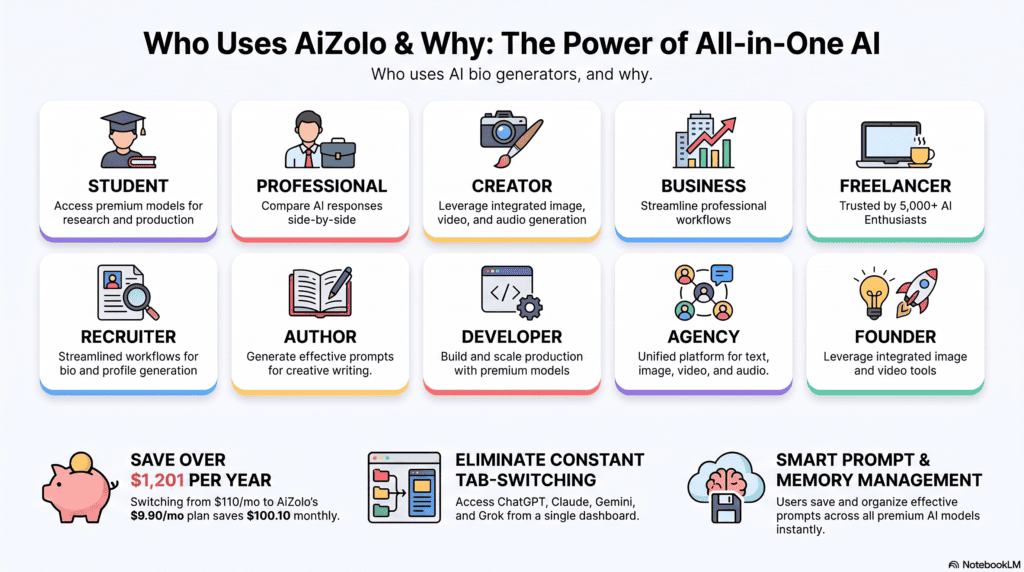
Students. Most students don’t have a long work history to draw on, which makes the blank page especially intimidating. An AI bio generator helps reframe coursework, class projects, and internships as legitimate professional experience — useful for a first LinkedIn profile or a portfolio site built before graduation.
Professionals. Career professionals often need the same story told three different ways: a detailed LinkedIn About section, a punchy resume summary, and a shorter version for a company directory page. Generating all three from one core set of facts keeps the narrative consistent instead of drifting between versions.
Influencers and creators. Creators live or die by their bio line — it’s often the deciding factor in whether someone follows or scrolls past. AI tools make it cheap to test five tonal variations in the time it would take to write one by hand.
Businesses. Teams without a dedicated copywriter often let “About Us” pages go stale for years. AI generators lower the barrier to keeping team bios and company descriptions current as people and priorities change.
Freelancers. A freelancer’s bio has to do real selling work across proposals, marketplace profiles, and a personal site. Because freelancers often serve several client types, generating niche-specific variations (one for agencies, one for direct clients) is a practical use of the tool.
Recruiters and agencies. Recruiters writing candidate summaries, or agencies producing bios for multiple client accounts, benefit most from the speed and consistency of formatting — the volume makes manual writing impractical.
Authors. Publishers and literary journals often require a very specific third-person format. AI tools are good at hitting that structure reliably, leaving the author to focus on the personal detail that makes their version stand out.
Developers. Technical professionals sometimes struggle to translate deep technical work into a plain-language bio for a non-technical audience — conference organizers, hiring managers, or investors. AI can help bridge that translation gap as a starting point.
Agencies. Agencies managing many client accounts benefit from standardized bio formats that stay on-brand across dozens of profiles, without needing a writer to manually draft each one.
Startup founders. Founders frequently need a bio that works for two very different audiences at once — investors evaluating credibility, and customers evaluating trust. AI drafts give founders a fast way to test which framing lands better with each.
Limitations of AI Bio Generators
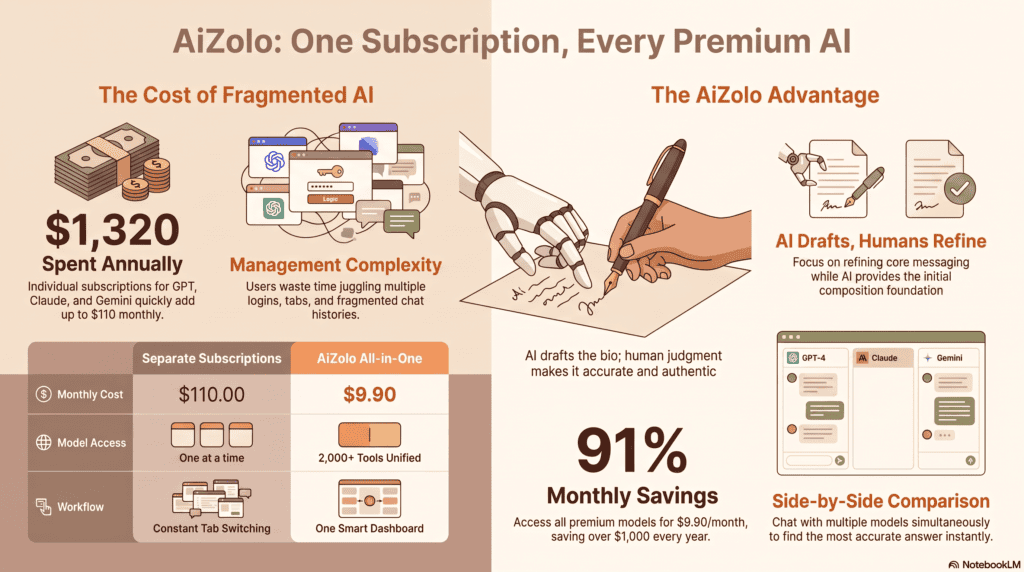
No AI bio generator is a complete substitute for self-reflection and good editing. Be aware of these limits:
- Genericness. Without specific inputs, output tends toward generic, interchangeable phrasing.
- Fact accuracy. The tool doesn’t know what’s true about you — it will confidently state things you never gave it, or embellish vague inputs.
- Voice mismatch. AI output defaults to a “safe” professional tone that may not match your actual personality.
- Context blindness. It doesn’t know your industry’s unwritten norms or your specific audience’s expectations as well as a human writer familiar with that world.
- Repetition across users. Popular tools using similar templates can produce bios that feel structurally similar to other users’ bios.
- Weak handling of nuance. Career changes, gaps, or unconventional paths are hard for a template-driven tool to frame well without specific guidance from you.
- Over-confidence in tone. AI drafts often sound more assertive than the person actually is, which can feel inauthentic if left unedited.
None of these are reasons to avoid the tools — they’re reasons to treat the output as a first draft, not a finished product. The editing step is not optional; it’s where the bio actually becomes yours.
The Future of AI Bio Generation

Bio generators are likely to keep moving toward personalization at the input stage — for example, pulling from an existing resume, LinkedIn profile, or portfolio automatically instead of requiring manual field entry.
Better tone-matching (analyzing a sample of your existing writing to mimic your actual voice) is a logical next step, as is tighter platform integration that adapts one core bio into every format automatically, respecting each platform’s exact constraints.
As with all AI writing tools, the trend is toward less generic output and more grounding in real, verifiable input — which is good news for anyone who wants a bio that still sounds human.
There’s also a reasonable expectation that voice-matching will improve — tools analyzing a short sample of your existing writing (an email, a LinkedIn post, a blog comment) to mirror your actual sentence rhythm rather than defaulting to a generic “AI voice.”
That single change would likely do more for authenticity than any new template or feature. Until then, the editing step remains the part that turns a generic draft into something that sounds like one specific person.
Frequently Asked Questions
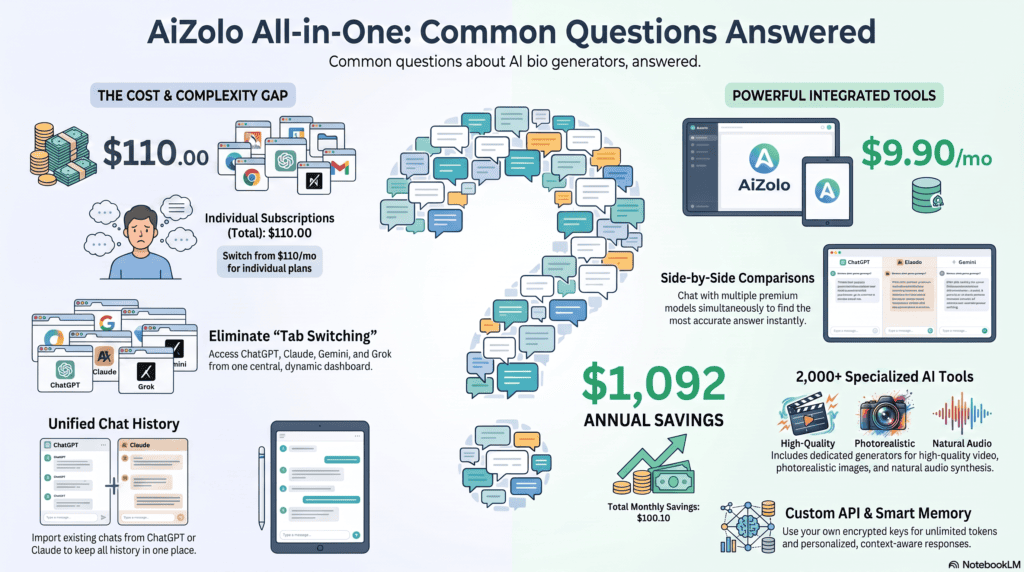
What is an AI Bio Generator? An AI bio generator is a tool that uses natural language processing to turn basic personal or business details into a ready-to-use biography for platforms like LinkedIn, Instagram, or a resume.
Is an AI Bio Generator free? Many AI bio generators offer a free tier with limited generations per month, while more advanced tone controls, multiple platforms, and unlimited use are often part of a paid plan.
How does an AI Bio Generator work? It collects structured inputs about you — role, achievements, tone — and feeds them into a language model, which generates a draft bio matched to your chosen platform and length.
Can AI write professional bios? Yes. AI can produce a solid first draft of a professional bio quickly, but it works best when you edit the result to add specific, verifiable details and adjust the tone to match your real voice.
Is an AI-generated bio good? It can be, but quality depends on your inputs and how much you edit afterward. Raw, unedited AI bios often read as generic; edited ones can be excellent.
What is the best AI Bio Generator? There isn’t a single universal “best” — the right tool depends on which platforms you need bios for, whether you want tone customization, and whether you need bulk generation for a team.
Can ChatGPT write bios? Yes. General-purpose AI writing assistants like ChatGPT can write bios if you give them clear prompts, though dedicated bio generators often have built-in platform templates and character limits that save editing time.
How do I create a professional bio? Start with your role, one or two quantified achievements, and your area of specialization. Draft with an AI tool if helpful, then edit for specificity, tone, and accuracy before publishing.
Is AI bio writing accurate? AI tools are accurate about grammar and structure but not about facts — they don’t know your real achievements unless you provide them, so always fact-check the output.
Can AI create LinkedIn bios? Yes. Most AI bio generators include a LinkedIn-specific template that respects the platform’s character limits and professional tone conventions.
Can AI write Instagram bios? Yes. Instagram-focused templates typically account for the 150-character limit and a more casual, personality-driven tone than LinkedIn.
How do I improve my personal bio? Add specific numbers and outcomes instead of adjectives, cut generic buzzwords, and make sure the opening line would make a stranger want to keep reading.
Are AI-generated bios unique? Not automatically. Because many tools use similar underlying language models and templates, output can feel structurally similar across users unless you edit in specific personal details.
Can AI write company bios? Yes. AI can draft company bios covering mission, differentiation, and audience, though the strongest versions still need a human to sharpen the specific value proposition.
Which AI tool is best for biographies? It depends on your use case — dedicated bio generators are faster for platform-specific formatting, while general AI writing assistants offer more flexibility for longer or more nuanced biographical writing.
Final Verdict
An AI bio generator is a genuinely useful starting point, not a finished product. It solves the blank-page problem and gives you a structured draft in seconds.
The bios that actually perform well online are the ones where someone took that draft and made it specific, honest, and a little more like how they actually talk.
Use the tool to get moving. Use your own judgment to get it right.
CTA
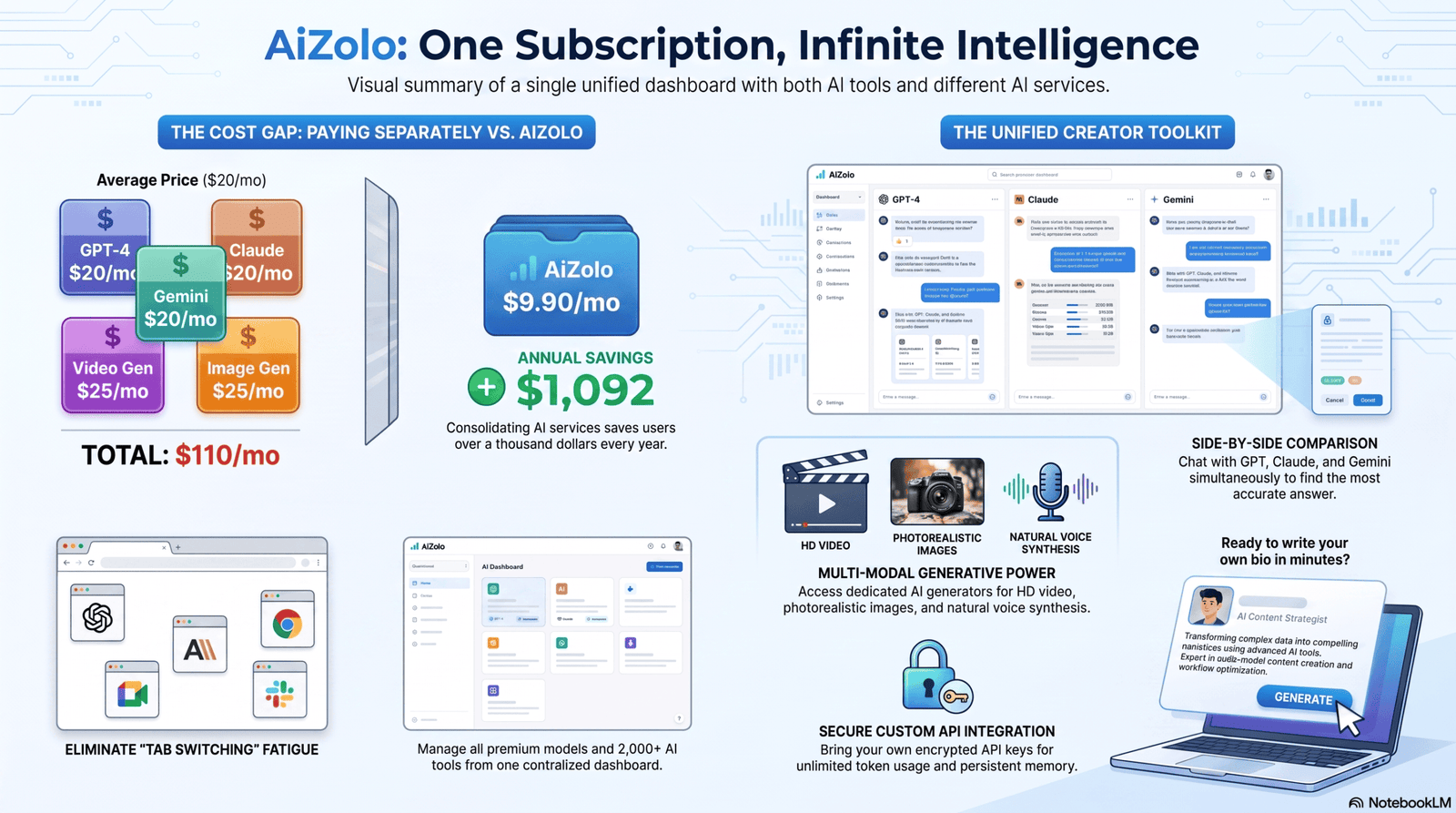
Writing a bio from scratch shouldn’t take an entire afternoon. Try Aizolo’s AI Bio Generator to get a polished first draft in seconds — then use the editing tips in this guide to make it sound unmistakably like you. Explore Aizolo’s full suite of AI writing tools to keep your personal brand consistent everywhere you show up online.
Author Bio
Author: Jeevesh Title: AI Researcher & SEO Content Strategist
Jeevesh researches artificial intelligence, AI productivity tools, search engine optimization, and content marketing. He specializes in evaluating AI software, testing emerging technologies, and creating in-depth educational content that helps readers make informed decisions.
Email: jeevesh@aizolo.com