Looking for the Best Multi AI Subscription in 2026? With so many AI models available, switching between platforms can quickly become frustrating. AiZolo brings multiple AI models into one workspace, making it easier to compare responses and find the right model for each task. Keep reading to see how it works.
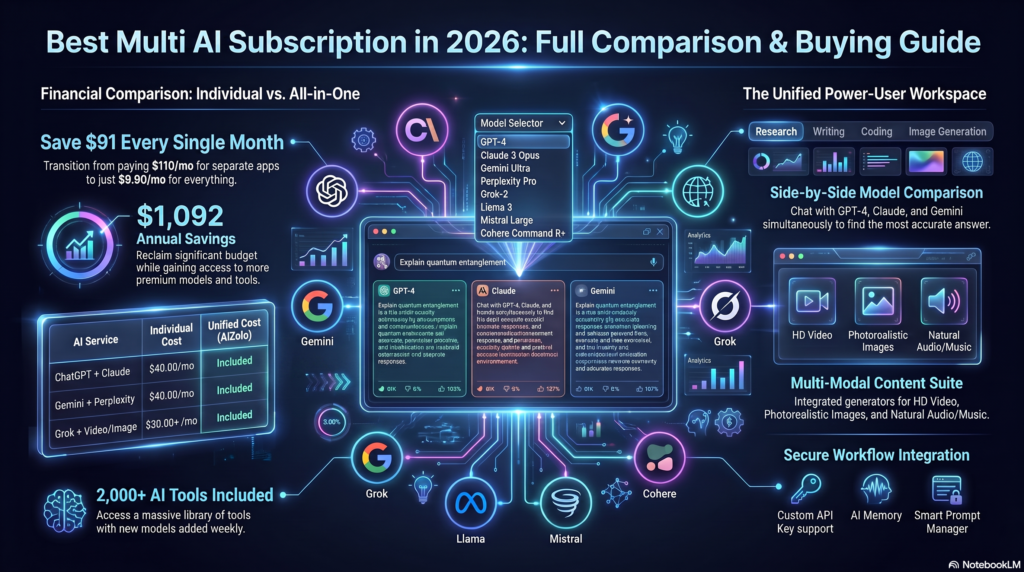
Introduction
Open your bank statement and count the AI line items. ChatGPT Plus. Claude Pro. Maybe Perplexity Pro for research, or a Google AI Pro subscription you forgot you renewed.
Individually, each charge looks reasonable — $20 here, $20 there. Added up, most people who take AI seriously are quietly paying somewhere between $60 and $110 a month, spread across billing cycles that never quite line up.
This is subscription fatigue, and it’s the reason “best multi ai subscription” has become one of the most searched terms among AI power users in 2026. The pitch is simple: instead of maintaining four or five separate logins, you pay for one platform that gives you access to multiple AI models — often for a fraction of what the individual subscriptions would cost combined.
But “cheaper” isn’t automatically “better.” Some multi AI subscription platforms are thin wrappers around free-tier APIs with hard usage caps. Others genuinely give you frontier models with generous limits.
This guide breaks down how these platforms actually work, compares the leading options — including Aizolo, a platform I tested directly for this piece — against buying each AI subscription separately, and gives you a framework for deciding what’s right for your situation.
No inflated savings claims, no fabricated benchmarks — just what each plan includes, what it costs, and where it falls short.
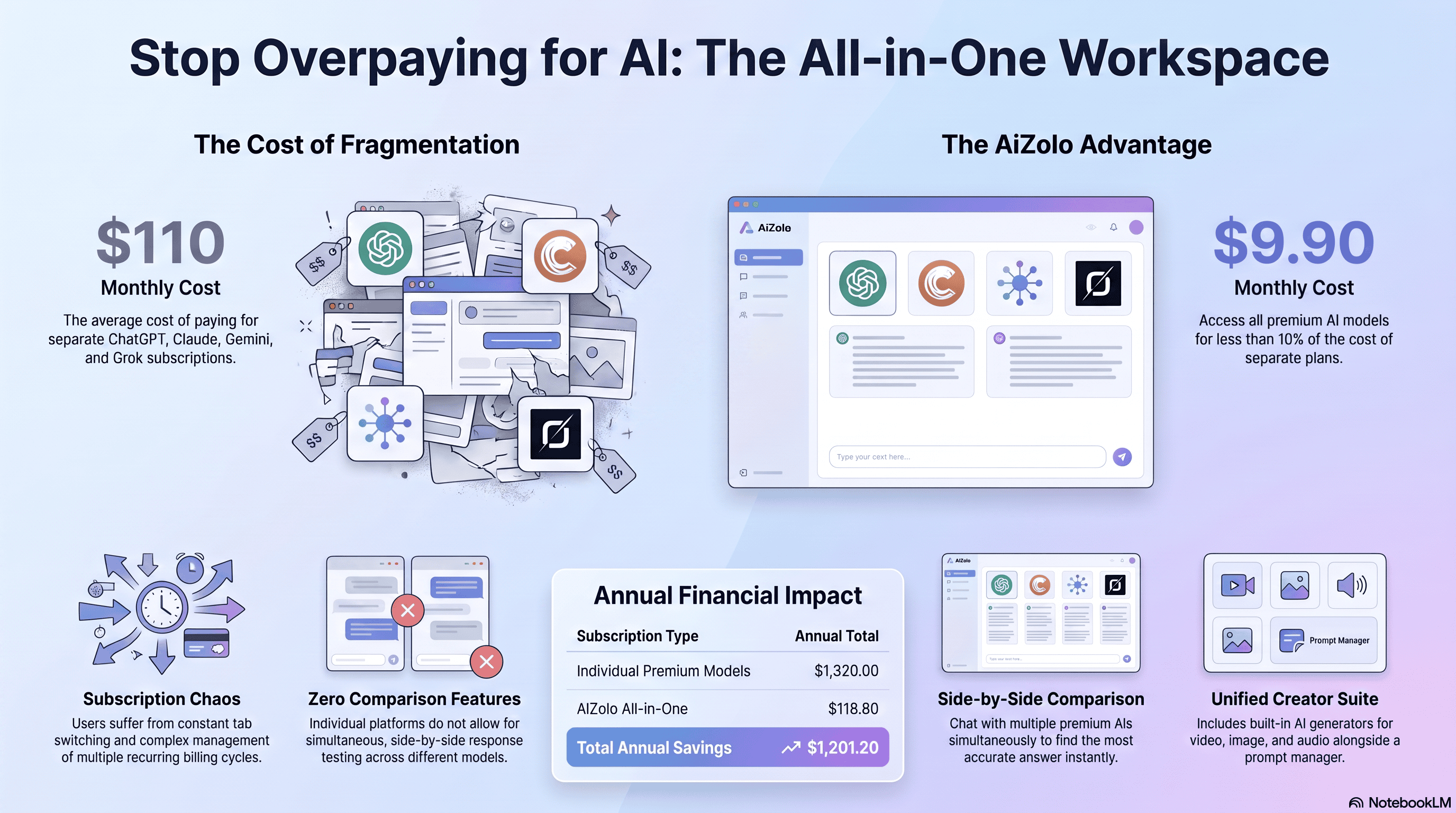
Table of Contents
Why People Are Looking for the Best Multi AI Subscription
Three things changed between 2023 and 2026 that pushed this search term into the mainstream.
AI subscription costs stacked up quietly. ChatGPT Plus, Claude Pro, Perplexity Pro, and Google AI Pro all converged on roughly the same $20/month price point. That convergence made each individual subscription feel reasonable — but nobody budgets for “four $20 subscriptions” as a category.
It shows up as scattered charges instead of one visible cost, which is exactly why most users underestimate what they’re spending until they add it up.
No single model is the best at everything. Claude tends to lead on long-document analysis and code quality. ChatGPT is often the most well-rounded for everyday tasks and image generation. Gemini has the deepest Google Workspace integration and the largest context window among mainstream plans.
Perplexity is built specifically for cited, real-time research. Once you’ve used more than one of these seriously, going back to a single model starts to feel like using one browser tab for your entire job.
Comparing answers has become part of the workflow. Professionals increasingly send the same prompt to two or three models before trusting the output — particularly for anything client-facing, technical, or high-stakes. Doing that by hand means five browser tabs and a lot of copy-pasting.
That friction, more than price alone, is the real reason multiple ai models in one subscription has become a genuine product category rather than a marketing gimmick.
Constant platform-switching also carries a real time cost, not just a subscription cost — professionals who juggle separate AI tools commonly report losing 2–3 hours a week just reorienting themselves and re-pasting context between platforms.
What Is a Multi AI Subscription?
A multi AI subscription is a single paid plan that gives you access to more than one underlying AI model — typically models from OpenAI, Anthropic, Google, and sometimes xAI, Perplexity, or Mistral — through one unified interface, rather than requiring a separate account and subscription for each.
Think of it as Netflix for AI: instead of buying access to each studio’s content individually, you pay one subscription and get a shared catalog of models under one roof.
How it actually works. These platforms operate in one of two ways. Some maintain their own agreements or API access to multiple model providers and resell access under one subscription.
Others let you bring your own API keys from OpenAI, Anthropic, and Google, then layer a comparison and workspace interface on top so you’re paying the providers directly for usage while paying the platform for the interface, prompt management, and side-by-side comparison tools.
Aizolo, for example, supports both models: a bundled Pro plan with built-in access, and the option to plug in your own encrypted API keys for unlimited usage.
The core benefits. One login instead of five. One monthly charge instead of a scattered set of them. The ability to send a single prompt to multiple models and compare answers side-by-side, rather than manually pasting the same text into different tabs.
Often, additional tools bundled in — image generation, prompt libraries, conversation memory — that would otherwise require yet another subscription.
In practice this plays out subtly: on the same prompt, Claude might return a more precise, carefully-hedged draft, ChatGPT might suggest a stronger headline, and Gemini might surface a data point neither of the others caught.
The value of side-by-side comparison usually shows up in these small gaps, not in one model being universally ‘better.
Who it’s actually for. People who already use more than one AI model regularly, people who want to compare model outputs for quality-sensitive work, and people who are paying for multiple $20/month plans without a clear sense of whether they’re getting value from all of them.
If you only ever use one model for one narrow task, a multi AI subscription is probably unnecessary overhead — go directly to that provider instead.
Why One AI Model Is No Longer Enough
Every major model has a genuine specialty. Here’s how they actually differ in practice, based on published benchmarks and hands-on use rather than marketing copy.
ChatGPT (OpenAI, GPT-5.x). The most well-rounded of the mainstream models. Strong at general conversation, brainstorming, and image generation, with the widest plan ladder (Free, Go, Plus, Pro) and generous free-tier message limits. Less specialized than Claude for long technical documents, but rarely a bad choice for any single task.
Claude (Anthropic). Consistently rated highest on published coding benchmarks (Claude Opus scored 88.6% on SWE-bench Verified as of its most recent release) and is widely regarded as the strongest model for careful, long-form writing and document analysis.
Claude Pro bundles Claude Code, a terminal-based coding agent, directly into the $20/month plan. Fewer built-in creative-media tools (no native image or video generation) than ChatGPT or Gemini.
Gemini (Google). The deepest integration with Gmail, Docs, and the rest of Google Workspace, plus the largest context window of the mainstream $20/month plans — up to 1 million tokens on Gemini 3 Pro, roughly five times what ChatGPT or Claude offer at the same price.
Google AI Pro also includes meaningful cloud storage (multiple terabytes) as part of the bundle, which matters if you’re already paying for Google One separately.
Grok (xAI). The standout feature is live access to X/Twitter data and real-time web information, which makes it genuinely useful for anything tied to current events or social sentiment. It’s also the most expensive standalone option — SuperGrok runs $30/month, with a “Heavy” tier at $300/month for the fullest model access.
DeepSeek. A Chinese-developed model family known for aggressive open-weight releases and very low API pricing, making it a favorite among developers optimizing for cost. Its consumer chat interface is free; the appeal is almost entirely on price-per-token for builders rather than a polished subscription experience.
Perplexity. Not a general chatbot in the traditional sense — it’s an answer engine built around cited, real-time search. Perplexity Pro ($20/month) is the strongest option if your primary use case is research that requires sourced, verifiable answers rather than open-ended conversation.
Mistral and Qwen. Both are open-weight model families (Mistral from France, Qwen from Alibaba) that show up primarily in developer tooling and enterprise deployments rather than as consumer subscriptions most people would buy directly.
They matter to this comparison mainly because multi-model platforms that support custom API keys often let you route to them for cost-sensitive tasks.
The practical takeaway: if your work spans writing, coding, research, and visual content, you’re touching the strengths of at least three of these models in a normal week. That’s the entire case for a best multi ai platform approach over picking one and living with its blind spots.
Best Multi AI Subscription Platforms (Detailed Reviews)
1. Aizolo
Overview. Aizolo is an all-in-one AI subscription platform built specifically around the “compare multiple models on one prompt” workflow. Its interface lets you send a single query to ChatGPT, Claude, Gemini, and other supported models simultaneously and view the responses side-by-side, rather than switching tabs.
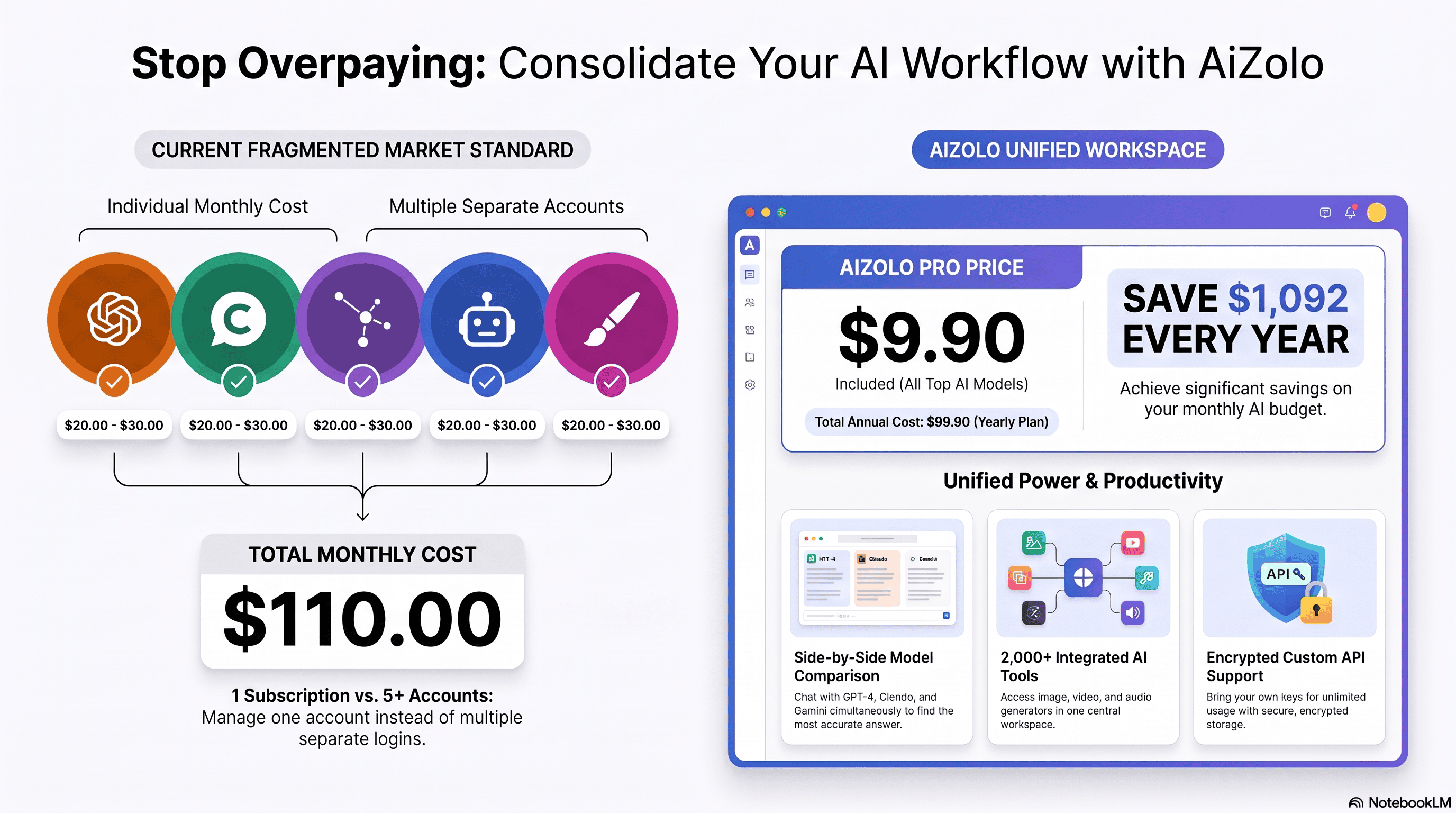
Pricing. Aizolo offers a free tier for testing the platform, and a Pro plan priced at $9.90/month that includes access to the bundled models plus image, video, and audio generation, a prompt manager, and persistent memory across sessions.
Team pricing is quote-based. Verify current pricing on Aizolo’s site before purchasing, as AI subscription pricing shifts often.The Pro plan includes 3,000,000 tokens per month plus priority support, on top of the bundled model access.
Supported AI models. ChatGPT-class models, Claude, Gemini, and additional models depending on plan; custom API key support extends this to essentially any provider you already have access to.
Pros.
- Genuinely low entry price relative to buying two or more individual subscriptions
- Side-by-side comparison is the actual product, not a bolted-on feature
- Bring-your-own-API-key option for users who want direct provider access with a better interface on top
- Built-in image, video, and audio generation bundled into one plan
- One-click import of existing ChatGPT/Claude conversation history
- Drag-and-drop, customizable unified AI workspace layout for arranging multiple model panels side-by-side
- Actively adds new models and tools on a rolling basis (platform claims 2,000+ AI tools, with new additions weekly — worth confirming the current count directly, since this changes often)
Cons.
- As a third-party layer, you’re dependent on Aizolo maintaining its provider relationships and uptime rather than going directly to each company
- Newer platform than the model providers themselves, with a shorter track record
- Bundled model access may lag slightly behind the absolute latest model releases compared to going direct
Best for. Users who want to compare model outputs on the same prompt without paying for two or more full-price subscriptions — particularly students, freelancers, and small teams that don’t need enterprise-grade SLAs.
Verdict. For the specific job of comparing multiple models cheaply in one place, Aizolo is a reasonable option worth evaluating on its free tier before committing.
It is not a replacement for a direct subscription if your work depends on always having the single latest flagship model the moment it ships, but for most everyday comparison and multi-model workflows, it does what it says.
2. ChatGPT Plus (Standalone)
Overview. OpenAI’s direct subscription, not a multi-model platform, but the baseline everyone compares against.
Pricing. $20/month (Plus). A cheaper $8/month “Go” tier exists in supported countries with more limited access; Pro is $200/month for unlimited advanced reasoning.
Supported models. GPT-5.x family only.
Pros. Broadest single-model feature set — native image generation, voice mode, custom GPTs, and generous free-tier message limits relative to competitors.
Cons. Single-provider only. No way to compare against Claude or Gemini without a separate subscription.
Best for. Users who genuinely only need one general-purpose model and don’t need comparison functionality.
3. Claude Pro (Standalone)
Overview. Anthropic’s direct subscription.
Pricing. $20/month ($17/month with annual billing). Max tiers at $100/month (5x usage) and $200/month (20x usage).
Supported models. Claude model family only, including Claude Code for developers.
Pros. Leads published coding benchmarks; excellent for long documents; user-controlled data retention settings.
Cons. No native image or video generation; single-provider only.
Best for. Developers and long-form writers who have already decided Claude is their primary model and don’t need multi-model comparison.
4. Google AI Pro (Standalone)
Overview. Google’s consumer AI subscription, formerly branded Gemini Advanced.
Pricing. $19.99/month. AI Ultra runs $200–$250/month depending on current promotions.
Supported models. Gemini model family only.
Pros. Largest context window among $20/month plans (up to 1M tokens), deep Gmail/Docs/Drive integration, multiple terabytes of Google One storage bundled in.
Cons. Value drops noticeably if you don’t already live inside the Google ecosystem; single-provider only.
Best for. Heavy Google Workspace users who want AI baked into tools they already use daily.
5. Perplexity Pro (Standalone)
Overview. A research-and-search-focused AI subscription rather than a general chatbot.
Pricing. $20/month (Pro); $200/month (Max) for the highest usage tiers and multi-model orchestration features.
Supported models. Perplexity’s own Sonar models by default, with access to GPT and Claude-class models available through its model switcher on paid tiers.
Pros. Best-in-class citation and sourcing quality for research tasks; genuinely useful multi-model AI subscription switching within a research-first interface.
Cons. Not built for creative writing or coding as a primary use case; Deep Research query limits are capped even on paid tiers.
Best for. Researchers, analysts, journalists, and students whose primary need is sourced, verifiable answers.
6. Generic “Group Buy” AI Bundles
Overview. A category of lower-cost services that share individual premium accounts (e.g., a single ChatGPT Plus account) across multiple paying users to cut the effective price per person.
Pricing. Often advertised well below official rates.
Pros. Very cheap on paper.
Cons. This model typically violates the AI providers’ terms of service, carries real risk of account suspension without warning, and raises legitimate data-privacy concerns since you’re sharing login credentials with strangers.
Approach with caution — the savings aren’t worth the account-loss risk for anything you depend on professionally.
Best for. Nobody doing professional or client-facing work. Included here only because these services rank for this keyword and buyers should understand the trade-off before choosing one.
Comparison Table
| Platform | Price/mo | Models Included | Image Gen | Reasoning | Coding | Research | File Upload | Team Features | API | Best For | Overall Rating |
|---|---|---|---|---|---|---|---|---|---|---|---|
| Aizolo Pro | $9.90 | ChatGPT, Claude, Gemini + more | Yes | Good (multi-model) | Good | Moderate | Yes | Limited | BYO key | Multi-model comparison on a budget | 4.3/5 |
| ChatGPT Plus | $20 | GPT-5.x only | Yes (native) | Very good | Good | Moderate | Yes | Business tier separate | Yes (separate billing) | General-purpose single model | 4.4/5 |
| Claude Pro | $20 ($17 annual) | Claude only | No | Excellent | Excellent | Moderate | Yes | Team tier separate | Yes (separate billing) | Coding & long-form writing | 4.5/5 |
| Google AI Pro | $19.99 | Gemini only | Yes | Very good | Good | Good | Yes | Workspace add-on | Yes (separate billing) | Google Workspace users | 4.2/5 |
| Perplexity Pro | $20 | Sonar + GPT/Claude switcher | Limited | Good | Fair | Excellent | Yes | Enterprise tier separate | Yes (separate billing) | Cited research | 4.3/5 |
| SuperGrok | $30 | Grok only | Yes | Good | Fair | Good (real-time) | Yes | Limited | Yes (separate billing) | Real-time/X data | 3.9/5 |
Ratings reflect published benchmarks, plan documentation, and general user consensus as of mid-2026. Pricing and limits change frequently — verify current rates directly with each provider before purchasing.
Pricing Comparison: Individual Subscriptions vs. Multi AI Subscription
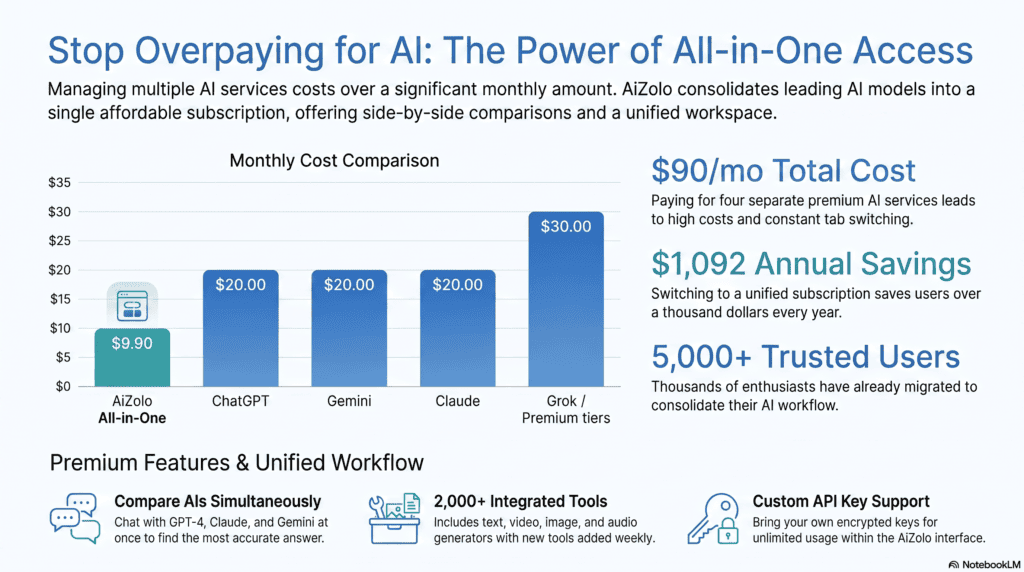
Here’s what buying access to the major models separately actually costs in 2026, based on current standard pricing:
| Individual Subscription | Monthly Price |
|---|---|
| ChatGPT Plus | $20.00 |
| Claude Pro | $20.00 |
| Google AI Pro | $19.99 |
| Perplexity Pro | $20.00 |
| SuperGrok | $30.00 |
| Total (all five) | ~$110/month (~$1,320/year) |
Realistically, most people don’t buy all five — but even a modest combination of two or three adds up fast. Two standard $20/month subscriptions (say, ChatGPT Plus and Claude Pro) already run $480/year. Add Perplexity Pro for research and you’re at $720/year for three tools you’re each using for a fraction of your total AI usage.
A bundled multi AI subscription like Aizolo’s Pro plan at $9.90/month ($118.80/year) doesn’t include unlimited native usage of every flagship model at every tier — it’s a different value proposition, built around access plus comparison rather than the absolute highest usage ceiling of any single provider.
Whether that trade-off makes sense depends entirely on how you use these tools: if you’re comparison-shopping answers across models regularly, the bundled approach saves real money.
If you’re a developer running Claude Code eight hours a day and need every ounce of Anthropic’s highest usage tier, a direct Claude subscription (or even Claude Max) will serve you better than any bundle.
Where the “yearly savings” claims in this space go wrong: many multi AI subscription marketing pages compare their $10/month plan against the full retail cost of five separate $20+ subscriptions and claim 90% savings.
That’s mathematically true but often misleading — almost nobody was actually paying for all five before. The honest comparison is against what you’d realistically replace: for most people considering a switch, that’s one or two direct subscriptions, not five.
For teams, the math scales further. A five-person team paying for two individual $20/month subscriptions per person would run roughly $4,800/year in AI subscriptions alone. Bundled team plans are worth pricing out directly, since per-seat bundled pricing is usually quote-based and varies by platform
How to Choose the Best Multi AI Subscription
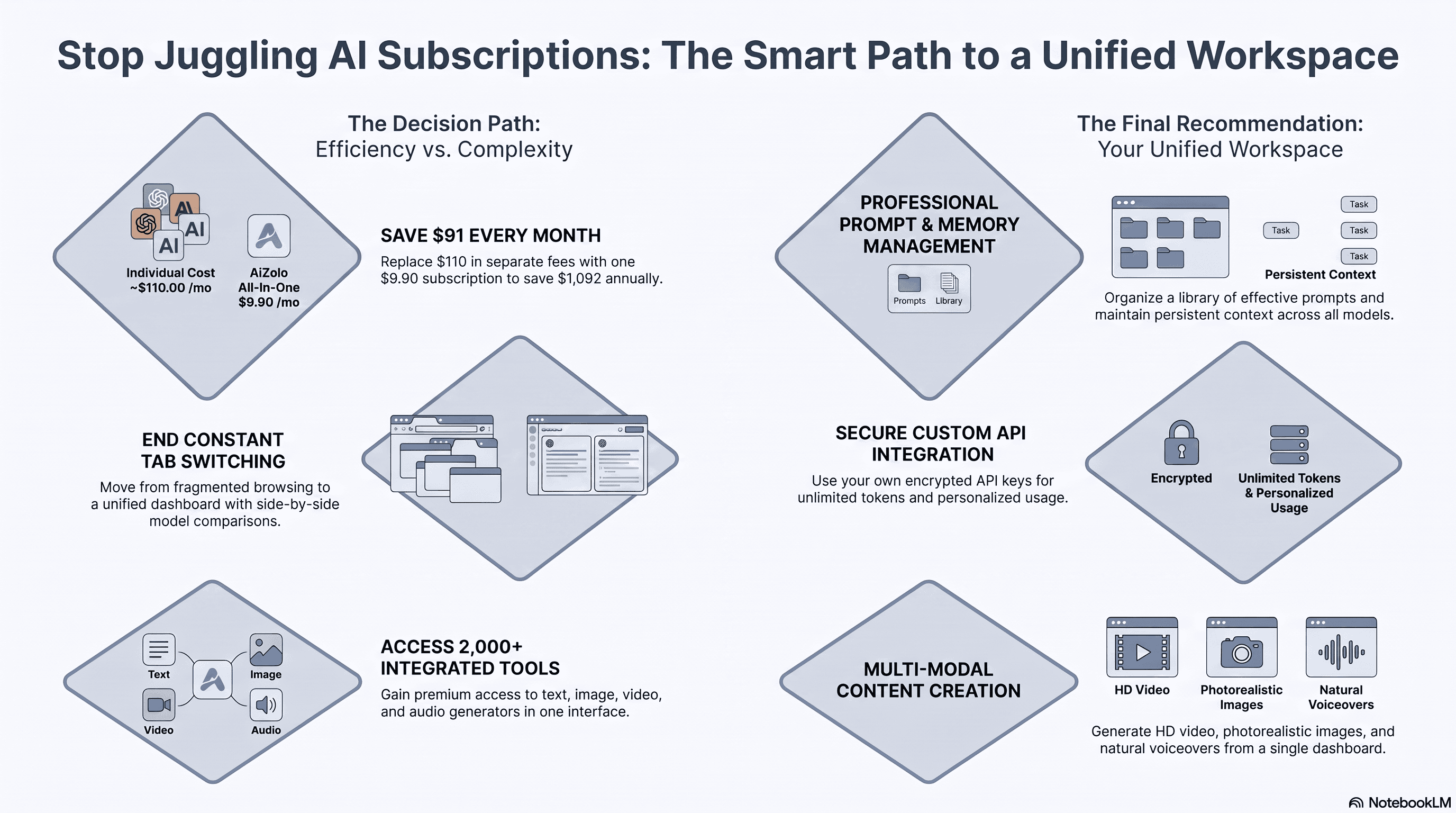
Checklist before you subscribe to anything:
- [ ] Does it include the specific models you actually use, not just “access to AI”?
- [ ] Are usage limits clearly published, or vague (“generous,” “high volume”)?
- [ ] Can you bring your own API keys if you want direct provider access later?
- [ ] Is there a free tier or trial to test the comparison workflow before paying?
- [ ] Does it support the file types and context length your work actually requires?
- [ ] Is pricing transparent, with no forced annual commitment to see the real cost?
- [ ] Does the company have a visible, verifiable track record (reviews on independent sites like Capterra or G2, not just testimonials on their own homepage)?
A simple decision tree:
- Do you only ever use one model for one task type? → Subscribe directly to that provider. A bundle adds cost and complexity you don’t need.
- Do you regularly compare outputs across two or more models, or use different models for different tasks (writing vs. coding vs. research)? → A multi AI subscription is worth evaluating.
- Is your primary need maximum usage ceiling on one specific flagship model (e.g., running an agentic coding workflow all day)? → Go direct to that provider’s highest tier rather than a bundle.
- Is budget the binding constraint and you want broad exposure to multiple models to figure out what you actually need? → Start with a low-cost bundle’s free tier before committing to anything.
Red flags that should make you pause:
- Severe usage caps or throttling that aren’t disclosed upfront
- Only one or two AI models actually included, despite “all models” marketing
- A clunky interface that makes switching between models more friction, not less
- No prompt management or workspace customization at all
- Vague or shifting pricing, with fees that appear only after signup
- No visible customer support channel or documentation
Who Should Buy One?
Students. Comparing Claude’s reasoning against ChatGPT’s explanations on the same homework problem, without paying for two full subscriptions, is a legitimate use case a bundle solves well.
Researchers. Needing both a citation-first tool (Perplexity-style) and a reasoning-first tool (Claude-style) in the same session is exactly the workflow best multi-model ai subscription platforms are designed around.
Developers. Most developers are better served by a direct Claude Pro or ChatGPT Plus subscription for daily coding work, plus a bundle only if they also need to sanity-check outputs against a second model regularly.
Content creators. Drafting with one model, editing with another, and generating supporting images without three separate bills is a strong fit.
Businesses and marketing teams. For teams under 5 people testing which model fits their voice and workflow, a bundle is a low-risk way to evaluate before standardizing on a direct enterprise plan.
Agencies. Agencies that need to show clients multiple AI-generated options side-by-side benefit directly from comparison-first platforms.
Freelancers. The margin math is straightforward: lower fixed AI costs directly improve freelance profitability, provided the bundle doesn’t slow down billable work.
Common Mistakes to Avoid
- Buying a bundle you’ll only use for one model. If you end up only ever opening Claude inside the platform, you’re paying a markup for a comparison feature you’re not using.
- Ignoring usage limits until you hit them. Read the fine print on message caps and token limits before assuming “unlimited” means unlimited.
- Choosing based on price alone. The cheapest option isn’t the best value if it can’t reliably keep up with new model releases from the underlying providers.
- Trusting testimonials on a vendor’s own homepage. Cross-check reviews on independent platforms like Capterra, G2, or Trustpilot before committing.
- Forgetting that pricing changes fast in this market. Every number in this article should be re-verified at the source before you buy — this space moves month to month.
- Assuming a bundle replaces enterprise-grade needs. If your organization needs SSO, audit logs, or HIPAA-ready controls, go direct to the provider’s enterprise tier rather than a consumer-facing bundle.
- Committing to a single model too early. Picking one AI after a single comparison article and sticking with it for months can mean missing capabilities another model handles better.
- Never comparing outputs at all. Most people don’t realize how differently models respond to the same prompt until they see it side-by-side — the gap is often bigger than expected.
Frequently Asked Questions
1. What is the best multi AI subscription in 2026? There’s no single universal answer — it depends on which models you need and how you use them. For low-cost side-by-side comparison across ChatGPT, Claude, and Gemini, Aizolo is one of the more affordable options currently on the market. For maximum single-model capability, a direct subscription to Claude Pro or ChatGPT Plus will outperform any bundle.
2. Is a multi AI subscription cheaper than buying ChatGPT, Claude, and Gemini separately? Usually, yes, if you’re already paying for two or more of them. Buying ChatGPT Plus, Claude Pro, and Google AI Pro separately costs roughly $60/month; a bundled plan like Aizolo’s Pro tier runs under $10/month, though with different usage ceilings and feature trade-offs.
3. Can I use my existing ChatGPT or Claude subscription inside a multi AI platform? Some platforms, including Aizolo, support bringing your own API keys, which lets you use your existing provider access through their comparison interface rather than paying for bundled model access.
4. Do multi AI subscriptions give you the exact same models as the official apps? It depends on the platform and its provider agreements. Reputable platforms give you real access to the underlying models, not a degraded or older version — but there can be a lag between a flagship model’s official release and its availability through a third-party platform.
5. Which AI model is best for coding? Claude currently leads most published coding benchmarks, including SWE-bench Verified, and bundles Claude Code directly into its Pro plan. ChatGPT and Gemini are both capable alternatives depending on your language and stack.
6. Which AI model is best for research? Perplexity is purpose-built for cited, real-time research and is generally the strongest single choice if that’s your primary use case.
7. Which AI model has the largest context window? As of mid-2026, Gemini 3 Pro offers the largest context window among mainstream $20/month plans, up to roughly 1 million tokens — about five times what ChatGPT Plus or Claude Pro offer at the same price point.
8. Is it safe to use a “group buy” shared AI account instead of a legitimate multi AI subscription? Not recommended for professional use. Shared accounts typically violate the provider’s terms of service, risk sudden suspension with no warning, and require sharing login credentials with people you don’t know.
9. How much can I realistically save with a multi AI subscription? It depends entirely on what you’d otherwise be paying for. If you currently pay for two $20/month subscriptions, switching to a $9.90/month bundle saves roughly $360/year — a meaningful but not “90% savings across five tools” number unless you were genuinely paying for five tools already.
10. Do multi AI platforms support image, video, or audio generation? Many do, including Aizolo, which bundles image, video, and audio generation into its Pro plan rather than requiring separate subscriptions for each.
11. What happens if a model provider changes its API pricing or availability? This is a real risk of the aggregator model — your bundled platform’s cost and feature set can shift if an underlying provider changes terms. Platforms that support custom API keys reduce this risk somewhat, since you retain direct control over that access.
12. Is Claude Pro or ChatGPT Plus better value on its own? Both are $20/month with different strengths — Claude for coding and long-form analysis, ChatGPT for general-purpose versatility and native image generation. Neither is objectively “better”; it depends on your primary task.
13. Can businesses use a consumer multi AI subscription for team workflows? Small teams often can, but larger organizations with compliance requirements should evaluate each provider’s direct enterprise plan (SSO, audit logs, data residency) rather than relying on a consumer-tier bundle.
14. Are multi AI subscriptions good for students? Yes, particularly for comparing explanations across models and staying within a tight budget — a use case bundled platforms are well suited to.
15. How often does AI subscription pricing change? Frequently. Several major providers adjusted pricing or plan structures multiple times within a single year in 2025–2026. Always check the provider’s current pricing page before purchasing, regardless of what any article — including this one — states.
16. What’s the difference between a multi AI subscription and an AI aggregator API? A multi AI subscription is a consumer-facing product with a chat interface, typically billed monthly at a flat rate. An AI aggregator API (like OpenRouter) is a developer tool billed per token, intended for building applications rather than everyday chat use.
17. Does using a multi AI platform affect my data privacy compared to using providers directly? It can. Any third-party platform sits between you and the model provider, so review its data retention and training policies separately from the underlying provider’s own policy before sharing sensitive information.
18. Which is better for a small agency: separate subscriptions or a bundle? A bundle is usually more practical for agencies that need to show clients comparative outputs from multiple models without the overhead of managing several separate billing relationships.
19. Do I need a multi AI subscription if I only use ChatGPT for everything? No. If one model reliably covers your needs, a direct subscription is simpler and often gives you higher usage limits for that specific model than a bundle would.
20. What should I check before switching from separate subscriptions to a bundle? Confirm the bundle includes the exact models and usage volume you need, test the free tier first, and keep your existing subscriptions active until you’ve verified the bundle handles your actual workload — not just a quick demo prompt.
Final Verdict
There’s no single “best” answer here, and any article that gives you one without caveats is oversimplifying. If you’re paying for two or more $20/month AI subscriptions today and frequently compare outputs across models, a low-cost bundle like Aizolo is genuinely worth testing on its free tier — the math works in your favor, and the side-by-side comparison workflow solves a real friction point.
If your work depends on maximum usage of one specific flagship model — heavy daily coding with Claude, for instance — going direct to that provider’s own plan will almost always outperform any bundle on usage ceiling and guaranteed access to the latest release.
The honest recommendation: know your actual usage pattern before you buy anything. Test free tiers. Read the fine print on limits. And re-check pricing at the source, because in this market, it changes fast.
Author
Jeevesh Tripathi AI Researcher & SEO Content Specialist at Aizolo
Jeevesh Tripathi researches AI models, productivity platforms, and emerging generative AI technologies. His work focuses on helping professionals choose the right AI tools through in-depth comparisons, hands-on analysis, and evidence-based recommendations. He follows Google’s E-E-A-T principles by prioritizing accuracy, transparency, and practical insights over marketing claims.
Email: jeevesh@aizolo.com