Marketing teams generate a huge share of their content with AI now, and that has created a strange new problem: agencies need to verify what their freelancers actually wrote, publishers need to know what they’re buying, and brands need to know whether “AI-assisted” content is going to look formulaic to Google or to readers.
That’s the gap AI detectors are trying to fill, and it’s why Aizolo and the best AI tools for detecting AI generated marketing text have become some of the most-discussed solutions in the content operations world in 2026.
The honest answer up front: no detector on this list is close to perfect, and any tool that claims otherwise is marketing, not measurement.
Vendor-published accuracy numbers (often 99%+) are usually measured on clean, ideal-condition text — full AI output versus verified human writing, no editing, no humanization.
Independent academic and third-party testing consistently finds real-world accuracy 10–25 percentage points lower, with false positive rates that matter a great deal if you’re making decisions about a freelancer’s livelihood or a student’s grade.
This guide pulls together vendor documentation, independent benchmarks (including the widely cited University of Chicago Booth School / BFI Working Paper audit and multiple third-party test labs), and user-reported experience to give you a realistic picture of each tool — not just the number on its homepage. We did not run our own controlled lab benchmark for this article; where we cite an accuracy figure, we attribute it to whoever measured it, and we flag vendor-self-reported numbers as such.
Table of Contents
How We Evaluated the Best AI Tools for Detecting AI Generated Marketing Text
We looked at each detector across the dimensions that actually matter for a marketing or content operations workflow:
- Detection accuracy on unedited AI output from GPT-4/GPT-5-class models, Claude, and Gemini
- False positive rate — how often genuinely human-written marketing copy gets wrongly flagged
- Performance on edited or “humanized” content, since almost no real marketing copy is unedited raw AI output
- API and CMS/workflow integration for teams scanning content at volume
- Pricing model (credits, subscriptions, or pay-per-scan)
- Multilingual support, relevant for global marketing teams
- Enterprise features — team seats, audit trails, SSO, LMS or CMS plugins
Every number below comes from a named source — a vendor’s own published claim, an independent lab, or an academic study — because the single biggest problem in this category is that vendor-reported accuracy and real-world accuracy are often very different things.
Quick Comparison Table
| Tool | Reported Accuracy | Independent/Real-World Accuracy | API | Free Tier | Starting Price | Best For |
|---|---|---|---|---|---|---|
| Pangram Labs | 99.98% (vendor) | Near-top-tier; independently validated by University of Chicago and University of Maryland researchers, with a documented false-positive rate as low as 1-in-10,000 in that research | Yes ($0.05/1,000 words) | Limited daily credits, no ongoing free plan | ~$20/mo | Lowest false-positive risk, high-stakes verification |
| Originality.ai | 99% on GPT-4 (vendor) | ~82–83% overall in independent multi-model benchmarks; strong on GPT-4/DeepSeek, weaker on Claude (~72–75%) | Yes | No ongoing free tier (limited signup credits) | ~$14.95–$30/mo (credit-based) | Content agencies, publishers, bundled plagiarism check |
| GPTZero | 99% (vendor); 99.3–99.5% on the 2026 Chicago Booth benchmark | Real-world estimates commonly land 88–95% on clean AI text, lower on humanized text; false positive rate reported between 0.05% and ~8% depending on the study | Yes (from ~$45/mo) | 10,000 words/month | ~$9.99–$23.99/mo | Education, ESL-conscious institutions, best free tier |
| Winston AI | 99.98% (vendor) | Independent benchmarks put real-world accuracy at roughly 76–92%, with false positives around 8–12% (higher for ESL writing) | Yes ($0.015/1,000 words) | 14-day trial only, no permanent free tier | ~$12–$18/mo | Publishers needing OCR, image detection, plagiarism |
| Copyleaks | 99%+ (vendor) | Roughly 76–91% in independent tests depending on content type and language; strongest on raw English AI text and DeepSeek output | Yes | ~10 pages/month | ~$10.99–$13.99/mo | Multilingual detection (30+ languages), enterprise API |
| ZeroGPT | 98%+ (vendor) | Independent testing places it around 67–85%, with false positive rates commonly cited between 15% and 26% | Limited/undocumented | Yes, generous free tier | ~$9.99–$26.99/mo | Quick free spot-checks, not high-stakes decisions |
| Sapling | Not independently benchmarked at scale | Mixed; some tests rank it near the top of free tools, others place it mid-pack | Yes (developer-focused) | Yes, 2,000 characters | ~$25/mo | Developers embedding detection via API into support/CRM tools |
| Hive Moderation | Not publicly benchmarked | ~80–85% in limited third-party testing | Yes (enterprise, high-throughput) | Public demo only | Enterprise/custom | High-volume platform and UGC moderation, not single-document checks |
| Turnitin | Claims under 1% false positive, ~85% AI writing caught (per company statements) | Independent estimates suggest ESL false positives run 2–5x higher than for native speakers; several universities have disabled the feature over reliability concerns | No public API (institutional only) | No — institutional license only | Institutional licensing only | Universities already on Turnitin for plagiarism |
| Scribbr AI Detector | N/A (built on QuillBot’s engine) | ~72–84% depending on the benchmark; notably weak on Claude-generated text in at least one third-party test | No | Yes, 10,000 words/month | Free / paid plagiarism add-on | Students wanting a free pre-submission check |
| Crossplag | Not independently benchmarked | ~58% in one independent 12-tool comparison — one of the lowest scores tested | Limited | Yes | Free/low-cost | Casual, low-stakes checks only |
Prices and credit structures change often — verify current numbers directly on each vendor’s pricing page before buying, especially for API and enterprise tiers.
Individual Tool Reviews
Pangram Labs
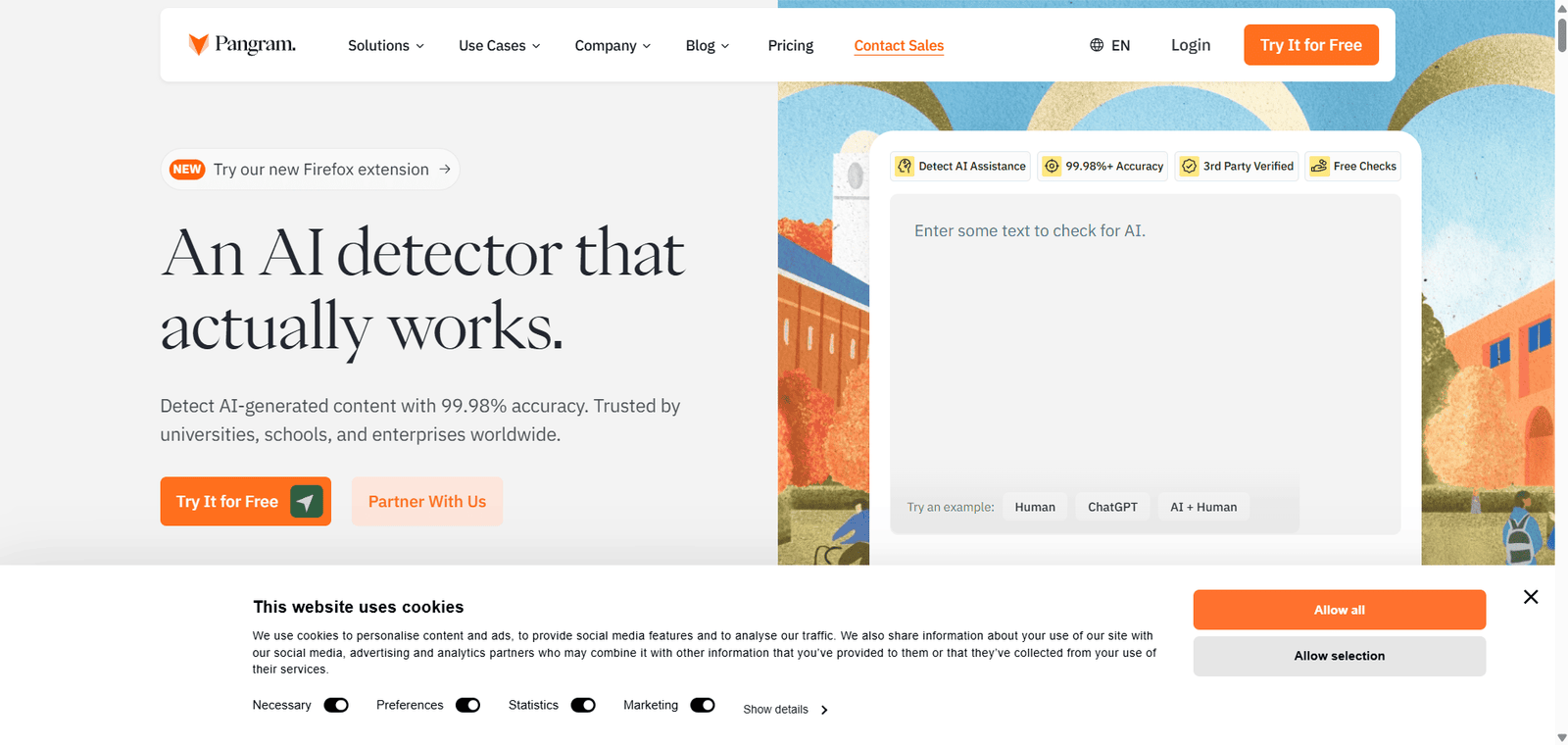
Overview: Pangram is the newest major entrant and has built its reputation almost entirely around independent academic validation rather than self-reported numbers.
Its core model is a fine-tuned classifier (the company calls the underlying approach EditLens) presented at ICLR in 2026, and the company has released open-weights components so outside researchers can audit the claims — something none of its major competitors have done.
Key features: Four-tier classification (fully human, lightly AI-assisted, moderately AI-assisted, fully AI-generated) instead of a binary score; sentence-level, sliding-window highlighting; detection across GPT-5, GPT-4o, Claude 4, Gemini 3, Llama 4, and DeepSeek; support for roughly 20 languages; LMS integrations for education customers.
Pros: The independent validation is the real differentiator — University of Chicago and University of Maryland researchers have both tested Pangram’s claims directly, rather than relying on the company’s own numbers. Segment-level analysis handles the hybrid, human-plus-AI-editing reality of most real content better than a single document-level score.
Cons: No meaningful ongoing free tier — a handful of daily credits is enough to try the tool, not to use it. At $0.05 per 1,000 words, its API pricing is the most expensive of the major detectors.
Pricing: Free trial (a few credits/day), Educator plan around $20/month, Professional around $35/month with API and batch processing, custom Enterprise pricing.
Verdict: If a false accusation would carry real professional, academic, or legal weight, Pangram is the detector with the strongest independent evidence behind its accuracy claims.
Originality.ai
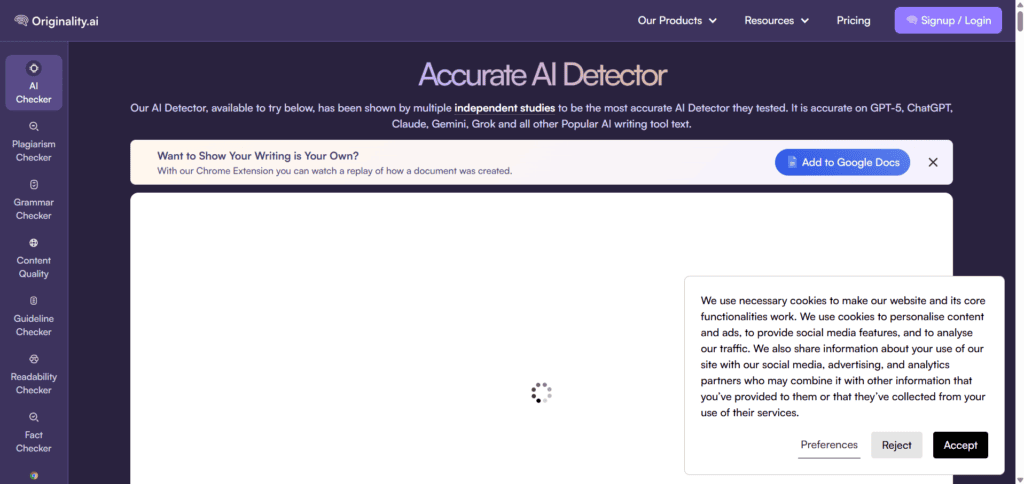
Overview: Originality.ai was built specifically for content marketers, SEO agencies, and publishers rather than educators, and it shows — the product bundles AI detection with plagiarism checking and a fact-checking layer in one scan, which matters for teams vetting freelancer submissions at scale.
Key features: Combined AI + plagiarism scan, Deep Scan mode aimed at catching humanized/paraphrased AI text, full-site crawling to audit an entire domain’s content at once, team dashboards with per-writer activity logs, REST API.
Pros: In one independent multi-model benchmark, Originality.ai came out on top among tested detectors at roughly 82–83% overall accuracy, ahead of GPTZero, Copyleaks, and Turnitin in that same test — with especially strong detection of GPT-4 and DeepSeek content. The audit trail and full-site scan are genuinely useful for agencies managing outsourced writers.
Cons: Claude detection is a consistent weak point across independent tests, with roughly one in four Claude-generated documents going undetected in at least one benchmark. No ongoing free tier — you get a small signup credit allotment and then pay per scan.
Pricing: Pay-as-you-go and subscription options starting around $14.95–$30/month depending on credit volume; Enterprise tier required for full API access.
Verdict: The strongest all-around pick specifically for content marketing and publishing workflows, provided you know its Claude blind spot and don’t treat any single score as gospel.
GPTZero
Overview: GPTZero was the first mainstream AI detector (launched by a Princeton student in January 2023) and has since become the most widely deployed tool in education, with a large user base and deep LMS integrations. It combines perplexity and burstiness analysis with a deep classifier trained on a large document corpus.
Key features: Free tier of 10,000 words/month with sentence-level highlighting; “Paraphraser Shield” aimed specifically at humanized/paraphrased text; Writing Replay for authorship evidence; Canvas, Google Classroom, and Moodle integrations; batch scanning on paid tiers.
Pros: GPTZero publishes more of its methodology than most competitors and participates in third-party benchmark suites like RAID. On the independently run 2026 Chicago Booth benchmark it scored among the highest of any tool tested, and multiple sources report a comparatively low false-positive rate, including a company-reported 1.1% rate on TOEFL essays after specific work to reduce ESL bias.
Cons: Real-world reviewer testing (Reddit, Trustpilot, and independent labs) reports meaningfully higher false-positive rates than the vendor’s own figures — estimates in various studies range from about 2% up to nearly 30% depending on methodology and content type, and GPTZero does not support some common marketing file types like PPTX or XLSX.
Pricing: Free (10,000 words/month), Individual around $9.99–$14.99/month, Professional around $23.99–$45.99/month with API, Classroom/Enterprise custom.
Verdict: The best combination of price and transparency for teams that want a credible free tier before committing, and a strong pick anywhere ESL false positives are a serious concern.
Winston AI
Overview: Winston positions itself for publishers, editors, and educators who want more than a bare AI score — it bundles OCR (so you can scan scanned documents or screenshots), AI image/deepfake detection, and plagiarism checking alongside text detection.
Key features: Sentence-level, color-coded probability map; OCR for scanned or handwritten documents; AI image detection; HUMN-1 “verified human-written” certification badge; PDF report export; support for around 11–12 languages.
Pros: The feature breadth is real — Winston is one of very few tools in this category that also does image/deepfake detection and OCR, which matters for publishers dealing with scanned manuscripts or screenshots.
Cons: Winston’s headline 99.98% accuracy claim is self-reported and not independently replicated. Multiple independent benchmarks — including a University of Florida academic dataset test and several third-party labs — place real-world accuracy closer to 76–92%, with Claude detection notably weaker (false negative rates cited around 20–28% in one analysis) and false positives running higher for ESL writers, in the 12–15% range by some estimates.
Pricing: No permanent free tier (14-day trial with limited credits); Essential around $18/month for 80,000 words, Advanced around $29/month, Business/Enterprise custom.
Verdict: Worth the premium specifically if you need OCR or image detection alongside text checks — treat the accuracy claim skeptically and cross-check anything high-stakes with a second tool.
Copyleaks
Overview: Copyleaks started in 2015 as a plagiarism-detection platform and pivoted into AI detection after ChatGPT’s 2022 launch, which gave it a head start on enterprise and institutional distribution that newer, detection-only tools lack.
Key features: 30+ language support (the broadest of any tool reviewed here), API built for high-volume integration, LMS plugins (Canvas, Moodle, Blackboard, Brightspace), code-plagiarism detection via Codeleaks, sensitivity toggles between conservative and aggressive detection modes.
Pros: Its multilingual reach is the standout feature — independent testing puts English-language accuracy around 91% with a roughly 6–7% false positive rate in one study, and it remains one of the few tools with meaningful, tested coverage outside English (though accuracy drops for non-English content, by some estimates 10–20 percentage points).
Cons: Detection of humanized or heavily rewritten AI text falls off sharply — one independent test found detection dropping from roughly 77% on raw AI text to as low as 25% or lower once text was run through a humanizer. Claude detection also lags GPT-4 and DeepSeek detection.
Pricing: Free tier (~10 pages/month), Personal plans from roughly $7.99–$13.99/month, Business/Education/Enterprise custom, API billed separately by usage.
Verdict: The strongest choice specifically for global marketing teams producing content in multiple languages, and a solid enterprise API option — less compelling if English-only accuracy is your only priority.
ZeroGPT
Overview: ZeroGPT is a free, no-signup detector that trades depth for accessibility — you can paste up to several thousand characters and get an instant score without creating an account.
Key features: Sentence-level highlighting, WhatsApp/Telegram bot access, bundled paraphraser/translator/summarizer tools, tiered paid plans for higher word limits.
Pros: The free tier is genuinely unlimited-feeling for casual use, and the interface has no friction — paste and check.
Cons: ZeroGPT’s marketed “98%+ accuracy” figure is not backed by any published methodology, and independent testing consistently finds a large gap between that claim and reality — estimates in different studies range from about 67% to 85% accuracy, with false-positive rates commonly cited between 15% and 26% (one large-scale analysis of tens of thousands of verified human essays found a 26.4% false-positive rate). That means roughly one in five to one in four genuinely human-written texts may be wrongly flagged.
Pricing: Free with character limits; paid tiers roughly $9.99–$26.99/month.
Verdict: Fine for a quick, low-stakes gut-check on a single piece of copy — not a tool to rely on for any decision with real consequences.
Sapling
Overview: Sapling is positioned primarily as a developer-facing API rather than a consumer product, and it’s commonly embedded inside customer-support and CRM tools (Zendesk, Salesforce, Intercom, Gmail) to flag AI-drafted responses before they reach a customer.
Key features: Lightweight probability score, sentence-level breakdown even on the free tier, fast processing optimized for short-form business text rather than long-form essays, shareable public result links.
Pros: It’s fast, its free tier is genuinely usable for short marketing copy and email-length content, and its API-first design makes it easy to slot into an existing support or content pipeline.
Cons: No plagiarism checking, no deep hybrid-text analysis, and it isn’t built for long-form documents — reviewers note it’s better suited to short business communication than full articles or research writing.
Pricing: Free (2,000 characters), Pro around $25/month (100,000 characters), Enterprise custom.
Verdict: A reasonable, affordable API option if you specifically need to check short-form marketing or support copy programmatically rather than run occasional manual checks.
Hive Moderation
Overview: Hive is a B2B, API-only detection and moderation platform used behind the scenes by social platforms, job boards, and large content operations rather than something an individual marketer would log into directly.
Key features: Single API endpoint covering both text and AI-generated image/deepfake detection, designed for real-time, high-throughput moderation of user-generated content at scale.
Pros: Built for volume — it can process large numbers of documents per minute, which matters for platforms moderating user-submitted content rather than checking individual articles.
Cons: No meaningful self-serve consumer product; independent testing (necessarily limited, since it’s an enterprise API) has put English-text accuracy in a middling 80–85% range, and there’s no public accuracy methodology to evaluate independently.
Pricing: Enterprise/custom only.
Verdict: Not a fit for a marketing team checking its own content — the right tool if you’re building AI-content moderation into a platform that hosts other people’s submissions.
Turnitin
Overview: Turnitin has anchored academic-integrity workflows since 1998 and added AI detection to its existing plagiarism product in 2023. It’s not purchasable individually — access requires an institutional license, so it’s more relevant to education than to marketing teams, but it’s frequently referenced as a benchmark competitor.
Key features: AI-writing percentage alongside the existing similarity/plagiarism score, sentence-level analysis, deep integration into existing academic workflows.
Pros: Turnitin has been unusually candid about its own limitations. Its Chief Product Officer has publicly stated the tool catches roughly 85% of AI writing while deliberately keeping the false-positive rate low (reportedly under 1% at the document level, though other estimates put native-English false positives around 3–4% and non-native-English rates considerably higher).
Cons: Not available to individuals or marketing teams at all — institutional-only. Several universities, including Vanderbilt, Johns Hopkins, and Curtin University in Australia, have reportedly disabled Turnitin’s AI-detection feature specifically over false-positive concerns.
Pricing: Institutional licensing only, negotiated per school/district.
Verdict: Not applicable to marketing content verification — included here because it’s the reference point every other tool gets compared against in academic contexts.
Scribbr AI Detector
Overview: Scribbr’s detector is worth understanding for one specific reason: it isn’t Scribbr’s own technology. Scribbr and QuillBot are sister brands under the same parent company (Learneo), and Scribbr’s detector runs QuillBot’s underlying detection engine with Scribbr’s branding on top — so results are typically near-identical between the two products.
Key features: Free tier of 10,000 words/month, no signup required, sentence-level probability, paid Turnitin-powered plagiarism add-on available separately.
Pros: Genuinely frictionless — no account, no monthly limit on scan count for casual use, and one third-party benchmark named Scribbr’s premium tier the most accurate detector tested among 12 tools, at roughly 84%.
Cons: Other independent tests found meaningfully lower numbers (around 72–78%) and a specific blind spot on Claude-generated text — one test found the free tier failed to catch any of three Claude samples. False-positive estimates in one benchmark ran close to 9%.
Pricing: Free; the bundled plagiarism check (via Turnitin) is a separate paid add-on, roughly $19.95 per check.
Verdict: A reasonable free first-pass check, particularly for students, but not the tool to lean on if your content mix includes much Claude-generated copy.
Crossplag
Overview: Crossplag is a lesser-known, lighter-weight detector that emphasizes a simple, transparent-feeling interface — paste text, get a percentage.
Key features: Basic AI-probability percentage, no sentence-level highlighting, simple UI, combined AI/plagiarism angle in some marketing.
Pros: Fast, low-friction, no learning curve.
Cons: In one independent 12-tool comparison, Crossplag scored around 58% accuracy — one of the lowest of the tools tested, on par with older-generation detectors like the original GPT-2 Output Detector, and it provides no explanation for its scores.
Pricing: Free/low-cost tiers.
Verdict: Only appropriate for the lowest-stakes, most casual spot-check — several tools reviewed above meaningfully outperform it at a similar or lower price.
Undetectable AI’s Built-In Checker
Worth a brief mention: some tools in this space, including Undetectable AI and JustDone, don’t run their own detection model at all — they aggregate results from several other detectors (GPTZero, Copyleaks, Sapling, etc.) into a combined score.
In independent testing this approach produced mixed results: reasonable accuracy on some models (Gemini) but missed most ChatGPT and Claude test samples in one review, and passed all human-written control text. Treat aggregator-style checkers as a convenience layer, not an independent accuracy signal — they inherit the weaknesses of whichever underlying tools they’re calling.
Why AI Detection Is Genuinely Hard in 2026

A few structural reasons explain why none of these tools clear the marketing claims on their homepages:
- Perplexity and burstiness are proxies, not proof. Most detectors measure how predictable a piece of text is to a language model (perplexity) and how much sentence complexity varies (burstiness). Human writing tends to vary more; AI writing tends to be smoother. But well-edited human prose — especially from technical writers, non-native English speakers, and anyone writing in a formal register — can look statistically similar to AI output, which is the root cause of most false positives.
- Humanizer tools are a moving target. A 2025 study on adversarial paraphrasing found that targeted rewriting cut detector performance by roughly 85% on average, and dedicated humanizer products push that further. Every detector vendor is in a constant arms race against tools built specifically to defeat them.
- Newer models narrow the statistical gap. As frontier models produce higher perplexity variation and more natural sentence rhythm, the signal detectors rely on gets weaker with each model generation — a dynamic that shows no sign of stopping.
- Claude is a consistent blind spot. Across nearly every independent benchmark referenced in this article — Originality.ai, Copyleaks, Winston AI, and Scribbr among them — Claude-generated text was detected less reliably than GPT-4/GPT-5 or Gemini output.
- Multilingual detection lags English detection everywhere. Even Copyleaks, the strongest multilingual performer reviewed here, shows a meaningful accuracy drop outside English.
Best AI Detector by Use Case
- Best for lowest false-positive risk: Pangram — the only tool in this roundup with detection claims independently validated by outside academic researchers.
- Best for content agencies and SEO teams: Originality.ai — bundled plagiarism checking, full-site scans, and per-writer audit trails.
- Best free tool: GPTZero — the most generous credible free tier (10,000 words/month) with published methodology.
- Best for publishers needing OCR/image checks: Winston AI.
- Best for multilingual marketing teams: Copyleaks — broadest language coverage of any tool reviewed.
- Best API for embedding into existing tools: Sapling, for short-form business text; Copyleaks or Hive Moderation for high-volume enterprise integration.
- Best for platforms moderating user-generated content: Hive Moderation.
- Best for universities/institutions: Turnitin, if you already hold a license — otherwise GPTZero for LMS integration.
- Best quick, casual, no-signup check: ZeroGPT or Scribbr’s free tier — useful as a first pass, not a final verdict.
Buying Guide: What to Actually Look For

- Detection accuracy vs. false-positive rate. These trade off against each other. A tool tuned to catch every trace of AI will also misfire on more human writing. Decide which error costs you more before you pick a tool.
- Performance on your actual content type. Marketing copy is short, casual, and heavily edited compared to academic essays — most published benchmarks are built around academic writing, so treat marketing-specific accuracy as an open question and test on your own samples.
- Model coverage. Confirm the tool is trained on recent GPT, Claude, and Gemini model generations specifically — detector accuracy decays as new model versions ship, and vendors that don’t publish update cadences may be working from stale training data.
- API and CMS integration, if you’re screening at volume rather than checking documents one at a time.
- Pricing structure. Credit-based (Originality.ai, Pangram, Winston, Copyleaks) versus flat subscription (GPTZero) versus free (ZeroGPT, Scribbr) — model your expected monthly word volume before comparing sticker prices.
- Data privacy and retention. If you’re scanning client or freelancer content, check whether the vendor retains submitted text and for how long.
- Reporting. If you need to show a client or manager evidence of a scan, confirm the tool offers exportable, timestamped reports — not every tool does.
- Compliance needs. Educational buyers should check FERPA posture and LMS integration; enterprise buyers should ask about SSO and audit logging.
Frequently Asked Questions
What is an AI content detector? A tool that analyzes text for statistical patterns — such as predictability (perplexity) and sentence-length variation (burstiness) — associated with language-model output, then returns a probability score estimating whether the text was AI-generated.
How accurate are AI detectors, really? Vendor claims commonly sit at 99%+, but independent, real-world testing across the tools in this article generally finds accuracy in the 70–95% range, with meaningful false-positive rates on genuinely human-written text.
Can AI detectors reliably detect ChatGPT-generated marketing copy? Most of the top tools catch raw, unedited ChatGPT output at a high rate. Accuracy drops substantially once that copy has been edited, paraphrased, or run through a humanizer tool — which describes most published marketing content.
Can AI detectors detect Claude-generated text? Less reliably than GPT-4/5 or Gemini text, across nearly every independent benchmark referenced in this article. If your team uses Claude heavily, weight that fact into your tool choice.
Is AI-generated marketing content bad for SEO? Google’s own guidance is that it evaluates content quality and helpfulness, not whether AI was involved in producing it — spam and low-quality content are penalized regardless of authorship. Detection tools are useful for verification and workflow purposes, not as a proxy for how content will rank.
Do any detectors have a genuinely reliable free tier? GPTZero (10,000 words/month) and Scribbr’s free tier are the most commonly cited as usable beyond a single test; ZeroGPT’s free tier is generous in volume but has one of the higher documented false-positive rates in this list.
Can AI-generated text be edited to reliably evade detection? Yes. Manual rewriting and dedicated humanizer tools measurably reduce detection rates across every tool tested in the sources referenced here. No detector in this category is “humanizer-proof.”
Should a marketing team rely on one detector alone? No. Every credible source in this space — including the vendors themselves — recommends treating a detector score as a signal for human review, not as a standalone verdict, especially for any decision with real consequences (client disputes, employment, academic outcomes).
Do AI detectors work well on short marketing copy, like ad headlines or product descriptions? Generally worse than on long-form content. Detectors rely on statistical patterns that need enough text to be reliable, and most published benchmarks focus on essay-length or article-length samples rather than 50–150 word marketing snippets.
Is there an AI detector with a published, independently audited methodology? Pangram is the clearest example, with its EditLens approach presented at ICLR and independently tested by University of Chicago and University of Maryland researchers. GPTZero also participates in third-party benchmarks like RAID and the Chicago Booth 2026 evaluation.
What’s the difference between an AI detector and a plagiarism checker? A plagiarism checker matches text against a database of existing content to find copying. An AI detector analyzes statistical writing patterns to estimate whether the text was machine-generated — the two are complementary, not interchangeable, which is why tools like Originality.ai, Copyleaks, and Turnitin bundle both.
Do false positives disproportionately affect non-native English writers? Yes, across virtually every detector and independent study referenced in this article, from a Stanford study on TOEFL essays to multiple 2026 benchmarks. This is one of the most consistent and well-documented weaknesses of the entire category, and it’s worth factoring in if your writing team includes non-native English speakers.
How often should I re-evaluate which detector I’m using? At least twice a year. New model versions ship faster than detectors can retrain, and several sources in this space note that six-month-old accuracy benchmarks may no longer reflect current performance.
Final Verdict
There is no single “best” AI detector for marketing content in 2026 — the right pick depends on what you’re optimizing for:
- Choose Pangram if a false accusation would carry real consequences and you want the most independently verified accuracy claims available.
- Choose Originality.ai if you’re an agency or publisher that wants AI detection and plagiarism checking bundled into one workflow with per-writer accountability.
- Choose GPTZero if you want the best free tier and the most transparent published methodology.
- Choose Copyleaks if your content operation spans multiple languages.
- Choose Winston AI if you specifically need OCR or image/deepfake detection alongside text.
Whichever tool you pick, use it as one input into an editorial process — not as an automated pass/fail gate. Every credible source referenced in this article, including the detector vendors themselves, agrees on that point.
Author Bio
Jeevesh researches and writes about AI platforms, content authenticity, AI detection technologies, and enterprise productivity software. His work focuses on hands-on evaluation, product documentation analysis, pricing research, and real-world workflow testing to help businesses choose the right AI tools based on practical performance rather than marketing claims.
Email: jeevesh@aizolo.com