It’s 11 p.m. You’ve just photographed twelve new pieces for your Etsy shop.
The photos look great.
The listing description box is still blank.
If that sounds familiar, you’re not alone. Most Etsy sellers didn’t start their shop because they love writing marketing copy. You started because you love making things.
But Etsy’s algorithm — and the shoppers browsing it — both reward listings with clear, keyword-rich, benefit-driven descriptions. Weak copy quietly costs you sales, even when your product is excellent.
This is where an AI generator for Etsy product descriptions comes in. Used well, it turns a fifteen-minute writing chore into a two-minute task, without making your shop sound like everyone else’s.
In this guide, you’ll learn what these tools actually do, how to prompt them properly, which options are worth trying, and a full workflow you can use today — including copy-paste prompt templates for jewelry, printables, clothing, and more.
Table of Contents
What Is an AI Generator for Etsy Product Descriptions?
An AI generator for Etsy product descriptions is a writing tool built on large language models (LLMs) — the same underlying technology behind tools like ChatGPT or Claude.
You give it product details. It returns a structured description.
Here’s what’s actually happening behind the scenes:
Natural Language Processing (NLP) The model breaks down your input — materials, dimensions, style, use case — and identifies which details matter most to a buyer.
Pattern learning from language LLMs have been trained on enormous volumes of text, so they understand persuasive structure: hook, feature, benefit, call-to-action.
Prompt-based generation The quality of what you get out depends heavily on what you put in. A vague prompt produces a generic description. A detailed one produces something close to publish-ready.
The tool doesn’t “know” your product exists in the physical world. It’s pattern-matching language, not inspecting the item. That’s why your input quality is the single biggest factor in output quality — more on that later.
Why Etsy Product Descriptions Matter More Than Sellers Think
It’s tempting to treat the description field as an afterthought once photos are done. That’s a mistake, for three reasons.
1. Etsy SEO reads your text, not your photos. Etsy’s search algorithm can’t “see” your product. It relies on your title, tags, category, and description text to understand what you’re selling and who to show it to.
2. Descriptions do the selling your photos can’t. A photo shows what something looks like. It can’t tell a buyer the ring is nickel-free, the mug is dishwasher-safe, or the print ships within 24 hours. That’s the description’s job.
3. Trust is built in the details. Vague listings (“Beautiful handmade necklace, great gift!”) read as low-effort. Specific ones (“18k gold-filled chain, hypoallergenic, 16–18 inch adjustable”) read as professional — and professional sellers convert better.
Accessibility matters too. Buyers using screen readers rely entirely on your text, since they can’t interpret an image the way a sighted shopper can.
Benefits of Using an AI Generator for Etsy Product Descriptions
Time savings Writing 20–30 listings manually can eat an entire weekend. A well-prompted AI draft takes minutes, leaving you time to edit rather than start from a blank page.
Consistency across your shop Etsy shops with 100+ listings often show wildly inconsistent tone — some polished, some rushed. AI helps standardize structure across your whole catalog.
Built-in SEO awareness Modern AI tools can weave in relevant keywords naturally when you ask them to, instead of the keyword-stuffed copy sellers wrote a decade ago.
Higher-converting structure Good AI output typically follows a proven pattern: hook, materials/specs, benefit, use case, and a soft call-to-action — the same structure copywriters have used for years.
Bulk listing support If you’re relisting an entire collection, AI tools handle repetitive variations (different colorways, sizes, personalizations) far faster than manual writing.
A creative unstuck point Even experienced writers hit blank-page syndrome. A first AI draft — even an imperfect one — gives you something to react to and improve.
None of this means AI replaces your judgment. It means it removes the blank page, not the editing.
How AI Creates High-Converting Etsy Descriptions
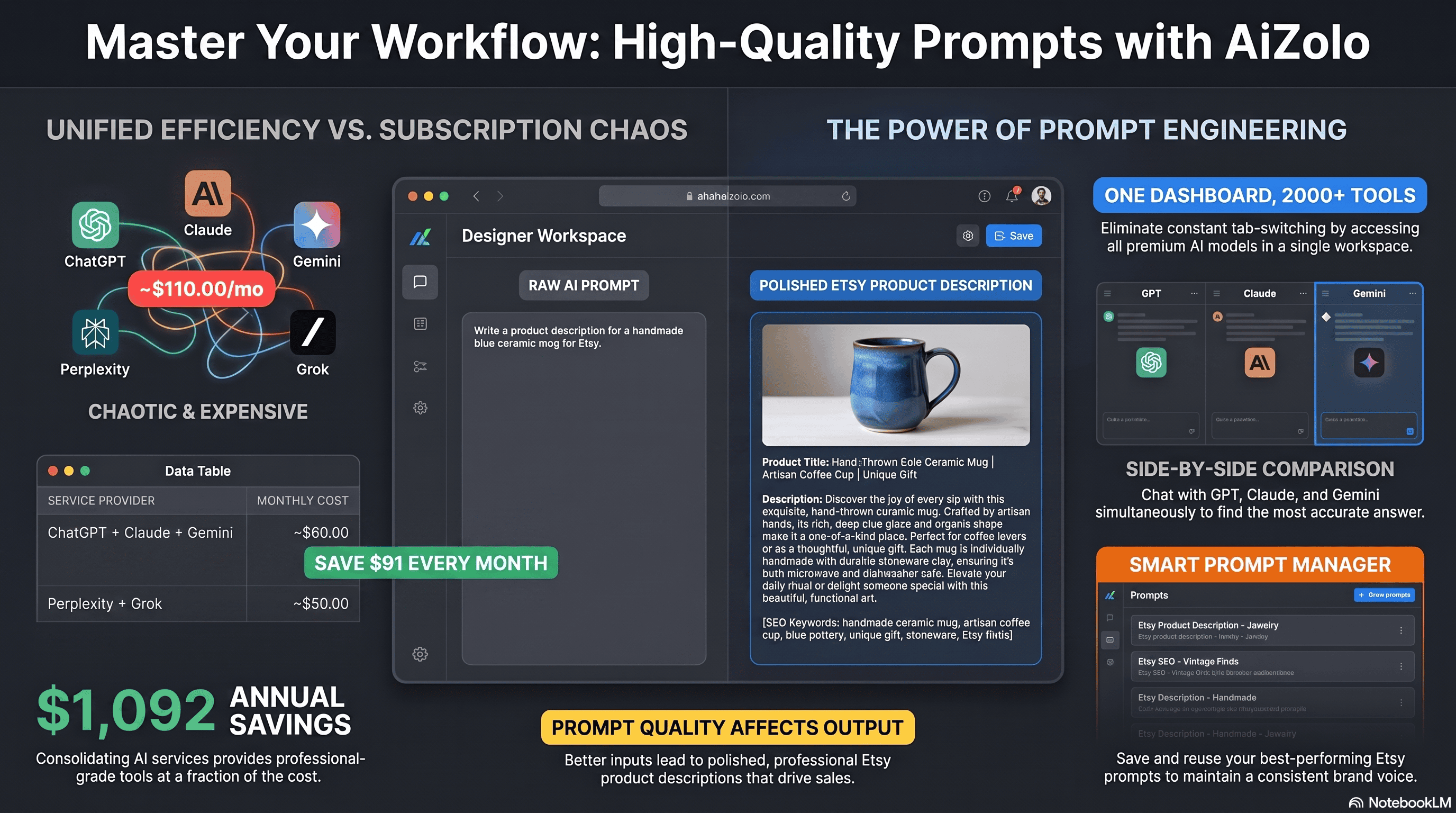
A generic prompt like “write a description for my candle” produces generic output. Here’s what actually improves results.
Give it real product attributes Material, size, color, scent, weight, care instructions — the more specific facts you provide, the less the AI has to guess (and invent).
Tell it your keywords List 3–5 target keywords or phrases you want naturally included, based on your own Etsy search research or tags.
Separate features from benefits A feature is “soy wax.” A benefit is “burns cleaner, so it won’t leave soot on your walls.” Ask the AI explicitly to translate features into benefits.
Specify the emotional angle Is this a gift? A treat-yourself purchase? A practical household item? Emotional framing changes tone significantly.
Ask for a clear call-to-action Something simple like “Perfect for birthdays — message me for rush shipping” performs better than no CTA at all.
The formula, in short: attributes + keywords + benefits + emotion + CTA = a usable first draft.
Best AI Generator for Etsy Product Descriptions: Comparing the Options
There’s no single “best” tool for every seller — it depends on budget, workflow, and how much SEO control you want. Here’s an honest look at the main options Etsy sellers actually use.
ChatGPT General-purpose and highly capable at conversational copywriting. Free tier available; paid plans unlock more advanced models. Not Etsy-specific, so you’ll need to build your own prompt templates and repeat context every session unless you save custom instructions.
Claude Strong at following detailed, multi-part instructions and maintaining a consistent tone across a long session. Also general-purpose rather than Etsy-specific, with free and paid tiers.
Gemini Google’s assistant, integrated into Google Workspace apps like Docs and Sheets, which can help sellers who already manage listings in spreadsheets. Also general-purpose.
Jasper A long-standing AI copywriting platform built for marketing teams, with brand-voice and workflow features. Historically priced for agencies and larger teams rather than solo Etsy sellers, so it can feel like more tool (and cost) than a small shop needs.
Copy.ai Marketing-focused AI writer with templates for ads, emails, and product copy. Not Etsy-specific, but usable with custom prompts.
Writesonic Another general marketing copy tool with SEO-adjacent features like content briefs. Again, not built specifically around Etsy’s listing format.
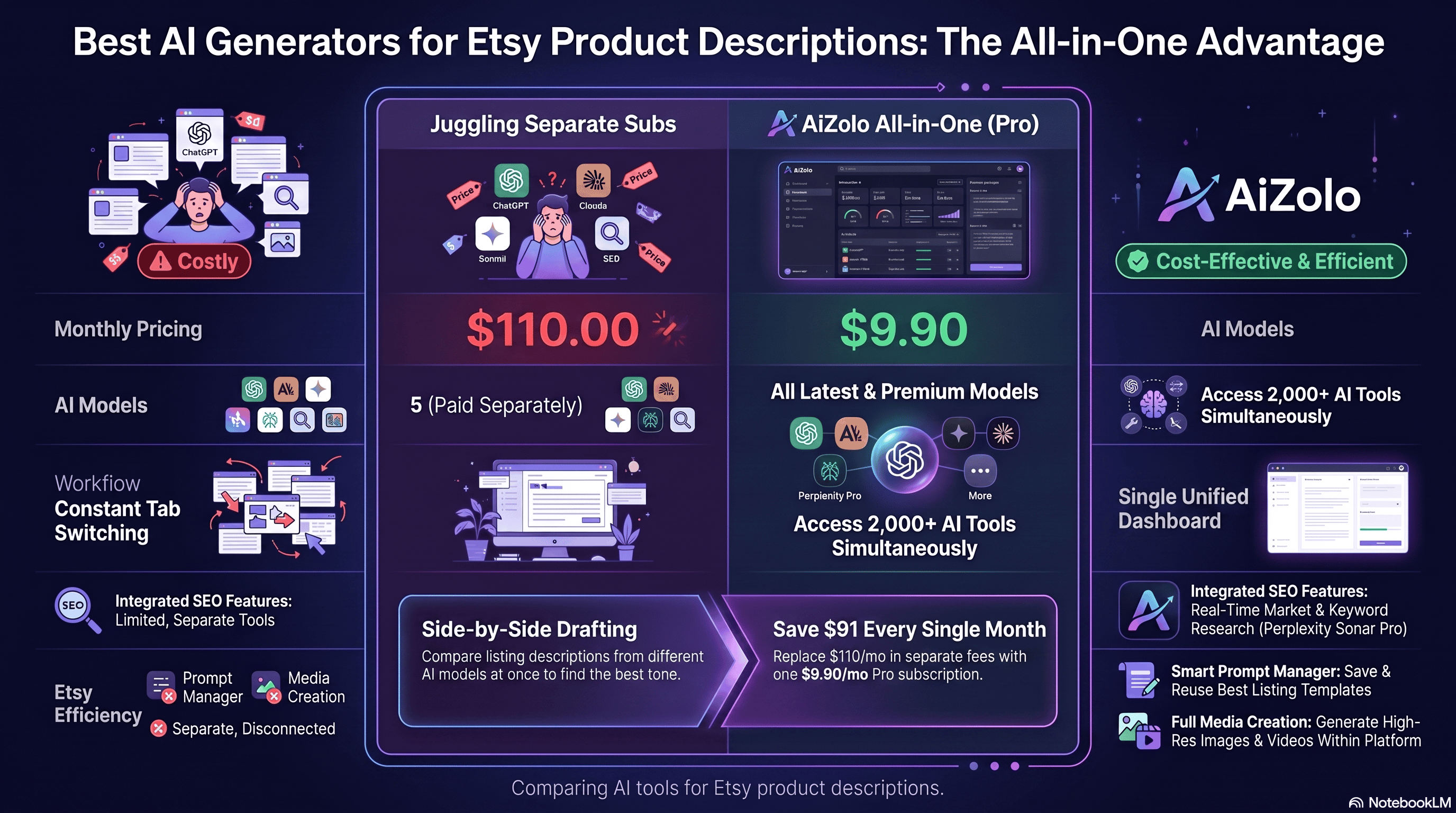
Aizolo An Etsy-and-ecommerce-focused writing workspace that gives sellers access to multiple AI models under one subscription, along with a prompt library built around listing formats (titles, tags, descriptions) rather than generic marketing copy.
The general-purpose tools (ChatGPT, Claude, Gemini) are excellent writers but weren’t built around Etsy’s listing structure specifically — you’re doing the prompt engineering yourself, every time, unless you save templates. Etsy-specific tools trade some of that raw flexibility for a workflow that’s already shaped around titles, tags, and descriptions.
Why Aizolo Is a Strong Choice for Etsy Sellers
If you sell on Etsy specifically — rather than needing a general marketing writer — a few things make a dedicated tool like Aizolo worth considering.

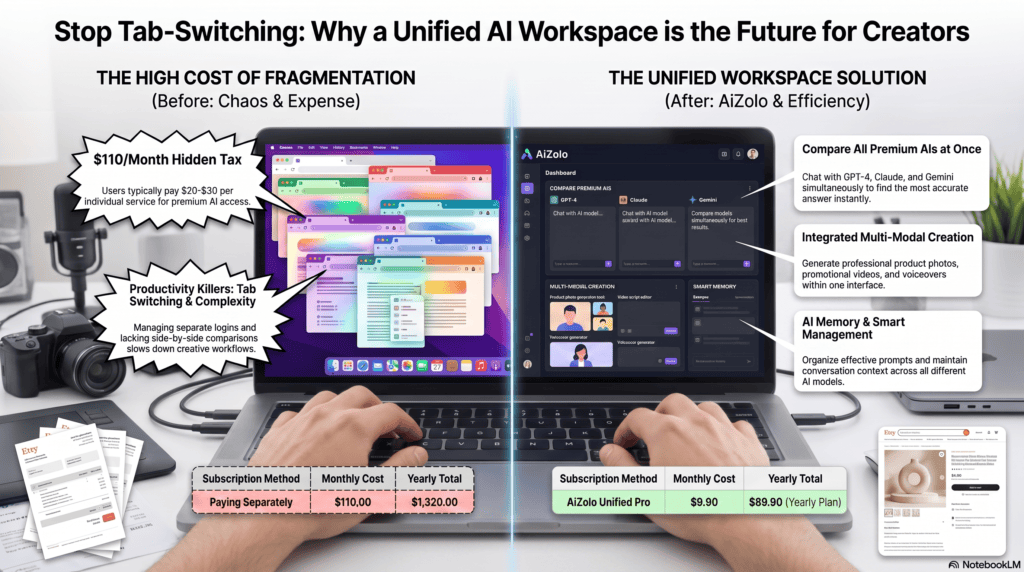
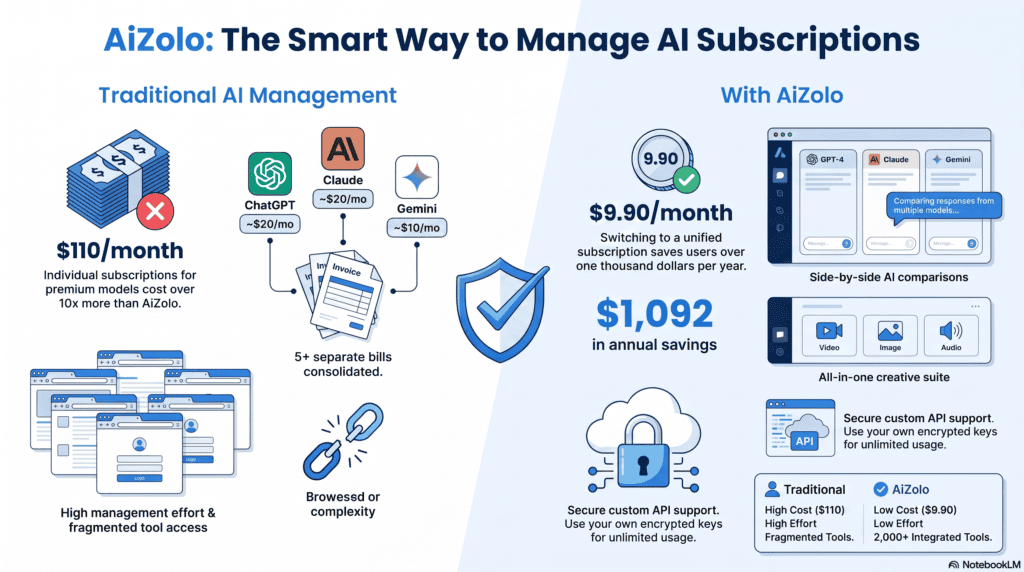
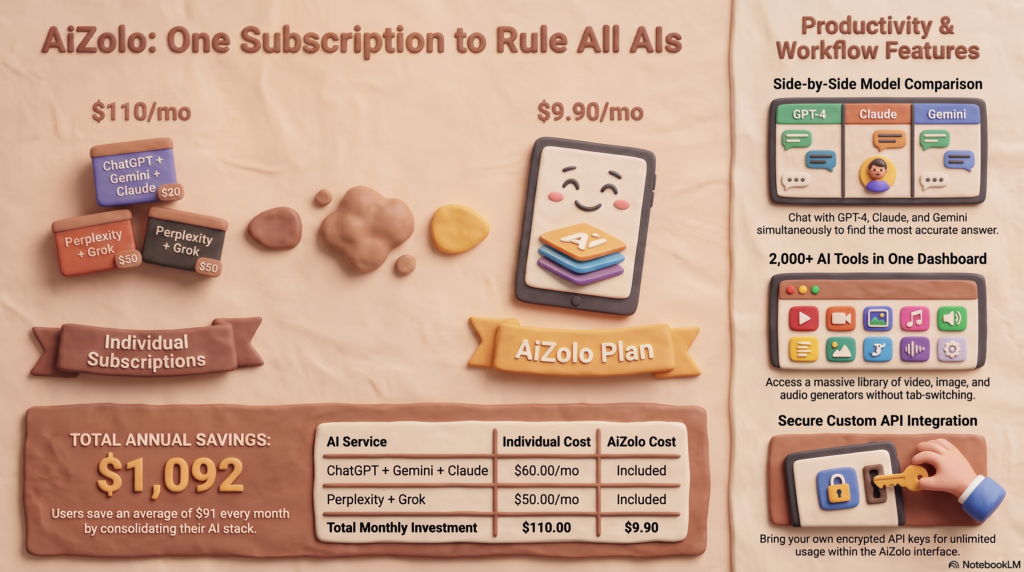
Access to multiple AI models in one place Instead of juggling separate subscriptions to compare outputs, you can generate from more than one model and pick the version that fits your voice best.
A single, more affordable subscription Rather than paying for several AI tools separately, sellers get one bill covering description, title, and tag generation.
A prompt library built for Etsy listings Templates are pre-structured around what Etsy actually rewards — titles under character limits, tag sets, benefit-driven descriptions — so you’re not building prompt structure from scratch.
A faster end-to-end workflow Because the tool is scoped to listings rather than general marketing content, there’s less setup per product.
Comparison mode Generating a couple of variations side by side makes it easier to pick the stronger draft instead of accepting the first output.
A dedicated workspace Useful for sellers managing dozens or hundreds of listings who want their drafts organized in one place rather than scattered across chat histories.
To be fair, it’s worth knowing the trade-offs too. A tool this specialized won’t match the raw flexibility of a general model for tasks outside Etsy listings — say, writing your shop’s About page essay or a long-form blog post. And like any AI output, drafts still need a human read-through before publishing. No AI generator, Aizolo included, should be treated as fully “set and forget.”
Step-by-Step: Using an AI Generator for Etsy Product Descriptions
Step 1: Gather product information Materials, dimensions, color options, care instructions, what makes it different from similar listings.
Step 2: Write a specific prompt Include your product attributes, 3–5 target keywords, and the emotional angle (gift, everyday use, luxury treat).
Step 3: Generate the draft Run the prompt. If the tool supports it, generate 2–3 versions to compare.
Step 4: Edit for accuracy Remove any claim the AI invented that isn’t true of your actual product. This step is non-negotiable.
Step 5: Optimize for SEO Check that your primary keyword phrase appears naturally in the first sentence, and that supporting keywords are spread through the body.
Step 6: Format for readability Etsy shoppers scan. Use short paragraphs, a bullet list of specs, and a clear closing line.
Step 7: Publish and monitor Track views and favorites after publishing. If a listing underperforms after two to three weeks, revisit the description before assuming the product itself is the problem.
Before and After: See the Difference
Poor description (typical seller draft): “Beautiful handmade necklace. Great gift for anyone. Check out my shop for more!”
Improved AI-assisted version: “This 18k gold-filled layered necklace is handcrafted with hypoallergenic materials, perfect for sensitive skin. The adjustable 16–18 inch chain makes it easy to style with any neckline. A thoughtful gift for birthdays, graduations, or a treat-yourself moment. Ships within 1–2 business days.”
Why the second version converts better: It states real materials, addresses a common buyer concern (allergies), specifies sizing, suggests occasions, and closes with a practical shipping detail — all things a buyer needs before clicking “Add to Cart.”
Notice what didn’t change: no invented claims, no exaggerated language. Just more of the real, useful information a buyer actually needs.
Prompt Templates You Can Copy Today
Swap in your own product details in the brackets.
Jewelry “Write an Etsy product description for a [material] [item type]. Highlight [key feature], mention it’s [hypoallergenic/adjustable/etc.], and suggest it as a gift for [occasion]. Include the keyword ‘[keyword]’ naturally. Keep paragraphs short.”
Clothing “Write an Etsy description for a [garment type] made from [fabric]. Mention available sizes [S–XL], fit type [oversized/fitted], and care instructions. Include the keyword ‘[keyword]’.”
Digital products “Write a description for a digital [file type] template. Explain what’s included, file formats provided [PDF/PNG/Canva], and how the buyer will receive it after purchase. Include the keyword ‘[keyword]’.”
Printables “Write an Etsy listing description for a printable [type, e.g., wall art]. Mention paper size options, that it’s an instant digital download, and print-at-home instructions. Include the keyword ‘[keyword]’.”
Home decor “Write a description for a [item] made from [material]. Mention dimensions, how it fits into [style, e.g., farmhouse/minimalist] decor, and care instructions. Include the keyword ‘[keyword]’.”
Handmade gifts “Write a warm, gift-focused description for a handmade [item]. Mention who it’s perfect for [occasion/recipient], personalization options if any, and estimated shipping time. Include the keyword ‘[keyword]’.”
Vintage items “Write a description for a vintage [item] from [era/decade if known]. Mention condition honestly, any visible wear, measurements, and why vintage buyers value pieces like this. Include the keyword ‘[keyword]’.”
Craft supplies “Write a description for [craft supply, e.g., resin molds]. Mention quantity per pack, material, recommended use, and skill level. Include the keyword ‘[keyword]’.”
Etsy SEO Best Practices to Pair With AI Descriptions
AI writing only works if it’s feeding Etsy’s search algorithm the right signals.
Primary keyword placement Use your main keyword phrase in the title, the first sentence of the description, and at least one tag.
Long-tail keywords Phrases like “personalized birthday gift for mom” often face less competition than single broad words like “necklace.”
Use all 13 tags Etsy allows up to 13 tags per listing — leaving tags empty is leaving free search visibility on the table.
Titles that front-load keywords Put your most important keyword phrase toward the beginning of the title, since Etsy (and shoppers) weight early words more heavily.
Category accuracy An oddly categorized listing can hurt discoverability even with a perfect description.
Image alt text Etsy allows alt text on photos — use it, since it also affects accessibility and can support search visibility.
Match buyer intent “Gift for new mom” and “minimalist nursery decor” target different buyer intents even for a similar product — write toward the specific intent your listing serves.
Avoid keyword stuffing Repeating the same phrase five times reads poorly to buyers and doesn’t help rankings — natural, varied language performs better.
Common Mistakes Sellers Make With AI-Generated Descriptions
Publishing the first draft unedited AI output is a starting point, not a finished listing. Skipping the edit step is the single most common mistake.
Generic, copy-paste-feeling descriptions If your prompt is vague, your output will sound like it could apply to any product. Specificity fixes this.
Duplicate listings across variations Copying one description across ten color variants without adjusting details can look thin to both buyers and Etsy’s systems.
Ignoring benefits in favor of features Listing only specs (“100% cotton, 200gsm”) without explaining what that means for the buyer misses half the persuasion job.
No emotional appeal Even practical products benefit from a sentence connecting to how the buyer will feel using it.
Weak or missing call-to-action A description that just stops, with no next step suggested, leaves conversion on the table.
Over-relying on AI without fact-checking AI models can generate confident-sounding but inaccurate details. Every material claim, care instruction, and size should be verified against your actual product before publishing.
AI vs. Manual Writing: A Fair Comparison
| Factor | AI-Generated | Manual Writing |
|---|---|---|
| Speed | Minutes per listing | 15–30+ minutes per listing |
| Consistency | High across many listings | Varies with time and energy |
| SEO structure | Strong if prompted well | Depends on seller’s SEO knowledge |
| Creativity/voice | Good, but needs personalization | Naturally authentic to the seller |
| Editing required | Always — fact-check and personalize | Still needed, but fewer invented details |
| Cost | Subscription fee, often per-model or per-tool | Free, but costs your time |
The realistic answer for most sellers: use AI for the first draft, and spend your saved time on editing, personalization, and photography instead of starting from zero.
Frequently Asked Questions
Is it against Etsy’s policy to use AI for product descriptions? No. Etsy does not prohibit sellers from using AI writing tools for descriptions, as long as the listing itself is accurate and the product complies with Etsy’s handmade, vintage, or craft supply guidelines.
Will an AI-generated description hurt my Etsy SEO? Not inherently. What matters to Etsy’s search algorithm is relevant keywords, accurate categorization, and buyer engagement — not whether a human or AI drafted the sentence structure.
Can AI write my product titles and tags too? Yes, most AI generators can produce titles and tag lists, though you should still verify character limits and keyword relevance manually.
Do I need to disclose that I used AI to write my listing? Etsy does not currently require sellers to disclose AI-assisted writing for descriptions, though policies can change, so it’s worth checking Etsy’s current seller policies periodically.
How much should I edit an AI-generated description? Always read it fully, correct any inaccurate details, and adjust the tone to match your shop’s voice before publishing.
Can AI describe handmade items accurately without seeing them? No — AI generates language based on what you tell it, not what it can see, so you must supply accurate attributes yourself.
What’s the ideal length for an Etsy product description? There’s no fixed rule, but most well-performing listings run 150–300 words, covering specs, benefits, and a call-to-action without padding.
Should I use the same AI-generated description for product variations? Adjust each variation slightly (color, size, or personalization details) rather than pasting an identical block across every listing.
Can AI help with Etsy shop policies and About sections too? Yes, general-purpose AI writing tools can help draft these, though they benefit even more from your personal voice since they build buyer trust.
Is a free AI tool good enough, or do I need a paid one? Free tiers of tools like ChatGPT can produce solid first drafts; paid or Etsy-specific tools tend to save more time at scale or add SEO-focused features.
How do I stop my AI descriptions from sounding robotic? Give detailed, specific prompts, ask for a conversational tone, and always do a final human edit pass for natural phrasing.
Can AI generate descriptions in bulk for a large shop? Yes, this is one of AI’s strongest use cases — but each draft still needs a quick individual review before publishing.
Will using an AI generator make my descriptions all sound the same? Only if your prompts are generic. Varying your product attributes, keywords, and emotional angle per prompt keeps output distinct.
What information should I never let AI invent? Materials, dimensions, safety claims (like “hypoallergenic” or “food-safe”), and shipping timelines — these must always be verified against your actual product.
Is Aizolo better than ChatGPT for Etsy sellers? They serve different needs: ChatGPT is a flexible general-purpose writer, while Aizolo is built specifically around Etsy listing workflows with templates and multiple models in one subscription. Which is “better” depends on whether you want flexibility or a ready-made Etsy-focused workflow.
Final Verdict
An AI generator for Etsy product descriptions won’t replace your product knowledge, your photography, or your judgment about what your shop stands for.
What it does is remove the blank page.
For most sellers, the most realistic workflow looks like this: gather real product details, write a specific prompt, generate a draft, then spend your time editing for accuracy and voice rather than starting from scratch.
Whether you use a general-purpose model like ChatGPT or Claude, or an Etsy-focused workspace like Aizolo, the tool matters less than the habit: specific inputs, honest editing, and consistent SEO structure across every listing you publish.
About the Author
Jeevesh Tripathi AI Researcher & SEO Content Strategist
Specializes in AI productivity, ecommerce automation, SEO, and generative AI workflows.