
Table of Contents
Introduction
Your product page gets traffic. It just doesn’t get sales. That gap is the single most expensive problem in ecommerce.
Most stores lose 60–80% of potential revenue not from lack of visitors, but from copy that fails to convert visitors into buyers—and Aizolo helps create copy that turns more visitors into customers.
AI has changed how fast and how well that copy can be fixed. Instead of spending weeks rewriting hundreds of listings by hand, teams now use AI to diagnose weak pages and rebuild them at scale.
This guide is different from the typical “top 10 AI writing tools” roundup. It’s built around a CRO-first workflow: diagnose the conversion problem first, then use AI as the rewriting engine, not the strategy.
In this guide, you’ll learn:
- Why product pages actually fail to convert
- How AI improves headlines, benefit copy, CTAs, and SEO simultaneously
- A tool-by-tool breakdown of the best AI options in 2026
- A repeatable AI rewriting workflow you can apply today
- Ready-to-use prompts for Shopify, Amazon, WooCommerce, and luxury listings
- A before/after rewrite example with the reasoning behind each change
- The mistakes that quietly sabotage AI-rewritten pages
From a CRO perspective, the pages that convert worst are rarely the ones with the least traffic. They’re the ones nobody has looked at critically in over a year.
What Is AI for Rewriting Low Conversion Product Pages?
AI for rewriting low conversion product pages refers to using large language models and specialized copywriting tools to analyze existing product page content and regenerate it for stronger persuasion, clarity, and search visibility.
This isn’t just “make the copy sound nicer.” It’s a structured process of identifying weak points — a flat headline, a missing trust signal, a buried benefit — and using AI to close those gaps quickly.
How it works
An AI model is given the existing page content, plus context about the product, audience, and goal. It then generates alternative copy optimized for a specific outcome: more clicks, more add-to-carts, or better keyword coverage.
The output is a draft, not a finished page. Editing and testing still happen afterward.
Who should use it
- Shopify and WooCommerce store owners managing large catalogs
- Amazon sellers competing on crowded search result pages
- DTC brands refreshing seasonal or underperforming SKUs
- Agencies rewriting client catalogs at scale
- Solo founders who don’t have a copywriter on staff
Benefits
AI rewriting shortens the time between “we noticed this page underperforms” and “we have a better version live.” That speed matters more than most teams realize, because low-converting pages compound lost revenue every single day they stay unfixed.
Why Product Pages Fail to Convert
Before reaching for any tool, it helps to understand what’s actually broken. In ecommerce audits, the same handful of issues show up again and again.
Weak, generic copy
Descriptions that read like a spec sheet rather than a sales pitch. “100% cotton, machine washable” tells a shopper nothing about why they should care.
Feature-focused instead of benefit-focused writing
Listing what a product has instead of what it does for the buyer is one of the most common conversion killers on ecommerce pages.
No emotional trigger
Purchase decisions are emotional first, justified logically second. Pages that skip the emotional hook lose shoppers who are otherwise ready to buy.
Lack of trust signals
Missing reviews, guarantees, shipping clarity, or return policy information creates hesitation at the exact moment a shopper is deciding.
Poor or buried CTAs
A weak “Add to Cart” button with no urgency, no reassurance, and no visual priority won’t move as many shoppers as a clear, confident call to action.
SEO issues
Thin content, missing keywords, and no semantic variation mean the page can’t even get found in search, regardless of how well it converts once someone lands there.
Duplicate descriptions
Manufacturer boilerplate copy pasted across dozens of competing stores tanks both rankings and differentiation.
Bad formatting
Walls of text, no bullet points, and no scannable structure push mobile shoppers away within seconds.
Missing benefit-driven bullet points
Bullets are prime real estate. Filling them with vague adjectives instead of concrete outcomes wastes that space.
How AI Improves Product Page Conversion
AI doesn’t replace strategy, but it executes on strategy far faster than manual rewriting. Here’s where it actually moves the needle.
Headline optimization
AI can generate dozens of headline variations built around benefit-first framing, testing different angles like urgency, exclusivity, or outcome.
Benefit-focused copy
Feed AI a feature list and ask it to translate each one into a customer outcome. This single step fixes one of the most common weaknesses in ecommerce writing.
CTA improvement
AI can generate CTA variants matched to funnel stage — first-time visitor versus returning cart abandoner — rather than using one generic button everywhere.
SEO rewriting
Modern AI tools can weave primary and semantic keywords into natural sentences instead of stuffing them, which keeps content both readable and search-friendly.
Tone adjustment
The same product can be rewritten for a luxury tone, a playful DTC tone, or a technical B2B tone in minutes, which is invaluable for multi-brand catalogs.
A/B testing ideas
AI can generate multiple structurally different versions of a page section, giving CRO teams real testable variants instead of one “best guess.”
Customer intent matching
AI can align copy with the actual search intent behind the keywords driving traffic, so the page answers the question the shopper actually came with.
Personalization at scale
For larger catalogs, AI can adapt tone and examples per category or audience segment without a full manual rewrite of every page.
Signs Your Product Page Needs AI Rewriting
Use this checklist during a quick audit:
- [ ] Bounce rate is high relative to category average
- [ ] Add-to-cart rate is below your store’s benchmark
- [ ] Copy reads like a spec sheet, not a sales pitch
- [ ] No emotional hook in the first two sentences
- [ ] Bullets list features, not outcomes
- [ ] CTA text is generic (“Buy Now” with nothing else)
- [ ] No trust signals near the CTA (reviews, guarantees, shipping info)
- [ ] Description is duplicated from a manufacturer or competitor
- [ ] Mobile view shows large unbroken paragraphs
- [ ] Page hasn’t been updated in over 12 months
- [ ] Keyword usage is thin or entirely missing
- [ ] No internal links to related products or collections
If a page hits four or more of these, it’s a strong candidate for an AI-assisted rewrite.
Best AI Tools for Rewriting Low Conversion Product Pages
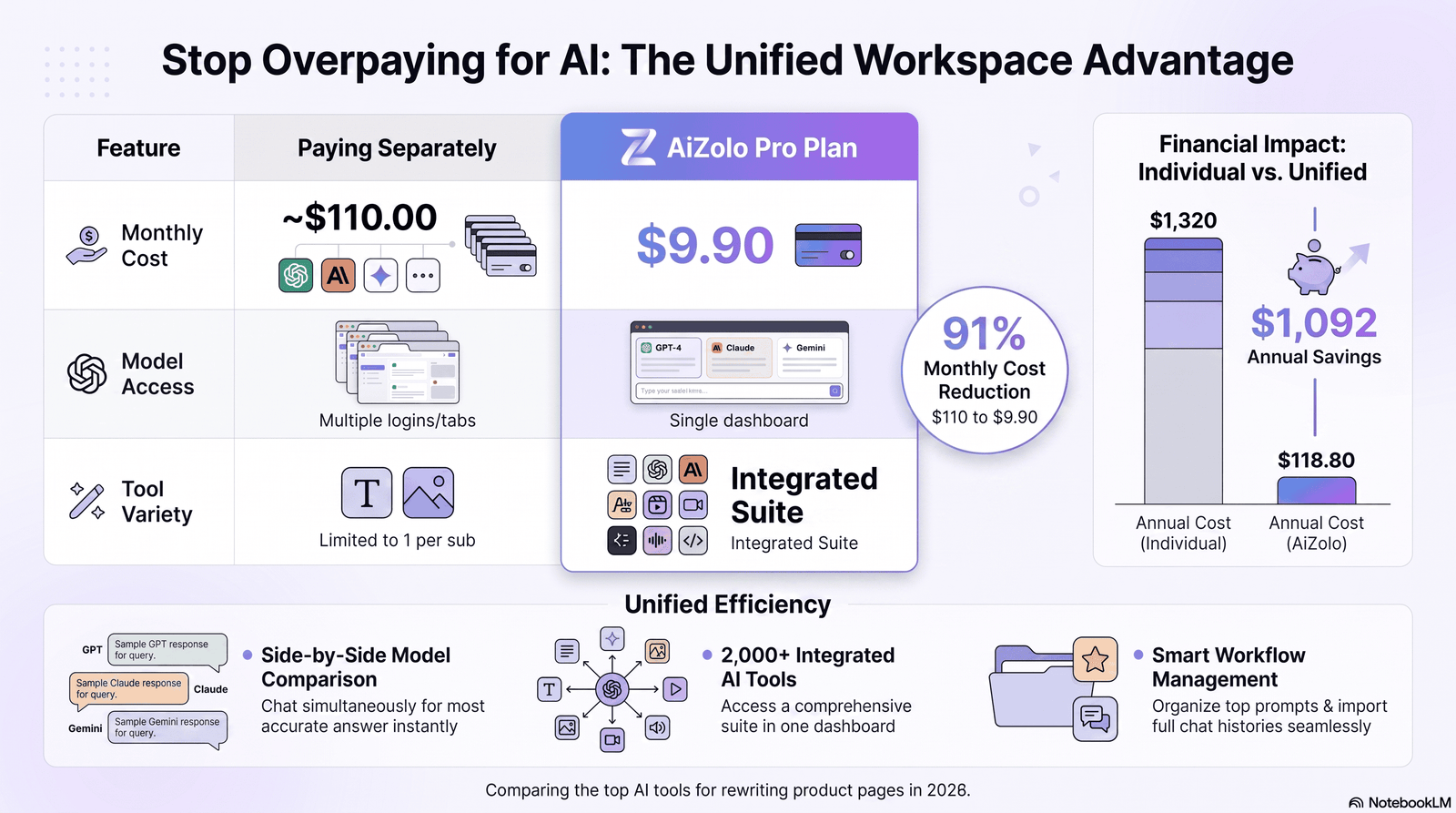
There’s no single “best” tool for every store. The right choice depends on catalog size, budget, and whether you need SEO depth or pure conversion copy. Here’s a practical breakdown.
ChatGPT (OpenAI)
Best for: Flexible, prompt-driven rewriting for any catalog size.
Overview: A general-purpose conversational AI that can rewrite product copy when given detailed prompts and product context.
Pros: Extremely flexible; strong at following detailed instructions; good at tone-matching.
Cons: Requires strong prompting skills; no built-in ecommerce templates; no native SEO scoring.
Pricing: Free tier available; paid plans for higher usage and advanced models.
Best use case: Small to mid-size catalogs where a human is actively prompting and editing each rewrite.
Claude (Anthropic)
Best for: Longer-form, nuanced copy and bulk rewriting with strong context handling.
Overview: A conversational AI known for careful reasoning and handling long documents, useful for rewriting entire catalogs in batches with consistent brand voice.
Pros: Strong at maintaining nuance and brand tone across long sessions; handles large amounts of context well.
Cons: Not ecommerce-specific out of the box; still needs human editing and SEO review.
Pricing: Free tier available; paid plans for extended usage.
Best use case: Brands that need consistent tone across a large batch of product descriptions in one sitting.
Gemini (Google)
Best for: Teams already inside the Google ecosystem (Docs, Sheets, Ads).
Overview: Google’s AI assistant, integrated across Workspace tools, useful for teams managing product feeds in Sheets.
Pros: Tight integration with Google tools; useful for teams managing bulk data in spreadsheets.
Cons: Less specialized for pure copywriting compared to dedicated tools.
Pricing: Free tier; paid tiers bundled with Google One/Workspace plans.
Best use case: Teams managing product feeds and descriptions directly inside Sheets.
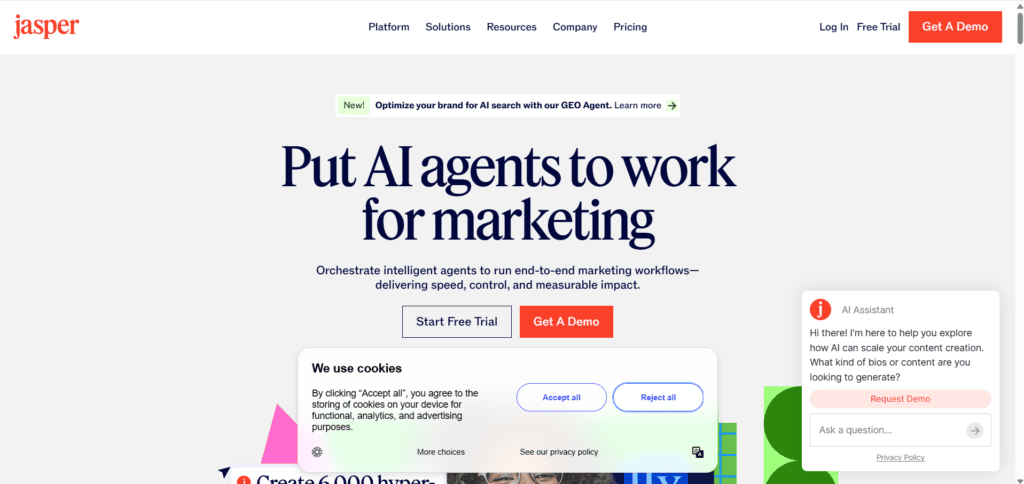
Jasper
Best for: Marketing teams needing brand-voice consistency at scale.
Overview: A marketing-focused AI writing platform with brand voice training and ecommerce templates.
Pros: Brand voice profiles; templates built for marketing copy; team collaboration features.
Cons: Higher price point than general-purpose chat tools; can still produce generic output without careful prompting.
Pricing: Paid plans only, positioned for teams and agencies.
Best use case: Agencies and mid-to-large brands that need consistent voice across many writers.
Copy.ai
Best for: Quick-turn product description generation for smaller catalogs.
Overview: A copywriting tool with pre-built templates including product description generators.
Pros: Fast template-based output; easy for non-writers to use.
Cons: Templates can feel formulaic without heavy editing.
Pricing: Free tier with limited credits; paid plans for higher volume.
Best use case: Small stores wanting quick first-draft descriptions.
Writesonic
Best for: Combined SEO content and product copy in one platform.
Overview: An AI content platform with SEO-focused tools alongside copywriting templates.
Pros: Built-in SEO features; product description templates.
Cons: Output quality varies by template; still needs human polish for conversion nuance.
Pricing: Free trial; tiered paid plans based on word volume.
Best use case: Teams wanting SEO and product copy generation in a single tool.
Anyword
Best for: Data-driven copy scoring and predictive performance.
Overview: A copywriting platform that scores generated copy against predicted performance metrics.
Pros: Predictive performance scoring; useful for prioritizing which variant to test first.
Cons: Predictive scores are directional, not guaranteed; premium pricing.
Pricing: Paid plans only, scaled by usage volume.
Best use case: Performance marketing teams running frequent A/B tests on product copy.
Hypotenuse AI
Best for: Bulk product description generation directly from product attributes/CSV.
Overview: An ecommerce-focused AI tool built specifically to generate descriptions from structured product data.
Pros: Built for catalog-scale generation; can work directly from spreadsheets of attributes.
Cons: Less flexible for highly custom, narrative-style brand copy.
Pricing: Paid plans tiered by number of products generated per month.
Best use case: Large catalogs needing hundreds of descriptions generated from attribute data.
Junia AI
Best for: SEO-forward content and blog-to-product content workflows.
Overview: An AI writing tool geared toward SEO content, also applicable to keyword-rich product copy.
Pros: Strong SEO tooling; good for aligning product pages with search intent.
Cons: Less specialized purely for conversion copywriting compared to CRO-focused tools.
Pricing: Free trial; paid subscription tiers.
Best use case: Stores prioritizing organic search traffic to product pages.
Tool Comparison Table
| Tool | Best For | SEO Strength | Bulk Catalog Support | Pricing Model |
|---|---|---|---|---|
| ChatGPT | Flexible manual rewriting | Medium | Manual/scripted | Free + paid |
| Claude | Long-form, consistent tone | Medium | Manual/scripted | Free + paid |
| Gemini | Sheets-based workflows | Medium | Good (via Sheets) | Free + paid |
| Jasper | Brand voice at scale | Medium-High | Good | Paid only |
| Copy.ai | Fast small-catalog drafts | Medium | Limited | Free + paid |
| Writesonic | Combined SEO + copy | High | Good | Free trial + paid |
| Anyword | Predictive performance scoring | Medium | Good | Paid only |
| Hypotenuse AI | Attribute-to-copy at scale | Medium | Excellent | Paid only |
| Junia AI | SEO-first product content | High | Good | Free trial + paid |
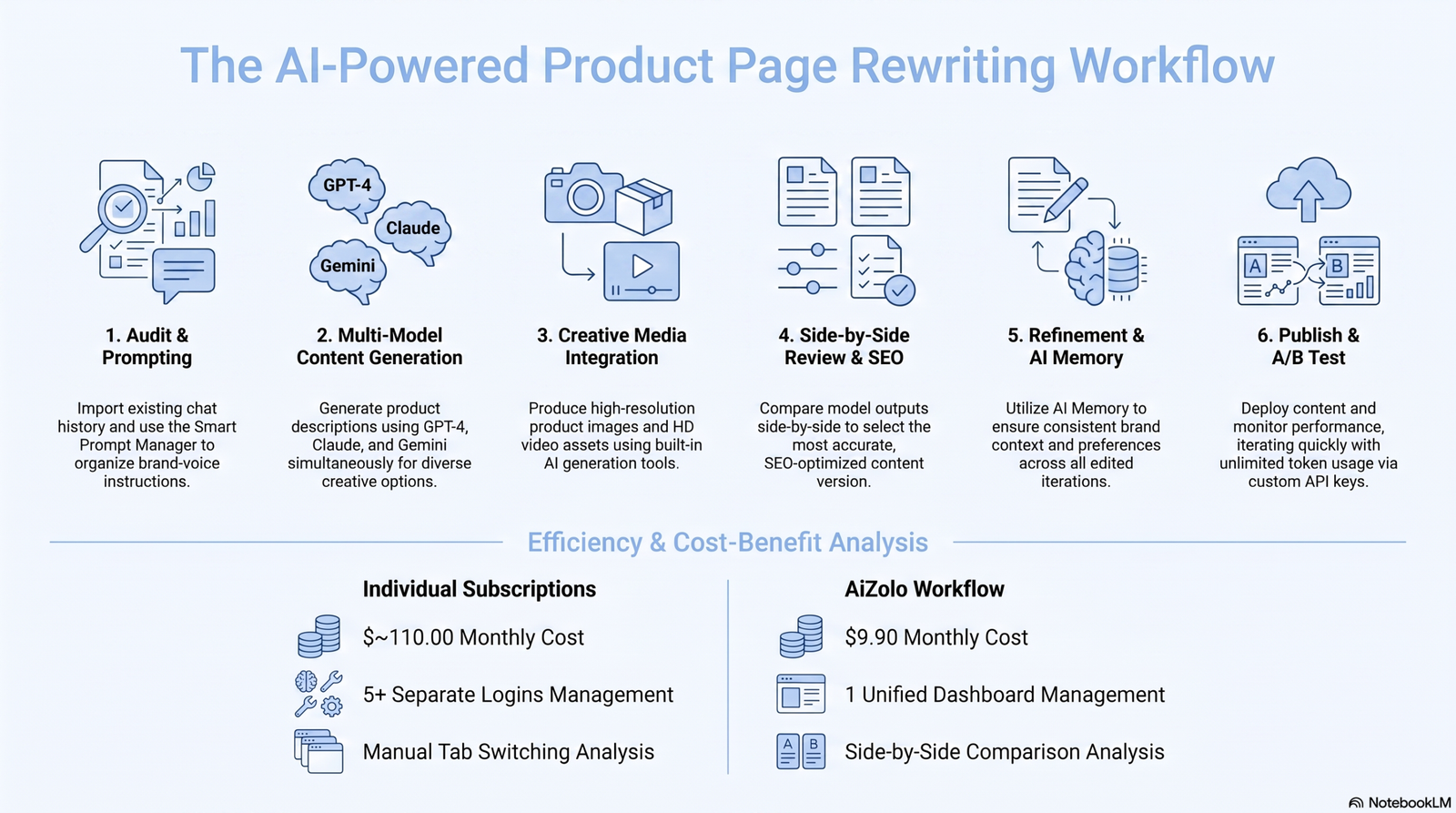
The AI Rewriting Workflow
A repeatable process matters more than any single tool. Here’s the workflow used across ecommerce audits, step by step.
Step 1: Pull the existing page. Save the current title, description, bullets, and CTA text exactly as they appear live.
Step 2: Run a conversion analysis. Identify which of the failure points from earlier in this guide apply — weak CTA, no trust signal, feature-only bullets, and so on.
Step 3: Write a detailed AI prompt. Include the product, audience, tone, target keyword, and specific weaknesses to fix (prompt examples below).
Step 4: Generate 2–3 variants. Don’t settle for the first output; generate alternatives and compare structure, not just wording.
Step 5: Edit for brand voice and accuracy. Remove anything that sounds generic, verify every factual claim, and adjust tone to match the brand.
Step 6: Optimize for SEO. Check keyword placement, add semantic variations naturally, and confirm the meta title and description are aligned.
Step 7: Human review. A second set of eyes — ideally someone who knows the product — checks for tone drift or inaccurate claims before publishing.
Step 8: Publish. Update the live page, keeping a backup of the previous version for comparison.
Step 9: Test. Run an A/B test or monitor before/after conversion metrics for at least one full sales cycle before declaring a winner.
Workflow at a Glance
| Stage | Action | Owner |
|---|---|---|
| 1. Audit | Identify weak page elements | CRO/marketing |
| 2. Prompt | Draft AI prompt with context | Copywriter/marketer |
| 3. Generate | Produce 2–3 AI variants | AI tool |
| 4. Edit | Human polish for voice & accuracy | Copywriter |
| 5. SEO check | Keyword and metadata review | SEO specialist |
| 6. Review | Final sign-off | Team lead |
| 7. Publish | Update live page | Store owner |
| 8. Test | A/B test or monitor metrics | CRO/analytics |
Prompt Examples for AI Product Page Rewriting
Use these as starting templates, adjusting the bracketed details for your product.
1. General conversion rewrite “Rewrite this product description for [product name] to focus on customer benefits rather than features. Target audience: [audience]. Tone: [tone]. Keep paragraphs short and end with a confident call to action.”
2. SEO-focused rewrite “Rewrite this product description to naturally include the keyword ‘[target keyword]’ and related terms like [semantic keywords], without keyword stuffing. Maintain a natural, persuasive tone.”
3. Amazon listing rewrite “Rewrite this Amazon product listing following Amazon’s bullet point best practices: lead each bullet with a benefit in caps, keep bullets under 200 characters, and include the keyword ‘[keyword]’ once naturally.”
4. Shopify product page rewrite “Rewrite this Shopify product description with a short benefit-driven headline, three scannable bullet points, and a closing paragraph that overcomes [specific objection, e.g., price/shipping time].”
5. Luxury product rewrite “Rewrite this description for a luxury audience. Use sensory, understated language, avoid exclamation points, and emphasize craftsmanship and exclusivity over price.”
6. CTA variant generator “Generate 8 CTA button and micro-copy variations for [product], optimized for [funnel stage: new visitor / cart abandoner / returning customer].”
7. Trust-signal integration “Rewrite this product description to naturally incorporate these trust elements: [X-day guarantee, free returns, verified reviews], without sounding like a disclaimer list.”
8. Mobile-first rewrite “Rewrite this description into short, scannable paragraphs of no more than 2 lines each, optimized for mobile reading.”
9. Objection-handling rewrite “Rewrite this description to directly address the most common objection for this product: [objection], while staying persuasive and concise.”
10. Multi-variant A/B test generator “Generate two structurally different versions of this product description — one emotion-led, one benefit-led — for A/B testing.”
Before vs After Example
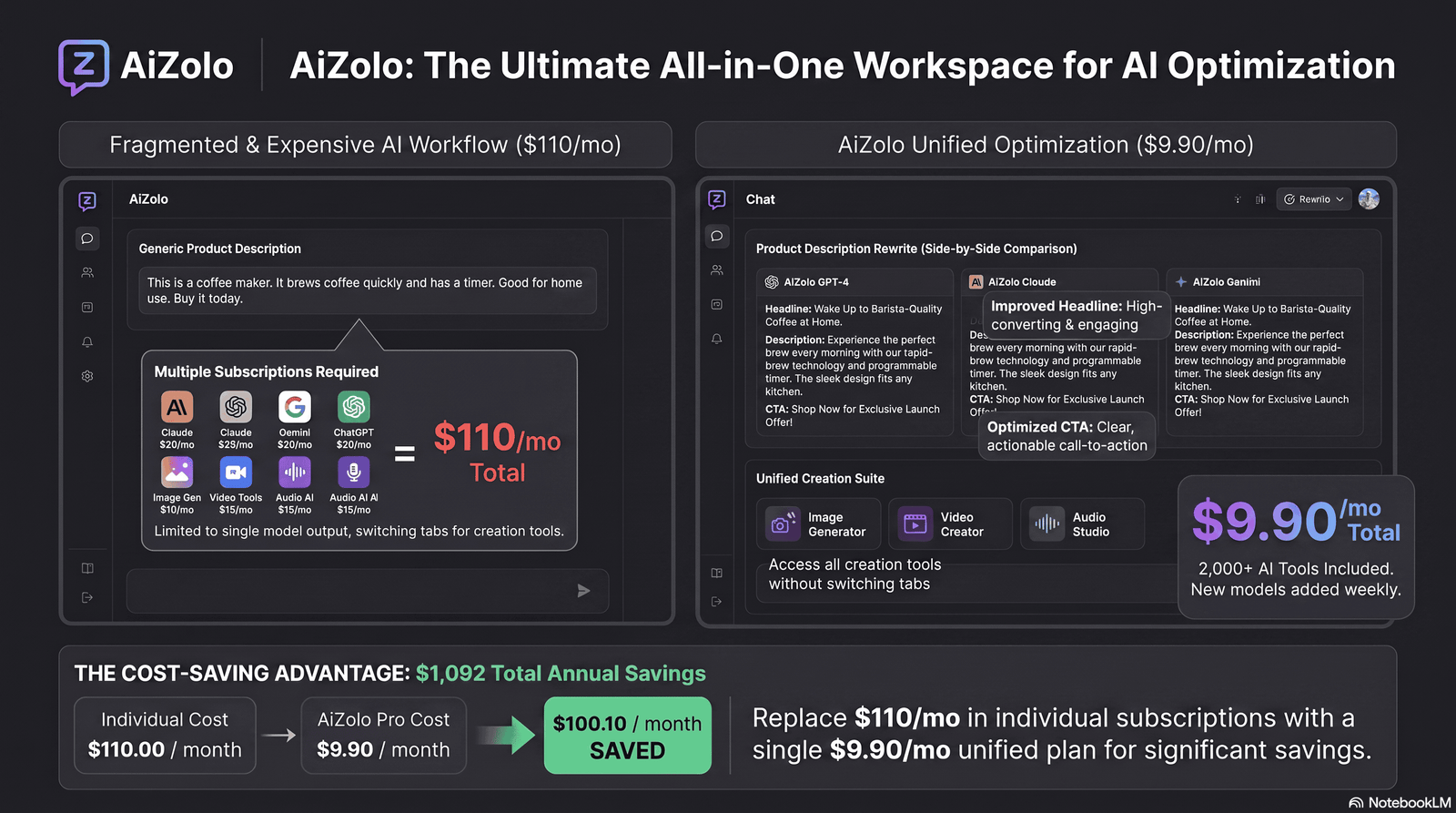
Before (typical low-converting copy):
“This jacket is made of 100% polyester. Available in sizes S–XL. Machine washable. Zippered pockets. Water resistant.”
After (AI-assisted rewrite):
“Stay dry without the bulk. This lightweight jacket shrugs off rain and wind, so you can head out without checking the forecast twice.
Zippered pockets keep your phone and keys secure on the move. Machine washable for easy care after every trip.
Available in sizes S–XL — find your fit and get moving.”
Why the rewrite converts better
The rewrite leads with a benefit (staying dry without bulk) instead of a spec (polyester). It also adds a light emotional trigger (heading out without worry) and a clear, low-pressure CTA at the end. Nothing in the rewrite invents a feature that wasn’t in the original — it simply reframes existing facts around the buyer’s actual motivation.
SEO Benefits of AI-Rewritten Product Pages
AI rewriting isn’t only about persuasion — done correctly, it also improves organic visibility.
Keyword optimization
AI can naturally weave the primary keyword and its variants throughout a description instead of repeating one exact phrase awkwardly.
Semantic keyword coverage
Including related terms (product page optimization, conversion copywriting, ecommerce SEO) helps search engines understand full topical relevance, not just exact-match phrases.
Search intent alignment
Matching copy to what a searcher actually wants — comparison, reassurance, or specs — improves both rankings and on-page engagement.
Click-through rate
Rewritten meta titles and descriptions that lead with a clear benefit tend to earn more clicks from search results pages than generic, feature-first titles.
Engagement signals
Scannable, benefit-led copy keeps visitors reading longer and reduces immediate bounce, both of which search engines can pick up on indirectly through user behavior.
Internal linking
A rewrite is a good opportunity to add contextual internal links to related products or category pages, strengthening site structure.
Metadata and schema
Updated copy should be paired with refreshed meta titles, descriptions, and structured data (Product schema) to fully capture the SEO benefit of the rewrite.
Readability
Short paragraphs and bullet-driven structure — both requirements of this rewriting process — align with what search engines and users both reward.
Common Mistakes When Using AI to Rewrite Product Pages
Overusing AI without editing
Publishing raw AI output without human review is the fastest way to end up with generic, forgettable copy across your entire catalog.
Ignoring hallucinations
AI can invent specifications, certifications, or claims that aren’t true. Every factual detail needs verification before publishing.
Ignoring brand voice
A rewrite that reads nothing like the rest of your brand creates inconsistency that confuses returning customers.
Skipping fact-checking
Numbers, materials, and dimensions must be checked against the actual product — never trust AI-generated specifics blindly.
No CRO testing
Publishing a rewrite and never measuring its impact means you can’t tell if it actually helped or quietly hurt conversion.
Publishing without editing
Even strong AI output benefits from a human pass for tone, accuracy, and flow.
Keyword stuffing
Overcorrecting for SEO by repeating the exact keyword phrase too often makes copy feel robotic and can trigger spam-related quality signals.
Human Editing Checklist for AI-Rewritten Product Pages
- [ ] Every factual claim (materials, dimensions, certifications) is verified
- [ ] Tone matches the rest of the brand’s copy
- [ ] No repeated or awkward keyword stuffing
- [ ] Bullets lead with benefits, not just features
- [ ] CTA is clear and appropriately urgent for the funnel stage
- [ ] Paragraphs are short and scannable on mobile
- [ ] No generic filler phrases (“in today’s world,” “unlock the power of”)
- [ ] Meta title and description updated to match new copy
- [ ] Internal links added where relevant
- [ ] Final read-through by someone unfamiliar with the AI draft
AI vs Human Copywriter
| Factor | AI Copywriting | Human Copywriter |
|---|---|---|
| Speed | Very fast, minutes per page | Slower, hours to days per page |
| Cost at scale | Low per-unit cost | Higher per-unit cost |
| Brand nuance | Requires careful prompting | Naturally strong if experienced |
| Factual accuracy | Needs verification | Generally more reliable if briefed well |
| Consistency across catalog | High, if prompts are standardized | Depends on writer availability |
| Emotional depth | Good, but can feel generic unedited | Typically stronger, more original |
| Best use case | Large catalogs, first drafts, testing variants | Hero products, brand storytelling, flagship pages |
The strongest setup in most ecommerce audits isn’t AI or human — it’s AI for volume and speed, human for judgment and final polish.
Best Practices for AI-Assisted Product Page Rewriting
- Always start with a conversion audit before rewriting, not after
- Standardize your prompts so tone stays consistent across the catalog
- Generate multiple variants and compare structure, not just wording
- Verify every factual claim before publishing
- Keep paragraphs short, especially for mobile shoppers
- Pair every rewrite with an SEO and metadata check
- Test rewrites against the original before rolling them out catalog-wide
- Keep a swipe file of your best-performing rewrites as future prompt examples
- Revisit rewritten pages quarterly — conversion issues resurface as competitors update their own listings
Frequently Asked Questions
Is AI-generated product copy penalized by Google? No — Google’s guidance focuses on content quality and helpfulness, not whether AI was involved in producing it, provided it’s original, accurate, and genuinely useful to readers.
How much does AI rewriting typically improve conversion rates? Results vary widely by store and product, so any specific percentage claim should be treated cautiously; the reliable approach is A/B testing your own rewrite against the original.
Can AI write product descriptions in my brand’s voice? Yes, if given clear tone guidelines and examples of existing brand copy to reference, though results still benefit from human editing.
Do I need to disclose that a page was rewritten with AI? There’s no general legal requirement to disclose AI use for standard product copy, though store policies can vary by platform and jurisdiction.
Which AI tool is best for a small Shopify store? For small catalogs, a general-purpose tool like ChatGPT or Claude with a solid prompt template is often sufficient without needing a paid ecommerce-specific platform.
Can AI rewrite Amazon listings without violating Amazon’s policies? Yes, as long as the rewritten copy follows Amazon’s content guidelines and doesn’t include prohibited claims, keyword stuffing, or misleading statements.
How often should I rewrite underperforming product pages? A quarterly review is a reasonable cadence for high-traffic pages, with lower-traffic pages reviewed at least twice a year.
Should I rewrite my entire catalog at once? No — prioritize the lowest-converting, highest-traffic pages first, since rewriting your entire catalog at once makes it hard to isolate what actually worked.
Can AI help with product page SEO metadata too? Yes, AI can generate meta titles and descriptions alongside the main copy, though these should still be reviewed for character limits and click-through appeal.
What’s the biggest risk of using AI for product copy? The biggest risk is publishing unedited output that contains factual errors or generic phrasing, since both quietly erode trust and conversion.
Does AI rewriting help with duplicate content issues? Yes — replacing manufacturer boilerplate with unique, rewritten copy is one of the most direct ways to resolve duplicate content problems on product pages.
Can I use AI to test multiple versions of the same page? Yes, generating structurally different variants is one of the best uses of AI for supporting a genuine A/B testing process.
How do I know if my product page truly needs a rewrite? Use the “Signs Your Product Page Needs AI Rewriting” checklist earlier in this guide — four or more matches is a strong signal.
Is it better to rewrite the whole page or just the description? It depends on the audit; often the headline, bullets, and CTA need the most attention, while the core description may only need light adjustment.
Do AI tools understand ecommerce-specific conversion psychology? General AI models don’t inherently understand it — they need to be prompted with specific conversion principles, which is why detailed prompting and human review matter so much.
Conclusion
Low-converting product pages rarely fail because of one big mistake — they fail from an accumulation of small ones: a flat headline, feature-only bullets, a forgettable CTA, and copy nobody has revisited in a year.
AI won’t fix a bad strategy, but it removes the biggest bottleneck in fixing weak copy: time. What used to take a copywriter days per page can now be drafted in minutes, leaving more time for the part that actually matters — human judgment, fact-checking, and testing.
Start with one underperforming page. Run it through the workflow in this guide, edit carefully, and measure the result before rolling the process out across your catalog.
Author Bio
Jeevesh Tripathi AI Researcher & SEO Content Strategist
Specializes in AI productivity tools, SEO, ecommerce optimization, and emerging AI technologies. Jeevesh researches industry trends, evaluates AI platforms, and creates evidence-based content that helps businesses improve search visibility and make informed technology decisions.
Email: jeevesh@aizolo.com
Pingback: How to Use AI for Generating Personalized Cold Emails (2026) – Proven Strategies That Actually Work