

Table of Contents
The 2 AM Crisis Every Author Faces
It was 2:47 AM on a Thursday night, and Sarah Chen had hit the wall.
Three months of pouring her heart into a manuscript about resilience, courage, and finding light in darkness—yet even after fifty-two thousand words of pure passion, characters that felt real enough to invite for coffee, and a plot twist that made beta readers gasp, she still hadn’t found a title that felt right, something an AI Book Title Generator could finally help unlock.
But she couldn’t get past the title page.
“Beyond the Shadows” felt too cliché. “Finding Light” sounded like every self-help book ever written. “The Courage Within” made her cringe. She’d spent the last six hours staring at a blank title field, scrolling through Amazon’s bestseller lists, and questioning whether she was even cut out to be an author.
The publishing deadline was in two weeks. Her Goodreads author page was ready. The book cover designer was waiting. Everything hinged on finding the perfect title—those magical few words that would make readers stop scrolling and click “buy now.”

Sarah’s not alone. According to recent publishing industry insights, choosing a book title ranks among the top three challenges authors face, alongside plot development and character creation. The title is your book’s first impression, its marketing hook, and often the deciding factor between obscurity and bestseller status.
This is where an ai book title generator becomes more than just a tool—it becomes a creative partner that understands genre conventions, market trends, and the psychology of reader engagement.
Why Book Titles Make or Break Publishing Success
Before we dive into how AI revolutionizes title creation, let’s talk about why this matters so much.
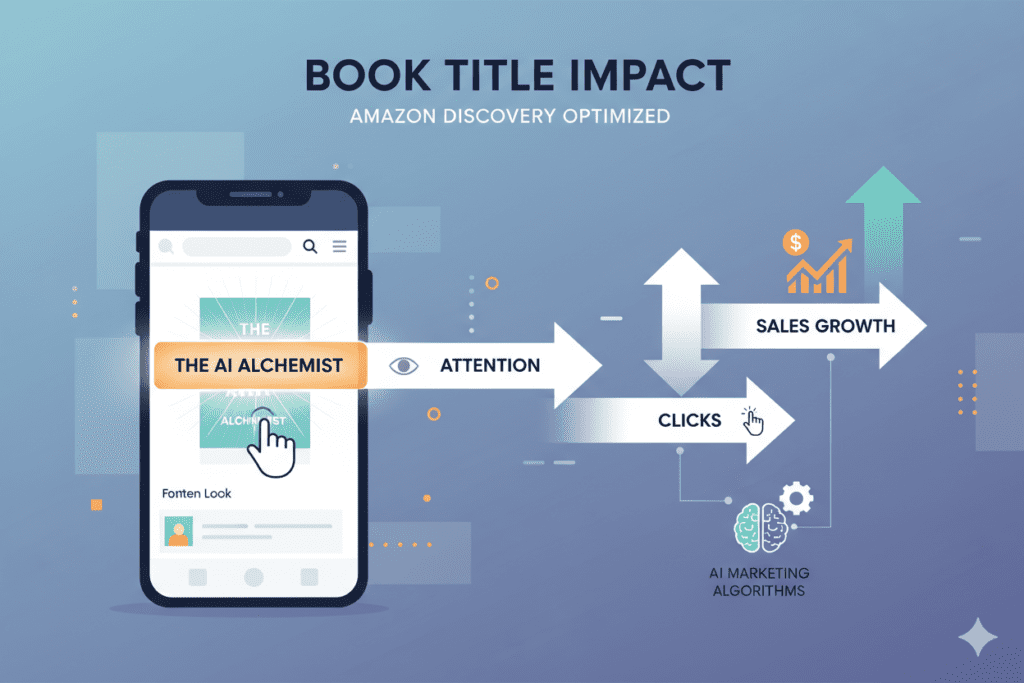
Your book title does more heavy lifting than almost any other element of your work:
It’s Your First Marketing Message: Before anyone reads your blurb, reviews your cover, or checks your author bio, they see your title. In the three seconds it takes a browser to scroll past your book on Amazon, your title either captures attention or gets forgotten.
It Signals Genre and Tone: Romance readers expect different title conventions than thriller fans. Fantasy novels often feature mystical language, while business books lean toward clarity and promise. Your title tells readers, “This book is for you.”
It Impacts Searchability: In the digital age, your title affects discoverability. Search algorithms on Amazon, Goodreads, and Google Books all factor titles into ranking decisions. A well-crafted title can mean the difference between page one and page twenty in search results.
It Creates Emotional Connection: Great titles evoke feeling. They promise transformation, adventure, answers, or escape. “Eat, Pray, Love” doesn’t just describe a journey—it invites you on one.
The challenge? Creating that perfect title requires balancing creativity with strategy, originality with marketability, and artistic vision with reader expectations. That’s a lot of pressure for a few words.
Traditional brainstorming methods—staring at blank pages, endless Google searches, surveying friends who give conflicting advice—can take weeks. Many authors spend more time choosing a title than writing entire chapters.
Enter the Game-Changer: AI Book Title Generator
Imagine having a creative partner who’s analyzed millions of successful book titles across every genre, understands market trends, and can generate dozens of compelling options in seconds.

That’s exactly what an ai book title generator offers.
These tools use advanced language models trained on vast databases of published works, bestseller lists, and genre-specific conventions. They understand what makes “The Silent Patient” work for psychological thrillers and why “Atomic Habits” resonates with self-improvement readers.
But here’s what most authors don’t realize: not all AI title generators are created equal.
The Problem with Single-AI Generators
Most standalone title generators rely on a single AI model, which means:
- Limited creative range: You get one AI’s interpretation of your book
- Genre biases: Some models excel at fiction but struggle with non-fiction titles
- No comparative insights: You can’t see how different AI approaches handle your concept
- Restricted features: Basic generators offer title suggestions and nothing more
This is where platforms like AiZolo transform the entire process.
How AiZolo Revolutionizes Book Title Creation
AiZolo takes the concept of an ai book title generator and supercharges it by giving you access to multiple premium AI models simultaneously—all in one platform.
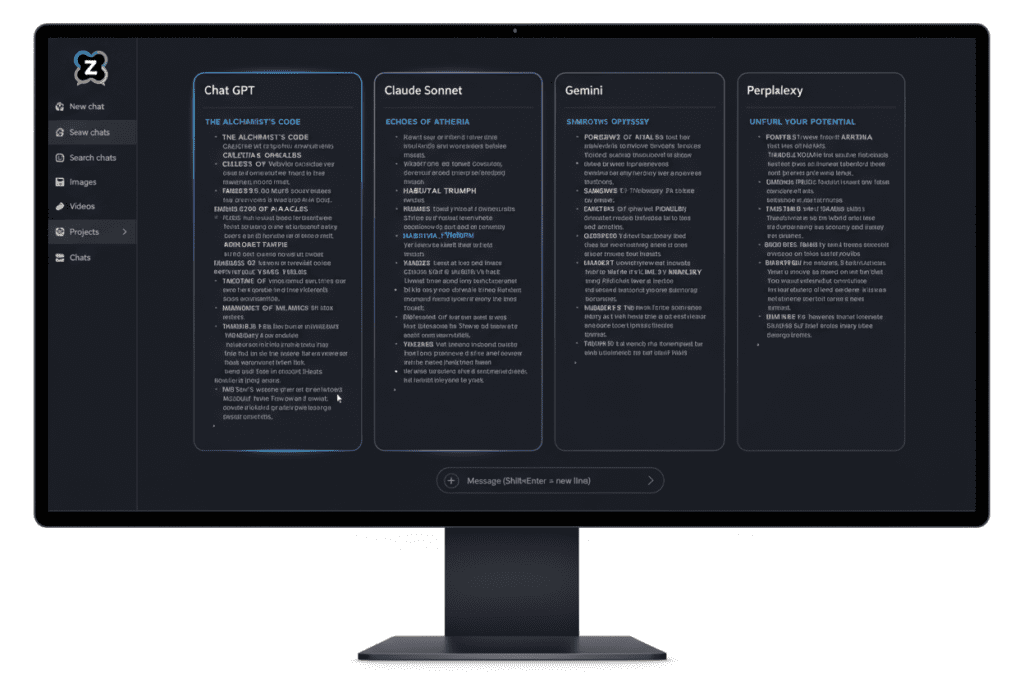
Think of it as having a panel of expert creative consultants, each bringing their unique perspective to your title challenge:
ChatGPT 5 might suggest titles emphasizing storytelling and emotional resonance.
Claude Sonnet 4 could offer titles with sophisticated wordplay and literary depth.
Google Gemini 2.5 Pro might generate titles optimized for search visibility and market trends.
Perplexity Sonar Pro can analyze current bestseller lists and suggest titles aligned with trending themes.
Instead of settling for one AI’s suggestions, you compare approaches in real-time, selecting elements from different suggestions to craft the perfect hybrid title.
Real-World Example: How AiZolo Helped Marcus Launch His Debut Novel
Marcus Williams had written a dystopian novel about climate refugees in 2050. He’d tried three different single-AI title generators and gotten variations of “The Last Hope,” “Rising Waters,” and “Tomorrow’s Exiles.”
They were fine. Just… fine.
Using AiZolo’s multi-AI comparison feature, Marcus input his book description and theme keywords into four AI models simultaneously:
- GPT-5 suggested: “When the Waters Rose” and “Displaced: A Climate Odyssey”
- Claude offered: “The Drowning World” and “Sanctuary Unbound”
- Gemini proposed: “High Water Mark” and “The Climate’s Children”
- Perplexity analyzed recent eco-fiction trends and suggested: “Flood Year” and “The Refugium”
Marcus combined elements from Claude’s “Drowning World” with Gemini’s “Children” concept, creating “Children of the Drowning World”—a title that immediately resonated with his beta readers and contributed to his book hitting #3 in Science Fiction on Amazon’s new release charts.
The entire process took 15 minutes instead of weeks of agonizing indecision.
The Multi-AI Advantage: Why One Platform Changes Everything
Here’s what makes AiZolo’s approach to book title generation so powerful:
1. Diverse Creative Perspectives
Each AI model has distinct strengths based on its training data and architecture. By consulting multiple AIs, you access:
- Different writing styles and tones
- Varied genre expertise
- Unique approaches to wordplay and symbolism
- Diverse cultural and linguistic influences
Think of it as the difference between asking one friend for title ideas versus surveying a dozen creative professionals.
2. Real-Time Comparison and Iteration
AiZolo’s dynamic layout lets you arrange AI responses side-by-side, making it easy to:
- Identify common themes across AI suggestions
- Spot unique ideas that stand out
- Combine elements from different titles
- Refine prompts based on what’s working
You’re not just generating titles—you’re having a collaborative creative session with multiple AI minds.
3. Genre-Specific Optimization
Different genres demand different title approaches:
Fantasy novels might need mystical language and world-building hints. Claude excels at crafting evocative, literary titles perfect for fantasy.
Business books require clear value propositions and searchable keywords. Gemini’s optimization for discoverability makes it ideal for non-fiction.
Romance novels need emotional hooks and genre signals. GPT-5’s understanding of human emotion and storytelling creates titles that resonate with romance readers.
Thrillers demand tension and intrigue. Perplexity’s analysis of current bestsellers helps identify what’s working in today’s thriller market.
With AiZolo, you leverage each AI’s genre strengths simultaneously.
4. Beyond Title Generation
While you’re using AiZolo as an ai book title generator, you’re also getting tools for your entire writing workflow:
- Generate compelling book blurbs and descriptions
- Create character names and backstories
- Develop chapter outlines and plot structures
- Write marketing copy for social media
- Craft author bios and press releases
- Design taglines and series titles
It’s an all-in-one creative workspace that grows with your project.
Step-by-Step: Using AiZolo to Generate Your Perfect Book Title
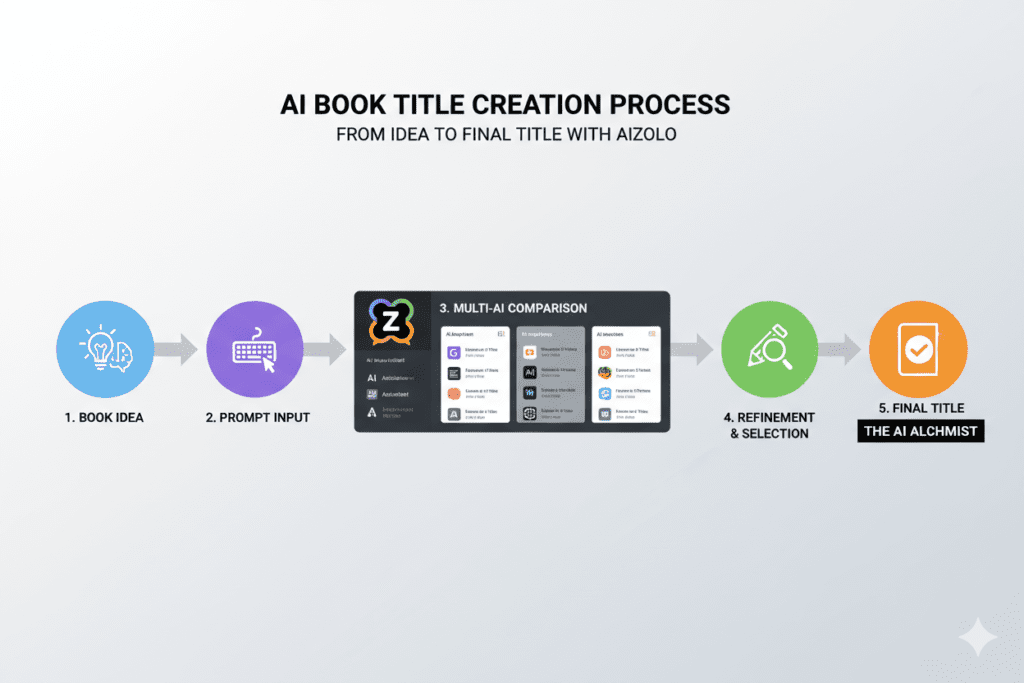
Let me walk you through the exact process that successful authors are using on AiZolo:
Step 1: Prepare Your Book Elements
Before prompting the AIs, gather:
- A 2-3 sentence book summary
- Your genre and sub-genre
- Key themes and motifs
- Target audience demographics
- Desired emotional tone
- Any keywords related to your book’s core concept
Step 2: Craft Your Prompt
Open AiZolo and select multiple AI models (I recommend starting with GPT-5, Claude Sonnet 4, and Gemini 2.5 Pro).
Create a detailed prompt like:
“Generate 5 book title options for a psychological thriller about a forensic psychiatrist who realizes her therapy patients are connected to a series of unsolved murders. The tone should be dark, sophisticated, and intriguing. Target audience is adult women aged 30-55 who enjoy authors like Gillian Flynn and Ruth Ware. Themes include trauma, memory, and the thin line between therapist and patient.”
Step 3: Compare and Analyze Results
AiZolo displays all AI responses simultaneously. Look for:
- Titles that immediately grab your attention
- Common themes or words appearing across multiple AIs
- Unique angles you hadn’t considered
- Titles that feel true to your book’s essence
Step 4: Refine and Iterate
Don’t settle for the first batch. Use AiZolo’s conversation history to refine:
“These are great! Can you generate 5 more options that emphasize the memory/trauma theme? I particularly liked the word ‘forgotten’ in Claude’s suggestion.”
The AIs build on previous responses, creating increasingly targeted suggestions.
Step 5: Test Your Top Choices
Once you’ve narrowed it down to 3-5 favorites:
- Ask AiZolo’s AIs for feedback on each title’s strengths and weaknesses
- Search Amazon to ensure your title isn’t too similar to existing books
- Test with beta readers or on social media
- Check domain availability if you plan to build a book-specific website
Step 6: Make Your Decision
Trust your instincts. The best title is one that:
- Accurately represents your book’s content and tone
- Stands out in your genre without being too weird
- Is easy to remember and spell
- Feels authentic to your author voice
Real Success Stories: Authors Who Found Their Perfect Titles

Emma Richardson – “The Last Garden” (Literary Fiction)
Emma spent two months debating between “Eden’s End” and “After Paradise” for her novel about urban farming and community resilience. Both felt too heavy-handed.
Using AiZolo, she discovered “The Last Garden” through Gemini’s suggestions—simple, evocative, and open to interpretation. The title helped her book get selected for her local library’s book club program, reaching 1,200 readers in the first three months.
David Park – “Code Red: The Cybersecurity Wake-Up Call” (Business/Technology)
David’s cybersecurity guidebook for small businesses was originally titled “Small Business Internet Security Guide”—accurate but completely unmemorable.
Through AiZolo’s multi-AI approach, he found that Perplexity excelled at identifying trending business book title formats, while GPT-5 added urgency and emotion. The resulting title “Code Red” immediately communicated danger and action, while the subtitle clarified the target audience. Sales increased 340% compared to his previous book with a generic title.
Lisa Chen – “Midnight in the Memory Palace” (Fantasy)
Lisa’s YA fantasy needed a title that captured both the contemporary setting and magical elements. Single-AI generators kept suggesting generic options like “The Memory Keeper” or “Palace of Dreams.”
By comparing suggestions across Claude, GPT-5, and Gemini on AiZolo, Lisa noticed “midnight” appeared multiple times, and “palace” created a sense of grandeur. She combined these with “memory” to create a title that intrigued readers without giving away plot details. Her book became a #1 new release in YA Fantasy on Amazon.
The Cost-Benefit Analysis: Why AiZolo Makes Financial Sense
Let’s talk numbers for a moment.
If you wanted to access all the premium AI models individually to use as title generators, you’d pay:
- ChatGPT Plus: $20/month
- Claude Pro: $20/month
- Gemini Advanced: $20/month
- Perplexity Pro: $20/month
Total: $80/month for AI access alone.
And you’d still be switching between tabs, copying prompts, and comparing suggestions manually.
AiZolo gives you all these AI models plus 2000+ additional AI tools for just $9.9/month.
That’s 91% savings compared to subscribing individually. For the price of two lattes, you get:
✓ Multi-AI comparison in a single interface
✓ Dynamic workspace customization
✓ Project management for organizing your work
✓ 3,000,000 tokens per month (plenty for multiple books)
✓ Image generation for book concepts
✓ Audio transcription for voice-to-text drafting
✓ Priority support
Whether you’re working on your first novel or your tenth, the investment pays for itself the first time you use it.
Try AiZolo’s free plan to test the ai book title generator features →
Beyond Titles: How Authors Use AiZolo Throughout the Writing Process
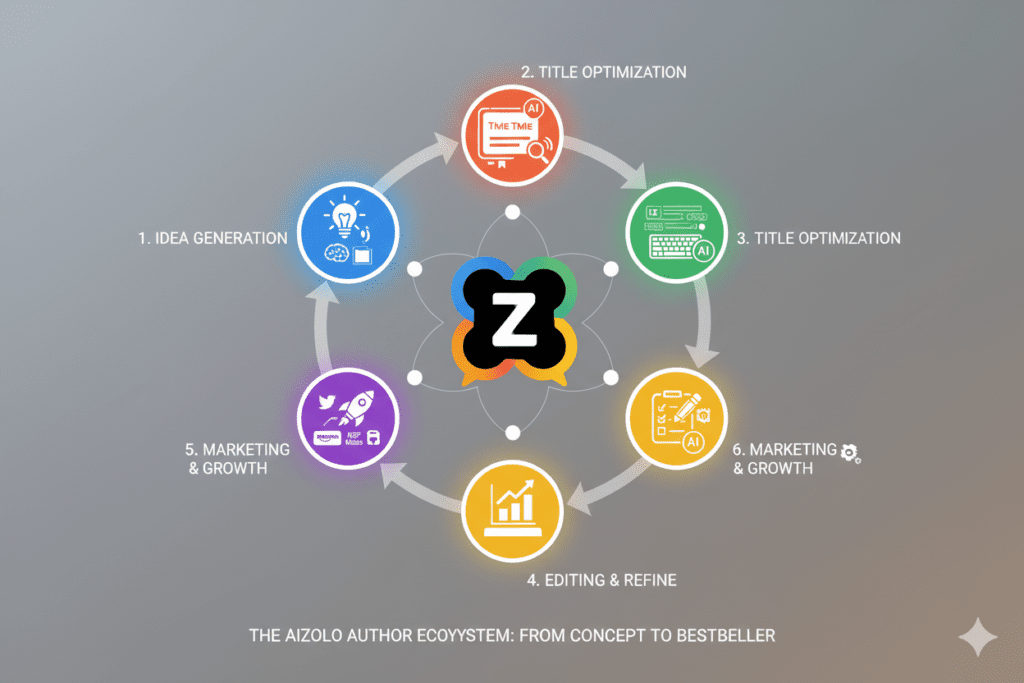
While this article focuses on the ai book title generator capabilities, savvy authors use AiZolo for their entire creative journey:
Pre-Writing Phase
- Brainstorm plot concepts and character arcs
- Research historical periods, locations, or technical topics
- Develop world-building elements for fantasy/sci-fi
- Create detailed character profiles and relationships
Drafting Phase
- Overcome writer’s block with AI-generated prompts
- Get suggestions for dialogue and scene transitions
- Check plot consistency and pacing
- Generate alternative versions of challenging passages
Editing Phase
- Identify weak areas in manuscript structure
- Get style and tone suggestions
- Refine chapter openings and endings
- Polish dialogue for authenticity
Publishing Phase
- Generate book descriptions that convert browsers to buyers
- Create compelling author bios
- Write social media content and marketing copy
- Develop launch strategies and promotional materials
Having all these capabilities in one subscription means you’re not just saving money—you’re creating a streamlined workflow that keeps you in creative flow instead of jumping between platforms.
Learn more about optimizing your creative workflow with AI tools for content creators.
Common Mistakes to Avoid When Using AI Book Title Generators
While AI book title generators are powerful, here are pitfalls to watch out for:
Mistake #1: Using Generic Prompts
Wrong: “Generate book titles for my mystery novel”
Better: “Generate book titles for a cozy mystery set in a small coastal Maine town featuring a bookstore owner who solves crimes using literary clues. Tone should be warm, witty, and inviting. Target readers aged 40-65 who enjoy Louise Penny and Donna Andrews.”
Specificity produces better results. The more context you provide, the more tailored the suggestions.
Mistake #2: Accepting the First Suggestion
AI excels at iteration. Generate multiple batches, refine your prompts, and combine elements from different suggestions. Your perfect title might be a hybrid of three different AI outputs.
Mistake #3: Ignoring Genre Conventions
While unique titles stand out, straying too far from genre expectations confuses readers. If you’re writing romance, titles like “The Quantum Mechanics of Love” might sound clever but won’t resonate with your target audience. Use AI to understand what works in your genre first.
Mistake #4: Forgetting to Check Availability
Always search Amazon, Google, and trademark databases before committing to a title. The last thing you want is to build marketing around a title that’s too similar to an existing bestseller or, worse, legally protected.
Mistake #5: Over-Relying on Trends
AI analyzes current trends, but book publishing has long lead times. A title that’s trendy in 2026 might feel dated by your 2027 publication date. Balance trendy elements with timeless appeal.
Tips for Maximizing Your AI Book Title Generator Results
Use Multiple Iterations
Don’t stop at the first round of suggestions. Ask follow-up questions:
- “Can you make these titles shorter?”
- “Give me options emphasizing the mystery element”
- “What if we used metaphorical language instead?”
Combine Human Creativity with AI Suggestions
The best titles often come from human-AI collaboration. Take elements from AI suggestions and remix them with your own ideas.
Test Your Titles
Before finalizing, test your top 3-5 titles:
- Create mock book covers with different titles
- Survey your social media followers
- A/B test titles in online writing communities
- Ask your beta readers which title would make them pick up the book
Consider Series Potential
If you’re writing book one of a series, ensure your title works within a larger branding strategy. Ask AIs: “If this is book one, what would books 2-4 be titled?”
Think About Audio Books
With audiobook popularity soaring, consider how your title sounds when spoken aloud. Avoid tongue-twisters or easily mispronounced words.
The Future of AI-Assisted Writing
The integration of AI into the writing process isn’t replacing authors—it’s empowering them.
Writing contests and challenges in 2026 are seeing record participation, with more emerging authors than ever before. The barrier to entry has lowered not because AI writes books, but because it removes friction from the creative process.
When you’re not spending weeks agonizing over a title, you’re spending more time:
- Developing complex characters
- Crafting compelling plots
- Refining your unique voice
- Building relationships with readers
- Writing your next book
Platforms like AiZolo recognize that modern authors need modern tools. The goal isn’t to automate creativity—it’s to amplify it.
For those interested in how AI is transforming creative work beyond writing, check out next-generation AI tools for professionals.
Getting Started: Your Action Plan
Ready to transform your title brainstorming process?
Step 1: Sign up for AiZolo’s free plan to test the multi-AI interface with limited tokens. No credit card required.
Step 2: Prepare your book concept document with summary, themes, and target audience details.
Step 3: Experiment with different AI models to see which ones resonate with your genre and style.
Step 4: Generate multiple batches of titles, refining your prompts based on what works.
Step 5: Narrow down to your top 5 favorites and test them with your target readers.
Step 6: If you’re serious about your writing career, upgrade to AiZolo Pro ($9.9/month) for unlimited access to all premium AI models and 3 million tokens monthly—enough for multiple book projects.
The investment in your author career starts with the right tools. While others are still switching between browser tabs and paying $80+ monthly for separate AI subscriptions, you’ll have everything you need in one streamlined platform.
Explore AiZolo’s pricing plans →
Frequently Asked Questions
Q: Will an AI book title generator give me the same title as other authors?
A: No. AI generates suggestions based on your specific prompt, which includes your unique book concept, themes, and style preferences. The more detailed your prompt, the more unique the suggestions. Plus, with AiZolo’s multi-AI approach, you’re combining elements from different AI models, creating truly original results.
Q: Can I copyright an AI-generated title?
A: Book titles themselves generally cannot be copyrighted, whether AI-generated or human-created. However, they can be trademarked if they become associated with a series or brand. The AI-generated title becomes yours to use once generated, as you’re directing the creative process.
Q: Which AI model is best for book titles?
A: It depends on your genre. Claude excels at literary and fantasy titles. GPT-5 is strong with contemporary fiction and emotional resonance. Gemini optimizes for discoverability. Perplexity analyzes market trends. That’s why AiZolo’s multi-AI approach is so powerful—you don’t have to choose just one.
Q: How many title options should I generate?
A: Most authors generate 30-50 options across several sessions, then narrow down to 5-10 favorites for testing. Quality over quantity, but having options prevents settling for mediocre.
Q: Can AI help with subtitles too?
A: Absolutely! Subtitles are often more straightforward than main titles. Prompt the AI with: “Generate subtitle options for [main title] that clarify the book’s promise and target audience.”
Q: What if I don’t like any of the AI suggestions?
A: Use them as inspiration rather than final answers. Often the perfect title comes from combining elements of different AI suggestions or using AI output to trigger your own creativity. Think of AI as a brainstorming partner, not a replacement for your creative judgment.
Final Thoughts: From Title Page to Bestseller List

Sarah Chen, the author we met at the beginning of this article, finally found her perfect title at 3:47 AM—exactly one hour after discovering AiZolo.
“Luminous Shadows: A Journey from Darkness to Light”
It combined Claude’s suggestion of “Luminous,” GPT-5’s “Journey,” and her original concept of shadows and light. The title felt true to her book’s essence while immediately communicating transformation and hope.
She hit her publishing deadline. Her book launched on schedule. And three months later, it hit #7 on the Amazon self-help bestseller list, with readers specifically mentioning how the title drew them in.
The right title doesn’t guarantee success, but the wrong title can absolutely guarantee obscurity.
In today’s competitive publishing landscape, every advantage matters. An ai book title generator isn’t just a convenience—it’s a competitive edge that levels the playing field between debut authors and established names.
You’ve poured your heart into your manuscript. You’ve created characters who feel real, plot twists that surprise, and prose that sings. Don’t let an inadequate title keep your book from finding its readers.
With AiZolo’s multi-AI platform, you have access to the same advanced AI technology that major publishing houses are beginning to integrate into their workflows—except you don’t need a multi-million-dollar budget or connections in New York.
You just need a great story and the right tools to help it reach the world.
Ready to discover your perfect book title?
Start for free on AiZolo today →
No setup fees. No credit card required. Just you, your book concept, and the most powerful AI writing tools available in one affordable platform.
Your readers are waiting. Your title is waiting to be discovered. And your author journey is about to get a whole lot easier.
About AiZolo
AiZolo is the all-in-one AI platform designed for creators, writers, and professionals who refuse to settle for ordinary tools. With access to ChatGPT 5, Claude Sonnet 4, Google Gemini 2.5 Pro, Perplexity Sonar Pro, and 2000+ specialized AI tools, AiZolo eliminates the need for multiple subscriptions while supercharging your creative workflow.
Trusted by over 10,000 creators worldwide, AiZolo saves users an average of $1,092 annually compared to individual AI subscriptions—while delivering better results through multi-AI comparison and collaboration.
Join the AiZolo community today and transform how you work with AI.
Related Reading from AiZolo Blog:
- AI Chatbot Online: Finding Your Perfect Digital Assistant
- World Best AI: Why One Platform Changed Everything
- Best All-in-One AI App for 2026
- Next Billion AI Revolution: Making Premium AI Accessible
Internal Links Suggested:
- AI Chatbot Online guide
- World Best AI platform comparison
- Best All-in-One AI App
- Next Billion AI accessibility
- All-in-One AI Tools List
External Links Suggested:
- ProWritingAid’s guide on book titles (authority on writing craft)
- Reedsy’s publishing resources (authority on indie publishing)
- Writer’s Digest article on title trends (industry authority)
- Amazon KDP guidelines (official publishing platform resource)
- Goodreads author program (reader community resource)
555
555