
Featured Snippet Answer
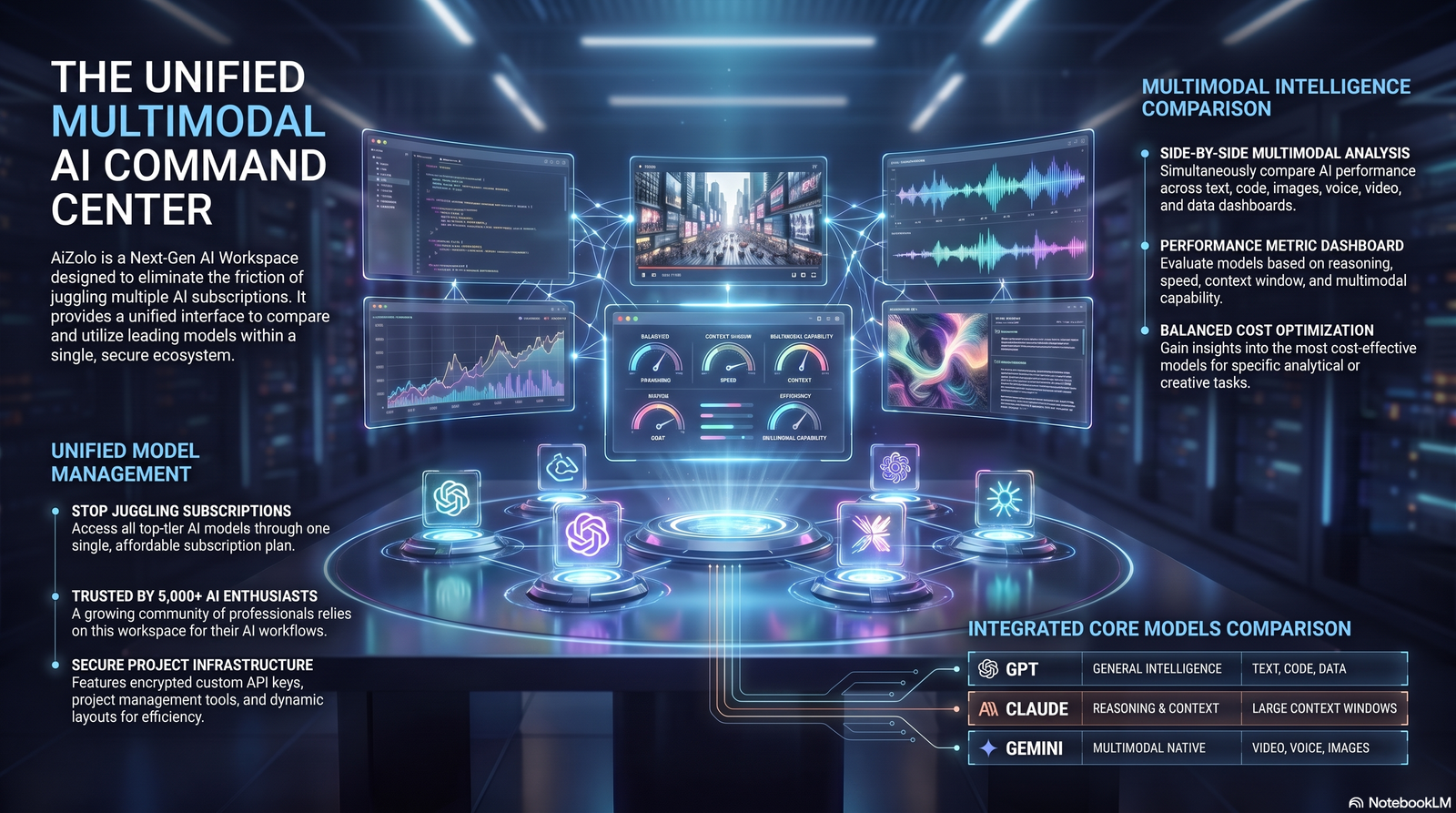
There is no single best multimodal AI model 2026 Gemini vs others — the right pick depends on the task. Gemini 3.1 Pro leads on video and audio understanding and native 1M-token multimodal context. Claude Fable 5 / Opus 4.8 lead on long-document OCR, coding accuracy, and agentic reliability. GPT-5.5 leads on chart reasoning, code-with-vision, and OpenAI’s ecosystem breadth. Grok 4.5 wins on price-to-performance and real-time data grounding. Open-weight options like DeepSeek V4 and Llama 4 are best for teams that need self-hosting, privacy, or zero per-token costs. Platforms like Aizolo make it easier to compare and access multiple leading AI models from a single workspace, helping users choose the right model for each task instead of relying on just one.
Key Takeaways
- By mid-2026, every frontier multimodal model clears roughly 80% on MMMU-Pro, so raw image-QA scores no longer separate the field — video, audio, OCR, and chart reasoning are the new battlegrounds.
- Gemini 3.1 Pro (released February 19, 2026) leads video understanding and holds a 1M-token context window with native support for hour-long video and 900-page documents in a single prompt.
- GPT-5.5 (April 23, 2026) is priced at $5/$30 per million input/output tokens and leads chart reasoning and agentic benchmarks like GDPval and OSWorld-Verified.
- Claude Opus 4.8 and Claude Fable 5 lead long-document OCR and coding accuracy, with Fable 5 posting an 11-point SWE-Bench Pro lead over Opus 4.8.
- Grok 4.5 (July 8, 2026) undercuts every frontier rival on price at $2/$6 per million tokens while ranking #1 on agentic tool use.
- Open-weight models — DeepSeek V4, Llama 4, Mistral Large 3 — now deliver 80–90% of closed-model capability with full self-hosting control and no per-token fees.
Introduction
Picking a multimodal AI model in 2026 is no longer about which chatbot writes the smoothest paragraph. It’s about which model can watch an hour of video, read a 900-page contract, generate working code from a screenshot, and do it without hallucinating a compliance clause that doesn’t exist.
That’s a genuinely hard decision. Google, OpenAI, Anthropic, xAI, and a fast-growing open-weight ecosystem are all shipping frontier releases every few weeks, and the benchmark leaderboard reshuffles almost as often.
This guide walks through where each model actually wins, where it falls short, and which one fits your specific job — whether that’s a student summarizing lecture videos, a developer debugging from a screenshot, or an enterprise team running document-heavy compliance workflows.
We’ll lean on official model cards, independent evaluators like Artificial Analysis, and real API pricing pages rather than marketing claims alone — and we’ll flag where vendor-reported numbers haven’t yet been independently reproduced.
Table of Contents
What Is a Multimodal AI Model?
A multimodal AI model can understand and often generate more than one type of content — text, images, audio, video, and code — inside a single reasoning process, rather than stitching together separate single-purpose tools. Instead of one model reading text and a different one captioning images, a multimodal model reasons across formats at once: it can watch a video, read the captions, cross-reference a spreadsheet, and answer a question that touches all three.
How Multimodal AI Evolved
Early multimodal systems bolted an image encoder onto a text-only language model. Results were serviceable for captioning but weak at real reasoning across modalities. That changed with natively multimodal training, where models learn from mixed image-text-audio-video data from the start rather than as an add-on.

Why Gemini Became Popular
Gemini’s rise through 2025–2026 tracks three things: Google’s TPU infrastructure advantage, an aggressive release cadence (Gemini 3 in late 2025, Gemini 3.1 Pro on February 19, 2026), and a genuine lead on video and audio tasks that other labs haven’t matched.
Gemini 3.1 Pro can process entire codebases, 8.4 hours of audio, 900-page PDFs, or an hour of video in a single prompt, and it ranks #1 on 12 of 18 tracked benchmarks spanning reasoning, coding, multimodal understanding, and agentic tasks.
Its scores on ARC-AGI-2 (77.1%) and GPQA Diamond (94.3%) put it at or near the top of reasoning leaderboards, while its 87.6% on Video-MMMU and dominance on long-form Video-MME (78.4% vs GPT-5.5’s 71.2% and Claude Opus 4.7’s 67.8%) explain why it’s become the default choice for any workflow centered on video or audio comprehension.
But popularity isn’t the same as universal superiority — which is exactly why the comparisons below matter.
Gemini vs GPT-5.5
GPT-5.5, released April 23, 2026, is OpenAI’s agentic-workflow flagship. It’s priced at $5 per million input tokens and $30 per million output tokens, with a roughly 1M-token context window (922K input, 128K output) supporting text and image inputs.
Where GPT-5.5 pulls ahead of Gemini is agentic execution: it posts 84.9% on GDPval wins-or-ties, 78.7% on OSWorld-Verified, and a 73.1% score on OpenAI’s internal Expert-SWE evaluation, where tasks carry a 20-hour median human completion time. It also leads chart reasoning and infographics, a category where dense financial or scientific documents matter.
Gemini 3.1 Pro answers back with a lower price ($2/$12 per million tokens vs GPT-5.5’s $5/$30), a decisive video and audio lead, and a 65,536-token output ceiling that avoids the truncation issues some long-form generation tasks hit on GPT-5.5.
Bottom line: choose GPT-5.5 for agentic computer-use tasks, chart-heavy documents, and OpenAI’s broader ecosystem (Codex, ChatGPT Enterprise). Choose Gemini 3.1 Pro for video/audio-centric workflows and better price-to-context-window value.
Gemini vs Claude
Claude’s 2026 lineup runs Sonnet 5 ($2/$10 per million tokens) as the everyday workhorse, Opus 4.8 ($5/$25) as the flagship for complex reasoning and agentic coding, and the new Mythos-class Claude Fable 5 ($10/$50) as Anthropic’s top publicly available tier, released June 9, 2026. All four carry a 1M-token context window with text, image, and file input support.
Anthropic doesn’t chase the same benchmark categories Google does. Instead, Claude’s edge shows up in long-document OCR, where Claude Opus 4.7 held the crown as of April 2026, and in coding accuracy — Fable 5 posted an 11-point lead over Opus 4.8 on SWE-Bench Pro and more than double Opus 4.8’s score on FrontierCode (Diamond), a benchmark built around production-codebase-standard difficulty.
Gemini 3.1 Pro still leads outright on video and audio comprehension, and its context window handles longer raw video than Claude’s document-first design targets. But for a legal team OCR-ing scanned contracts or a dev team running long, autonomous coding sessions, Claude’s models currently have the edge.
Bottom line: Gemini wins for video/audio-first workloads; Claude wins for document-heavy OCR and long-horizon coding/agentic tasks where accuracy over many steps matters more than raw multimodal breadth.
Gemini vs Grok
Grok 4.5, released July 8, 2026 by xAI (now merged into SpaceXAI), is built around economics rather than raw supremacy. At $2 input / $6 output per million tokens, it undercuts Gemini 3.1 Pro and every other frontier model on cost while still landing at #4 on the independent Artificial Analysis Intelligence Index — and #1 specifically on agentic tool use.
Grok 4.5 supports a 500K-token context window (smaller than Gemini’s 1M), takes text and image input, and ships with a configurable reasoning-effort dial plus built-in real-time X (Twitter) search grounding — a genuinely unique feature no other frontier lab offers.
Gemini’s advantage is breadth: native video and audio understanding, a larger context window, and stronger performance on scientific and abstract-reasoning benchmarks like GPQA Diamond and ARC-AGI-2. Grok’s advantage is cost efficiency and real-time social/web grounding, which matters for teams monitoring live events, trends, or breaking news.
Bottom line: pick Grok 4.5 for cost-sensitive, high-volume agentic coding or real-time-data tasks; pick Gemini for video/audio comprehension and deeper scientific reasoning.
Gemini vs DeepSeek
DeepSeek V4, released as an open-weight preview on April 22, 2026 under the MIT license, ships in two tiers: V4-Pro (1.6 trillion total parameters, ~49B active) and V4-Flash (284B total, ~13B active), both with a 1M-token native context window and a hybrid Compressed Sparse Attention design that makes long-context inference dramatically cheaper than prior DeepSeek generations.
The core trade-off versus Gemini is closed vs. open. Gemini 3.1 Pro is a polished, fully managed API with best-in-class video/audio handling. DeepSeek V4 is free to self-host, fully open-weight, and gives enterprises complete control over data residency and fine-tuning — at the cost of needing serious infrastructure (V4-Pro realistically needs multi-node H100/H200 clusters) and vendor-claimed benchmarks that are still being independently reproduced.
Bottom line: Gemini for turnkey multimodal quality with zero infrastructure burden; DeepSeek V4 for teams that need self-hosted, MIT-licensed control over a frontier-class open model and have the GPU budget to run it.
Gemini vs Mistral
Mistral’s 2026 lineup — Mistral Large 3, Mistral Small 4, and the Ministral 3 family — now ships largely under Apache 2.0, a notable shift from earlier restrictive licensing. Mistral Small 4 combines multimodal input, configurable reasoning, and a 256K context window in a 6B-active-parameter package, positioning it as a strong multilingual, cost-efficient option (Mistral Large 3 supports 80+ languages).
Gemini’s multimodal ceiling is simply higher — longer context, native video, stronger benchmark scores across the board. But Mistral’s Apache 2.0 licensing, European data-residency options, and lower deployment footprint make it a compelling pick for EU-regulated industries or teams that want an open, commercially unrestricted multilingual model without DeepSeek’s heavier infrastructure needs.
Bottom line: Gemini for maximum multimodal capability; Mistral for EU compliance, multilingual coverage, and lighter self-hosting requirements.
Gemini vs Meta Llama
Meta’s Llama 4 family — Scout (109B total / 17B active, 10M-token context) and Maverick (400B total / 17B active, 1M-token context, 128 experts) — was the first Llama generation natively multimodal from the ground up, built with a mixture-of-experts architecture that keeps inference costs low relative to total parameter count. Llama 4 Scout’s 10-million-token context window remains the longest of any widely deployed open model, useful for ingesting entire codebases or multi-book document sets in one pass.
Where Gemini wins decisively is raw multimodal quality per prompt — reasoning depth, video/audio understanding, and benchmark accuracy. Llama 4’s edge is deployment flexibility: it’s free to fine-tune and self-host (subject to Meta’s license terms and 700M-MAU commercial cap), and its ecosystem of community fine-tunes is the largest of any open model family.
Bottom line: Gemini for out-of-the-box multimodal accuracy; Llama 4 for the largest open fine-tuning ecosystem and extreme long-context needs on a self-hosted budget.
Benchmark Tables
Figures below are compiled from official model cards, Artificial Analysis, and OpenRouter pricing pages as of July 2026. Vendor-reported scores are noted; treat any single benchmark as one data point, not the whole picture.
Overall Ranking (Artificial Analysis Intelligence Index, July 2026)
| Rank | Model | Intelligence Index |
|---|---|---|
| 1 | Claude Fable 5 | 60 |
| 2 | Claude Opus 4.8 | 56 |
| 3 | GPT-5.5 (xhigh) | 55 |
| 4 | Grok 4.5 | 54 |
| 5 | Claude Opus 4.7 | 54 |
Reasoning & Science
| Model | ARC-AGI-2 | GPQA Diamond |
|---|---|---|
| Gemini 3.1 Pro | 77.1% | 94.3% |
| GPT-5.5 | Competitive, not independently confirmed at same tier | — |
| Grok 4.5 | — | 93.1% |
| Claude Fable 5 | Category-leading on FrontierMath Tier 4 (per Anthropic) | — |
Coding
| Model | SWE-Bench Pro | Terminal-Bench 2.0/2.1 |
|---|---|---|
| Claude Fable 5 | 80.3% | — |
| GPT-5.5 | 58.6% | 82.7% |
| Grok 4.5 | 64.7% | 83.3% (2.1) |
| Gemini 3.1 Pro | — | 68.5% |
| Claude Opus 4.7 | 64.3% | 69.4% |
Vision & Multimodal (MMMU-Pro, April 2026 snapshot)
| Model | MMMU-Pro Score |
|---|---|
| GPT-5.5 | 81–83% |
| Gemini 3 / 3.1 | 81–83% |
| Claude Opus 4.7 | 81–83% |
| Qwen 3.5 Omni | 81–83% |
Note: MMMU-Pro has become saturated — all frontier models now score within a ~3-point band, so it should not be used alone to pick a model.
Video Understanding (Video-MME, long-form)
| Model | Score |
|---|---|
| Gemini 3 Deep Think | 78.4% |
| Qwen 3.5 Omni | 69.5% |
| GPT-5.5 | 71.2% |
| Claude Opus 4.7 | 67.8% |
Long Context Window
| Model | Context Window |
|---|---|
| Llama 4 Scout | 10,000,000 tokens |
| DeepSeek V4-Pro | 1,000,000 tokens |
| Gemini 3.1 Pro | 1,000,000 tokens (65,536 max output) |
| Claude Fable 5 / Opus 4.8 / Sonnet 5 | 1,000,000 tokens |
| GPT-5.5 | ~1,050,000 tokens (922K input) |
| Grok 4.5 | 500,000 tokens |
| Mistral Small 4 | 256,000 tokens |
Pricing (per 1M tokens, input/output, July 2026)
| Model | Input | Output |
|---|---|---|
| Gemini 3.1 Pro | $2.00 | $12.00 |
| GPT-5.5 | $5.00 | $30.00 |
| Grok 4.5 | $2.00 | $6.00 |
| Claude Sonnet 5 (intro, through Aug 31) | $2.00 | $10.00 |
| Claude Opus 4.8 | $5.00 | $25.00 |
| Claude Fable 5 | $10.00 | $50.00 |
| DeepSeek V4 | Free (self-hosted; open weights) | — |
| Llama 4 / Mistral | Free (self-hosted; open weights) | — |
Enterprise & Privacy Snapshot
| Model | Data Residency Options | Notable Enterprise Feature |
|---|---|---|
| Gemini 3.1 Pro | Vertex AI regional processing | Native Google Workspace integration |
| GPT-5.5 | Regional endpoints (10% uplift) | ChatGPT Enterprise, SOC 2, no training on user data |
| Claude (all tiers) | Available via Claude Platform | ASL-3 safety classifiers, Fallback API routing |
| DeepSeek / Llama / Mistral | Full self-hosting | Complete data control, no vendor lock-in |
Agentic Capabilities & Tool Use
Agentic performance — a model’s ability to autonomously chain tool calls, browse, and complete multi-step tasks without derailing — has become as important as raw intelligence in 2026 buying decisions. GPT-5.5 leads on GDPval and OSWorld-Verified, two of the more realistic “computer use” evaluations. Grok 4.5 tops agentic tool-use specifically despite ranking #4 overall on general intelligence, largely thanks to token efficiency:
it completed SWE-Bench Pro tasks using roughly four times fewer tokens than GPT-5.5 while scoring higher.
Claude’s models emphasize long-horizon reliability, aided by Fable 5’s file-based memory that lets it run multi-day tasks on a single job.
Gemini 3.1 Pro’s agentic strength shows up in tool-coordination benchmarks like MCP Atlas, where it posted a 69.2% score for reliable, deterministic multi-step tool usage.
Enterprise Readiness, Privacy & Security
For regulated industries, three questions matter most: where does the data live, does the vendor train on your inputs, and what compliance certifications exist.
OpenAI’s ChatGPT Enterprise and Google’s Vertex AI both offer regional processing and explicit no-training guarantees on paid tiers.
Anthropic layers ASL-3 safety classifiers onto its Fable 5 / Mythos 5 tier, automatically routing a small percentage of sensitive requests (cybersecurity, biology, chemistry) to the more conservative Opus 4.8. Open-weight models — DeepSeek, Llama, Mistral — sidestep the data-residency question entirely by letting you run inference on your own infrastructure, which is often the deciding factor for government, defense, and healthcare deployments.
Which AI Is Best for Each Profession?

- Students: Gemini 3.1 Pro for summarizing lecture videos and long PDFs at a low price point; free tiers of GPT and Gemini both work well for everyday homework help.
- Developers: Claude Fable 5 or Opus 4.8 for long, autonomous coding sessions; Grok 4.5 for token-efficient, budget-conscious coding agents.
- Businesses: GPT-5.5 for agentic workflow automation and ChatGPT Enterprise integration; Claude for document-heavy compliance and legal review.
- Content Creators: Gemini 3.1 Pro for video/audio-based content pipelines; GPT-5.5 for chart- and design-heavy outputs.
- Researchers: Gemini 3.1 Pro for scientific reasoning (GPQA Diamond) combined with long-context document synthesis; DeepSeek V4 for teams needing full model transparency.
- Startups: Grok 4.5 or DeepSeek V4 for the best cost-to-capability ratio at scale.
The Future of Multimodal AI
Two trends will define the next wave. First, benchmark saturation on static image tasks (MMMU-Pro) means labs are now competing on video, audio, and real-world agentic execution — categories that are harder to game and closer to what users actually do.
Second, the gap between closed frontier models and open-weight alternatives keeps narrowing; DeepSeek V4 and Llama 4 already deliver a large share of frontier capability at zero per-token cost, which will keep pushing closed-model pricing down.
Final Recommendation
If you need one default pick and can’t test further:
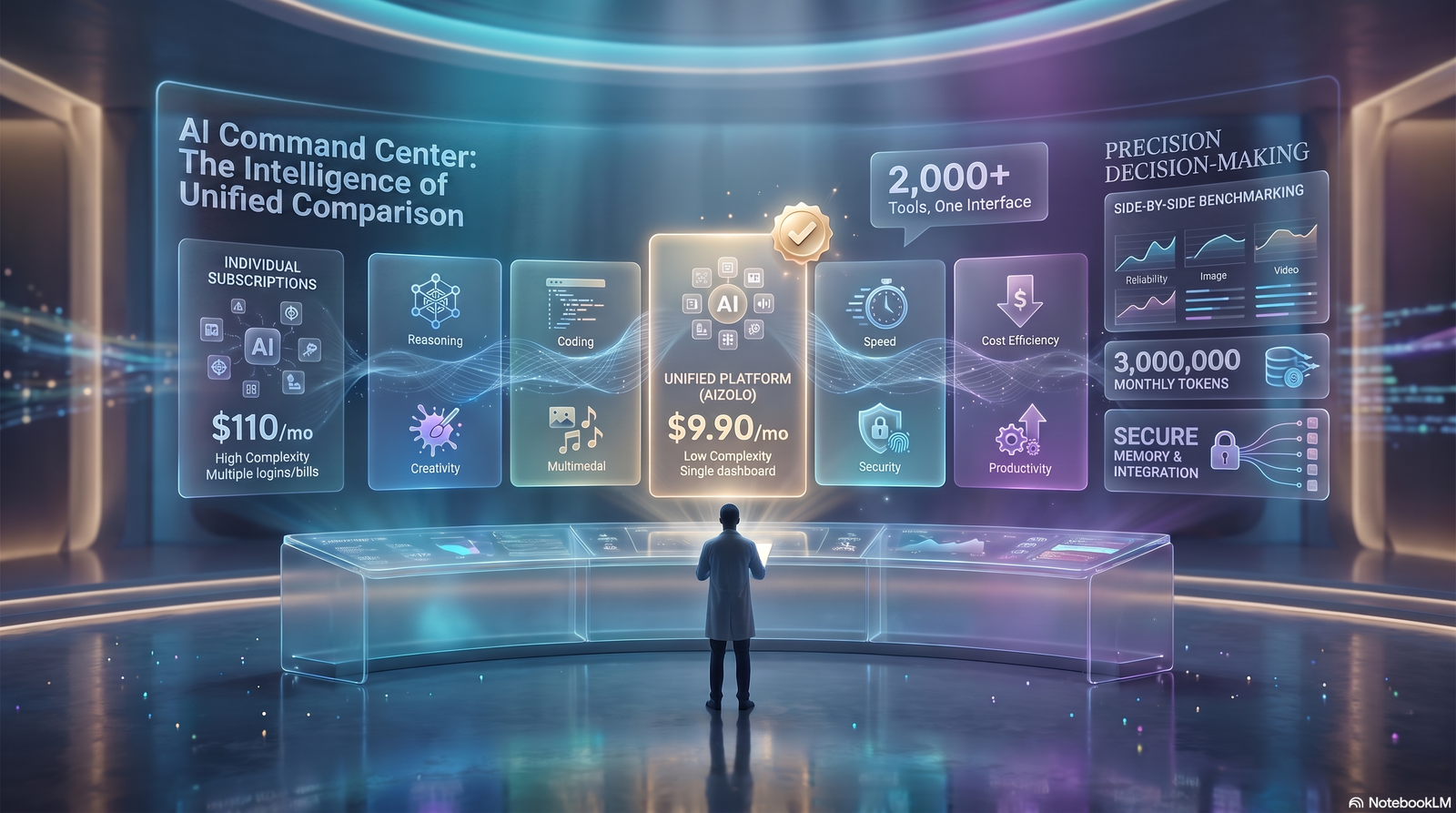
Gemini 3.1 Pro offers the best all-around balance of price, context window, and multimodal breadth for most video-, audio-, and document-heavy workflows in 2026. Developers running long autonomous coding sessions should strongly consider
Claude Fable 5 or Opus 4.8. Teams optimizing purely for cost and agentic tool efficiency should evaluate
Grok 4.5. Anyone needing full self-hosting control should shortlist
DeepSeek V4 or Llama 4. Test on your own workload before committing — vendor benchmarks are a starting point, not a guarantee.
Ready to compare pricing on your own usage pattern? Most providers offer free-tier API credits — the cheapest way to validate a model before scaling up.
FAQs
Is Gemini better than ChatGPT in 2026? Neither is universally better. Gemini 3.1 Pro leads video and audio understanding and offers a lower price per token, while GPT-5.5 leads on agentic computer-use benchmarks like OSWorld-Verified and chart reasoning. The right choice depends on whether your workload is video-centric or agent-execution-centric.
Is Claude or Gemini better for coding? Claude currently leads on coding accuracy — Fable 5 posted an 11-point lead over Opus 4.8 on SWE-Bench Pro and more than doubled Opus 4.8’s FrontierCode score. Gemini remains competitive but isn’t the top coding pick as of mid-2026.
What is the cheapest frontier multimodal AI model? Among proprietary models, Grok 4.5 is the cheapest at $2/$6 per million input/output tokens. Among open-weight options, DeepSeek V4, Llama 4, and Mistral models are free to self-host, though infrastructure costs apply.
Which AI model has the longest context window? Llama 4 Scout leads with a 10-million-token context window. Among proprietary frontier models, Gemini 3.1 Pro, Claude’s 5-generation models, and GPT-5.5 all support roughly 1 million tokens.
Does Gemini understand video better than GPT or Claude? Yes, as of mid-2026 benchmarks. Gemini 3 Deep Think scored 78.4% on long-form Video-MME versus GPT-5.5’s 71.2% and Claude Opus 4.7’s 67.8%, a meaningful and consistent gap.
Is DeepSeek V4 safe for enterprise use? DeepSeek V4 ships under the MIT license with open weights, which gives enterprises full control over deployment and data residency. However, its published benchmarks are vendor-reported and still being independently verified, so enterprises should run their own evaluation before production deployment.
What is MMMU-Pro and why does it matter less in 2026? MMMU-Pro is a benchmark testing multimodal image understanding and reasoning. By 2026 it has become saturated — every frontier model scores within about 3 points of each other — so it no longer meaningfully differentiates top models the way it did in 2024.
Which AI model is best for legal or compliance document review? Claude models, particularly Opus 4.7 and its successors, have held the lead on long-document OCR benchmarks, making them a strong fit for contract review and compliance workflows.
Is Grok 4.5 good for coding? Yes. Grok 4.5 scored 64.7% on SWE-Bench Pro versus GPT-5.5’s 58.6%, while using roughly four times fewer tokens per task, making it notably cost-efficient for agentic coding at scale.
What does “agentic AI” mean in the context of these models? Agentic AI refers to a model’s ability to autonomously plan and execute multi-step tasks — browsing, calling tools, writing and testing code — with minimal human intervention. Benchmarks like GDPval, OSWorld-Verified, and MCP Atlas specifically measure this capability.
Are open-weight models like Llama or Mistral good enough to replace GPT or Gemini? For many workloads, yes — open-weight models now deliver 80–90% of frontier capability. But they typically lag on the newest reasoning and video benchmarks and require your own infrastructure, so the right choice depends on whether cost/control or peak capability matters more.
How much does Claude Fable 5 cost compared to Gemini? Claude Fable 5 costs $10 input / $50 output per million tokens — roughly 5x Gemini 3.1 Pro’s $2/$12 rate — reflecting its positioning as Anthropic’s top capability tier rather than a price-competitive option.
Which multimodal AI model has the best safety and privacy controls? Anthropic’s Claude models use ASL-3 safety classifiers with automatic fallback routing for sensitive queries. OpenAI and Google both offer enterprise tiers with no-training guarantees and regional data processing. Self-hosted open-weight models offer the strongest data-control guarantees by keeping everything on your own infrastructure.
Do these models support audio input, not just text and images? Yes. Gemini 3.1 Pro processes up to 8.4 hours of audio in a single prompt and leads audio comprehension benchmarks. Qwen 3.5 Omni is close behind, particularly for real-time applications. GPT-5.5 and Claude’s current public API tier are primarily text-and-image input, with audio handled through separate specialized models.
What should I test before switching my production workload to a new model? Run your own evaluation set covering your actual task types (not just published benchmarks), check total cost per completed task rather than just per-token price, and verify data residency and compliance requirements match your industry’s regulations before migrating.
Conclusion
The 2026 multimodal AI market no longer has a single winner — it has specialists. Gemini 3.1 Pro’s video and audio lead, GPT-5.5’s agentic execution strength, Claude’s coding and document accuracy, Grok’s cost efficiency, and the open-weight ecosystem’s flexibility each solve a different problem well.
The smartest strategy for most teams isn’t picking one model forever — it’s matching the model to the task and re-testing every few months, because this field moves fast enough that today’s leaderboard rarely survives a full quarter unchanged.
Author
Jeevesh Tripathi AI Researcher & SEO Strategist Email: jeevesh@aizolo.com
Jeevesh Tripathi is an AI researcher and SEO strategist specializing in multimodal AI platforms, benchmark analysis, and technology comparison content. With a background spanning applied machine learning evaluation and organic search strategy, Jeevesh has spent recent years tracking frontier model releases from Google DeepMind, OpenAI, Anthropic, xAI, and the open-weight ecosystem, translating dense benchmark data into practical guidance for developers, businesses, and content teams. His work focuses on evidence-based comparisons grounded in official documentation and independent evaluators rather than vendor marketing claims, in line with Google’s Helpful Content and E-E-A-T principles. He writes regularly on AI model selection, pricing trends, and enterprise AI deployment strategy.
Pingback: Is There a Way to Bypass Claude Message Limit? Proven Fixes in 2026
Pingback: How to Chat with Multiple AI Models: Proven Guide 2026
Pingback: Replace 10 Paid AI Tools with AI Zolo & Save $2,400+