Introduction
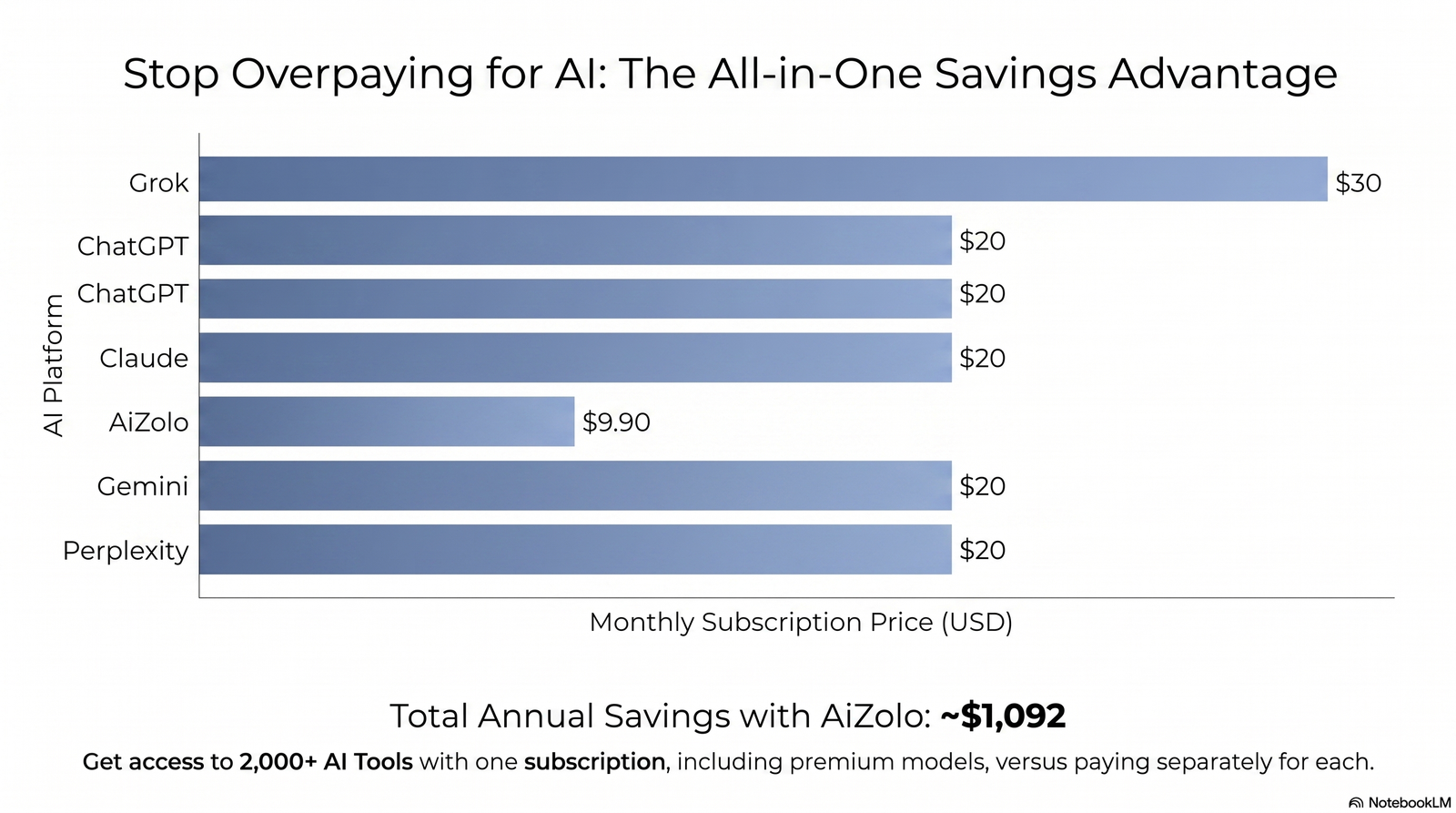
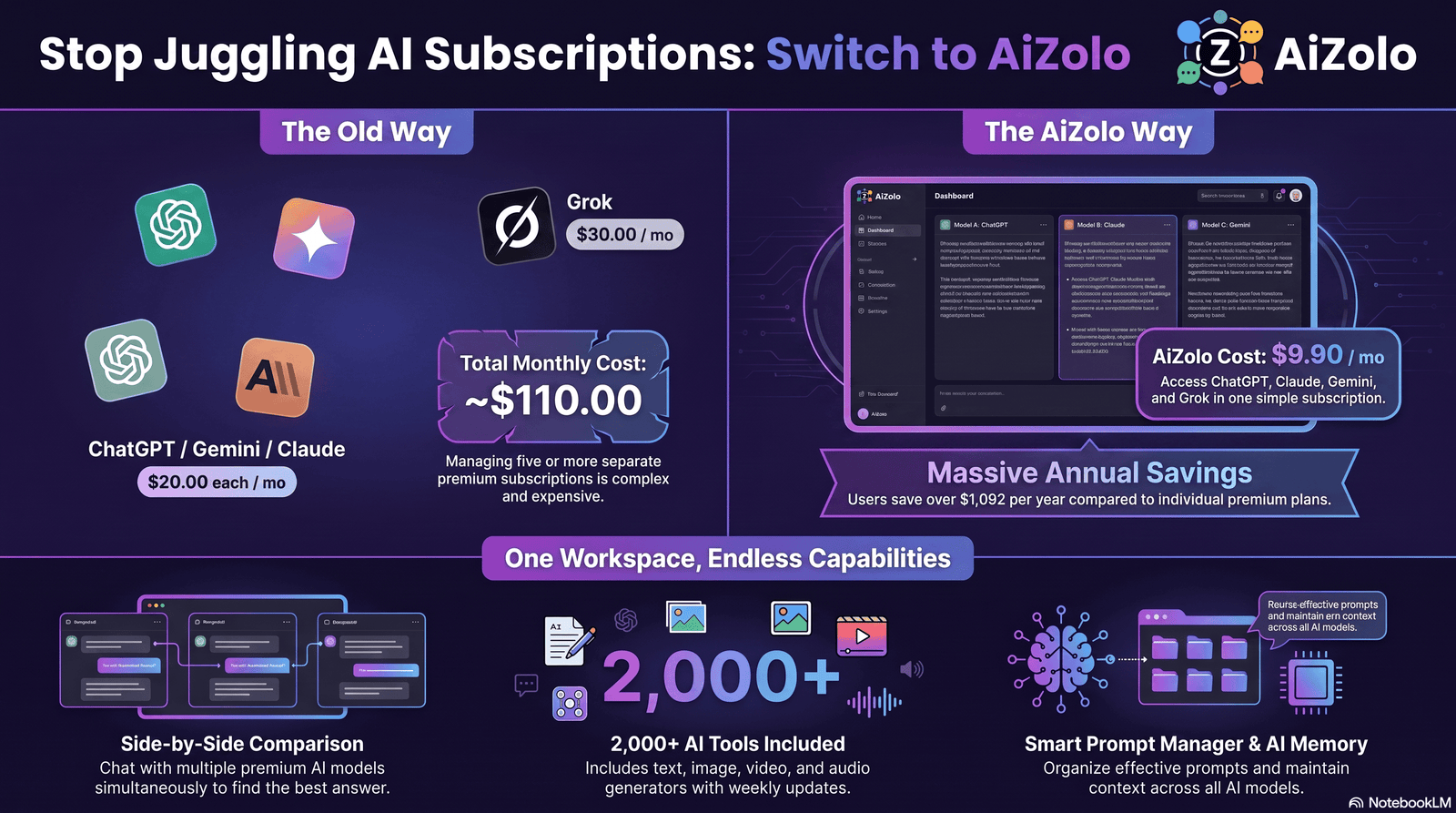
If you tried to build on Meta’s AI stack in the first week of July 2026, you ran into a wall. On July 6, 2026, Meta shut down the Llama API public preview—the closest thing it had to a first-party developer API—after just fourteen months in beta. For teams using platforms like Aizolo to access multiple AI models, this shift highlighted the importance of flexible, multi-model AI ecosystems that aren’t tied to a single provider.
That single event reshapes any meta ai models api differences comparison 2026 you’re likely to find elsewhere, because most of that content was written before the shutdown.
AI APIs matter more in 2026 than they did two years ago because the cost of picking wrong has gone up. Context windows, agentic tool-use, and per-token pricing now vary by an order of magnitude between vendors, and switching mid-product is expensive.
Meta still deserves your attention, but for a different reason than in 2024. It’s no longer “the open-source alternative to OpenAI.” It’s a company mid-pivot — walking away from open weights toward a proprietary model called Muse Spark, while its old Llama models live on almost entirely through third-party hosts.
In this guide, you’ll get a grounded, source-checked comparison of Meta’s current model lineup against OpenAI, Anthropic, Google Gemini, Mistral, and DeepSeek — pricing, benchmarks, context windows, licensing, and where each one actually makes sense in production.
Table of Contents
What Are Meta AI Models, Really?
Meta AI models fall into two very different buckets now, and conflating them is the single most common mistake in older comparison articles.
Bucket one is Llama — the open-weight model family (Llama 2, 3, and 4) that anyone can download, fine-tune, and self-host. Meta doesn’t operate a first-party paid API for these anymore.
Bucket two is Muse Spark — Meta’s new proprietary, closed-weight model line, built by the newly formed Meta Superintelligence Labs (MSL) under Alexandr Wang, the former Scale AI CEO who joined Meta as part of its reported $14.3 billion investment in Scale AI.
These two buckets have almost nothing in common architecturally, commercially, or strategically. A fair comparison treats them separately.
The Evolution of Meta’s AI Strategy: Llama 2 → Llama 3 → Llama 4 → Muse Spark
Llama 2 and Llama 3: building the open-source narrative
Llama 2 and Llama 3 established Meta as the default choice for teams that wanted a capable, free-to-download model they could run on their own infrastructure.
Both shipped under Meta’s custom Llama Community License, not an OSI-approved open-source license — a distinction that matters more than most articles admit (more on that in the licensing section).
Llama 4: the launch that didn’t land
Llama 4 arrived in April 2025 with three variants — Scout, Maverick, and the still-unreleased Behemoth — built on a mixture-of-experts (MoE) architecture with native multimodality.
At launch, Meta’s own benchmark data showed Maverick beating GPT-4o on several tasks, and Scout offering a 10-million-token context window, the largest of any open-weight model at the time.
The reception cooled fast. Independent evaluators found a meaningful gap between Meta’s launch benchmarks and the publicly available checkpoint’s real-world performance, and reports later surfaced that Meta had used specialized, unreleased variants fine-tuned for benchmark tasks to produce some of the headline numbers.
Behemoth, the flagship “teacher” model, was quietly shelved after it underperformed internal targets.
The fallout was structural, not just reputational: eleven of the fourteen researchers on the original 2023 Llama paper have since left Meta, and Zuckerberg has publicly acknowledged that Meta’s AI agent progress is running behind its own roadmap. Weigh any Llama 4 benchmark claim you read — including the ones in this article — against that context.
Muse Spark: the pivot to proprietary
On April 8, 2026, Meta shipped Muse Spark — internally code-named “Avocado” — its first model from Meta Superintelligence Labs. It’s a reasoning model: multimodal (text, image, speech), with built-in tool-use and multi-agent orchestration, trained to match older midsize Llama 4 performance at roughly an order of magnitude less compute, according to Meta’s technical blog.
The strategic shift is the real story. Muse Spark is proprietary. Meta has said it “hopes” to open-source future variants, and a version is reportedly in development, but as of this writing, Muse Spark access is limited to a private-preview API for select partners, with no public pricing and no general-availability date. Meta followed up in July 2026 with Muse Spark 1.1, tuned specifically to work inside popular agentic coding harnesses, signaling that Meta is now chasing the same agentic-coding market that Anthropic and OpenAI compete in.
This means Meta currently runs three separate motions at once: legacy open-weight Llama models (self-host or third-party API only), a closed Muse Spark model in gated preview, and a free consumer assistant (Meta AI in WhatsApp, Instagram, Messenger, and Ray-Ban Meta glasses) that now runs on Muse Spark.
Meta’s Model Lineup in 2026
| Model | Type | Status (July 2026) | Best For |
|---|---|---|---|
| Llama 4 Maverick | Open-weight, MoE (17B active / ~400B total) | Available via third-party hosts | Cost-sensitive, self-hostable general-purpose workloads |
| Llama 4 Scout | Open-weight, MoE (17B active / ~109B total) | Available via third-party hosts | Long-document analysis, edge/high-throughput deployments |
| Llama 4 Behemoth | Open-weight (planned flagship) | Shelved/never publicly released | N/A |
| Llama 3.3 / 3.1 / 3.2 family | Open-weight, dense | Still widely hosted, some sizes being deprecated by inference vendors | Legacy deployments, small-model edge use |
| Llama Guard 4 / Prompt Guard 2 | Safety classifiers | Available, open-weight | Content moderation, input/output filtering pipelines |
| Muse Spark | Proprietary, reasoning + multimodal | Private preview API (select partners only) | Powers the free Meta AI consumer assistant; not yet broadly available to developers |
| Muse Spark 1.1 | Proprietary, agentic-coding tuned | Private preview | Agent harnesses, coding workflows |
A note on Information Gain: most existing “Meta AI models” roundups you’ll find were published before July 6, 2026, and still describe a first-party Llama API with public pricing. That API no longer exists. If you land on a guide showing api.llama.com pricing tables, treat it as outdated.
How Meta AI APIs Actually Work Now
There are three practical paths into Meta’s models today, and none of them is “sign up at ai.meta.com and get a key,” which is how it worked from April 2025 to July 2026.
1. Third-party inference APIs (the main path for Llama)
Since Meta wound down its own Llama API, developers route through hosts like Groq, Together AI, Fireworks AI, DeepInfra, Replicate, or hyperscaler marketplaces (AWS Bedrock, Azure AI Foundry, Google Cloud Vertex AI). Each host sets its own price, speed, and SLA on the same open weights — so the “Meta API price” question doesn’t have one answer anymore. It depends entirely on which host you pick.
2. Self-hosting
Because Llama weights are downloadable, teams with sufficient GPU budget can run Scout or Maverick on their own infrastructure. This removes per-token cost entirely but shifts spend to hardware and MLOps. As a rough guide, teams processing more than 50–100 million tokens per month consistently tend to reach break-even against managed API pricing within 6–12 months, though this varies heavily with utilization and hardware choice.
3. Muse Spark private preview
If you’re one of Meta’s selected launch partners, you can access Muse Spark through a gated API. For everyone else, Muse Spark is currently only usable indirectly, through the free Meta AI consumer apps — not as a product you can build on.
API compatibility
One thing Meta got right: the old Llama API (and most third-party Llama hosts) used an OpenAI-compatible request format. If you already built against OpenAI’s SDK, migrating to a Llama host is usually a base-URL and API-key change, not a rewrite.
# Example: calling a hosted Llama 4 Maverick model via an OpenAI-compatible endpoint
from openai import OpenAI

client = OpenAI(
    base_url="https://api.your-chosen-host.com/v1",  # e.g. Groq, Together, Fireworks, DeepInfra
    api_key="YOUR_HOST_API_KEY"
)

response = client.chat.completions.create(
    model="meta-llama/Llama-4-Maverick-17B-128E-Instruct",
    messages=[{"role": "user", "content": "Summarize the key differences between Llama 4 Scout and Maverick."}],
    max_tokens=500
)

print(response.choices[0].message.content)
// Example: Node.js equivalent
import OpenAI from "openai";

const client = new OpenAI({
  baseURL: "https://api.your-chosen-host.com/v1",
  apiKey: process.env.HOST_API_KEY,
});

const response = await client.chat.completions.create({
  model: "meta-llama/Llama-4-Scout-17B-16E-Instruct",
  messages: [{ role: "user", content: "Extract key entities from this 200-page contract." }],
  max_tokens: 800,
});

console.log(response.choices[0].message.content);
Meta AI vs OpenAI
OpenAI remains the largest closed-model ecosystem, with GPT-5.5 as its current flagship general-availability model and a GPT-5.6 preview tier (Sol, Terra, Luna) rolling out to select users.
Where Meta competes on openness and self-hosting economics, OpenAI competes on breadth of tooling — Assistants, Realtime API, Codex, and a mature enterprise sales motion.
Where Meta (Llama) wins: zero licensing fee for most companies, full control over weights and fine-tuning, no vendor lock-in on inference.
Where OpenAI wins: turnkey reliability, first-party API with published SLAs, stronger agentic tooling maturity, no dependency on a third-party host’s uptime.
Where Muse Spark stands: too early to call. It’s not broadly available, so it isn’t a like-for-like alternative to GPT-5.5 yet — it’s a roadmap item.
Meta AI vs Anthropic
Anthropic’s Claude line (Opus 4.8, Sonnet 5, Haiku 4.5, plus the newer Fable 5 and Mythos 5 models) is generally positioned at the high-reasoning, high-reliability end of the market, and is frequently cited as a top performer on coding benchmarks like SWE-bench Verified.
Llama’s advantage over Claude isn’t raw capability — it’s economics and control. A self-hosted or cheaply hosted Llama 4 Scout can run at a fraction of Claude’s per-token cost for high-volume, lower-complexity tasks. Claude’s advantage is consistency: a first-party API, published rate limits, and benchmark scores that hold up under independent evaluation, which is precisely where Llama 4’s launch claims ran into trouble.
Anthropic’s own ecosystem had a notable 2026 event worth knowing about if you’re comparing vendor stability: Claude Fable 5 and Mythos 5 were briefly taken offline on June 12, 2026 to comply with U.S. Department of Commerce export controls, then restored on July 1, 2026 after the controls were lifted.
It’s a useful reminder that even first-party, well-funded APIs carry availability risk — just a different kind than Meta’s strategic pivot.
Meta AI vs Google Gemini
Google’s Gemini 3.1 Pro and Gemini 3.5 Flash sit in the mid-to-premium pricing band and are tightly integrated with Google Cloud, Workspace, and Android. Gemini’s long-context handling and native multimodal input (especially video) remain a differentiator.
Against Llama, Gemini is more expensive per token but ships as a fully managed, first-party product with predictable uptime — the opposite trade-off from self-hosted Llama. Against Muse Spark, Gemini simply has years of production maturity that Muse Spark hasn’t earned yet.
Meta AI vs Mistral
Mistral is the closest philosophical cousin to old-Llama: a lab that still ships genuinely open and semi-open models (Mistral Small, among others) alongside a hosted API. Mistral Small competes directly with Llama 4 Scout on price-conscious, high-throughput use cases.
The practical difference is licensing clarity — several Mistral models use more permissive, OSI-style licenses than Meta’s Llama Community License, which carries commercial-use conditions Mistral’s don’t.
Meta AI vs DeepSeek
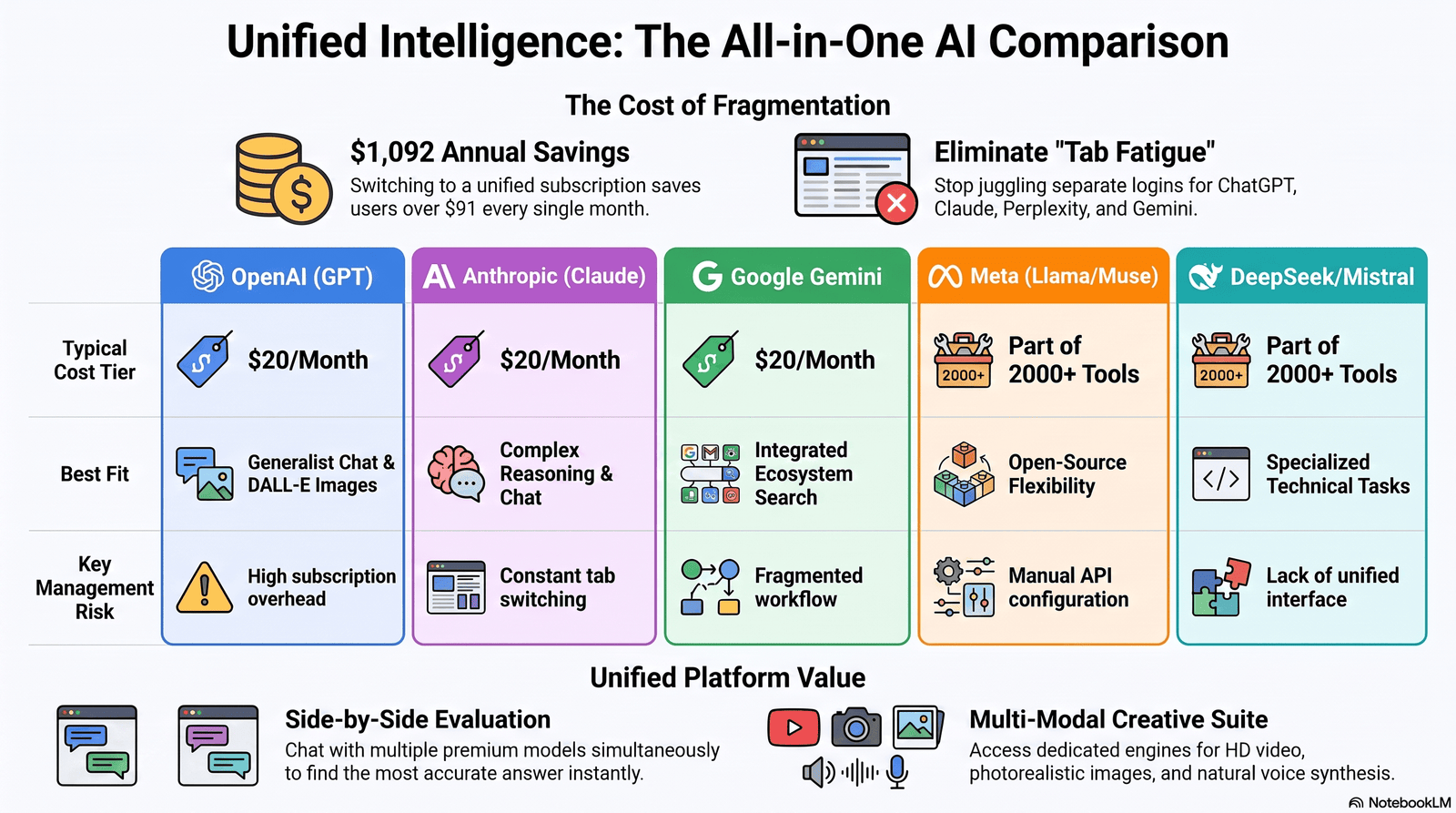
DeepSeek has become the reference point for aggressive pricing. DeepSeek V4 Flash is among the cheapest capable models on the market, and it also ships as open weights, making it a direct competitor to Llama 4 Scout for cost-sensitive, self-hostable deployments.
The honest comparison: DeepSeek currently wins on price-to-capability ratio for many benchmarked tasks, while Llama’s advantage is a larger, more mature third-party hosting ecosystem (more providers, more regional availability, more tooling integrations) built up over three Llama generations.
Meta AI Pricing Breakdown
Pricing is the fastest-moving variable in this whole comparison — treat every number below as a snapshot, not a guarantee, and verify current rates on each vendor’s official pricing page before budgeting.
Llama hosted pricing (third-party, per 1M tokens, input/output)
| Model | Cheapest Observed Host | Approx. Price Range Across Hosts | Context Window |
|---|---|---|---|
| Llama 4 Scout | Varies by host | ~$0.08–$0.35 input | Up to 1,048,576 tokens (marketed up to 10M) |
| Llama 4 Maverick | DeepInfra | ~$0.15–$0.35 input / $0.60 output | 1,048,576 tokens |
| Llama 3.3 70B | DeepInfra | ~$0.23–$0.90 input, similar output | 128K tokens |
| Llama 3.1 8B | DeepInfra | ~$0.02–$0.20 input | 128K tokens |
| Llama 3.1 405B | Varies | ~$0.80–$9.50 depending on host | 128K tokens |
Self-hosting cost reference (approximate, hardware-dependent)
| Hardware | Approx. Cost | Suitable For |
|---|---|---|
| RTX 4090 (24GB) | ~$1,600–$2,000/card | Small quantized models, low-volume Scout inference |
| A100 80GB | ~$15,000–$20,000/card | Llama 3.3 70B or Scout at INT4 |
| H100 80GB | ~$25,000–$35,000/card | Scout at INT4, higher throughput |
| DGX H100 (8x H100) | ~$300,000+ | Maverick-scale inference |
| Cloud H100 rental | ~$2–$4/hour/GPU | On-demand Maverick inference (4x H100 ≈ $8–$16/hour) |
Competitor pricing for context (per 1M tokens, input/output, standard tier)
| Model | Input | Output | Context Window |
|---|---|---|---|
| GPT-5.5 (OpenAI) | $5.00 | $30.00 | 1M+ (varies by tier) |
| Claude Opus 4.8 (Anthropic) | $5.00 | $25.00 | 1M |
| Claude Sonnet 5 (Anthropic, intro pricing through Aug 31, 2026) | $2.00 | $10.00 | 1M |
| Gemini 3.1 Pro (Google) | $2.00 | $12.00 | 1M |
| Gemini 3.5 Flash (Google) | $1.50 | $9.00 | 1M |
| DeepSeek V4 Flash | $0.14 | $0.28 | 1M |
| Mistral Small | ~$0.15 | ~$0.60 | Varies |
| Llama 4 Maverick (hosted) | ~$0.15–$0.35 | ~$0.60 | 1M |
The pattern is clear: hosted Llama 4 sits in roughly the same budget tier as DeepSeek and Mistral’s small models — well below frontier closed models like GPT-5.5 or Claude Opus — but above the very cheapest DeepSeek Flash tier. Muse Spark has no public price yet, so it can’t be placed on this table honestly.
Performance: Reasoning, Coding, Math, and Long Context
Benchmark claims in the Meta ecosystem need an extra layer of scrutiny in 2026, given the documented gap between Meta’s launch-day Llama 4 numbers and independent third-party evaluations. With that caveat stated plainly:
- Reasoning: Llama 4 Maverick’s independently measured intelligence scores have generally landed in the mid-tier percentile range relative to frontier closed models, rather than matching Meta’s original launch comparisons to GPT-4o.
- Coding: Top-tier coding benchmarks (like SWE-bench Verified) have been led by Claude and GPT-5-class models in 2026 evaluations, with open-weight models — including Llama 4 — typically trailing the frontier closed models on this specific task category.
- Math: Similar pattern — frontier closed reasoning models generally outperform Llama 4 on hard math benchmarks, though the gap narrows on simpler tasks.
- Long context: This is genuinely a Llama strength. Llama 4 Scout’s marketed 10-million-token context window is the largest claimed figure of any openly available model, useful for large codebase or document-corpus analysis, though real-world “effective” context (how well a model actually uses tokens deep in a long prompt) is typically shorter than the marketed maximum for every vendor, not just Meta.
Because benchmark methodology differs across evaluators (Artificial Analysis, Stanford HELM, LMSYS-style arenas, and vendor-published numbers all measure slightly different things), don’t treat any single benchmark as definitive — check the methodology before making a purchasing decision.
Benchmark comparison table (illustrative, verify current scores before deciding)
| Model | Category Strength | Known Weakness |
|---|---|---|
| Llama 4 Maverick | Cost-to-capability ratio, open fine-tuning | Coding/math trail frontier closed models |
| Llama 4 Scout | Long-context document processing | Raw reasoning depth vs. frontier models |
| Muse Spark | Efficiency claims (Meta-reported) | No independent third-party verification yet |
| Claude Opus 4.8 / Sonnet 5 | Coding (SWE-bench), reliability | Higher cost per token |
| GPT-5.5 | General reasoning breadth, tooling | Highest output cost among mainstream flagships |
| Gemini 3.1 Pro | Native multimodality, Google ecosystem | Mid-tier pricing for mid-tier reasoning gains |
| DeepSeek V4 Flash | Price-to-performance | Newer ecosystem, less enterprise track record |
Vision, Multimodality, and Speech
Llama 4 introduced native multimodal input (text and image) at launch, and Muse Spark extends this further with text, image, and speech input plus visual chain-of-thought reasoning. Meta AI’s consumer app also includes image generation, now powered by Muse-series models rather than legacy Llama.
Compared to competitors, Meta’s multimodal story is currently strongest in the free consumer assistant (Meta AI in WhatsApp/Instagram/Messenger) rather than in a developer-facing API, since Muse Spark isn’t broadly available yet. Anthropic, OpenAI, and Google all offer production-grade multimodal APIs today that Meta developers can access immediately, which Meta currently cannot match at the API layer.
Licensing, Commercial Use, and Legal Risk
This is where a lot of “Llama is free and open source” claims fall apart under scrutiny, and it’s a section every technical buyer should read carefully.
Llama models ship under the Llama Community License, a custom agreement — not an OSI-approved open-source license. Key conditions:
- 700 million MAU threshold: if your product (or your affiliates’ products) exceeds 700 million monthly active users, you must request a separate license from Meta, granted at Meta’s sole discretion.
- No training competing models: you can’t use Llama outputs to train or improve a competing foundation model.
- Attribution requirement: you must display “Built with Llama” and retain Meta’s notice files in redistributed copies.
- EU multimodal restriction: the (now-retired) Llama API’s terms specifically barred individuals or companies domiciled in the EU from accessing multimodal models through that service — a restriction relevant to anyone who was relying on it, and worth checking on any successor Meta product.
None of this affects most startups day-to-day, but it is a real dependency that belongs in legal and procurement review — especially for companies planning to scale past the MAU threshold or operate in the EU.
Muse Spark, being fully proprietary and gated to a private preview, currently has no public license terms to evaluate at all — another reason it isn’t yet a fair substitute for Llama in a build decision.
Licensing comparison table
| Model Family | License Type | OSI-Approved? | Key Commercial Condition |
|---|---|---|---|
| Llama 2/3/4 | Llama Community License | No | 700M MAU cap, no training competitors, attribution required |
| Muse Spark | Proprietary (API terms, not yet public) | N/A | Unknown — private preview only |
| GPT-5.5 (OpenAI) | Proprietary API terms | No | Standard commercial API terms of service |
| Claude (Anthropic) | Proprietary API terms | No | Standard commercial API terms of service |
| Gemini (Google) | Proprietary API terms | No | Standard commercial API terms of service |
| Mistral (select models) | Apache 2.0 (for some releases) | Yes (for those releases) | Varies by specific model |
| DeepSeek | Custom open license (varies by version) | Partial | Check specific model card |
Privacy, Security, and Guardrails
Meta ships dedicated safety tooling alongside Llama: Llama Guard 4 (content classification against the MLCommons hazard taxonomy), Llama Prompt Guard 2 (prompt-injection detection), and LlamaFirewall (a broader application-layer security framework), plus CyberSecEval 4 for evaluating AI systems in security-operations contexts. These are open-weight and can be self-hosted inside your own pipeline, which is a genuine advantage for regulated or security-conscious teams that want auditability.
For the discontinued Llama API, Meta had stated customer data would not be used to train its own models, and that fine-tuned models built through the API could be exported to another host — a reasonable data-portability stance while it lasted. Whether Muse Spark’s future commercial terms preserve that same portability promise is not yet publicly documented.
Third-party hosts (Groq, Together, Fireworks, DeepInfra, hyperscalers) each have their own data-handling policies, separate from Meta’s — read each host’s terms individually rather than assuming Meta’s stance carries over.
Limitations and Hallucination Risk
Every model in this comparison hallucinates under some conditions — that’s a category-wide limitation, not a Meta-specific flaw. What’s specific to the current Meta ecosystem:
- Benchmark-claim risk: given the documented gap between Meta’s launch benchmarks and independent Llama 4 evaluations, treat any Meta-published benchmark (including early Muse Spark numbers) with extra skepticism until independent labs replicate them.
- Fragmentation risk: because Llama is hosted by many third parties, model behavior, safety filtering, and even exact weights (quantization level) can vary by provider — a bug or hallucination pattern may be host-specific, not model-specific.
- Roadmap uncertainty: with Meta’s own research team turnover and public admission of lagging agent progress, some published roadmap commitments (like open-sourcing a future Muse Spark variant) carry real execution risk.
Developer Ecosystem and SDK Support
Llama’s ecosystem strength is breadth, not centralization: 25+ launch partners at LlamaCon (AWS, NVIDIA, Databricks, Google Cloud among them), Hugging Face integration, and community fine-tuning frameworks like LlamaFactory and Unsloth. Every major inference framework — Ollama, vLLM, NVIDIA NIM — supports Llama out of the box.
Muse Spark’s SDK story is currently limited by its private-preview status; Meta has said Muse Spark 1.1 was specifically trained to work well inside popular third-party agent harnesses, suggesting Meta intends to plug into the existing agentic-coding tool ecosystem rather than build a competing one from scratch, similar to how the retired Llama API supported the OpenAI SDK format.
API feature comparison table
| Feature | Llama (via third-party hosts) | Muse Spark | OpenAI | Anthropic | Gemini |
|---|---|---|---|---|---|
| First-party API | No (discontinued July 2026) | Private preview only | Yes | Yes | Yes |
| OpenAI SDK compatibility | Usually (host-dependent) | Unconfirmed | Native | Via compatible layer | Via compatible layer |
| Self-hosting option | Yes | No | No | No | No |
| Fine-tuning | Yes (open weights) | Unconfirmed | Yes (select models) | Limited | Yes (select models) |
| Public pricing | Varies by host | Not published | Published | Published | Published |
| Prompt caching | Host-dependent | Unconfirmed | Yes | Yes (up to 90% discount) | Yes |
| Batch API discount | Host-dependent | Unconfirmed | Yes (50%) | Yes (50%) | Varies |
Real-World Use Cases and Enterprise Adoption
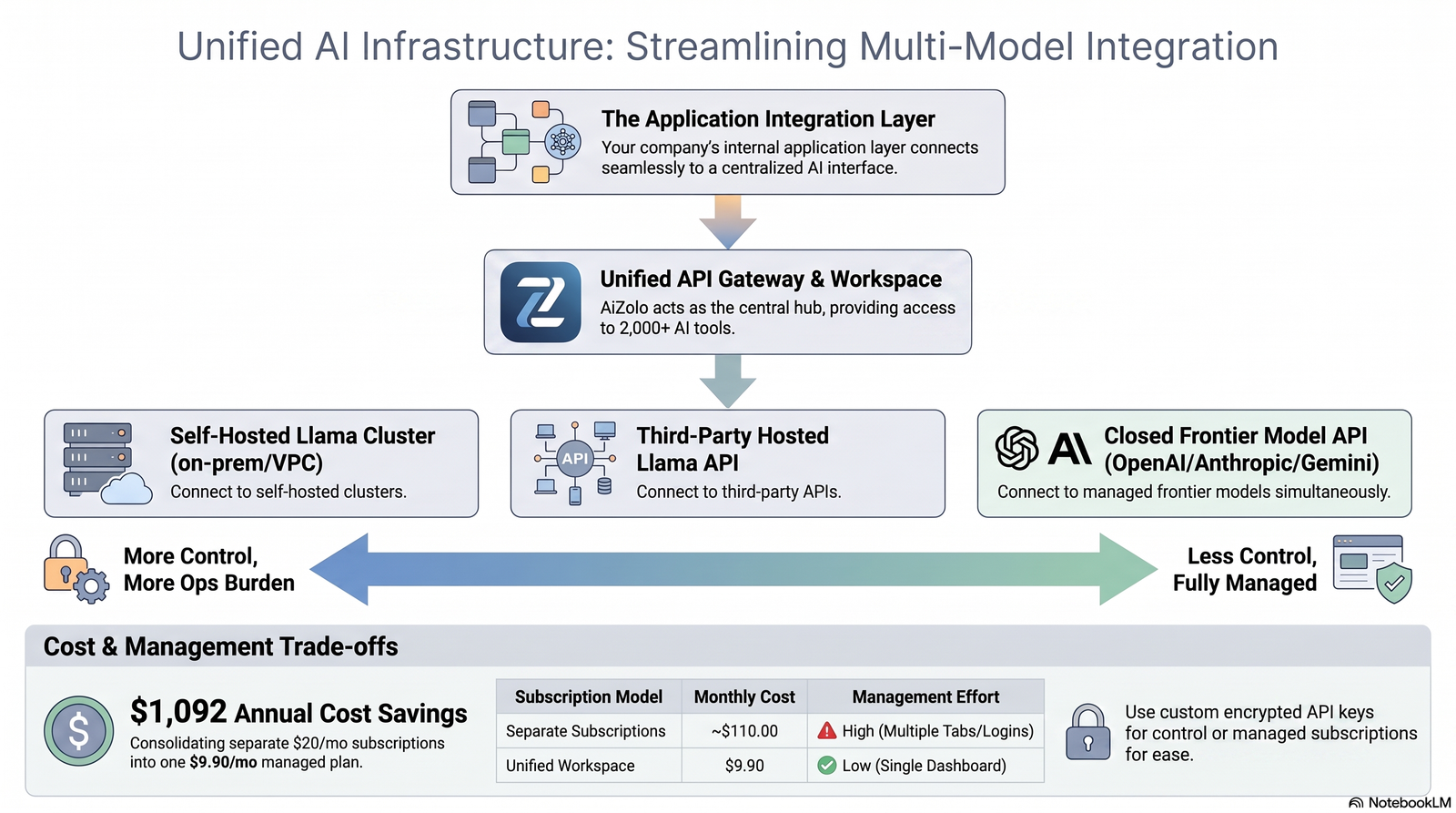
When self-hosted or third-party-hosted Llama makes sense: high-volume, moderate-complexity workloads (classification, summarization, RAG retrieval support, internal tooling) where cost-per-token at scale matters more than frontier reasoning; regulated environments that need full control over weights and data flow; companies already invested in GPU infrastructure.
When Muse Spark might make sense (once broadly available): teams that want Meta’s agentic-coding direction specifically, or that are already deep in the Meta ecosystem (WhatsApp Business API, Instagram commerce) and want tighter integration.
When OpenAI, Anthropic, or Gemini are the better call today: anything requiring guaranteed first-party SLAs right now, frontier coding or reasoning performance, mature enterprise support contracts, or multimodal capability you can access immediately rather than waiting on a preview program.
Enterprise readiness comparison table
| Factor | Llama (hosted) | Muse Spark | OpenAI | Anthropic | Gemini |
|---|---|---|---|---|---|
| GA availability | Yes (via hosts) | No (private preview) | Yes | Yes | Yes |
| Published SLA | Host-dependent | No | Yes | Yes | Yes |
| Enterprise support contracts | Via host/hyperscaler | Not yet public | Yes | Yes | Yes |
| Data residency control | High (self-host option) | Unknown | Standard cloud terms | Standard cloud terms | Standard cloud terms, GCP integration |
| Compliance certifications | Host-dependent | Unknown | Widely documented | Widely documented | Widely documented |
Decision Framework: Which API Should You Actually Use?
A simple way to think about it:
- Budget is the primary constraint, and you can self-host or tolerate host variability → hosted or self-hosted Llama 4 Scout/Maverick, or DeepSeek as a close price competitor.
- You need the cheapest possible managed API with no self-hosting → DeepSeek V4 Flash or Mistral Small currently lead on price-to-capability among managed options.
- You need top-tier coding or agentic reliability today, and can’t wait on a preview program → Claude (Opus 4.8 or Sonnet 5) or GPT-5.5.
- You’re deep in Google Cloud/Workspace already → Gemini 3.1 Pro or 3.5 Flash for tighter platform integration.
- You specifically want Meta’s future agentic direction and can tolerate being a design partner, not a GA customer → apply for Muse Spark’s private preview, but don’t build your production roadmap around it yet.
- You need full data control and can’t send data to any third-party API → self-hosted Llama is the only entry on this list that fully satisfies that requirement without a custom enterprise deal.
2026 Roadmap and What Comes Next
Meta’s public signals point toward three things worth watching for the rest of 2026: a wider Muse Spark rollout beyond the current private preview, continued investment in agentic-coding tuning (the Muse Spark 1.1 update was an early signal), and — separately — reports that Meta is exploring a cloud-infrastructure business that would sell spare AI compute and model access to outside customers, a shift from “model company” to “AI infrastructure operator.”
None of this is finalized, and given Meta’s recent track record of missed timelines on Behemoth, treat specific dates as provisional until Meta confirms them in an official release note.
For builders, the practical takeaway is to design your integration layer so switching providers is cheap — favoring OpenAI-compatible endpoints and abstraction libraries — because 2026 has already shown that even a company as large as Meta can retire a developer API after fourteen months.
FAQs
1. Does Meta still have a public Llama API? No. Meta wound down the Llama API public preview on July 6, 2026. Llama model weights are still downloadable, and third-party providers still host them.
2. What is Muse Spark? Muse Spark is Meta’s new proprietary, multimodal reasoning model from Meta Superintelligence Labs, announced April 8, 2026. It’s currently in private preview for select partners.
3. Is Llama actually open source? No, not by the OSI definition. It’s released under the custom Llama Community License, which includes commercial-use conditions like the 700 million MAU threshold.
4. Is Llama free to use commercially? Yes, for most companies, at zero licensing cost — but you still pay for inference (self-hosted compute or a third-party host’s per-token price), and the license has conditions worth reviewing.
5. How much does Llama 4 Maverick cost via API? It varies by host; observed hosted rates have generally sat in the roughly $0.15–$0.35 per million input tokens and around $0.60 per million output tokens range, but always check the specific provider’s current pricing page.
6. Is Llama 4 better than GPT-4o or GPT-5.5? Meta’s own launch benchmarks claimed Llama 4 Maverick beat GPT-4o on several tasks, but independent evaluations found a smaller gap, and later reporting suggested some launch numbers came from specialized unreleased variants. Verify current independent benchmarks before relying on either vendor’s claims.
7. Can I use Llama models with the OpenAI SDK? Often yes — most third-party Llama hosts support an OpenAI-compatible request format, so migration typically means changing the base URL and API key.
8. What happened to Llama 4 Behemoth? It was previewed as Meta’s flagship “teacher” model but was shelved after underperforming internal benchmarks; it has not been publicly released as of mid-2026.
9. Is Muse Spark open source? No, it’s currently proprietary. Meta has said it hopes to open-source a future variant but hasn’t set a public date.
10. Which is cheaper: self-hosting Llama or using a managed API? It depends on volume. Teams processing more than roughly 50–100 million tokens per month consistently may reach break-even on self-hosting within 6–12 months; below that, managed hosted APIs are typically simpler and cheaper overall.
11. Does Meta’s Llama license restrict who can use it? Yes — companies (or their affiliates) exceeding 700 million monthly active users must request a separate license from Meta, and Llama outputs can’t be used to train competing foundation models.
12. What’s the largest Llama context window? Llama 4 Scout is marketed with support for up to 10 million tokens of context, though the standard hosted context window figure listed by most providers is 1,048,576 tokens.
13. Is DeepSeek cheaper than Llama? Often, yes — DeepSeek V4 Flash is among the cheapest capable models on the market and directly undercuts most hosted Llama pricing, though Llama’s third-party hosting ecosystem is more mature.
14. Does Meta offer fine-tuning? Yes, for open-weight Llama models via self-hosting or through providers offering managed fine-tuning. Muse Spark’s fine-tuning support isn’t yet publicly documented.
15. Is Meta AI (the consumer assistant) the same as the Llama API? No. The Meta AI consumer app in WhatsApp, Instagram, Messenger, and meta.ai now runs on Muse Spark, not the developer-facing Llama models, and is free with usage limits.
16. Which vendor has the best coding benchmark scores in 2026? Independent 2026 evaluations have generally shown Claude and GPT-5-class models leading dedicated coding benchmarks like SWE-bench Verified, with Llama trailing on this specific category — though methodologies and rankings shift, so check current leaderboard data before deciding.
Conclusion
The honest answer to “which Meta AI API should I use in 2026” is: it depends on which Meta you mean. If you want open weights, cost control, and self-hosting flexibility, hosted or self-hosted Llama 4 still works — just route through a third-party provider, since Meta’s own API is gone.
If you’re hoping for a first-party Meta alternative to GPT-5.5 or Claude Opus 4.8, Muse Spark is the one to watch, but it isn’t broadly available yet, so it can’t be your production plan today.
For most teams making a real decision this quarter, the pragmatic path is: use Llama where cost and control matter most, use a frontier closed model (OpenAI, Anthropic, or Gemini) where reliability and top-tier reasoning matter most, and keep your integration layer flexible enough to add Muse Spark later without a rewrite.
Author Bio
Jeevesh Tripathi Email: jeevesh@aizolo.com
Jeevesh Tripathi writes about AI tools, large language models, and enterprise AI adoption, with a focus on helping technical teams evaluate foundation-model APIs, pricing structures, and productivity platforms. His work centers on translating fast-moving model releases and licensing changes into practical, decision-ready guidance for developers and enterprise buyers.