Quick Summery: This AI subscription price comparison table breaks down the latest 2026 pricing across ChatGPT, Claude, Gemini, Grok, and Perplexity, covering free, standard, premium, and team plans. It also explains hidden costs, usage limits, budget tiers, and when an all-in-one platform like AiZolo can reduce the cost of managing multiple AI subscriptions.
Summary: What This Guide Covers
This AI subscription price comparison table maps every consumer and team plan across ChatGPT, Claude, Gemini, Grok and Perplexity as of August 2026 — not just the familiar $20 tier.
The short version:
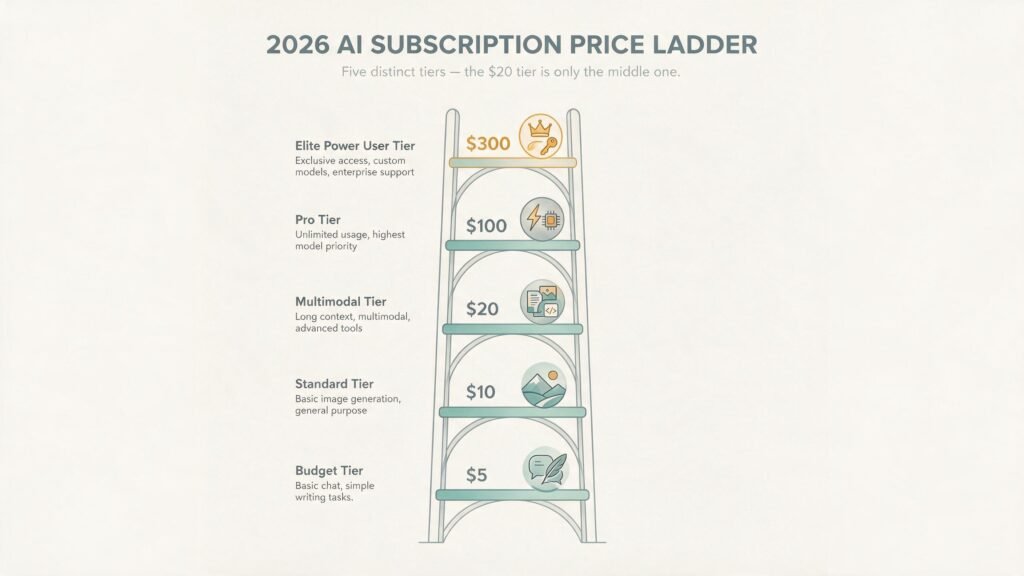
- The $20/month standard tier is now the middle of the ladder, not the top or the bottom.
- A budget layer opened up in 2026: Google AI Plus at $4.99, ChatGPT Go at $8, SuperGrok Lite at $10.
- Power-user plans now cluster at $100, with ceilings running from $200 to $300.
- Team seats are priced separately and rarely match consumer rates — $14 to $40 per seat is the normal band.
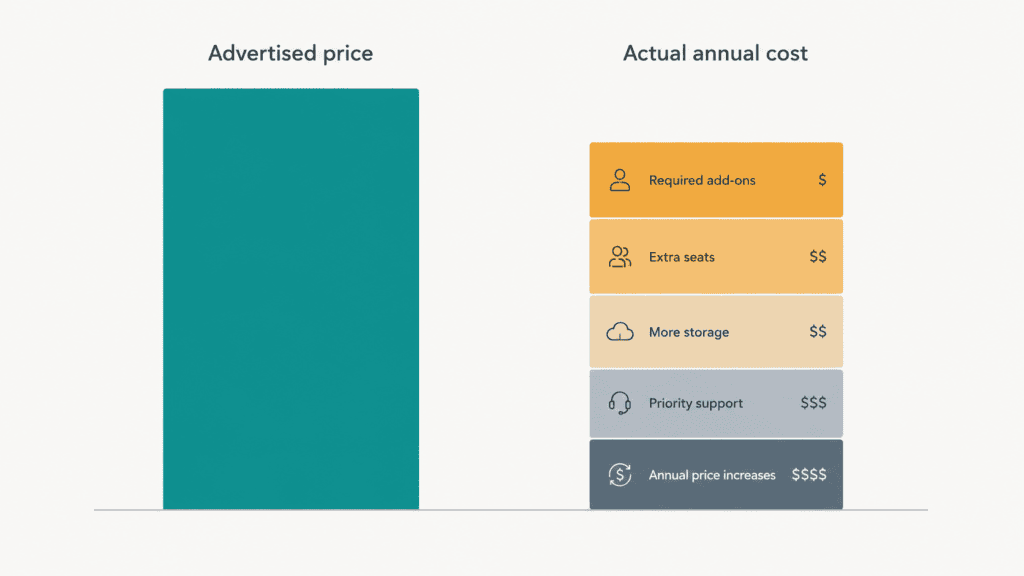
- The sticker price is not the real cost. Taxes, annual lock-ins, overage credits and rate limits change the arithmetic significantly.
- Subscribing to all five standard plans lands near $110/month. Most people never needed all five.
Who this is for: anyone auditing what they already pay, or pricing out an AI stack before committing. If you want platform reviews and buying recommendations instead of raw pricing data, start with the best multi AI subscription guide.
Table of Contents
1. How to Read This AI Subscription Price Comparison Table
Every figure below was checked against provider pricing pages and independent pricing trackers in August 2026. All amounts are USD, before local taxes.
Three things worth knowing before you read the numbers.
Prices move quarterly now, not annually. Three of the five major providers changed a published price during the first half of 2026 alone. Treat any pricing table — including this one — as a snapshot with a date on it.
Regional totals differ from list prices. GST in India, VAT in the EU and state sales tax in the US are applied on top. An Indian user paying for a $20 plan is closer to $23.60 after 18% GST.
Tiers are not equivalent across providers. A “Pro” plan means something different at every company. Comparing labels instead of limits is the single most common error in AI pricing comparison work.
Methodology note: Where sources disagreed on a figure, we flagged it rather than picking one. AI pricing changes fast enough that a confidently wrong number is worse than an acknowledged gap.
2. The Complete 2026 Pricing Table: Every Tier
Most pricing guides show one row per provider. That flattens a market that has genuinely stratified. Here is the full ladder, split by tier band.
Budget and entry tiers
| Plan | Price/month | What you get | Notable catch |
|---|---|---|---|
| ChatGPT Free | $0 | Limited access to the current GPT model | Carries ads in the US since February 2026 |
| ChatGPT Go | $8 | Higher limits than Free, below Plus | Also ad-supported |
| Google AI Plus | $4.99 | Entry Gemini access, modest storage | Cut from $7.99 in June 2026 |
| SuperGrok Lite | $10 | Reduced-limit Grok access | Narrow feature set |
| Claude Free | $0 | Daily message caps | No entry paid tier below Pro |
| Perplexity Free | $0 | Limited Pro searches daily | Resets daily, not monthly |
| DeepSeek | $0 | Free web chat | No subscription; API is per-token |
This band did not exist in a meaningful way twelve months ago. It is the most important structural change in AI pricing this year.
The standard tier
| Plan | Price/month | Annual option | Headline strength |
|---|---|---|---|
| ChatGPT Plus | $20.00 | — | Broadest feature ecosystem, ad-free |
| Claude Pro | $20.00 | ~$17/mo billed yearly | Coding and long-document work |
| Google AI Pro | $19.99 | — | Largest context window, Workspace integration, bundled storage |
| Perplexity Pro | $20.00 | — | Cited, sourced research |
| SuperGrok | $30.00 | — | Real-time X/social data |
Four of five providers converged on effectively the same number. That convergence is a pricing decision, not a quality signal — a point worth holding onto when you compare AI subscriptions on value rather than on price alone.
Power-user and ceiling tiers
| Plan | Price/month | Positioning |
|---|---|---|
| ChatGPT Pro (mid) | $100 | Added April 2026 |
| ChatGPT Pro (top) | $200 | Highest consumer tier |
| Claude Max 5× | $100 | Five times Pro usage |
| Claude Max 20× | $200 | Twenty times Pro usage |
| Google AI Ultra | $99.99 | Repriced downward at Google I/O 2026 |
| Google AI Ultra (high-limit) | $199.99 | Higher ceiling variant |
| SuperGrok Heavy | $300 | Highest single-provider consumer price |
| Perplexity Max | $200 | Research at volume |
Reported Google AI Ultra pricing varies across sources — some still list the older $249.99 figure. Check the live page before budgeting for it.
Team and business seats
| Plan | Price per seat/month |
|---|---|
| Google Workspace with Gemini | ~$14 |
| ChatGPT Business | ~$20 |
| Claude Team | ~$25 |
| Grok Business | ~$30 |
| Perplexity Enterprise Pro | ~$40 |
Seat pricing is where budgets actually break. A ten-person team on two standard tools each is a five-figure annual line item before anyone opens a document.
3. What Is an All-in-One AI Subscription Service?
Short answer: an all-in-one AI subscription service is a single paid plan that routes you to several underlying models — typically from OpenAI, Anthropic and Google — through one interface and one bill, instead of requiring a separate account and payment for each provider.
The category exists because usage patterns stopped matching billing structures. People use three or four models but were being asked to pay four separate subscriptions to do it.
4. Why “Per Month” Is the Wrong Unit
Two plans at $20 can differ by an order of magnitude in what they actually let you do. Price per month tells you almost nothing without the limit attached.
Published rate limits vary widely at the same price point — some plans measure in messages per three hours, others per five hours, others in monthly deep-research credits. A researcher who burns through capped credits in week two is not on a $20 plan in any practical sense.
A better unit: cost per completed task. Take the work you actually did last month, divide the subscription cost by it, and the ranking often reverses.
Rate limits are the number to check first, not last. If you routinely hit them, the guide on how to get unlimited messages on Claude AI covers the practical workarounds.
5. The Hidden Line Items No Pricing Page Shows
An honest AI subscription price comparison table has to account for the costs that appear after checkout, not on the pricing page.
Local tax. Not included in any advertised US-dollar figure. Budget 5–20% on top depending on jurisdiction.
Currency conversion and card fees. International cards commonly add 1.5–3.5% per charge, applied every month, silently.
Advertising on free and entry tiers. Ads arrived on ChatGPT’s Free and Go tiers in the US in February 2026. Paid tiers stay ad-free. That is a real quality difference at the bottom of the ladder.
Bundled goods you may already pay for. Google AI Pro includes cloud storage. If you already pay for Google One separately, you are double-buying — or you can cancel the old one and the effective price drops.
Annual lock-in. Annual billing typically saves 10–20%. It also removes your ability to leave when a better plan launches, which in this market happens often.
Overage and credit systems. Some plans meter specific features — image generation, deep research, video — separately from chat. Read what is metered before assuming a flat rate.
The switching tax. Not a line item at all, but real. Every context re-explanation and tab switch is unbilled time. Consolidating tools is partly a time argument, which is covered in detail in how to use multiple AI at once.
6. Compare AI Subscriptions by Budget Band
Rather than asking “which plan is best,” a more useful question is “what does each budget band actually buy in 2026?”
$0/month
Free tiers are more capable than they were a year ago, but come with daily caps and — on some platforms — ads. Workable for occasional use, unreliable under deadline. The rundown of the best free AI chatbots covers where the caps actually bite.
Under $10/month
The new budget band. Google AI Plus at $4.99 and ChatGPT Go at $8 remove the hard free-tier ceiling without the full $20 commitment. Good for students and light users; limited for professional volume.
Around $20/month
One flagship model, properly. This is the right band if you genuinely use one provider for nearly everything.
$40–$60/month
Two or three standard subscriptions stacked. This is the band most people drift into without deciding to, and where consolidation math starts to matter.
$100+/month
Either one power-user tier or four or five standard plans. Justified when a single model is load-bearing for billable work — heavy daily coding, for instance, as detailed in the best AI models for coding comparison.
7. Four Cost Profiles, Priced Out
Generic pricing tables assume everyone has the same needs. These four profiles show how the same table produces four different answers.
| Profile | Typical stack | Monthly | Annual | Main pressure point |
|---|---|---|---|---|
| Student | One entry tier or free | $0–$8 | $0–$96 | Caps hit during exam weeks |
| Freelancer | Two standard plans | ~$40 | ~$480 | Cost is a direct margin hit |
| In-house marketer | Three standard plans | ~$60 | ~$720 | Duplicate capability across tools |
| Small team (5 people) | Two seats each | ~$400 | ~$4,800 | Per-seat multiplication |
The pattern is consistent: the problem is rarely any single subscription. It is the multiplication — across tools, or across people, or both.
Teams in particular should model per-seat cost before headcount grows, since the arithmetic compounds quietly. The affordable all-in-one AI subscription for startups guide works through team-scale planning specifically.
8. Where a Bundled Plan Changes the Arithmetic
Bundled multi-model platforms sit outside the standard tier structure, so they need their own row in any honest comparison.
AiZolo is one such platform. Its Pro plan is listed at $9.90/month and covers access to several major models through one interface, alongside image, video and audio generation, a prompt manager and persistent memory. Current terms are on the AiZolo pricing page.
Where the math favours a bundle: you currently pay for two or more standard plans, and you use each for a fraction of your work. Replacing $40–$60 with a single sub-$10 plan is a meaningful annual difference.
Where it does not: you need the maximum usage ceiling on one specific flagship model, or you need guaranteed same-day access to new releases. Direct subscriptions win on both.
Read savings claims carefully. A bundle compared against all five standard plans shows a ~$100/month gap. That is arithmetically correct and practically misleading, because very few people were paying for all five. Compare against what you would genuinely cancel — usually one or two plans.
Anyone evaluating aggregators specifically will find the AiZolo vs OpenRouter and AiZolo vs Poe breakdowns useful, since flat-rate and per-token models price out very differently.
9. What Actually Changed in 2026
Anyone reading an AI subscription price comparison table published even six months ago is working from stale figures. Here is what moved.
January 2026 — ChatGPT Go went global. An $8 tier opened the gap between free and $20.
February 2026 — Ads arrived. ChatGPT’s Free and Go tiers began carrying advertising in the US. Paid tiers were unaffected.
April 2026 — OpenAI added a $100 Pro tier. A middle rung, positioned against Claude Max 5×. The ladder gained a step.
June 2026 — Google cut its entry tier. Google AI Plus dropped from $7.99 to $4.99, pushing the market’s floor lower.
Google I/O 2026 — Ultra repriced. Google AI Ultra came down substantially from its earlier level, with a higher-limit variant above it.
The pattern: competition is now happening at the edges — below $10 and above $100 — while the $20 middle stays frozen. Expect the next changes at those edges too.
10. Build Your Own Comparison Table in Six Steps
A published AI subscription price comparison table is a starting point. Your actual numbers matter more than anyone’s averages.
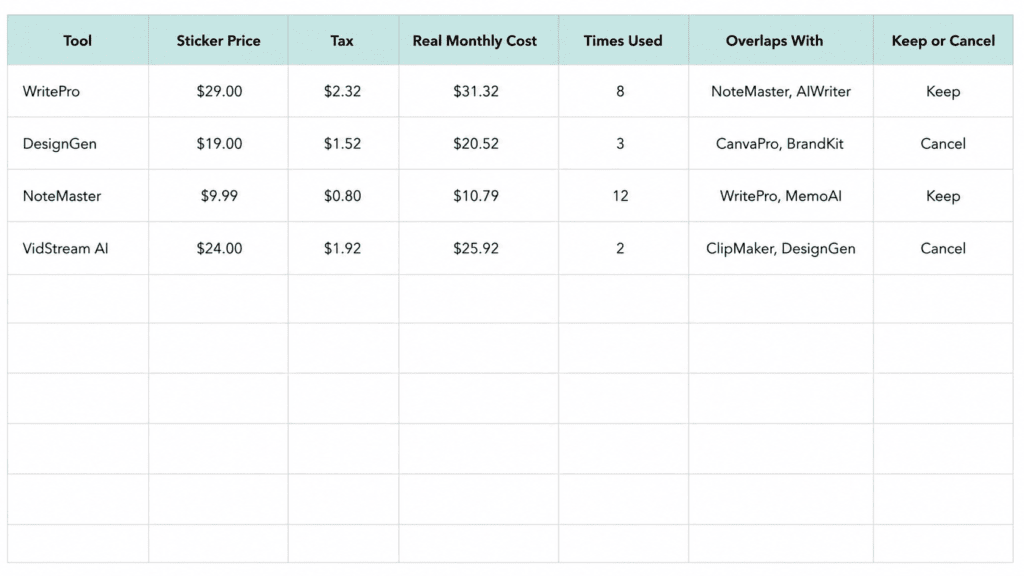
Step 1 — List every charge. Include tools billed to personal cards and expensed later. This is where most audits find surprises.
Step 2 — Add the real total. Sticker price plus tax plus any conversion fee, per tool, per month.
Step 3 — Log actual usage for two weeks. Note which tool you opened, for what, and whether another could have done it.
Step 4 — Mark the overlaps. Any capability you are paying for twice is a candidate for cancellation.
Step 5 — Check your rate-limit reality. Did you hit caps? On which tool? That determines whether you need a higher tier or a different one.
Step 6 — Decide, then re-check in ninety days. Given how often pricing shifted this year, a quarterly review is proportionate.
Expert tip: Do not cancel anything on the day you switch. Run the new setup alongside the old for one full billing cycle, on real work rather than test prompts.
11. Five Mistakes People Make Reading Pricing Tables
Comparing tier names instead of tier limits. “Pro” is a marketing label. Two Pro plans at the same price can differ enormously in usage allowance.
Assuming price signals quality. The $20 convergence reflects market positioning. Within that band, models differ on capability, not on price — see what each AI model is best at for the capability breakdown.
Budgeting the list price. Tax and card fees are not optional. Build them in from the start.
Committing annually before piloting monthly. The discount is real. So is the risk of being locked into a plan that gets superseded eight weeks later.
Trusting an undated table. If a pricing page does not say when it was last verified, treat every figure as a hypothesis. That includes this one — these figures are current as of August 2026.
12. Frequently Asked Questions
What does an AI subscription cost in 2026? The standard tier sits at $19.99–$20/month across ChatGPT, Claude, Google AI Pro and Perplexity. Entry tiers start around $4.99 and power-user plans run $100–$300.
How much to subscribe to every major AI tool? ChatGPT Plus, Claude Pro, Google AI Pro, Perplexity Pro and SuperGrok together come to roughly $110/month, or about $1,320 a year.
What is the cheapest paid AI subscription? Google AI Plus at $4.99/month is currently the lowest entry tier among major providers, followed by ChatGPT Go at $8.
Is an all-in-one AI subscription cheaper than separate plans? It generally is if you would otherwise pay for two or more. If you use one provider exclusively, a direct subscription usually gives better limits for the money.
Why do most AI plans cost the same $20? Convergent pricing, not convergent capability. It signals premium positioning while staying below the threshold where people cancel out of habit.
Do team plans cost the same as consumer plans? No. Per-seat pricing typically runs $14–$40 depending on provider and tier, and adds admin, privacy and collaboration features not present in consumer plans.
Does an AI subscription price comparison table go out of date quickly? Yes. Multiple published prices changed during the first half of 2026 alone. Always check the live pricing page before purchasing.
Are AI subscription prices the same in every country? List prices are broadly uniform in USD, but local tax and conversion fees change the final amount. Regional variation is covered in in which country is Claude the cheapest.
Is annual billing worth it? Only once you are confident in the tool. The 10–20% discount is real, but so is being locked in through a year of fast-moving releases.
Which AI subscription is best for research? Perplexity is built specifically for cited, sourced answers. For a capability-by-capability view, see ChatGPT vs Grok vs Gemini vs Claude vs Perplexity.
Do free AI tiers still work for professional use? For occasional tasks, yes. Daily caps and — on some platforms — ads make them unreliable for deadline work.
What should I check before switching plans? Confirm the models you need are included, verify the usage limits against your real volume, and keep the old plan running for one overlapping billing cycle.
13. Verdict
The most useful thing an AI subscription price comparison table can tell you in 2026 is that the market stratified while most buyers were not looking.
There is now a genuine budget band under $10, a frozen $20 middle, and a fast-moving premium layer above $100. Anyone still choosing between “free” and “twenty dollars” is working from a 2024 map.
The practical takeaway: audit before you optimise. Most people who feel overcharged are not on the wrong plan — they are on three plans doing overlapping work.
Once you know your real number, the decision is usually straightforward: consolidate if you are paying for overlap, go direct if one model is genuinely load-bearing, and re-check the numbers quarterly, because this market has not held still for a full year yet.
About the Author
Jeevesh Tripathi — AI Researcher & SEO Content Strategist at AiZolo
Jeevesh Tripathi tracks AI platform pricing, model capability releases and subscription market structure. His work centres on giving professionals verifiable numbers rather than vendor claims, with pricing figures cross-checked against provider pages and independent trackers before publication.
He writes in line with Google’s E-E-A-T guidance: every price in this guide carries a verification date, disputed figures are flagged rather than smoothed over, and readers are directed to primary sources before purchase.
Contact: jeevesh@aizolo.com
Last verified: Septemper 2026. Pricing in this market changes frequently — check provider pages before committing to any plan.