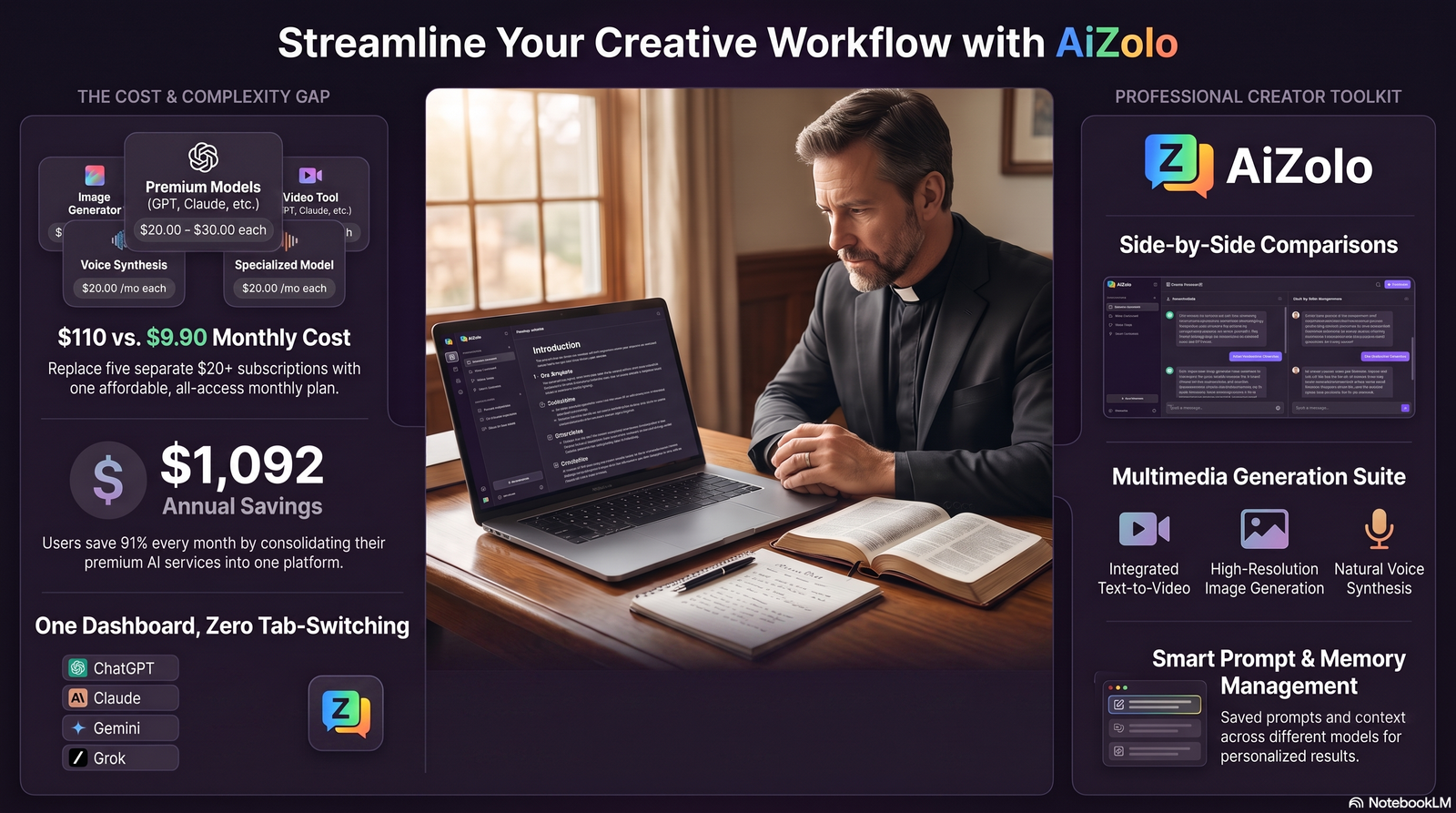
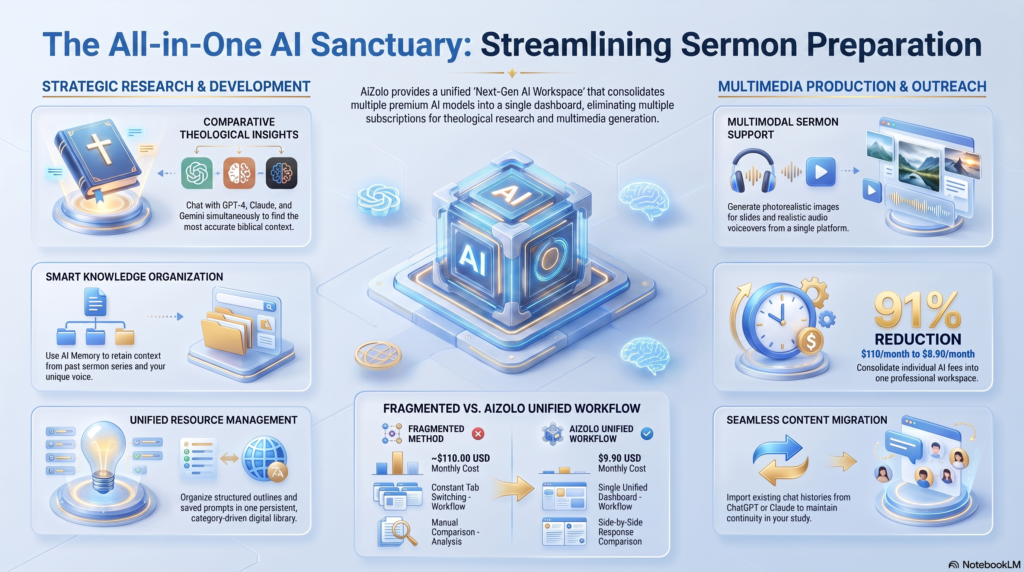
Sermon preparation is one of the most time-consuming parts of pastoral ministry. With Aizolo, pastors can streamline exegesis, outlining, illustration research, and rewriting, reducing the time it takes to prepare a meaningful sermon.
An AI sermon generator can compress that workload dramatically — drafting outlines, suggesting Scripture connections, and organizing scattered notes into a usable structure in minutes.
But AI does not preach. It does not shepherd a congregation, discern the Spirit’s leading, or sit with a grieving family. Pastors remain fully responsible for the theological accuracy and spiritual weight of every message they deliver.
In this guide, you’ll learn what an AI sermon generator actually is, how it works, its real benefits and real limitations, the best tools available in 2026, a step-by-step workflow, ready-to-use prompts, and the ethical guardrails every church leader should know before adopting one.
Table of Contents
What Is an AI Sermon Generator?
An AI sermon generator is a software tool — usually built on a large language model (LLM) — that helps pastors draft sermon outlines, Scripture-based content, illustrations, and discussion questions from a topic, passage, or theme.
Most tools work through prompt-based generation: you type a request (“Create an outline on Romans 8:28 for a grief-focused sermon”), and the AI produces a structured draft using natural language processing (NLP) to interpret intent and generate coherent text.
Some are general-purpose AI assistants (like ChatGPT, Claude, or Gemini) used creatively for ministry work. Others are purpose-built ministry automation platforms designed specifically around sermon planning, Bible study, and church administration.
It’s important to understand what these tools are not:
- They are not ordained. They hold no theological authority.
- They do not “know” Scripture the way a trained exegete does — they predict likely text based on patterns in training data.
- They cannot verify their own citations with certainty, which is why every reference requires human checking.
Think of an AI sermon generator the way you’d think of a research assistant with a large library and no judgment: extremely fast, occasionally wrong, and never a substitute for the pastor’s own study and prayer.
How Does an AI Sermon Generator Work?
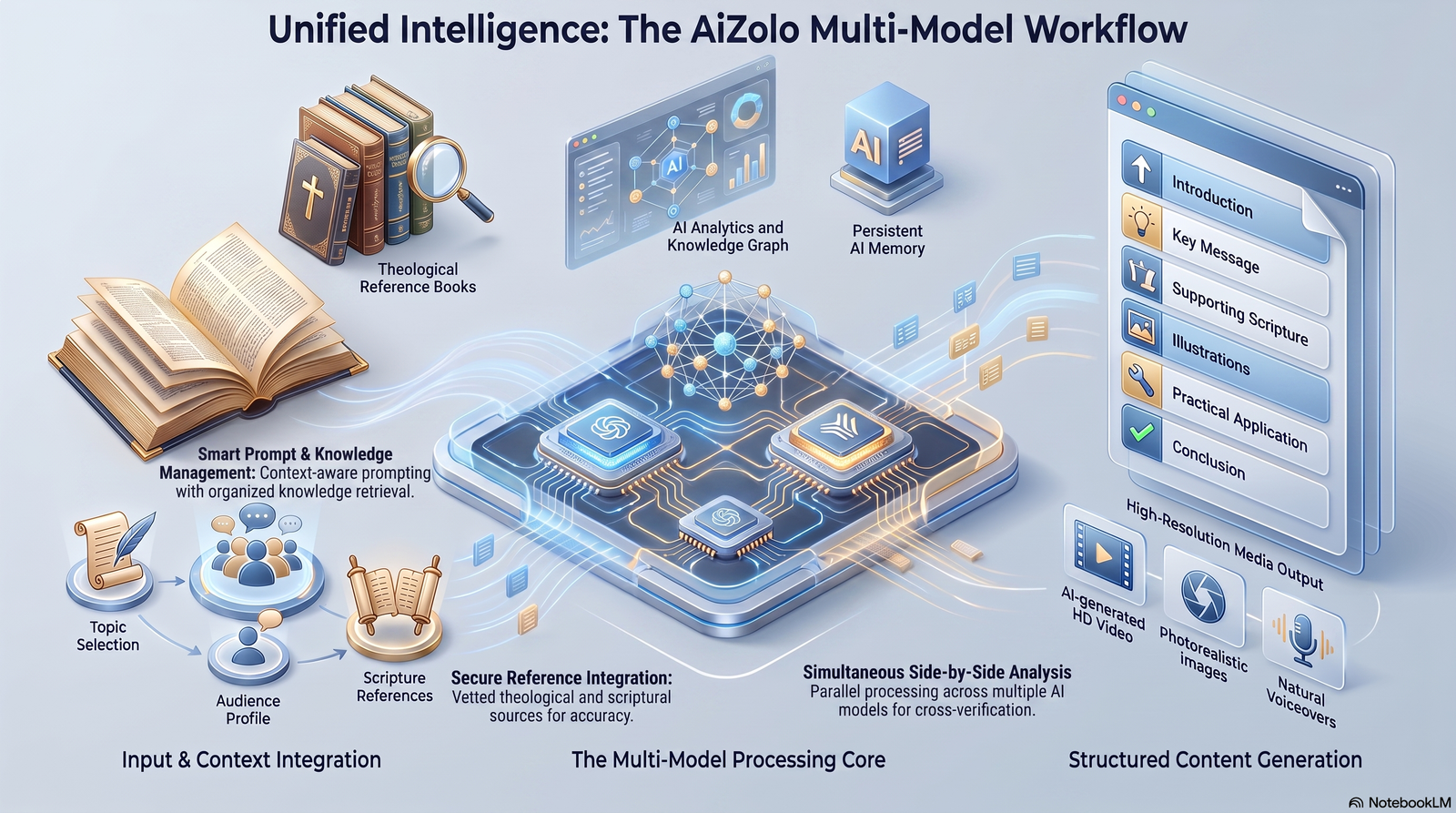
Most tools follow a similar underlying process, even when the interface looks different.
- Input collection — You provide a topic, Bible passage, audience, or sermon series theme.
- Language model processing — The AI’s NLP engine parses your prompt, identifying key entities (book, chapter, theological theme, tone).
- Content generation — The model drafts an outline, points, transitions, and often a suggested introduction or closing.
- Reference suggestion — Some tools attach Scripture cross-references or commentary excerpts, which must always be verified against the actual text.
- Editing and refinement — You revise tone, depth, length, or theological angle through follow-up prompts.
- Human review — The pastor checks doctrine, sourcing, and pastoral fit before the sermon is ever preached.
That last step is not optional. It’s the difference between using AI as a drafting tool and outsourcing spiritual authority to a machine.
Key Features of AI Sermon Generators
Modern tools typically offer a combination of the following:
- Sermon outlines — structured points, sub-points, and transitions
- Topic and theme suggestions — for series planning or seasonal preaching
- Scripture reference suggestions — cross-references to verify manually
- Illustrations and stories — analogies to make abstract ideas concrete
- Discussion questions — for small groups or sermon-based Bible studies
- Prayer generation — opening or closing prayers matched to the message
- Tone adjustment — formal, conversational, youth-oriented, expository
- Denominational customization — some tools let you set a theological lens (Reformed, Wesleyan, Baptist, Catholic, non-denominational)
- Editing assistance — tightening language, adjusting length, improving flow
No AI sermon generator does all of these equally well. General AI assistants tend to be stronger at flexible writing and reasoning, while ministry-specific platforms often excel with built-in Bible databases, sermon preparation features, and church workflow integration.
Benefits of Using an AI Sermon Generator
| Benefit | What It Looks Like in Practice |
|---|---|
| Time savings | Draft an outline in minutes instead of hours |
| Brainstorming | Generate multiple angles on a passage quickly |
| Research support | Surface cross-references and historical context to verify |
| Overcoming writer’s block | Get a starting structure when the page is blank |
| Content organization | Turn scattered notes into a coherent flow |
| Team collaboration | Share drafts with staff or volunteers for feedback |
For bi-vocational pastors, church planters, or leaders juggling multiple weekly messages (Sunday sermon, midweek study, youth talk), this time savings is often the single biggest reason to adopt AI assistance.
Limitations of AI Sermon Generators
AI tools have real weaknesses that every church leader should understand before relying on one.
- Hallucinations — AI can generate confident-sounding but fabricated facts, quotes, or historical claims.
- Wrong Bible references — verse numbers, translations, or attributions can be inaccurate and must be checked against a physical or trusted digital Bible.
- Theological inaccuracies — models are trained on a mix of traditions and can blend doctrine inconsistently.
- Lack of pastoral wisdom — AI doesn’t know your congregation’s grief, conflict, or context.
- Context issues — a passage’s original language, audience, and genre can be flattened into generic application.
- Citation verification gaps — commentary or scholar quotes attributed by AI should never be used without confirming the original source.
None of this makes AI unusable. It means AI output is a first draft, not a finished sermon.
Can AI Replace Pastors?
No. An AI sermon generator can assist with drafting, but it cannot replace the pastoral office.
Preaching is only one part of pastoral ministry. The role also includes:
- Pastoral care — visiting the sick, counseling the grieving, walking with people through crisis
- Spiritual discernment — sensing what a specific congregation needs to hear, in a specific season
- Community leadership — building trust, resolving conflict, shepherding relationships
- Theological responsibility — standing accountable before God and the congregation for what is taught
An AI model has no relationship with your congregation, no accountability structure, and no capacity for discernment. It can suggest words. It cannot carry the weight of shepherding people.
Used well, AI sermon generators free up time so pastors can spend more energy on the parts of ministry that genuinely require a human — and a called one at that.
Best Use Cases for AI Sermon Generators
- Sunday morning sermon drafting
- Youth ministry talks and lessons
- Small group and Bible study guides
- Daily devotions and reading plans
- Church newsletters and announcements
- Teaching notes for Sunday school
- Mission trip and outreach messaging
- Sermon series brainstorming
- Guest speaker preparation notes
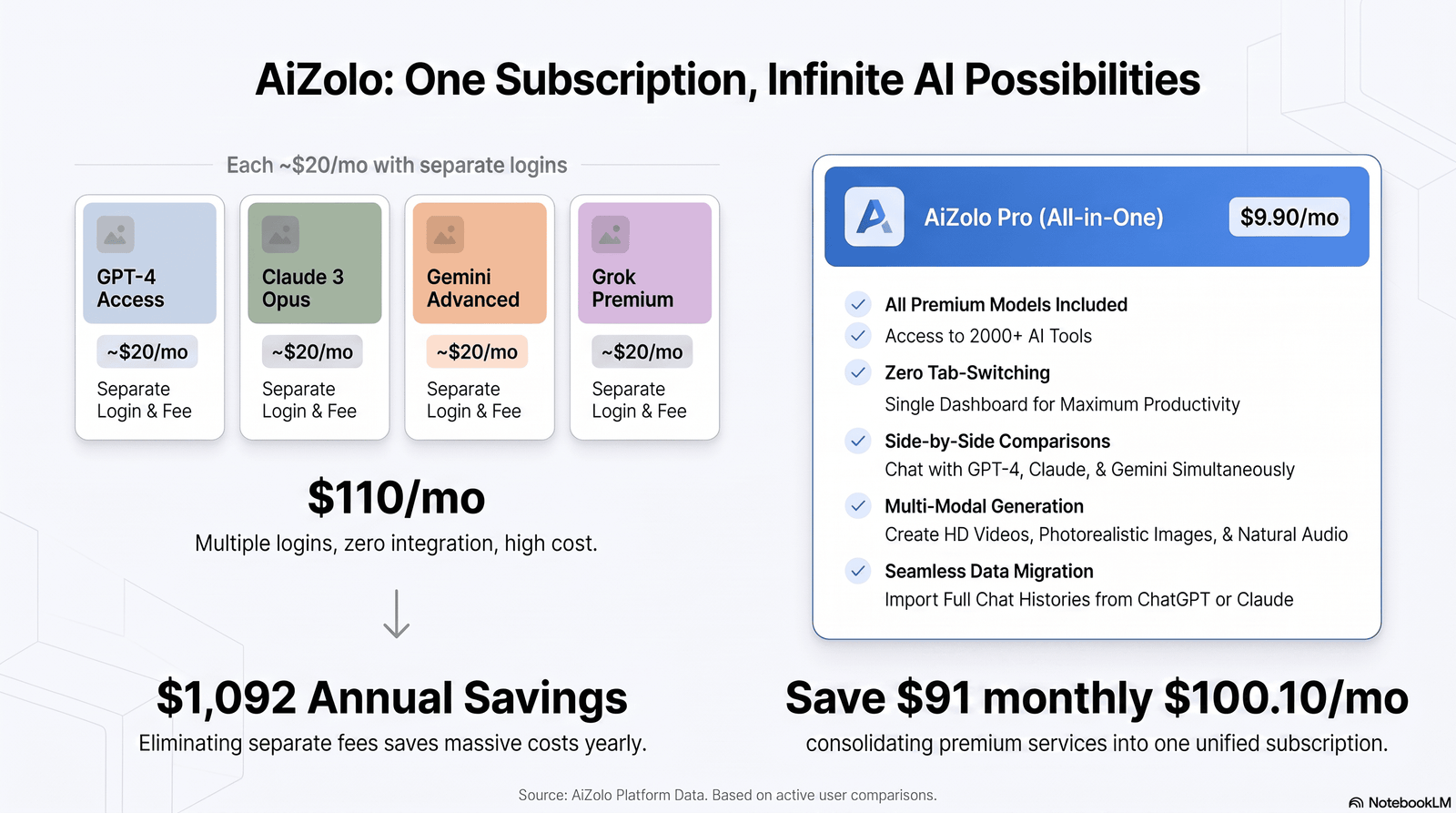
Best AI Sermon Generator Tools (2026 Comparison)
| Tool | Best For | Free Plan | Bible Support | Customization | Strengths | Limitations |
|---|---|---|---|---|---|---|
| ChatGPT | General drafting, flexible research | Yes (limited) | Via prompting, no built-in Bible database | High, via custom instructions | Strong reasoning, wide use cases | No native Scripture verification |
| Claude | Long-form outlines, nuanced theological tone | Yes (limited) | Via prompting, no built-in Bible database | High, strong at following detailed instructions | Careful, balanced writing; good at longer structured content | No native Scripture verification |
| Gemini | Quick brainstorming, Google Workspace integration | Yes (limited) | Via prompting, no built-in Bible database | Moderate | Fast integration with Docs/Sheets | Less consistent on nuanced theological tone |
| Perplexity | Research and source-checking | Yes (limited) | Cites web sources, useful for fact-checking | Moderate | Good for verifying claims with citations | Not built for creative sermon drafting |
| Ministry-focused platforms | Denomination-specific workflows, built-in commentaries | Varies by provider | Often includes curated Bible databases | High, tailored to church use | Purpose-built features, church admin integration | Smaller model quality vs. major AI labs; subscription cost |
How to read this table: general AI assistants (ChatGPT, Claude, Gemini, Perplexity) offer stronger raw writing and reasoning quality. Ministry-specific tools trade some of that flexibility for built-in Bible databases and workflow features tailored to church staff. Many pastors use both — a general assistant for drafting, and a Bible tool for reference verification.
Step-by-Step: How to Create a Sermon Using AI
- Start with your own study first. Read the passage, note initial impressions, and identify the main theological point before opening any AI tool.
- Give the AI clear context. Include the passage, audience, sermon length, and tone you want.
- Generate an initial outline. Ask for three to five main points with supporting Scripture.
- Verify every reference. Check each citation against your Bible translation of choice — never trust a verse number without confirming it.
- Request illustrations or discussion questions. Ask the AI to suggest analogies or application questions for your context.
- Rewrite in your own voice. Adjust language, stories, and emphasis to match how you actually speak and what your congregation needs.
- Pray over and finalize the message. No workflow substitutes for the spiritual preparation that precedes preaching.
AI Sermon Outline Example
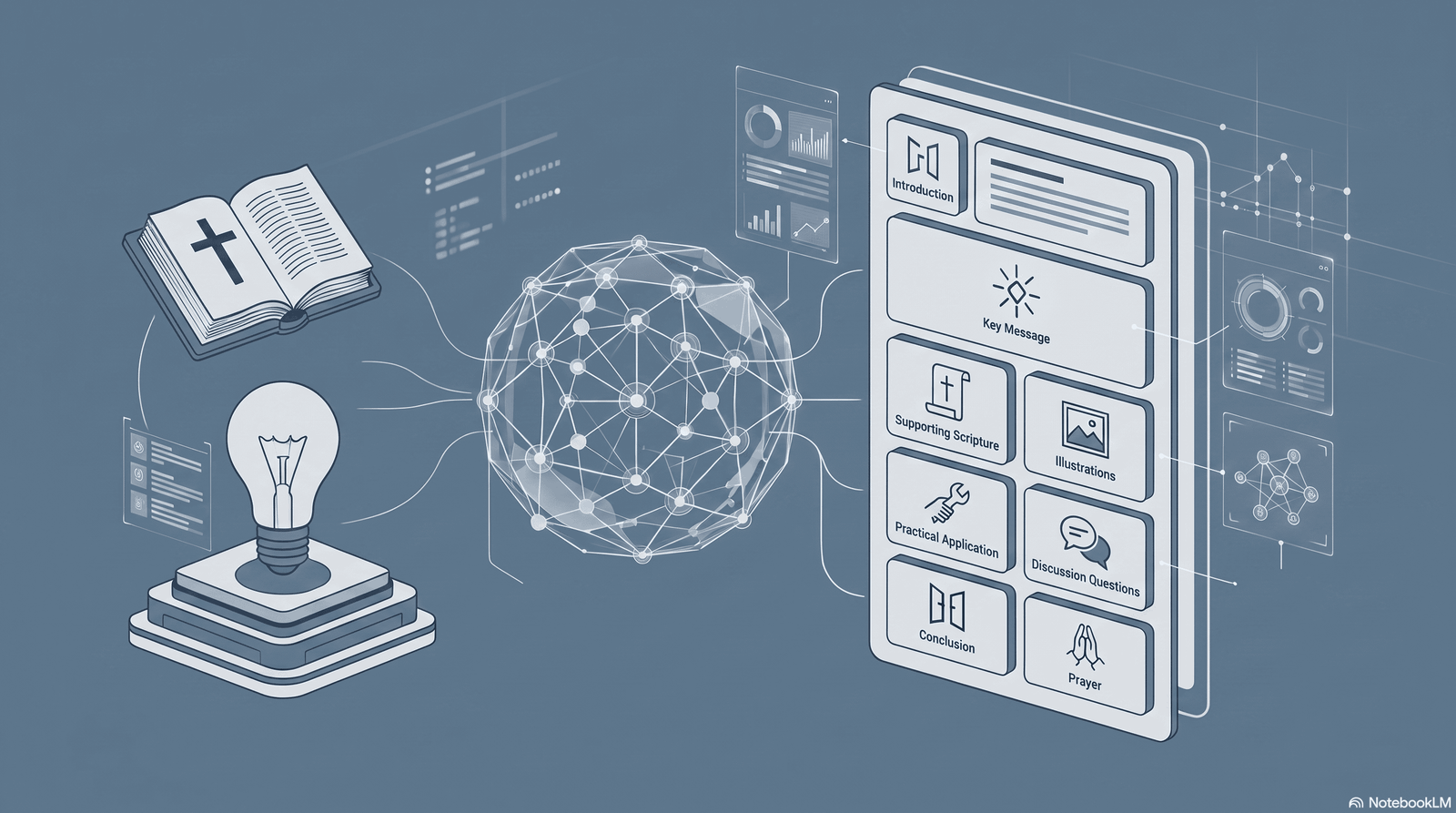
Seeing a real example makes the workflow concrete. Below is a sample outline an AI tool might generate for a message on Romans 8:28, before pastoral editing.
Passage: Romans 8:28 Audience: General Sunday congregation Theme: Trusting God in hardship
Introduction Open with a short, honest illustration about a season when circumstances made no sense at the time.
Point 1 — God’s purpose is present even in unclear seasons. Unpack the phrase “all things work together” and its original context within Paul’s larger argument in Romans 8.
Point 2 — “Good” in this verse is defined by God’s purpose, not comfort. Distinguish between circumstantial comfort and spiritual formation as the passage’s intended meaning.
Point 3 — This promise is anchored to those who love God, not a universal guarantee. Clarify the conditional framing Paul uses, avoiding a misapplication as a blanket promise for all people in all situations.
Closing Return to the opening illustration and reframe it through the lens of the sermon’s main point; close with a short prayer.
This is a useful starting skeleton — not a finished sermon. A pastor would still need to verify the Romans 8 context against commentaries, adjust the illustration to fit the specific congregation, and add pastoral application drawn from actual counseling and community experience that no AI tool has access to.
Callout box: AI-generated outlines are scaffolding, not a finished structure. Treat the first draft as raw material for your own study — never as a final message.
AI for Bible Study, Devotions, and Ministry Teams
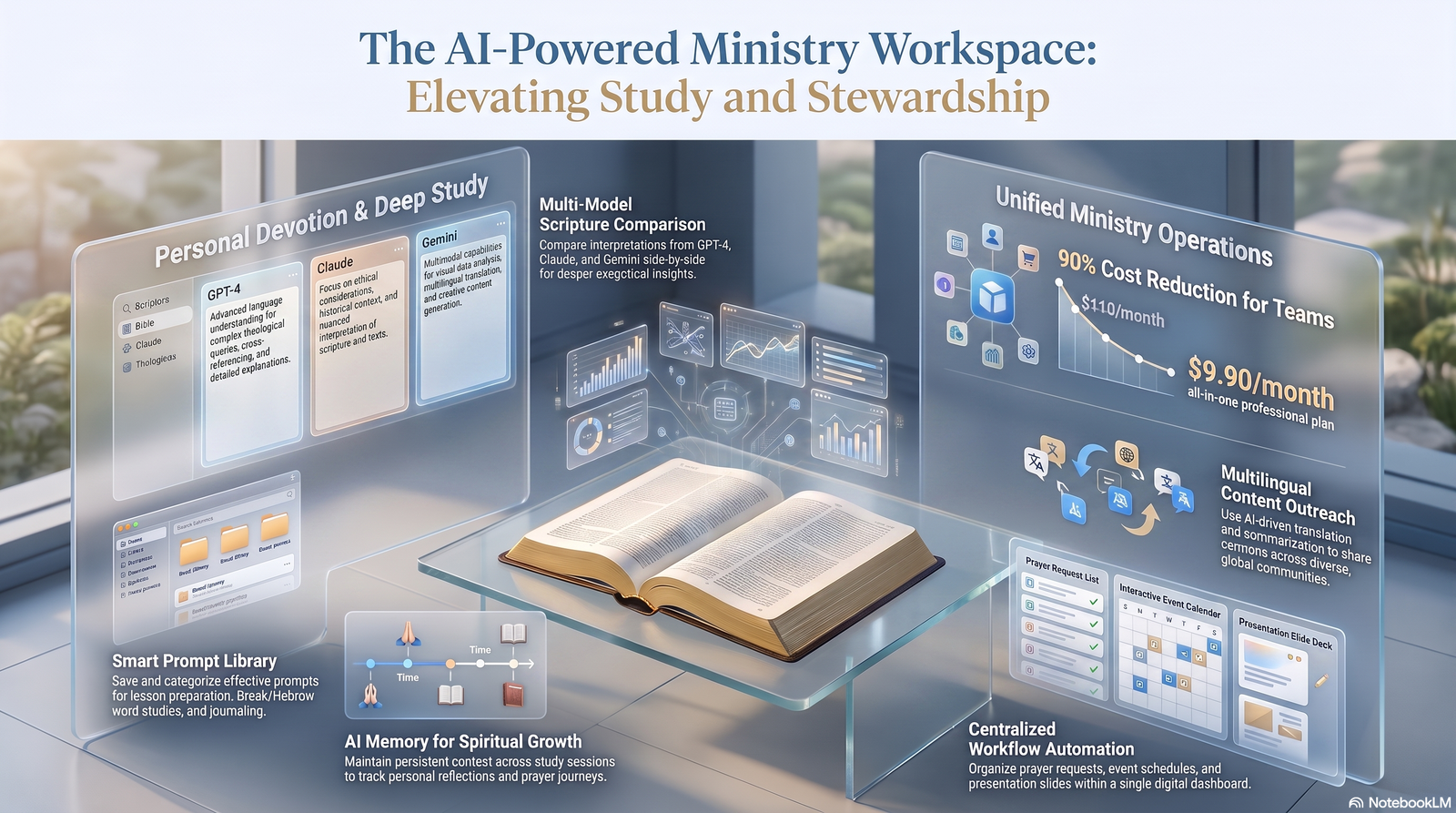
Beyond Sunday sermons, AI tools are increasingly used across broader church workflows.
- Bible study leaders use AI to draft discussion questions and summarize historical or cultural background for a passage, which they then verify against trusted commentaries.
- Youth and children’s ministry teams use AI to simplify complex theological ideas into age-appropriate language.
- Ministry teams and church staff use AI to draft newsletters, outreach copy, and volunteer training materials, freeing staff time for direct people-facing ministry.
- Individuals use AI-assisted devotional generators to structure personal daily reading plans, always alongside — not instead of — their own Bible reading.
In each of these cases, the pattern is the same: AI drafts, a human reviews, and the final content reflects the reviewer’s own theological judgment and pastoral awareness of their specific audience.
Best AI Prompts for Sermon Preparation
Use these as starting points, then adjust for your passage, audience, and denomination.
- “Create a 3-point expository outline on [passage] for a Sunday morning service.”
- “Suggest cross-references related to [theme] that I should manually verify.”
- “Write three possible sermon introductions on the theme of forgiveness.”
- “Give me a modern-day illustration that explains [theological concept] simply.”
- “Draft five small-group discussion questions based on [passage].”
- “Summarize the historical and cultural context of [book/chapter] in plain language.”
- “Suggest a sermon series outline of six weeks on the topic of [theme].”
- “Write a closing prayer that reflects the main point of this sermon: [summary].”
- “Rewrite this outline in a more conversational tone for a youth audience.”
- “Give me potential objections a skeptical listener might raise about [topic].”
- “Suggest a memorable one-sentence summary of this sermon’s main idea.”
- “Draft discussion questions appropriate for new believers versus mature believers.”
- “Suggest transition sentences between these three sermon points: [list points].”
- “Write a short devotional based on this week’s sermon passage.”
- “Give me three alternate titles for a sermon on [theme].”
- “Suggest ways to shorten this outline for a 20-minute midweek message.”
- “List key Greek or Hebrew words worth researching further in [passage].”
- “Draft an outline that addresses grief pastorally without being clinical.”
- “Suggest application points tailored to working parents.”
- “Write a brief announcement paragraph inviting people to this sermon series.”
Ethical Considerations
Before adopting AI for sermon work, church leaders should think through several ethical questions.
- Copyright and originality — AI-generated text can closely resemble existing commentary or published sermons; always rewrite substantially in your own words.
- Transparency — some congregations and denominations expect disclosure when AI assisted in sermon preparation; consider your context and conscience.
- Fact-checking — treat every factual or historical claim from AI as unverified until confirmed independently.
- Scripture verification — cross-check every citation against a trusted Bible translation before it reaches the pulpit.
- Responsible AI use — use AI to support your own study, not to bypass it; the goal is a better-prepared pastor, not a faster shortcut around preparation.
These aren’t reasons to avoid AI. They’re the guardrails that keep its use responsible.
Tips for Better Results
- Give the AI specific context: audience age, sermon length, and occasion (holiday, funeral, baptism, series).
- Ask for multiple options rather than accepting the first draft.
- Request the AI’s reasoning (“why did you choose this cross-reference?”) to catch weak logic.
- Break long sermons into sections and generate each separately for more focused output.
- Always follow up generated content with your own commentary and study tools.
Common Mistakes to Avoid
- Preaching an AI-generated verse reference without checking it against Scripture.
- Copying AI output verbatim instead of rewriting it in your own voice.
- Using AI as a replacement for prayer and personal study rather than a supplement to it.
- Ignoring theological inconsistencies because the writing “sounds” polished.
- Failing to consider your specific congregation’s needs, which AI cannot know.
The Future of AI in Ministry
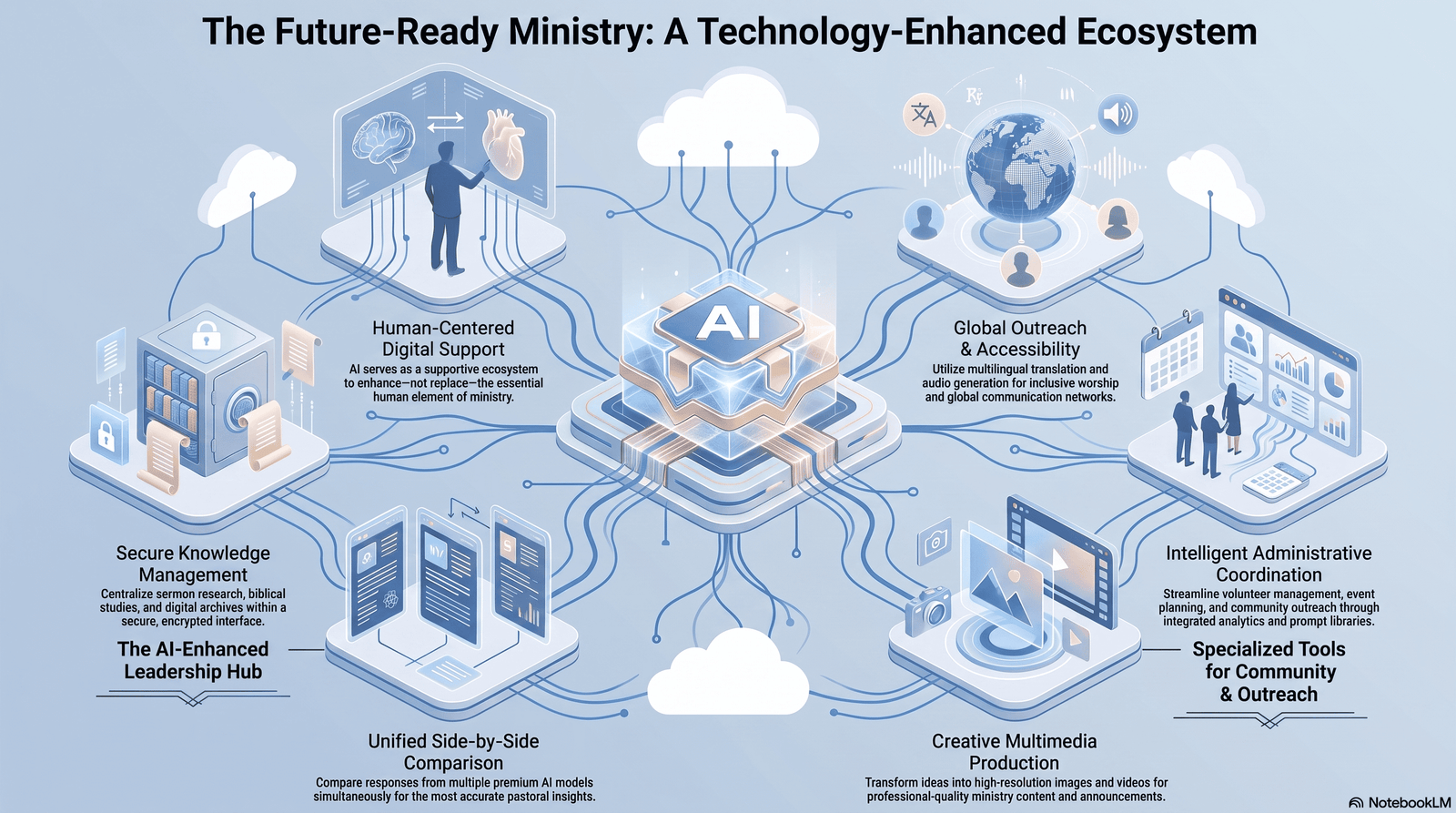
AI tools in ministry will likely keep improving in accuracy, Bible database integration, and denominational customization over the next few years. Expect tighter integration with church management software, more reliable citation-checking features, and better support for multiple Bible translations.
At the same time, most denominational and theological education leaders continue to emphasize that preaching is a pastoral and spiritual discipline, not a content-generation task. The most likely long-term outcome is AI becoming a standard research and drafting tool — similar to how Bible software and concordances became standard decades ago — while the responsibility for the message itself stays firmly with the preacher.
Conclusion
An AI sermon generator can save real time, spark fresh angles on familiar passages, and help organize scattered notes into a workable outline. Used with discernment, it’s a genuinely useful research and drafting assistant.
It is not, and should not be treated as, a substitute for prayer, study, or pastoral judgment. Every reference needs verification. Every draft needs a human voice. Every message still belongs to the pastor who preaches it.
If you’re preparing your next sermon, try starting with one AI-generated outline this week — then rewrite it fully in your own words and verify every Scripture reference before Sunday.
Frequently Asked Questions
1. What is an AI sermon generator? A tool that uses AI language models to help draft sermon outlines, illustrations, and discussion questions based on a topic or Bible passage.
2. Is it wrong for pastors to use AI for sermon prep? Most denominations view it as acceptable when used as a drafting and research aid, provided the pastor verifies content and retains full responsibility for the message.
3. Can AI sermon generators get Bible verses wrong? Yes. AI models can misquote or misattribute verses, so every reference should be checked against a trusted Bible translation.
4. Are free AI sermon generators available? Yes — general AI assistants like ChatGPT, Claude, and Gemini offer free tiers usable for sermon brainstorming, though usage limits apply.
5. What’s the difference between a general AI assistant and a ministry-specific AI tool? General assistants offer stronger flexible writing; ministry-specific tools often include curated Bible databases and church workflow features.
6. Should I disclose that I used AI to prepare a sermon? This depends on your congregation and denomination’s expectations; many leaders choose transparency as a matter of trust.
7. Can AI write an entire sermon for me? It can draft one, but preaching it without personal study, prayer, and verification is not recommended.
8. Is AI-generated sermon content considered plagiarism? It can closely resemble existing sources; always substantially rewrite AI output in your own words to avoid unintentional copying.
9. Can AI help with Bible study preparation, not just sermons? Yes — AI tools are commonly used to draft discussion questions, summarize context, and organize small-group study guides.
10. Do AI sermon generators understand different denominations? Some tools allow you to specify a theological tradition, but accuracy varies and should always be reviewed by the pastor.
11. What are the biggest risks of using AI for sermons? Hallucinated facts, incorrect Bible references, and theological inconsistency are the most common risks.
12. Can AI generate sermon illustrations and stories? Yes, AI is often strong at generating relatable analogies, though originality and appropriateness should be reviewed.
13. Is there a best AI tool specifically for pastors? There’s no single best tool; many pastors combine a general AI assistant for drafting with a dedicated Bible tool for verification.
14. How much time can AI actually save in sermon prep? Many users report saving several hours per week on outlining and organization, though study and prayer time should not be reduced.
15. Will AI eventually replace the need for pastors? No — preaching is one part of pastoral ministry; pastoral care, discernment, and community leadership remain distinctly human responsibilities.
Author Bio
Jeevesh Tripathi Content Researcher & AI Content Specialist, Aizolo Email: jeevesh@aizolo.com
Jeevesh Tripathi researches and writes about AI tools and their responsible application across content, research, and ministry-adjacent workflows. With a background in SEO strategy and hands-on testing of AI writing and research tools, he focuses on producing content that meets Google’s Helpful Content and EEAT standards while staying grounded in factual accuracy. His work emphasizes practical guidance over hype — helping readers understand both the genuine capabilities and real limitations of AI tools before adopting them. At Aizolo, Jeevesh specializes in translating complex AI capabilities into clear, trustworthy resources for non-technical audiences, including church leaders exploring how AI can responsibly support — never replace — their existing work and judgment.