Table of Contents
Introduction
Type a question into a chat box today and there’s a decent chance a human never reads it. A model reads it, understands the intent behind it, and answers — often better and faster than a person could.
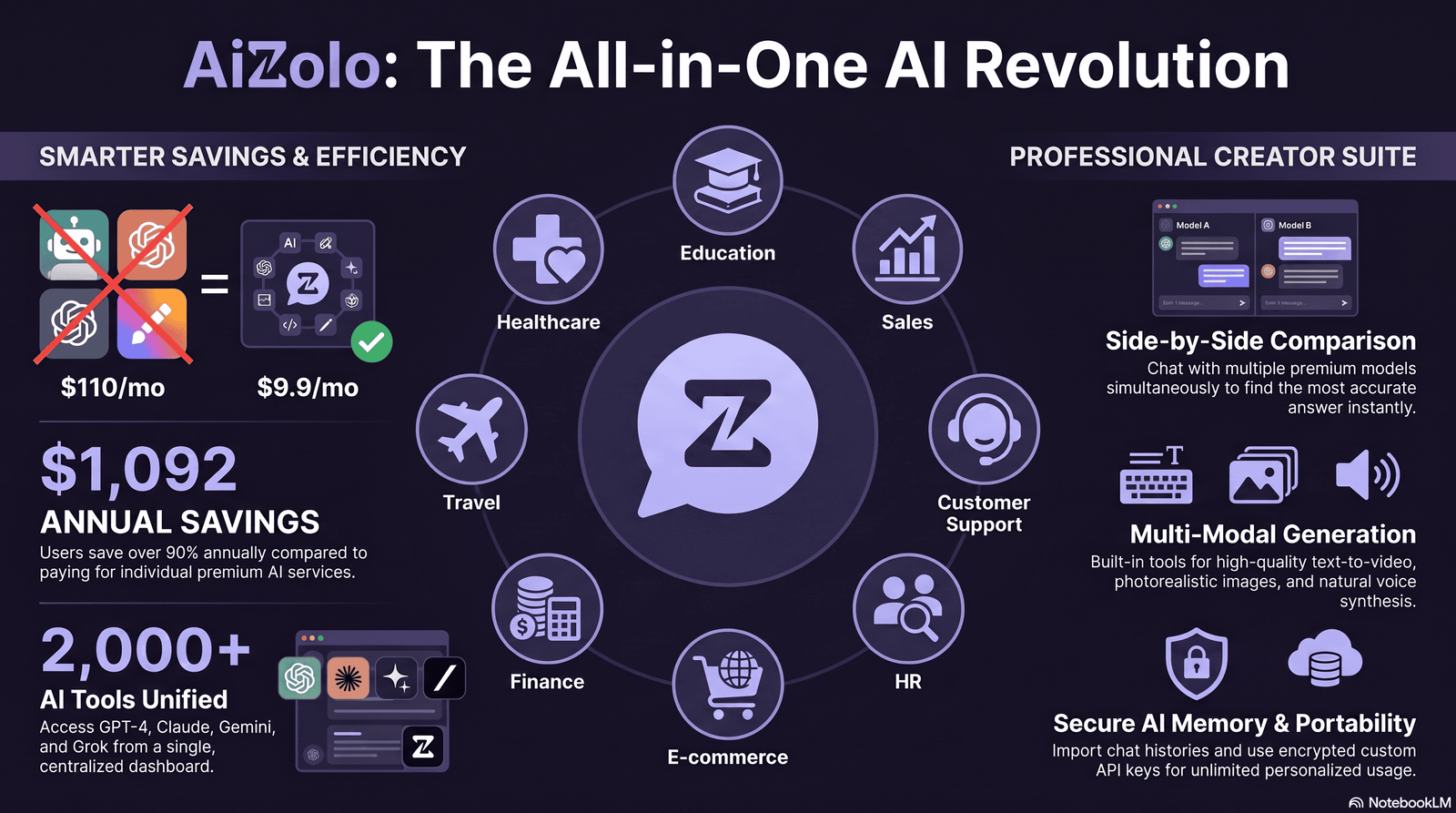
That shift is the story of conversational AI apps in 2026. What started as clunky, rule-based chatbots has turned into software that can hold a real phone call, remember your order history, and close a support ticket without anyone noticing it wasn’t human. Platforms like Aizolo also make it easier to access and compare multiple AI models in one place, helping users choose the right conversational AI solution for different tasks.
If you’re still getting familiar with the underlying concept before comparing vendors, our explainer on what conversational chat actually is is a good starting point.
The numbers back up what most of us have already felt. Fortune Business Insights puts the global conversational AI market at $17.97 billion in 2026, up from $14.79 billion the year before, and projects it will reach $82.46 billion by 2034.
Precedence Research, using a broader definition of the category, estimates the market could climb as high as $155.23 billion by 2035. The exact figure depends on who’s counting, but the direction is the same everywhere: up, fast.
Gartner expects conversational AI deployed inside contact centers alone to cut agent labor costs by $80 billion in 2026. Adoption has moved well past the pilot stage — research from Salesforce found that 88% of contact centers now use AI in some form, and 30% of service cases are already resolved without a human touching them.
This isn’t just an enterprise story. On the personal side, voice assistants, AI language tutors, and AI companion apps have become part of daily routines for tens of millions of people. Statista projects the number of voice assistant users in the US alone will reach 157.1 million by 2026.
This guide covers everything you need to actually choose and use a conversational AI app — how the technology works, the platforms worth considering in 2026, what they cost, where they shine, where they fall short, and how to avoid the mistakes that sink most AI rollouts.
What Are Conversational AI Apps?
Conversational AI apps are software applications that let people communicate with a computer system using natural, everyday language — spoken or typed — and receive responses that feel like a real conversation rather than a rigid menu of options.
Under the hood, these apps combine several technologies: natural language processing to interpret meaning, machine learning models (increasingly large language models) to generate responses, and often speech recognition and text-to-speech to handle voice.
The category spans a wide range of products. It includes:
- AI chatbot apps embedded on websites and in messaging apps
- AI voice assistants like the ones built into phones and smart speakers
- AI voice agents that handle phone calls for businesses
- AI companion and language-learning apps used by individuals
- Enterprise conversational AI platforms that power customer support, sales, and internal tools at scale
What separates a modern conversational AI app from an old-school chatbot is context. A 2022-era bot matched keywords to canned answers. A 2026 conversational AI app, built on large language models, can hold a multi-turn conversation, look up account information, take actions inside other software, and adjust its tone depending on who it’s talking to.
How Conversational AI Works
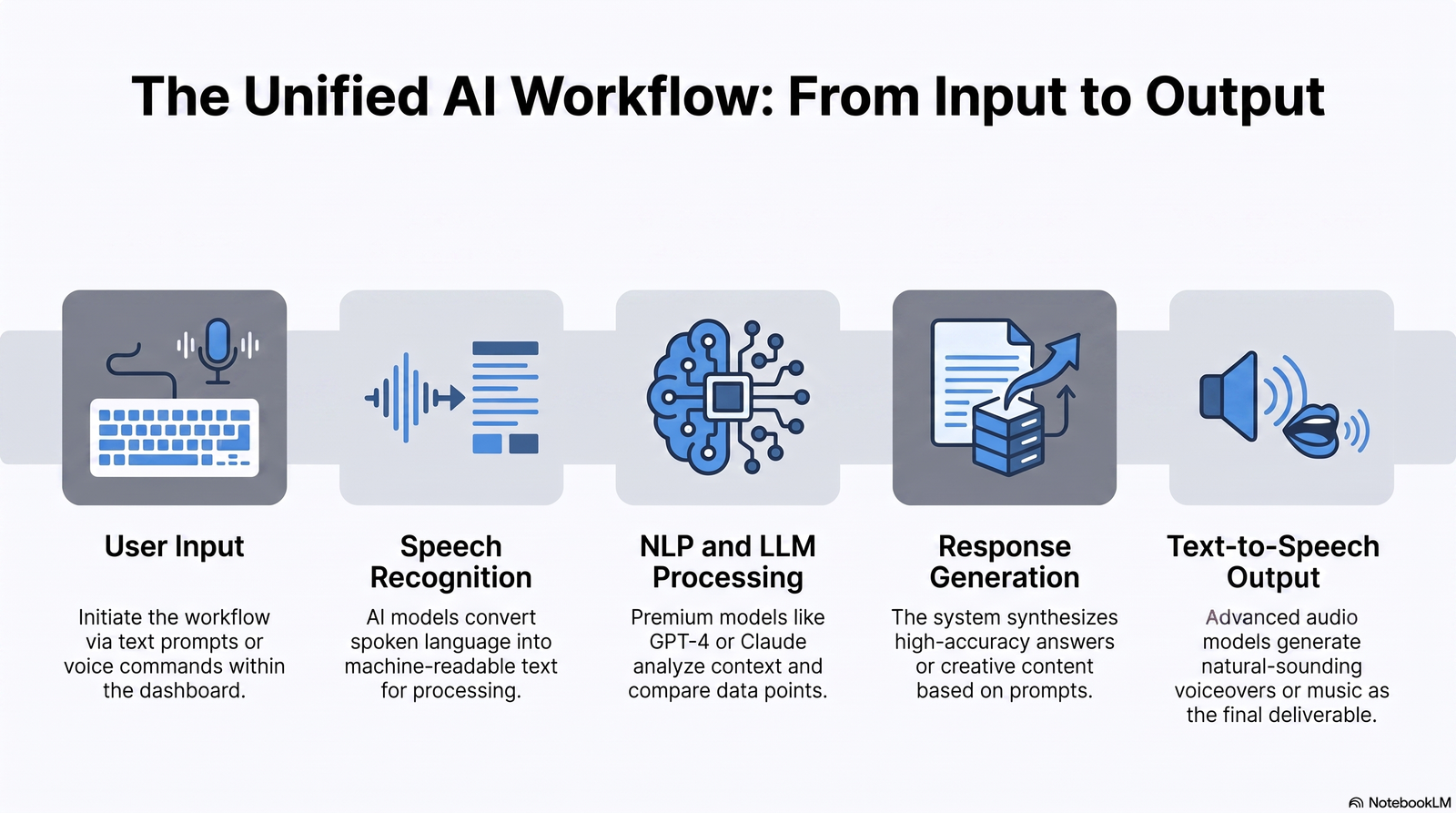
Every conversational AI app relies on a similar pipeline, even if the vendor branding makes it look different. Understanding the pieces helps you evaluate products with more confidence.
Large Language Models (LLMs)
The LLM chatbot wave changed the baseline for what a conversational app can do. Instead of scripting every possible reply, developers now prompt or fine-tune a foundation model — from providers like OpenAI, Anthropic, Google, or Meta — and let it generate responses dynamically.
This is why so many 2026 platforms advertise support for multiple models. Retell AI, for example, lets developers choose between GPT-5.x variants and Claude 4.5/4.6 Sonnet depending on the latency and cost profile they need for a given voice agent.
Multimodal AI
The newest layer is multimodal AI — models that can process text, voice, and sometimes images or video together. Video-based conversational agents, like the kind Tavus builds, extend this further into face-to-face AI video conversations, which are increasingly used in sales demos, HR interviews, and language practice.
Every conversational AI app relies on the same underlying pipeline — natural language processing to interpret intent, large language models to generate responses, and often speech recognition and text-to-speech for voice. We cover exactly how each stage works, and how it differs from a scripted chatbot, in our full explainer on conversational chat. Below, we focus on how that pipeline plays out across the platforms actually worth considering in 2026.
Types of Conversational AI Apps
Not every conversational AI app is built for the same job. Broadly, they fall into these categories:
1. Customer support AI chatbots Handle FAQs, order tracking, returns, and troubleshooting on websites and in help centers. Examples: Intercom Fin, Tidio, Zendesk AI.
2. AI sales and marketing chatbots Qualify leads, book meetings, and guide prospects through a funnel. Examples: Drift (now under Salesloft), Pipedrive’s AI features.
3. AI phone agents / voice AI agents Answer or place phone calls for appointment booking, lead qualification, or support. Examples: Retell AI, Vapi, Bland AI.
4. Enterprise virtual assistants Power internal help desks, HR queries, and IT support inside large organizations. Examples: IBM watsonx Assistant, Microsoft Copilot Studio.
5. Developer platforms and frameworks Give engineering teams the building blocks to create custom bots. Examples: Google Dialogflow CX, Amazon Lex, Rasa.
6. AI companion and language-learning apps Built for personal use — conversation practice, emotional support, or casual chat. Examples: language-speaking apps, Replika-style companions.
7. Multimodal / video AI agents Combine voice, video, and text for more human-like interactions. Example: Tavus.
Best Conversational AI Apps in 2026
The right app depends heavily on your use case — a solo language learner and a 500-agent contact center need completely different tools. Below is a researched breakdown of the platforms that come up most often across enterprise, SMB, and developer conversations in 2026.
Comparison Table: Best Conversational AI Apps
| App | Best For | Core Strength | Voice Support | Free Tier |
|---|---|---|---|---|
| Intercom Fin | Mid-market to enterprise customer support | Pay-per-resolution AI agent, multi-channel | Yes | Trial only |
| IBM watsonx Assistant | Regulated enterprises (finance, healthcare) | Compliance, hybrid cloud, IBM ecosystem | Yes | Free plan available |
| Google Dialogflow CX | Developers building custom bots | Deep Google Cloud + Gemini integration | Yes | Usage-based free tier |
| Retell AI | Technical teams building voice agents | Modular, low-latency voice infrastructure | Yes (voice-first) | Pay-as-you-go |
| Tavus | Sales, HR, and training video agents | Real-time AI video conversation | Video + voice | Limited free credits |
| Tidio (Lyro) | Small business support and sales | Easy setup, budget-friendly | No | Yes |
| Pipedrive AI | Sales teams already using Pipedrive CRM | Conversational AI layered on CRM data | No | Included in paid CRM plans |
| Microsoft Copilot Studio | Microsoft 365 / Teams-centric enterprises | Native integration with Microsoft stack | Yes | Trial credits |
| Amazon Lex | AWS-native developer teams | Tight AWS Bedrock/Lambda integration | Yes | AWS free tier |
Intercom Fin
Fin is Intercom’s AI customer service agent, and in 2026 it effectively became the company’s identity — Intercom renamed its parent entity to Fin in May 2026, and in June 2026 Salesforce signed a definitive agreement to acquire Fin for roughly $3.6 billion, with the deal expected to close in Salesforce’s fiscal Q4 2027.
Features: Multi-channel support (chat, email, WhatsApp, voice), pay-per-resolution billing, a Copilot tool for human agents, and integrations with Salesforce, HubSpot, Zendesk, and other helpdesks.
Pros:
- Public, usage-based pricing you can model
- Doesn’t charge when it hands off to a human
- Documented real-world resolution rates of roughly 42–50%
Cons:
- Costs scale directly with support volume, which makes budgeting harder at high volume
- Pending Salesforce acquisition adds uncertainty to long-term pricing and roadmap
Who should use it: Mid-market to enterprise support teams that want a mature, widely deployed AI agent and are comfortable with usage-based pricing.
IBM watsonx Assistant
IBM’s enterprise-grade conversational AI platform, built for organizations that need strong compliance credentials alongside automation.
Features: Visual no-code builder, retrieval-augmented generation, support for multiple LLM providers, and certifications including ISO 27001/27017/27018 and HIPAA-aligned controls.
Pros:
- Strong fit for healthcare, banking, and other regulated industries
- Deep integration with the broader IBM watsonx.ai ecosystem
- Multi-channel and multi-language support
Cons:
- Steeper learning curve than SMB-focused tools
- Enterprise pricing requires a custom quote for full capabilities
Who should use it: Large enterprises, especially in regulated industries, that need governance and hybrid-cloud deployment options.
Google Dialogflow CX
Google’s developer-first conversational AI platform, now integrated with Gemini models for more dynamic, generative responses.
Features: Generative “playbooks” for dynamic conversation flows, support for over 25 languages in CX (95+ in the older ES version), and native Google Cloud integration.
Pros:
- Transparent, usage-based pricing ($0.007 per text request on CX)
- Strong for teams already building on Google Cloud
- Generous free tier for testing and small projects
Cons:
- Requires more engineering effort than no-code competitors
- Enterprise support tiers start around $10,000/month
Who should use it: Development teams that want full control over conversation design and already use Google Cloud infrastructure.
Retell AI
A voice-first infrastructure platform aimed at engineering teams building custom AI phone agents rather than buying a finished product.
Features: WebSocket-based real-time voice streaming, bring-your-own-LLM (GPT-5.x, Claude 4.5/4.6, Gemini 3.0), bring-your-own telephony (Twilio, Telnyx, Vonage), and ElevenLabs voice integration.
Pros:
- Transparent base rate and modular pricing
- Low latency (~600ms), which matters enormously for voice UX
- No mandatory subscription — true pay-as-you-go
Cons:
- The advertised $0.07/min base rate covers voice infrastructure only; a fully working setup with LLM, TTS, and telephony typically runs $0.13–$0.31 per minute
- Requires technical setup — not a drag-and-drop tool
Who should use it: Technical teams that want to assemble and optimize a custom voice AI stack rather than use an off-the-shelf agent.
Tavus
A platform for real-time, video-based AI conversations — useful anywhere a static chat window feels too impersonal.
Features: Real-time AI video agents that can hold face-to-face conversations, used for sales demos, training simulations, and interview practice.
Pros:
- Differentiated multimodal experience beyond text or voice alone
- Strong fit for use cases where visual presence builds trust
Cons:
- Newer category with a smaller ecosystem of integrations than text/voice-only competitors
- Video AI is more resource-intensive and typically costs more per interaction
Who should use it: Sales, HR, and training teams that want a more human-feeling AI interaction than chat or voice alone can offer.
Tidio (Lyro AI)
A budget-friendly chatbot platform built for small and mid-sized businesses that don’t need enterprise-grade complexity.
Features: No-code chatbot builder, Lyro AI agent add-on, live chat, and social channel integrations.
Pros:
- Genuinely usable free plan
- Fast setup — most small teams can launch within a day
- Tidio claims Lyro can autonomously resolve up to 67% of inquiries
Cons:
- AI capability is gated behind a separate paid add-on (starting around $39/month for 50 AI conversations)
- Conversation-based pricing can get expensive as volume grows
Who should use it: Small businesses and solo founders who want an affordable entry point into AI-powered support.
Pipedrive AI
Pipedrive has layered conversational AI features directly into its CRM, giving sales teams a way to query pipeline data and automate follow-ups in natural language rather than through dashboards.
Pros:
- No separate platform to manage if you’re already a Pipedrive customer
- Keeps conversational features tied directly to CRM data
Cons:
- Less flexible as a standalone conversational AI solution outside the CRM
- Not designed for customer-facing chat or voice at scale
Who should use it: Sales teams that want AI assistance inside their existing CRM workflow rather than a separate conversational AI product.
[Internal Link: AI Automation Guide]
Pricing Comparison
Pricing in this category has become genuinely difficult to compare at a glance, because vendors bill on completely different models: per seat, per resolution, per minute, or per conversation.
| App | Pricing Model | Entry-Level Cost | Notes |
|---|---|---|---|
| Intercom Fin | Per resolution | $0.99 per resolution (50-resolution minimum if standalone) | Seat plans from roughly $29–$139/seat/month if using full Intercom suite |
| IBM watsonx Assistant | Tiered subscription | Free plan; paid plans from ~$140/month | Enterprise tier requires custom quote |
| Google Dialogflow CX | Per request | $0.007 per text request | Enterprise support starts at $10,000/month |
| Retell AI | Per minute (usage-based) | $0.07/min base; $0.13–$0.31/min realistic total | No mandatory subscription |
| Tidio (Lyro) | Subscription + AI add-on | Free tier; Lyro add-on from $39/month | Base plans range $29–$749/month |
| Tavus | Usage-based | Limited free credits, then usage pricing | Contact vendor for enterprise rates |
| Pipedrive AI | Bundled with CRM plan | Included in paid CRM tiers | Not sold as a standalone product |
A general rule that held true across nearly every vendor we researched: the advertised headline price is rarely the total bill. Seat fees, per-resolution charges, channel add-ons (like WhatsApp), and premium voice options each add to the real monthly cost. Always model your expected volume before committing to a contract.
Real-World Use Cases by Industry
Healthcare
Conversational AI apps handle appointment scheduling, medication reminders, and initial symptom triage, freeing clinical staff for higher-value work. HIPAA-aligned platforms like IBM watsonx Assistant are commonly chosen here specifically because of their compliance certifications.
Education
AI speaking assistants and language-practice apps let learners rehearse conversations without the social pressure of a classroom, available on demand at any hour.
Sales
AI voice agents and chatbot platforms qualify inbound leads, schedule demos, and follow up automatically — work that used to require a dedicated SDR team for the first-touch conversation.
Customer Support
This remains the single largest use case. Salesforce’s research found that 88% of contact centers now use AI in some form, with 30% of cases resolved by AI and a projection of 50% by 2027.
HR
Internal conversational AI tools answer policy questions, guide onboarding, and can even conduct first-round screening interviews through video-based agents.
E-commerce
Chatbots handle order tracking, product recommendations, and return requests directly inside the shopping experience, often through WhatsApp or in-app chat.
Finance
Banks and fintechs use conversational AI for balance inquiries, fraud alerts, and basic account servicing, almost always paired with strict identity verification and audit logging.
Travel
AI phone agents and chatbots handle booking changes, flight status updates, and itinerary questions around the clock, across time zones.
Marketing
Conversational AI powers lead capture on landing pages and personalized product discovery flows that adjust based on what a visitor says they need.
Common Mistakes When Adopting Conversational AI
Launching without a clean knowledge base. Resolution rates depend far more on the quality of the underlying content than on which platform you pick. A well-maintained knowledge base can push a mid-tier tool to outperform a premium one running on thin documentation.
Ignoring the real cost model. Usage-based pricing looks cheap in a demo and expensive at scale. Model your actual monthly volume before signing a contract.
Deploying voice agents without latency testing. Anything above roughly one second of response delay starts to feel unnatural on a phone call. Test under real network conditions, not just in a quiet office.
Treating AI as a full replacement for humans on day one. The platforms with the best outcomes in 2026 use a hybrid model — AI handles routine volume, humans handle escalations and emotionally sensitive conversations.
Skipping a fallback path. Every deployment needs a clear, fast route to a human agent. Customers forgive an AI that doesn’t know the answer; they don’t forgive one that traps them in a loop.
Privacy, Security & Compliance

Conversational AI apps process sensitive information by design — names, account details, health information, and financial data often pass directly through the chat or call.
Before adopting any platform, check for:
- Data retention policies — how long conversation transcripts are stored, and whether they’re used for further model training
- Compliance certifications relevant to your industry (HIPAA for healthcare, SOC 2 and ISO 27001 broadly, PCI DSS for payment data)
- Regional data residency options if you operate under GDPR or similar regulations
- Access controls for who inside your organization can view conversation logs
Enterprise-focused platforms like IBM watsonx Assistant lead with these certifications explicitly, which is one reason they remain the default choice for banks and healthcare providers even when cheaper alternatives exist.
Enterprise Adoption in 2026
The adoption data from 2026 tells a consistent story: conversational AI has moved from experimentation to infrastructure.
- 78% of global enterprises reported using conversational AI in at least one customer-facing function, according to research cited by AllAboutAI.
- 88% of contact centers use AI in some form, per Salesforce research.
- 91% of customer service leaders say executive leadership is actively pushing them to implement AI, according to SlickText.
- Gartner projects that 40% of enterprise applications will feature task-specific AI agents by 2026, up sharply from prior years.
- 42% of organizations are expected to hire dedicated AI-focused CX roles — conversational AI designers, automation analysts — by 2026, according to Gartner.
The market itself is also consolidating. In 2026, Salesforce agreed to acquire Fin (formerly Intercom) for roughly $3.6 billion, and Drift was acquired by Salesloft, prompting many teams to re-evaluate long-term vendor stability alongside features and price.
Future Trends
Agentic workflows are replacing single-turn bots. Instead of answering one question at a time, 2026-era platforms increasingly complete multi-step tasks — rebooking a flight, updating a CRM record, and sending a confirmation, all inside one conversation.
Voice is catching up to text. Latency has dropped enough (Retell AI’s ~600ms pipeline is a good example) that phone-based AI agents now feel close to a real call rather than an obvious bot.
Multimodal AI is expanding beyond novelty. Video-based agents from companies like Tavus are moving into mainstream sales and HR workflows, not just demos.
Outcome-based pricing is spreading. Intercom Fin’s pay-per-resolution model has pushed competitors toward similar usage-based structures instead of flat seat pricing.
Consolidation is accelerating. The Salesforce–Fin deal and the Drift–Salesloft acquisition both point toward a market where a handful of large players absorb specialized conversational AI vendors rather than competing against them indefinitely.
Buying Guide: How to Choose the Right Conversational AI App
Work through these questions before evaluating specific products:
1. What’s the primary channel? Text-only support, voice, or both? Voice AI agents (Retell AI, watsonx Assistant, Dialogflow CX) require different infrastructure than chat-only tools like Tidio.
2. What’s your realistic monthly volume? Usage-based pricing (per resolution, per minute, per request) can be cheaper at low volume and dramatically more expensive at scale than a flat subscription. Model both scenarios.
3. Do you have compliance requirements? Healthcare, finance, and other regulated industries should shortlist platforms with explicit certifications, such as IBM watsonx Assistant, before comparing feature lists.
4. How technical is your team? Developer-first platforms (Dialogflow CX, Retell AI, Amazon Lex) offer more control but require engineering resources. No-code tools (Tidio, Intercom) get you live faster with less flexibility.
5. What’s already in your stack? If you’re deeply invested in Salesforce, Google Cloud, AWS, or Microsoft 365, the native option (Agentforce/Fin, Dialogflow, Lex, Copilot Studio) usually integrates with the least friction.
6. What happens when the AI doesn’t know the answer? Test the human handoff experience directly, not just the happy path. This is where most poor deployments actually fail.
FAQs
What are conversational AI apps used for? They’re used to automate natural-language interactions — customer support, sales conversations, appointment booking, and personal use cases like language practice — through chat, voice, or video.
Are conversational AI apps the same as chatbots? Not exactly. A chatbot is one type of conversational AI app. The category also includes voice assistants, AI phone agents, and video-based AI agents.
What is the best conversational AI app for small businesses? Tidio is generally the most accessible starting point for small teams because of its free tier and straightforward setup, though AI capability requires a paid add-on.
What is the best conversational AI platform for enterprises? IBM watsonx Assistant and Intercom Fin are among the most widely deployed enterprise options, chosen respectively for compliance strength and mature AI resolution performance.
How much do conversational AI apps cost? Costs range from free small-business plans to enterprise contracts worth tens of thousands of dollars a month. Most platforms bill per seat, per resolution, per request, or per minute — often a combination of several.
Do conversational AI apps use ChatGPT? Some do. Many platforms, including voice infrastructure tools like Retell AI, let you choose between multiple large language models, including OpenAI’s GPT models and Anthropic’s Claude models, rather than being locked to one provider.
Is conversational AI the same as generative AI? Not quite — see the full distinction between conversational AI, generative AI, and agentic AI in our conversational chat guide.
Can conversational AI handle phone calls? Yes. AI phone agents built on platforms like Retell AI or IBM watsonx Assistant can handle inbound and outbound calls, using speech recognition and text-to-speech to hold a real-time voice conversation.
How accurate are AI chatbots at resolving customer issues? Real-world resolution rates typically range from 30–70%, depending heavily on the quality of the underlying knowledge base rather than the platform alone, based on multiple 2026 industry comparisons.
What is the difference between Dialogflow ES and Dialogflow CX? ES is Google’s earlier, simpler bot-building tool. CX is the more advanced version built for complex conversations, with generative “playbooks” and Gemini integration, priced at $0.007 per text request versus $0.002 for ES.
Is Drift still available in 2026? Drift was acquired by Salesloft, and multiple industry sources report the standalone Drift product is being sunset in 2026, which has pushed many former Drift customers to evaluate alternatives.
What happened to Intercom in 2026? Intercom renamed its corporate entity to Fin in May 2026, after its AI agent product of the same name, and in June 2026 Salesforce signed a definitive agreement to acquire Fin for approximately $3.6 billion.
Are conversational AI apps safe to use with sensitive data? It depends on the vendor’s certifications and data handling policies. Look specifically for HIPAA alignment, SOC 2, ISO 27001, and clear data retention terms before using any platform with sensitive customer data.
Do I need coding skills to build a conversational AI app? No-code platforms like Tidio and Intercom let non-technical teams launch a bot quickly. Developer-first platforms like Dialogflow CX, Amazon Lex, and Retell AI require engineering resources for full customization.
What’s the difference between an AI chatbot and an AI voice agent? An AI chatbot communicates through text. An AI voice agent adds speech recognition and text-to-speech so it can hold a spoken conversation, typically over the phone or through a voice assistant.
Conclusion
Conversational AI apps stopped being a novelty around 2024 and became infrastructure by 2026. The market data reflects that shift clearly — double-digit growth forecasts, contact centers running AI at 88% adoption, and billion-dollar acquisitions reshaping the vendor landscape in real time.
There’s no single best conversational AI app. A solo founder testing Tidio’s free plan and a bank deploying IBM watsonx Assistant across a call center are solving completely different problems with completely different constraints.
What matters is matching the platform to your actual volume, compliance needs, technical resources, and channel — text, voice, or video — rather than chasing whichever tool has the flashiest demo. Start with a clear knowledge base, test the human handoff path honestly, and model the real cost at your expected scale before you sign anything.
Author Bio
Jeevesh Tripathi Email: jeevesh@aizolo.com
Jeevesh Tripathi researches and writes about AI tools, SaaS technology, and enterprise software adoption, with a focus on translating vendor documentation, pricing structures, and industry reports into practical buying guidance. His work draws on primary sources — official product documentation, analyst research from firms like Gartner and Forrester, and direct platform comparisons — rather than secondhand summaries, with an emphasis on verifying claims before publishing them.