Introduction
A researcher who wants ChatGPT, Claude, Gemini, and Perplexity today is looking at roughly $80 a month before adding Grok or a coding-focused plan.
That’s close to $1,000 a year, just to compare answers across models.
Most of that spend goes unused. With Aizolo, nobody needs to run the same query through five chat windows every single day.
The real question isn’t which single AI model is best. It’s the cheapest way to use multiple AI models for research without stacking five separate bills.
This guide breaks down what each major AI subscription actually costs in 2026, why researchers reach for more than one model in the first place, and where a single unified subscription genuinely saves money instead of just promising to.
Table of Contents
Why researchers now use multiple AI models
No single model wins every task. That’s not a marketing line, it’s a pattern that shows up in daily research work.
Different strengths, different tasks
Some models are stronger at long-context document analysis. Others are faster at web-grounded, cited answers. A few are better at structured reasoning or code-heavy tasks.
Using one model for everything means settling for its weakest area on some fraction of your work.
Cross-verification catches errors
Running the same research question through two models is a fast sanity check. When both models agree on a fact, confidence goes up.
When they disagree, that’s a signal to dig into primary sources before citing anything.
Lower hallucination risk
No model is immune to confidently stating something false. Multi-model comparison doesn’t eliminate hallucination, but it makes contradictions visible instead of invisible.
A single model’s mistake, read in isolation, looks exactly like a correct answer.
Faster overall workflow
Switching models for what each does best is often quicker than forcing one model through a task it’s weak at, then manually fixing the output.
A model with strong web search handles current-events questions faster than a model with no search grounding.
Why paying for separate AI subscriptions becomes expensive
Here’s what the standard paid tier costs for each major provider, as of mid-2026.
| Platform | Standard Plan | Monthly Cost |
|---|---|---|
| ChatGPT Plus | GPT-5.x access | $20.00 |
| Claude Pro | Opus/Sonnet access | $20.00 |
| Google AI Pro (Gemini) | Gemini 3.1 Pro access | $19.99 |
| Perplexity Pro | Search + multi-model | $20.00 |
| Grok (SuperGrok) | Grok frontier access | $30.00 |
| DeepSeek | Free chat / pay-per-token API | $0 (API billed separately) |
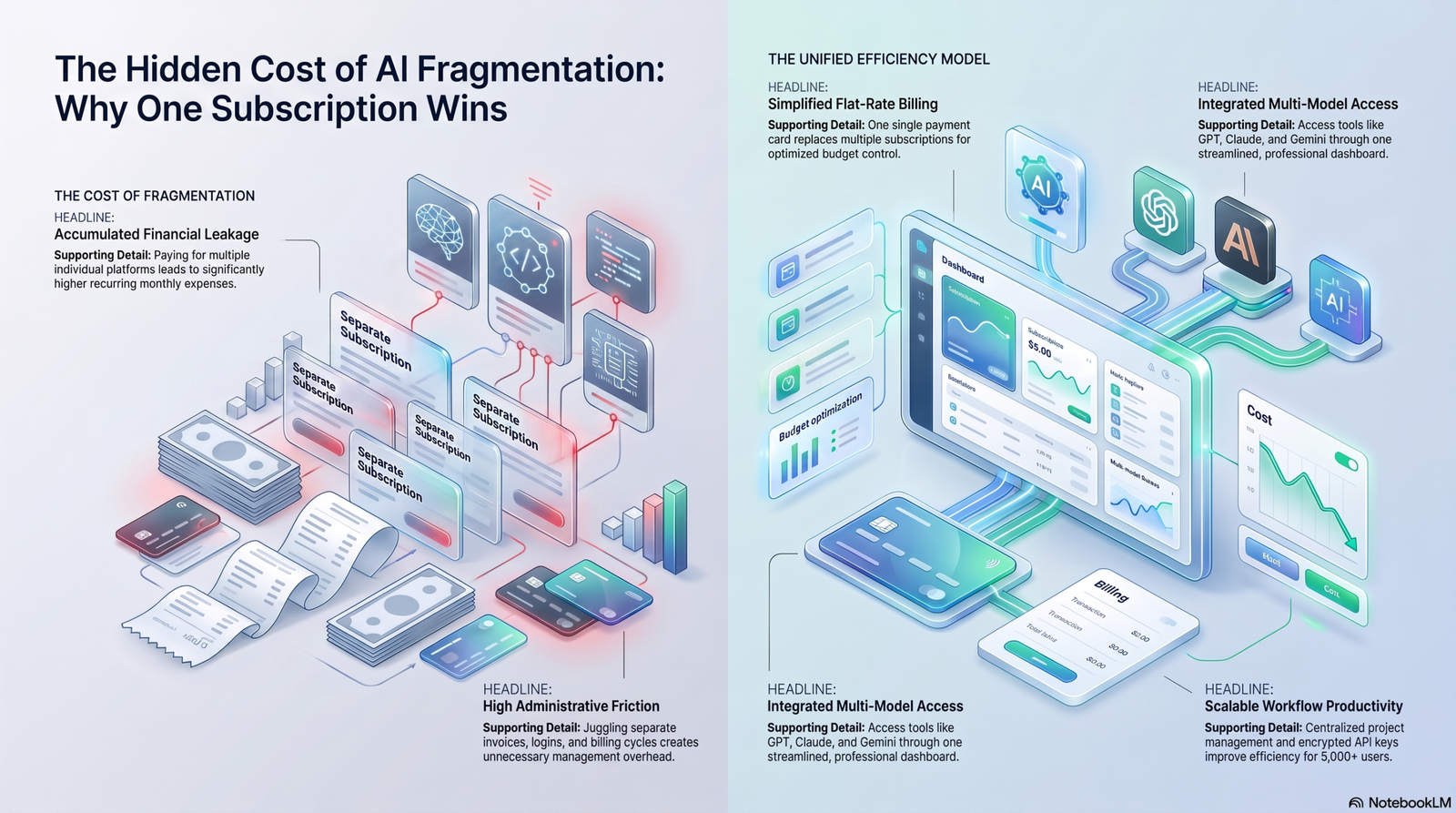
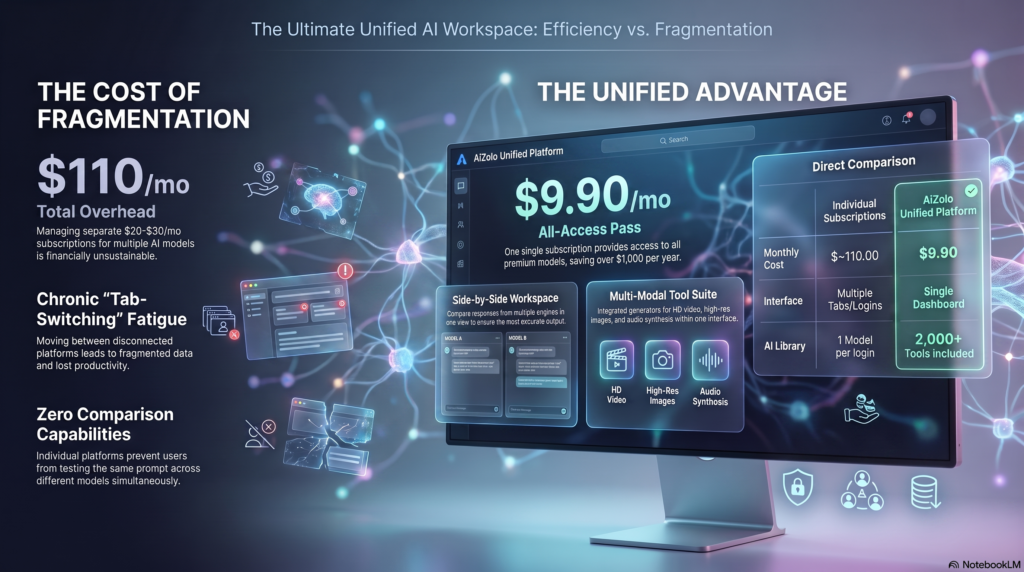
Add the first five together and a researcher is paying around $110 per month, or roughly $1,320 per year, just for headline-tier access.
That figure doesn’t include:
- Business or Team seats, which run higher per user
- API overage charges on top of a flat subscription
- Higher usage tiers (Claude Max, ChatGPT Pro, Google AI Ultra) that push individual plans to $100–$200 a month
- The time cost of logging into five separate apps to ask one question five ways
Most people don’t use all five plans at full capacity. They pay full price for occasional access, which is the core inefficiency multi-subscription research spending has.
Cheapest way to use multiple AI models for research
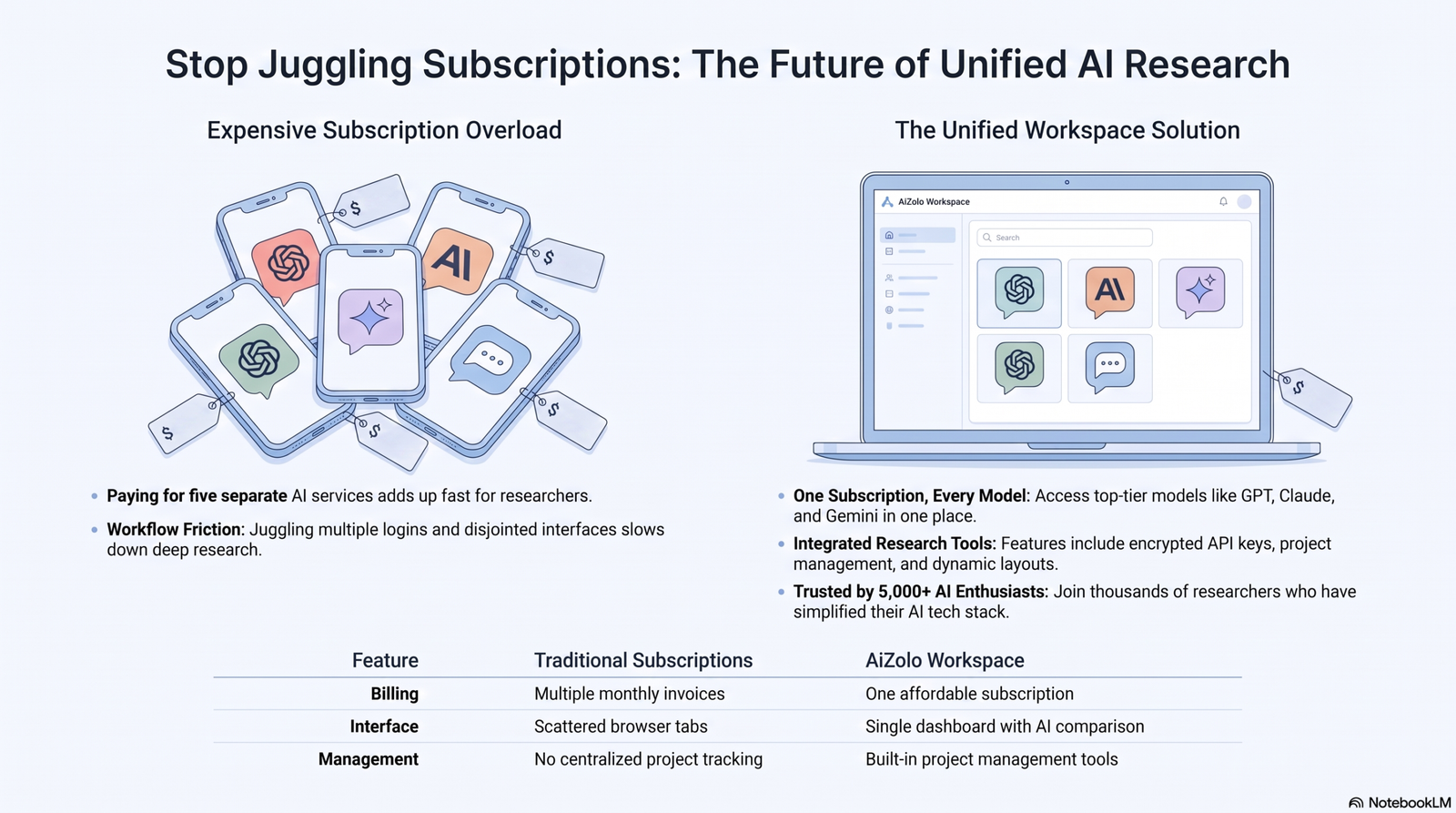
The cheapest way to use multiple AI models for research is not stacking individual subscriptions. It’s using a single platform that gives access to several models under one bill.
This works through a few mechanisms:
AI aggregators
An aggregator platform holds API access to multiple providers — OpenAI, Anthropic, Google, DeepSeek, and others — and resells that access through one flat subscription.
Because the aggregator buys at API rates and serves many users, the per-user cost is a fraction of five retail subscriptions.
Unified workspaces
Instead of five browser tabs, a unified workspace puts a model selector inside one chat window. Switching from Claude-class reasoning to a search-grounded model takes one click, not a new login.
Single-subscription platforms
One monthly or annual charge replaces the need to manage five separate billing cycles, five separate free-tier limits, and five separate accounts.
Prompt reuse across models
A shared workspace lets you paste one research prompt and send it to multiple models without retyping it in each provider’s app.
Side-by-side comparison for research workflows
For research specifically, an interface that shows two or more model responses next to each other is more useful than switching tabs and trying to remember what the last model said.
How AI aggregators reduce research costs
The savings aren’t a marketing trick — they come from a few structural differences in how aggregators are built.
Single billing
One invoice instead of five. Easier to track, easier to justify on an expense report, easier to cancel if it’s not being used.
One interface
No relearning five different UIs. The research workflow — ask, compare, refine, cite — stays consistent regardless of which model answers.
Shared prompt history
A research question asked in January is searchable in July, in one place, instead of scattered across five app histories.
Side-by-side comparison
Seeing two models’ answers stacked next to each other makes disagreement obvious immediately, which supports the cross-verification benefit covered earlier.
No multiple logins
Every additional login is friction. Aggregators cut that down to one account for an entire research toolkit.
Lower switching cost
Testing whether a different model handles a specific research question better costs a click, not a new $20/month commitment.
Best platforms to access multiple AI models
| Platform | Models Supported | Monthly Cost | Free Plan | Best For | Pros | Cons |
|---|---|---|---|---|---|---|
| ChatGPT Plus | GPT-5.x family only | $20 | Yes, limited | Deep single-model workflows | Highest message volume on one model | No access to Claude, Gemini, or DeepSeek |
| Claude Pro | Claude family only | $20 | Yes, limited | Long-document analysis, coding | Large context window, strong reasoning | Single-provider, no cross-model comparison |
| Google AI Pro | Gemini family only | $19.99 | Yes, limited | Search-grounded answers, Workspace users | 1M token context, Workspace integration | Locked to Google’s ecosystem |
| Perplexity Pro | Multiple models, but search-first | $20 | Yes, limited | Cited, sourced answers | Built-in citations, some model choice | Not built for deep multi-model comparison |
| Aizolo | Multiple leading models in one workspace | Single affordable plan | Varies | Researchers comparing models on a budget | One login, one bill, side-by-side answers | Newer platform, smaller community than incumbents |
A quick read of this table shows the pattern: single-provider apps are priced almost identically to each other ($20 give or take), but each one locks you into that provider’s model family alone.
An aggregator-style platform is the only category built specifically to remove that lock-in.
Why Aizolo is an affordable choice
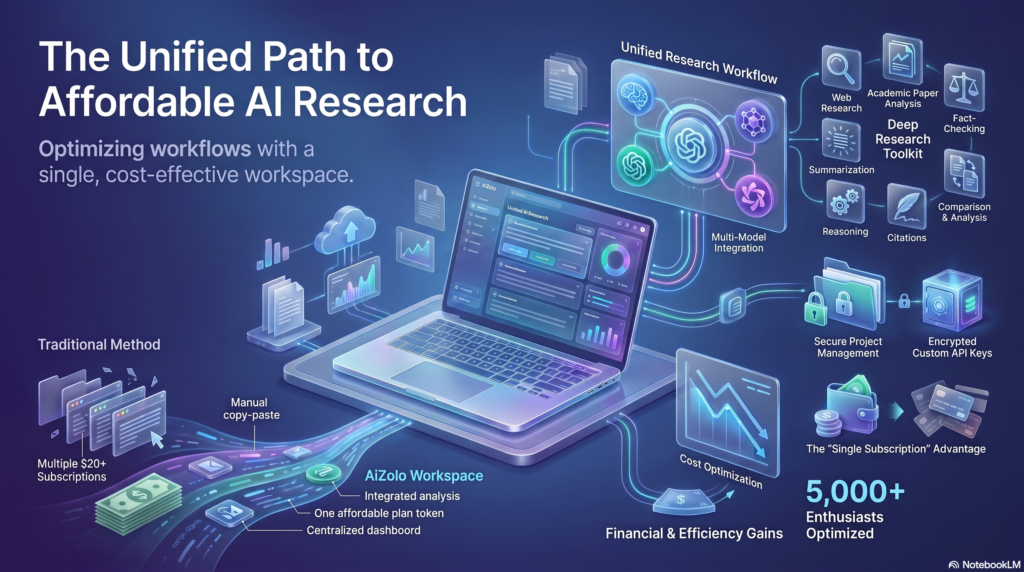
For researchers comparing model outputs regularly, paying for one subscription that includes multiple AI models is more practical than paying for each model separately.
Aizolo is built around that idea: one subscription, multiple AI models, in a single workspace.
Instead of five logins, a researcher gets one dashboard where prompts can be sent to different models and compared without switching apps.
This matters most for research tasks specifically, where the value isn’t any single model’s opinion — it’s what multiple models agree or disagree on.
For a student or independent researcher watching a budget, that single-subscription structure is the more sustainable option compared to renewing five separate $20 plans every month.
It won’t replace every provider-specific feature — Custom GPTs, Gemini’s native Workspace integration, or Claude Code’s terminal tooling are still tied to their home platforms.
But for the core research task — ask a question, get multiple perspectives, compare, cite — it covers the actual job most researchers are hiring five subscriptions to do.
Real research workflow example
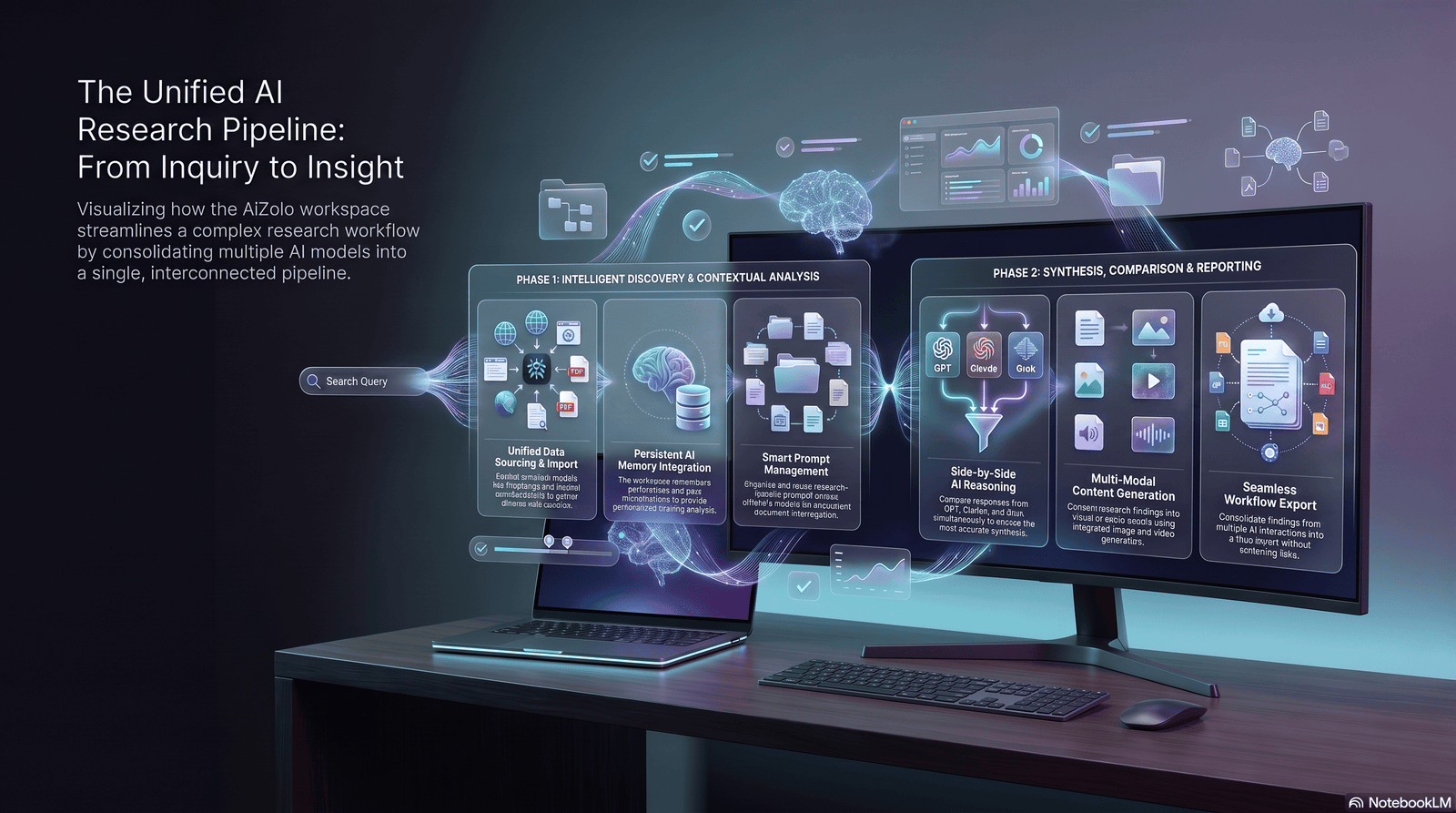
Here’s what a multi-model research session looks like in practice, using a medical research topic as the example.
Step 1: Ask the same question across models
A researcher investigating a treatment’s side-effect profile asks the same question to ChatGPT, Claude, Gemini, and DeepSeek.
Step 2: Compare outputs
ChatGPT’s answer leans on general medical knowledge. Claude gives a more structured breakdown by severity. Gemini pulls in a recent search result. DeepSeek offers a concise summary with fewer caveats.
Step 3: Flag disagreements
If one model mentions a side effect the others don’t, that’s the item to verify against a primary source — a peer-reviewed study or a regulatory filing — not to accept or reject on its own.
Step 4: Merge insights
The final research note combines the strongest parts of each answer: Claude’s structure, Gemini’s recency, and DeepSeek’s brevity, with everything checked against original sources.
Step 5: Save money doing it
Running this workflow across four separate $20/month subscriptions costs roughly $80 a month regardless of how often it’s used. Running it inside one aggregator subscription costs a fraction of that, with the same four models available on demand.
When separate subscriptions still make sense
A unified platform isn’t the right call for every researcher. A few scenarios where a dedicated, single-provider subscription is worth paying for on its own:
Deep integration with one ecosystem
A researcher who lives inside Google Docs and Gmail all day genuinely benefits from Gemini’s native Workspace integration in a way an aggregator can’t fully replicate.
Heavy coding workloads
Claude Code or Codex-specific tooling is built for developers running agentic coding sessions, not general research. That’s a different use case with different pricing logic.
Enterprise compliance requirements
Organizations with strict data-residency, audit, or vendor-approval requirements may be contractually limited to a single approved provider.
Extremely high single-model usage
A researcher running thousands of queries a day against one specific model might genuinely need that provider’s highest usage tier, where a shared aggregator plan could hit rate limits sooner.
The honest advice: if 90% of your work happens in one model and you rarely need a second opinion, one dedicated subscription is simpler. If comparing models is a regular part of your process, an aggregator is cheaper and faster.
Pros and cons
| Pros | Cons | |
|---|---|---|
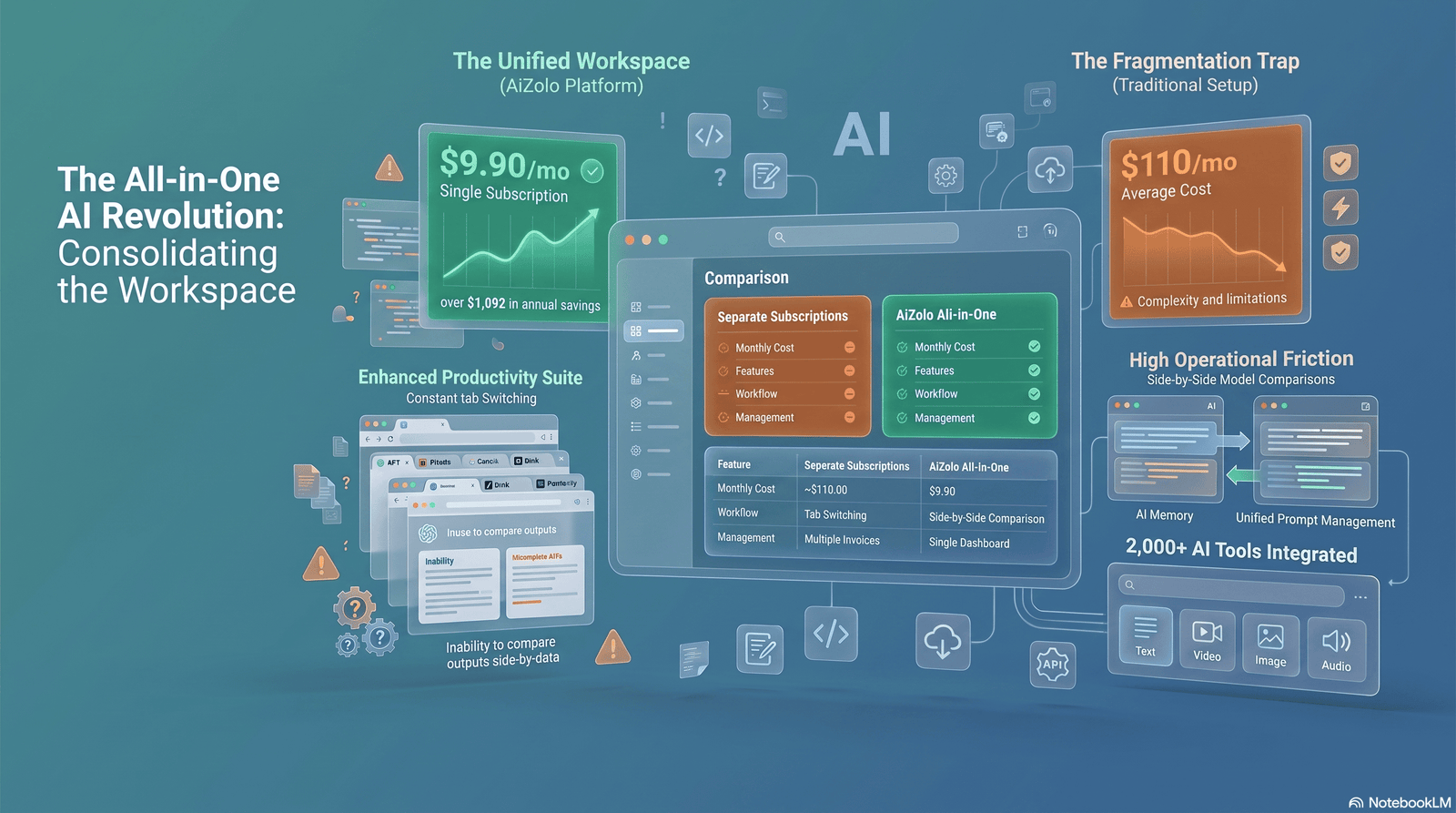
| Separate subscriptions | Full native features per provider, highest usage limits per model, deepest ecosystem integration | Highest total cost, multiple logins, no built-in comparison view |
| AI aggregators / unified workspaces | Lower total monthly cost, one login, side-by-side comparison, shared prompt history | Some native features unavailable, usage caps shared across models, newer platforms have smaller track records |
Frequently Asked Questions
What is the cheapest way to use multiple AI models for research? Using a single aggregator or unified-workspace subscription is the cheapest way to use multiple AI models for research, since it replaces several $20/month plans with one lower-cost bill.
Is it worth paying for ChatGPT, Claude, and Gemini separately? For most individual researchers, no. The combined cost is roughly $60/month for three providers, and most people don’t use all three enough to justify three separate bills.
Do AI aggregators use the same models as the official apps? Yes, in most cases aggregators connect to the same underlying models through official APIs, though message limits, response speed, and access to the very latest model versions can differ from the native apps.
Can I compare AI responses side by side for free? Some platforms offer limited free comparison, but full side-by-side comparison across several models with usable limits typically requires a paid plan of some kind.
Which AI model is best for academic research? It depends on the task. Long-document analysis favors large-context models, current-events questions favor search-grounded models, and structured summaries vary by model. That variation is exactly why researchers use more than one model.
Does using multiple AI models reduce hallucinations? It reduces the risk of accepting a hallucination unchecked, because disagreement between models is a signal to verify. It doesn’t eliminate hallucination risk from any individual model.
Is Perplexity considered a multi-model platform? Perplexity offers some model selection within its Pro plan, but it’s built primarily as a search-first, citation-first tool rather than a general multi-model comparison workspace.
How much do researchers typically spend on AI subscriptions per year? Combining ChatGPT Plus, Claude Pro, Google AI Pro, and Perplexity Pro at their standard tiers comes to roughly $960 a year before adding Grok or higher usage tiers.
Is DeepSeek free to use? DeepSeek’s web chat is free. Programmatic API access is billed per token, separate from any subscription plan.
What should I look for in an AI aggregator platform? Check which specific models are included, whether responses can be viewed side by side, how prompt history is stored, and whether the pricing is a flat monthly rate or usage-based.
Are AI aggregators safe for sensitive research data? Review any platform’s data retention and training-use policy before entering sensitive material, the same way you would with any individual AI provider.
Can academic researchers get discounts on AI subscriptions? Some providers, like Perplexity, offer discounted education tiers with student verification. Most major chat subscriptions don’t offer formal academic discounts beyond that.
Do multi-model platforms support citation verification? Some do, particularly ones with search-grounded models included. Always verify a citation against the original source rather than trusting any AI-generated citation directly.
Is it better to use one AI model deeply or several models lightly? For narrow, repetitive tasks, one model deeply is usually sufficient. For open-ended research questions, cross-checking a few models tends to catch more gaps.
How do I switch between AI models without losing my research thread? A unified workspace with shared prompt history keeps the thread intact across model switches. Without one, copying the same prompt manually between separate apps is the workaround.
Conclusion
Five separate AI subscriptions add up to roughly $1,300 a year for access that most researchers use in bursts, not constantly.
The cheapest way to use multiple AI models for research isn’t cutting models out — it’s cutting the redundant subscriptions.
A single aggregator-style workspace, like Aizolo, keeps the multi-model comparison researchers actually need while dropping the four extra bills that come with it.
If your research process already involves checking more than one model’s answer, that comparison belongs in one workspace, not five browser tabs.
Explore Aizolo’s single subscription for multiple AI models and see whether it covers your research workflow before renewing separate plans.
External Links (8–12 authoritative sources)
- OpenAI Pricing — https://openai.com/pricing
- Anthropic Pricing — https://www.anthropic.com/pricing
- Google Gemini Pricing — https://gemini.google/subscriptions/
- xAI (Grok) Pricing — https://x.ai/grok
- Perplexity Pricing — https://www.perplexity.ai/pro
- DeepSeek API Documentation — https://api-docs.deepseek.com/
- Google Search Central — https://developers.google.com/search
- Google Helpful Content guidance — https://developers.google.com/search/docs/fundamentals/creating-helpful-content
- Google Spam Policies — https://developers.google.com/search/docs/essentials/spam-policies
- Google Search Central: Core Updates — https://developers.google.com/search/updates/core-updates
Author Bio
Jeevesh Tripathi AI Researcher & Technical Content Writer Email: jeevesh@aizolo.com
Jeevesh Tripathi researches AI tool pricing, model comparisons, and practical research workflows for businesses and independent researchers. His work focuses on evidence-backed cost analysis rather than promotional claims, drawing on hands-on testing of AI subscription plans, API pricing structures, and multi-model workflows across academic and business research contexts.