How well do you really know your customers? A business may know the ages, locations, and occupations of its customers but have no idea why they buy what they do, what keeps them from purchasing, or what factors influence their choices.
Learning how to use AI for customer persona and audience research can help you find those answers in customer interviews, surveys, reviews, support conversations, and other existing data.
While AI can analyze vast amounts of data, flag common themes, and attempt to classify thoughts and actions, the accuracy of its findings will depend on how much information you give it and how seriously you evaluate its results.
When using AI for audience research, you can also try AiZolo to compare how different AI models interpret the same customer data, helping you uncover useful perspectives on customer motivations, pain points, and purchasing behavior.
This article will discuss best practices in soliciting and presenting evidence to identify customer motivations and pain points and construct a proper persona, determine if the given persona is realistic, and utilize this information to influence the audience.
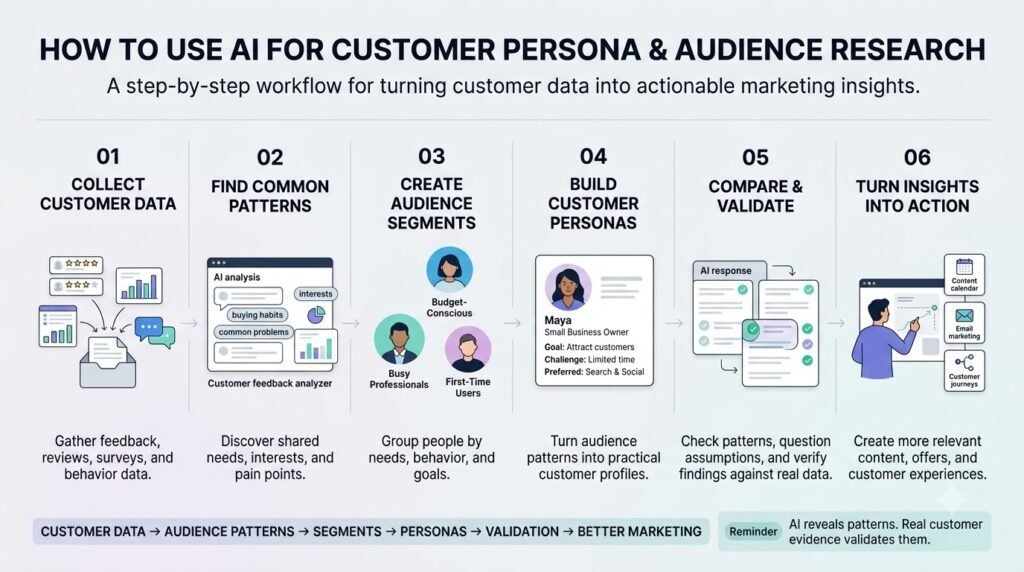
Table of Contents
What Is AI-Powered Customer Persona and Audience Research?
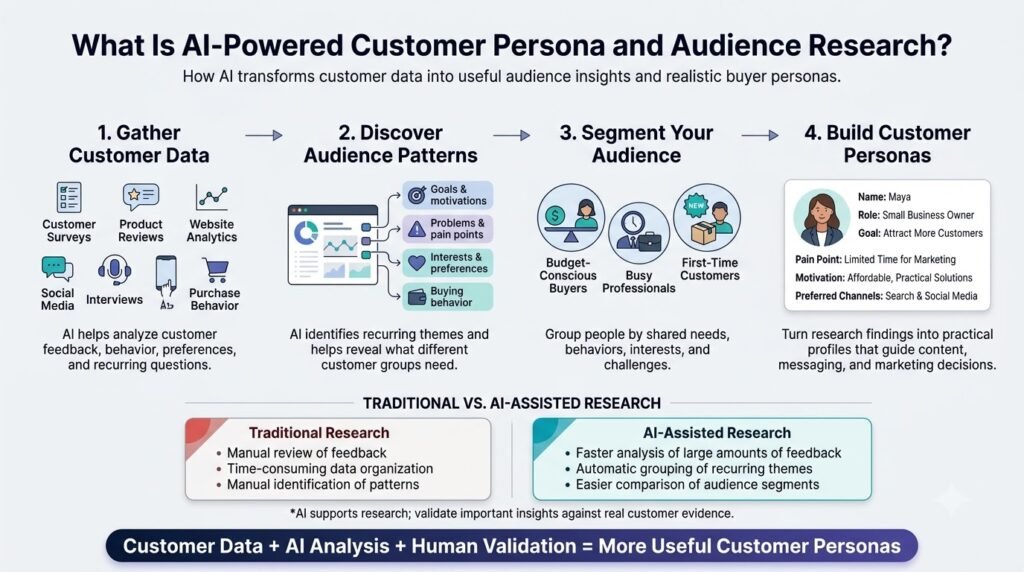
AI-powered customer persona and audience research uses artificial intelligence to analyze customer information, identify patterns, and turn those findings into useful audience profiles.
It allows researchers to organize disparate pieces of information and see a bigger picture—understand what their customers need, want, and how they are likely to behave and approach the purchase.
A customer persona typically describes the target audience or the group of customers that have similar purchasing motives, needs, behaviors, and attitudes.
Audience research is the broader process of understanding who those people are, what they care about, and how they make decisions.
For example, a software company might discover two different groups among its customers. Freelancers may care about cost and time spent while customers may care more about collaboration and consistency.
A good persona makes these distinctions clear, highlighting the differences between one set of customers and another rather than trying to squeeze everyone into a single category.
On the other hand, AI can recognize patterns, but it cannot comprehend whether these patterns make sense or not. That requires relevant customer evidence and human review.
How Can You Collect the Right Customer Data Before Using AI?
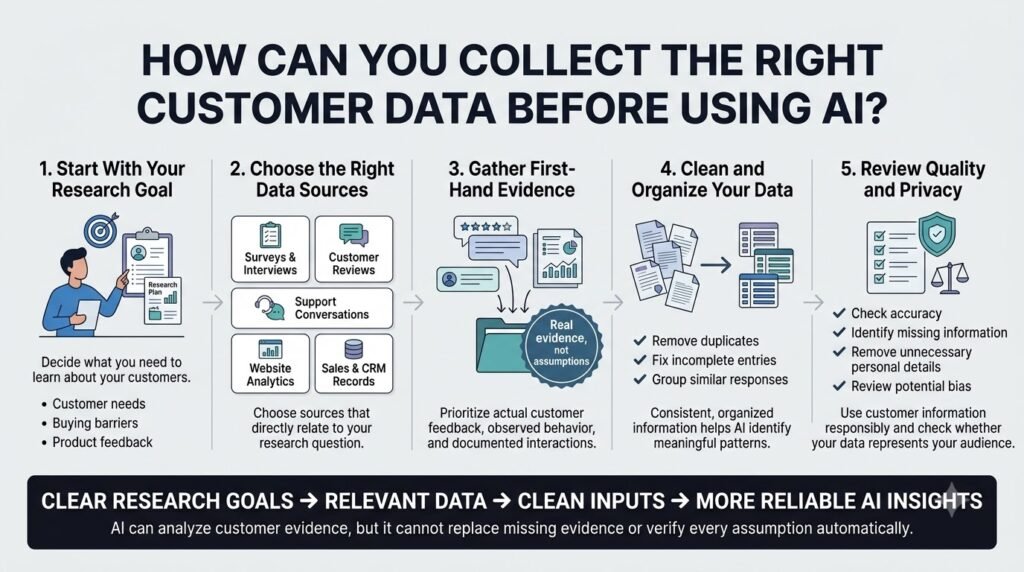
Start by importing information that reflects the real customers’ voices rather than asking the assistant to create a customer persona based on features of your perfect buyer. Use actual customer interviews, reviews, and feedback to build a customer persona.
You can also use data from your website’s analytical tools or salespeople’s notes on held meetings with prospects.
Depending on your needs, select which of the available customer data to use for creating the persona. For example, interviews can help you understand the reasons for purchase, while reviews can reflect the most common complaints, and website analytics can highlight popular pages or products.
| Data source | What AI can help you discover |
| Customer interviews | Goals, motivations, objections, and decision-making |
| Surveys | Stated preferences, priorities, and satisfaction |
| Product reviews | Common complaints, desired features, and expectations |
| Support conversations | Repeated problems and points of confusion |
| Sales call notes | Purchase concerns, budget limits, and reasons for choosing a product |
| Website analytics | Patterns in visits, engagement, and conversion behavior |
How Should You Prepare Customer Data for AI Analysis?
You should eliminate duplicates, fix any obvious formatting problems, and separate out what is said by customers and what is your interpretation.
If the data has personally identifiable information, make sure you remove any unnecessary PII and scrub the data according to your company’s privacy and consent policies before uploading it to the AI tool.
Make sure to retain the original source or record ID so that you can trace insights back to where they came from. If you can’t associate a customer’s supposed preference with an actual observation, note that it’s an assumption on your part.
How Can AI Identify Customer Pain Points and Motivations?
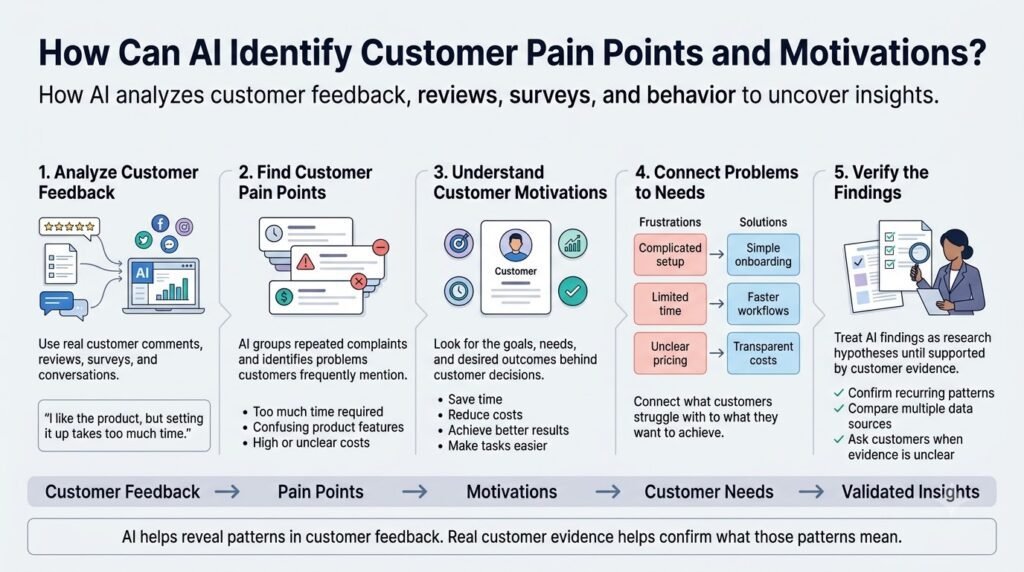
AI can group similar customer comments, identify patterns, and differentiate between what customers are saying and why they are saying it. It is most useful when you provide real feedback and ask it to show the evidence supporting each pattern.
Imagine a project management company reviewing customer comments such as:
- “I spend too much time asking colleagues for updates.”
- “I cannot tell which tasks are overdue.”
- “Our weekly status meetings take too long.”
AI may group these comments under a more general topic: difficulty in tracking the progress of a project on a team. That theme points to a possible customer need, but it does not prove that every customer shares it or that one specific feature will solve it.
What Prompt Can You Use to Analyze Customer Feedback?
Use a prompt that asks the AI to classify the feedback, tally recurring themes, and separate evidence from interpretation. Here’s an example of such a prompt applied to a body of reviews, interview notes, or similar qualitative data.
Customer pain-point analysis prompt:
Analyze the customer feedback below for [product or service].
Group similar comments into recurring themes. For each theme, provide:
- The customer problem.
- Supporting evidence using short excerpts or record IDs.
- The number of relevant records.
- The likely underlying need.
- Alternative interpretations.
- A confidence level.
Separate direct evidence from your interpretation. Do not invent quotes, counts, demographics, or motivations. If the data is insufficient, say so.
Customer feedback: [Paste anonymized feedback here]
Review the results against the original comments. A theme that recurs in the feedback from different customers is important to address, but frequency is not a proxy for significance: a less common issue can be disproportionately impactful on a valuable segment of customers.
How Can You Create Customer Personas With AI?
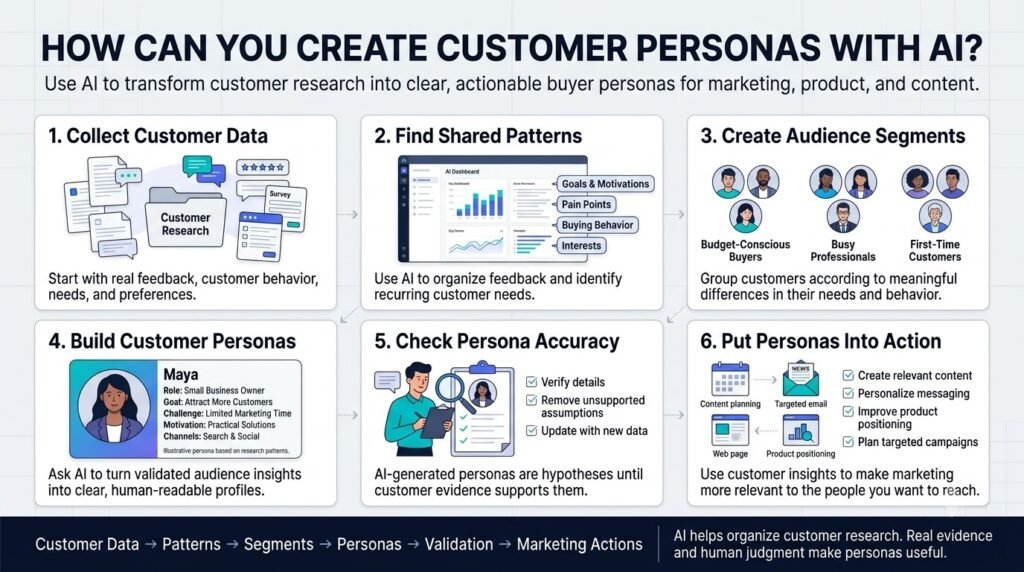
Once you’ve discovered patterns, instruct the AI to create customer personas – a collection of desired traits, common goals, behaviors, and pain points. Each persona should represent a distinct group of consumers and serve as a basis for your team’s decisions.
For example, a B2B software company might identify these two provisional personas from its customer interviews.
Persona A: The Independent Professional
- Primary need: Save time without adding costs.
- Goals: Complete work efficiently and manage tasks independently.
- Pain points: Complicated software, expensive subscriptions, and lengthy setup.
- Decision criteria: Simplicity, affordability, and speed.
Persona B: The Marketing Team Lead
- Primary need: Coordinate work and maintain consistency.
- Goals: Improve collaboration and keep projects organized.
- Pain points: Scattered information, inconsistent output, and limited visibility into team activity.
- Decision criteria: Shared workflows, reliable results, and team coordination.
These are just a few example personas. Create a persona based on extensive customer research and evidence that different customer segments have different characteristics.
What Should Every AI-Generated Customer Persona Include?
A proper persona should also feature the customer’s key goals, challenges, expectations, decision-making criteria, objections, and related behaviors, as well as the evidence for each of the conclusions reached.
Demographic information should only be included if it is relevant and justified based on the collected and analyzed data.
Customer persona creation prompt:
Using the customer research provided, create a provisional persona for each distinct group supported by the evidence.
Include:
- Shared needs and goals.
- Pain points and desired outcomes.
- Behaviors and buying triggers.
- Objections and decision criteria.
- Preferred support or communication.
- Evidence supporting each claim.
Separate observed facts from hypotheses. Do not invent names, ages, job titles, income levels, or other demographics. If two groups lack meaningful differences, do not create separate personas.
Research findings: [Paste validated findings here]
Do not turn a persona into a biography. While creating a vivid image of a person may be appealing, a properly structured persona features a brief description of a customer’s behaviors and expectations, rather than a detailed story of an imaginary person.
How Can AI Help You Segment Your Target Audience?
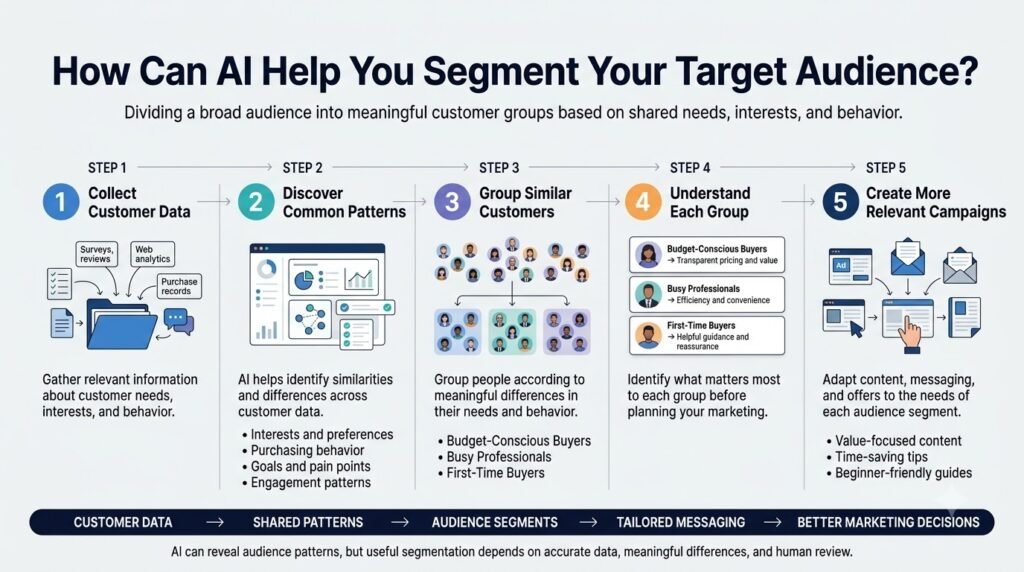
Through the proper use of artificial intelligence, one can separate the broad customer base into segments that share common characteristics, such as pain points, product usage patterns, budget constraints, or buying motivations.
Subsequently, one can develop a set of messages, product offerings, or levels of support that best fit each identified segment.
For example, an online learning platform business can have three main customer segments: students who need a comprehensive course, career-driven adults who value concise modules, and management that wants to train their subordinates.
One can see that these segments’ ages can overlap, yet their buying motivations and patterns are different.
First, use AI to separate your customer base; then, examine the generated segments and their statistical power. In doing so, compare the created segments to your in-house information, such as purchases, retention, surveys, or product usage.
Which Audience Segmentation Criteria Should You Use?
When selecting your criteria, choose ones that will help you understand customer needs, or will indicate significant differences in behaviors. Choose criteria based upon your business model, and the data that is available to you.
| Segmentation criterion | Example |
| Needs-based | Customers who need speed versus detailed control |
| Behavioral | Occasional users versus frequent users |
| Use-case-based | Individual projects versus team collaboration |
| Purchase-related | Price-sensitive buyers versus buyers prioritizing support |
| Lifecycle-based | New customers versus established customers |
Don’t assume that customers within the same age range, location, or occupation will have similar needs. While it’s possible that these different people will share some commonality, their behaviors and motivations may differ, making such segmentation ineffective.
How Do You Validate AI-Generated Customer Personas?
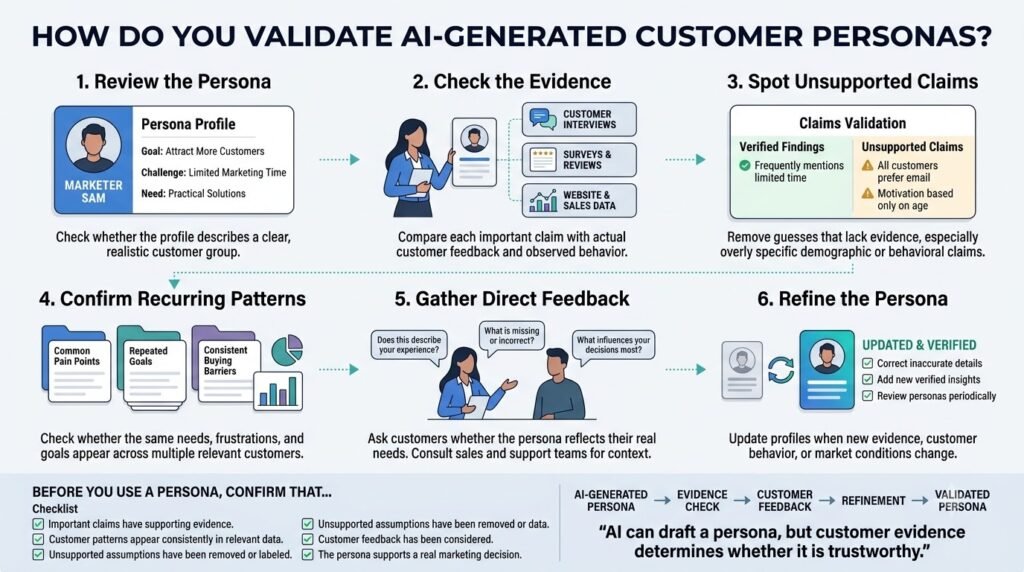
Make sure that every persona is validated by existing evidence, such as interviews, survey data, customer files, and observed behaviors. After all, personas generated by AI programs are just that – always remember that personas are only hypotheses until they are proven to be valid.
Use this four-step validation process:
- Trace every important claim. Find the interview, survey response, review, or other record that supports each major customer need or behavior.
- Look for evidence across customers. Check whether a pattern appears across several independent customers, rather than relying on one memorable comment.
- Ask customers follow-up questions. Test uncertain assumptions through interviews or surveys. Ask about recent experiences rather than leading customers toward the answer you expect.
- Update the persona as evidence changes. Revise or retire profiles when customer behavior, product use, or business conditions change.
You can also ask a second AI model to challenge the persona by identifying unsupported assumptions, conflicting evidence, and alternative explanations. For a broader process of checking AI-generated claims, see AiZolo’s guide to fact-checking AI-generated answers before publishing.
How Can You Measure Whether a Customer Persona Is Useful?
A useful persona helps your team make a decision that would otherwise be less informed. Test whether it enhances the relevance of your messages, prioritizes your products, improves the onboarding experience, or has some other measurable impact.
For example, a marketing team could compare two landing-page messages: one focused on saving time and another focused on improving team coordination. If the messages are tied to validated persona needs, the team can test whether each message appeals to its intended audience.
Define the success measure before the test, such as qualified sign-ups or completed onboarding. A persona does not prove that a marketing message will work; controlled testing helps establish whether the proposed message makes a difference.
How Can You Compare AI Models During Customer Research?
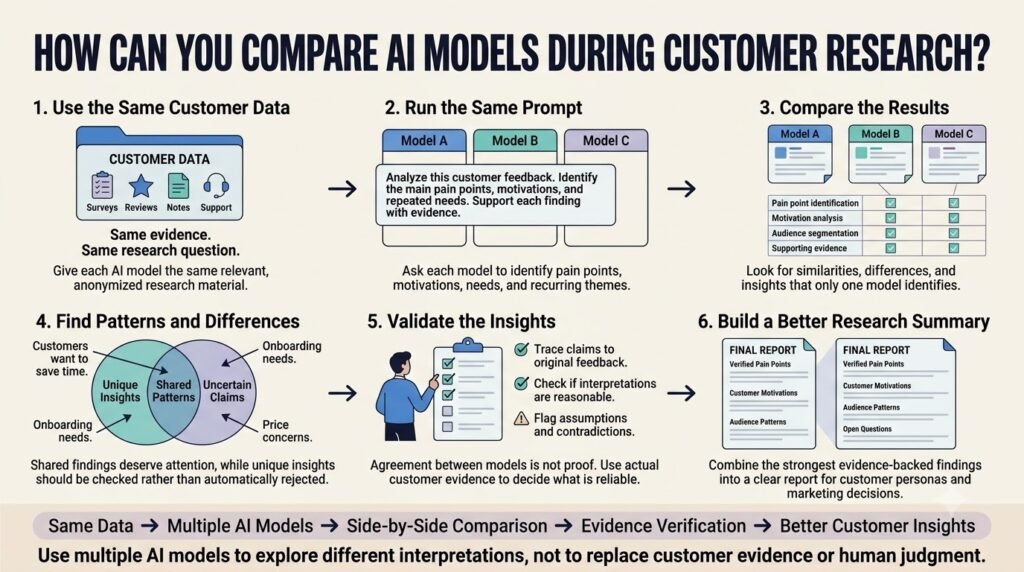
Different AI models might analyze the same customer data in different ways. You can compare the results of different models to identify differing themes, but agreement across models does not indicate truth.
A useful experiment is to present the same anonymized dataset and prompt to two or three different AI tools, then compare the themes, supporting evidence, segmentations, and uncertain assertions they return.
Then you can go back to the data to determine which conclusions are supported by evidence.
AiZolo has a workspace for comparing multiple AI models against the same research prompt, which may be helpful for identifying variations in interpretation across different systems.
Use the same anonymized customer dataset prompting multiple AI assistants and evaluate the results based on evidence, rather than asserting that any one interpretation is correct simply because it is consistent.
What Mistakes Should You Avoid When Using AI for Audience Research?
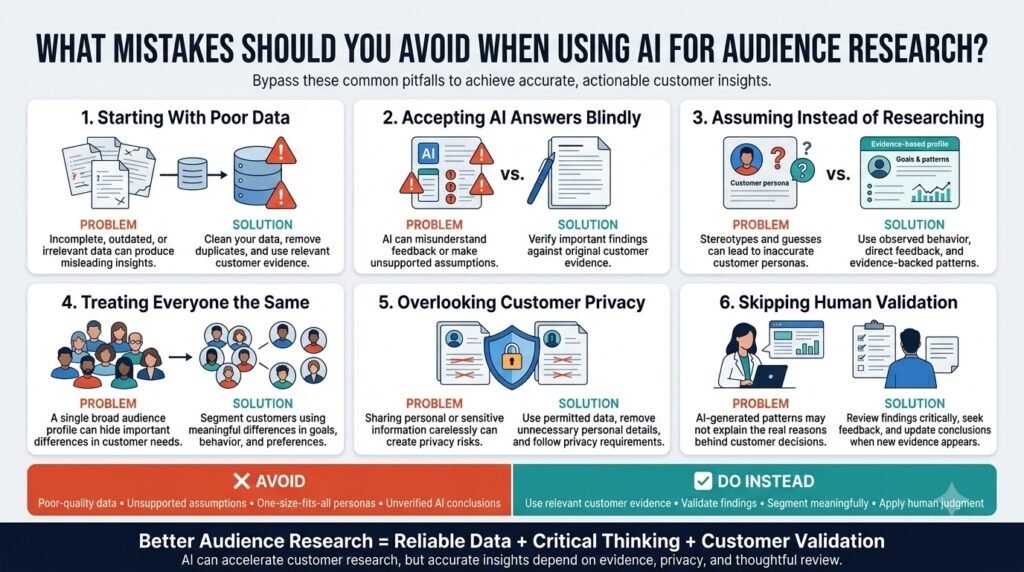
The four main mistakes in this case are creating AI to invent the target audience, accepting guesses as facts, ignoring biased data, and developing an excessive number of personas. These mistakes lead to the creation of unrealistic customer personas.
Avoid these common problems:
- Starting without customer evidence: Use real feedback or clearly label the output as an initial hypothesis.
- Trusting every AI conclusion: Verify important claims against their source records.
- Overgeneralizing from small samples: A few comments can reveal a question to investigate, but they may not represent the wider audience.
- Confusing correlation with motivation: A behavior pattern does not automatically explain why customers behave that way.
- Creating unnecessary personas: Combine groups when their needs and decisions are not meaningfully different.
- Ignoring privacy: Remove unnecessary personal information and use customer data only in accordance with applicable requirements and your organization’s policies.
- Never updating the profiles: Revisit personas when new evidence contradicts previous assumptions.
Keep the scope focused on understanding customers. If your research also uncovers unmet market needs, AiZolo’s guide to automated market gap analysis covers that separate process in more detail. Likewise, using validated personas later to plan and organize publishing belongs in the broader marketing content pipeline workflow, rather than being the main goal of this research.
What Is the Best Way to Use AI for Customer Persona Research?
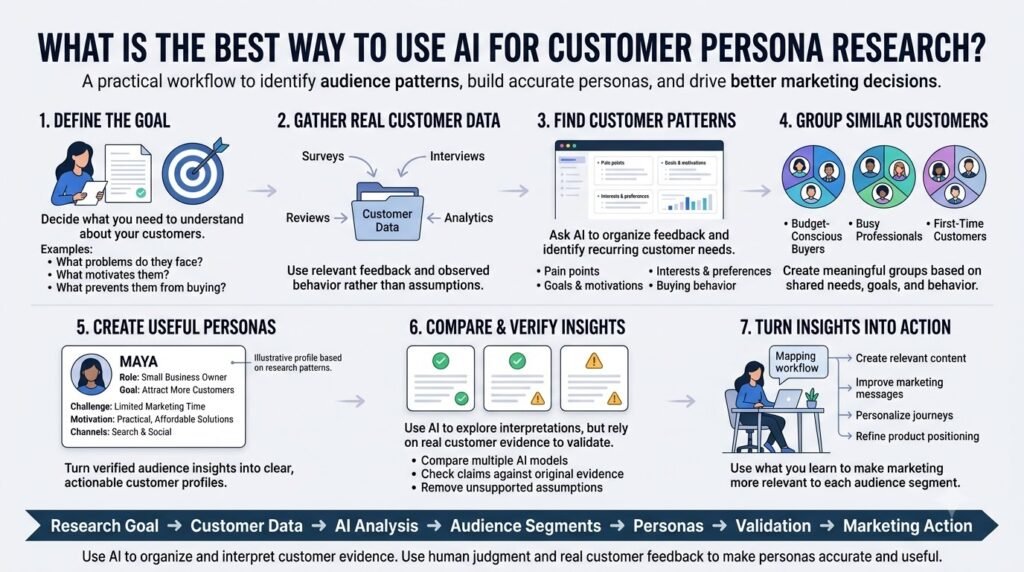
The most effective is to leverage AI to structure real customer evidence, formulate plausible explanations, and design provisional personas that you test with people and data. That way, your research remains grounded while still letting you take action on the insights.
So you can avoid the trap of plausible-sounding but ultimately incorrect assumptions from an AI becoming your customer strategy.
Use this seven-step workflow as a repeatable process:
- Define the research question. Decide what you need to understand, such as why customers abandon checkout or what makes a team choose one software product over another.
- Collect relevant customer evidence. Gather interviews, survey responses, reviews, support messages, or other appropriate data.
- Ask AI to identify patterns. Group recurring needs, motivations, objections, and problems while retaining links to the underlying evidence.
- Build provisional personas. Create profiles around meaningful differences in customer needs and behavior.
- Validate the findings. Check source records, seek customer feedback, and challenge unsupported conclusions.
- Test a practical decision. Use the persona to test messaging, onboarding improvements, or another relevant business decision.
- Refresh the personas. Update them when new customer evidence changes your understanding.
This workflow also follows the principle behind Google’s guidance on helpful, reliable, people-first content: provide genuine value, prioritize accuracy, and add meaningful analysis rather than relying on automated output alone.
FAQs: How to Use AI Customer Persona and Audience Research
Can AI create customer personas without customer data?
While AI can create a persona based on a description of your target audience, keep in mind that it is based on assumptions and does not constitute verified customer insight. Use an initial persona to help you identify interviewees and develop questions, then update it with actual customer insights before using it to inform marketing or product decisions.
Which AI tools can help with customer persona research?
While general-purpose AI assistants can analyze interview transcripts and organize open-ended survey responses, research tools can help you collect and verify supporting evidence, and quantitative analysis tools can quantify relevant survey results.
Choose your tools based on your needs to find or organize information, your research design, and your privacy and verification requirements.
How do you create buyer personas with AI?
Collect customer evidence, ask AI to recognize patterns in needs and behaviors, and create groups based on common attributes. Develop tentative personas that include goals, pain points, decision criteria, and supporting evidence. Perform validation based on the initial pool of evidence and customer feedback before finalizing personas.
How much customer data do you need to create a persona?
There is no established threshold for the minimum sample size because it should be based on the makeup of the audience and the specific research question. In some cases, a few interviews can help build a body of evidence, but before concluding that any particular outcome applies to a larger customer base, researchers will want more diverse data.
Can AI replace customer interviews and surveys?
No. While AI can help to organize existing responses and suggest follow up questions, it is unlikely to be able to identify every motivation and confirm every assumption without proper supporting evidence.
Interviews and surveys can help to ask clarifying questions, probe into surprising answers, and ensure that the connections identified by AI are actually reflective of customers’ experiences.
How can you prevent AI from inventing customer characteristics?
Make sure to provide source material for the AI to analyze, require it to back up any important insights with evidence, and instruct it to distinguish between observations and hypotheses.
In other words, do not ask the AI to identify motivations or assumptions for which there is no supporting information, such as specific demographic details or sensitive characteristics. Double-check claims that the AI makes that are not obvious, using the original documents, and note any uncertainties.
How often should customer personas be updated?
Review personas when entering a new market, introducing important product changes, observing shifts in customer behavior, or identifying information that may contradict a company’s understanding of its customers.
Growth companies with evolving audiences may find it necessary to update these documents more frequently than organizations with a consistent customer base.
Moreover, it is required to update personas based on research findings instead of following a predetermined schedule regardless of actual changes.
How can you use customer personas to improve marketing?
Utilize personas to create relevant content and effectively market products and services by reflecting customers’ values, interests, concerns, and decision-making criteria.
For instance, one can design messages emphasizing the product’s simplicity for users who value straightforward instructions and addressing the need for collaboration for teams. Additionally, it is possible to conduct experiments to measure the power of the developed personas.
What Should You Remember About Using AI for Customer Persona and Audience Research?
AI is only worth it if it can help you understand your customers better. That doesn’t mean you should rely on it to create some ideal customer persona, but rather use it to analyze the real data you have about your market.
Gather the feedback, analyze it, form a hypothesis about the customer persona, then test your theory by making a single practical decision based on the information you gathered and processed. You don’t need a full persona, you need to know what your customers really want to make the right choice.
Author
Anshika Verma — Content Researcher and Writer
Anshika Verma writes about AI tools, AI models, and creator technologies. Her content focuses on explaining practical workflows, evaluating AI-assisted approaches, and helping readers understand the benefits and limitations of using AI in real-world tasks.