Quick Summary: AI can simplify competitor content analysis by helping you compare articles, identify content gaps, evaluate examples, and build a stronger content brief.
The key is to verify AI-generated insights and focus on what your audience actually needs rather than copying competitors.
If you want a second perspective on your findings, AiZolo lets you compare responses from multiple AI models in one workspace, making it easier to explore different angles before deciding which insights are worth using.
Competitor research can be challenging, especially when you have to read and analyze a bunch of articles, remember what’s in them, compare the structure of your piece to theirs, and think about what unique value your article should have.
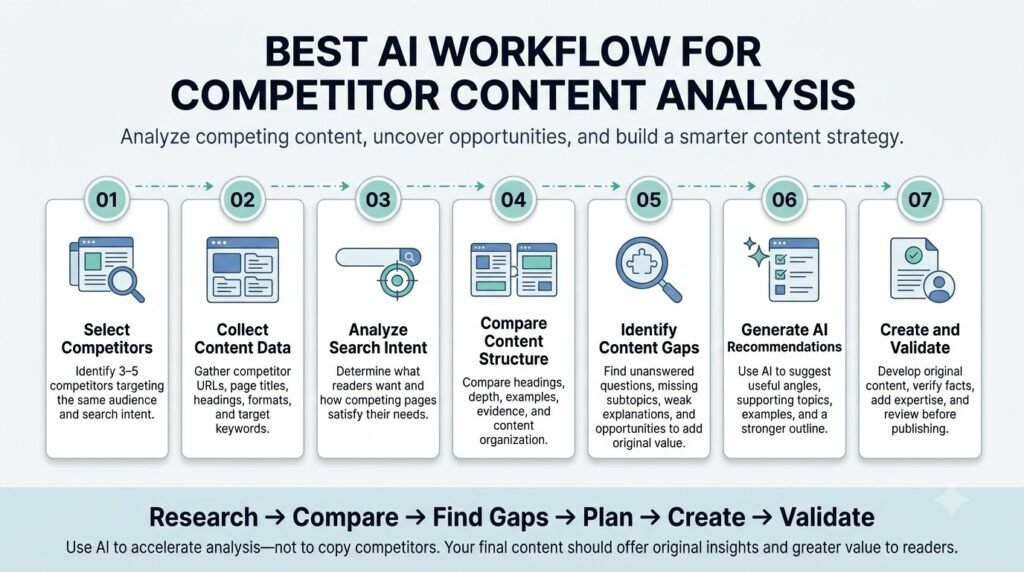
The best AI workflow for competitor content analysis turns that scattered research into a repeatable process without letting AI make every decision for you.
The point is not to imitate or even to create something longer than your competitors. Instead, you want to know how they positioned the topic, what examples they used, what questions they tried to answer, and what unique solution you could offer to your audience.
This guide will tell you what to do in seven steps, from finding the right pages to use as a benchmark to creating a content brief based on your research.
We’ll also share some AI prompts to help you get started, a comparison grid, and some tips on how to evaluate the results of your research.
Table of Contents
What Is the Best AI Workflow for Competitor Content Analysis?
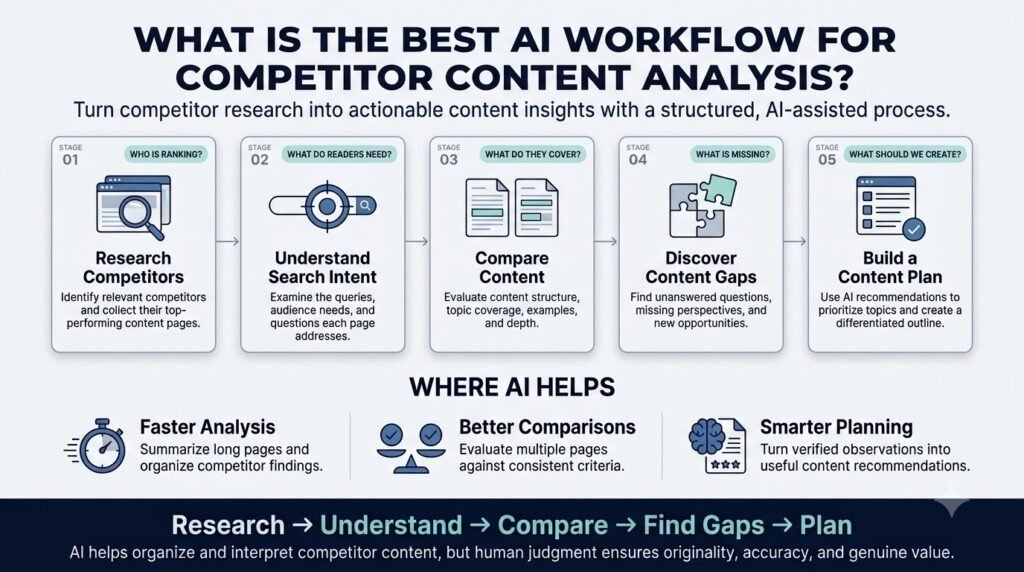
The optimal approach combines manual and AI-driven research, data extraction, comparative analysis, and human evaluation.
The process involves collecting competitor articles, using the AI to identify common criteria across the selected websites, examining the extracted information against the articles for accuracy, and ultimately building a unique content brief based on the findings.
A particular example of such an outline could be
choosing the competitors -> gathering their articles -> collecting the necessary insights -> comparing the coverage -> evaluating differences and similarities -> verifying the information ->
and defining a content brief.
In this case, every step produces an end result that can be taken as a new beginning for a different outline. As a consequence, there are fewer chances that one will get a ready response that requires additional refinement.
Why Should You Use AI to Analyze Competitor Content?
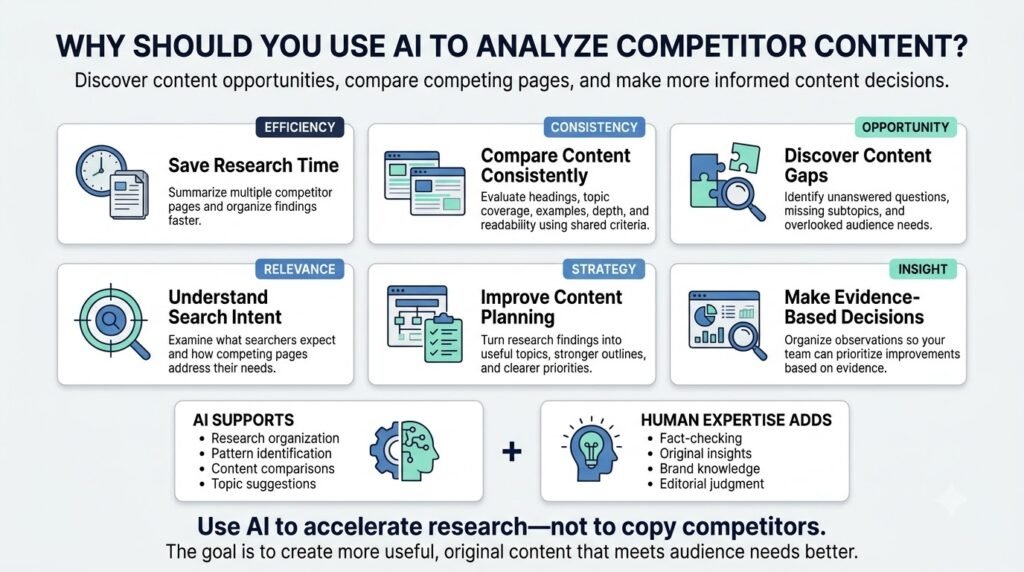
AI is helpful in cases when someone needs to compare several long articles based on certain criteria.
Instead of switching between the pages and trying to remember the structure, examples, explanations, and other details of the papers, it is possible to sort out the observations and form a comparative table.
For example, there are three similar articles about email marketing automation. One discusses the setup process, another one – the necessary examples, and the third one covers the most common errors.
Instead of spending hours analyzing the content, one can use an AI tool to organize the information into a well-structured comparison.
On the other hand, such tools are not capable of selecting the most and least authoritative sources, determining the relevance and importance of certain details, or figuring out the critical points that have to be compared.
All these aspects require human input based on the collected data, search results, audience, and other factors.
Step 1: How Do You Choose the Right Competitor Articles?
Begin with the precise topic you want to address, then research the pages that currently rank for that query. Select competitive articles that share the same audience and intent rather than choosing popular sites in your niche solely for their traffic.
For example, if you write a practical guide, analyze other tutorials covering the same topic. While a product landing page or an industry overview report can offer valuable background, they should not be considered direct competitors.
What Should You Collect From Each Article?
Record the following information before asking AI to analyze the pages:
- Article title and URL
- Publication or update date, when available
- Intended audience and apparent purpose
- Main headings and subheadings
- Key explanations, examples, and supporting evidence
- Content format, such as a tutorial, checklist, comparison, or case study
- Questions the article answers directly
Save the text of the article or the important excerpts and the URL of the page. If the page has interactive components, tables, or important visual elements, make notes of those separately instead of making assumptions about the content of the extracted text.
Step 2: How Can AI Extract the Same Information From Every Article?
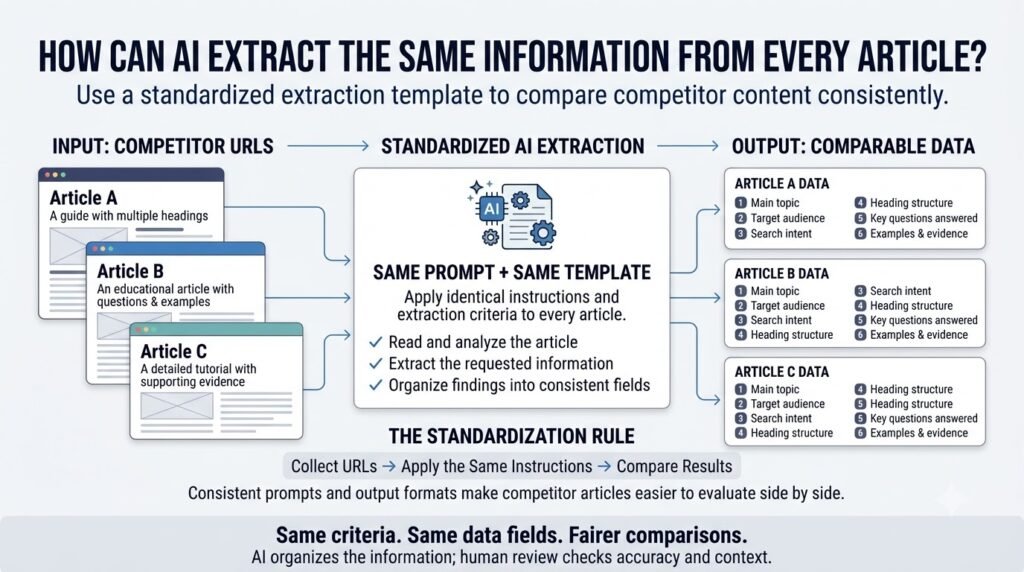
Give AI a standard extraction template and apply it to each competitor. The comparison of one article’s examples against another article’s overall topic structure produces misleading results.
Make the model discern between what the article says and what the model thinks.
Force it to include a heading, quote, or brief excerpt from the supplied article with every significant observation so that the user can jump back to the source page and verify that the model hasn’t fabricated information.
Reusable prompt:
Analyze the competitor article provided below for content research.
URL: [Insert URL]
Target topic: [Insert topic]
Extract the following:
- The article’s main purpose and intended audience.
- Its central argument or key takeaway.
- The main headings and subheadings.
- The important subtopics covered.
- The examples, evidence, instructions, or practical resources included.
- The questions answered explicitly.
- The content format and level of explanation.
- Any claims that appear to need further verification.
Support each significant observation with a heading or brief excerpt from the supplied article. Distinguish between direct observations and model interpretations.
Never invent information, interpolate inferences, or assume a topic is absent based on the article’s length or content.
Repeat the prompt for each competitor, and keep the outputs in a single spreadsheet or research document for easy comparison.
Step 3: How Do You Compare Competitors Without Just Counting Headings?
Compare what each article actually helps the reader understand, not merely how many sections it contains.
Two articles may use different headings while answering the same underlying question, and two equally long articles may offer very different levels of practical detail.
Use a shared comparison table with criteria such as these:
| Comparison criterion | What to examine |
| Main purpose | What problem is the article trying to solve? |
| Topic coverage | Which important aspects of the subject are explained? |
| Explanation quality | Are the ideas clear, specific, and understandable? |
| Practical value | Does the article include examples, instructions, or templates? |
| Evidence | Are important claims supported by reliable sources? |
| Structure | Can readers find answers in a logical order? |
| Originality | Does it provide a distinct perspective or useful insight? |
| Limitations | Does it explain trade-offs, exceptions, or situations where advice may not work? |
Ask AI to identify similarities and differences across these dimensions. Then check the most important observations against the actual articles rather than accepting the comparison as a final verdict.
A useful outcome could be that three competitors teach how to configure a tool, but just one teaches how to troubleshoot common failures. This observation is more useful than stating that three articles have similar outlines.
Step 4: How Can You Find What Competitors Explain Poorly?
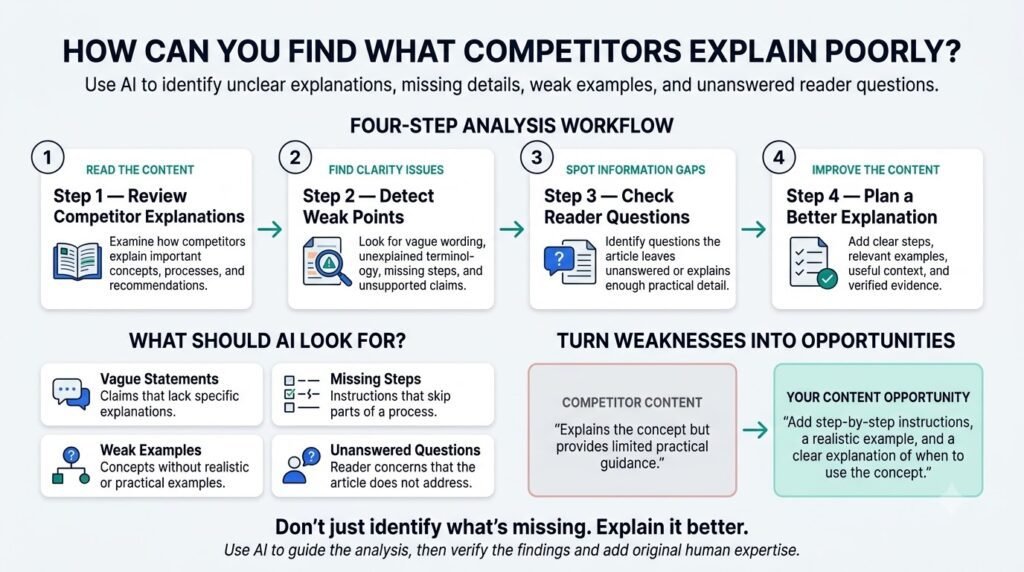
Look for opportunities where the reader might need more help. For instance, unclear instructions, definitions of obscure terms, missing examples, unsubstantiated claims, or recommendations that presuppose too much information.
These specific suggestions can be applied to your own article without making the entire research report a general SEO analysis.
For instance, several articles about email automation mention setting up a welcome series but do not explain what to do with customers who have already purchased the product. Your article could describe such a process in detail with an example of a decision tree.
Be careful with the word missing. A topic that does not appear in one competitor’s article is not automatically an important omission. It may be irrelevant to that article’s purpose, unnecessary for the audience, or covered elsewhere in the competitor’s resource library.
When competitor research reveals a possible gap, check whether it reflects a genuine audience need or a broader market opportunity.
AiZolo’s guide to using AI for automated market gap analysis explains how to evaluate unmet needs and competitor weaknesses. For content analysis, keep the focus on whether the observation helps readers understand the topic more clearly.
What Prompt Helps Identify Useful Editorial Opportunities?
Reusable prompt:
Compare the verified notes from these competitor articles about [topic].
Identify:
- Important questions that readers may still have after reading the articles.
- Instructions that are unclear or lack a practical example.
- Claims that need stronger evidence or qualification.
- Different approaches or recommendations that deserve explanation.
- Useful scenarios, constraints, or trade-offs that could be explained more clearly.
For each observation, identify the source article and supporting excerpt. The why of the issue’s relevance to the reader should be explained.
Separate confirmed observations from hypotheses, and do not recommend including a section unless it serves the intended audience and purpose of the article.
This focuses the analysis on editorially useful findings. If you also need to compare ranking keywords that are covered by competitors but not your website, treat that as a minor supporting research task, rather than the main purpose of this process.
Step 5: How Do You Decide Which Findings Deserve Attention?
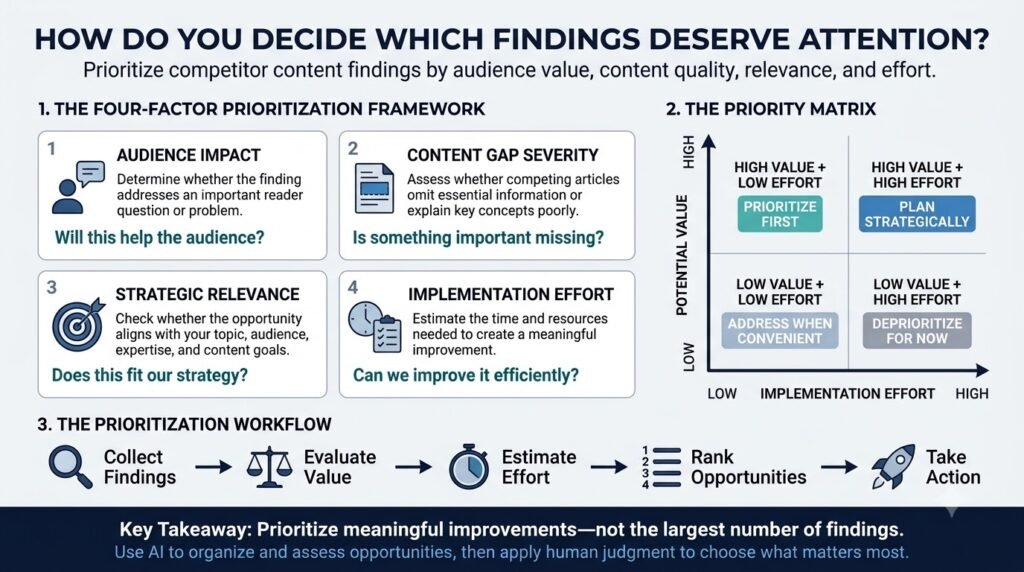
Not every difference between competitor articles deserves a new section in your content. Prioritize findings according to their usefulness to readers, their relevance to your article’s purpose, the strength of the supporting evidence, and the effort required to address them.
A simple scoring framework can help your team make consistent decisions.
| Criterion | Score |
| Relevance to the target reader | 0–3 |
| Importance to completing the reader’s task | 0–3 |
| Evidence that the current coverage is insufficient | 0–3 |
| Ability to add a genuinely useful explanation | 0–3 |
| Effort required | 0–3, with higher scores meaning less effort |
Add the scores to arrive at a maximum of 15 points. Use it as a launching pad for conversation, not as a scientific indicator of potential ranking or guaranteed traffic.
For instance, an ambiguous instruction that thwarts completion of a task by the reader might merit immediate attention while an absent historical tidbit that makes no difference to the reader’s choice can be safely deleted.
The final determination should be based on the value of the topic, not the point total.
Step 6: How Do You Verify AI’s Competitor Analysis?
Check the original articles before using AI-generated observations in your content brief. AI can overlook a paragraph, misunderstand a comparison, misread a table, or describe something as missing when it appears elsewhere on the page.
Verify the following:
- Coverage: Does the article really include or omit the identified topic?
- Context: Does the cited excerpt support the model’s interpretation?
- Accuracy: Are factual claims and technical explanations supported by reliable sources?
- Freshness: Are dates, instructions, and product details still current?
- Fairness: Are you comparing equivalent pages and judging them against the same criteria?
A competitor article is evidence of what that publisher wrote, not proof that every claim in it is correct.
When you need to verify a technical claim, prefer original documentation, official announcements, or primary research over repeating the same statement across several competitor articles.
Google’s guidance on creating helpful, reliable, people-first content is also relevant here: the finished article should offer original value to readers rather than merely summarizing what other pages already say.
For a broader process covering technical health, on-page issues, and overall website performance, see AiZolo’s guide to analyzing website SEO with AI tools. That guide addresses a wider SEO audit; this workflow is specifically about understanding competing articles and deciding how to create a more useful one.
Step 7: How Do You Turn the Analysis Into a Better Content Brief?
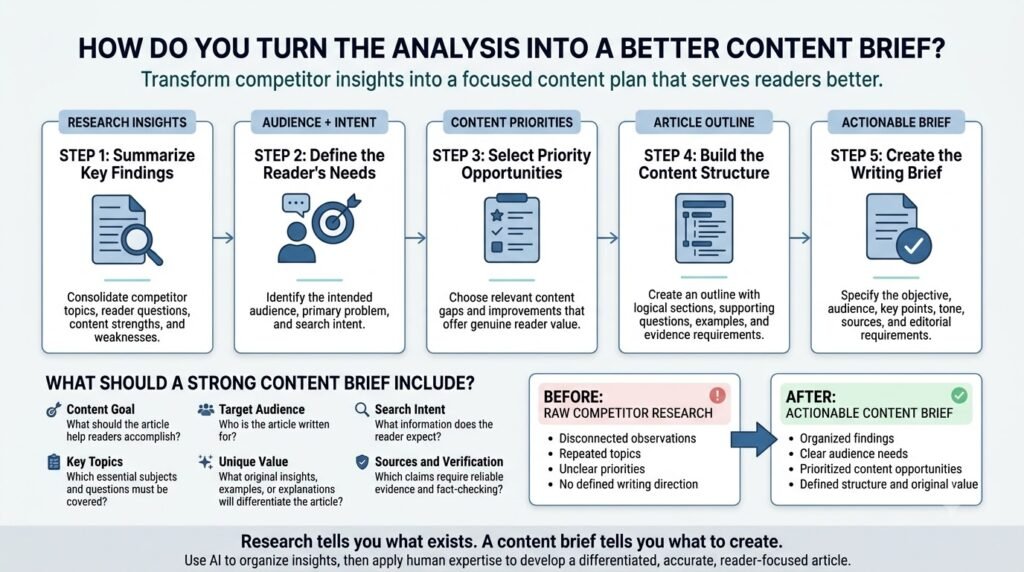
The final output should be a brief that tells the writer what the new article needs to accomplish and why. It should preserve useful research findings without copying a competitor’s structure or turning every observed difference into another heading.
Include these elements:
- Target reader and the problem they need to solve
- Primary topic and intended search intent
- Important questions the article must answer
- Verified competitor observations
- Examples or explanations your article can add
- Claims requiring authoritative sources
- Proposed heading structure
- Relevant internal links
- Editorial boundaries and topics to keep brief
Reusable content-brief prompt:
Using the verified competitor analysis below, draft an original content brief for an article about [topic].
Specify the target reader, their problem, the article’s unique angle, the key questions to be answered, the evidence/examples required, and the proposed headings.
Suggest where to elaborate on the subject in more detail or from a different angle than your competitors do. Avoid copying the headings from the analyzed articles, presenting made-up research data, or adding subtopics for the sake of length.
Maintain the balance between related subjects: delete or expand items according to the primary intent of the search. Mark any questions requiring further research before proceeding to the next step.
Before finalizing the brief, ask yourself if it offers the reader a compelling reason to select your article over the existing ones. If the brief is found to imitate the structure of the competitors’ articles with changed words, return to the research stage and look for a new angle.
Once the competitor analysis is complete, the findings can inform your editorial planning process. If you need to organize research into briefs, assignments, and publishing stages, see this guide to building a marketing content pipeline.
How Can You Compare AI Models During Competitor Research?
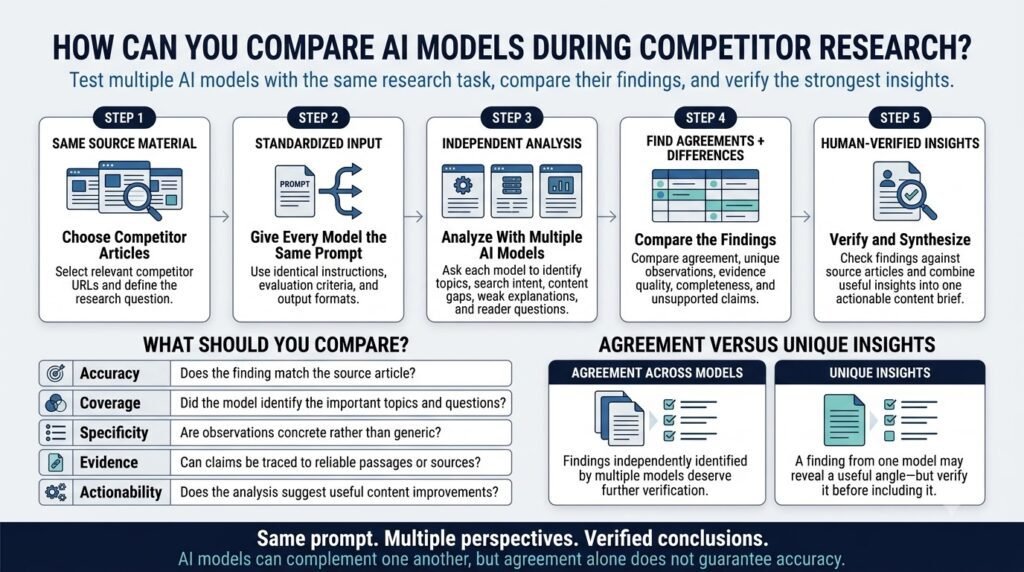
Different AI models may organize the same material differently, which can be useful when you need another perspective on a complex set of articles. One model may identify recurring explanations, while another may point out assumptions or practical scenarios that deserve closer examination.
For a high-value article, you could ask one model to extract structured observations, another to challenge the proposed conclusions, and a final reviewer to check whether the brief follows the original evidence.
Keep the source articles available throughout the process; agreement between models does not establish that a finding is correct. AiZolo provides a workspace for using multiple AI models and comparing their responses.
If you want to test this approach, run the same competitor-analysis prompt through different models, compare the observations, and verify the most useful findings against the source pages before using them.
For another example of a structured multi-model process, see AiZolo’s guide to the best AI brainstorming technique using multiple models.
The same principle applies to competitor research: independent perspectives can broaden your thinking, but the evidence and your editorial judgment should determine the final result.
What Mistakes Should You Avoid in AI Competitor Content Analysis?
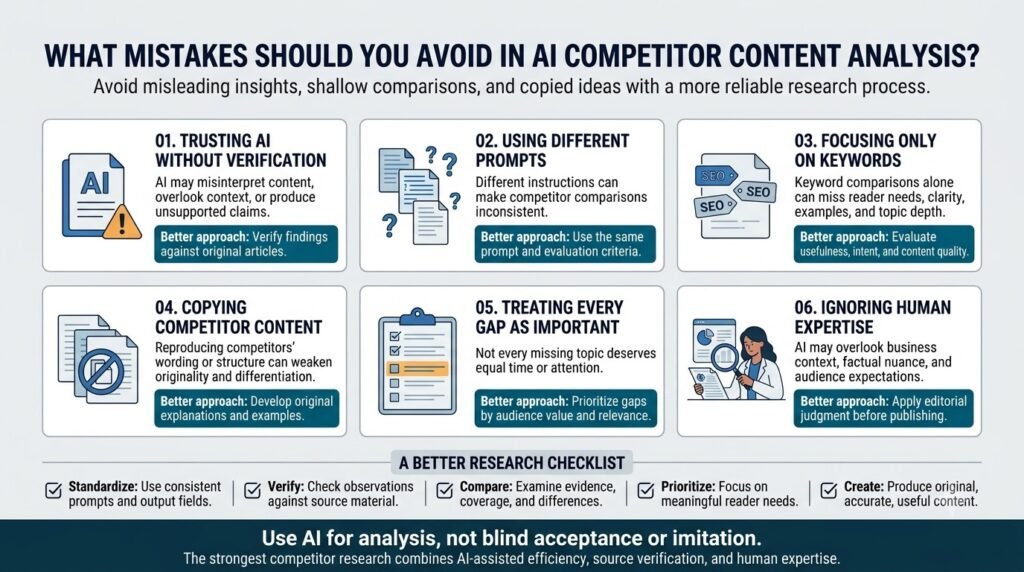
The most common mistakes are: using AI summaries as objective truths, picking the wrong competitors that have nothing to do with the target audience, and thinking that all the sub-topics that were not covered by a competitor’s article should be included in yours.
These wrong decisions lead to research that only produce more information that does not improve the final result.
Do not copy the headings of other articles, do not judge the quality of content on the quantity of words, and do not ask the AI to make up statistics about search engine performance, traffic, and keywords.
If the tool does not have access to this data, it cannot generate an accurate report about these elements.
Last but not least, avoid using this strategy as an excuse to publish a low-quality long-form article. Use the research to improve the content by addressing the identified issues and removing the unnecessary part.
FAQs: Best AI Workflow for Competitor Content Analysis
What is competitor content analysis?
Competition content analysis is a process during which you study your competitors’ articles to define the topic, structure, explanation, examples, evidence, and target audience. It is an opportunity to look at the problem from a new perspective, learn, and see what options are available to you.
Which AI tools are best for competitor content analysis?
Tools for analyzing competition content vary from the ability to collect the materials to analyze the article’s structure and compare the documents.
However, there are some differences between tools designed to collect and process web pages and those that process lengthy texts, articles, and analyze keywords. A competent analysis requires verifying the collected information from reliable sources.
How do you analyze competitor blog posts with AI?
Collect relevant articles and run them through the AI, using the same extraction prompt for all. Record the topics, headings, examples, evidence, and limitations extracted by the AI.
Build a comparison table, fact-checking the most compelling results against the source page, and use the most interesting observations to craft a new content brief.
Can AI identify gaps in competitor content?
The AI may find that certain questions go unanswered or receive vague answers, there may be missing examples, or topics may be covered in different ways. In these cases, you should take the insight from the AI and research the question or problem for yourself to see if it requires further discussion.
How many competitor articles should you analyze?
There is no magic number of articles to use. Begin with a few, such as 3–5, then observe the results. If you notice different approaches that suggest themselves to be worthy of further analysis or contain important unanswered questions, consider expanding your sample pool.
The quality and relevance of analysis is much more important than quantity.
Is competitor content analysis the same as an SEO audit?
No. Competitor content analysis is used to research how the competing articles cover the subject and what they offer to the readers. An SEO audit refers to reviewing the website’s technical and on-page aspects to determine its relevance and visibility in search results.
The competitor research may be utilized for an SEO audit, but these concepts are different.
How can you use competitor research without copying content?
One should analyze the competing articles as a model and seek to offer a different perspective, structure, and arguments. Build your synopsis based on the problem you see fit to address, research the data and facts independently, include your examples and explanations, and make unique editorial choices for better content.
Does using multiple AI models improve competitor analysis?
Working with several models increases the likelihood of discovering new angles, questions, and solutions that have not been considered. However, it does not necessarily mean that the chosen models are correct or that the information they provide is accurate.
It is advisable to review the critical points identified in the models, compare them to the findings, and confirm them against external sources.
Competitor research can also help you discover useful topics for future articles. For a complementary approach to turning audience needs and research into article ideas, explore these blog content ideas for AI workspace users.
Final Takeaway: What Makes This AI Workflow Effective?
The most efficient way to use AI to perform competitor content analysis is to devise an appropriate set of instructions for the model to follow.
The instructions must include choosing the necessary pages, obtaining the required information from them, comparing the obtained data, examining inconsistencies, checking the accuracy of the resulting information, and expanding on it to create a unique piece of content.
While using such instructions for an AI model can make the process of creating articles faster and more organized, it is essential to remember that the initial information and the judgment of the person using the model play an essential role in the final article.
Additionally, an article should be created in a way that would benefit the audience and help them better understand the topic rather than provide the same information word by word.
About the Author
Anshika Verma is a content researcher and writer focused on researching AI tools, models, and creator technologies. Her work emphasizes practical workflows, source verification, and clear explanations that help readers evaluate AI-assisted approaches thoughtfully.