Type a question into Google today and there’s a good chance you never scroll past the first screen. An AI-written summary sits at the top, already answering you. No blue links, no scrolling, no deciding—and platforms like Aizolo reflect how AI-powered answers are changing what “Googling something” means for many people today.
So it’s a fair question: Will AI Replace Google Search? Not by a rival search engine—those have come and gone for two decades—but by AI itself, the same technology Google is using to hold onto its own users. That’s why Will AI Replace Google Search has become one of the biggest debates in the future of online search.
The short answer: no, not yet, and probably not entirely. But the way people search has already changed more in the last two years than in the previous decade. This article walks through what’s actually happening, backed by current data, so you can see past the hype in either direction.
Table of Contents
What “AI Search” Actually Means
“AI search” isn’t one thing. It covers several different products that get lumped together in headlines:
- AI Overviews — the AI-generated summary box Google inserts above normal search results.
- Google AI Mode — a separate, opt-in conversational search experience inside Google.
- ChatGPT Search — OpenAI’s built-in web search feature inside ChatGPT.
- Perplexity — a standalone “answer engine” built around citations.
- Copilot and Gemini as assistants — chat-first tools that can search the web when needed.
Mixing these up is the number one reason people talk past each other on this topic. Google AI Overviews and Google AI Mode are Google’s own products, not competitors to Google — they’re Google trying to stay ahead of ChatGPT and Perplexity rather than get replaced by them.
How Google Search Actually Works
Google Search runs on three basic stages: crawling, indexing, and ranking. Bots crawl the web, index the content they find, and then a ranking system — built on hundreds of signals including relevance, authority, and page experience — decides what shows up and in what order for a given query.
Historically, the output was a list of ten blue links. You did the synthesizing yourself: opening a few tabs, comparing them, forming a view.
How AI Search Works
AI search systems work differently. Instead of just retrieving and ranking documents, they use a technique often called retrieval-augmented generation: pull in a handful of relevant sources, then generate a single written answer that synthesizes across them, often with citations attached.
The synthesis step is the real difference. Google’s classic model finds information for you. AI search tools attempt to answer for you.
AI vs Traditional Search: A Direct Comparison
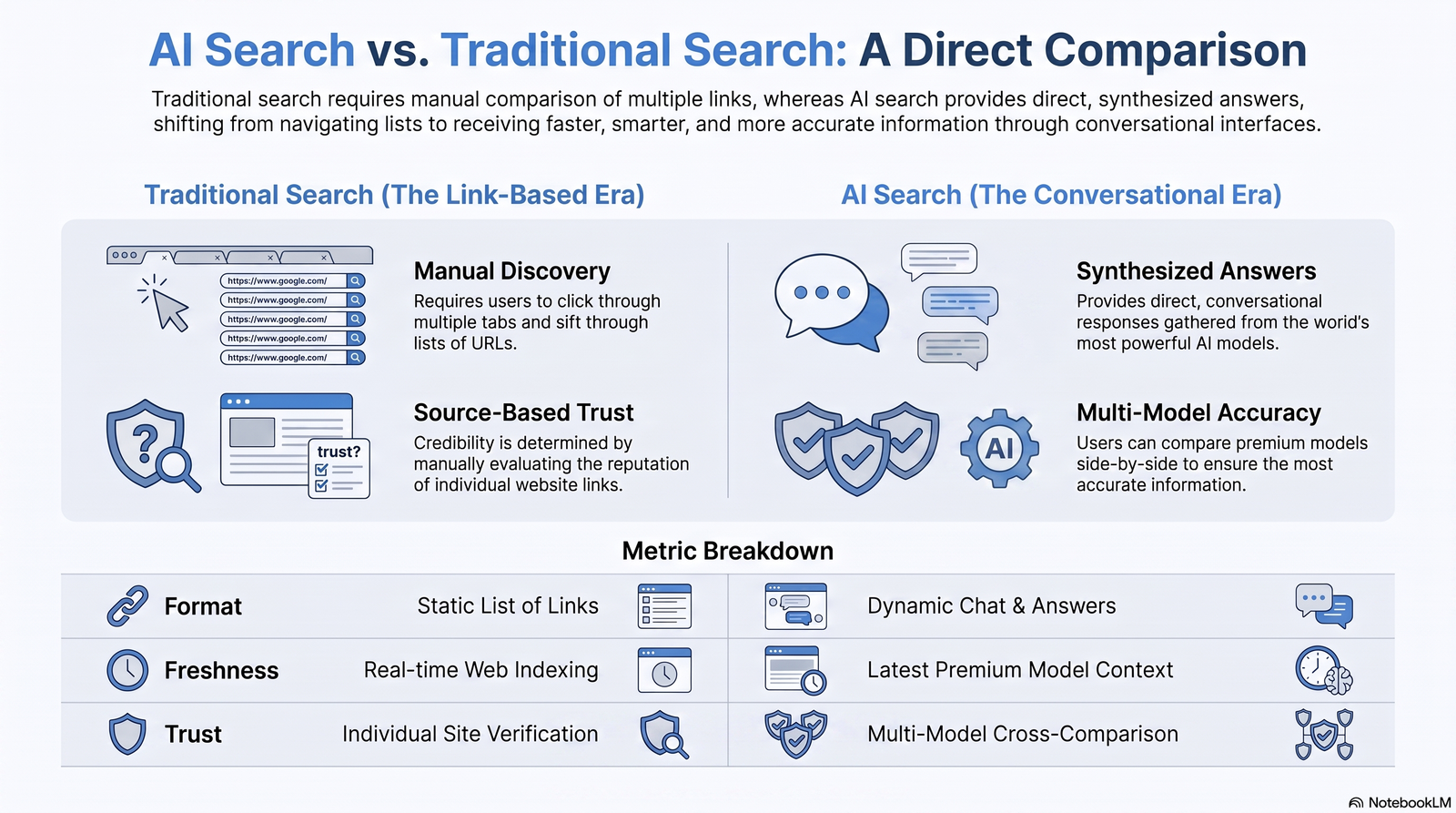
| Factor | Traditional Google Search | AI Search (ChatGPT, Perplexity, AI Overviews) |
|---|---|---|
| Output format | Ranked list of links | Synthesized written answer |
| User effort | You compare sources yourself | The system compares for you |
| Freshness | Near real-time via crawling | Varies; some tools lag behind live crawling |
| Source transparency | You see the domain before clicking | Citations vary; some tools cite generously, others sparsely |
| Best for | Navigation, shopping, local, transactional | Research synthesis, explanation, comparison |
| Risk of errors | Low (you read the source directly) | Higher (hallucination risk in generated text) |
| Ad monetization | Mature, proven at scale | Still being built out |
Can AI Really Replace Google Search?
Here’s where the data gets more interesting than the hype. Google still commands roughly nine in ten global search queries by volume, according to StatCounter figures widely cited across industry trackers in 2026 — its position on navigational, transactional, and local searches remains essentially unchallenged. Nobody is asking ChatGPT for driving directions or to check if a store is open.
Where the shift is real is informational and research-style queries. Industry estimates for 2026 put AI platforms — ChatGPT Search, Perplexity, Google’s own AI Mode and Overviews combined — capturing somewhere in the range of 15–20% of informational query volume, concentrated in exactly the categories that used to send the most traffic to blogs, guides, and explainer content.
Put simply: Google isn’t losing the search market. It’s losing a specific, valuable slice of it — the “help me understand this” slice — to answer-style tools, including its own AI Overviews.
Quick Summary
Google dominates overall search volume. AI tools are winning a specific subset: research, explanation, and comparison queries. That subset happens to be the one content creators depend on most.
Where AI Performs Better
- Synthesizing across many sources fast. Comparing five product reviews or three medical studies in seconds instead of ten tabs.
- Conversational follow-up. You can refine a question without starting over, which traditional search never supported well.
- Explaining, not just linking. For “explain how X works” queries, a direct written answer often beats reading three separate pages.
- Coding and technical troubleshooting. Developers increasingly reach for ChatGPT or Claude before a search engine for debugging help.
Where Google Still Performs Better
- Local search. AI Overviews still appear on a small minority of local queries — most people still want a map and a phone number, not a paragraph.
- Shopping. E-commerce queries have shown the smallest AI-driven traffic decline of any category, since product search benefits from filters, images, and price comparison that link-based results still handle well.
- Freshness at scale. Google’s crawling infrastructure is built for real-time indexing of breaking news across the entire web; most AI assistants either browse live (slower, narrower) or rely on a less current index.
- Source verification. Clicking through to the original page remains the most reliable way to confirm something, especially for anything high-stakes like medical or financial information.
Myth vs Fact
Myth: “AI Overviews mean Google search traffic is collapsing everywhere.”
Fact: The decline is heavily concentrated in informational content. E-commerce and local search have been far more resilient, and some studies now show zero-click rates plateauing or even easing slightly as Google adjusts its layouts.
Real-World Examples of the Shift
A software how-to blog that used to rank #1 for “how to fix [error message]” queries may now find that Google answers the fix directly inside an AI Overview, with the blog cited as a small link below the fold — if it’s cited at all. The searcher gets the fix, the site gets far fewer clicks for the same ranking position.
Compare that to a local bakery’s Google Business listing: AI Overviews rarely touch that query at all, because “bakery near me” is a map-and-hours intent, not a research intent.
The Hallucination Problem
The single biggest trust gap between AI search and traditional search is accuracy. Traditional search shows you the source directly — you judge its credibility yourself.
AI-generated answers compress multiple sources into new sentences, and that compression step can introduce factual errors, misattributed claims, or outdated information stated with total confidence.
This isn’t a minor technical footnote. It’s the reason AI search companies keep adding visible citations, “verify this” prompts, and confidence indicators — and it’s the reason Google has been cautious about how aggressively it expands AI Mode into higher-stakes query categories like health and finance.
Expert Tip
Treat any AI-generated answer to a factual question the way you’d treat a summary from a smart colleague who read the material quickly: useful as a starting point, not as the final word. Click through to the primary source before you rely on anything consequential.
Citations, Trust, and the New SEO Battlefield
Traditional SEO optimized for ranking position. AI search optimization — often called Generative Engine Optimization (GEO) or Answer Engine Optimization (AEO) — optimizes for being cited inside the answer itself, which isn’t the same skill.
Data from 2026 tracking studies shows citation patterns cluster heavily: a relatively small number of authority domains — sites like Wikipedia, Reddit, and major outlets — account for a disproportionate share of AI citations across tools.
That’s a warning sign for smaller, independent publishers: ranking well on Google no longer guarantees visibility inside AI-generated answers, because the two systems weigh authority and structure differently.
Did You Know?
Being cited inside an AI Overview is now associated with a meaningfully higher click-through rate than an uncited page ranking in the same position — being mentioned by name inside the AI’s answer appears to build enough trust that people click through anyway.
Freshness and Real-Time Information
Google’s crawling advantage matters most for anything time-sensitive: breaking news, live scores, stock prices, today’s weather.
AI chat tools that don’t browse live, or that browse a narrower slice of the web, simply cannot compete here. This is one of the more durable reasons a full replacement of Google looks unlikely in the near term — the infrastructure gap is real, not just a branding one.
Shopping Searches
E-commerce has been the most AI-resistant search category so far. Visual comparison, price filtering, reviews, and instant checkout are all things a scrolling product grid does better than a paragraph of prose. Google has responded by leaning into AI-assisted shopping features rather than abandoning the grid format — augmenting, not replacing.
Local Search
Local intent queries — “near me,” store hours, directions — remain overwhelmingly a Google Maps and Google Business Profile problem, not an AI-chat problem.
AI Overviews touch only a small share of local searches. If your business depends on local search visibility, the immediate threat from AI search is low; your priority is still your Google Business Profile.
News
News is a genuinely contested category. AI Overviews and AI Mode summarize breaking stories quickly, but publishers have reported steep referral traffic declines as a result — some large newsrooms have publicly discussed double-digit percentage drops in Google referral traffic over the past year.
This has pushed several major publishers into direct negotiations, partnerships, and in some cases legal action against AI companies over how their content is used.
Research and Learning
This is the category where AI tools genuinely shine, and where the “replacement” narrative is most justified.
Students, researchers, and professionals increasingly start with a conversational AI tool rather than a search bar for explanation-heavy tasks — asking it to compare theories, summarize a paper, or explain a concept step by step.
Traditional search still wins when the task is “find me the primary source,” which is exactly why the two are increasingly used together rather than one replacing the other.
Coding
Developers were early adopters of AI-first workflows. Tools built specifically for coding assistance, along with general models like ChatGPT and Claude, have become a default first stop for debugging and syntax questions — a category Google used to own almost entirely through sites like Stack Overflow.
Productivity
Beyond search itself, AI tools are increasingly embedded directly into productivity software — drafting, summarizing, and scheduling — which quietly reduces the number of times someone opens a search tab in the first place. This is a slower, less visible threat to Google than ChatGPT Search, but arguably a bigger long-term one: fewer searches happening at all.
Google’s Response: AI Mode and AI Overviews
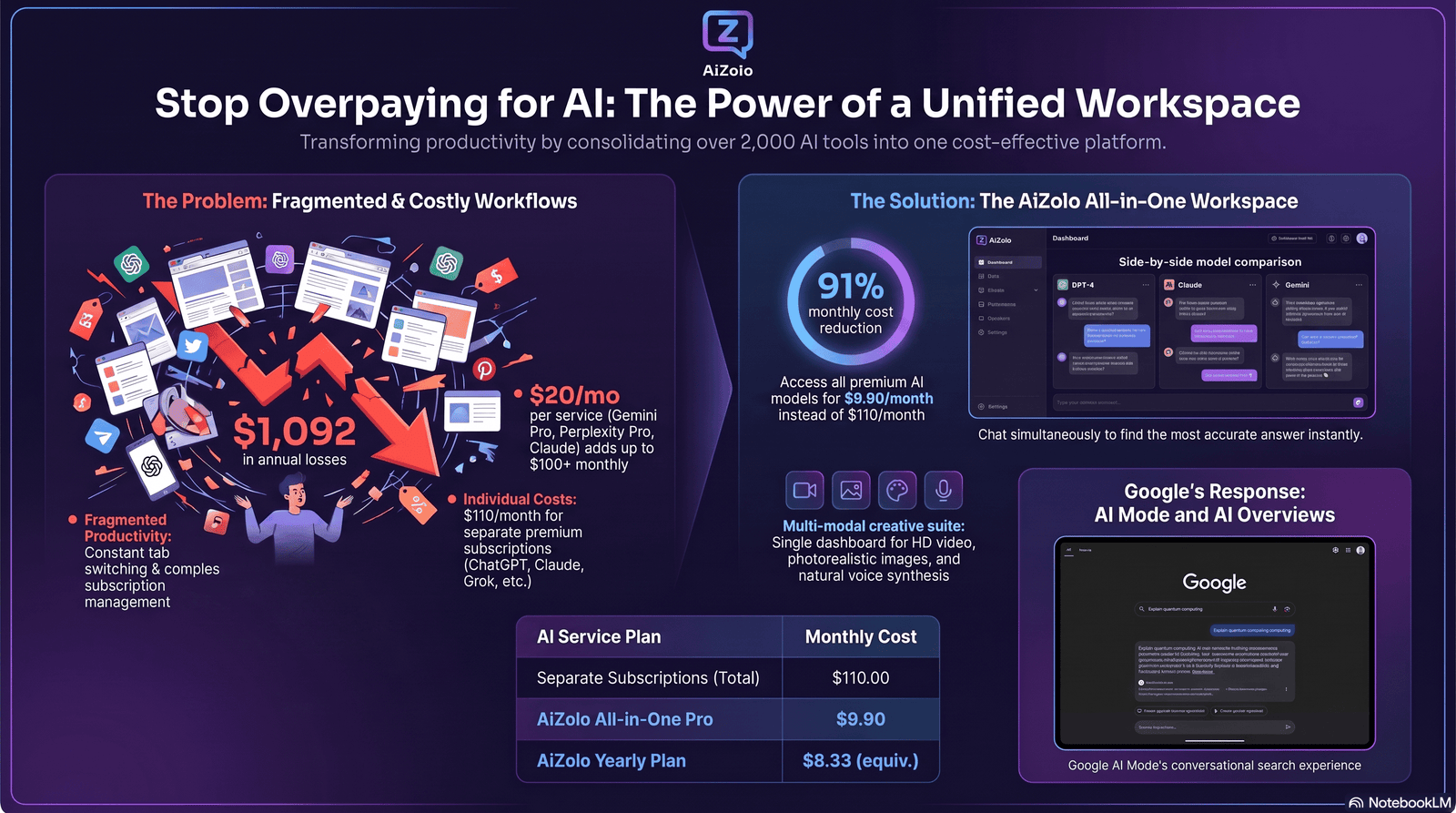
Google’s strategy has been to build its own AI search layer rather than let ChatGPT and Perplexity own the category.
AI Overviews now appear on a substantial share of tracked queries, and AI Mode — a fully conversational, opt-in experience — has scaled to well over 100 million monthly active users.
Google has continued rolling out updates through 2026, including inline citations and hover previews designed to make AI-generated answers feel more transparent and less like a traffic dead-end for publishers.
The strategic logic is straightforward: if AI search is going to happen either way, Google would rather it happen with Google’s ads and Google’s index underneath it than lose default search-engine status on phones and browsers to a competitor.
Key Takeaway
Google’s answer to “will AI replace Google Search” appears to be: not by someone else’s AI. Google is racing to make sure that if search becomes AI-native, it’s Google’s AI doing it.
Impact on SEO
SEO isn’t dying, but the target has split in two:
- Traditional SEO — still matters for rankings, especially transactional and local intent.
- Generative/Answer Engine Optimization — a newer discipline focused on structuring content so AI systems can extract, trust, and cite it: clear direct answers near the top of a page, strong topical authority, original data, and clean structured markup.
Sites that ignore the second discipline risk ranking well while becoming invisible inside AI-generated answers — a gap that didn’t meaningfully exist before 2024.
Impact on Publishers
Publisher-side data through 2025 and into 2026 has shown a real decline in Google referral traffic tied to AI Overviews, with the effect landing hardest on smaller, independent sites that lack the brand recognition to earn citation-driven clicks. Larger, high-authority publishers have generally weathered the shift better, partly because they’re more likely to be the cited source in the first place.
The Future of Websites and Content Creators
The sites that will do best in an AI-mediated search world share a few traits: original research or data no one else has, clear topical authority in a defined niche, strong author credibility (real EEAT, not just the acronym), and content structured so both humans and machines can parse it quickly.
Generic, reworded “best of” content — the bread and butter of a lot of SEO-driven publishing over the last decade — is exactly the category most exposed to AI compression.
The Future of Businesses
For businesses, the practical shift is measurement, not panic. Click-through rate from search alone is becoming a less complete picture of visibility; whether your brand gets mentioned inside AI answers — even without a click — is becoming a meaningful, trackable signal in its own right, sometimes called “share of voice” inside generative answers.
Predictions for the Next Five Years
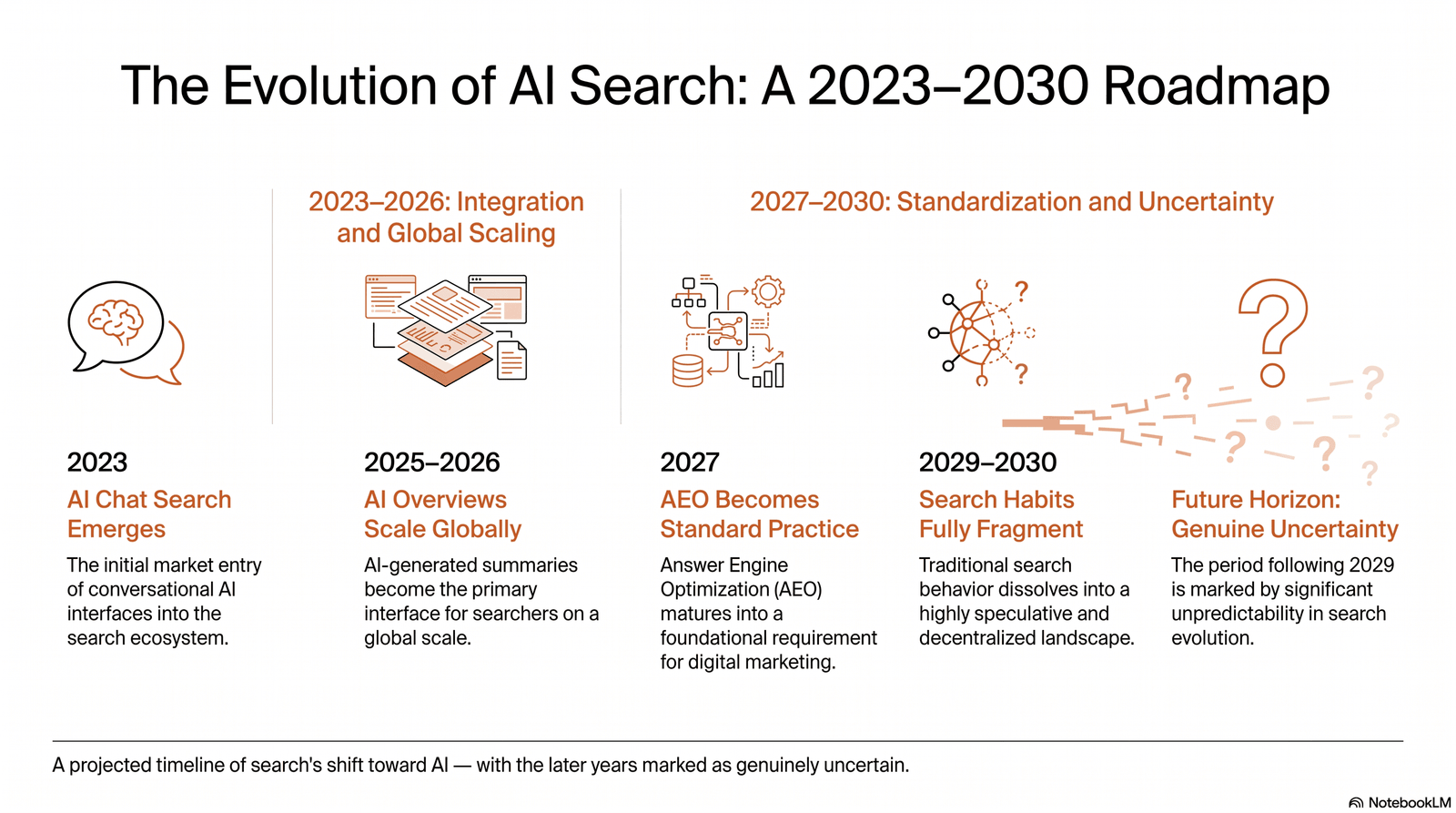
Being honest about the difference between what the data supports and what’s still a forecast:
Reasonably well-supported by current trends:
- AI Overviews and AI Mode will keep expanding into more query types.
- The AEO/GEO discipline will become a standard part of SEO practice, not a niche add-on.
- Local and shopping search will remain the most Google-resistant, AI-resistant categories in the near term.
More speculative:
- Whether a genuinely new default search habit (not “Google it” but “ask it”) fully takes hold among younger users over the next five years is still an open question — early behavioral data leans that direction among under-25 users, but it’s not yet the mainstream pattern.
- Whether regulatory or publisher-led pushback (licensing deals, legal action) meaningfully slows how AI companies use web content is genuinely uncertain and worth watching.
So, Will AI Replace Google Search?
Not wholesale, and not soon. What’s happening is closer to a split than a replacement: Google still owns navigation, local, shopping, and most transactional search outright, while AI tools — including Google’s own AI Overviews and AI Mode — are taking over the “explain this to me” layer of search that used to route through ten blue links and a lot of your own reading.
The more useful question for anyone reading this isn’t “will Google disappear,” but “which of my searches, and which of my content, sits in the part of the map that’s already shifted.”
For most people and most businesses, that answer is knowable today, and it’s worth figuring out now rather than after the traffic is gone.
FAQs
1. Will AI completely replace Google Search? Unlikely in the near term. Google still handles the vast majority of global search volume, especially for navigation, local, and shopping queries.
AI tools are capturing a meaningful slice of research and explanation-style queries, but a full replacement isn’t supported by current usage data.
2. What’s the difference between Google AI Overviews and Google AI Mode? AI Overviews are AI-generated summaries inserted into standard search results.
AI Mode is a separate, opt-in, fully conversational search experience. Both are Google products, not third-party competitors.
3. Is ChatGPT Search better than Google? For research, comparison, and explanation tasks, many users find ChatGPT Search faster and easier to follow.
For local search, shopping, and time-sensitive information, Google’s crawling infrastructure and ad-supported shopping tools still generally perform better.
4. Why has my website’s traffic dropped even though I still rank well? This is the AI Overview effect: your page can hold its ranking position while receiving fewer clicks, because users get their answer from the AI summary without clicking through.
This is one of the most common causes of traffic decline reported by publishers in 2025 and 2026.
5. What is Generative Engine Optimization (GEO)? GEO is the practice of structuring content so AI search tools are more likely to extract, trust, and cite it — direct answers, clear structure, strong topical authority, and original data, rather than optimizing purely for a ranking position.
6. Do AI search tools hallucinate facts? Yes, this remains a known limitation. AI-generated answers can misstate facts or misattribute information, especially on niche or fast-changing topics. Verifying important claims against the original source is still good practice.
7. Is local search safe from AI disruption? Largely, for now. AI Overviews appear on only a small share of local queries. Local search still depends heavily on Google Business Profile optimization rather than AI-answer visibility.
8. Which industries are most affected by AI Overviews? Informational content — how-to guides, explainers, health and education content, and B2B research — has seen the sharpest click-through declines. E-commerce and local search have been comparatively resilient.
9. Should I stop doing traditional SEO? No. Traditional SEO still drives rankings and traffic for transactional and local intent. GEO/AEO should be added alongside it, not used to replace it.
10. How is Google responding to competition from ChatGPT and Perplexity? By building its own AI-native search products — AI Overviews and AI Mode — rather than ceding the category.
Google has continued to add features like inline citations to make these results more transparent to users and less damaging to publishers.
11. Are younger users searching differently than older users? Early data suggests younger users are more likely to start with a conversational AI tool rather than a traditional search bar, though this hasn’t become the dominant pattern across the broader population yet.
12. What should content creators do to stay visible? Focus on original data, clear direct answers near the top of the page, strong demonstrated expertise, and content structured for easy extraction — the same fundamentals that make content genuinely useful to a human reader tend to make it easier for AI systems to trust and cite as well.
CONCLUSION
Google Search isn’t being replaced — it’s being split. The transactional, local, and shopping searches that make up most of Google’s volume are holding steady.
The research and explanation searches that used to send traffic to blogs and guides are increasingly being answered directly, sometimes by ChatGPT or Perplexity, and increasingly by Google’s own AI Overviews and AI Mode.
If you create content or run a business online, the practical move isn’t to bet everything on AI search or to ignore it. It’s to figure out which of your queries already sit in the “answered directly” bucket, and build genuine expertise and original data into that content so you’re the source AI tools choose to cite — because being cited, not just ranked, is quickly becoming the new visibility that matters.
Author Bio
Jeevesh Tripathi AI Researcher & SEO Strategist Email: jeevesh@aizolo.com
Jeevesh Tripathi is an AI researcher and SEO strategist who studies the intersection of generative AI, search behavior, and content strategy. With a background in analyzing how large language models retrieve, synthesize, and cite information, Jeevesh helps publishers and businesses adapt their content strategy for a search landscape that now spans both traditional ranking systems and AI-generated answers. His work focuses on translating fast-moving platform changes — from Google’s AI Overviews to emerging answer engines like Perplexity — into practical, evidence-based guidance, with an emphasis on distinguishing what the data actually supports from what remains speculative.