Customer reviews give more insight than just whether customers like or dislike your product. They can highlight trends in customer expectations, new product preferences, common quality issues and changes in customer satisfaction.
However, it can be difficult to spot any trends when looking at hundreds or thousands of reviews. By reading through each comment you can get a feel for individuals’ experiences, however it will be difficult to see if customer opinions are changing or if a specific area is becoming more important.
This is where AI can help. By organizing reviews by date, identifying recurring topics, comparing sentiment, and examining customer opinions across different periods, businesses can use AI to identify trends in customer reviews and understand what is changing.
In this guide we will show you how to set up your review data, use AI to spot new trends, compare different sentiments in customer reviews and check your results to make business decisions.
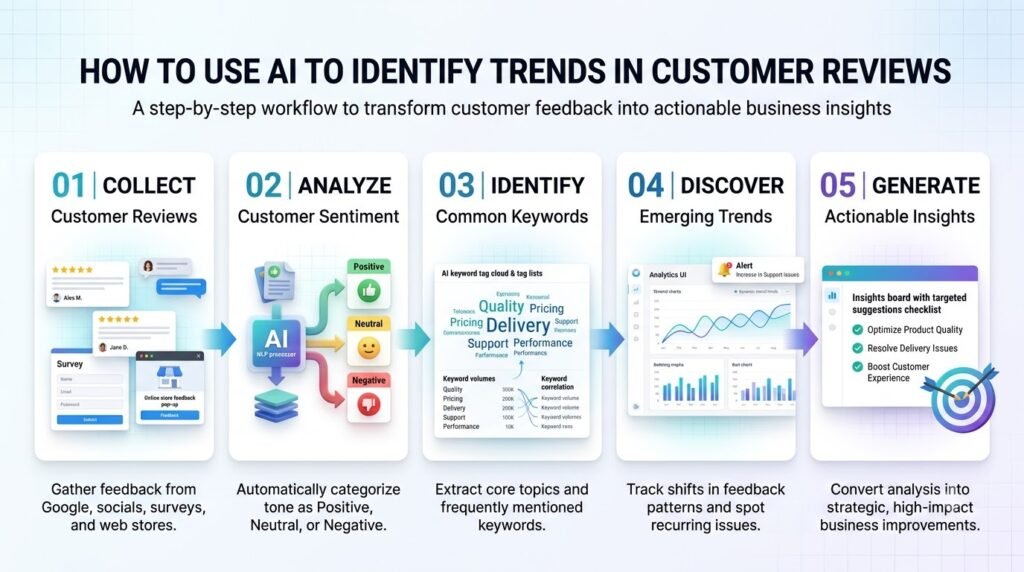
Table of Contents
What Are Customer Review Trends?
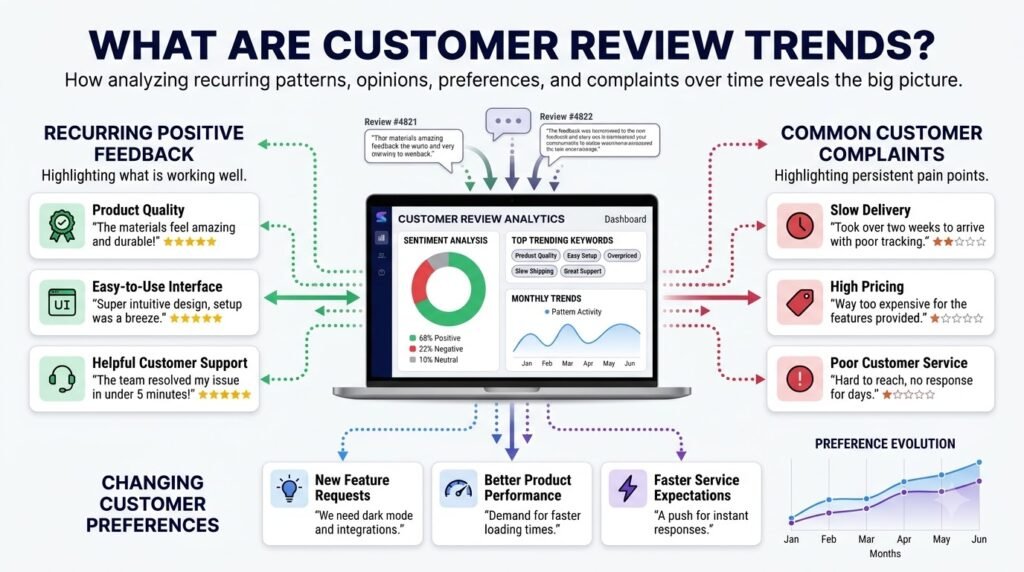
Customer review patterns refer to trends or noticeable changes in the views, experiences, preferences and expectations of your customers.
For example, you may find that customers are consistently commenting on the great design of your product however are increasingly commenting on issues with the battery.
Alternatively another business may find that increasingly they are receiving comments about quick delivery which shows that this is becoming an important factor for their customers.
Patterns can be useful when comparing reviews across different times.
Customer Review Trends vs. Individual Customer Complaints
These give insight into individual customer experiences. Trend analysis provides information about the prevalence of certain topics and whether the prevalence or sentiment has changed over time.
For example:
- Individual complaint: A customer says their headphones stopped charging.
- Recurring issue: Several customers report charging problems.
- Review trend: Mentions of charging problems increase across three consecutive months.
The third example provides a time-based signal that deserves further investigation.
If your primary goal is to identify recurring complaints and understand their possible causes, see our guide on how to analyze customer feedback and find common complaints.
Why Tracking Customer Review Trends Over Time Matters
Products can have high overall ratings but still have been having a dip in satisfaction recently.
If you just look at the product’s average rating you may miss this.
The product may have had an average of 4.5 stars for a few months but recently there have been more negative comments about the products packaging or late delivery.
By analysing how the reviews are changing over time it can help a business identify any changes quicker, find out what could be causing them and if customers expectations are also changing.
What Can AI Reveal From Customer Reviews?
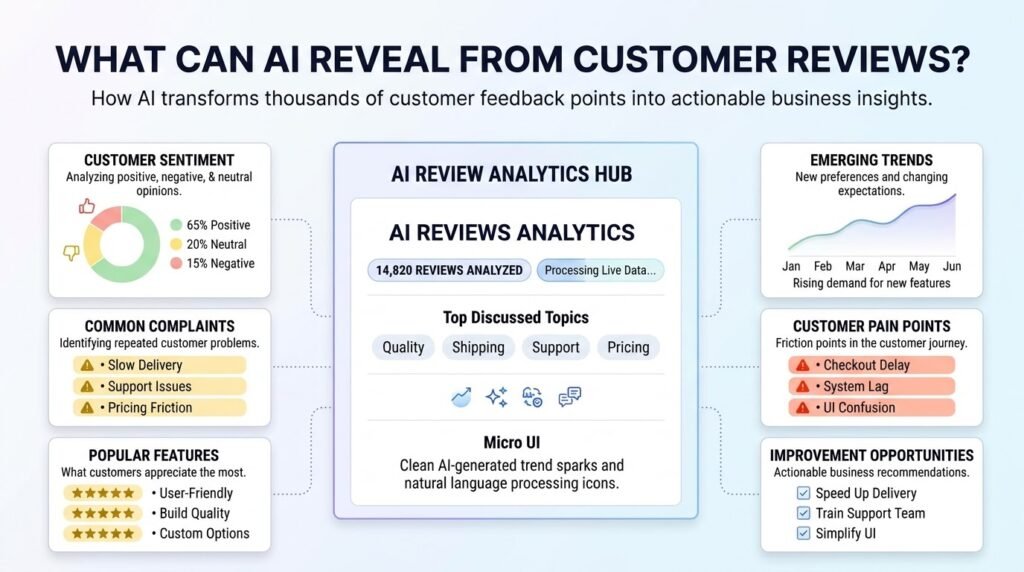
AI can examine review text and help businesses identify different types of customer behavior and opinion patterns.
The most useful findings are not limited to positive and negative sentiment. They also include the specific product features, experiences, and expectations behind those opinions.
1. Changing Customer Sentiment
Sentiment analysis identifies the emotional direction of customer comments, generally classifying them as positive, negative, or neutral.
AI can also allow comparison between the different categories over time.
A business may find that older reviews often mention their customer service being helpful but newer reviews are mentioning longer response times more often.
This suggests a possible change in customer satisfaction that should be investigated further.
Google Cloud’s Natural Language documentation explains how sentiment analysis evaluates the emotional direction of text using numerical sentiment scores. These scores can support analysis, although they should not be treated as a complete measure of customer satisfaction.
2. Emerging and Declining Review Themes
A review theme represents a recurring topic discussed by customers.
Examples include:
- Product durability
- Delivery speed
- Packaging quality
- Ease of installation
- Customer support
- Pricing and value
AI can group together reviews on similar topics.
For example, if your customers used to write a lot about your products appearance but have started to talk more about how easy they are to install in recent reviews.
This may suggest that you should focus more on the installation experience when developing or educating your customers on your product.
Businesses should look at new topics coming up and topics that were previously important but are becoming less frequent.
3. Changing Product Feature Preferences
Customers often provide feedback on what they like and want to improve about the products.
AI can determine this by identifying product related themes and seeing how often they appear in reviews.
For example a Laptop company may find that more customers are mentioning battery life, keyboard comfort and portability.
This can help product teams understand what features customers are interested in.
4. Recurring Quality and Service Patterns
AI can help to identify if certain quality or service issues are being mentioned more.
A business might discover:
- Increasing mentions of damaged packaging.
- More comments about delayed deliveries.
- Repeated concerns about product durability.
- Declining satisfaction with customer support.
However, an increased number of mentions does not necessarily mean that the service has deteriorated. This should be looked into to see if there is a change in order volumes, operational history and other evidence.
Once AI identifies recurring customer feedback patterns, businesses can organize these findings into visual reports to monitor customer sentiment, product performance, and emerging issues.
Learn how to create AI-powered business dashboards to turn business data into easier-to-understand visual insights.
5. Changing Customer Expectations
Customer expectations will change as products, competitors and market conditions change.
For example, initially customers will value the ability to connect to an app, but as time goes on they will expect more integrations, speed and personalisation.
By analysing the language and themes in reviews over time AI can be used to identify these changes in expectations.
6. Seasonal Customer Review Patterns
Some customer review patterns are influenced by seasonal purchasing behavior.
For instance, an air conditioning company may get more comments about how well their product cools in the summer. An online store might get more comments around big shopping periods relating to delivery.
By comparing the same time of year across multiple years businesses can identify any regular seasonal trends.
How to Prepare Customer Reviews for AI Analysis
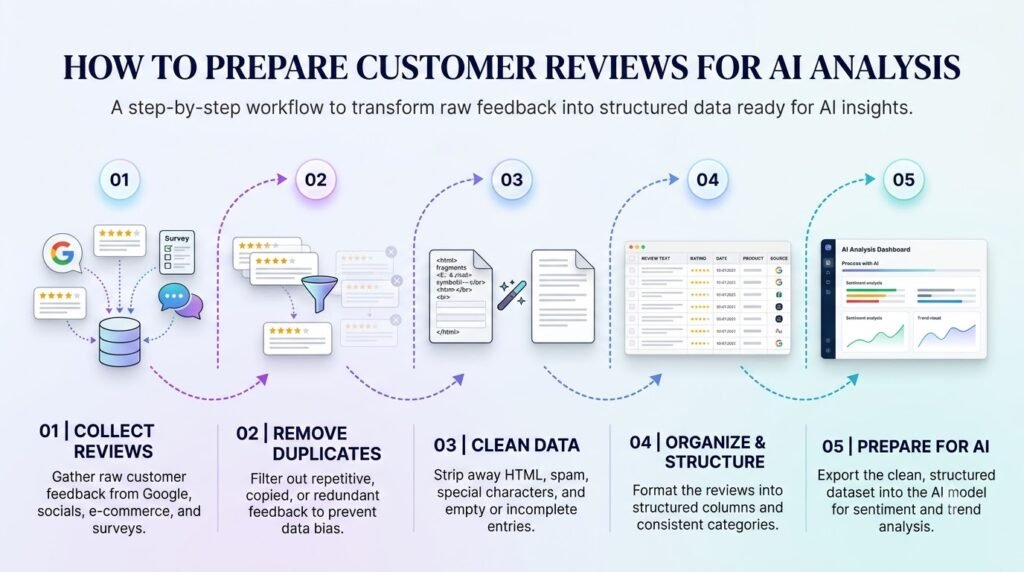
Prepare your data well before handing it over to an AI to find trends in customer reviews. If they are not organised well it can cause confusion.
This can happen if there is missing data such as dates, product types or sources.
Collect Reviews From Relevant Sources
Start by gathering reviews from platforms where customers discuss your products or services.
Depending on your business, these might include:
- Amazon product reviews
- Google Business Profile reviews
- Trustpilot reviews
- G2 and Capterra reviews
- Reviews collected through your own website
Use legal methods of exporting. Use platform integrations or legal data gathering methods.
You don’t need to use all sources straight away. One product and one reliable review source will make it easier to start with.
Organize Reviews by Date and Product
A useful dataset should contain enough information to compare reviews accurately.
A basic spreadsheet could include:
| Review ID | Review Date | Product | Rating | Review Text |
| R001 | Jan 08 | Headphones A | 5 | Excellent sound quality and comfortable fit. |
| R002 | Jan 16 | Headphones A | 3 | Battery life could be better. |
| R003 | Feb 12 | Headphones A | 2 | The battery drains too quickly. |
| R004 | Mar 05 | Headphones A | 2 | Charging takes longer than expected. |
This structure allows AI to examine review text alongside dates, product names, and ratings.
Remove Duplicates and Unnecessary Personal Information
Ensure there are no duplicate reviews, missing dates, inconsistent product names and formatting issues.
Remove any unnecessary personal information before uploading the customer data to an AI service.
Wherever possible, keep the original review ID so that you can easily trace the AI findings back to the original comments.
Create Comparable Time Periods
Divide reviews into meaningful time periods.
For example:
- January to March
- April to June
- July to September
- October to December
Monthly comparisons may be more useful for high-volume businesses, while quarterly comparisons may work better for products receiving fewer reviews.
The important point is to use comparable periods and account for differences in review volume.
How to Use AI to Identify Trends in Customer Reviews
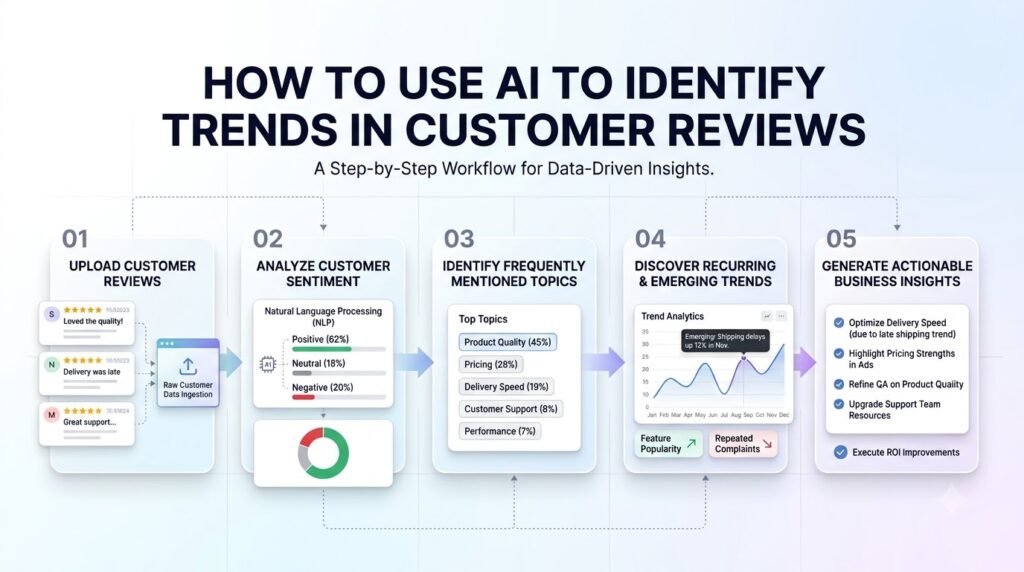
Once the reviews are organized, you can use AI to identify patterns through a structured workflow.
Step 1: Define the Customer Review Trend You Want to Investigate
Start by deciding what you want to understand.
A broad instruction such as “Analyze these customer reviews” may produce a general summary without identifying meaningful changes.
Instead, define a specific research question.
Examples include:
- Are customers becoming less satisfied with product durability?
- Which features are receiving more positive mentions?
- Are delivery-related complaints increasing?
- What new product preferences are appearing?
- Which customer concerns have become less common?
A focused question gives AI a clearer analytical direction.
Step 2: Organize Reviews Into Time-Based Datasets
Give AI a list of reviews along with their original dates.
Ask AI to sort them into your chosen time frames and analyse each one individually.
For example, you might want to compare reviews from January, February and March.
Ensure you’re comparing the same product category and ideally the same source of reviews. This will help to ensure that any differences are not due to differences between products or platforms but actual changes in customer sentiment.
Step 3: Classify Customer Sentiment Across Review Periods
Ask AI to identify positive, negative, and neutral sentiment in each period.
However, do not stop at the overall sentiment classification.
Ask it to identify the specific subjects associated with each sentiment.
For example:
- Positive: Comfortable design and clear sound.
- Negative: Short battery life and slow charging.
- Neutral: Packaging and product dimensions.
This makes it easier to identify which aspects of the customer experience are changing.
For more detailed analysis, ask AI to distinguish sentiment toward individual product features rather than assigning only one overall sentiment to an entire review.
This is known as aspect-based sentiment analysis.
Step 4: Identify Recurring and Emerging Customer Review Topics
Next, ask AI to group similar review comments into themes.
For example, these comments could belong to one theme:
- “The battery does not last through the day.”
- “I need to charge these headphones too often.”
- “Battery performance is disappointing.”
The common theme is battery life.
Ask the AI to compare the frequency of themes over time.
This can help identify what is a well-established preference among customers, and what is new.
Topic modelling and text clustering are popular methods for discovering themes within sets of documents.
However, an AI-generated theme should still be checked against the original review text.
Step 5: Compare Product Features and Customer Preferences
Understand what features of the product are driving customer conversation and how views are evolving.
For example, you may find that your smart phone business has positive comments around camera quality but increasingly negative comments around battery performance.
Ask AI to separate:
- Frequently praised features.
- Frequently criticized features.
- Features receiving more attention recently.
- Features receiving less attention.
- New preferences mentioned by customers.
This can help provide insight when developing products, marketing and communicating with customers.
Step 6: Identify Significant Changes in Customer Review Trends
Once you have your themes and sentiment classifications you can compare across time.
Look for:
- Increasing negative mentions of a particular feature.
- Growing positive discussion around a new feature.
- Declining mentions of previously popular features.
- New customer concerns.
- Repeated seasonal patterns.
Just because something is mentioned more times it doesn’t mean it’s become more important.
For example, if you have 100 reviews in January and 400 in February. This means that although something has been mentioned 20 times in January and 40 times in February, the percentage of reviews it makes has gone down.
Ask AI to work out the number and percentage of mentions. It will do this using accurate totals.
Step 7: Validate AI-Identified Trends Using Original Reviews
Finally, ensure the patterns you have found are backed up by the actual reviews. Ask the AI to highlight some example review IDs and short snippets for every key finding.
Verify:
- Whether the reviews genuinely support the identified theme.
- Whether the sentiment classification is appropriate.
- Whether the review dates are correct.
- Whether the number of mentions matches the original dataset.
- Whether the change is large enough to deserve attention.
The AI should assist you in organising and interpreting the review data.
Practical Example: Identifying Trends in Product Reviews
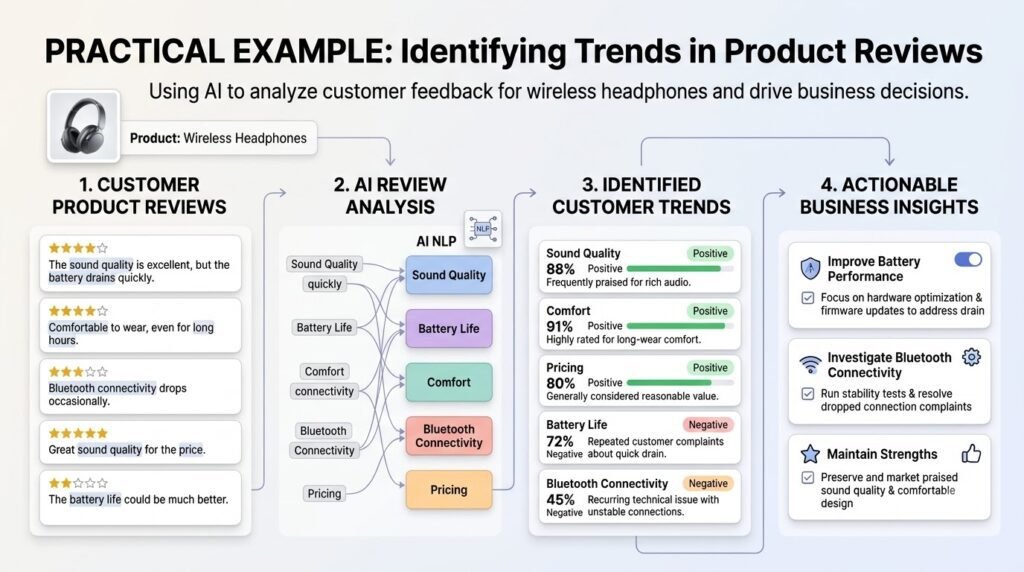
Imagine you are an electronics retailer who wants to understand how opinions on a specific set of wireless earbuds are evolving. You’ve got hundreds of reviews but it would be hard to spot wider trends by reading through each review.
For a practical analysis, the team can use the publicly available Amazon Reviews’23 dataset, which contains real customer reviews, product identifiers, ratings, and timestamps.
Once one of the wireless earbuds has been selected, the team can use AI to group the reviews by features of the product and compare customer sentiment across different months.
This table shows how the data could be displayed. The below are examples only, not actual results from the dataset.
| Product feature | January | February | March | Possible trend |
| Battery life | Mostly positive | Mixed feedback | More negative comments | Customer satisfaction may be declining |
| Sound quality | Positive | Positive | Positive | Consistent product strength |
| Bluetooth connectivity | Few mentions | More negative mentions | Repeated connection concerns | An emerging issue to investigate |
| Comfort | Positive | Positive | Mostly positive | Stable customer satisfaction |
| Charging speed | Mixed feedback | More negative comments | More positive comments | Customer opinions may be improving |
This enables the retailer to dig deeper into the information they have.
If there was an increase in negative comments about battery life then this may indicate a problem with the product that may need looking into. Whereas if there were constant positive comments on the sound quality it could indicate a strength.
The team can then look into these trends and see if they are present in specific versions of the product, batches of manufacture or any other data available to them to decide what action to take.
This example shows how businesses can use AI to identify trends within their customers reviews, track how their perception of the product is changing and identify what customer preferences they should look into.
Customer review trends can also provide useful information about overall business performance. By combining customer feedback with other business metrics, companies can better understand what is working and where improvements are needed.
Explore how to use AI for business performance analysis to evaluate performance using multiple data sources.
Useful AI Prompts for Customer Review Trend Analysis
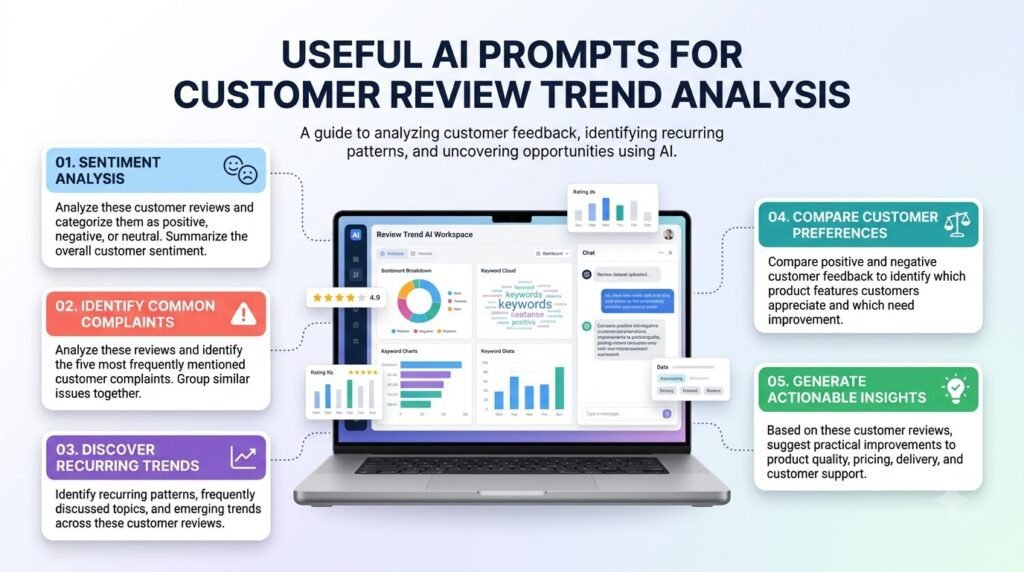
The quality of AI analysis depends partly on how clearly you define the task.
The following prompts can help you investigate different types of customer review trends.
Customer Sentiment Trend Prompt
Use this when comparing customer opinions across multiple periods.
Prompt:
Analyze the customer reviews provided below and identify how customer sentiment changes over time.
Organize the analysis by month or quarter using the original review dates.
For each period:
- Classify reviews as positive, negative, or neutral.
- Identify the main subjects associated with each sentiment.
- Calculate review counts and sentiment percentages using the supplied data.
- Highlight noticeable changes compared with previous periods.
- Include supporting review IDs and short excerpts.
Do not invent review counts, dates, or percentages. If the dataset does not provide sufficient evidence, explain the limitation.
Customer reviews: [Insert review dataset]
Emerging Topic Detection Prompt
Use this to identify topics that are becoming more common.
Prompt:
Analyze the customer reviews below and identify emerging and declining topics.
Group reviews into meaningful themes, then compare their frequency across the supplied time periods.
For each theme, provide:
- Theme name.
- Description.
- Number of reviews mentioning the theme in each period.
- Percentage of total reviews in each period.
- Sentiment associated with the theme.
- Representative review IDs.
- Whether the theme is emerging, declining, stable, or inconclusive.
Distinguish genuinely new topics from topics that were previously present but have become more frequent.
Do not invent evidence or treat a small number of mentions as a confirmed trend.
Customer reviews: [Insert review dataset]
Product Feature Preference Prompt
Use this to understand changing product preferences.
Prompt:
Analyze the customer reviews for [Product Name] and identify which product features customers appreciate or criticize.
Compare the findings across the supplied time periods.
Identify:
- Most frequently praised features.
- Most frequently criticized features.
- Features receiving increasing positive attention.
- Features receiving increasing negative attention.
- Newly emerging customer preferences.
- Features receiving less attention over time.
Provide supporting review IDs and short excerpts for each finding.
Separate customer statements from your interpretation. Do not assume that mention frequency automatically represents customer importance.
Customer reviews: [Insert review dataset]
Period-over-Period Comparison Prompt
Use this when you already have review summaries for different periods.
Prompt:
Compare the customer review analysis for [Period A] and [Period B].
Identify meaningful differences in:
- Overall sentiment.
- Product feature preferences.
- Recurring review themes.
- Positive and negative customer experiences.
- Emerging concerns.
- Declining topics.
Present the results in a comparison table.
Include both raw mention counts and percentages where the underlying review totals are available.
Highlight which changes deserve further investigation and explain why.
Do not claim that one event caused a change unless the dataset provides evidence supporting that conclusion.
Period A data: [Insert data]
Period B data: [Insert data]
How to Validate AI-Identified Customer Review Trends
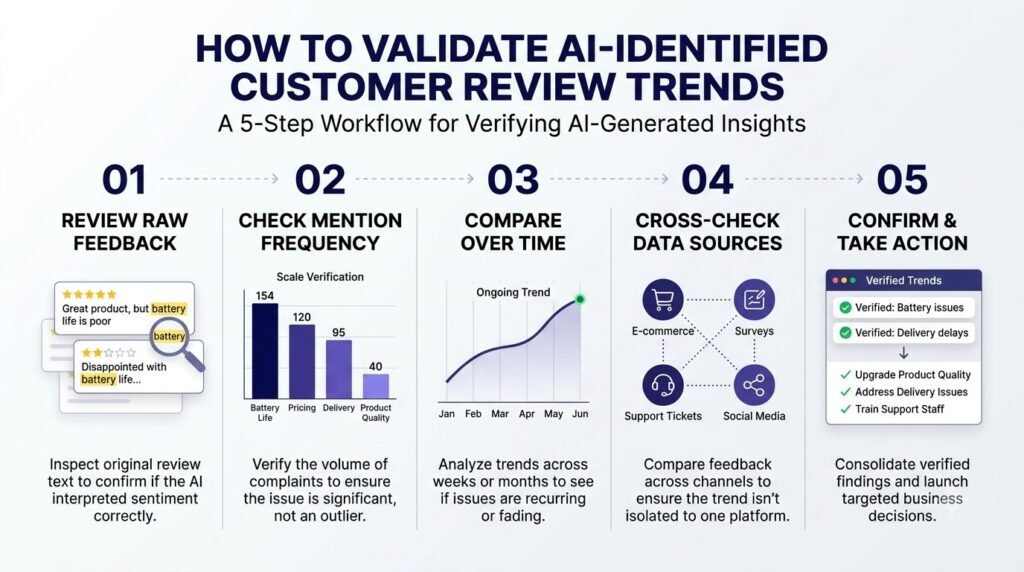
AI can identify patterns quickly, but not every pattern represents a genuine change in customer behavior.
Before using the findings to make business decisions, validate them.
Check Review Counts and Supporting Evidence
A trend should be supported by actual customer comments.
Ask for the relevant review IDs, dates and snippets for all key findings.
This will help you to see if the AI has incorrectly grouped comments or misinterpreted what a customer meant.
Account for Unusual Review Spikes
A sudden increase in review mentions might be caused by:
- A product launch.
- A temporary service disruption.
- A marketing campaign.
- A seasonal purchasing period.
- A change in review collection practices.
Investigate these possibilities before treating the change as a long-term trend.
Separate Correlation From Causation
Suppose negative battery-related reviews increase after a product update.
This may not always be the case. There may be many reasons for this change and they may be related to different customer segments, or changes in product usage.
Or they may be unrelated issues. AI can help us find correlations but further evidence will be needed to find the causes.
After validating customer review trends, businesses can include the findings in regular performance reports to track changes and communicate important insights across teams.
Learn how to build an AI-powered business reporting workflow to organize business data and generate consistent reports.
Common Mistakes to Avoid When Using AI for Customer Review Trend Analysis
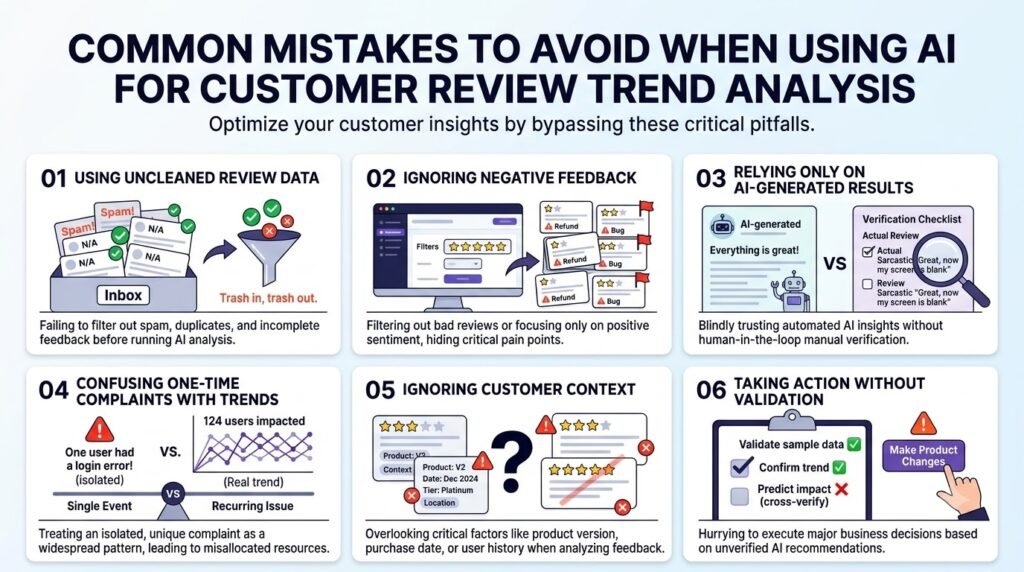
1. Treating Every Negative Review as a Trend
While one detailed complaint can be significant, this may not be an indication of a common customer preference or issue.
Look for a pattern of evidence.
2. Ignoring Review Volume
If you don’t consider the overall number of reviews you may draw incorrect conclusions.
Using percentages will help you to see if a particular topic is increasing as a percentage of the total number of reviews.
3. Mixing Different Products and Periods
If you’re combining reviews from different products, versions of a product or different customer segments then you may miss out on some key differences.
Keep your data organised and compare like for like.
4. Trusting AI-Generated Statistics Without Verification
AI-generated counts and percentages should be checked against the original dataset.
For large datasets, use spreadsheet formulas, SQL, or a dedicated analysis tool to verify numerical results rather than relying entirely on generated summaries.
5. Ignoring Review Quality and Authenticity
Not all reviews are reliable.
Duplicate reviews, suspicious review patterns, incentivised reviews and changes in how reviews are collected can affect reliability.
Businesses should also comply with any consumer review regulations. In the US, the Federal Trade Commission has a consumer review regulation covering specific misleading practices relating to fake reviews and testimonials.
Once recurring customer issues have been identified and verified, document the steps your team will take to address them.
A structured business process documentation system can help teams standardize improvement procedures, assign responsibilities, and maintain consistency.
How to Compare AI Models for Customer Review Trend Analysis
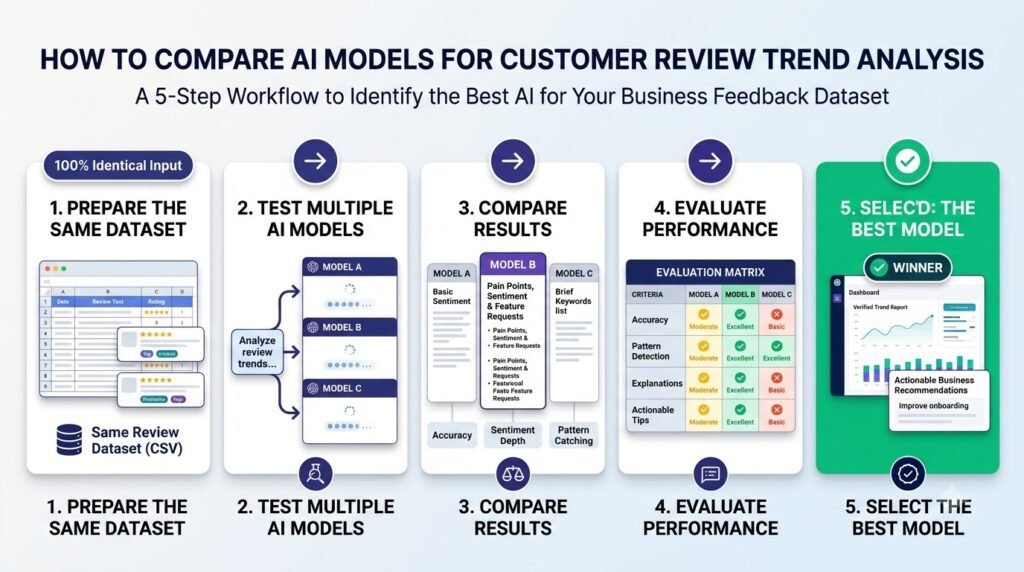
Different AI models will classify the customer reviews differently.
One may produce more general categories, such as product quality whilst the other may create more specific categories like battery life, charging time and durability.
Comparing the two can help find patterns that we may have missed and also see if the patterns are backed up by the reviews.
For this type of work, you can use AiZolo to test the same review-analysis prompt across multiple AI models and compare their responses side by side.
Its comparison workspace, project management, and Smart Prompt Manager can help organize repeatable analysis tasks without constantly switching between separate AI platforms.
However, model agreement does not prove that a trend is correct. Always verify the findings against the actual review dataset.
Frequently Asked Questions
1. How Can You Use AI to Identify Trends in Customer Reviews?
Using AI text analysis you can categorise reviews into sentiment, topics and see how often they appear. By looking at the dates of your reviews and the comments, you can see what new trends are appearing, what topics are becoming less popular, and how your customers are feeling.
2. Can ChatGPT Analyze Customer Reviews?
Yes. If you give ChatGPT a well-structured dataset of customer reviews, it can identify any patterns or themes within the data, compare the sentiment and track changes over time. Include dates, product names and ratings where possible. Check that the numbers and conclusions are accurate.
3. How Do You Track Customer Sentiment Over Time?
Group reviews by month or quarter, categorise them and analyse to see how they change over time. Look at how many and what percentage of reviews are positive, negative or neutral. Also look at what features of the product have led to changes in sentiment.
4. What Is the Difference Between Customer Feedback Analysis and Review Trend Analysis?
Customer feedback analysis helps you understand your customer’s opinions, issues and satisfaction. Review trend analysis helps understand how the themes, sentiment and preferences within the reviews change over time. They can be used together but provide different analysis.
5. Can AI Identify Emerging Product Preferences?
Yes. AI can group reviews by product features and measure how often they are mentioned over time. If there is an increase in the mentions it could mean there has been an increase in interest. It is important to look at the sentiment, number of reviews, customer segments and evidence to back up the increase.
6. How Many Customer Reviews Are Needed for AI Trend Analysis?
There is no set minimum. The number of data points required will depend on the quality of the review, how common the topic is, what category of product you’re looking at and the time frames. However, generally you will need more data points to make more accurate conclusions about trends.
7. How Accurate Is AI Customer Review Trend Analysis?
The accuracy of this will depend on the quality of the reviews used, the language, model, classification method and validation. AI can be easily confused by sarcastic, mixed or contextual comments. By checking the original reviews, number of reviews and sentiment classifications we can avoid any misleading conclusions.
8. What Are the Best Metrics for Tracking Customer Review Trends?
Useful metrics include average star rating, percentage of positive and negative reviews, topic frequency, aspect sentiment, number of reviews and changes in themes over time. Although there is no one metric that will give you the full picture, using quantitative metrics alongside some representative customer comments will help.
Conclusion
Learning how to use AI to identify trends in customer reviews helps businesses move beyond individual comments and understand how customer opinions change over time.
Using date filtering, sentiment analysis, topic detection and checking against the raw comments can help you understand how people’s opinions on your product are changing and identify any potential issues with the customer experience.
The most effective way to use this is to combine the AI analysis with accurate review data and human common sense. Don’t take the patterns given by the AI as facts but use them as a basis to ask more insightful questions and make more informed decisions.
Customer review analysis can also support wider operational improvements. Businesses can use identified trends to improve customer support, product quality, and service delivery as part of a broader strategy to automate business operations with AI.
About the Author
Anshika Verma is a content researcher and writer focused on researching AI tools, AI models, and creator technologies. She creates practical, research-based guides that help readers understand AI capabilities, evaluate different tools, and apply AI to real-world workflows.