Summery
AI makes it easier for businesses to analyze customer feedback, identify recurring complaints, detect negative sentiment, and uncover possible root causes.
By following a structured seven-step process, businesses can turn scattered reviews, surveys, support tickets, and customer conversations into actionable insights.
However, AI-generated findings should always be checked against original feedback before making business decisions.
For a more reliable analysis, businesses can use AiZolo to run the same customer feedback analysis prompt across multiple AI models and compare their responses side by side.
This helps identify differences in complaint categorization, discover overlooked patterns, and review AI-generated insights before prioritizing improvements.
Combining multi-model analysis with human verification can help businesses make better-informed decisions and improve customer experiences.
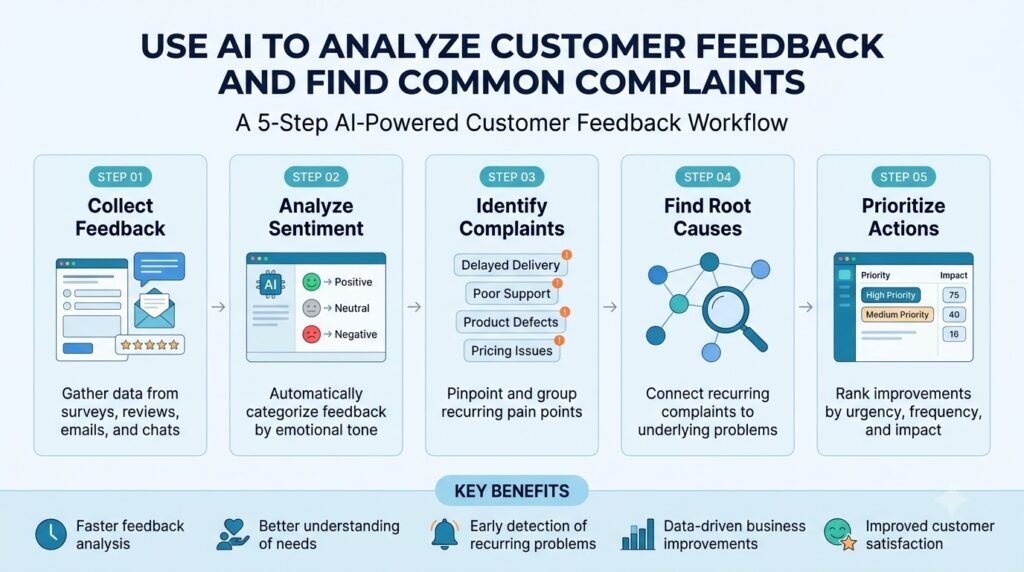
Customer feedback can provide insights into why customers are struggling to use your product, what is causing frustration with a service and what issues regularly occur.
However, comments are often spread out between reviews, support tickets, surveys, emails and chats making it hard to spot patterns.
AI can be used to help you organise customer comments, identify what issues are occurring repeatedly and group together negative feedback.
By using AI you can avoid having to manually go through responses and instead create a list of issues to focus on from the unstructured customer comments.
This guide explains how to use AI to analyze customer feedback and find common complaints through a practical seven-step workflow, with examples and reusable prompts.
Table of Contents
Why Businesses Struggle to Identify Common Customer Complaints
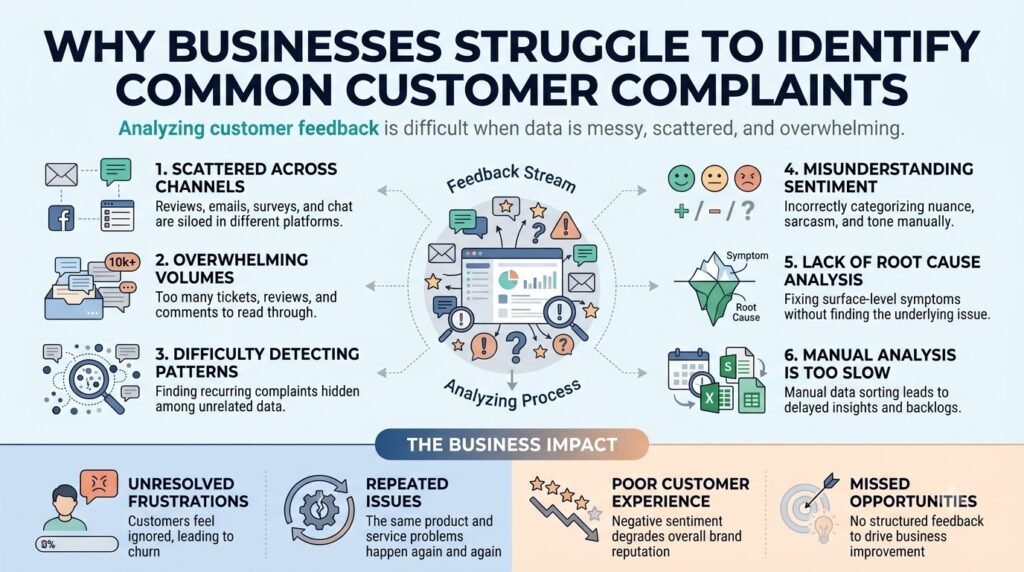
Most businesses already collect customer feedback, but collecting it and understanding it are two different tasks.
The customer may have left negative feedback saying that delivery was late, written a review complaining that the item wasn’t well packaged and contacted customer support regarding an issue with tracking. This may indicate a larger issue with fulfilling the orders.
Common challenges include:
- Scattered feedback: Customer comments are stored across different platforms, making it difficult to review them together.
- Repetitive manual work: Employees spend time reading, tagging, and organizing individual comments.
- Different wording: Customers describe the same problem in different ways, making manual categorization inconsistent.
- Hidden patterns: Less obvious issues can remain unnoticed when teams focus only on recent or highly visible complaints.
- Difficulty prioritizing: Businesses may struggle to determine which complaints require immediate attention.
AI can help to analyse the data, finding similar phrases, grouping similar complaints and showing overarching themes.
It should still be cross-referenced with the actual feedback received however. Just because a phrase comes up repeatedly it doesn’t necessarily mean all customers are having the same issue at its core.
If you are exploring a broader approach to automating business activities, our guide on how to automate different business operations with AI explains how AI can support different operational tasks.
What AI Can Find in Customer Feedback
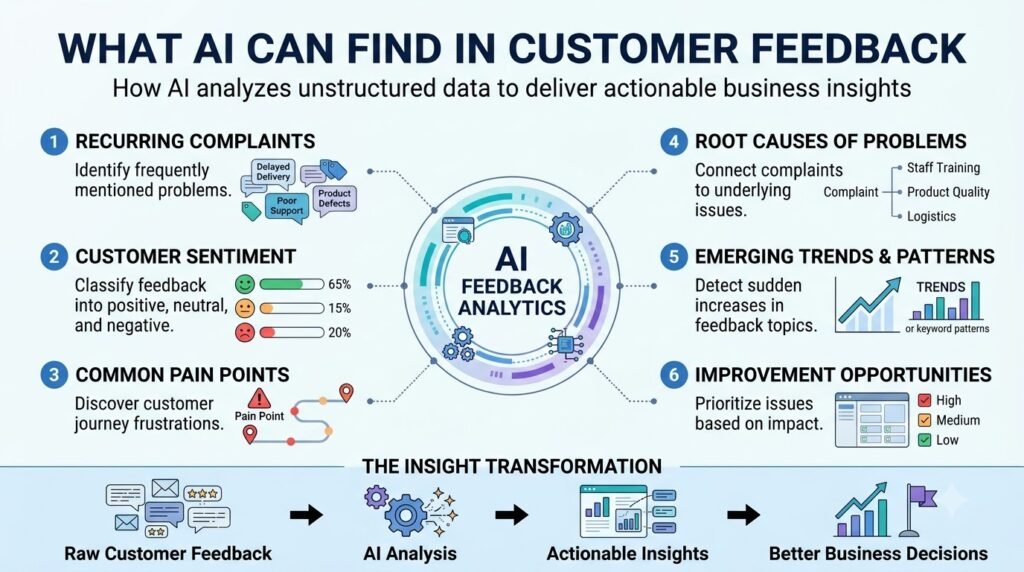
AI can be used to process text based feedback by using Natural Language Processing (NLP) and language models. This can help you identify patterns within the text.
Here are the main types of findings you can extract.
1. Recurring Customer Complaints
AI can group comments that describe similar problems, even when customers use different words.
For example:
- “The application takes too long to open.”
- “Loading the dashboard is extremely slow.”
- “I have to wait several seconds whenever I open a report.”
AI may group these comments under one theme: Slow application performance.
2. Negative Customer Sentiment
Sentiment analysis can be used to classify feedback into positive, negative or neutral sentiments.
This will enable businesses to find comments that are showing frustration, disappointment, dissatisfaction, or confusion.
Google Cloud’s Natural Language documentation explains how sentiment analysis uses numerical scores to represent the emotional direction of text.
3. Complaint Frequency
AI can count how often a particular issue appears in a feedback dataset.
For example, it may identify that delivery delays appear in 35 comments, payment failures in 22, and damaged packaging in 12.
This will highlight to businesses what complaints are being frequently raised.
4. Possible Root Causes
AI can be used to help to investigate why these complaints are being raised frequently by analysing similar comments.
For example, there might be several complaints regarding late deliveries mentioning the same location of delivery, stage in the delivery process or issue with processing the order.
This can give an idea on why complaints are being raised. This doesn’t mean it is definitely due to this though and further investigation would be required.
5. Customer Experience Patterns
AI can also detect if certain issues are arising with particular customer groups, products, service types or points in their journey.
This means that businesses can look more closely into if it’s a problem that affects everyone or just a specific segment.
Which Customer Feedback Sources Should You Analyze?
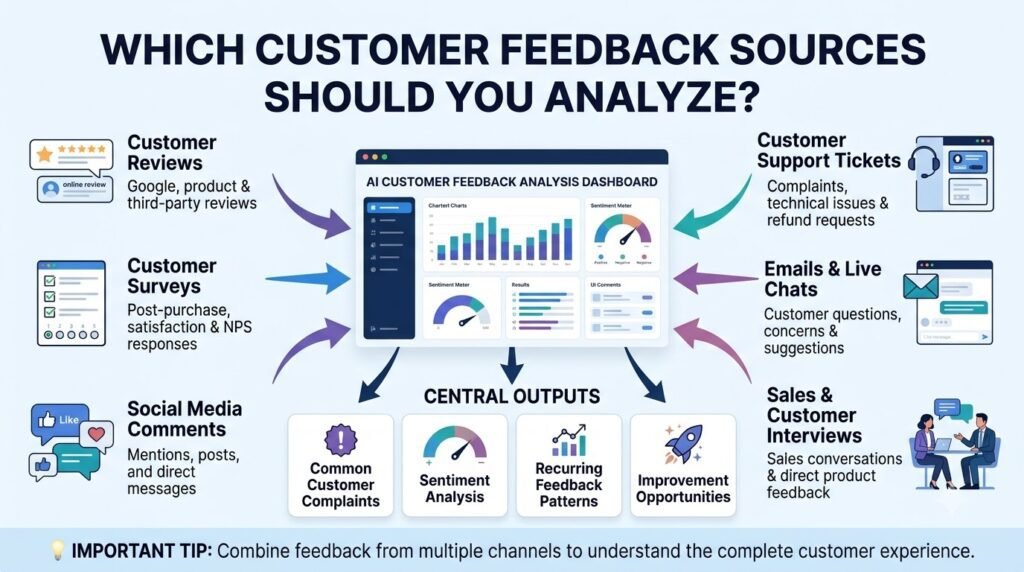
Before using AI, identify where your business receives customer feedback. The quality of your analysis depends partly on the range and relevance of the information you provide.
| Feedback source | What AI can help identify |
| Product reviews | Product defects, usability problems, and unmet expectations |
| Support tickets | Repeated technical issues and service complaints |
| Customer surveys | Satisfaction concerns and recurring suggestions |
| Email conversations | Service delays, communication problems, and unresolved requests |
| Social media comments | Public complaints and repeated customer frustrations |
| Chat conversations | Confusing instructions and support difficulties |
| Cancellation feedback | Reasons customers decide to leave |
You do not need to analyze every source immediately.
Start with one or two channels that contain enough relevant feedback to reveal meaningful patterns. You can expand the analysis as your process becomes more consistent.
If your goal is also to understand broader customer motivations and audience differences, AiZolo’s guide to customer persona and audience research covers that separate research process.
How to Use AI to Analyze Customer Feedback in 7 Steps
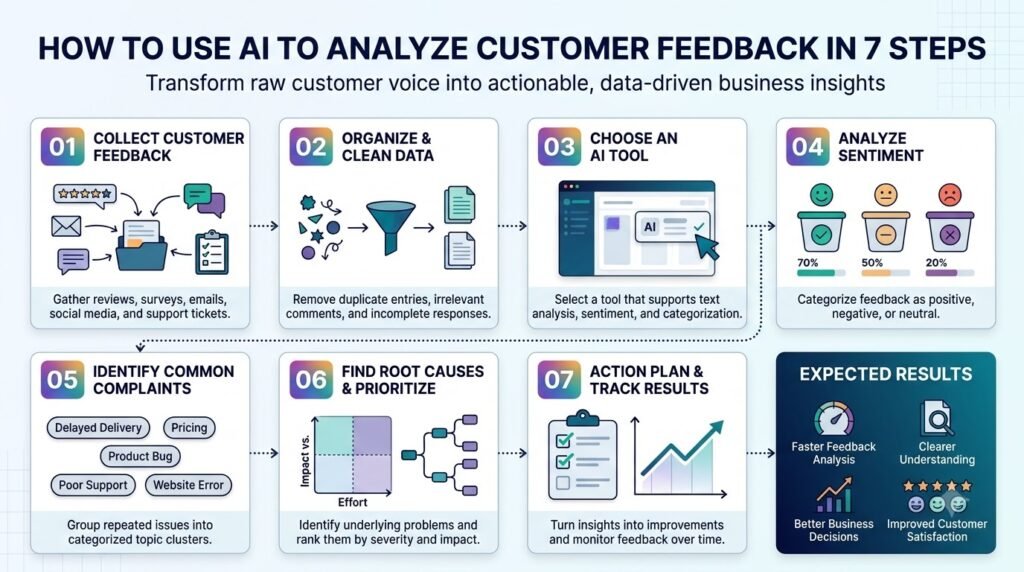
Having a process will help make it easier to replicate and verify your analysis.
There are 7 steps to follow to turn unstructured feedback into a clear list of common complaints.
Step 1: Collect and Organize Customer Feedback
Start by collecting feedback from the sources most relevant to your business.
You might gather:
- Recent product reviews.
- Customer support tickets.
- Survey responses.
- Customer emails.
- Chat transcripts.
- Cancellation comments.
Place the information into a spreadsheet or another organized format.
Where possible, include useful fields such as:
| Field | Example |
| Feedback ID | FB-001 |
| Date | November 2 |
| Source | Product review |
| Product | Product A |
| Customer comment | The checkout process keeps failing |
| Category | Not assigned |
| Sentiment | Not assigned |
Keep the original comment unchanged so you can verify AI-generated interpretations later.
For larger data sets, you can break your information down into different categories (product, date, feedback source or customer group) to make it easier to analyse differences between them.
Step 2: Clean the Data and Protect Customer Information
Before uploading feedback to an AI tool, prepare the dataset.
Where possible remove duplicates. Fix any obvious formatting issues. Split comments into separate records.
You should also remove unnecessary personally identifiable information, including:
- Customer names.
- Email addresses.
- Phone numbers.
- Account numbers.
- Payment details.
- Other sensitive identifiers.
Follow your organisations data security policy and any privacy requirements.
Do not assume that by removing the customers name all the feedback will be anonymised. There could be other identifying information.
A clean and secure dataset will give the AI something more useful to work with and reduce the risk of exposing any unnecessary customer information.
Step 3: Categorize Similar Customer Complaints
Now ask AI to group similar comments into meaningful complaint categories.
For example, consider these customer statements:
- “I cannot log into my account.”
- “The password reset link does not work.”
- “The application keeps signing me out.”
- “The checkout page takes too long to load.”
- “My payment was declined even though my card works.”
AI could organize them into categories such as:
| Complaint category | Related comments |
| Login and authentication | Comments 1, 2, and 3 |
| Website performance | Comment 4 |
| Payment problems | Comment 5 |
This makes it easier to identify common issues without treating every comment as a completely separate problem.
However, categories should be specific enough to support action. For example, combining every technical complaint under a broad category called “Website problems” may hide important differences.
Ask AI to explain why each comment belongs to a particular category and preserve the original feedback ID.
Step 4: Detect Negative Sentiment and Customer Frustration
After categorizing feedback, analyze the emotional tone of customer comments.
AI can help identify whether customers are satisfied, neutral, disappointed, frustrated, or angry.
For example:
| Customer comment | Possible sentiment | Complaint |
| The delivery arrived three days late. | Negative | Delivery delay |
| The support team was helpful, but the issue took too long to resolve. | Mixed | Slow resolution |
| The checkout process was simple. | Positive | No complaint |
| I have contacted support three times without receiving an answer. | Strongly negative | Unresponsive support |
Do not rely on sentiment labels alone.
A negative comment may describe a minor inconvenience, while a neutral-sounding message may report a serious payment or security problem.
Use sentiment as one signal alongside the actual complaint, its frequency, and its potential impact.
Step 5: Measure How Frequently Complaints Occur
Once AI has grouped similar comments, ask it to count the number of unique feedback records associated with each complaint.
This helps distinguish frequently reported problems from isolated experiences.
For example, imagine a business analyzing 100 customer feedback records.
| Complaint | Number of records | Percentage |
| Delivery delays | 35 | 35% |
| Payment failures | 25 | 25% |
| Poor customer support | 20 | 20% |
| Product quality concerns | 12 | 12% |
| Website navigation problems | 8 | 8% |
These are illustrative figures, not actual business research.
The results suggest that delivery delays appear most frequently in this particular dataset.
However, frequency alone should not determine which issue gets fixed first. A complaint that appears only a few times may still involve a serious safety, payment, privacy, or compliance concern.
Also, ensure that repeated messages from the same customer are not incorrectly counted as independent customers. Track both the number of feedback records and, where possible, the number of unique customers.
Step 6: Investigate Possible Root Causes
Identifying a complaint is only the beginning. Businesses also need to understand what might be causing it.
Ask AI to compare comments within the same complaint category and identify recurring circumstances.
For example, consider several comments about delayed deliveries:
- Customers in one region mention late shipments.
- Multiple complaints refer to orders placed during weekends.
- Some customers report that tracking information was not updated.
- Others mention that dispatch notifications arrived late.
AI may identify possible connections between these complaints.
The business can then investigate whether the problem relates to regional delivery capacity, order processing, tracking updates, or another operational issue.
Ask the AI to distinguish between:
- Directly stated customer experiences.
- Patterns supported by multiple records.
- Possible explanations.
- Information that requires further investigation.
This prevents a plausible AI-generated explanation from being mistaken for a confirmed root cause.
Step 7: Prioritize Complaints and Recommend Improvements
Finally, organize the identified complaints according to their frequency, severity, customer impact, and urgency.
A useful prioritization framework is:
| Priority | Complaint characteristics | Suggested response |
| High | Serious security, payment, safety, or widespread service problems | Investigate and escalate promptly |
| Medium | Repeated usability or customer service issues | Assign an owner and plan corrective action |
| Low | Isolated inconveniences or minor suggestions | Monitor and evaluate over time |
Ask AI to recommend possible improvements, but let the responsible team validate and approve those recommendations.
For example:
| Common complaint | Possible improvement |
| Delivery delays | Investigate dispatch and delivery performance |
| Payment failures | Review payment processing and error handling |
| Slow support responses | Evaluate support workload and response procedures |
| Confusing navigation | Review website usability and navigation structure |
Once you have validated the findings, you can turn them into a structured business update. If you need to communicate broader operational results, see the AI-powered business reporting workflow.
Example: Finding Common Complaints From Customer Reviews
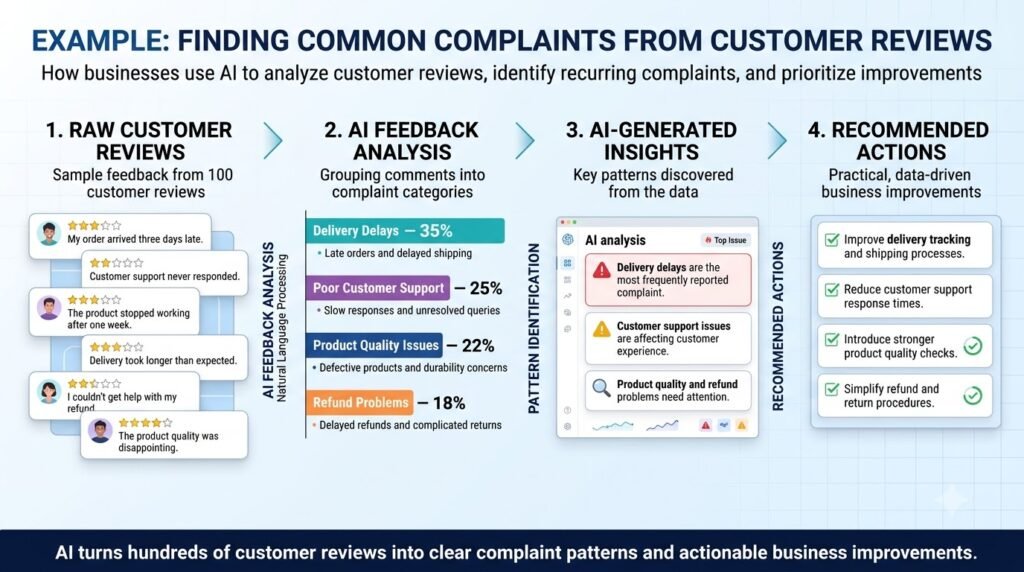
Imagine an online retail business receives 200 customer comments from product reviews, support tickets, and post-purchase surveys.
The team wants to understand why customers are dissatisfied.
Instead of reading every comment separately, the team provides an appropriately anonymized dataset to an AI assistant and asks it to identify recurring complaint categories.
The AI identifies these illustrative findings:
| Complaint category | Feedback records | Main concern |
| Delivery problems | 72 | Orders arrive later than expected |
| Product quality | 48 | Products do not match expectations |
| Payment problems | 35 | Transactions fail or remain pending |
| Customer support | 28 | Customers wait too long for responses |
| Website usability | 17 | Customers struggle to find information |
The team then reviews the original comments behind each category.
When looking at delivery issues, we see there are a few comments around dispatch being late and some comments about the courier delivering late.
Whilst this could be seen as a clear root cause, the team will need to review the orders and delivery information to understand why this is happening.
By identifying these issues the business can then allocate them to teams to investigate. They can also track if the number of complaints decrease over time.
The key benefit here is you have a more structured process for identifying, validating and resolving repeat issues that customers are experiencing.
Useful AI Prompts for Customer Complaint Analysis
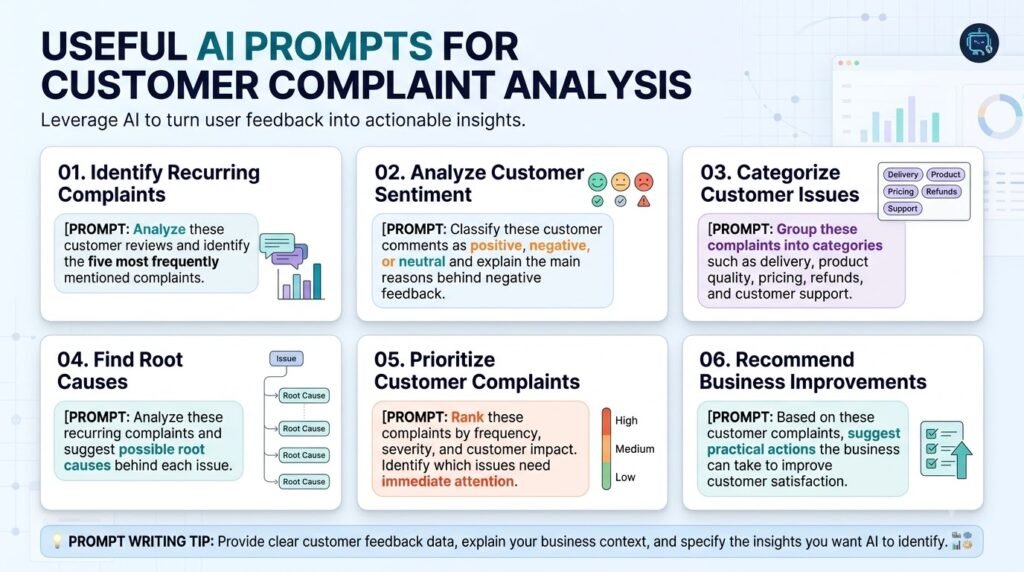
A well-written prompt can improve the structure and usefulness of AI-generated findings.
Instead of asking AI to simply summarize customer feedback, give it a specific analytical task and define the output you expect.
Prompt 1: Identify Common Customer Complaints
Act as a customer experience research analyst.
Analyze the customer feedback below and identify the most common complaints.
Your tasks:
1. Group similar complaints into meaningful categories.
2. Identify the main problem described in each category.
3. Count the number of unique feedback records associated with each complaint.
4. Include representative customer quotes or feedback IDs.
5. Identify repeated patterns across different comments.
6. Separate confirmed observations from possible explanations.
Do not invent customer quotes, feedback counts, or findings.
Do not combine unrelated complaints into broad categories.
Present the findings in a table.
Customer feedback:
[Paste anonymized feedback here]
Prompt 2: Analyze Negative Customer Sentiment
Act as a customer feedback sentiment analyst.
Review the following customer comments.
For each comment:
1. Classify the sentiment as positive, negative, neutral, or mixed.
2. Identify the complaint or concern, if present.
3. Explain the reason for the sentiment using the customer’s actual words.
4. Flag comments that may require urgent human review.
5. Identify recurring negative themes.
Do not assume that every negative comment represents a serious problem.
Provide the results in a structured table.
Customer feedback:
[Paste anonymized feedback here]
Prompt 3: Find Possible Root Causes
Act as a business problem analysis specialist.
Analyze the following customer complaints.
Identify:
1. The most frequently reported problems.
2. Common circumstances associated with each problem.
3. Possible root causes.
4. Evidence supporting each possible explanation.
5. Alternative explanations.
6. Additional information needed to confirm the root cause.
Clearly distinguish customer-reported facts from AI-generated hypotheses.
Do not present assumptions as confirmed causes.
Customer complaints:
[Paste anonymized feedback here]
Prompt 4: Prioritize Customer Complaints
Act as a customer experience improvement analyst.
Review the customer complaint categories below.
Evaluate each issue based on:
1. Frequency.
2. Severity.
3. Customer impact.
4. Business impact.
5. Urgency.
Assign a suggested priority of high, medium, or low.
Explain why each issue received its priority.
Recommend practical next steps and the department that may need to investigate.
Do not treat frequency as the only measure of importance.
Complaint data:
[Paste analysis results here]
How to Check Whether AI-Identified Complaints Are Accurate
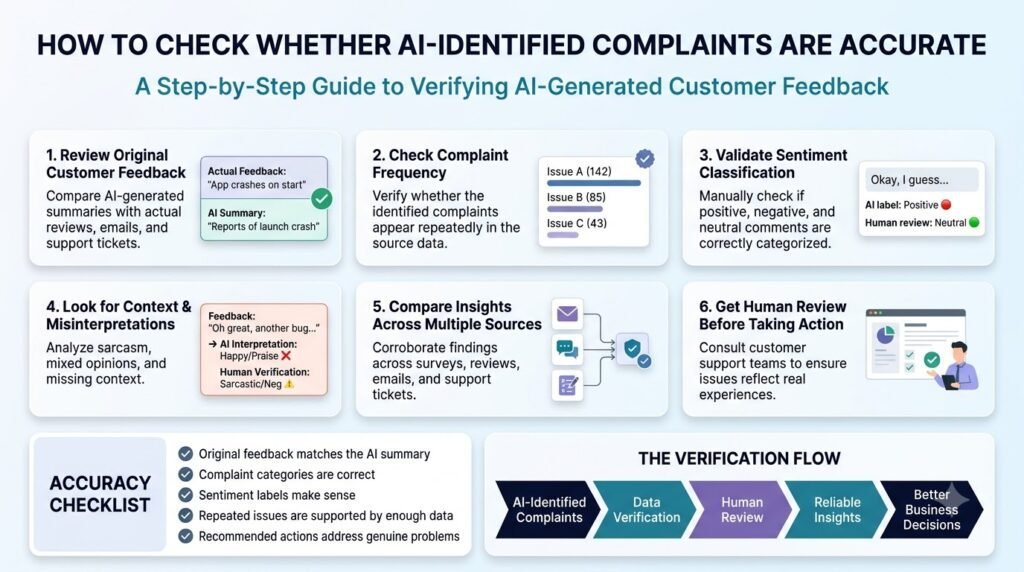
Finally, while AI can be a great tool for identifying useful patterns, it should not be taken as the final word on your business.
Before acting on the findings, validate them.
Use these checks:
- Verify the original comments: Confirm that each complaint category is supported by actual customer statements.
- Check the counts: Compare AI-generated totals with the original feedback records.
- Review similar but different issues: Make sure the model has not combined separate problems into one category.
- Check unusual complaints: Investigate whether low-frequency issues involve significant risks.
- Compare customer segments: Determine whether a problem affects all customers or only a specific group.
- Look for missing context: Review relevant order records, support history, or product information when necessary.
By looking at the same anonymised feedback using multiple AI models, you can see differences in how they group, interpret and potentially identify causes.
AiZolo provides a multi-model workspace where you can run the same prompt across different AI models and compare their responses side by side.
This can help question your original analysis.
Remember that agreement between AI models does not prove that a finding is correct. The original customer feedback remains the evidence.
Tools for Analyzing Customer Feedback With AI
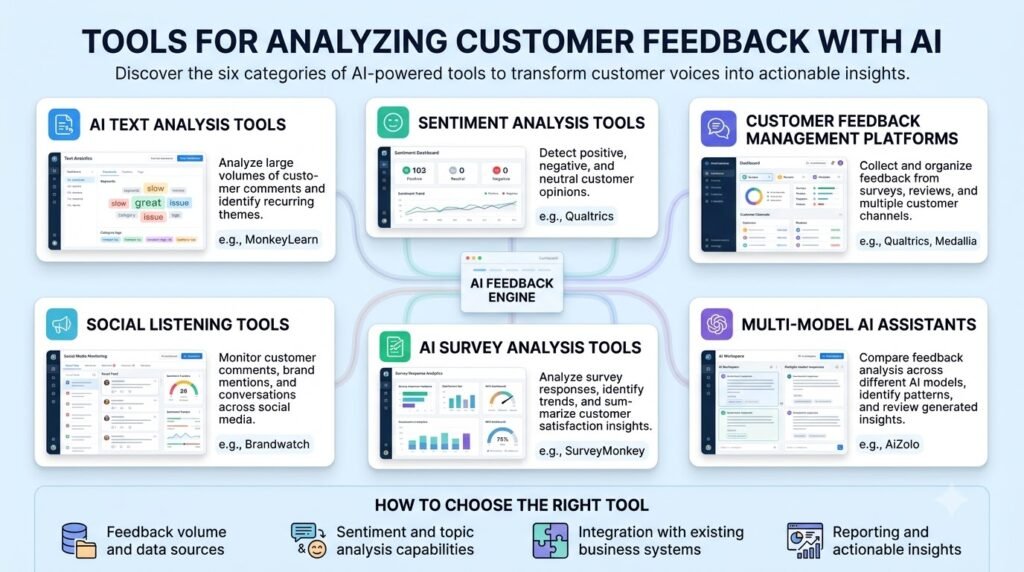
The right tool depends on the volume of feedback, the channels you use, and how much control your team needs over the analysis process.
Consider these options:
| Tool or approach | Suitable use |
| ChatGPT and other general-purpose AI assistants | Categorizing comments, summarizing feedback, and identifying themes |
| AiZolo | Comparing how different AI models interpret the same feedback and prompts |
| Google Cloud Natural Language API | Programmatic text and sentiment analysis |
| Spreadsheet tools | Organizing feedback records and checking complaint counts |
| Dedicated customer feedback platforms | Managing feedback across supported channels and workflows |
Google Cloud’s Natural Language API provides sentiment analysis and entity analysis capabilities. It includes information explaining the difference between Sentiment Score and Magnitude.
This means there is another level of review available if you want to compare how the AI interprets your data.
You can run a previously saved prompt to see how different models categorise the same anonymised comments.
Make sure to choose tools which will work with your data sources, privacy requirements and review process.
Common Mistakes to Avoid When Using AI for Customer Feedback Analysis
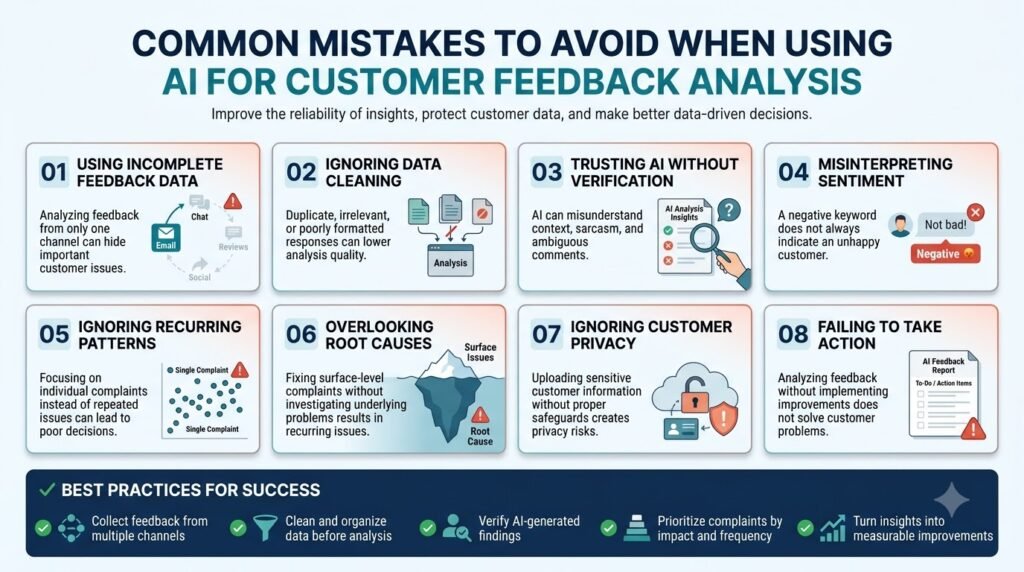
AI can help us analyse feedback more efficiently, but there are many factors that can affect the accuracy of results.
1. Analyzing Poor-Quality Data
Duplicate, incomplete or incorrect data entries can cause inaccurate counts of complaints.
What to do: Clean the data and keep the original feedback IDs.
2. Trusting AI-Generated Counts Without Checking
Incorrect comment counts, incorrect merging of data, and duplicates may occur.
What to do: Check key totals against the raw data or spreadsheet.
3. Treating Every Negative Comment as an Urgent Problem
Not every dissatisfied customer is reporting a serious operational failure.
What to do: Consider the seriousness, how often it occurs and what effect it could have on customers.
4. Ignoring Less Frequent Complaints
A rare complaint may still represent a serious issue involving payments, security, or customer safety.
What to do: Review separately issues with a high impact or those that are sensitive.
5. Confusing Possible Causes With Confirmed Causes
AI systems can provide insights into why something might be happening, but they cannot prove.
What to do: Validate root-cause hypotheses using business records and relevant teams.
6. Uploading Sensitive Customer Information Without Appropriate Controls
Customer feedback may contain personal or confidential information.
What to do: Minimize the information shared with AI systems and follow applicable privacy and security requirements.
How to Turn Customer Complaints Into Business Improvements
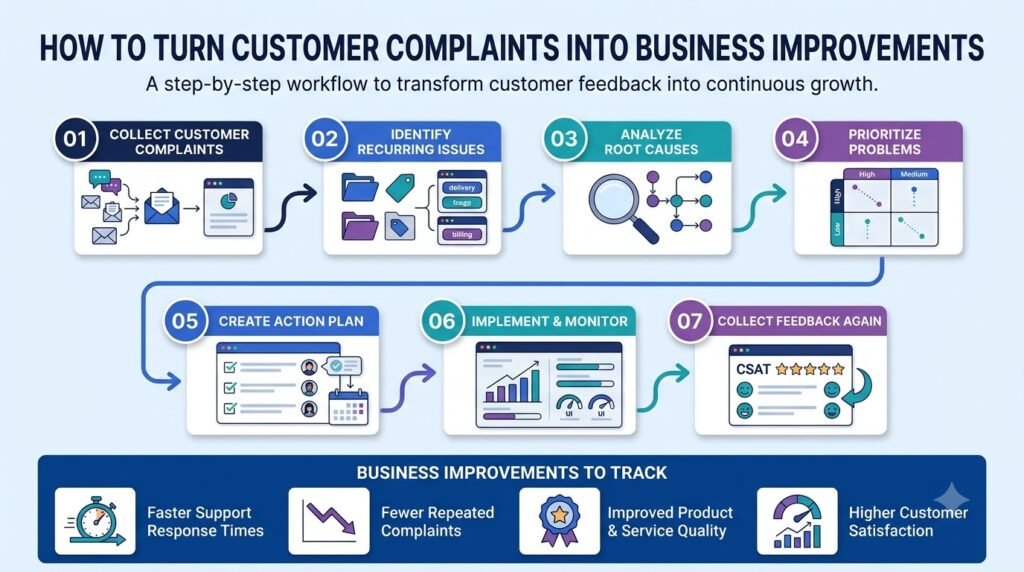
The final goal of customer feedback analysis is to improve the experience customers receive.
Once you have identified and validated recurring complaints, convert them into specific improvement tasks.
For example:
- Assign each important complaint category to a responsible department.
- Document the supporting customer evidence.
- Define the problem that needs to be investigated.
- Agree on a practical corrective action.
- Establish a measurable way to evaluate the result.
- Review new customer feedback to determine whether the issue continues.
Use KPIs such as the number of complaints, number of repeated contacts, time taken to resolve and customer satisfaction.
If customers are complaining that they are receiving slow responses, monitor if the average response time has improved since the support team changed their process.
If users are complaining about issues navigating your product, monitor if there is an improvement in the relevant feedback since usability improvements.
This can be presented in regular reports to show teams where complaints are improving and where they still need to focus on.
Most importantly, close the feedback loop. Where appropriate, communicate meaningful improvements to customers so they can see that their concerns were considered.
FAQs: Use AI to Analyze Customer Feedback and Find Common Complaints
1. Can AI identify common customer complaints?
Yes. AI can analyze customer comments, reviews, support tickets, and survey responses to group similar problems into recurring categories.
It can also identify negative sentiment and summarize common themes. However, businesses should verify the complaint categories and counts against the original feedback before making decisions.
2. How do you use ChatGPT to analyze customer reviews?
Provide ChatGPT with an appropriately anonymized collection of customer reviews and ask it to group similar complaints, identify recurring themes, count feedback records, and provide supporting quotes.
Request a structured table and instruct the model not to invent statistics or conclusions that are not supported by the reviews.
3. What is the difference between sentiment analysis and complaint analysis?
Sentiment analysis identifies the emotional direction of customer feedback, such as positive, negative, or neutral. Complaint analysis focuses on the actual problems customers report.
Combining both helps businesses understand not only what customers are experiencing but also how they feel about those experiences.
4. Can AI analyze customer feedback from multiple sources?
Yes, provided the feedback can be exported or otherwise accessed in a compatible format. Businesses can combine reviews, surveys, support tickets, emails, and chat transcripts into an organized dataset.
They should retain source information so that AI-generated findings can be traced back to the original comments.
5. How accurate is AI customer feedback analysis?
Accuracy depends on feedback quality, model capabilities, language, context, and the complexity of the complaints. AI can identify useful patterns, but it may misclassify comments or combine unrelated issues. Human review and verification against original records are important for reliable results.
6. How often should businesses analyze customer complaints?
The frequency depends on feedback volume and business needs. Businesses receiving frequent support tickets or product reviews may benefit from weekly or continuous monitoring, while smaller organizations may review feedback monthly. Serious complaints should be escalated as soon as they are identified.
7. Can AI help businesses prioritize customer complaints?
Yes. AI can organize complaints according to frequency, severity, customer impact, and possible business consequences. It can suggest which issues deserve attention first, but responsible teams should validate the priorities, especially when complaints involve security, payments, compliance, or customer safety.
Conclusion
Learning how to use AI to analyze customer feedback and find common complaints gives businesses a more structured way to understand customer problems.
AI can be used to make sense of messy data, understand common themes, analyse sentiment, understand how common complaints are and uncover potential causes. However it’s important that your data is clean, you have appropriate privacy measures and people checking the results.
Begin by using a small set of customer comments to find the most common complaints and verify them.
Not only do you want to analyse more customer comments but you want to understand what the common issues are so that you can improve the customer experience.
Author
Anshika Verma
Anshika Verma is a content researcher and writer focused on researching AI tools, AI models, and creator technologies. Her content explores practical AI workflows, emerging technologies, and ways businesses and creators can use AI effectively in real-world situations.