The 3 AM Crisis That Changed Everything
Sarah’s eyes burned as she stared at her screen, surrounded by empty coffee cups. It was 3 AM on a Thursday, and she was only 47 products into her catalog of 500. Her new ecommerce store was supposed to launch in two days, but she was drowning in product descriptions.

Each listing needed to be unique, engaging, and optimized for search engines. But writing compelling copy that balanced SEO keywords with natural, persuasive language felt impossible. She’d hired a freelance copywriter who charged $50 per description, but her budget ran out after just 100 products. The math was brutal: 500 products × $50 = $25,000. Money she simply didn’t have.
Sound familiar? If you’ve ever felt overwhelmed by the sheer volume of content needed to run a successful ecommerce business, you’re not alone. The good news? Creating SEO optimized ecommerce descriptions using AI has revolutionized how online store owners approach product content in 2025.
Why Traditional Product Description Writing Is Broken
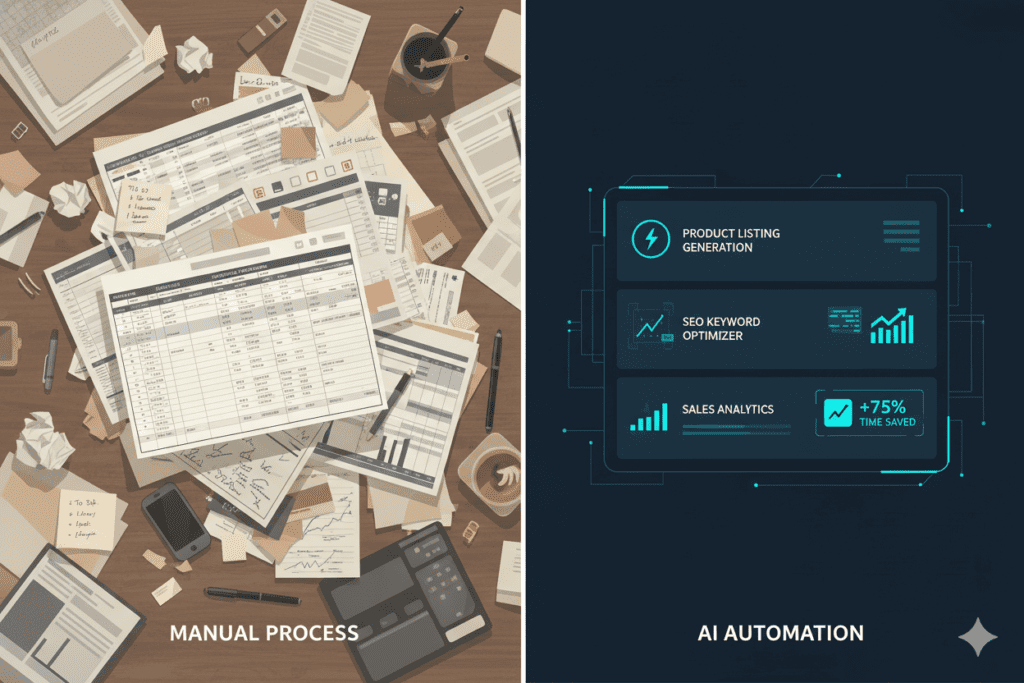
Before we dive into solutions, let’s address the elephant in the room. Traditional approaches to writing ecommerce descriptions face three major problems:
Time Consumption: The average product description takes 15-30 minutes to write when you factor in research, keyword analysis, and editing. For a store with 200 products, that’s 50-100 hours of work.
Inconsistency Issues: When multiple writers or tools are involved, maintaining a consistent brand voice across hundreds of products becomes nearly impossible. One description sounds formal, another casual, and a third tries too hard to be clever.
SEO Knowledge Gap: Most business owners understand that SEO matters, but implementing best practices like keyword density, semantic variations, and search intent alignment requires specialized expertise.
What Makes an Ecommerce Description “SEO Optimized”?
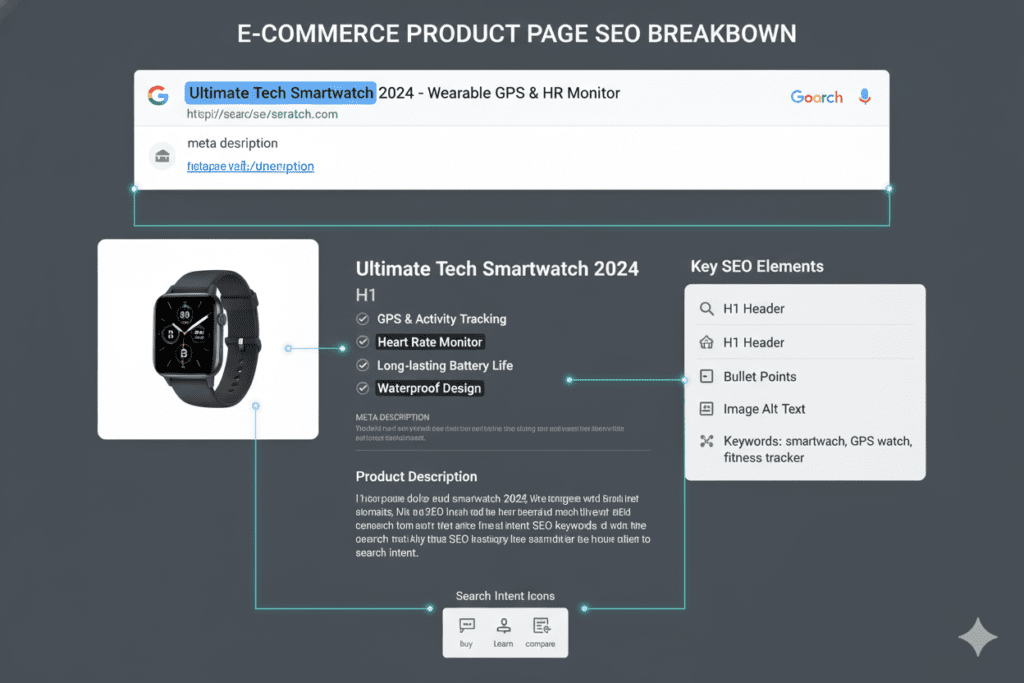
Before exploring AI solutions, it’s important to understand what separates mediocre product descriptions from those that rank on page one of Google. SEO optimized ecommerce descriptions using AI should include:
Strategic Keyword Placement: Your primary keyword should appear in the title, first 100 words, and naturally throughout the description without stuffing.
Semantic Variations: Modern search engines understand context. Include related terms and phrases that support your main keyword naturally.
Structured Content: Use headers, bullet points, and short paragraphs to improve readability for both humans and search engine crawlers.
Optimal Length: Aim for 100-400 words per description. Too short means missed SEO opportunities; too long risks losing reader attention.
Unique Content: Duplicate content from manufacturer descriptions tanks your SEO. Every description must be original.
Search Intent Alignment: Understand whether users searching for your product want to buy, compare, or learn. Your description should match that intent.
The AI Revolution in Ecommerce Content Creation
Here’s where things get exciting. Artificial intelligence has fundamentally transformed how we create SEO optimized ecommerce descriptions using AI. Instead of spending hours on each product, modern AI tools can generate compelling, unique, and search-optimized content in seconds.

But here’s the catch: not all AI solutions are created equal.
The Problem With Using ChatGPT Alone
Many store owners discover ChatGPT and think they’ve found the magic bullet. They open a browser tab, paste in product details, and ask ChatGPT to write a description. And it works… sort of.
The issues emerge when you scale:
- You’re manually copying and pasting for each product
- You need to provide detailed prompts every single time
- You’re switching between ChatGPT, your keyword research tool, and your ecommerce platform
- You lack the specialized ecommerce training that purpose-built tools offer
- You’re paying $20/month for ChatGPT Plus, but still investing hours in manual work
This is where having access to multiple AI models simultaneously becomes a game-changer.
How Multiple AI Models Create Better Product Descriptions
Think about this: different AI models have different strengths. Claude excels at maintaining brand voice consistency. ChatGPT generates creative angles quickly. Gemini provides excellent factual accuracy. Perplexity can pull in real-time market data.
What if you could access all of them at once?
This is exactly what platforms like AiZolo enable. Instead of juggling multiple subscriptions costing $110+ per month, you get access to ChatGPT 5, Claude Sonnet 4, Google Gemini 2.5 Pro, Perplexity Sonar Pro, and more—all for just $9.9/month.
Image Prompt: Split screen showing cluttered browser tabs with multiple AI tools vs clean AiZolo interface with all models in one dashboard
Here’s how this multi-model approach transforms ecommerce content creation:
Strategy 1: The Comparison Method for Perfect Descriptions
When creating SEO optimized ecommerce descriptions using AI, start by asking multiple AI models to generate descriptions for the same product. With AiZolo’s side-by-side comparison feature, you can:
- Input your product details and primary keywords
- Generate descriptions from 3-4 different AI models simultaneously
- Compare the outputs in real-time
- Cherry-pick the best elements from each
- Create a superior final description that leverages each model’s strengths
Real Example: A handmade jewelry seller used this method and discovered that Claude provided beautiful emotional storytelling, while ChatGPT nailed the technical specifications. By combining both, her conversion rate jumped 34%.
Strategy 2: The Iterative Refinement Approach
Start with one AI model to create a basic description, then refine it through others:
- Use ChatGPT to generate the initial creative description
- Run it through Claude to ensure consistent brand voice
- Use Perplexity to add data-backed selling points
- Final polish with Gemini for SEO optimization
This iterative process, which would require four separate subscriptions and constant tab-switching, becomes seamless with an all-in-one platform.
The Complete Workflow for Creating SEO Optimized Ecommerce Descriptions Using AI
Let me walk you through the exact process that transformed Sarah’s business from our opening story. After discovering multi-model AI platforms, she went from drowning in work to launching her 500-product store on time. Here’s her complete workflow:
Step 1: Gather Your Product Intel
Before touching any AI tool, compile these details:
- Product name and category
- Key features and specifications
- Primary and secondary keywords (use tools like Ahrefs or Google Keyword Planner)
- Target audience demographics
- Unique selling propositions
- Brand voice guidelines
Step 2: Create Your Master Prompt Template
Don’t recreate the wheel for every product. Develop a reusable prompt structure:
“Write a compelling product description for [PRODUCT NAME] that targets [AUDIENCE]. Include these specifications: [SPECS]. Primary keyword: [KEYWORD]. Tone: [BRAND VOICE]. Length: 200-300 words. Focus on benefits over features. Include a call-to-action.”
With platforms like AiZolo, you can save this as a project template with custom system prompts, ensuring consistency across your entire catalog.
Step 3: Generate and Compare Multiple Versions
Access multiple AI models simultaneously and generate 3-4 variations. Look for:
- Which version has the most natural keyword integration?
- Which one best captures your brand voice?
- Which includes the most compelling benefits?
- Which has the best structure and readability?
Step 4: Synthesize and Polish
Combine the best elements from each version. Add your human touch—personal insights, specific customer testimonials, or unique brand personality that AI might miss.
Step 5: Optimize and Validate
Before publishing, verify your description includes:
- Primary keyword in the first 100 words
- 2-3 instances of the primary keyword throughout (avoid stuffing)
- Semantic keyword variations
- Clear structure with scannable formatting
- Strong call-to-action
- Proper length (100-400 words)
Try AiZolo for free to experience multi-model AI description generation
Advanced Techniques for Maximum SEO Impact

Once you’ve mastered the basics of creating SEO optimized ecommerce descriptions using AI, these advanced strategies will take your results to the next level:
Technique 1: The Semantic Cluster Approach
Instead of optimizing each product description in isolation, create semantic relationships between related products. Use AI to identify and incorporate related keywords that strengthen your overall topical authority.
Example: A fitness equipment store doesn’t just optimize individual product pages for “adjustable dumbbells” or “resistance bands.” They use AI to identify semantic relationships and strategically link related products, building topical clusters that boost domain authority.
Technique 2: Dynamic Description Variations
Create multiple versions of each product description optimized for different customer journey stages:
- Discovery Stage: Focus on education and problem-solving
- Consideration Stage: Emphasize comparisons and specifications
- Decision Stage: Highlight social proof and urgency
With access to multiple AI models, you can generate these variations quickly and A/B test which performs best.
Technique 3: Review-Enriched Descriptions
Use AI to analyze customer reviews and incorporate authentic language and concerns into your descriptions. This approach dramatically improves authenticity and addresses real customer questions proactively.
Ask your AI platform: “Analyze these customer reviews and identify the top 5 benefits customers mention most frequently: [PASTE REVIEWS]”
Then incorporate these insights into your description update.
Real Success Stories: How Businesses Transform With AI

Case Study 1: Boutique Fashion Retailer
Maria ran a small online boutique with 300 products. She was spending $15,000 annually on copywriters for product descriptions. After implementing multi-model AI description generation, she:
- Reduced content creation costs by 91%
- Increased organic traffic by 156% in 6 months
- Improved conversion rates by 23%
- Freed up 15 hours per week for marketing strategy
She credits having access to multiple AI models simultaneously as the key differentiator. “Claude understood my brand voice perfectly, while ChatGPT came up with creative angles I never would have thought of,” she explains.
Case Study 2: Electronics Dropshipping Store
James managed a tech accessories store with over 1,000 SKUs. His challenge wasn’t just volume—it was keeping descriptions current as products evolved and new competitors entered the market.
Using a multi-AI approach, he:
- Created a system to regenerate descriptions quarterly with updated SEO keywords
- Implemented dynamic pricing language based on market conditions
- Reduced time per description from 30 minutes to 3 minutes
- Improved average search rankings from page 3 to page 1 for key products
Case Study 3: Handmade Crafts Marketplace
Sophia sells custom home décor on multiple platforms (Etsy, Shopify, Amazon). Each platform has different requirements for product descriptions. Creating platform-specific, SEO optimized ecommerce descriptions using AI transformed her workflow:
She uses different AI models for different platforms—Claude for Etsy’s story-driven approach, ChatGPT for Amazon’s feature-focused format, and Perplexity for incorporating trending design insights. Her sales increased 67% within four months.
The AiZolo Advantage for Ecommerce Sellers
Let’s be honest about why having all AI models in one platform matters for creating SEO optimized ecommerce descriptions using AI. Traditional approaches force you to:
- Pay $110+ monthly for separate subscriptions (ChatGPT Plus $20, Claude Pro $20, Gemini Advanced $20, Perplexity Pro $20, Grok $30)
- Switch between multiple tabs and interfaces
- Copy and paste content repeatedly
- Maintain separate prompt libraries
- Lose context when moving between tools
AiZolo solves these pain points by offering:
All Premium AI Models in One Dashboard
Access ChatGPT 5, Claude Sonnet 4, Google Gemini 2.5 Pro, Perplexity Sonar Pro, Grok 4, and 100+ other AI models from a single interface. Compare outputs side-by-side, and choose the best results instantly.
Project Management for Ecommerce
Create dedicated projects for different product categories with custom system prompts. Your brand voice, keyword requirements, and formatting preferences are automatically applied to every generation.
Dynamic Layout for Workflow Optimization
Arrange AI model windows however you want—side by side for comparison, stacked for iterative refinement, or minimized for focus. Your workspace adapts to your workflow, not the other way around.
Custom API Key Support
Already have API credits with OpenAI, Anthropic, or Google? Use your own encrypted API keys for unlimited generations beyond the included token limits.
Cost Efficiency That Actually Makes Sense
At just $9.9/month, AiZolo costs 91% less than maintaining individual subscriptions to each AI platform. For ecommerce businesses generating hundreds of descriptions monthly, this isn’t just savings—it’s the difference between profitability and financial strain.
Explore AiZolo’s plans and start your free trial today
Common Mistakes to Avoid When Creating AI-Generated Descriptions
Even with the best tools, certain pitfalls can undermine your SEO efforts when creating ecommerce descriptions:
Mistake 1: Trusting AI Blindly Without Review
AI is powerful but not infallible. Always review generated content for:
- Factual accuracy about your products
- Compliance with advertising standards
- Appropriate tone for your audience
- Natural keyword integration without stuffing
Mistake 2: Ignoring Brand Voice Consistency
Using multiple AI tools without proper prompting creates inconsistent descriptions. One product sounds formal and corporate; another feels casual and quirky. This inconsistency damages brand perception.
Solution: Create detailed brand voice guidelines and use project management features to ensure every AI generation follows these rules consistently.
Mistake 3: Forgetting the Human Element
SEO optimized ecommerce descriptions using AI should enhance human creativity, not replace it entirely. The most effective approach combines:
- AI’s speed and data-processing capability
- Human insight, empathy, and brand understanding
- Real customer feedback and testimonials
- Unique value propositions only humans can articulate
Mistake 4: Neglecting Regular Updates
Search algorithms evolve, competitors adapt, and customer preferences shift. Descriptions optimized perfectly six months ago might underperform today. Schedule quarterly reviews and updates using AI to refresh content with current keywords and trends.
Mistake 5: Overlooking Technical SEO Elements
Great descriptions need technical support:
- Proper schema markup for products
- Optimized image alt text
- Internal linking to related products
- Mobile-responsive formatting
- Fast page load speeds
AI can help with content, but technical implementation matters equally.
The Future of Ecommerce Content: What’s Next?

As we look toward 2026 and beyond, several trends will shape how we create SEO optimized ecommerce descriptions using AI:
Trend 1: Hyper-Personalization at Scale
Imagine generating unique product descriptions tailored to individual customer segments—Gen Z shoppers see descriptions emphasizing style and social responsibility, while Baby Boomers get content focusing on quality and reliability. AI makes this scalable personalization possible.
Trend 2: Voice Search Optimization
With voice commerce growing rapidly, product descriptions must adapt to conversational queries. AI tools trained on voice search patterns will automatically optimize content for “how,” “where,” and “best” questions.
Trend 3: Multilingual Content Generation
Expanding to international markets traditionally meant hiring translators. Modern AI generates native-quality descriptions in dozens of languages simultaneously, maintaining brand voice across linguistic barriers.
Trend 4: AI-Powered Content Performance Analytics
Future platforms will use AI not just to generate descriptions but to analyze which versions perform best, automatically optimizing based on conversion data and search rankings.
Your Action Plan: Getting Started Today
Ready to transform your ecommerce content strategy? Here’s your step-by-step action plan for implementing SEO optimized ecommerce descriptions using AI:
Week 1: Foundation Building
- Audit your current product descriptions and identify weaknesses
- Research and document primary keywords for your top 50 products
- Create brand voice guidelines and example descriptions you love
- Sign up for AiZolo’s free trial to access multiple AI models
Week 2: System Development
- Create reusable prompt templates for different product categories
- Test multiple AI models to identify which excel at different aspects (creativity, technical specs, emotional appeal)
- Develop your personal workflow for generating, comparing, and polishing descriptions
- Set up project management structure for different product lines
Week 3: Implementation
- Generate new descriptions for your top 50 revenue-generating products
- A/B test new AI-optimized descriptions against originals
- Track metrics: organic traffic, time on page, bounce rate, conversion rate
- Refine prompts based on performance data
Week 4: Scaling and Optimization
- Roll out successful templates to remaining products
- Establish a regular content refresh schedule
- Train team members on your AI-powered workflow
- Document processes for consistency
Measuring Success: Key Metrics That Matter
How do you know if your AI-generated descriptions are working? Track these key performance indicators:
Search Engine Rankings: Monitor keyword positions for products with updated descriptions. Tools like Google Search Console show which queries drive traffic.
Organic Traffic Growth: Compare traffic to product pages before and after implementing AI-optimized descriptions. Look for sustained increases over 3-6 months.
Conversion Rate Changes: More traffic means nothing without conversions. Track whether new descriptions improve add-to-cart and purchase rates.
Time on Page: Engaging descriptions keep visitors reading longer. Increased time on page signals quality content to search engines.
Bounce Rate Reduction: If visitors immediately leave after landing on your product page, your description isn’t meeting their search intent.
Return on Investment: Calculate time and money saved through AI automation compared to traditional content creation methods.
Additional Resources for Ecommerce Success
Want to dive deeper into AI-powered ecommerce strategies? Check out these valuable resources:
Internal Resources:
- How to Chat with Multiple AI Models – Master the art of leveraging different AI models for superior results
- Best AI Tools for Content Creation – Discover how content creators use AI to 10x their productivity
- How to Save Money on AI Subscriptions – Cut AI costs by 90% while accessing more tools
External Resources:
- Google’s Product Structured Data Guidelines – Ensure your descriptions meet technical requirements
- Ahrefs Keyword Research Guide – Master keyword strategy for ecommerce
- Shopify’s Guide to Product Descriptions – Fundamental principles that complement AI generation
Conclusion: Your Ecommerce Content Transformation Starts Now
Remember Sarah from our opening story? She’s now running a thriving online store with 500+ products, all with unique, SEO optimized ecommerce descriptions using AI. She generates content in minutes that would have taken weeks using traditional methods. Her organic traffic has tripled, and her conversion rate improved by 41%.
The difference between struggling with content creation and scaling your ecommerce business efficiently comes down to using the right tools strategically. Creating SEO optimized ecommerce descriptions using AI isn’t about replacing human creativity—it’s about augmenting it. It’s about freeing yourself from tedious, repetitive work so you can focus on strategy, customer relationships, and business growth.

The transformation is available to every ecommerce seller today. Whether you’re managing 50 products or 5,000, AI-powered description generation can save you thousands of hours and tens of thousands of dollars annually while delivering superior SEO results.
The question isn’t whether you should adopt AI for ecommerce content creation—it’s whether you can afford not to. Your competitors are already leveraging these tools. The stores ranking above you in search results are likely using sophisticated AI workflows.
But here’s the exciting part: the technology is now accessible to everyone. You don’t need a technical background or a massive budget. With platforms like AiZolo offering all premium AI models for just $9.9/month, the barrier to entry has never been lower.
Take action today. Your future self—the one managing a thriving ecommerce business with perfectly optimized product descriptions and consistent sales growth—will thank you.
Get started with AiZolo for free and transform your ecommerce content strategy in 2025.
Frequently Asked Questions
Q: Can AI-generated descriptions hurt my SEO if Google detects them?
A: Google’s guidelines focus on content quality and usefulness, not how it’s created. As long as AI-generated descriptions are unique, valuable, and edited by humans, they won’t negatively impact SEO. In fact, properly optimized AI content often performs better than generic human-written descriptions.
Q: How do I maintain brand voice across AI-generated descriptions?
A: Use detailed prompts with specific brand voice guidelines, provide example descriptions you love, and use project management features to enforce consistent standards. Platforms like AiZolo allow you to save custom system prompts that automatically apply your brand voice to every generation.
Q: Should I use different AI models for different types of products?
A: Absolutely! Different models have unique strengths. Claude excels at emotional storytelling (perfect for lifestyle products), ChatGPT generates creative angles quickly (great for innovative products), and Perplexity provides data-backed insights (ideal for technical products). Experiment to find the best fit.
Q: How often should I update product descriptions?
A: Review and refresh descriptions quarterly at minimum, or whenever you notice ranking declines. Products that directly compete with ranking competitors should be monitored monthly. Use AI to make updates quick and painless.
Q: What’s the ideal length for SEO optimized ecommerce descriptions?
A: Aim for 100-400 words. This range provides enough content for keyword optimization and customer information without overwhelming readers. High-value products can justify longer descriptions (400-800 words) with detailed specifications and benefits.
About the Author: This guide combines insights from successful ecommerce entrepreneurs who have transformed their content strategies using AI. For more resources on AI-powered business tools, visit AiZolo’s blog.