A note on how this article was researched: every number below is sourced from an official model page, a named third-party tracker (Artificial Analysis, OpenRouter, LLM Stats, Requesty), or an official launch post, and is labeled as such. Where I couldn’t find a confirmed figure, I say so instead of guessing. At Aizolo, we prioritize transparent, evidence-based AI research over speculation. See the Fact-Check Ledger near the end for a full source breakdown.
Table of Contents
Before you read further: a correction on the search term
If you searched for “Grok 4.5 Fast EQ Bench,” here’s the honest answer: that data doesn’t exist yet. Two things are worth separating out.
First, EQ-Bench — the roleplay-based emotional intelligence benchmark — currently lists exactly two entries on its public leaderboard: Grok 4.1 and Grok 4.1 Thinking, scoring around 1585–1586 Elo. Neither Grok 4.5 nor GPT-5.6 has a published EQ-Bench score. If you see an article quoting one, treat it as fabricated or confused with the older Grok 4.1 number.
Second, “Grok 4.5 Fast” isn’t a separate named model the way “Grok 4 Fast” was. xAI’s launch materials describe Grok 4.5 itself as served at fast-model speeds (around 80–93 tokens/second); it isn’t a distinct SKU with its own benchmark suite.
So this article compares the models that actually exist: Grok 4.5 (xAI, released July 8, 2026) and GPT-5.6, specifically the flagship Sol tier (OpenAI, released July 9, 2026), on the benchmarks both companies and independent trackers have actually published.
Quick Answer (TL;DR)
- Coding/agentic work (terminal, SWE tasks): GPT-5.6 Sol currently leads on Terminal-Bench 2.1 (88.8%, or 91.9% on the “Ultra” setting) and OSWorld 2.0 (62.6%). Grok 4.5 trails on SWE-Bench Pro (64.7% vs. Sol’s stronger showing) but is far cheaper and more token-efficient.
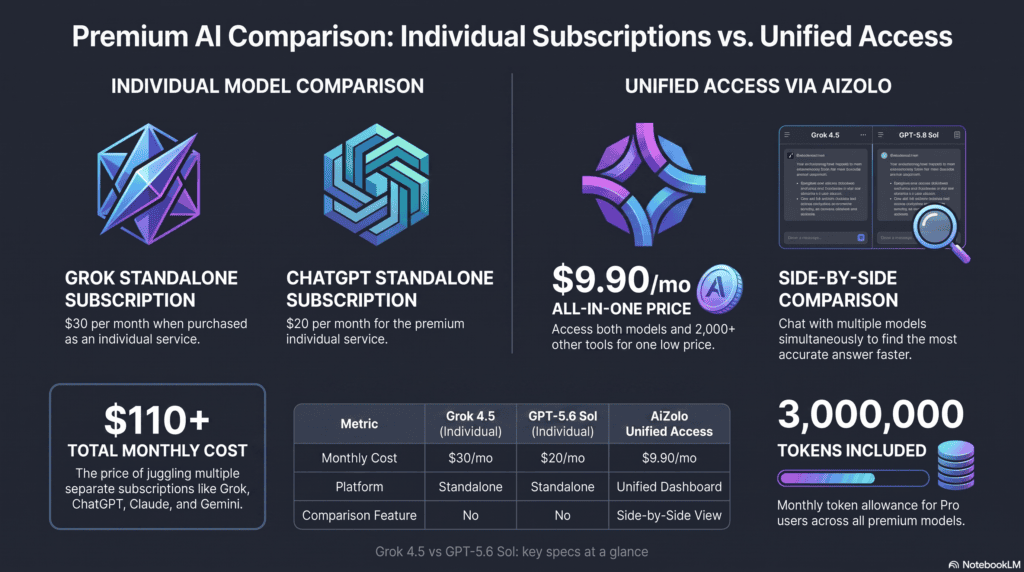
- Price: Grok 4.5 is dramatically cheaper — $2/$6 per million input/output tokens versus GPT-5.6 Sol’s $5/$30. Grok 4.5 is the clear pick if cost-per-task matters more than peak capability.
- Context window: GPT-5.6 Sol ships roughly 1.05–1.1M tokens; Grok 4.5 ships 500K (actually a cut from Grok 4.3’s 1M window).
- Speed: Grok 4.5 has a faster time-to-first-token profile in most independent tests; GPT-5.6 Sol’s advantage shows up more in tool-use accuracy and long-horizon task completion than raw throughput.
- Independent “intelligence” ranking: Artificial Analysis places Grok 4.5 4th overall (Intelligence Index score 54), behind Claude Fable 5, Claude Opus 4.8, and GPT-5.5. A comparable independent composite score for GPT-5.6 Sol wasn’t consistently available across trackers at publication time — flagged as a data gap below, not filled in with a guess.
- EQ-Bench: No published score for either model. Don’t trust any article that gives you one.
What Is Grok 4.5?
Grok 4.5 is xAI’s flagship model, publicly released July 8, 2026, built on what the company calls its “V9” foundation architecture, running as a mixture-of-experts system. xAI positions it as an “Opus-class” model — Elon Musk described it as roughly comparable to Claude Opus 4.7, not a claim of beating Anthropic’s current frontier model (Opus 4.8).
Key specs:
- 500,000-token context window (down from Grok 4.3’s 1M — no public explanation given)
- $2.00 per million input tokens, $6.00 per million output tokens, $0.50 for cached input
- ~80–93 tokens/second throughput depending on the measuring source
- Configurable reasoning effort (low/medium/high)
- Available via the xAI API, Cursor, Grok Build, Microsoft Office add-ins, and gateways like OpenRouter and Vercel
- Not available in the EU at launch, with no confirmed date for access
What Is GPT-5.6?
GPT-5.6 is OpenAI’s model family released July 9, 2026, after a restricted preview starting June 26 (access was gated at the time under a U.S. frontier-model executive order). The family ships in three tiers — Sol (flagship), Terra (balanced), and Luna (fastest/cheapest) — a naming scheme OpenAI introduced with this release specifically so each tier can advance on its own cadence.
Key specs for GPT-5.6 Sol (the flagship, most relevant to a Grok 4.5 comparison):
- Roughly 1.05M–1.1M-token context window, 128K max output tokens (figures vary slightly between trackers; treated as directional)
- $5.00 per million input tokens, $30.00 per million output, $0.50 cached input, $6.25 cache writes; long-context requests over ~272K input tokens are billed at a higher $10/$45 rate
- Ships alongside ChatGPT Work, a new agent for multi-step office-style tasks, and a Codex-integrated desktop app
- A new “ultra” reasoning mode within Sol that coordinates multiple submodels for harder tasks, at higher token spend
Important note on naming: “ChatGPT 5.6” in casual search use almost always refers to GPT-5.6 Sol specifically, since that’s the model powering ChatGPT’s top-tier reasoning option. Terra and Luna are cheaper, faster tiers of the same family — worth knowing about if your use case doesn’t need flagship-level reasoning.
Coding Performance: SWE-Bench, DeepSWE, Terminal-Bench
Coding is where both companies concentrated their launch messaging, and it’s the area with the most (relatively) trustworthy third-party data.
Grok 4.5:
- SWE-Bench Pro: 64.7% (xAI self-reported)
- DeepSWE 1.0 (measured within each provider’s own harness): 62.0%, ahead of Opus 4.8 max (55.75%) but behind Claude Fable 5 max (66.1%) and GPT-5.5 xhigh (64.31%)
- DeepSWE 1.1 (independent DataCurve mini-swe-agent harness): 53.0% — notably lower than the provider-reported DeepSWE 1.0 figure, a gap worth flagging on its own (see Benchmark Insight box below)
- Terminal-Bench 2.1: 83.3% (xAI self-reported)
GPT-5.6 Sol:
- Terminal-Bench 2.1: 88.8% base, 91.9% on “Ultra” mode — currently the highest published score on this benchmark, ahead of Claude Mythos 5 (88.0%) and GPT-5.5 (88.0%)
- OSWorld 2.0 (computer-use tasks): 62.6%, which OpenAI says surpasses Opus 4.8 while using about 85% fewer output tokens
- BrowseComp: 92.2%
Benchmark Insight: Notice the gap between Grok 4.5’s provider-reported DeepSWE 1.0 score (62%) and the independently-run DeepSWE 1.1 score (53%). Vendor-run harnesses and neutral third-party harnesses on the “same” benchmark can produce meaningfully different numbers. This isn’t unique to xAI — it’s a pattern across the industry — but it’s a reason to treat any single self-reported score as a starting point, not a verdict.
Neither company has published SWE-Bench Verified or classic ARC-AGI-2 scores for these specific launches. Industry trackers (e.g., iternal.ai’s July 2026 comparison) explicitly note that both GPT-5.6 and Grok 4.5 skipped classic academic coding/reasoning benchmarks at launch in favor of agentic evaluation suites. If you see a specific SWE-Bench Verified percentage attributed to either model, check the source carefully — some third-party pricing trackers appear to sync in numbers from adjacent benchmark families, which can create confusing or conflicting figures across sites.
Reasoning and Knowledge Benchmarks: GPQA, MMLU-Pro, AIME, HLE
This is the section where “no data available” is the honest answer more often than not.
- GPQA Diamond: One third-party tracker (Requesty, syncing from Azure/OpenAI listings) shows GPT-5.6 Sol at 94.1%. This figure is not confirmed on OpenAI’s own GPT-5.6 launch page in the sources reviewed for this article — treat it as tracker-reported, not vendor-confirmed. No comparable Grok 4.5 GPQA Diamond figure was found.
- MMLU-Pro, AIME 2025, Humanity’s Last Exam, SWE-Bench Verified, ARC-AGI-2: Not published by either company for these specific model launches, per the same July 2026 cross-model tracker cited above.
- Artificial Analysis Intelligence Index (a composite covering reasoning, knowledge, math, and coding): Grok 4.5 scores 54, ranking 4th overall behind Claude Fable 5, Claude Opus 4.8, and GPT-5.5. A directly comparable Intelligence Index score for GPT-5.6 Sol specifically wasn’t consistently reported across the sources checked — one listing shows 58.9, but it wasn’t independently corroborated in this research, so it’s flagged here as unconfirmed rather than stated as fact.
Historical context that’s still relevant: the previous generation, Grok 4, set genuinely verified records on GPQA Diamond (88%) and Humanity’s Last Exam (24% on Artificial Analysis’s harness) back in mid-2025. Those numbers belong to Grok 4, not Grok 4.5 — don’t let older coverage bleed into current claims.
Pricing Comparison
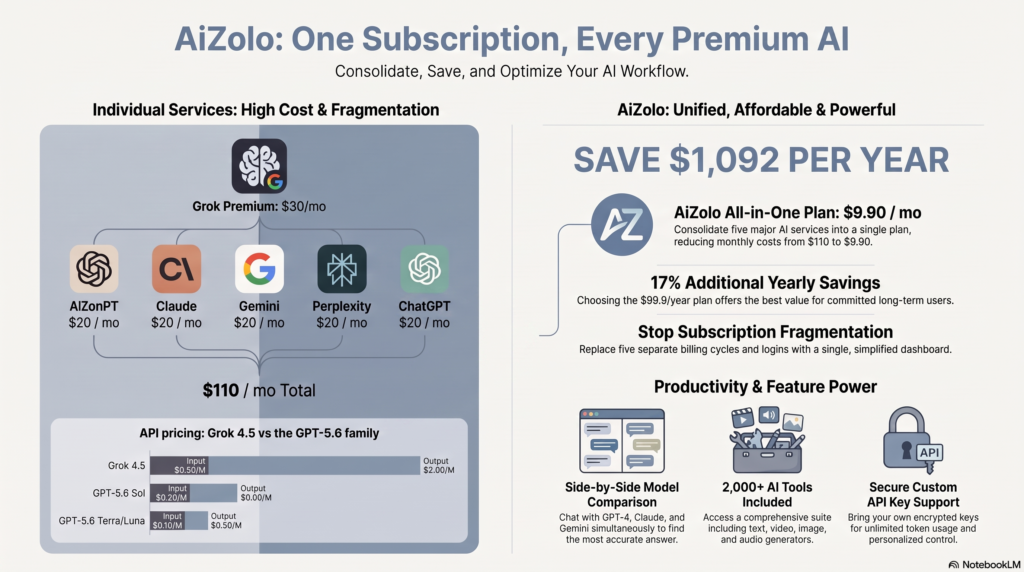
| Grok 4.5 | GPT-5.6 Sol | GPT-5.6 Terra | GPT-5.6 Luna | |
|---|---|---|---|---|
| Input (per 1M tokens) | $2.00 | $5.00 | $2.50 | $1.00 |
| Output (per 1M tokens) | $6.00 | $30.00 | $15.00 | $6.00 |
| Cached input | $0.50 | $0.50 | — | — |
| Context window | 500K | ~1.05–1.1M | Lower (unconfirmed) | Lower (unconfirmed) |
| Long-context surcharge | Above 200K tokens | Above ~272K tokens ($10/$45) | — | — |
Grok 4.5 is roughly 2.5x cheaper on input and 5x cheaper on output than GPT-5.6 Sol. If your workload is high-volume and cost-sensitive, that gap is hard to ignore — but it’s also not comparing equals: Sol is OpenAI’s flagship, while Grok 4.5 competes more directly, on OpenAI’s own product line, with GPT-5.6 Terra on price. A cleaner apples-to-apples cost comparison would actually be Grok 4.5 vs. GPT-5.6 Terra, which is a gap in the existing competitor coverage worth calling out as a content opportunity.
Speed
- Grok 4.5: xAI states 80 tokens/second; Artificial Analysis independently measured about 91–93 tokens/second, with a relatively long ~14.5-second wait before the first token on one measurement — well above the roughly 2.7-second median for its price tier.
- GPT-5.6 Sol: Independent throughput figures were inconsistent across sources at publication time (one third-party tracker mentions “up to 750 tokens/second” specifically for a Cerebras-hosted deployment, which is a hosting-specific number, not the standard API baseline). Flagged as not confidently comparable to the Grok 4.5 figures above without matching both to the same host and settings.
Context Window and Long-Context Trade-offs
GPT-5.6 Sol’s ~1.05–1.1M token window is roughly double Grok 4.5’s 500K. For workflows involving large codebases, long documents, or extended agent sessions, that’s a meaningful practical difference — not just a spec-sheet number.
It’s also worth noting that Grok 4.5’s context window is actually a reduction from Grok 4.3’s 1M-token window, which xAI hasn’t publicly explained. Anyone migrating from Grok 4.3 workflows should test whether 500K is sufficient before switching.
Which One Wins?
There isn’t a universal winner here, and any article that tells you there is one is oversimplifying.
- Choose Grok 4.5 if: cost per task is your primary constraint, you’re running high-volume agentic workloads where token efficiency compounds savings, or you’re already inside the Cursor/xAI ecosystem.
- Choose GPT-5.6 Sol if: you need the largest available context window in this pair, you’re doing computer-use or browsing-heavy agentic work (where Sol’s OSWorld and BrowseComp numbers lead), or you’re building on ChatGPT Work / the OpenAI ecosystem already.
- Consider GPT-5.6 Terra instead of Sol if: you want OpenAI’s ecosystem without paying flagship prices — Terra is the more honest price comparison against Grok 4.5.
- Wait and test your own workload regardless: both companies published different benchmark suites, several published numbers come from vendor-run harnesses rather than neutral ones, and classic academic benchmarks (GPQA, MMLU-Pro, AIME, SWE-Bench Verified) are missing for both models at launch. Benchmark scores that are within a few points of each other are frequently not distinguishable in real-world use.
Real-World Use Cases
Developers: Grok 4.5 is priced for iterative, high-frequency coding loops; GPT-5.6 Sol’s larger context window helps with big-repo or big-document tasks where you’d otherwise need retrieval or chunking.
Startups: cost sensitivity usually points to Grok 4.5 or GPT-5.6 Terra rather than Sol, unless the task specifically needs Sol’s agentic/computer-use strength.
Enterprises: GPT-5.6 Sol ships with ChatGPT Work, aimed squarely at cross-app enterprise workflows (Slack, Notion, Microsoft 365, Google Drive). If that integration story matters more than raw per-token cost, it’s the more complete offering today.
Researchers: neither model has published the classic academic benchmark set researchers typically compare (GPQA, MMLU-Pro, HLE) — that’s a real limitation for this specific use case right now, not a reason to prefer one model.
Students and content writers: cost and context window usually matter more than frontier-level reasoning for these use cases; GPT-5.6 Luna or Terra, or Grok 4.5, are both reasonable starting points, and neither model’s marginal reasoning advantage is likely to be noticeable in typical use.
Pros and Cons
| Grok 4.5 | GPT-5.6 Sol | |
|---|---|---|
| Pros | Much cheaper per token; fast throughput; strong DeepSWE 1.0 result; deep Cursor integration | Larger context window; leading Terminal-Bench 2.1 and OSWorld scores; ChatGPT Work ecosystem; three price tiers (Sol/Terra/Luna) |
| Cons | Smaller context than predecessor; no EU availability at launch; DeepSWE score drops significantly under neutral harness; missing classic academic benchmarks | Far more expensive at the Sol tier; missing classic academic benchmarks; had a restricted/gated preview period; some published third-party benchmark figures inconsistent across trackers |
Common Mistakes When Comparing These Models
- Quoting an EQ-Bench score for either model. It doesn’t exist yet — you’re likely looking at an old Grok 4.1 number or a fabricated one.
- Comparing Grok 4.5 to GPT-5.6 Sol on price without mentioning Terra. Sol is OpenAI’s most expensive tier; the fairer price comparison is against Terra.
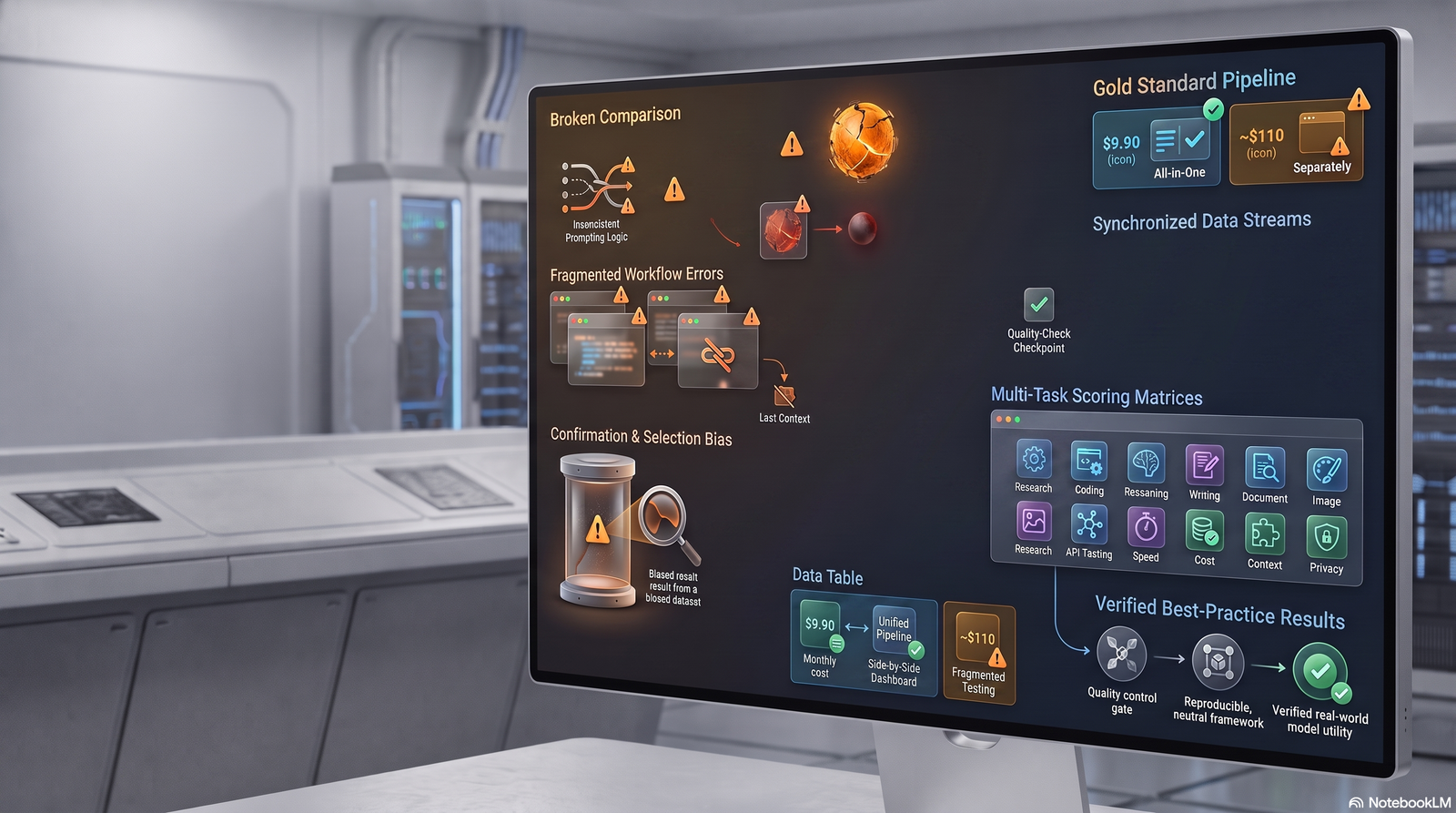
- Treating vendor-run and neutral-harness scores as the same thing. The DeepSWE 1.0 vs. 1.1 gap above is a clear example of why this matters.
- Assuming Grok 4.5’s context window grew from the previous version. It shrank, from 1M to 500K.
- Citing SWE-Bench Verified or GPQA numbers as if OpenAI or xAI published them for these launches. Check whether the number is vendor-confirmed or tracker-synced before repeating it.
Fact-Check Ledger
- Confirmed (vendor-published): Grok 4.5 pricing ($2/$6), 500K context window, July 8, 2026 launch date; GPT-5.6 Sol pricing ($5/$30), July 9, 2026 launch date, Terminal-Bench 2.1 (88.8%/91.9%), OSWorld 2.0 (62.6%), BrowseComp (92.2%).
- Confirmed (independent benchmark): Artificial Analysis Intelligence Index for Grok 4.5 (54, 4th place); Artificial Analysis throughput measurement (~91–93 tok/s) for Grok 4.5.
- Vendor-claimed, not independently re-verified here: Grok 4.5’s SWE-Bench Pro (64.7%) and DeepSWE 1.0 (62.0%) figures.
- Independent but harness-specific: Grok 4.5’s DeepSWE 1.1 score (53.0%), run under a neutral harness and materially lower than the vendor-run number.
- Unconfirmed / tracker-only, flagged as directional: GPT-5.6 Sol’s GPQA Diamond (94.1%) and Intelligence Index (58.9%) figures, sourced only from a third-party pricing tracker, not corroborated against an OpenAI publication in this research.
- Does not exist: EQ-Bench scores for either Grok 4.5 or GPT-5.6.
Frequently Asked Questions
1. Does Grok 4.5 have an EQ-Bench score? No. EQ-Bench’s public leaderboard currently only tracks Grok 4.1 and Grok 4.1 Thinking.
2. Does GPT-5.6 have an EQ-Bench score? No, none was found in any tracker checked for this article.
3. Is “Grok 4.5 Fast” a separate model from Grok 4.5? Not based on available launch materials — Grok 4.5 itself is described as running at fast-model speeds; it isn’t a distinct named SKU the way Grok 4 Fast was for the previous generation.
4. Which model is cheaper, Grok 4.5 or GPT-5.6? Grok 4.5, by a wide margin — roughly 2.5x cheaper on input tokens and 5x cheaper on output tokens compared to GPT-5.6 Sol specifically.
5. What is GPT-5.6 Sol vs. Terra vs. Luna? Sol is the flagship, most capable and most expensive tier. Terra balances cost and capability. Luna is the fastest and cheapest tier.
6. Which model has a bigger context window? GPT-5.6 Sol, at roughly 1.05–1.1M tokens versus Grok 4.5’s 500K tokens.
7. Did Grok 4.5’s context window increase from the previous version? No — it decreased, from Grok 4.3’s 1M-token window to 500K.
8. Which model is faster? Grok 4.5 shows a faster measured throughput in the sources reviewed (~91–93 tokens/second), though it also showed a longer wait before the first token in at least one measurement. A confident head-to-head speed comparison with GPT-5.6 Sol wasn’t possible from available data.
9. Does either model lead on SWE-Bench Verified? Neither company published a SWE-Bench Verified score for these specific launches, according to the July 2026 cross-model tracker cited in this article.
10. Is Grok 4.5 available in the EU? No, not at launch, per xAI’s own materials, with no confirmed date given.
11. What does “Opus-class” mean for Grok 4.5? It’s xAI/Musk’s own framing, describing Grok 4.5 as roughly comparable to Claude Opus 4.7 — not a claim of beating Anthropic’s current frontier model, Opus 4.8.
12. Why did GPT-5.6 have a restricted preview before public release? Reporting indicates the preview period (starting June 26, 2026) was gated under a U.S. frontier-model executive order requiring partner vetting before wider release.
13. Which model is better for coding? It depends on the task type: GPT-5.6 Sol currently leads on Terminal-Bench 2.1 and computer-use tasks; Grok 4.5 posted a stronger DeepSWE 1.0 score than GPT-5.5 under vendor-run harnesses, though its neutral-harness DeepSWE 1.1 score is notably lower.
14. Are the GPQA and MMLU-Pro scores you see online for these models trustworthy? Be cautious. Several figures circulating for GPT-5.6 Sol trace back to a single third-party pricing tracker rather than an OpenAI publication — this article flags those as unconfirmed rather than presenting them as fact.
15. Should I pick based on benchmarks alone? No. Models scoring within a few points of each other on a shared benchmark are often indistinguishable in practice; testing both on your actual workload is more reliable than a leaderboard ranking.
Final Verdict
Grok 4.5 wins on price and, in most measurements reviewed here, on throughput. GPT-5.6 Sol wins on context window size and on the two headline agentic benchmarks both companies chose to publish — Terminal-Bench 2.1 and OSWorld 2.0.
Neither model has published the classic academic benchmark suite (GPQA, MMLU-Pro, AIME, HLE, SWE-Bench Verified) that would make a fuller comparison possible, and neither has an EQ-Bench score at all. Anyone telling you otherwise, or handing you a confident overall “winner,” is filling gaps that the source data doesn’t currently support.
Author Bio
Jeevesh Tripathi — AI Researcher & Technical Writer Email: jeevesh@aizolo.com
Jeevesh Tripathi writes on AI model evaluation and benchmarking, with a focus on separating vendor claims from independently verified results. This article was compiled from primary sources (xAI and OpenAI launch materials) and named third-party trackers (Artificial Analysis, OpenRouter, LLM Stats, Requesty), current as of July 18, 2026; frontier model benchmarks change quickly, so figures should be re-verified against current sources before republishing.