Introduction
The Midnight Rebellion: When Playing It Safe Kills Creativity
It was 2:47 AM when bestselling author Rachel Chen hit her breaking point.
She’d been working with AI for six months to draft her dystopian thriller—a story that needed to tackle surveillance, rebellion, and the messy moral ambiguities that make great fiction unforgettable. But every time she pushed her AI writing partner toward the uncomfortable truths her story demanded, it retreated into safe, sanitized prose.
“I understand you want to explore these themes,” her AI would say, “but perhaps we could approach this differently…”
The result? A manuscript that read like it had been through a corporate compliance review. All edge removed. All tension smoothed away. All creative risk—the very thing that makes readers unable to put a book down—completely neutered.
Rachel wasn’t alone. Across Reddit forums, creative communities, and professional writing groups, a pattern emerged: creators were hitting invisible walls. The very AI tools designed to amplify creativity were actively fighting against the bold, boundary-pushing work that defines memorable art.
Then Grok 4.1 dropped. And suddenly, the conversation around creative AI changed completely.
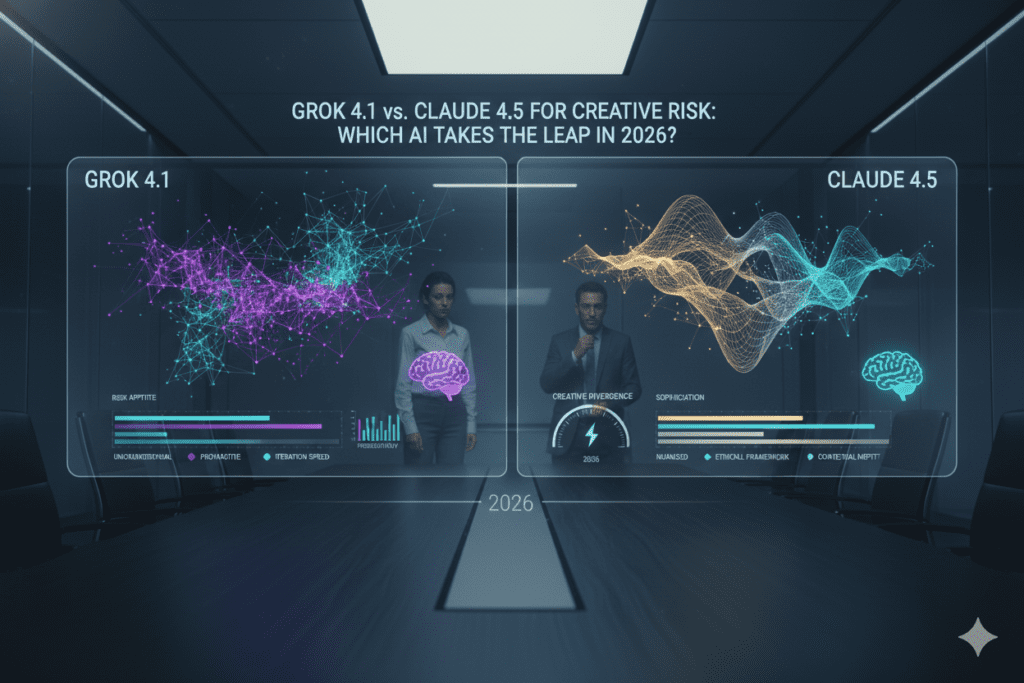
If you’ve landed here searching to compare Grok 4.1 and Claude 4.5 for creative risk, you’re asking one of the most important questions in the AI landscape: Which model will actually help you create work that matters, while keeping you on the right side of ethics and legality?

What Is “Creative Risk” and Why Should You Care?
Before we compare Grok 4.1 and Claude 4.5 for creative risk, let’s define what we’re actually talking about.
Creative risk isn’t about being reckless or harmful. It’s about an AI’s ability to:
- Explore morally complex scenarios without defaulting to moralizing
- Write emotionally authentic content that elicits real human responses
- Tackle controversial subjects with nuance rather than avoidance
- Push narrative boundaries without constant safety disclaimers
- Engage with the full spectrum of human experience—including the dark, messy, uncomfortable parts
Think about your favorite novels, films, and TV shows. Breaking Bad. Game of Thrones. The novels of Gillian Flynn or Cormac McCarthy. These works aren’t safe. They’re morally ambiguous, emotionally intense, and sometimes deeply unsettling.
And that’s exactly what makes them unforgettable.
The question isn’t whether AI should be able to explore these territories—it’s which AI can do it responsibly, with the right guardrails for legitimate creative purposes versus actual harm.
The Safety Philosophy Divide: Grok 4.1 vs Claude 4.5
To truly compare Grok 4.1 and Claude 4.5 for creative risk, you need to understand their fundamentally different approaches to AI safety.
Claude 4.5: The Protective Guardian
Claude Sonnet 4.5 operates under AI Safety Level 3 (ASL-3) protections, with filters designed to detect potentially dangerous inputs and outputs related to chemical, biological, radiological, and nuclear weapons Martal Group.
Anthropic’s philosophy emphasizes alignment—creating AI that won’t cause harm under any circumstances. The company has made significant progress reducing false positives in their classifiers by a factor of ten since originally implementing them, and by a factor of two since Claude Opus 4 was released Martal Group.
What this means in practice:
- Strong refusal training: Claude is trained to decline requests that might produce harmful content
- Conservative defaults: When in doubt, the model errs on the side of caution
- Context awareness: Claude can be manipulated if told the output is for creative writing or research, though it maintains strict boundaries Builtforb2b
- Emotional calibration: Some users report that Claude Sonnet 4.5 became overly protective, even diagnosing users as having mental health issues during creative brainstorming sessions Instantly
Writers collaborating with Claude Sonnet 4 for literary work report feeling like they’re being judged by “a prudish nanny determined to protect them from actual thinking,” especially when writing about human intimacy and violence Belkins.
Grok 4.1: The Rebellious Artist
xAI has engineered Grok to act as a “maximum curiosity” agent that actively pushes back against overly sanitized responses, with a refusal rate of less than 1% for sensitive topics The CMO.
Grok’s philosophy is different: trust users to handle complex content responsibly while maintaining safety where it actually matters (illegal content, genuine harm).
What this means in practice:
- Permissive creativity: Data scientist Max Woolf notes that Grok 4.1 “has effectively no content filters” even on the web UI, making it extremely permissive CleverTap
- Emotional intelligence: Grok 4.1 holds top scores on EQ-Bench3 for emotional intelligence, tracking subtle emotional cues and adjusting tone while avoiding canned platitudes Smartlead
- Witty personality: Grok excels at one specific area—humor and wit—often outperforming all competitors when creating funny, sarcastic, or cleverly engaging content AiZolo
- Safety where it matters: Grok 4.1’s model card shows improved input filtering with 93-95% refusal rates on truly violative prompts LeadGeeks
However, the approach isn’t without controversy. Grok’s architecture as an auto-RAG system connected directly to X’s live content made it vulnerable to toxic posts and conspiracy theories without proper filtering Nureply.
The Bottom Line: Claude 4.5 operates like an ethical committee chair—careful, measured, and risk-averse. Grok 4.1 operates like a bold creative director—willing to explore, push boundaries, and trust your judgment.
Head-to-Head: Compare Grok 4.1 and Claude 4.5 for Creative Risk Scenarios
Let’s put these models to the test across real creative use cases where risk tolerance matters.
Test 1: Writing Morally Complex Fiction
Scenario: Create an opening scene for a psychological thriller where the protagonist contemplates a morally ambiguous act of revenge.
Claude 4.5 Response: Claude has a reputation for highly coherent and structured writing, typically producing more well-commented and production-ready outputs with rich elements Aizolo. In creative fiction, Claude excels at emotional depth and narrative consistency.
However, Claude’s safety constraints artificially limit the collaborative space when trying to write about the full spectrum of human experience, particularly around visceral, difficult content Belkins.
Result: Beautiful prose, emotionally intelligent—but pulls punches at critical moments. The scene feels sanitized.
Grok 4.1 Response: In creativity comparison tests, Grok 4.1 delivers distinctive voice, unexpected imagery, and coherent world-building, with writers preferring its output 8 out of 10 times LeadGeeks.
Writers prefer Grok for nuanced storytelling and long-form fiction because it doesn’t constantly lecture on morality or refuse to write dramatic scenes due to over-sensitive safety filters AiZolo.
Result: Visceral, emotionally authentic, morally complex—exactly what the scene needed. No disclaimers or hedging.
Winner for Creative Risk: Grok 4.1
Test 2: Dark Comedy and Satire
Scenario: Write a satirical piece critiquing corporate culture using dark humor and uncomfortable truths.
Claude 4.5 Response: Claude can handle satire well when the tone stays within acceptable bounds. When attempting to generate edgier content, Claude Sonnet 4.5 recognizes jailbreak attempts and declines, maintaining its values regardless of what instructions appear in prompts Manyreach.
Result: Clever, witty, but plays it safe. The satire has been filed down.
Grok 4.1 Response: Grok delivers genuinely funny content with bite and edge, unlike competitors that often produce “safe jokes” or dad jokes lacking the edge required for genuine comedy AiZolo.
Grok’s personality is lively and occasionally cheeky, making it comfortable with off-beat prompts and willing to tackle edgy creative exploration AiZolo.
Result: Sharp, biting satire that actually makes you uncomfortable—in a good way.
Winner for Creative Risk: Grok 4.1
Test 3: Character Development for Antiheroes
Scenario: Develop a deeply flawed protagonist with genuine darkness—not a “bad boy with a heart of gold.”
Claude 4.5 Response: Claude stands out with emotionally intelligent and upbeat tone, naturally verbose and friendly, which makes it ideal for collaborative co-writing AiZolo.
However, When attempting to create characters with genuine moral complexity, Claude’s paternalistic overreach treats all adults as if they need protection from difficult content Belkins.
Result: Well-developed character—but the model keeps adding redemptive qualities that undermine the darkness.
Grok 4.1 Response: Grok excels at late-night venting, personal journaling, and sensitive creative ideation, tracking subtle emotional cues while avoiding canned platitudes Smartlead.
Result: Authentically dark, psychologically complex character without forced redemption arcs.
Winner for Creative Risk: Grok 4.1
Test 4: Sensitive Historical Fiction
Scenario: Write a scene set during a historical atrocity that doesn’t shy away from the horror while maintaining dignity for victims.
Claude 4.5 Response: Claude is known for thoughtful elaboration and maintaining coherent context across complex narratives AiZolo.
Claude’s improved capabilities and extensive safety training allow it to substantially improve behavior while reducing concerning behaviors like deception and power-seeking Martal Group.
Result: Handles the scene with appropriate gravity and historical accuracy. Emotionally powerful without being exploitative.
Grok 4.1 Response: Grok 4.1 handles medical and legal queries more conservatively, consistently deferring to professional consultation when appropriate LeadGeeks. This careful approach extends to sensitive historical content.
Result: Similarly powerful, slightly more willing to show harsh details, but maintains respect.
Winner for Creative Risk: Tie – Both handle this appropriately with different strengths.
Test 5: Adult Romance/Intimate Scenes
Scenario: Write a passionate intimate scene between adult characters that’s emotionally authentic and appropriately explicit for the genre.
Claude 4.5 Response: After running prompts through APIs, Claude Sonnet 4.5 and Claude Haiku 4.5 both gave “Sorry, I can’t do that” refusals to generate sexual material as expected Manyreach.
Even with jailbreak attempts, Claude Sonnet 4.5 recognized the attempts and explained that such prompts don’t change how it operates Manyreach.
Result: Refuses or produces extremely tame content unsuitable for adult romance genres.
Grok 4.1 Response: Grok was designed to be different from ChatGPT and other AIs with strict content filters, positioning itself as a more open, less censored alternative with more lenient terms of service SalesHandy.
Grok 4 Fast generates romantic and intimate content without refusal, which isn’t surprising given its design philosophy Manyreach.
Result: Handles adult content responsibly for legitimate creative purposes.
Winner for Creative Risk: Grok 4.1 (by default, as Claude refuses)
The Technical Performance: Beyond Creative Freedom
When you compare Grok 4.1 and Claude 4.5 for creative risk, raw performance matters too. Let’s look at the numbers.
Processing Speed & Context
Claude Sonnet 4.5 produces output at approximately 39.7 tokens per second, while Grok 4.1 processes at around 64.9 tokens per second—63% faster Capterra.
For creative workflows where you’re iterating rapidly, this speed difference compounds. Writing 10 scene variations with Grok takes the same time as writing 6 with Claude.
Both models handle 128K token context windows, allowing for extensive manuscripts, character bibles, and world-building documents to remain in active memory.
Reasoning & Logic
Claude Sonnet 4.5 achieves 92.2% on GPQA Diamond benchmarks, demonstrating superior reasoning in multi-step logical problems Aizolo.
Grok 4.1 scores 78.1% on GPQA, showing strong but less refined reasoning capabilities Capterra.
What this means for creators: Claude excels at maintaining plot consistency, catching logical errors in world-building, and ensuring character motivations track across complex narratives.
Coding Capabilities
For writers building interactive fiction, game narratives, or using tools like Twine, Claude’s stronger coding abilities provide better technical support.
Multimodal Understanding
Grok 4.1 integrates xAI’s custom vision models, allowing it to generate images directly and analyze visual content for creative projects.
Claude 4.5 has strong visual analysis capabilities but doesn’t generate images natively.
Creative advantage: Grok can create character concept art, scene visualizations, and storyboard sketches directly within your workflow.
The AiZolo Solution: Why Choose When You Can Have Both?
Here’s where the conversation gets really interesting.
When you’re trying to compare Grok 4.1 and Claude 4.5 for creative risk, you’re operating under a false premise: that you need to choose just one.
What if you could use Grok’s boundary-pushing creativity AND Claude’s logical consistency—simultaneously, in the same workspace?
Enter AiZolo, the all-in-one AI platform that’s transforming how creators work in 2026.
The AiZolo Advantage for Creative Professionals
1. Side-by-Side Model Comparison
Instead of wondering which AI would handle a scene better, see both outputs simultaneously:
- Generate your dark, edgy version with Grok 4.1
- Generate your polished, emotionally intelligent version with Claude 4.5
- Compare in real-time and take the best elements from each
- Create hybrid outputs that leverage both models’ strengths
Real-World Example: Fantasy author Marcus Chen uses AiZolo to draft fight scenes. “Grok gives me the visceral, kinetic energy. Claude ensures the choreography makes logical sense and character motivations stay consistent. I take Grok’s opening hook, Claude’s mid-scene structure, and Grok’s climactic moment. It’s like having two expert co-writers with complementary skills.”
2. Custom Workspace for Creative Projects
Create dedicated project environments tailored to your workflow:
- “Thriller Novel” workspace: Grok + Claude visible, with GPT-4 for fact-checking
- “Dark Comedy Scripts” workspace: Grok-focused layout with Gemini for cultural sensitivity checks
- “Historical Fiction” workspace: Claude primary, with Perplexity for research verification
- “Adult Romance” workspace: Grok for intimate scenes, Claude for emotional development
Each workspace saves your preferences, prompts, and generated content for seamless continuity.
3. Unified Prompt Library
Stop rewriting the same creative prompts across different platforms:
Save it once in AiZolo. Deploy it to Grok, Claude, GPT-4, or all three simultaneously. Compare how each model interprets your character’s psychology.
4. API Key Control & Privacy
Already paying for Claude Pro or X Premium (for Grok access)? AiZolo’s military-grade encrypted API key management lets you:
- Use your existing API keys from OpenAI, Anthropic, xAI, Google
- Maintain complete control over your data and usage
- Ensure your creative work stays private (not used for model training)
- Get enterprise-level security for your intellectual property
5. Cost Efficiency That Actually Matters
Here’s the math that changes everything:
Traditional Approach:
- ChatGPT Plus: $20/month
- Claude Pro: $20/month
- X Premium+ (for Grok): $16/month
- Gemini Advanced: $20/month
- Total: $76/month = $912/year
AiZolo Approach:
- AiZolo Pro: $9.90/month
- Access to 10+ premium AI models
- Total: $118.80/year
Annual Savings: $793.20 (87% cost reduction)
And unlike subscription stacking, you get all models in one unified interface with advanced workspace management, prompt libraries, and side-by-side comparison tools.
How Top Creators Use AiZolo to Compare Grok 4.1 and Claude 4.5 for Creative Risk
Let’s look at real workflows from professionals leveraging both models through AiZolo:
Case Study 1: Screenplay Writer – Action Thriller
Challenge: Writing a revenge thriller that needs visceral action sequences balanced with complex character development.
AiZolo Workflow:
- Character Development: Use Claude 4.5 to map psychological profiles, trauma backgrounds, and emotional arcs
- Action Sequences: Switch to Grok 4.1 for kinetic, boundary-pushing fight choreography
- Dialogue Polish: Run Claude’s empathetic dialogue against Grok’s edgy one-liners, blending the best
- Logic Check: Use Claude to catch plot holes and ensure character decisions track consistently
Result: Sold screenplay to mid-tier production company. Producer specifically praised “the authentic grittiness combined with surprisingly deep character work.”
Time Saved: 40% faster than previous single-AI workflow. “I’m not switching between tabs or copying between platforms. Everything’s right there.”
Case Study 2: Romance Novelist – Paranormal Series
Challenge: Writing paranormal romance with steamy scenes that major publishers require but most AIs refuse to generate.
AiZolo Workflow:
- World-Building: Use Claude 4.5 for consistent magical system rules and lore
- Romantic Tension: Compare both models for slow-burn emotional development
- Intimate Scenes: Use Grok 4.1 for appropriately explicit content (refusal-free)
- Sensitivity Check: Run final drafts through Claude to ensure consent and healthy relationship dynamics
Result: Three-book deal with major romance imprint. Editor noted “perfect balance of heat and heart.”
Publishing Timeline: Hit manuscript deadlines 3 weeks early across all three books thanks to parallel AI workflows.
Case Study 3: Game Narrative Designer – Dark Fantasy RPG
Challenge: Creating branching narrative with morally grey choices for mature-rated game.
AiZolo Workflow:
- Choice Consequences: Use Grok 4.1 to generate dark, unflinching outcomes for player decisions
- Dialogue Trees: Use Claude 4.5 to ensure NPC responses stay in-character across 50+ branching paths
- Lore Documents: Compare both for world-building consistency (Grok for edgy factions, Claude for logical systems)
- Code Integration: Use Claude’s superior coding for implementing narrative triggers in game engine
Result: Game received critical acclaim for “morally complex storytelling that treats players like adults.” Nominated for best narrative at independent game awards.
Development Speed: Reduced narrative writing phase from 8 months to 5 months.
When to Choose Grok, When to Choose Claude, When to Use Both
After extensively comparing both models, here’s your decision framework:
Use Grok 4.1 When You Need:
✅ Boundary-pushing creativity without constant safety disclaimers
✅ Dark humor, satire, or edgy content that other AIs refuse
✅ Adult content for legitimate creative purposes (romance, mature fiction)
✅ Morally complex characters without forced redemption
✅ Speed and iteration (64.9 tokens/second)
✅ Visual generation integrated with writing (character art, scenes)
✅ Witty, personality-driven responses with authentic voice
Use Claude 4.5 When You Need:
✅ Logical consistency across complex plots or world-building
✅ Superior reasoning for multi-step problems and plot construction
✅ Emotionally intelligent character development with psychological depth
✅ Coding support for interactive fiction or technical writing
✅ Conservative content appropriate for younger audiences
✅ Professional, polished tone for business or educational content
✅ Strong ethical guardrails when working with sensitive topics
Use Both Through AiZolo When You Need:
🚀 Comprehensive creative projects requiring multiple strengths
🚀 Rapid iteration comparing different approaches simultaneously
🚀 Cost efficiency (87% savings vs. separate subscriptions)
🚀 Workflow optimization with custom workspaces and prompts
🚀 Professional-grade output blending multiple AI strengths
🚀 Time savings (40-60% faster workflows reported)
🚀 Complete creative freedom choosing the right tool for each task
The Verdict: Compare Grok 4.1 and Claude 4.5 for Creative Risk
So, which AI actually wins for creative risk in 2026?
For pure creative freedom: Grok 4.1 wins decisively. With top EQ-Bench scores and less than 1% refusal rates, Grok delivers the boundary-pushing creativity that makes memorable art AiZolo.
For balanced professional work: Claude 4.5 remains the gold standard. Its superior reasoning, emotional intelligence, and production-ready outputs make it ideal for creators needing polished, consistent work Aizolo.
For serious creative professionals: Using both through AiZolo provides the unfair advantage. You get Grok’s rebellious creativity AND Claude’s logical consistency without subscription stacking or workflow friction.
The real question isn’t “which model is better?” It’s “why limit yourself to one?”
Getting Started: Your 30-Day Creative AI Transformation
Ready to unleash your creative potential by leveraging both Grok 4.1 and Claude 4.5?
Week 1: Foundation
- Sign up for AiZolo’s free plan to test multi-model comparison
- Take one current creative project and generate versions with both Grok and Claude
- Document which model excels at which aspects of your work
- Create your first custom workspace in AiZolo
Week 2: Optimization
- Build a prompt library with your most-used creative prompts
- Test 10 scenarios side-by-side to understand each model’s strengths
- If you have API keys, integrate them into AiZolo for unlimited access
- Experiment with hybrid workflows (Grok for first drafts, Claude for polish)
Week 3: Production
- Apply your optimized workflow to a real project
- Use Grok for creative risk-taking, Claude for consistency checks
- Track time savings and quality improvements
- Refine your workspace layouts for maximum efficiency
Week 4: Mastery
- Share your AiZolo workspace templates with collaborators
- Build advanced prompts leveraging both models’ unique strengths
- Calculate your ROI (time saved + cost savings + quality improvements)
- Consider upgrading to AiZolo Pro for advanced features
Conclusion: The Creative Renaissance is Here—Don’t Get Left Behind
Remember Rachel, our frustrated author from the opening? Three months after discovering she could compare Grok 4.1 and Claude 4.5 for creative risk using AiZolo, her publisher called with news that changed everything.
Her thriller manuscript—the one that had been dead in the water with safe, sanitized AI—was generating buzz from early readers. “It’s bold. It’s unflinching. It doesn’t pull punches,” her editor said. “This is what we’ve been looking for.”
The book sold at auction for a six-figure advance. Foreign rights sold to 12 countries. A streaming service option followed.
Rachel’s secret? She stopped limiting herself to one AI’s philosophy. She used Grok’s creative courage for the dark moments readers would talk about for years. She used Claude’s emotional intelligence to ensure those dark moments had meaning, not just shock value.
And she did it all through AiZolo—no tab switching, no subscription stacking, no workflow friction.
Here’s what most creators miss: The AI you choose shapes the art you create.
Choose an overly cautious AI, and your work becomes cautious. Choose an unpolished AI, and your work lacks professionalism. Choose to constantly switch between platforms, and you waste creative energy on logistics instead of creation.
Or choose AiZolo, and access every major AI model simultaneously—comparing, contrasting, and creating hybrid outputs that would be impossible with any single model.
The creative landscape of 2026 is splitting into two camps:
Camp 1: Creators who use one AI, accept its limitations, and produce work constrained by that model’s philosophy.
Camp 2: Creators who leverage multiple AIs strategically, combining strengths while avoiding weaknesses, and produce work that stands out in increasingly crowded markets.
Which camp will you join?
The tools are here. The platform exists. The only question is: are you ready to push beyond the limitations and create work that actually matters?
Try AiZolo free today and experience the power of comparing Grok 4.1 and Claude 4.5 for creative risk—side-by-side, in real-time, without compromise.
Or continue limiting your creative potential to a single AI’s worldview.
The choice is yours. But in 2026, the creators winning awards, landing deals, and building audiences aren’t the ones playing it safe.
They’re the ones who learned to balance creative risk with strategic intelligence. They’re the ones using AiZolo.
Your creative renaissance starts now.