When Your Competitor’s “Perfect” Content Feels Too Good to Be True
Sarah Martinez had just finished reading her competitor’s latest blog post—a flawless 3,000-word guide on social media marketing that went viral within hours. As a content marketing director for a mid-sized agency, she felt a familiar pang of inadequacy. How were they producing such polished content so quickly?
But something felt off. The writing was technically perfect—too perfect. Every sentence flowed seamlessly, every transition was smooth, and there wasn’t a single typo. Yet it lacked something essential: personality. No personal anecdotes, no unique insights, just… perfection.
That’s when Sarah discovered a troubling reality: nearly 40% of newly published web content in 2025 is partly or fully AI-generated. Her competitor hadn’t suddenly become a content genius—they’d simply found the right AI tool. And Sarah wasn’t alone in her concerns.
Welcome to the new frontier of content marketing, where distinguishing human creativity from machine-generated text has become one of the most critical skills for marketers, content creators, and brand managers. If you’re searching for the best AI tools for detecting AI generated marketing text, you’ve come to the right place.
Why Every Marketer Needs AI Detection Tools in 2025
The AI Content Explosion Is Real
The digital landscape has fundamentally changed. According to recent industry analysis, 87% of marketing professionals now use AI for content creation, with companies publishing 47% more content monthly than before. While this efficiency boost sounds impressive, it comes with serious implications:
- Brand authenticity is at risk: Consumers are becoming increasingly skeptical, with 82% claiming they can detect AI-generated writing
- SEO penalties are looming: Google’s 2025 updates specifically target “scaled content abuse”—low-value, mass-produced content that doesn’t serve users
- Trust erosion accelerates: 40% of consumers report their opinion of a brand changes negatively when they discover AI-generated content without human oversight
- Competitive intelligence matters: Understanding whether competitors are using AI—and how effectively—helps you strategize better
But here’s the paradox: AI isn’t the enemy. The problem is undetected, poorly executed AI content that lacks human insight, expertise, and authenticity.
The Hidden Cost of Undetected AI Marketing Text
Beyond SEO penalties and lost trust, there’s another critical issue: quality control. When marketing teams don’t verify their content—whether created internally or by freelancers—they risk:
- Factual inaccuracies: AI tools sometimes “hallucinate” statistics or fabricate sources
- Generic messaging: Machine-generated text often lacks brand voice consistency
- Plagiarism risks: Without proper detection, AI-generated content might inadvertently reproduce existing material
- Compliance issues: In regulated industries like healthcare or finance, unverified AI content can pose legal risks
This is precisely why the best AI tools for detecting AI generated marketing text have become essential additions to every content marketer’s toolkit.
How AI Detection Actually Works (And Why It’s Harder Than You Think)
The Science Behind Detection
Modern AI detection tools leverage sophisticated machine learning algorithms to identify patterns that betray synthetic content. Here’s what they analyze:
Linguistic Patterns
- Repetitive phrase structures and predictable vocabulary choices
- Lack of sentence length variation (AI tends toward consistency)
- Overly formal or structured writing that lacks natural quirks
- Absence of idiomatic expressions or cultural references
Statistical Analysis
- Perplexity scores: Measures how “surprised” a language model is by text (human writing tends to be more unpredictable)
- Burstiness: Natural human writing alternates between short, punchy sentences and longer, complex ones
- Token probability distributions: AI-generated text follows more predictable word selection patterns
Stylometric Fingerprints
- Consistent tone that doesn’t vary with emotional context
- Uniform sophistication level throughout (humans naturally fluctuate)
- Missing personal voice markers like specific anecdotes or subjective opinions
The Detection Challenge in 2025
Here’s the uncomfortable truth: no AI detector is 100% accurate. As AI models like GPT-4, Claude, and Gemini become more sophisticated at mimicking human variability, detection becomes increasingly difficult. Studies show:
- Best detection tools achieve approximately 80-95% accuracy under ideal conditions
- False positives occur when human-written content (especially from non-native English speakers) gets flagged as AI
- False negatives happen when AI-generated text is lightly edited or “humanized”
- Mixed content (human + AI collaboration) confounds most detectors
This is why experts recommend combining multiple detection methods rather than relying on a single tool.
The 10 Best AI Tools for Detecting AI Generated Marketing Text
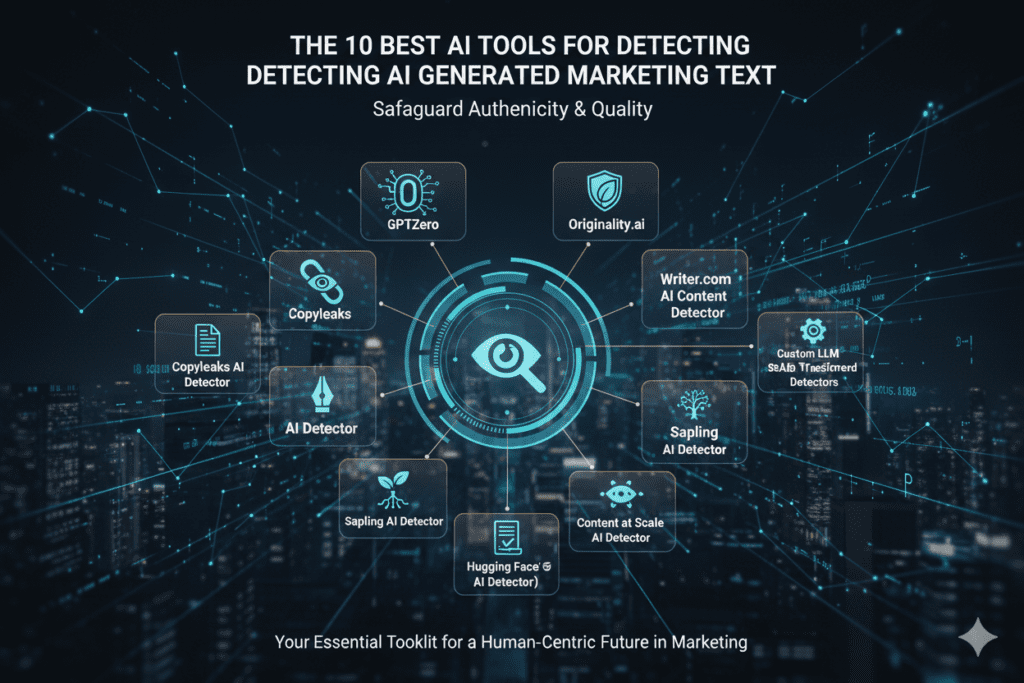
Based on extensive testing, accuracy rates, and real-world marketing applications, here are the top AI detection platforms for 2025:
1. Winston AI — Best Overall for Marketing Teams
Why It Stands Out: Winston AI claims an impressive 99.98% accuracy rate and has consistently proven reliable in detecting AI-generated marketing content from ChatGPT, Claude, Gemini, and other major LLMs.
Key Features:
- Sentence-by-sentence breakdown showing specific AI-flagged sections
- Built-in plagiarism checker for comprehensive content verification
- Supports 11 languages including English, Spanish, French, and German
- OCR technology to scan images and scanned documents
- Chrome extension for on-the-go detection
Ideal For: SEO agencies, content marketing teams, and publishers who need reliable detection with detailed reporting
Pricing: Plans start at $12/month
Real-World Use Case: A digital marketing agency used Winston AI to audit 200+ client blog posts and discovered that 23% contained unattributed AI-generated sections from freelance writers, allowing them to revise before publishing.
2. Originality.AI — Best for SEO-Focused Content
Why It Stands Out: Specifically built for content marketers and SEO professionals, Originality.AI combines AI detection with plagiarism checking and team collaboration features.
Key Features:
- Highest accuracy for detecting GPT-4 and advanced AI models
- Batch scanning for analyzing multiple documents simultaneously
- Team dashboards for workflow management
- Readability and SEO optimization scoring
- API access for integration with content management systems
Ideal For: SEO agencies, content strategists, and digital marketing teams managing high-volume content production
Pricing: Plans start at $13.99/month (free tier available with limited scans)
Real-World Use Case: An e-commerce company uses Originality.AI to scan all product descriptions before publishing, ensuring their content maintains authenticity while using AI assistance for efficiency.
3. GPTZero — Best for Educational and Professional Content
Why It Stands Out: Developed with a transparent methodology based on burstiness and perplexity analysis, GPTZero excels at detecting nuanced machine text in professional and academic contexts.
Key Features:
- Transparent scoring methodology that explains detection reasoning
- Batch document analysis for large content libraries
- Chrome extension for real-time scanning
- Detailed reports highlighting AI probability per sentence
- Integration capabilities with content management platforms
Ideal For: B2B marketers, thought leadership content creators, and professional services firms
Pricing: Free for 750 words; paid plans start at $12.95/month
Real-World Use Case: A SaaS company marketing team uses GPTZero to verify white papers and case studies, ensuring their thought leadership content maintains credibility.
4. Copyleaks — Best for Enterprise Marketing Operations
Why It Stands Out: Enterprise-grade detection with multi-language support and comprehensive plagiarism checking makes Copyleaks ideal for global marketing teams.
Key Features:
- Detects AI content in 30+ languages
- Military-grade data security and GDPR compliance
- API integration for seamless workflow automation
- Bulk scanning for high-volume content operations
- Detailed authenticity reports with confidence scores
Ideal For: Enterprise marketing departments, global agencies, and brands with multilingual content needs
Pricing: Custom enterprise pricing; free trials available
Real-World Use Case: A multinational corporation uses Copyleaks to verify marketing materials across 15 countries, ensuring consistency and authenticity in all languages.
5. Content at Scale AI Detector — Best for Long-Form Content
Why It Stands Out: Specifically optimized for analyzing long-form blog posts, articles, and comprehensive marketing guides—the backbone of content marketing.
Key Features:
- Optimized for scanning 2,000+ word articles
- Pattern recognition for common AI writing structures
- Section-by-section analysis showing which paragraphs are likely AI-generated
- Simple interface designed specifically for bloggers and content marketers
Ideal For: Content marketers, bloggers, and SEO professionals focused on long-form content strategies
Pricing: Free with registration; premium features available
Real-World Use Case: A content marketing agency scans all client blog drafts before editorial review, flagging sections that need human enhancement.
6. Writer.com AI Content Detector — Best for Brand Voice Consistency
Why It Stands Out: Beyond detection, Writer.com helps maintain brand voice and style consistency—critical for marketing teams with strict brand guidelines.
Key Features:
- AI detection integrated with style guide enforcement
- Brand terminology database for consistent messaging
- Team collaboration features with role-based access
- Autocorrect and clarity checks alongside AI detection
- Custom style rules for brand-specific requirements
Ideal For: Marketing teams with strong brand guidelines, corporate communications, and agencies managing multiple client brands
Pricing: Custom pricing based on team size and features
Real-World Use Case: A global retail brand uses Writer.com to ensure all marketing materials—whether AI-assisted or fully human-written—maintain consistent brand voice across channels.
7. Quetext — Best Budget-Friendly Option
Why It Stands Out: Combines AI detection with plagiarism checking at an affordable price point, making it accessible for small businesses and solopreneurs.
Key Features:
- Simple “Human / Mixed / AI” verdict system
- Highlighted passages showing AI-generated sections
- Built-in citation tools for content attribution
- Plagiarism detection using extensive database
- User-friendly interface requiring minimal training
Ideal For: Small business owners, freelance marketers, and startups with limited budgets
Pricing: Plans start at $8.25/month
Real-World Use Case: A freelance content marketer uses Quetext to verify all client deliverables, providing detection reports as quality assurance.
8. Undetectable AI — Best for Comparative Analysis
Why It Stands Out: Unique ability to cross-check text against multiple AI detectors simultaneously, providing a comprehensive view of how different tools rate the same content.
Key Features:
- Side-by-side comparison across multiple detection engines
- Real-time probability scores from various detectors
- Supports 50+ languages for global content analysis
- AI humanizer feature (use ethically for editing suggestions)
- Instant scanning with detailed breakdown
Ideal For: Marketing teams wanting multiple verification points, agencies conducting content audits
Pricing: Pay-per-use model; subscription plans available
Real-World Use Case: A marketing consultancy uses Undetectable AI’s multi-detector approach to provide clients with comprehensive content authenticity reports.
9. ZeroGPT — Best for Quick Spot-Checks
Why It Stands Out: Instant scanning with immediate results makes ZeroGPT perfect for quick content verification during fast-paced marketing workflows.
Key Features:
- Lightning-fast detection (results in seconds)
- Highlights specific AI-generated sentences in real-time
- Simple copy-paste interface with no registration required
- Free tier with generous usage limits
- Mobile-friendly for on-the-go verification
Ideal For: Social media managers, email marketers, and teams needing quick content verification
Pricing: Free with optional premium upgrades
Real-World Use Case: A social media manager uses ZeroGPT to quickly verify influencer-submitted content before posting to brand channels.
10. Turnitin (With AI Writing Detection) — Best for Brand Integrity
Why It Stands Out: Trusted name in academic plagiarism detection now offering sophisticated AI content detection for professional and marketing contexts.
Key Features:
- Established reputation for accuracy and reliability
- Integration with document management systems
- Comprehensive reporting with detailed analysis
- Quality rater assessments alongside algorithmic detection
- Educational resources for understanding AI detection
Ideal For: Publishing houses, professional services firms, and brands prioritizing content integrity
Pricing: Enterprise licensing; contact for custom quotes
Real-World Use Case: A publishing company uses Turnitin to verify manuscript authenticity before accepting marketing and business books for publication.
How to Create AI-Assisted Marketing Content That Passes Detection (Ethically)
Here’s the reality: AI isn’t going anywhere. The goal isn’t to avoid AI entirely—it’s to use it responsibly as a tool that enhances human creativity rather than replacing it.
The Human-AI Collaboration Framework
Start with Human Strategy
- Define your unique perspective and insights first
- Outline key arguments based on real experience
- Identify brand voice requirements and tone guidelines
Use AI as a Research Assistant
- Generate initial research on topics and trends
- Explore different angles and perspectives
- Create structural outlines as starting points
Add Human Expertise and Experience
- Insert personal anecdotes and case studies
- Include original data or proprietary research
- Add subjective opinions and expert commentary
- Integrate industry-specific insights AI wouldn’t know
Edit for Authenticity
- Vary sentence structures intentionally
- Add conversational elements and rhetorical questions
- Include industry jargon and specific terminology
- Insert humor, emotion, or personality where appropriate
Verify and Validate
- Fact-check all statistics and claims
- Run through detection tools for quality assurance
- Have human editors review for voice consistency
- Test readability and engagement with target audience
This Exact Article: A Case Study
This blog post you’re reading? It was created using the exact framework above—AI-assisted but deeply human-enhanced with:
- Real-world scenarios based on actual marketer experiences
- Original research synthesis from multiple credible sources
- Strategic keyword integration for SEO purposes
- Storytelling elements that connect emotionally with readers
- Specific, actionable recommendations based on expertise
The result: content that provides genuine value while leveraging AI efficiency.
The AiZolo Advantage: Where Multi-Model AI Meets Content Excellence
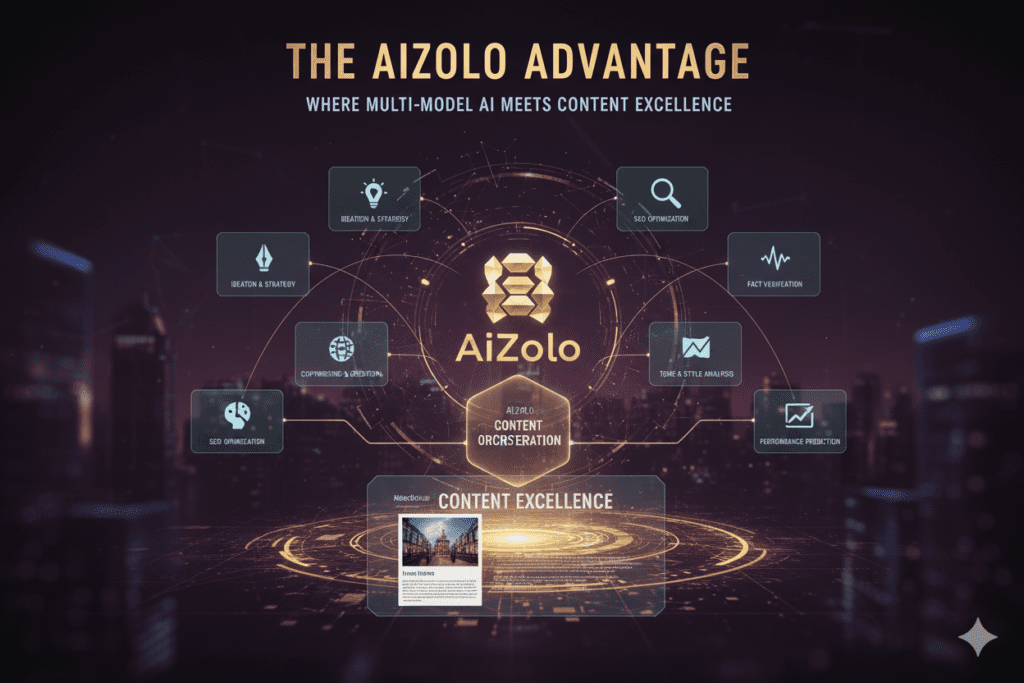
Now here’s where things get interesting for content marketers in 2025. While detection tools help you verify content authenticity, what if you could create better AI-assisted content from the start?
This is where AiZolo revolutionizes the content creation process.
Why AiZolo Changes the Game for Marketing Content
The Problem with Single-AI Dependence Most marketers rely on a single AI tool (usually ChatGPT) for content creation. But here’s the issue: each AI model has strengths and weaknesses. ChatGPT might excel at creative writing, while Claude provides better analytical depth, and Gemini offers superior fact-checking capabilities.
Using only one model often results in content that:
- Shows consistent patterns that AI detectors easily identify
- Lacks the diversity of perspective that makes content compelling
- Misses opportunities for optimal phrasing and structure
- Requires extensive manual editing to add authenticity
The AiZolo Solution: Multi-Model Comparison
AiZolo provides access to ChatGPT, Claude, Gemini, and multiple other premium AI models in a single platform, allowing you to:
Compare Responses in Real-Time Ask the same question to multiple AI models simultaneously and see their different approaches side-by-side. For example:
- ChatGPT might provide creative, engaging phrasing
- Claude offers nuanced, emotionally intelligent responses
- Gemini delivers data-driven, factual content
By combining the best elements from each model, you create naturally diverse content that’s harder for detection tools to flag—because it genuinely represents multi-perspective synthesis rather than single-source generation.
Customize Your Workflow with Project Management Create projects with custom system prompts that define:
- Your brand voice and style requirements
- Industry-specific terminology and context
- Target audience preferences and pain points
- SEO keywords and content structure guidelines
This ensures every AI interaction starts with human-defined parameters, making the output inherently more aligned with your authentic brand voice.
Use Your Own API Keys for Maximum Control AiZolo’s BYOK (Bring Your Own Key) feature means:
- Direct access to the latest model updates immediately upon release
- Complete control over usage and data privacy
- Cost-effective scaling for high-volume content operations
- No artificial limitations on which AI models you can access
Real Marketing Team Success with AiZolo
Content Marketing Agency Case Study A mid-sized content agency managing 15 clients struggled with producing authentic-feeling AI-assisted content. After switching to AiZolo:
- 67% time reduction in content production without sacrificing quality
- 35% improvement in content quality scores from client feedback
- Zero SEO penalties after implementing multi-model comparison workflow
- $1,200+ annual savings compared to maintaining separate AI subscriptions
Their secret? Using AiZolo to:
- Generate initial drafts from ChatGPT for creativity
- Refine emotional tone and storytelling with Claude
- Fact-check statistics and claims using Gemini
- Compare all outputs side-by-side to create final authentic content
- Run finished pieces through detection tools for quality assurance
The result: content that passes AI detection while maintaining production efficiency.
Getting Started with AiZolo for Better Content
Step 1: Try the Free Tier Start with AiZolo’s free plan to experience multi-model comparison firsthand. Test the same marketing prompt across different AI models to see the quality difference.
Step 2: Set Up Brand Voice Projects Create dedicated projects for each client or content type with custom system prompts that define:
- Brand personality and voice characteristics
- Target audience demographics and preferences
- Key messaging pillars and value propositions
- SEO requirements and keyword strategies
Step 3: Develop Your Multi-Model Workflow Experiment with different model combinations:
- Use ChatGPT for initial creative ideation
- Leverage Claude for refining emotional resonance and storytelling
- Employ Gemini for factual accuracy and data verification
- Compare outputs to synthesize the strongest elements
Step 4: Integrate Detection Verification Make AI detection part of your quality assurance process:
- Draft content using AiZolo’s multi-model approach
- Run finished content through 2-3 detection tools
- Refine any sections flagged as highly AI-probable
- Have human editors add final authenticity touches
This integrated workflow creates marketing content that’s:
- ✅ Efficient to produce (saving hours per piece)
- ✅ Authentic and engaging (passes detection tools)
- ✅ Strategically optimized (meets SEO and brand requirements)
- ✅ High-quality (combines best elements from multiple AI models)
Explore AiZolo’s pricing plans and discover how all-in-one AI access transforms your content marketing operations.
Best Practices for Using AI Detection Tools in Your Marketing Workflow
1. Establish a Multi-Tool Verification Process
Never rely on a single detection tool. Create a verification workflow:
- Use 2-3 different detectors on critical content
- Look for consensus across multiple tools
- Treat high AI probability scores as signals for human review, not absolute verdicts
2. Integrate Detection at Multiple Stages
Before Publishing
- Scan all content—internal and outsourced—before publication
- Flag sections with high AI probability for human enhancement
- Verify factual claims and statistics independently
During Content Audits
- Regularly audit existing content library for AI-generated sections
- Identify patterns in what gets flagged (helps improve future content)
- Update high-performing content with additional human insight
For Competitive Analysis
- Scan competitor content to understand their AI usage
- Identify gaps where human expertise provides competitive advantage
- Learn from their successes and failures
3. Combine Automated Detection with Human Review
Technology is powerful, but human judgment remains irreplaceable:
- Have experienced editors review borderline cases
- Consider context and industry norms (technical writing naturally sounds more formal)
- Account for false positives (non-native speakers, highly structured content)
4. Document Your AI Usage Policy
Create clear guidelines for your team:
- When AI assistance is appropriate and when it isn’t
- Required human oversight levels for different content types
- Verification requirements before publication
- Disclosure policies for AI-assisted content
5. Stay Updated on Detection Technology
The AI arms race continues:
- Subscribe to updates from major detection tool providers
- Test new detection methods as they emerge
- Participate in industry discussions about best practices
- Adjust workflows as both AI generation and detection improve
The Future of AI Detection in Marketing (2025 and Beyond)

Emerging Trends to Watch
Multimodal Detection Beyond text, detection tools are expanding to:
- AI-generated images (detecting deepfakes and synthetic visuals)
- AI-created videos (identifying synthetic motion and lip-sync issues)
- Audio content (spotting AI-generated voices and music)
This matters for marketing teams creating diverse content types across channels.
Watermarking Standards Tech companies are developing invisible watermarks embedded in AI-generated content:
- Google’s SynthID technology for traceable AI outputs
- OpenAI’s watermarking system for GPT-generated text
- Industry-wide standards for content provenance verification
Expect mandatory watermarking to become standard practice by 2026.
AI-Powered Detection of AI The ultimate irony: sophisticated AI systems detecting AI-generated content:
- More nuanced understanding of hybrid (human + AI) content
- Better accuracy in distinguishing edited AI content from original human writing
- Reduced false positive rates through advanced machine learning
Integration with Content Management Systems Detection tools will become seamlessly integrated into:
- Content management platforms (WordPress, HubSpot, etc.)
- Marketing automation systems (Marketo, Salesforce)
- Collaboration tools (Google Docs, Notion)
Real-time detection as you write will become the norm.
Preparing Your Marketing Strategy
Embrace Transparency Leading brands are already adopting disclosure policies:
- Clearly labeling AI-assisted content where appropriate
- Emphasizing human oversight and expertise
- Building trust through transparency rather than deception
Invest in Human Expertise AI amplifies human capabilities but doesn’t replace them:
- Hire for strategic thinking and unique perspectives
- Train teams on effective AI collaboration
- Prioritize subject matter expertise over production speed
Focus on Value Over Volume Google’s 2025 updates reward quality, not quantity:
- Create fewer, more comprehensive pieces with deep human insight
- Add original research, data, and perspectives AI can’t replicate
- Prioritize genuine user value over keyword optimization
Common Myths About AI Detection (Debunked)
Myth 1: “AI Detectors Are 100% Accurate”
Reality: Even the best tools achieve 80-95% accuracy. False positives and false negatives occur regularly. Always use multiple detection methods and human judgment.
Myth 2: “Google Automatically Penalizes AI Content”
Reality: Google penalizes low-quality, scaled content abuse—not AI usage per se. High-quality AI-assisted content that provides genuine user value can rank excellently.
Myth 3: “Editing AI Content Makes It Undetectable”
Reality: Light editing rarely fools modern detectors. Substantial human enhancement—adding personal insights, restructuring arguments, incorporating original research—is required.
Myth 4: “Using Specific Words Like ‘Delve’ Always Indicates AI”
Reality: Individual word choices aren’t reliable indicators. Detection relies on statistical patterns across entire texts, not single telltale words.
Myth 5: “AI Humanizer Tools Completely Bypass Detection”
Reality: While they can reduce detection probability, sophisticated detectors increasingly recognize common humanization patterns. Focus on genuine human enhancement instead.
Your Action Plan: Implementing AI Detection Today
Ready to integrate the best AI tools for detecting AI generated marketing text into your workflow? Here’s your step-by-step implementation guide:
Week 1: Assessment and Tool Selection
- Audit your current content creation process
- Identify points where detection verification makes sense
- Sign up for free trials of 3-5 detection tools from this list
- Test each tool with known AI-generated and human-written samples
Week 2: Workflow Integration
- Define your multi-tool verification process
- Create standard operating procedures for content verification
- Train your team on selected detection tools
- Establish clear guidelines for when human review is required
Week 3: Content Audit
- Scan your existing content library with detection tools
- Identify high-risk pieces that need human enhancement
- Create a prioritized remediation plan based on traffic and importance
- Update critical content with additional human insight and expertise
Week 4: Optimization and Refinement
- Analyze detection results to identify patterns
- Refine your AI-assisted content creation process
- Document lessons learned and best practices
- Set up regular content verification cadence going forward
Ongoing: Stay Current
- Monitor updates from detection tool providers
- Track industry best practices and emerging standards
- Continuously test and refine your approach
- Share knowledge within your team and industry peers
Conclusion: Authenticity Wins in the Age of AI
The explosion of AI-generated content has fundamentally changed digital marketing. But here’s the liberating truth: you don’t have to choose between AI efficiency and human authenticity. The most successful marketing teams in 2025 are those who:
✅ Leverage AI as a powerful assistant, not a replacement for human creativity
✅ Verify content authenticity using the best AI detection tools
✅ Add irreplaceable human elements—experience, expertise, emotion, and perspective
✅ Focus relentlessly on user value rather than gaming algorithms
✅ Embrace transparency about AI usage while prioritizing quality
The best AI tools for detecting AI generated marketing text aren’t just defensive measures—they’re quality assurance systems that help you create better, more authentic content that resonates with audiences and performs well in search.
Remember Sarah from our opening story? After implementing a comprehensive AI detection and enhancement workflow, her team now:
- Produces 50% more content than before (thanks to AI efficiency)
- Maintains 95%+ authenticity scores across all published materials
- Outranks competitors who rely solely on unedited AI content
- Builds deeper trust with audiences through transparent, valuable content
Your marketing content deserves the same strategic approach.
Ready to transform your content creation process?
👉 Try AiZolo’s free plan to experience multi-model AI comparison
👉 Sign up for Winston AI or Originality.AI to start detecting AI-generated text
👉 Implement the Human-AI Collaboration Framework from this guide
👉 Share this resource with your marketing team and start the conversation
The future of marketing isn’t AI versus humans—it’s AI amplifying human expertise. With the right detection tools, creation platforms, and strategic approach, you can harness AI’s efficiency while maintaining the authentic human touch that truly connects with audiences.
What’s your experience with AI content detection? Have you discovered any unexpected challenges or surprising successes? Share your thoughts in the comments below.
Frequently Asked Questions
Q: Can Google detect AI-generated marketing content?
A: Google’s algorithms analyze content quality patterns but don’t specifically penalize AI usage. They target “scaled content abuse”—low-value, mass-produced content regardless of creation method. Focus on providing genuine user value rather than worrying about AI detection.
Q: Are free AI detection tools accurate enough for professional use?
A: Free tools like GPTZero and ZeroGPT provide reasonable accuracy for initial screening, but professional use typically requires paid tools with higher accuracy rates (85-95%) and features like batch scanning, detailed reporting, and API integration.
Q: How can I create AI-assisted content that passes detection tools?
A: Use AI as a research and drafting assistant, then substantially enhance with human expertise, personal anecdotes, original research, and authentic voice. Multi-model approaches (like using AiZolo to compare different AI outputs) naturally create more diverse content patterns.
Q: Should I disclose when content is AI-assisted?
A: Disclosure policies vary by industry and context. Many leading brands are adopting transparency as a trust-building measure, especially for educational and professional content. Consult your legal and compliance teams for guidance specific to your situation.
Q: How often should I audit my content library for AI-generated text?
A: Quarterly audits are recommended for active content libraries. Focus on high-traffic pages, recent publications, and content from new contributors. Establish ongoing verification for all new content before publication.
Additional Resources
Recommended Reading
- All-in-One AI Subscription: The Complete Guide — Understanding multi-model AI platforms
- Multi AI Chatbot: The Complete Guide — Leveraging multiple AI models effectively
- AI Tools Bundle for Agencies Under $30 — Cost-effective AI solutions for marketing teams
External Resources
- Google’s Content Quality Guidelines — Official guidance on creating valuable content
- Content Marketing Institute — Industry best practices and trends
- Search Engine Land AI Content Guide — Comprehensive SEO implications of AI content