Table of Contents
Featured Snippet Answer
The best AI aggregator for 10 million token context depends on what you’re optimizing for. AiZolo is the strongest pick for individuals and small teams who want a low-cost, bring-your-own-key workspace that lets them switch between Gemini, Claude, and GPT in one interface.
OpenRouter is the best pick for developers who need raw API access to 300+ models, including the handful that support 1M+ tokens, with transparent, near-passthrough pricing.
As of mid-2026, no hosted, general-purpose chat model actually ships a full 10-million-token window in production — Meta’s open-weight Llama 4 Scout is the only model that advertises 10M tokens, and it requires self-hosting or a third-party inference provider. Most frontier hosted models (Gemini 3.1 Pro, Claude Opus 4.8, GPT-5.5) top out at 1 million tokens. An aggregator’s real value isn’t a bigger number on a spec sheet — it’s giving you the right model, at the right context length, without paying for five separate subscriptions.
Key Takeaways
- No mainstream hosted chat model currently offers a true 10M-token window. Llama 4 Scout advertises 10M tokens but is open-weight only; hosted frontier models (Gemini, Claude, GPT) cap out at 1M–2M tokens.
- Aggregators solve a real problem: instead of paying $20–$30/month each for ChatGPT, Claude, and Gemini, a single aggregator subscription (or a bring-your-own-key setup) gives you all of them.
- Effective context is smaller than advertised context. Independent testing consistently shows recall quality drops well before a model hits its stated token limit — plan for roughly 60–70% of the advertised maximum.
- Cost and latency both rise with context length. A 1M-token prompt on a premium model can cost several dollars per call and takes noticeably longer to return a first token.
- Different platforms suit different users: OpenRouter and developer-first tools win for API access and routing logic; AiZolo, Poe, and You.com win for chat-first, subscription-based workflows.
Introduction
If you’ve searched for the best AI aggregator for 10 million token context, you’ve probably already run into the same wall I did: everyone advertises “million-token” and “massive context,” but almost nobody explains what that actually gets you, what it costs, or which models really support it. Long-context AI is genuinely useful — for legal discovery, full codebase reviews, and synthesizing hundreds of research papers — but it’s also one of the most marketed, least understood specs in AI right now.
This guide breaks down what a 10-million-token context window actually means, which models come close to it, and which AI aggregators are worth using if huge context windows matter to your work. I’ll also cover where long context genuinely helps, where it’s a waste of money, and how to choose a platform without getting oversold on a number that sounds impressive but rarely gets used in full.
What Is an AI Aggregator?
An AI aggregator is a platform that sits on top of multiple AI providers — OpenAI, Anthropic, Google, Meta, DeepSeek, and others — and gives you access to all of them through one account, one interface, and often one bill. Instead of maintaining separate logins and subscriptions for ChatGPT, Claude, and Gemini, you log into a single dashboard and pick whichever model fits the task in front of you.
Aggregators generally fall into three categories:
- Chat-first aggregators (AiZolo, Poe, You.com) — built around a conversational interface where you can compare models side by side, save prompts, and organize work into projects.
- API-first aggregators / routers (OpenRouter, Vellum) — built for developers who want to call multiple models programmatically, with automatic fallback if a provider goes down.
- Enterprise orchestration platforms — built for teams that need governance, audit logs, and model routing baked into internal tools.
The appeal is simple: model quality leapfrogs every few months, and no single provider stays ahead on every task. An aggregator means you’re never locked into one company’s roadmap.
What Is a 10 Million Token Context Window?
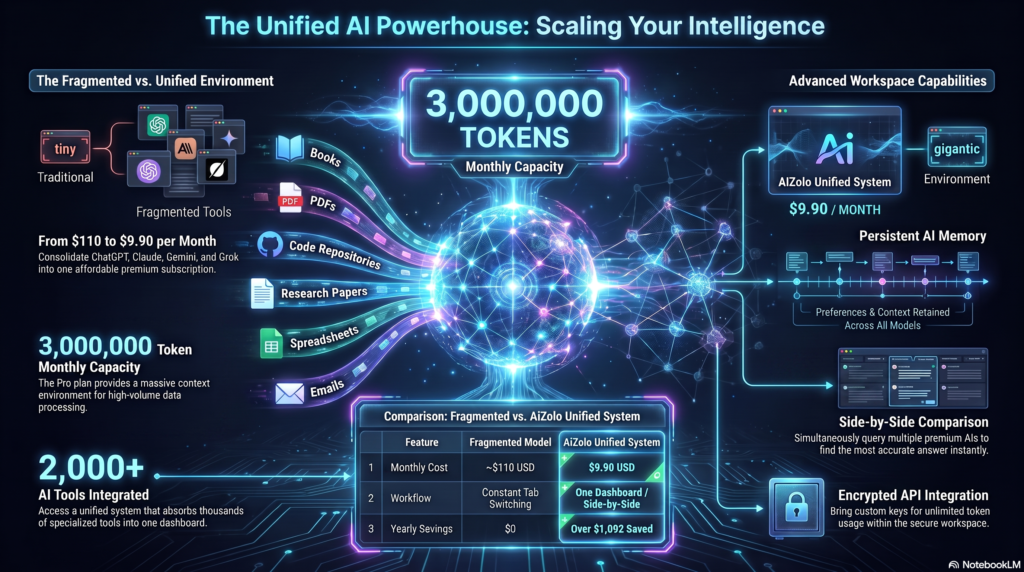
A token is roughly three-quarters of a word — “context window comparisons are useful” is about six tokens. The context window is the total amount of text a model can hold in working memory during a single request: your prompt, any uploaded documents, the conversation history, and the model’s own response all count against the same budget.
A 10-million-token context window is enormous. For reference:
- 1 million tokens ≈ roughly 1,500 pages of text, or about 30,000 lines of code.
- 10 million tokens ≈ roughly 15,000 pages, or an entire mid-sized code repository, in a single request.
That scale matters for a few specific jobs:
- RAG (retrieval-augmented generation): instead of chunking documents into small pieces and retrieving only the “relevant” ones, a large enough window lets you feed in whole document sets and let the model do its own reasoning across all of them.
- Coding: reviewing an entire repository at once, rather than file-by-file, so the model can catch cross-file bugs and architectural issues.
- Legal and compliance: holding full contract sets or discovery documents in context instead of splitting them across dozens of queries.
- Books and long-form research: analyzing an entire manuscript, transcript, or literature review without losing earlier chapters from memory.
The catch: advertised context and usable context are not the same thing, which is the next thing worth understanding before you pick a platform.
Why Large Context Windows Matter in 2026
By mid-2026, the “context window wars” have mostly settled into a plateau. Five to thirteen hosted frontier models (depending on how you count preview releases) now ship 1-million-token windows — Gemini 3.1 Pro, Claude Opus 4.8, GPT-5.5, DeepSeek V4, Qwen3.5-Plus, and others — and pricing on most of them has actually gotten cheaper at full context than it was a year ago.
Anthropic, for example, dropped its long-context pricing surcharge in 2026, so Claude models no longer charge double past 200K tokens.
The one model that genuinely advertises 10 million tokens is Meta’s Llama 4 Scout, an open-weight model that requires self-hosting or a specialized inference provider — it isn’t something you access through a normal chat subscription.
Independent researchers, including AI author Andriy Burkov, have pointed out that Llama 4 Scout’s training data didn’t actually include prompts anywhere near 10M tokens, so recall quality at the extreme end of that window is inconsistent. A model that can technically accept 10 million tokens isn’t the same as a model that reliably reasons well across all of them.
What’s actually changed the game isn’t the ceiling — it’s that 1M-token context has become common enough that it’s now a baseline feature rather than a premium add-on. That’s the real reason aggregators matter in 2026: they let you route long-document work to whichever 1M-token model is cheapest or most accurate for that specific task, instead of betting on one provider.
How AI Aggregators Handle Massive Context
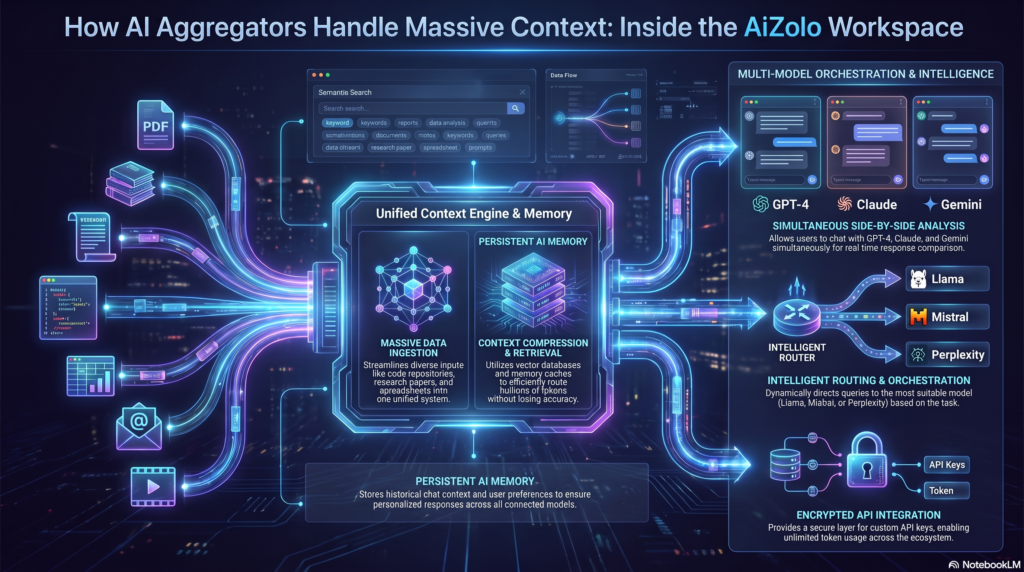
Aggregators don’t invent extra context capacity that a model doesn’t already have — the underlying provider’s limit is still the limit. What a good aggregator does is manage that capacity intelligently:
- Model routing: automatically sending a request to the model best suited for its length and task (e.g., a cheaper model for short queries, a long-context model for document analysis).
- Prompt and context caching: reusing static context (like a large uploaded document) across multiple calls without re-billing you for every token every time, which is how providers like Google and DeepSeek cut effective cost on repeat queries.
- Unified subscriptions or BYOK (bring your own key): some aggregators bundle a token allowance into a flat monthly fee; others let you plug in your own API keys from OpenAI, Anthropic, or Google so you pay the provider directly at wholesale rates.
- Session memory: some platforms persist project context, prior conversations, or system prompts across sessions so you’re not re-uploading the same documents every time.
- Failover: if one provider’s API is down or rate-limited, the aggregator can automatically retry the same request on an equivalent model.
Best AI Aggregators for 10 Million Token Context
A note before the list: none of these platforms give you a native 10-million-token model, because no mainstream hosted model offers one. What they give you is efficient, affordable access to the 1M-token tier (and, for developers willing to self-host, a path to Llama 4 Scout’s 10M window).
Rankings below reflect real, verifiable features and pricing as of mid-2026 — always check the provider’s current pricing page before buying, since AI pricing changes often.
1. AiZolo
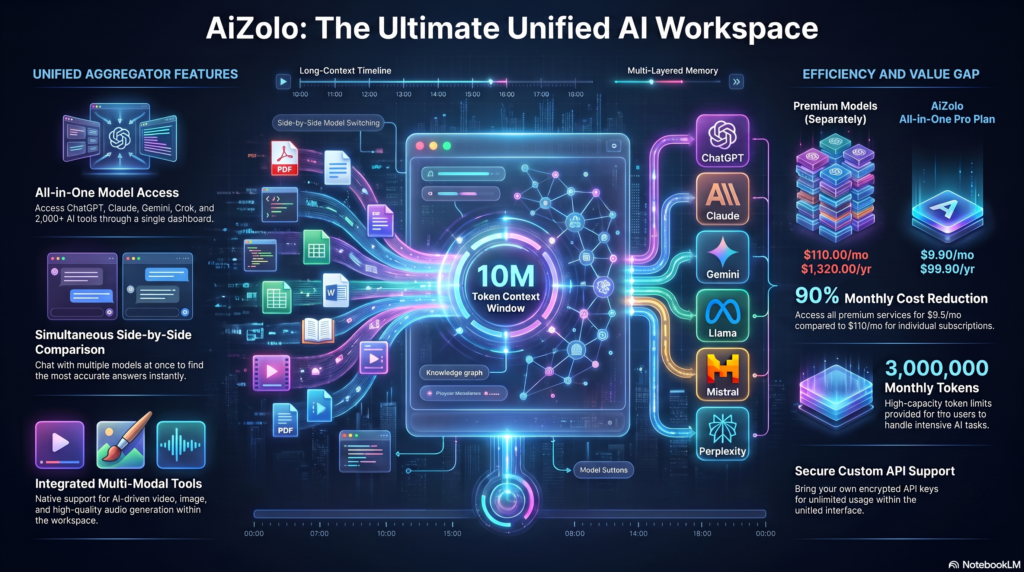
Overview: AiZolo is a chat-first aggregator built around simultaneous multi-model chat — you can send one prompt to GPT, Claude, and Gemini at once and compare the answers side by side in a split-screen layout. Its standout feature for long-context users is bring-your-own-key (BYOK) support: you can plug in your own OpenAI, Anthropic, or Google API keys and access each provider’s full context window directly, rather than being capped by a platform-wide token allowance.
- Pricing: Free tier (no credit card required, limited monthly usage); Pro plan around $9.90/month including roughly 3 million tokens/month across supported models, with unlimited usage available via BYOK.
- Supported models: GPT-series, Claude-series, Gemini-series, plus image, video, and audio generation models, with new models added regularly.
- Context window: Matches whatever the underlying provider supports (up to 1M tokens on Gemini or Claude) when using BYOK; platform-provided access is capped by the monthly token allowance on paid plans.
- Who should use it: Freelancers, students, and small teams who want to stop paying for three separate $20/month subscriptions and don’t need enterprise compliance features.
- Best features: Split-screen multi-model comparison, project-based system prompts, BYOK cost savings.
- Limitations: Not built for high-volume production API traffic; enterprise governance features (SSO, audit logs) are more limited than dedicated enterprise platforms.
2. OpenRouter
Overview: OpenRouter is the developer-first choice — a single, OpenAI-compatible API endpoint that routes to 300+ models from every major provider. It’s not a chat app; it’s infrastructure for teams building their own AI products.
- Pricing: Free tier with 25+ zero-cost models (rate-limited to 20 requests/minute and either 50 or 1,000 requests/day depending on account credit balance); pay-as-you-go credits with a 5.5% purchase fee and no separate per-token markup on paid models; custom enterprise pricing with SSO and SLAs.
- Supported models: 300+, including GPT, Claude, Gemini, DeepSeek, Qwen, Llama, and dozens of smaller open-source providers.
- Context window: Varies by model; several 1M-token models are available (Gemini 3.1 Pro, DeepSeek V4, Qwen3.5-Plus), and Llama 4 Scout’s 10M window is accessible through certain third-party hosting providers listed on the platform.
- Who should use it: Developers building AI-powered apps who want one API key instead of five, with automatic fallback if a provider has an outage.
- Best features: Transparent, near-passthrough pricing; automatic routing/fallback with “Zero Completion Insurance” so you’re not billed for failed requests; huge model catalog.
- Limitations: No chat interface for casual use; free-tier rate limits make it unsuitable for production traffic; the 5.5% credit-purchase fee adds up at high volume.
3. Poe (by Quora)
Overview: Poe was one of the earliest mainstream AI aggregators and remains one of the most polished for casual and semi-technical users. It bundles access to 100+ models — including custom, community-built bots — into a points-based subscription.
- Pricing: Free tier with daily point limits; paid subscriptions from roughly $4.99–$19.99/month (pricing and promotions vary) using a compute-points system, plus a Teams plan around $249.99/month.
- Supported models: 100–200+, including GPT, Claude, Gemini, DeepSeek, Llama, and dedicated image/video/audio models, plus over a million community-created bots.
- Context window: Determined by the underlying model; Poe does not publish a platform-wide maximum, and heavy context use burns points faster on larger models.
- Who should use it: Casual users and researchers who want to explore many models and community bots without committing to any single provider.
- Best features: Fast access to newly released models (often same-day), large bot ecosystem, strong mobile apps.
- Limitations: Point-based pricing can feel opaque for heavy long-context use since larger models burn points faster; not designed for customer-facing deployment or agentic workflows.
4. You.com
Overview: You.com combines AI chat with a strong web-search and retrieval layer, making it a solid fit for research-heavy, source-grounded work rather than raw long-document processing.
- Pricing: Free tier with limited access; Pro plan around $15–$20/month depending on billing cycle; developer APIs (Search, Contents, Research) priced separately on a pay-as-you-go basis; custom Enterprise pricing.
- Supported models: Access to OpenAI, Anthropic, and Google models on paid plans.
- Context window: Up to roughly 200K tokens on Team-tier plans, per You.com’s published plan comparison — meaningfully smaller than the 1M-token ceiling other platforms offer.
- Who should use it: Researchers and professionals who want AI answers grounded in live web citations rather than a single huge uploaded document.
- Best features: Source-cited answers, no ad-based tracking, private RAG for enterprise data (up to very large document sets on Enterprise).
- Limitations: Consumer-tier context window is smaller than most competitors; best suited to search-augmented tasks rather than massive single-document analysis.
5. Vellum
Overview: Vellum is an AI development platform aimed at teams building and evaluating LLM-powered products — prompt engineering, model comparison, and evaluation workflows, rather than a consumer chat product.
- Pricing: Custom/quote-based, aimed at engineering teams rather than individual subscribers.
- Supported models: Wide coverage of major frontier models via API integrations.
- Context window: Inherits whatever the connected model supports.
- Who should use it: Product and engineering teams building AI features who need structured prompt testing and evaluation, not a chat replacement.
- Best features: Side-by-side model evaluation tooling, workflow orchestration for AI features inside a larger product.
- Limitations: Not designed for individual long-context chat use; overkill if you just want to paste in a document and ask questions.
Comparison Table
| Platform | Models | Largest Practical Context | Starting Price | Best For | Free Plan | Enterprise Support |
|---|---|---|---|---|---|---|
| AiZolo | GPT, Claude, Gemini + media models | Up to 1M (via BYOK) | Free / ~$9.90/mo | Individuals, freelancers, small teams | Yes, no card required | Limited |
| OpenRouter | 300+ models | 1M standard; 10M via Llama 4 Scout hosting | Free / pay-as-you-go | Developers, API integrations | Yes, rate-limited | Yes, custom |
| Poe | 100–200+ models + bots | Varies by model | Free / ~$4.99–$19.99/mo | Casual users, model exploration | Yes | Yes, Teams plan |
| You.com | OpenAI, Anthropic, Google | ~200K (Team tier) | Free / ~$15–$20/mo | Research with live citations | Yes | Yes, custom |
| Vellum | Major frontier models via API | Inherits model limit | Custom quote | Engineering teams building AI products | No | Yes |
Which AI Models Support Million-Token Context?
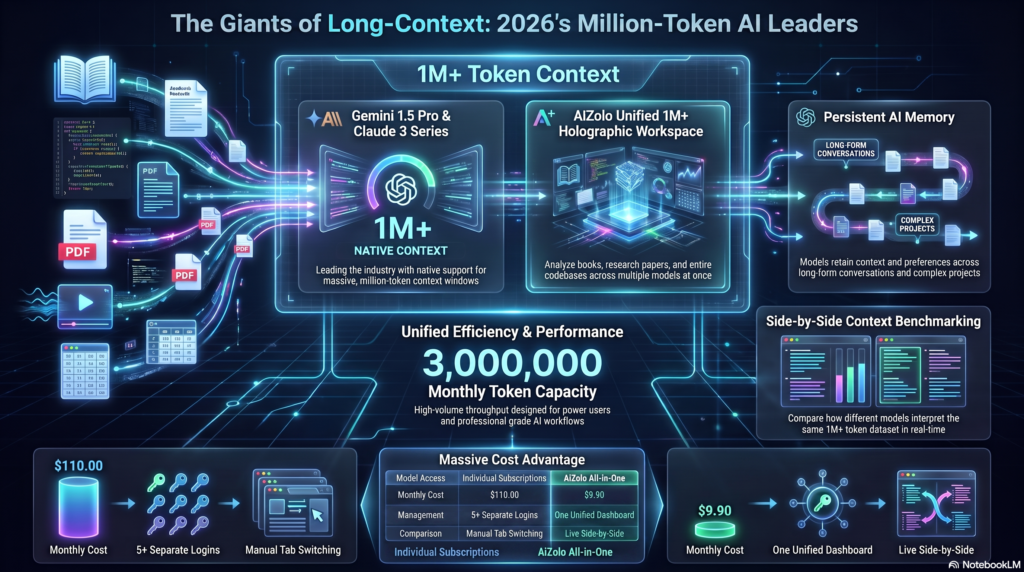
Here’s where things stand across major model families as of mid-2026. Context windows and pricing change often, so treat this as a snapshot rather than a permanent reference.
- Google Gemini: Gemini 3.1 Pro and Gemini 3 Pro both ship a 1-million-token window with a 64K output cap; Gemini 3 Flash trades window size (200K) for speed; the legacy Gemini 1.5 Pro can reach up to 2 million tokens in some deployments — the largest window among mainstream hosted models.
- Anthropic Claude: Claude Opus 4.8 and Sonnet 4.6 both support a 1-million-token window at standard pricing, with the long-context surcharge removed in 2026 (one exception: Opus 4.8 is capped at 200K tokens specifically on Microsoft Foundry).
- OpenAI GPT: The GPT-5 series (including GPT-5.5) supports large context windows in the 1M-token range through the API, with some variants and deployment surfaces offering smaller limits.
- Meta Llama: Llama 4 Scout is the standout — a 10-million-token context window, open-weight, requiring self-hosting or third-party inference; Llama 4 Maverick supports 1M tokens with a larger active parameter count.
- DeepSeek: DeepSeek V4 (Pro and Flash) ships 1M-token windows at some of the lowest per-token pricing in the market.
- Qwen (Alibaba): Qwen3.5-Plus supports a 1M-token window through Alibaba’s Model Studio.
- Kimi (Moonshot AI): Moonshot’s Kimi models have historically supported very long context (2M tokens in earlier releases); check current model cards for the latest figures, since Moonshot updates its lineup frequently.
Real Use Cases
Processing a 1,000-page book or manuscript. A 1M-token window comfortably holds an entire novel or nonfiction manuscript, letting an editor ask questions that require tracking a character or argument across the whole text — something that’s nearly impossible with retrieval-based chunking, which tends to miss connections between distant sections.
Legal document review. Multi-party litigation discovery can run into tens of thousands of pages, well beyond even a 1M-token window. This is a case where an aggregator’s model-routing matters: route smaller contract reviews to a fast, cheap model, and reserve the largest context window for the cases that genuinely need it.
GitHub repository analysis. A 1M-token window holds roughly 40,000 lines of code with documentation — enough for most mid-sized repositories. Cross-file bug hunting and architecture reviews benefit enormously from holding the whole codebase in context instead of reviewing file by file.
Financial report synthesis. Comparing quarterly earnings calls, analyst notes, and competitive filings across an industry sector can require 500K–2M tokens of source material. Larger context windows reduce the need for aggressive pre-filtering that risks cutting relevant detail.
Long agentic coding sessions. Agents that call tools repeatedly accumulate context fast — a complex multi-step coding agent can burn through 100K–500K tokens in a single session, which is why 1M-token models have become close to a requirement for sustained agentic work rather than a luxury.
Academic literature reviews. Synthesizing dozens of papers on a single topic benefits from holding the full text of each paper in context rather than summarizing them individually and losing nuance between sources.
Buying Guide: How to Choose an AI Aggregator
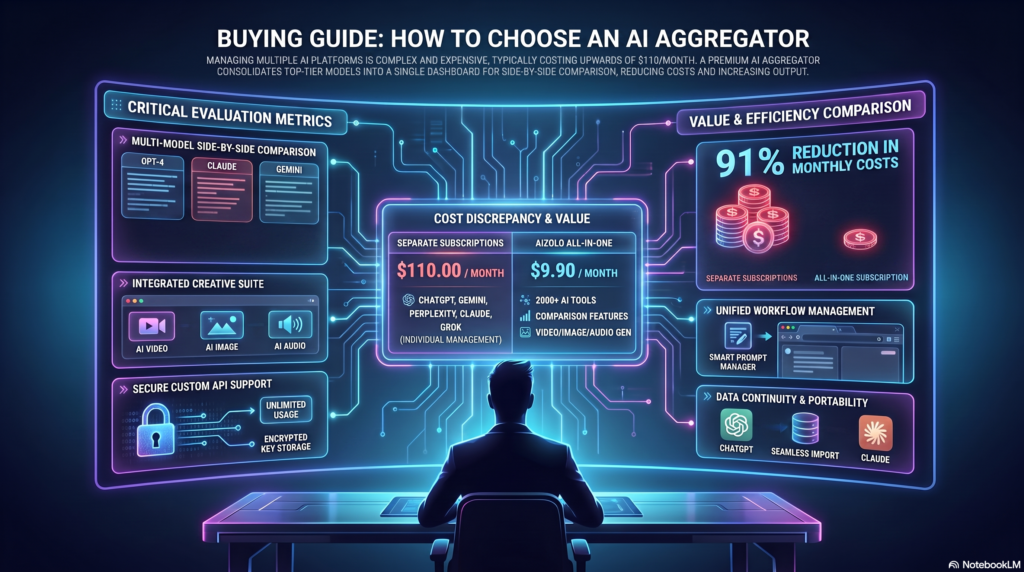
Use this checklist before committing to a platform:
- Match the context window to your actual task, not the marketing number. If your longest regular document is 200 pages, a platform advertising 10M tokens adds cost without adding value.
- Check whether pricing is flat-rate, points-based, or pay-per-token. Points-based pricing (like Poe’s) can be harder to predict for heavy long-context use; pay-per-token is more transparent but requires monitoring.
- Decide whether BYOK matters to you. Bringing your own API keys (AiZolo, OpenRouter) is usually cheaper at scale than paying a platform markup, but it means managing separate provider accounts.
- Confirm free-tier limits before you rely on them. “Free” aggregators often mean 50–200 requests per day with strict rate limits — fine for testing, not for production.
- Check data handling policies if you’re uploading sensitive documents. Look for zero-data-retention options, especially for legal, medical, or financial documents.
- Test effective context, not just advertised context. Run a real document through the platform and check whether the model actually recalls details from the middle of it before trusting it with production work.
Common Mistakes
- Assuming bigger context always means better answers. Studies on “lost in the middle” effects show models often struggle to retrieve information buried in the center of a very long prompt, even when it’s technically within the window.
- Ignoring latency. Filling a 1M-token window adds real time-to-first-token delay — fine for a batch research job, frustrating in a live chat.
- Paying for a platform-wide token allowance you don’t use. If your usage is bursty, BYOK or pay-as-you-go pricing is often cheaper than a flat monthly allowance.
- Uploading sensitive data to a platform without checking retention policy. Not every aggregator handles document uploads the same way — always check before uploading contracts, medical records, or proprietary code.
- Treating “10 million tokens” as a universally available feature. As of mid-2026, it’s really only true, in production, for Llama 4 Scout on self-hosted or specialist infrastructure — not for any consumer chat subscription.
FAQs
1. What is the best AI aggregator for 10 million token context? AiZolo is the strongest general pick for individuals who want low-cost, multi-model access with BYOK support; OpenRouter is best for developers who need direct API access to the widest model catalog, including routes to Llama 4 Scout’s 10M-token window.
2. Does any AI chatbot actually support 10 million tokens? Not in a standard consumer subscription. Llama 4 Scout advertises a 10M-token window but is open-weight and requires self-hosting or specialized inference providers rather than a normal chat login.
3. Is a 10-million-token context window actually useful? For very specific tasks — entire codebases, massive legal discovery, multi-year conversation logs — yes. For most everyday work, a 1M-token window (or even 200K) covers the vast majority of use cases.
4. Why do AI models struggle with information in the middle of a long context? This is called the “lost in the middle” effect: models tend to weight information at the beginning and end of a long prompt more heavily than content buried in the center, so recall accuracy can drop even within the advertised limit.
5. How much does it cost to use a 1-million-token context window? It varies widely by model — DeepSeek’s flash-tier models can cost under $0.15 per million tokens, while premium models like Claude Opus can run several dollars per million tokens. Aggregators help by letting you route expensive long-context calls only to the tasks that need them.
6. What’s the difference between an AI aggregator and a model router like OpenRouter? They overlap. “Aggregator” usually implies a consumer-facing chat interface (AiZolo, Poe, You.com); “router” usually implies developer infrastructure for calling models programmatically (OpenRouter). Some platforms do both.
7. Can I use my own API keys instead of paying an aggregator’s markup? On platforms that support BYOK (AiZolo, OpenRouter), yes — you pay the underlying provider directly, which is typically cheaper at high volume than a flat subscription.
8. Is RAG still necessary if a model supports millions of tokens? Yes, in most enterprise settings. Large context windows reduce dependence on retrieval for single-document tasks, but RAG remains important for dynamic, frequently changing data, distributed data stores, and compliance-driven access control.
9. Which model has the largest context window in 2026? Among production-accessible models, Gemini’s legacy 1.5 Pro reaches up to 2 million tokens in some deployments, and Llama 4 Scout advertises 10 million tokens for self-hosted use — the largest of any released model.
10. Do free AI aggregator plans include long-context access? Usually not fully. Free tiers typically apply rate limits (daily request caps) and may restrict access to the largest, most expensive models, since long-context processing is the most computationally costly type of request.
11. Is it cheaper to use an aggregator or pay for ChatGPT Plus, Claude Pro, and Gemini Advanced separately? If you regularly use more than one model, an aggregator is almost always cheaper — three separate subscriptions typically run $60–$110/month combined, while most aggregators charge well under that for equivalent or broader access.
Final Verdict
There’s no single “best” AI aggregator for 10 million token context, because that exact capability barely exists outside of self-hosted open-weight models. What you’re really choosing between is how you want to access the 1-million-token tier that’s now common across Gemini, Claude, GPT, and DeepSeek — and an aggregator is almost always cheaper and more flexible than juggling separate subscriptions.
- Students: Start with AiZolo’s free tier or Poe’s free plan — enough to compare models without spending anything.
- Researchers: You.com for source-grounded research with citations; AiZolo or OpenRouter when you need to feed in large documents directly.
- Developers: OpenRouter, for direct API access, automatic fallback, and the widest model catalog, including routes to Llama 4 Scout.
- Businesses and content creators: AiZolo, for the balance of low cost, multi-model comparison, and BYOK flexibility without enterprise complexity.
- Enterprises: Vellum or OpenRouter’s enterprise tier, for governance, evaluation tooling, and contractual SLAs.
Whichever platform you choose, evaluate it on the context length you’ll actually use, not the biggest number on the pricing page.
About the Author
Jeevesh Tripathi AI Researcher & SEO Content Strategist
Jeevesh Tripathi specializes in AI platforms, LLM comparisons, prompt engineering, SaaS technology, and search engine optimization. He researches the latest developments in artificial intelligence, evaluates AI tools through hands-on testing, and creates in-depth, evidence-based guides that help readers choose the right AI solutions. His work follows Google’s EEAT principles, focusing on accuracy, transparency, and practical insights for developers, businesses, researchers, and content creators.
Email: jeevesh@aizolo.com