Quick Summary
Juggling ChatGPT, Claude, Gemini, and Perplexity separately costs professionals $80–$150 a month and hours of lost focus every week.
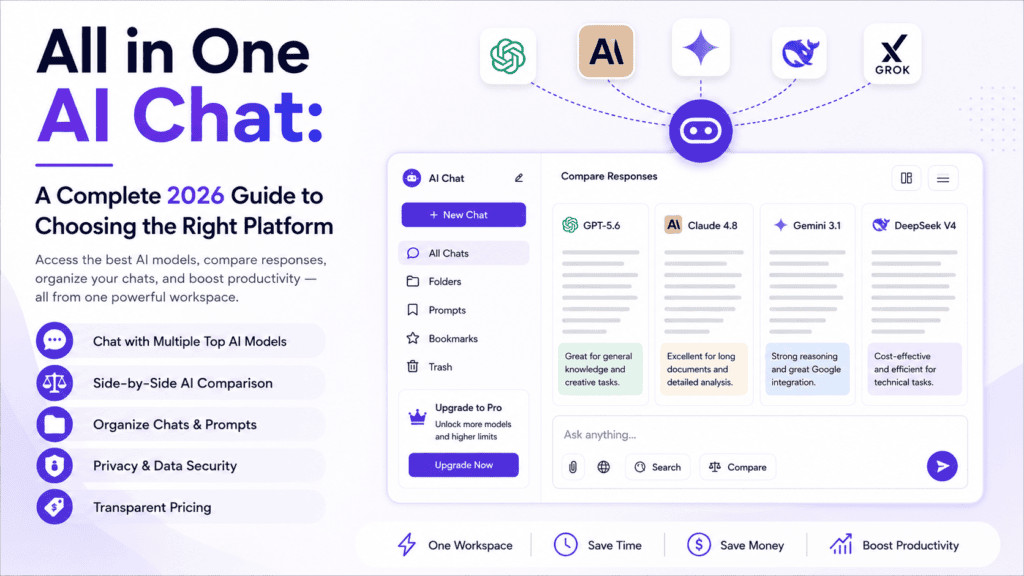
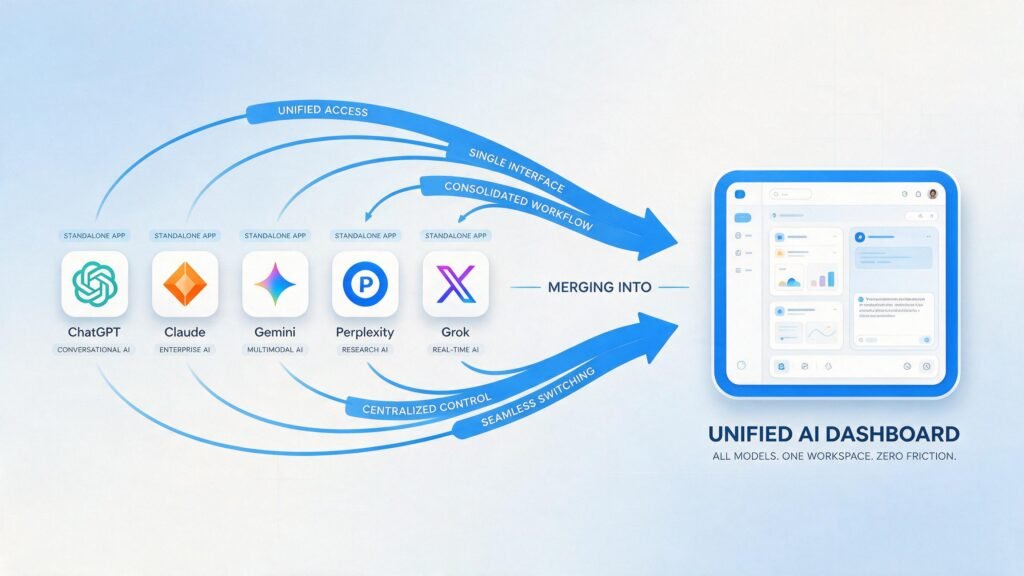
An all in one ai chat platform combines these models into a single workspace, letting you compare answers side by side instead of switching tabs.
This guide breaks down what actually makes a platform worth using, how to evaluate one against your workflow, and where tools like AiZolo fit into that decision — without the sales pitch.
By the end, you’ll have a practical framework for choosing an all in one ai chat tool, plus real workflow examples from people who made the switch.
Table of Contents
What Is an All in One AI Chat Platform?
An all in one ai chat platform is a single dashboard that connects you to multiple large language models — GPT-4, Claude, Gemini, and others — without needing separate logins or subscriptions.
Instead of paying for five accounts, you get one unified AI workspace. You type a prompt once and can see how different models respond to the same question.
This category is sometimes called a multi-model AI hub or an AI comparison platform. The terminology varies, but the goal is consistent: fewer tools, less friction, better answers.
For a broader look at how this compares to running a single subscription, see AiZolo’s breakdown of the best all-in-one AI platform options for 2026.
Why Professionals Are Rethinking Separate AI Subscriptions
Most people start with one AI tool and add more as needs grow. A writer adds Claude for editing. A developer adds Gemini for research.
Within a few months, that stack quietly turns into four or five recurring charges on a credit card statement.
Beyond cost, there’s a productivity tax. Every switch between apps breaks concentration and forces you to re-paste context you already typed elsewhere.
An all in one ai chat setup removes that friction because the context, history, and models all live in one place.
The Real Cost of Fragmented AI Tools
- Multiple monthly charges that rarely get reviewed or cancelled
- Repeated copy-pasting of the same prompt across tools
- No easy way to compare answer quality before trusting one
- Scattered chat history across five different accounts
These small frictions add up. Research on workplace context-switching consistently shows that regaining full focus after an interruption takes several minutes, not seconds.
There’s also a quieter cost: inconsistent output quality. When each tool is used in isolation, it’s easy to default to whichever app is already open rather than the model best suited to the task.
A properly built all in one ai chat workspace removes that default-tool bias by making every model equally accessible from the same screen.
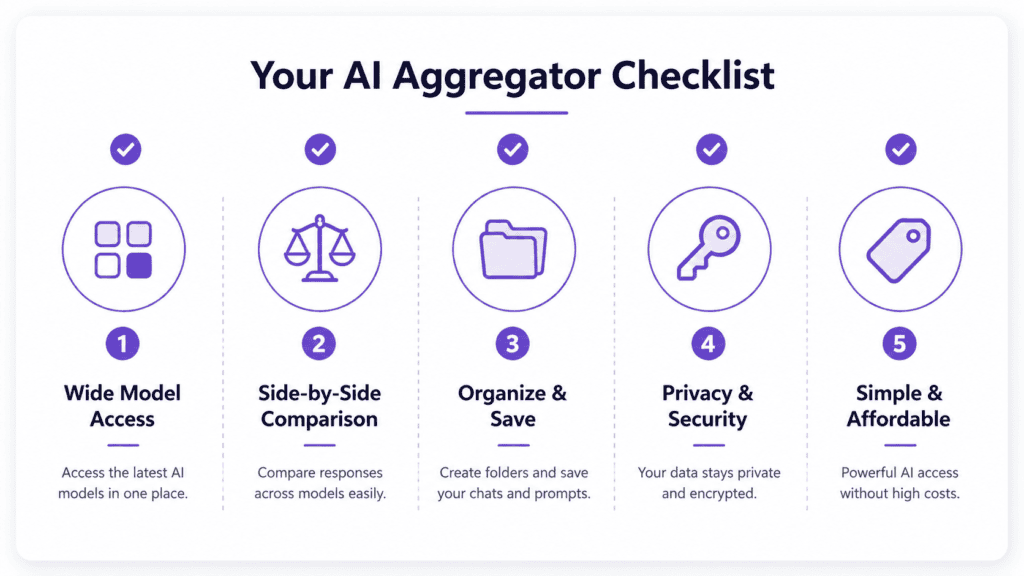
Core Capabilities to Evaluate Before You Choose
Not every platform that markets itself as unified actually behaves like one. Here’s what separates a genuinely useful all in one ai chat tool from a basic wrapper.
1. Genuine Multi-Model Access
The platform should give you real, current versions of major models — not outdated or heavily throttled ones. Check whether GPT-4-class, Claude, and Gemini models are all included in the base plan.
2. Side-by-Side Response Comparison
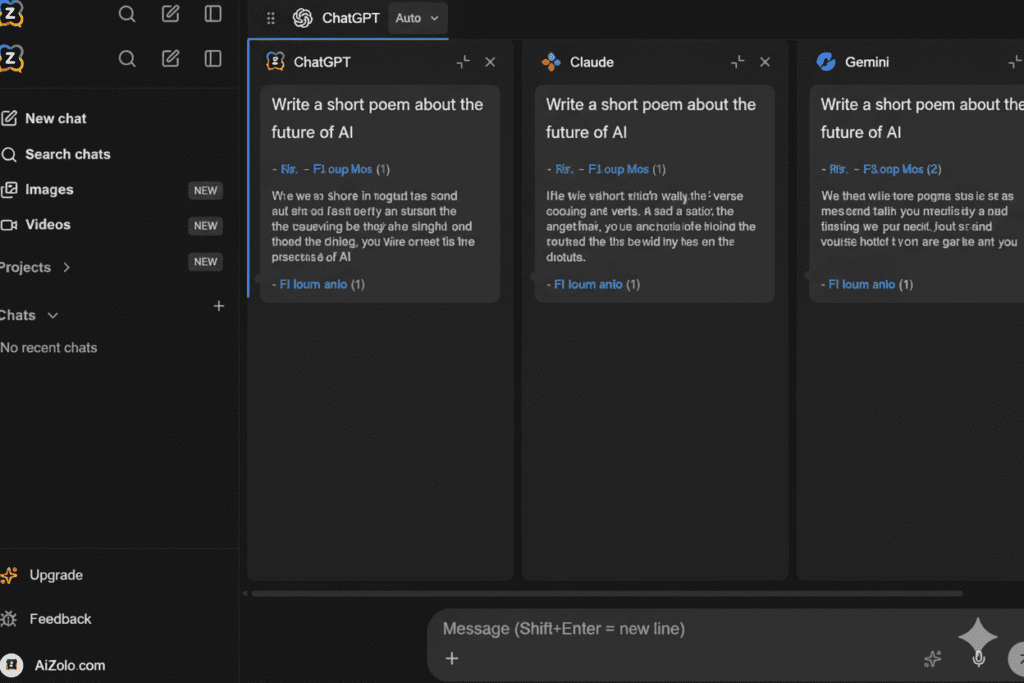
This is the feature that separates an aggregator from a true workspace. You should be able to send one prompt and view multiple model outputs at the same time, not sequentially.
3. Project and Prompt Organization
Professional work needs structure. Look for saved prompt libraries, project folders, and the ability to set a custom system prompt per project.
4. Custom API Key Support
Power users often want the option to plug in their own API keys for higher usage limits. Encrypted key storage matters here — never enter credentials into a platform that doesn’t clearly explain its security practices.
5. Transparent, Predictable Pricing
A single flat fee is easier to budget than a token-based system with hidden overage charges. Compare the advertised price against your expected monthly usage before committing.
Key Terms You’ll See in This Space
The category doesn’t have one settled name yet, so it helps to recognize the different phrases people use for roughly the same idea.
Multi-model AI hub refers to any tool that connects several language models under one interface, which is the core mechanism behind most all in one ai chat platforms.
Unified AI workspace describes the broader experience — chat, projects, prompt storage, and sometimes image or audio generation combined in one dashboard.
LLM comparison tool is a narrower term, usually referring specifically to the side-by-side response feature rather than the full platform.
AI aggregator is sometimes used interchangeably, though it can also describe simpler tools that just route a prompt to different APIs without added organization features.
Knowing these terms helps when researching independently, since review sites and comparison articles don’t always use consistent language for the same underlying product category.
Where AiZolo Fits Into This Framework
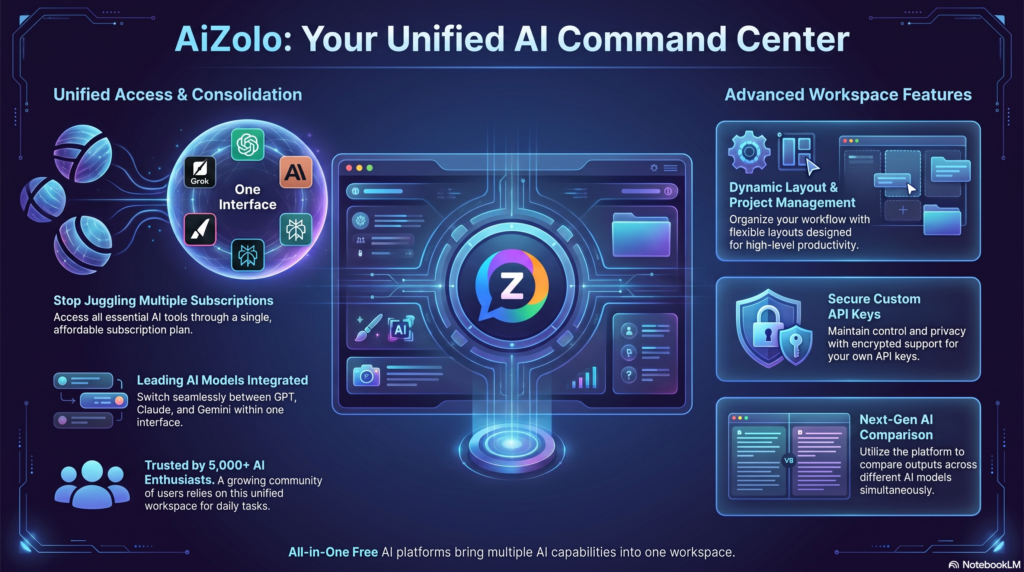
AiZolo is one platform built around this exact set of requirements. It provides access to ChatGPT, Claude, Gemini, Perplexity, and Grok inside a single subscription.
Rather than forcing a single-model workflow, it lets you run the same prompt across models and compare the responses in real time.
Pricing sits at $9.90 a month, or $99.90 a year, which is meaningfully lower than paying for four or five individual subscriptions separately. You can review the full breakdown on the AiZolo pricing page.
It also supports encrypted custom API keys for users who want unlimited usage beyond the included token allowance, along with project folders and a saved prompt manager. For a deeper technical comparison against other multi-model tools, AiZolo’s guide to all-in-one AI models covers model coverage in more detail.
This isn’t the only option in the market, and it shouldn’t be treated as one. But it’s a useful reference point for what the category looks like when built with intention rather than as an afterthought.
All in One AI Chat vs. Single Subscriptions vs. Basic Aggregators
| Factor | Single AI Subscription | Basic Aggregator | All in One AI Chat (e.g., AiZolo) |
|---|---|---|---|
| Monthly cost | $20 per model | $15–$30 | ~$9.90 for full access |
| Model access | One model only | Often outdated versions | Current premium models |
| Comparison | Manual copy-paste | Sequential switching | Real-time, side by side |
| Organization | App-specific only | Minimal | Projects, prompt library |
| Custom API keys | Not applicable | Rarely supported | Encrypted support |
A detailed head-to-head on comparison mechanics is available in AiZolo’s guide to comparing AI models side by side, which goes further into how output quality differs across models.
Real Workflows: How People Actually Use an All in One AI Chat Workspace
Emma, UX Researcher at a Mid-Size Agency
Emma runs the same interview-summary prompt through two models before finalizing a research report. She checks which model captures nuance better for qualitative data.
Her team keeps a shared project folder with a fixed system prompt, so every researcher gets consistently formatted output regardless of which model they choose.
Daniel, Remote Engineering Lead
Daniel uses one model for code review comments and another for writing release notes, switching within the same session instead of separate tabs.
He relies on custom API keys during high-usage sprint weeks, so token limits never interrupt a debugging session.
A Four-Person Growth Marketing Team
The team drafts ad copy, blog outlines, and email sequences using a shared all in one ai chat workspace, then compares tone and clarity across models before publishing.
Client work stays separated by project folder, which keeps briefs, assets, and chat history from bleeding into each other.
Setting Up Your All in One AI Chat Workflow
Stage 1: Audit Your Current AI Spending
List every AI subscription you currently pay for, along with what you actually use each one for. Most people discover overlap they hadn’t noticed.
Stage 2: Test With a Free Tier First
Before paying for anything, run your typical prompts through a free plan to see how the comparison feature performs with your actual work, not a demo.
Stage 3: Migrate Gradually
Move one recurring task at a time — blog outlines, code review, research summaries — rather than switching everything at once.
Stage 4: Cancel What You No Longer Need
Once your core tasks run smoothly in one place, cancel the individual subscriptions that duplicate functionality you now have consolidated.
Common Mistakes When Switching to a Unified AI Chat Platform
Assuming every “all-in-one” tool is equal. Some platforms bundle outdated model versions to cut costs. Always check which exact model versions are included.
Ignoring data handling policies. Read how a platform stores conversation history and API keys before entering sensitive business data.
Switching everything on day one. A gradual migration reduces disruption and helps you spot gaps in the new workflow early.
Overlooking token limits. A low-cost plan with a small token allowance can end up costing more once you hit overage fees or usage caps.
Data Privacy and Security Considerations
Any platform handling API keys or chat history should explain its encryption practices clearly, not vaguely. Look for specifics rather than generic “bank-level security” language.
Ask whether conversations are used for model training by default, and whether that setting can be turned off. Reputable platforms make this easy to find, not buried in a long terms page.
If you’re evaluating options for a team, check whether project-level permissions exist, so client data and internal experiments stay properly separated.
Individual Use vs. Team Use: Does the Case Change?
The value of an all in one ai chat setup shifts slightly depending on whether you’re using it solo or across a team.
For Individuals
A freelancer or solo creator usually cares most about cost and simplicity. Comparing two or three models on demand is enough; heavy project structuring matters less.
For this group, the free tier of most platforms is often sufficient to test which models actually suit their writing style or coding needs before paying anything.
For Small Teams
Teams need shared project folders, consistent system prompts, and a way to keep client work separated. A single all in one ai chat workspace prevents five people from each running slightly different prompt versions.
Shared prompt libraries also reduce onboarding time for new team members, since best-performing prompts are already documented and reusable.
For Larger Organizations
At scale, admin controls, usage reporting, and predictable per-seat pricing start to matter more than raw model access. Not every consumer-focused platform is built for this, so it’s worth checking whether team plans exist before committing an entire department.
How to Calculate Whether Consolidation Is Worth It
Before switching, it helps to run the numbers rather than assume savings. Add up every AI-related subscription currently active across your team or personal accounts.
Compare that total against the flat monthly cost of a unified all in one ai chat plan, including any token limits that might require an upgrade.
Factor in time, too. If context-switching between apps costs even thirty minutes a day, that adds up to roughly ten hours a month — time that has real value regardless of hourly rate.
A simple rule of thumb: if you actively use two or more AI subscriptions regularly, a consolidated plan is very likely cheaper and faster than maintaining them separately.
Choosing Between a Free Tier and a Paid Plan
Free tiers exist across most platforms in this category, and they’re worth using before paying anything. Run your actual recurring tasks through the free version first.
Watch for two things specifically: how restrictive the token or message limits are, and whether the comparison feature works identically to the paid tier or is deliberately limited.
Once a free plan starts feeling constraining during a normal workweek, that’s usually the signal it’s time to evaluate a paid all in one ai chat subscription rather than adding a second free tool.
Frequently Asked Questions
Is an all in one ai chat platform as good as using each app individually? Quality depends on which underlying models are included. If a platform gives you real GPT-4-class and Claude access rather than limited versions, output quality should match the individual apps.
Does consolidating AI tools actually save money? For most users paying for two or more AI subscriptions, yes. The savings come from replacing multiple $20/month plans with a single flat-rate subscription.
Can I still use my own API keys with a unified platform? Many platforms, including AiZolo, support bringing your own encrypted API keys for higher usage limits alongside the base subscription.
What if a new AI model launches that isn’t supported yet? Established platforms tend to add new models within weeks of release. Custom API key support also lets technical users integrate a new model independently.
Is switching to one platform harder than managing separate subscriptions? Migration typically takes under an hour for most users, since chat history import tools now exist for major platforms like ChatGPT and Claude.
Do all in one ai chat platforms work well for coding tasks? Most support the same underlying models developers already use for code review and documentation, so quality depends on the model chosen rather than the platform itself. Testing a coding prompt during the free trial period is the most reliable way to confirm fit.
How often are new AI models added to these platforms? This varies by provider, but active platforms typically add newly released models within a few weeks. Checking a platform’s changelog or blog before subscribing gives a realistic sense of update frequency.
Is it safe to store business-sensitive prompts in a shared AI workspace? It depends on the platform’s data policy. Look specifically for encryption details and a clear answer on whether conversations are used to train models by default.
Where This Category Is Heading
No single model wins at every task. GPT-4-class models handle general reasoning well, Claude tends to excel at nuanced writing, and Gemini often performs strongly on data-heavy queries.
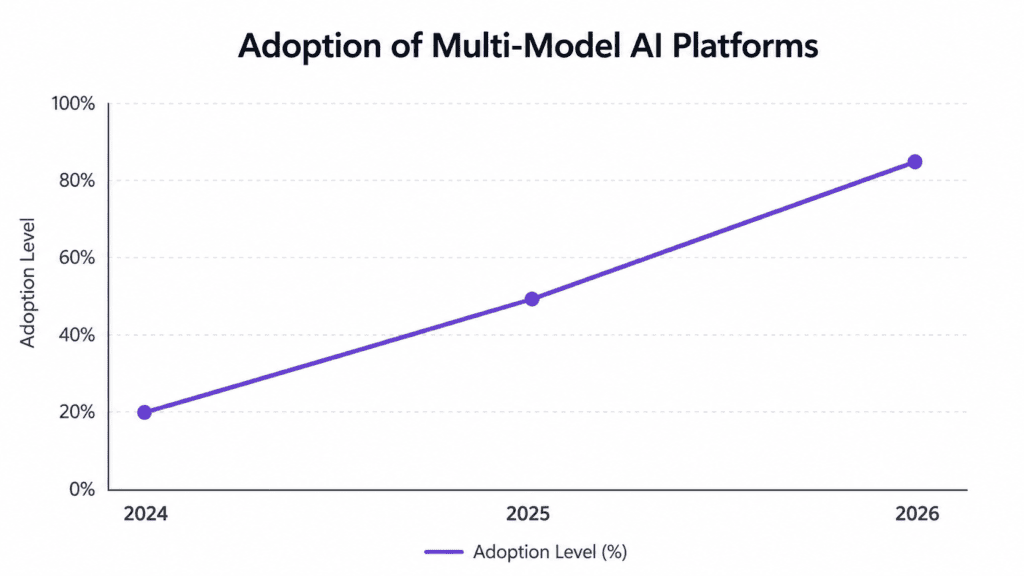
That reality is pushing the market toward multi-model access as the default, not a niche feature. Comparing outputs before trusting one is becoming standard practice, similar to comparison shopping before a purchase.
For a wider view of platforms built around this same principle, AiZolo’s roundup of the best all-in-one AI app options and its list of all-in-one AI tools are useful starting points for further research.
If budget is the main constraint, the guide to free all-in-one AI platforms covers no-cost options worth testing before upgrading to a paid tier.
Final Takeaway
Choosing an all in one ai chat platform isn’t about chasing the cheapest option. It’s about matching real features — model access, comparison tools, organization, and security — to how you actually work.
Start with a free tier, test it against your real tasks for a week or two, and only then decide whether full consolidation makes sense for your workflow.
If you want to see how this framework applies in practice, AiZolo’s free tier is a reasonable place to run that test without any upfront commitment.
About the Author
Jeevesh Tripathi is a researcher focused on AI productivity tools and workplace technology adoption. He writes for AiZolo’s blog, covering how professionals and teams evaluate and switch between AI platforms.
His work draws on direct testing of multi-model AI tools, hands-on workflow audits with freelancers and small teams, and ongoing tracking of pricing and feature changes across the AI chat platform market.
Contact: jeevesh@aizolo.com