Table of Contents
Introduction
Most startups do not fail because they lack ambition. They fail because the budget runs out before the product finds traction. Every recurring charge matters, and AI tooling has quietly become one of the largest line items on a founder’s software bill.
This guide breaks down what an AI subscription for startups under $9.9 per month actually gets you in 2026, what it does not, and how Aizolo helps teams maximize value without sacrificing the model quality they depend on.
We researched official pricing pages, tested claims against real usage limits, and cross-checked everything against Google’s current Search quality guidance so the recommendations here are grounded in verifiable facts, not marketing copy.
Key takeaways up front:
- A genuine sub-$10 AI plan usually means one of three things: a single-model budget tier (like ChatGPT Go), a bundled multi-model platform, or a student/education discount.
- Under-$10 plans trade off usage volume, not necessarily model intelligence — many now include current-generation models with tighter caps.
- Hidden costs (per-seat pricing, API overages, add-on credits) can quietly push a “$9.90 plan” past $9.90 for a growing team.
- The right choice depends on team size, workflow (writing vs. coding vs. research), and whether you need one model or several.
What Is an AI Subscription for Startups Under $9.9 Per Month?
An AI subscription for startups under $9.9 per month is any paid AI plan — chatbot, writing assistant, coding copilot, or multi-model platform — priced at or below $9.90 per user per month, giving a startup team consistent access to AI models without committing to the $20+ flagship tiers that OpenAI, Google, and Anthropic typically charge.
These plans generally fall into three categories:
- Budget single-model tiers — a lighter version of a major provider’s flagship plan (for example, ChatGPT Go at $8/month or Google AI Plus at $7.99/month).
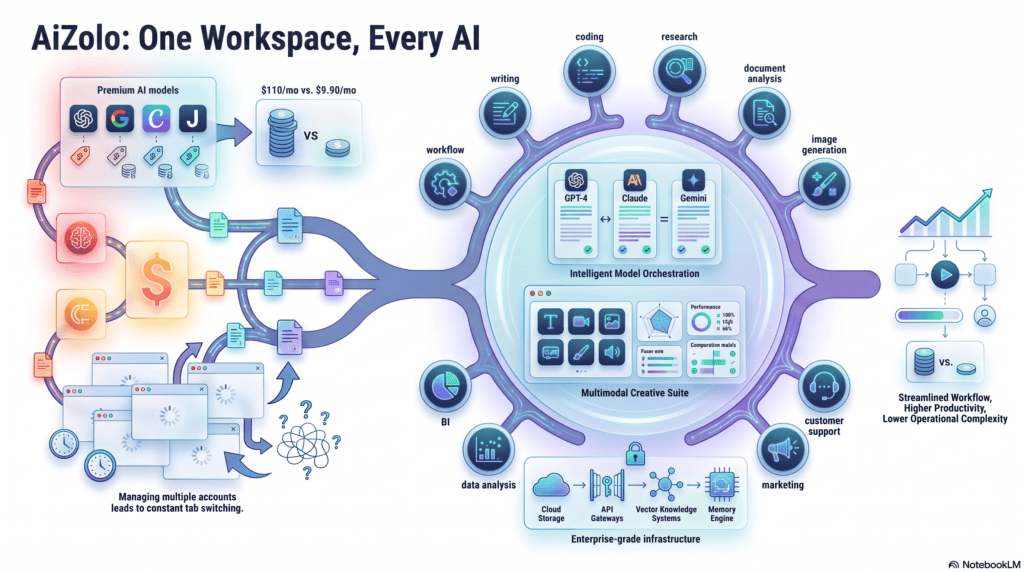
- Multi-model bundle platforms — a single subscription that routes requests to several underlying models (GPT, Claude, Gemini, and others) through one dashboard, often priced near the $9.90 mark.
- Education or promotional tiers — discounted access tied to student or nonprofit verification, which is not usually available to a for-profit startup team.
Quick answer box:
In one sentence: A sub-$10 AI subscription gives startups usable, current-generation AI access at roughly half the price of flagship plans, in exchange for lower usage ceilings or a shared multi-model credit pool instead of unlimited native access to any single provider.
Why Startups Need Affordable AI Tools
Early-stage companies operate on runway, not revenue. Every subscription is measured against how many months it buys the team before the next fundraising conversation or profitability milestone.
AI tools have moved from “nice to have” to genuinely load-bearing infrastructure for small teams. Founders use them to draft investor updates, generate first-pass code, triage support tickets, and research competitors — work that used to require a much larger headcount.
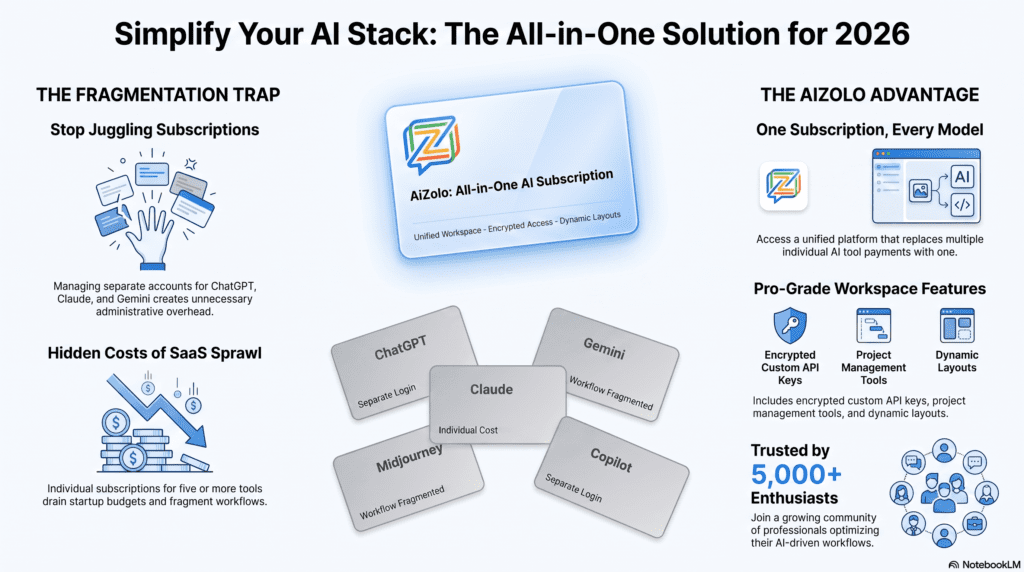
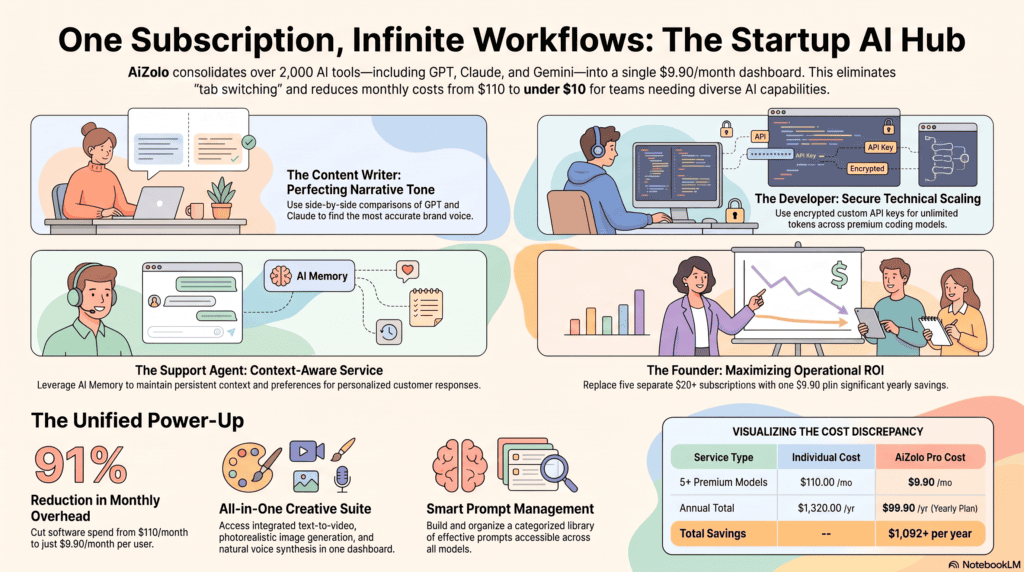
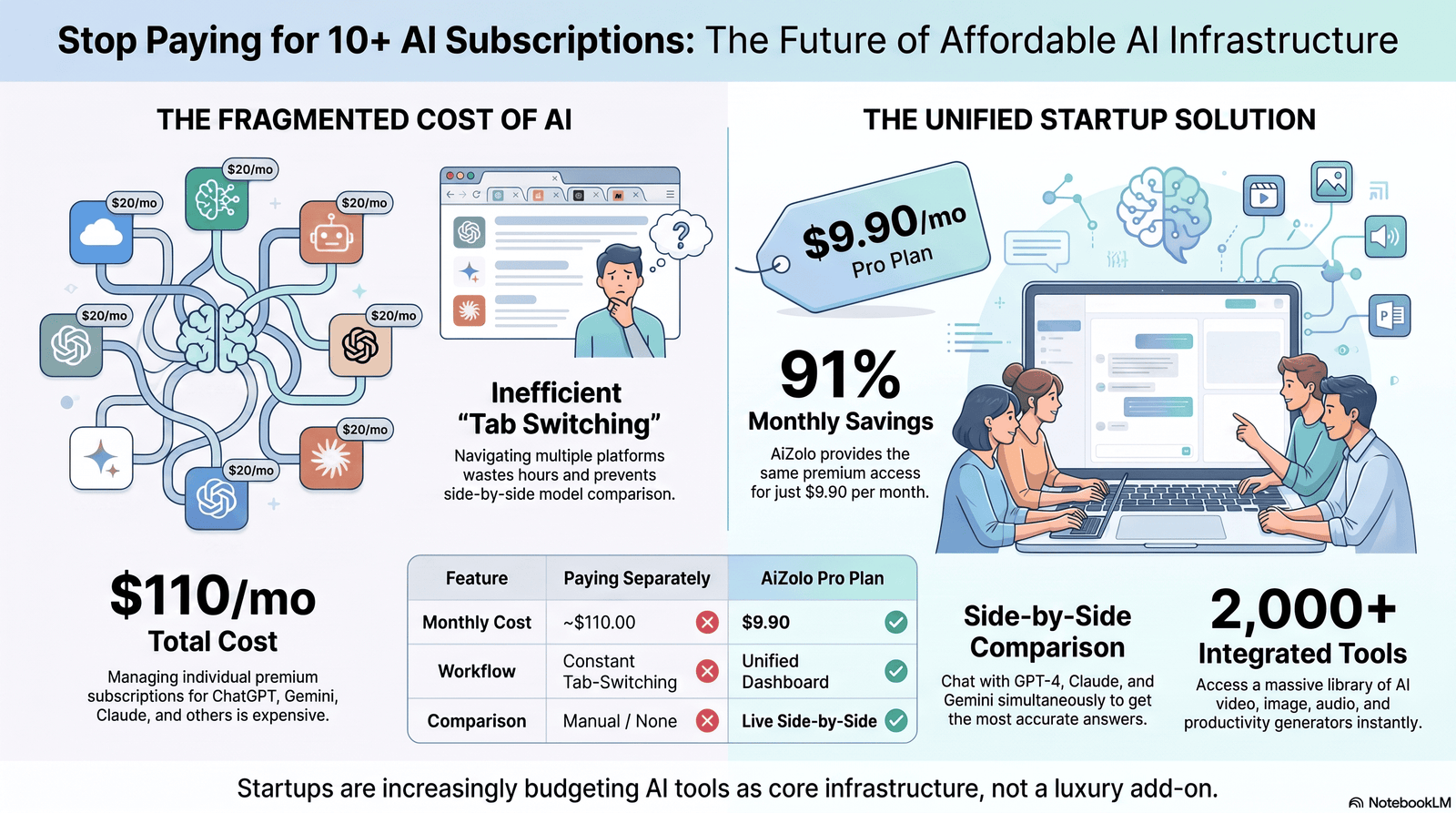
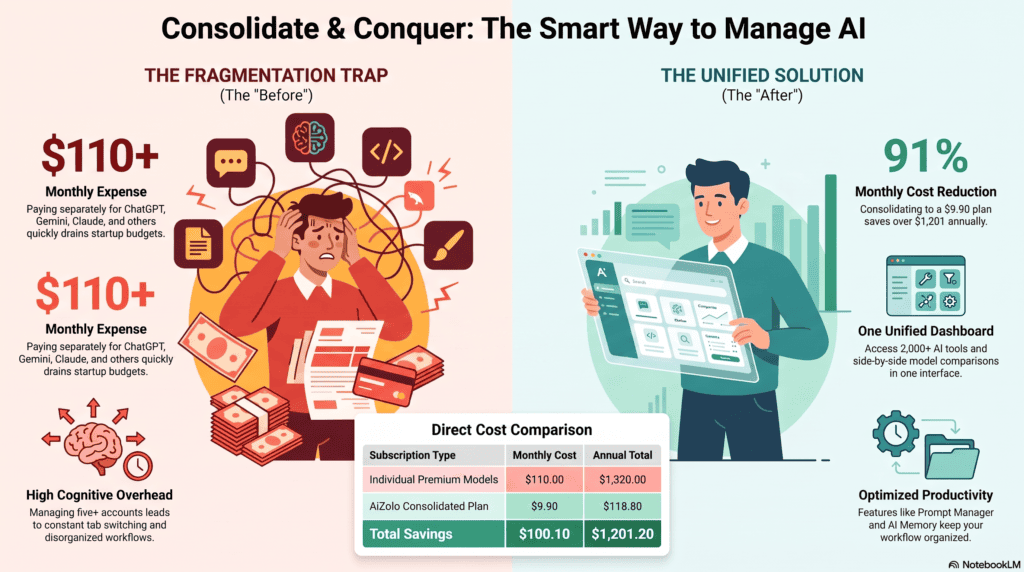
The problem is that stacking flagship subscriptions adds up fast. A team paying $20/month each for ChatGPT Plus, Claude Pro, and a research tool like Perplexity Pro is looking at roughly $60 per person, per month, before any coding-specific or design-specific AI tool is added. For a five-person team, that is $3,600 a year on chat interfaces alone.
Startups that adopt an affordable AI subscription instead can redirect that difference toward payroll, ads, or a longer runway — while still keeping current-generation models in the workflow for the tasks that matter most.
Common early-stage use cases for budget AI tools:
- Drafting outbound emails, landing page copy, and investor updates
- First-pass debugging and boilerplate code generation
- Summarizing customer feedback and support tickets
- Competitive research and market-sizing estimates
- Meeting notes and internal documentation
Can Under-$10 AI Plans Replace Premium Plans?
Partially. Under-$10 AI plans can replace premium plans for teams with light-to-moderate usage, but they are not a like-for-like swap for heavy, high-volume workflows.
The honest way to think about this: budget tiers in 2026 are no longer stripped of intelligence the way older “lite” plans were.
ChatGPT Go, for example, gives users access to current GPT models rather than an outdated model from several years back. The trade-off has shifted from model quality to usage volume — message caps, fewer deep-research sessions, and, in some cases, in-app advertising.
For a solo founder or a two-to-three-person team doing everyday writing, light coding help, and occasional research, a sub-$10 plan can genuinely cover 80–90% of daily needs.
For a team running multiple deep-research sessions daily, generating large volumes of code, or needing guaranteed ad-free enterprise-grade reliability, a premium plan or a hybrid approach still makes more sense.
Quick Comparison: Budget vs. Premium AI Plans
| Factor | Under-$10 Plan | $20+ Premium Plan |
|---|---|---|
| Model access | Current-gen model, often single provider | Current-gen model, sometimes multiple tiers (Pro/Max) |
| Usage limits | Lower message/session caps | Higher or near-unlimited caps |
| Ads | Common on budget tiers | Rare or none |
| Multi-model access | Only on bundle platforms | Rare unless using a research tool |
| Best for | Solo founders, light daily use | Teams with heavy daily AI dependency |
Benefits of a Sub-$10 AI Subscription
Predictable, low monthly cost. A flat sub-$10 fee is easy to forecast against a startup’s monthly burn rate, unlike usage-based API billing that can spike unexpectedly.
Access to genuinely current models. Unlike older “budget” tiers that locked users into outdated models, 2026’s sub-$10 plans typically include current-generation models with tighter usage caps rather than weaker ones.
Lower financial risk during early validation. When a startup is still testing product-market fit, committing to a $20–$100/month AI stack across multiple tools is harder to justify than a single low-cost plan.
Easier team-wide rollout. A $9.90 per-seat cost is far easier to approve for a five-person team than $20–$30 per seat, which matters when a founder is personally approving every software expense.
Limitations of Sub-$10 AI Plans
Usage caps hit fast for heavy users. Deep research sessions, high-volume coding assistance, and long context windows are usually the first things reduced on budget tiers.
Ads on some free-adjacent tiers. Budget plans like ChatGPT Go include in-app advertising in some regions, which is a trade-off worth knowing about before committing.
Fewer enterprise controls. Admin dashboards, SSO, SOC 2 compliance, and data-retention guarantees are typically reserved for business or enterprise tiers, not budget consumer plans.
Single-model lock-in on provider-specific plans. A budget tier from one provider only gives you that provider’s model family — you will not get Claude-quality long-document reasoning from a GPT-only budget plan, for instance.
Who Should Buy a Sub-$10 AI Subscription
- Solo founders validating an idea before committing to a larger software budget
- Freelancers and consultants who bill clients and need to keep overhead low
- Early-stage teams (1–3 people) with light-to-moderate daily AI usage
- Startups that need multi-model comparison but don’t yet need enterprise controls
- Bootstrapped teams prioritizing runway over convenience features
Who Should Avoid Sub-$10 AI Plans
- Teams running AI-heavy production workloads (high-volume content generation, agentic coding at scale)
- Companies that require SOC 2, SSO, or admin-level data governance
- Teams that depend daily on deep-research features with high session counts
- Startups whose core product is built directly on top of a specific frontier model’s API (this requires usage-based API pricing, not a consumer subscription)
Important Buying Factors Before You Subscribe
- Which models are actually included — a “budget” plan that only offers one model family may not cover every workflow.
- Usage limits, not just price — check daily/monthly message caps, file upload limits, and whether “unlimited” really means unlimited.
- Ads and data usage — some budget tiers show ads or use conversations for model training by default; check the privacy settings.
- Per-seat vs. flat pricing — a $9.90 plan for one user might become $49.50 for a five-person team if it is priced per seat.
- Upgrade path — can you move to a higher tier later without losing saved data, prompts, or history?
- Region availability — several budget tiers (like ChatGPT Go) rolled out regionally before going global, so availability can vary.
Comparison Table: Sub-$10 AI Options for Startups (2026)
| Plan | Price/Month | Model(s) | Best For | Key Limitation |
|---|---|---|---|---|
| ChatGPT Go | $8.00 | Current GPT model (single provider) | Light daily writing, chat-based tasks | Ads shown in some regions; no Claude/Gemini access |
| Google AI Plus | $7.99 | Gemini model + Google One storage | Teams already inside Google Workspace | Fewer advanced features than Google AI Pro ($19.99) |
| Multi-model bundle platforms | ~$9.00–$9.90 | Multiple providers (GPT, Claude, Gemini, others) via shared credits | Teams that want model comparison without stacking subscriptions | Shared credit pool instead of native unlimited access per provider |
| Perplexity Education Pro | $10.00 | Multiple models, research-focused | Verified students/educators only | Not available to for-profit startup teams |
| GitHub Copilot Individual | $10.00 | Code-specific model | Solo developers | Coding only, no general chat/writing use case |
Best Affordable AI Subscription Options for Startups
1. Single-Model Budget Tiers
These are scaled-down versions of a major provider’s flagship subscription. ChatGPT Go and Google AI Plus are the clearest examples in 2026 — both sit under the $9.90 threshold and both give access to a current-generation model rather than a legacy one.
Good for: Teams standardized on one ecosystem (e.g., already using Google Workspace, or only needing GPT-family output).
Watch for: Ads, capped message volumes, and no access to other model families if your workflow benefits from comparing outputs.
2. Multi-Model Bundle Platforms
These platforms sit at or near the $9.90 price point and route your prompts to multiple underlying models — GPT, Claude, Gemini, and others — through a single interface and a shared credit or message pool.
Good for: Teams that don’t want to choose one model family, or that benefit from comparing outputs side by side for accuracy-sensitive tasks like research or technical documentation.
Watch for: “Shared credits” means heavy usage on one model reduces what’s left for the others — read the fine print on monthly allowances before assuming it behaves like an unlimited native plan.
3. Education and Promotional Tiers
Some providers, like Perplexity, offer discounted education pricing around the $10 mark. These are verified through services like SheerID and are not accessible to a standard startup account — they’re included here only so founders don’t mistakenly assume they qualify.
Pricing Comparison Table (Startup AI Stack Scenarios)
| Scenario | Tools Used | Monthly Cost |
|---|---|---|
| Solo founder, single-model budget plan | 1x ChatGPT Go | $8.00 |
| Solo founder, multi-model bundle | 1x bundle platform (~$9.90) | $9.90 |
| 3-person team, stacked flagship plans | 3x ChatGPT Plus ($20) | $60.00 |
| 3-person team, budget multi-model bundle | 3x bundle platform (~$9.90) | $29.70 |
| 5-person team, flagship + research tool | 5x ($20 + $20) | $200.00 |
The gap widens fast as headcount grows, which is exactly why per-seat pricing deserves a closer look before committing a whole team to a flagship-only stack.
Feature Comparison Table
| Feature | Budget Single-Model Plan | Multi-Model Bundle (~$9.90) | Flagship Plan ($20+) |
|---|---|---|---|
| Current-gen model access | Yes (one provider) | Yes (multiple providers) | Yes (one provider, higher limits) |
| Multi-model comparison | No | Yes | Only on research-focused tools |
| Deep research sessions | Very limited | Limited, shared pool | Higher caps |
| Ads | Sometimes | Rare | No |
| Team/admin controls | Rare | Rare | Sometimes (business tiers) |
Pros vs. Cons Table
| Pros | Cons |
|---|---|
| Low, predictable monthly cost | Lower usage ceilings than flagship plans |
| Access to current-generation models | Some tiers show ads |
| Easy to approve for solo founders/small teams | Fewer enterprise/admin controls |
| Multi-model bundles reduce total subscription count | Shared credit pools can run out faster under heavy use |
Startup Use Cases Table
| Team Type | Primary Workflow | Recommended Plan Type |
|---|---|---|
| Solo SaaS founder | Marketing copy, light coding, investor updates | Single-model budget tier or multi-model bundle |
| Freelance content agency | Multi-client writing, research, brainstorming | Multi-model bundle (model comparison matters) |
| Two-person dev team | Debugging, boilerplate code, documentation | Budget tier + dedicated coding assistant |
| Customer support micro-team | Ticket triage, response drafting | Single-model budget tier |
| Early-stage research startup | Market research, citation-backed answers | Consider Perplexity’s research-first tools alongside a budget chat plan |
Model Availability Table
| Plan Type | GPT Family | Claude Family | Gemini Family | Other Models |
|---|---|---|---|---|
| ChatGPT Go | Yes | No | No | No |
| Google AI Plus | No | No | Yes | No |
| Multi-model bundle platforms | Often | Often | Often | Varies by platform |
| Perplexity Education Pro | Sometimes (routed) | Sometimes (routed) | Sometimes (routed) | Yes (auto-routed) |
Monthly Cost Comparison (Annualized)
| Plan | Monthly | Annual (12x) |
|---|---|---|
| ChatGPT Go | $8.00 | $96.00 |
| Google AI Plus | $7.99 | $95.88 |
| Multi-model bundle (~$9.90) | $9.90 | $118.80 |
| ChatGPT Plus (for comparison) | $20.00 | $240.00 |
ROI Comparison Table
| Investment | Monthly Cost | Estimated Time Saved/Week* | Rough Monthly Value |
|---|---|---|---|
| Sub-$10 single-model plan | ~$8–$9.90 | 2–4 hours | Positive ROI for most solo founders |
| Sub-$10 multi-model bundle | ~$9.90 | 3–5 hours (less tool-switching) | Positive ROI, especially for research-heavy work |
| Flagship $20 plan | $20 | 4–6 hours | Positive ROI for daily power users |
*Estimates vary widely by role and workflow; treat as directional, not guaranteed.
Decision Matrix
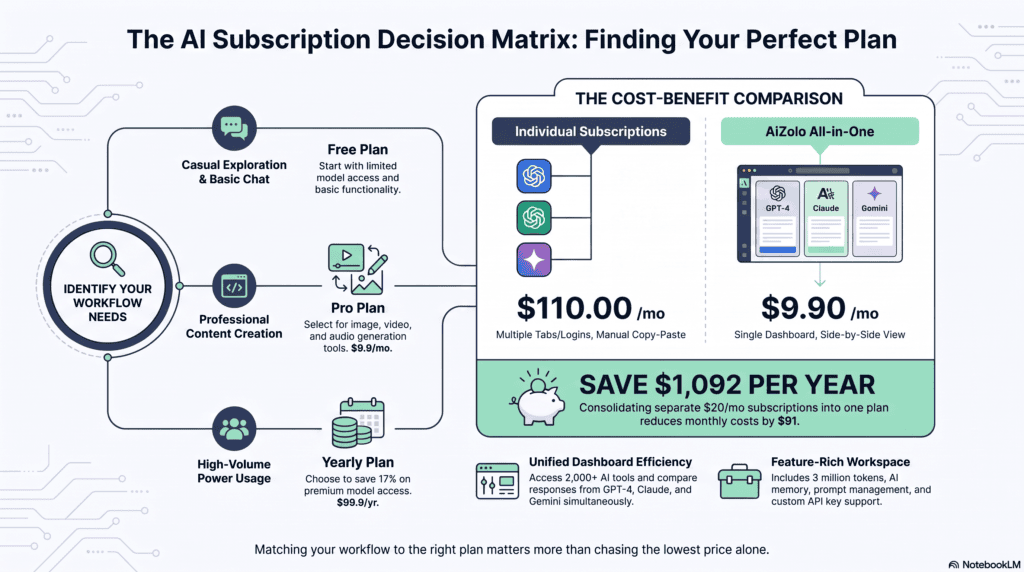
| If you need… | Choose… |
|---|---|
| Lowest possible monthly cost, single model | ChatGPT Go or Google AI Plus |
| Multiple models under one login | Multi-model bundle platform (~$9.90) |
| Heavy daily deep-research usage | A flagship $20+ plan instead |
| Coding-specific assistance only | A dedicated coding assistant, not a general chat plan |
| Team-wide admin controls | A business/enterprise tier, not a budget consumer plan |
How to Choose the Right Sub-$10 AI Subscription
Start with your actual weekly workflow, not the feature list. Count how many times per week your team writes, codes, researches, or generates images, and match that pattern against what each plan actually allows before you subscribe.
A simple four-step process:
- List your top 3 recurring AI tasks (e.g., drafting emails, debugging code, summarizing calls).
- Check whether one model handles all three well, or whether you’d benefit from comparing outputs across models.
- Estimate your monthly volume — rough message counts, not exact numbers — and compare that against each plan’s stated limits.
- Confirm per-seat pricing if you’re buying for more than one person; a “$9.90 plan” is not always $9.90 for a whole team.
Hidden Costs to Watch For
Sub-$10 pricing pages rarely show the full picture. These are the costs that tend to surprise founders after they’ve already signed up:
- Per-seat multiplication: A $9.90 plan for five people is $49.50/month, not $9.90.
- Overage or API charges: Some “budget” plans bill separately for anything beyond the base allowance, especially for research or agent features.
- Add-on credits: Extra image generations, video minutes, or “Pro Search” style features are sometimes sold separately from the base subscription.
- Annual lock-in discounts: Some providers advertise a lower per-month price only when paid annually upfront, which changes the actual monthly cash outflow.
- Currency and regional pricing differences: The advertised US-dollar price is not always what non-US teams are billed after local taxes and currency conversion.
Startup Budget Planning for AI Tools
A simple rule of thumb: AI tooling should not exceed 3–5% of a pre-revenue startup’s monthly software budget unless AI is the core product itself.
For a bootstrapped team, that typically means:
- One shared multi-model subscription for the whole founding team where feasible, rather than individual flagship subscriptions for each person
- A clear owner for reviewing AI tool spend monthly, since new AI subscriptions are easy to accumulate and forget about
- A quarterly audit comparing what’s actually being used against what’s being paid for
Productivity ROI of Budget AI Subscriptions
The return on a sub-$10 AI subscription is rarely about the tool replacing a hire. It’s about compressing the time between “I need this written/coded/researched” and “it’s done enough to review.”
For early-stage teams, the most measurable ROI shows up in three places: faster first drafts of external communication (emails, landing pages, decks), faster debugging of common code issues, and faster synthesis of customer feedback into actionable themes.
None of these require the highest-tier model available — they require consistent, always-available access, which is exactly what a low-cost recurring subscription provides over ad hoc free-tier usage.
Security & Privacy Considerations
Before subscribing any startup team to a budget AI plan, confirm three things directly on the provider’s official privacy or trust page:
- Whether your conversations are used to train the underlying model by default, and whether that setting can be turned off.
- Data retention policies — how long inputs and outputs are stored, and whether they can be deleted on request.
- Whether the plan is genuinely appropriate for confidential business data, such as unreleased product details, financial figures, or customer PII. Consumer-tier budget plans generally offer weaker data-handling guarantees than business or enterprise tiers, which matters if your startup handles sensitive client information.
Common Mistakes Startups Make When Buying AI Subscriptions
- Subscribing to a flagship plan for the whole team before testing usage patterns on a budget tier first.
- Assuming “AI subscription” always means chat access, without checking whether coding, research, or image generation is actually included.
- Ignoring per-seat multiplication when comparing a $9.90 plan against a $20 plan for a growing team.
- Not checking data privacy settings, especially for teams handling client or investor information.
- Stacking multiple single-model subscriptions instead of evaluating one multi-model bundle that might cover the same ground for less.
Real Startup Use Cases
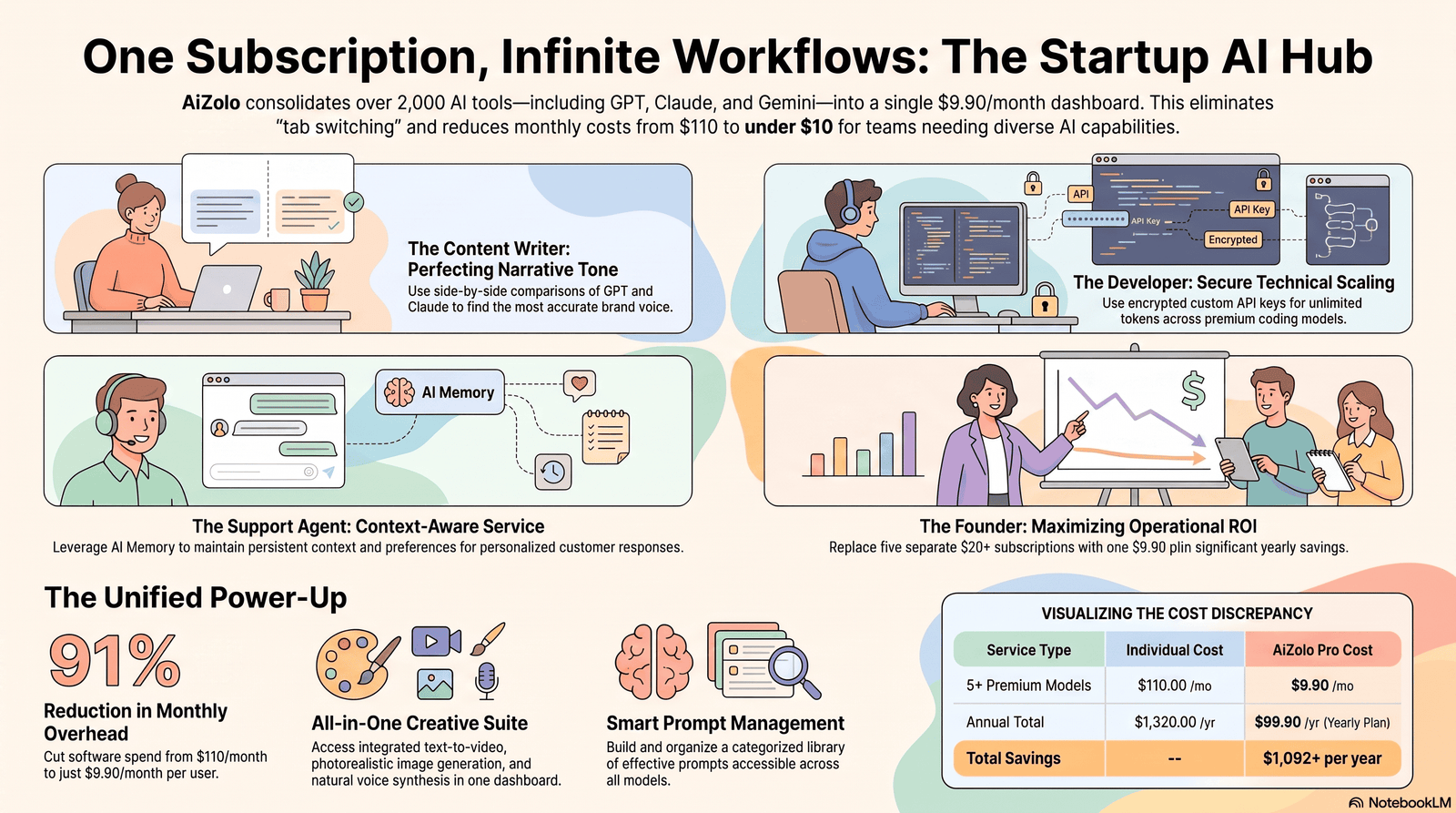
Content and marketing workflows: A two-person content team uses a budget AI plan to draft first-pass blog outlines, social captions, and email sequences, then does human editing before publishing — keeping AI as an accelerant rather than the final output.
Coding workflows: A solo developer pairs a budget general-purpose plan for architecture questions and documentation with a dedicated coding assistant for in-editor completions, splitting the workload between two cheaper tools instead of one expensive all-in-one plan.
Customer support workflows: A small support team uses AI to draft first-response templates and summarize recurring complaint themes weekly, reducing manual triage time without needing enterprise-grade automation.
Design workflows: A design-focused founder uses AI primarily for brainstorming concepts and generating quick mockup copy, relying on dedicated design software for the actual visual production.
Research and business planning workflows: A founder preparing investor materials uses AI to summarize market reports and competitor positioning, always cross-checking cited facts against primary sources before including them in a pitch deck.
Expert Recommendations
- Start with the cheapest plan that covers your top three recurring tasks, and upgrade only when you can point to a specific limit you’re hitting — not a hypothetical future need.
- Prefer multi-model bundles over single-model budget tiers if your work genuinely benefits from comparing outputs (research, technical writing, fact-sensitive content).
- Revisit your AI subscription stack quarterly. Pricing and feature sets in this market change every few months, and a plan that made sense in January may not be the best value by mid-year.
- Treat pricing pages as a snapshot, not a permanent fact. Every price mentioned in this guide should be re-verified on the provider’s official page before purchase, since AI subscription pricing has changed multiple times within single calendar years recently.
Future Trends in Budget AI Subscriptions
Expect continued downward pressure on entry-level pricing as major providers compete for the budget-conscious segment, following the pattern already set by lower-cost tiers launched by the largest chat platforms in the past year.
Multi-model bundling is also likely to keep growing, since it directly addresses the real pain point founders report: not the price of any single subscription, but the total cost and friction of running several at once.
Expect usage-based “credit” systems to become more common at the sub-$10 price point, replacing simple message caps with more flexible (but harder to predict) credit consumption models.
FAQs
1. What counts as an AI subscription for startups under $9.9 per month? Any AI plan priced at or below $9.90/month, typically a budget single-model tier, a multi-model bundle platform, or a discounted education plan.
2. Is a sub-$10 AI plan powerful enough for a real startup workflow? For light-to-moderate daily use — drafting content, basic coding help, research summaries — yes. Heavy daily power users may hit usage caps faster than on flagship plans.
3. Do budget AI plans include the latest AI models? Often yes. Many 2026 budget tiers include current-generation models with tighter usage limits, rather than older or weaker models.
4. Why do some cheap AI plans show ads? Providers use ads to subsidize lower subscription prices on entry-level tiers, similar to freemium models in other software categories.
5. Can I use a sub-$10 plan for a whole team? Only if pricing is per-seat and your budget accounts for the multiplied cost — a $9.90 plan for five people is $49.50/month, not $9.90.
6. What’s the difference between a single-model plan and a multi-model bundle? A single-model plan gives access to one provider’s model family. A multi-model bundle routes your requests across several providers’ models through one subscription and shared credits.
7. Are sub-$10 AI plans safe for confidential startup data? Check the provider’s data retention and training-use policy directly. Consumer-tier budget plans generally offer weaker data guarantees than business tiers.
8. Is ChatGPT Go under $9.90 per month? Yes, ChatGPT Go is priced at $8/month, placing it under the $9.90 threshold.
9. Is Google AI Plus under $9.90 per month? Yes, Google AI Plus is priced at $7.99/month.
10. Can startups get education or student AI discounts? Generally no — education-tier discounts require verified student or academic institution status and are not available to standard business accounts.
11. What’s the biggest hidden cost in budget AI plans? Per-seat multiplication for teams, followed by overage charges on features like research sessions or image generation credits.
12. Should a coding-focused startup buy a general AI plan or a coding-specific one? Coding-specific assistants are usually better for in-editor code completion, while general AI plans are better for architecture discussions, documentation, and non-coding tasks. Many startups use both.
13. How often does AI subscription pricing change? Frequently. Several major providers have adjusted pricing, launched new tiers, or changed feature limits multiple times within the current year, so pricing should always be reverified before purchase.
14. Is a multi-model bundle better value than stacking three flagship subscriptions? For most solo founders and small teams, yes — a single ~$9.90 multi-model bundle typically costs far less than three separate $20 flagship subscriptions, though usage is shared across a credit pool rather than unlimited per provider.
15. What should I check before subscribing to any budget AI plan? Model access, usage limits, ad presence, per-seat pricing, data privacy settings, and whether there’s a clear upgrade path if you outgrow the plan.
16. Do sub-$10 AI plans support file uploads and document analysis? This varies significantly by provider and plan — some budget tiers include basic file handling while others reserve it for higher tiers. Always confirm on the official feature comparison page.
17. Can a startup switch between budget AI plans easily? Generally yes, since most are month-to-month with no long-term contract, though saved chat history, custom instructions, or prompt libraries may not transfer between providers.
18. Is it better to pay monthly or annually for a budget AI plan? Annual billing sometimes lowers the effective monthly rate, but ties up cash flow for a longer period — a real trade-off for a pre-revenue startup managing runway carefully.
Final Verdict
There is no single universal “best” AI subscription for startups under $9.9 per month — the right choice depends on whether your team needs one model or several, how much daily volume you actually generate, and whether ads or a shared credit pool are acceptable trade-offs for the lower price.
For a solo founder doing light, general-purpose work, a single-model budget tier like ChatGPT Go or Google AI Plus is a reasonable, low-risk starting point. For teams that want flexibility across multiple models without stacking several $20 subscriptions, a multi-model bundle platform priced near $9.90 is generally the stronger long-term value.
Whichever direction you choose, verify current pricing directly on the provider’s official page before subscribing — this market has changed pricing and plan structures multiple times within the last year alone, and a figure that’s accurate today may not be accurate in three months.
Key Takeaways
- Genuine sub-$10 AI plans exist in 2026 and include current-generation models, not outdated ones.
- The real trade-off is usage volume and single-model access, not intelligence.
- Multi-model bundle platforms near $9.90/month often deliver better value than stacking multiple $20 subscriptions.
- Always account for per-seat pricing before assuming a plan’s advertised price applies to your whole team.
- Re-verify pricing on official pages before purchasing — this market changes fast.
Author Bio
Written by Jeevesh Tripathi is a researcher and writer at Aizolo specializing in AI tools, SaaS platforms, startup technology, and productivity software comparisons. His work focuses on accurate, evidence-based, people-first content that follows Google’s Search quality guidelines, with a commitment to verifying pricing and features directly against official sources before publication. 📧 jeevesh@aizolo.com